Syed Tajamul
BHCNMT
INTRODUCTION
• Acetylecholine (Ach) is a neurotransmitter discovered by Otto Loewi in early 20th century from a frogs Heart.
• Transmits signals between nerve cells(neurons) and neuron and Muscles(neuromuscular junctions) and the
functions are:
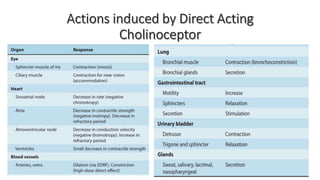
• 1. Autonomic NS: stimulation of Parasympathetic nervous system
• 1. Neuromuscular Junctions: released at end plates of motor neurons at NMJs— contraction—essential for
movements and motor control
• 2. Cognitive functions— arousal of cognitive functions, decreased Ach is linked to Alzheimer’s Disease
• 3. Heart Function— binds receptors at SA node— decreases heart rate
• 4. Respiratory System—Bronchoconstriction
• 5. GI System— stimulates salivation, increases GI motility, relax Sphicters
• 6. Urinary System— contraction of Bladder detrusor muscle and relax of internal Urethral sphincter—
promotes emptying of bladder.
• Eye Functions—constricts of pupil (Miosis) – helps adjust the shape of lense
• All these functions of parasympathetic response is know as “Rest and Digest’ or ‘ Feed and Breed’ opposite
to ‘Fight and Flight’ of sympathetic NS.
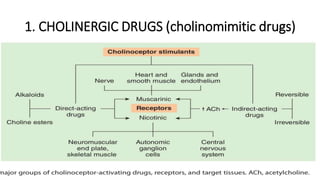
1. CHOLINERGIC DRUGS (cholinomimitic drugs)
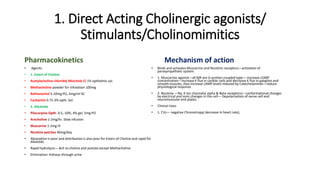
1. Direct Acting Cholinergic agonists/
Stimulants/Cholinomimitics
Pharmacokinetics
• Agents:
• 1. Esters of Choline
• Acetylecholine chloride( Miochole E) 1% opthalmic sol.
• Methacholine powder for inhalation 100mg
• Bethanechol 5-10mg PO, 5mg/ml SC
• Carbachol 0.75-3% opth. Sol.
• 2. Alkaloids
• Pilocarpine Opth. 0.5,-10%, 4% gel, 5mg PO
• Arecholine 1-2mg/hr. Slow infusion
• Muscarine 1-2mg IV
• Nicotine patches 40mg/day
• Absorption is poor and distribution is also poor for Esters of Choline and rapid for
Alkaloids
• Rapid hydrolysis— Ach to choline and acetate except Methacholine
• Elimination: Kidneys through urine
Mechanism of action
• Binds and activates Muscarinic and Nicotinic receptors—activation of
parasympathatic system.
• 1. Muscarinic agonist—all MR are G-protien coupled type—-increase cGMP
concentration—increase K flux in cardiac cells and decrease K flux in ganglion and
smooth muscles, Also increase cAMP levels induced by Catecholamines—reduce
physiological response
• 2. Nicotine —Na, K Ion channels( alpha & Beta receptors)—conformational changes
by electrical and ionic changes in the cell— Depolarization of nerve cell and
neuromuscular end plates.
• Clinical Uses:
• 1. CVs— negative Chronotropy( decrease in heart rate),
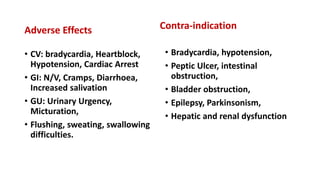
Adverse Effects
• CV: bradycardia, Heartblock,
Hypotension, Cardiac Arrest
• GI: N/V, Cramps, Diarrhoea,
Increased salivation
• GU: Urinary Urgency,
Micturation,
• Flushing, sweating, swallowing
difficulties.
Contra-indication
• Bradycardia, hypotension,
• Peptic Ulcer, intestinal
obstruction,
• Bladder obstruction,
• Epilepsy, Parkinsonism,
• Hepatic and renal dysfunction
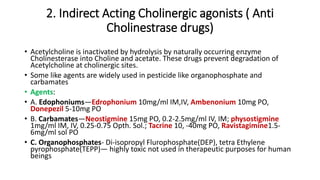
2. Indirect Acting Cholinergic agonists ( Anti
Cholinestrase drugs)
• Acetylcholine is inactivated by hydrolysis by naturally occurring enzyme
Cholinesterase into Choline and acetate. These drugs prevent degradation of
Acetylcholine at cholinergic sites.
• Some like agents are widely used in pesticide like organophosphate and
carbamates
• Agents:
• A. Edophoniums—Edrophonium 10mg/ml IM,IV, Ambenonium 10mg PO,
Donepezil 5-10mg PO
• B. Carbamates—Neostigmine 15mg PO, 0.2-2.5mg/ml IV, IM; physostigmine
1mg/ml IM, IV, 0.25-0.75 Opth. Sol.; Tacrine 10, -40mg PO, Ravistagimine1.5-
6mg/ml sol PO
• C. Organophosphates- Di-isopropyl Flurophosphate(DEP), tetra Ethylene
pyrophosphate(TEPP)— highly toxic not used in therapeutic purposes for human
beings
Pharmacokinetics
• Absorption: from skin, lungs and
conjunctiva very poor, limited in oral
Preps. — needs large doses except
Physostigmine
• Metabolism: microsmal enzymes CYP
450 & UDPof Liver
• T1/2: 20 to 120 mins
• Well distributed except CNS
• OPs are readily absorbed through all
routes –distributed to CNS—making
them Dangerous-
Mechanism of Action
• These agents inhibit majorly
acetylecholinestrase and also
butyrylcholinestrase at some levels,
increases the levels of endogenous
acetylcholine.
• Edrophoniums & Carbamates Reversibly
binds to Hydrogen bonds of enzyme on
active sites of acetylcholine— preventing
access to Acetylcholine—also known as
reversible Cholinesterase inhibitors
• OPs undergo initial binding and
hydrolyzes by the enzyme – stable
Phosphorous enzyme—hydrolyzes in
water at very slow rate(100s of Hours)—
known as aging which is dangerous.
Adverse effects
• CNS; Miosis, Blurred Vision, headache dizziness, drowsiness, CNS
depression
• CV: Bradycardia, Heartblock, Hypotension, cardiac Arrest
• GI: N/V salivation, Involuntry defecation, diarrhoea
• GU: Increased Urinary Urgency,
Clinical Uses Of Cholinergic agents
• Opthalamic: Glucoma—Pilocarpine- Constricts pupil Sjogrens Syndrome—stimulate tears and
saliva(xerostomia).
• Alzheimer’s disease— Donepezil, Revistgmine—improve cognitive functions
• Myasthenia gravis— pyridostigmine— improve muscle strength
• Urinary retention—edrophonium—relax internal Sphincter
• Cardiac arrhythmias — acetylcholine , carbachol –pacemakers of heart – negative chronotropic
• Post-operative Ileus—Bethanechol— stimulates intestinal smoooth muscles
• Neuromuscular Blockade Reversal— Neostigmine— restoring Muscle functions post surgery.
• Antidotes for OP Poisoning:
• Atropine 2mgIV/ 15mins.
• Pralidoxime(PAM) IV BD/ TID
• Diacetylmonoxime(DAM)
• Drugs which bind with cholinergic receptors and block the action of
acetylcholine— also known as Muscarinic antagonist or
Parasympatholytics or Cholinolytics.
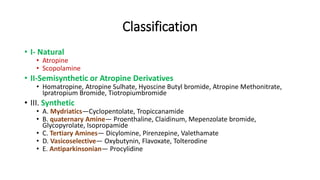
Classification
• I- Natural
• Atropine
• Scopolamine
• II-Semisynthetic or Atropine Derivatives
• Homatropine, Atropine Sulhate, Hyoscine Butyl bromide, Atropine Methonitrate,
Ipratropium Bromide, Tiotropiumbromide
• III. Synthetic
• A. Mydriatics—Cyclopentolate, Tropiccanamide
• B. quaternary Amine— Proenthaline, Claidinum, Mepenzolate bromide,
Glycopyrolate, Isopropamide
• C. Tertiary Amines— Dicylomine, Pirenzepine, Valethamate
• D. Vasicoselective— Oxybutynin, Flavoxate, Tolterodine
• E. Antiparkinsonian— Procylidine
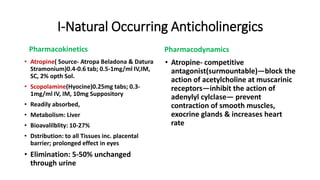
I-Natural Occurring Anticholinergics
Pharmacokinetics
• Atropine( Source- Atropa Beladona & Datura
Stramonium)0.4-0.6 tab; 0.5-1mg/ml IV,IM,
SC, 2% opth Sol.
• Scopolamine(Hyocine)0.25mg tabs; 0.3-
1mg/ml IV, IM, 10mg Suppository
• Readily absorbed,
• Metabolism: Liver
• Bioavalilblity: 10-27%
• Dstribution: to all Tissues inc. placental
barrier; prolonged effect in eyes
• Elimination: 5-50% unchanged
through urine
Pharmacodynamics
• Atropine- competitive
antagonist(surmountable)—block the
action of acetylcholine at muscarinic
receptors—inhibit the action of
adenylyl cylclase— prevent
contraction of smooth muscles,
exocrine glands & increases heart
rate
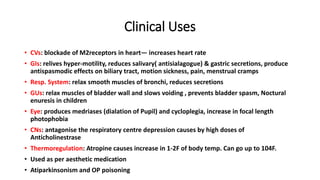
Clinical Uses
• CVs: blockade of M2receptors in heart— increases heart rate
• GIs: relives hyper-motility, reduces salivary( antisialagogue) & gastric secretions, produce
antispasmodic effects on biliary tract, motion sickness, pain, menstrual cramps
• Resp. System: relax smooth muscles of bronchi, reduces secretions
• GUs: relax muscles of bladder wall and slows voiding , prevents bladder spasm, Noctural
enuresis in children
• Eye: produces medriases (dialation of Pupil) and cycloplegia, increase in focal length
photophobia
• CNs: antagonise the respiratory centre depression causes by high doses of
Anticholinestrase
• Thermoregulation: Atropine causes increase in 1-2F of body temp. Can go up to 104F.
• Used as per aesthetic medication
• Atiparkinsonism and OP poisoning
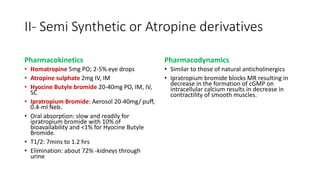
II- Semi Synthetic or Atropine derivatives
Pharmacokinetics
• Homatropine 5mg PO; 2-5% eye drops
• Atropine sulphate 2mg IV, IM
• Hyocine Butyle bromide 20-40mg PO, IM, IV,
SC
• Ipratropium Bromide: Aerosol 20-40mg/ puff,
0.4-ml Neb.
• Oral absorption: slow and readily for
ipratropium bromide with 10% of
bioavailability and <1% for Hyocine Butyle
Bromide.
• T1/2: 7mins to 1.2 hrs
• Elimination: about 72% -kidneys through
urine
Pharmacodynamics
• Similar to those of natural anticholinergics
• Ipratropium bromide blocks MR resulting in
decrease in the formation of cGMP on
intracellular calcium results in decrease in
contractility of smooth muscles.
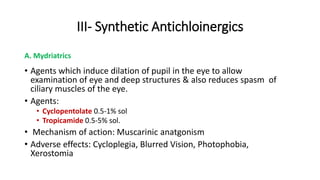
III- Synthetic Antichloinergics
A. Mydriatrics
• Agents which induce dilation of pupil in the eye to allow
examination of eye and deep structures & also reduces spasm of
ciliary muscles of the eye.
• Agents:
• Cyclopentolate 0.5-1% sol
• Tropicamide 0.5-5% sol.
• Mechanism of action: Muscarinic anatgonism
• Adverse effects: Cycloplegia, Blurred Vision, Photophobia,
Xerostomia
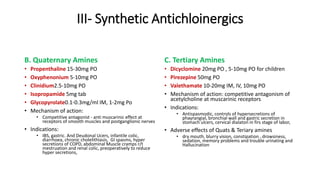
III- Synthetic Antichloinergics
B. Quaternary Amines
• Propenthaline 15-30mg PO
• Oxyphenonium 5-10mg PO
• Clinidium2.5-10mg PO
• Isopropamide 5mg tab
• Glycopyrolate0.1-0.3mg/ml IM, 1-2mg Po
• Mechanism of action:
• Competitive antagonist - anti muscarinic effect at
receptors of smooth muscles and postganglionic nerves
• Indications:
• IBS, gastric. And Deudonal Ucers, infantile colic,
diarrhoea, chronic cholelithiasis, GI spasms, hyper
secretions of COPD, abdominal Muscle cramps r/t
mestruation and renal colic, preoperatively to reduce
hyper secretions,
C. Tertiary Amines
• Dicyclomine 20mg PO , 5-10mg PO for children
• Pirezepine 50mg PO
• Valethamate 10-20mg IM, IV, 10mg PO
• Mechanism of action: competitive antagonism of
acetylcholine at muscarinic receptors
• Indications:
• Antispasmodic, controls of hypersecretions of
phayrangial, bronchial wall and gastric secretion in
stomach ulcers, cervical dialaton in firs stage of labor,
• Adverse effects of Quats & Teriary amines
• dry mouth, blurry vision, constipation , drowsiness,
sedation, memory problems and trouble urinating and
Hallucination
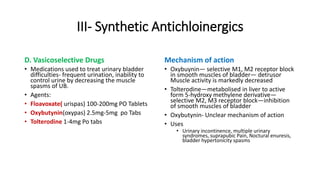
III- Synthetic Antichloinergics
D. Vasicoselective Drugs
• Medications used to treat urinary bladder
difficulties- frequent urination, inability to
control urine by decreasing the muscle
spasms of UB.
• Agents:
• Floavoxate( urispas) 100-200mg PO Tablets
• Oxybutynin(oxypas) 2.5mg-5mg po Tabs
• Tolterodine 1-4mg Po tabs
Mechanism of action
• Oxybuynin— selective M1, M2 receptor block
in smooth muscles of bladder— detrusor
Muscle activity is markedly decreased
• Tolterodine—metabolised in liver to active
form 5-hydroxy methylene derivative—
selective M2, M3 receptor block—inhibition
of smooth muscles of bladder
• Oxybutynin- Unclear mechanism of action
• Uses
• Urinary incontinence, multiple urinary
syndromes, suprapubic Pain, Noctural enuresis,
bladder hypertonicity spasms
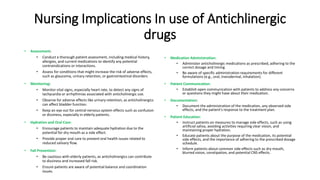
Nursing Implications In use of Antichlinergic
drugs
• Assessment:
• Conduct a thorough patient assessment, including medical history,
allergies, and current medications to identify any potential
contraindications or interactions.
• Assess for conditions that might increase the risk of adverse effects,
such as glaucoma, urinary retention, or gastrointestinal disorders
• Monitoring:
• Monitor vital signs, especially heart rate, to detect any signs of
tachycardia or arrhythmias associated with anticholinergic use.
• Observe for adverse effects like urinary retention, as anticholinergics
can affect bladder function.
• Keep an eye out for central nervous system effects such as confusion
or dizziness, especially in elderly patients.
• Hydration and Oral Care:
• Encourage patients to maintain adequate hydration due to the
potential for dry mouth as a side effect.
• Provide proper oral care to prevent oral health issues related to
reduced salivary flow.
• Fall Prevention:
• Be cautious with elderly patients, as anticholinergics can contribute
to dizziness and increased fall risk.
• Ensure patients are aware of potential balance and coordination
issues.
• Medication Administration:
• Administer anticholinergic medications as prescribed, adhering to the
correct dosage and timing.
• Be aware of specific administration requirements for different
formulations (e.g., oral, transdermal, inhalation).
• Patient Communication:
• Establish open communication with patients to address any concerns
or questions they might have about their medication.
• Documentation:
• Document the administration of the medication, any observed side
effects, and the patient's response to the treatment plan.
• Patient Education:
• Instruct patients on measures to manage side effects, such as using
artificial saliva, avoiding activities requiring clear vision, and
maintaining proper hydration.
• Educate patients about the purpose of the medication, its potential
side effects, and the importance of adhering to the prescribed dosage
schedule.
• Inform patients about common side effects such as dry mouth,
blurred vision, constipation, and potential CNS effects.
Adverse Effects

Cholinergic & AntiCholinergics.pptx

  • 1.
  • 2.
    INTRODUCTION • Acetylecholine (Ach)is a neurotransmitter discovered by Otto Loewi in early 20th century from a frogs Heart. • Transmits signals between nerve cells(neurons) and neuron and Muscles(neuromuscular junctions) and the functions are: • 1. Autonomic NS: stimulation of Parasympathetic nervous system • 1. Neuromuscular Junctions: released at end plates of motor neurons at NMJs— contraction—essential for movements and motor control • 2. Cognitive functions— arousal of cognitive functions, decreased Ach is linked to Alzheimer’s Disease • 3. Heart Function— binds receptors at SA node— decreases heart rate • 4. Respiratory System—Bronchoconstriction • 5. GI System— stimulates salivation, increases GI motility, relax Sphicters • 6. Urinary System— contraction of Bladder detrusor muscle and relax of internal Urethral sphincter— promotes emptying of bladder. • Eye Functions—constricts of pupil (Miosis) – helps adjust the shape of lense • All these functions of parasympathetic response is know as “Rest and Digest’ or ‘ Feed and Breed’ opposite to ‘Fight and Flight’ of sympathetic NS.
  • 4.
    1. CHOLINERGIC DRUGS(cholinomimitic drugs)
  • 5.
    1. Direct ActingCholinergic agonists/ Stimulants/Cholinomimitics Pharmacokinetics • Agents: • 1. Esters of Choline • Acetylecholine chloride( Miochole E) 1% opthalmic sol. • Methacholine powder for inhalation 100mg • Bethanechol 5-10mg PO, 5mg/ml SC • Carbachol 0.75-3% opth. Sol. • 2. Alkaloids • Pilocarpine Opth. 0.5,-10%, 4% gel, 5mg PO • Arecholine 1-2mg/hr. Slow infusion • Muscarine 1-2mg IV • Nicotine patches 40mg/day • Absorption is poor and distribution is also poor for Esters of Choline and rapid for Alkaloids • Rapid hydrolysis— Ach to choline and acetate except Methacholine • Elimination: Kidneys through urine Mechanism of action • Binds and activates Muscarinic and Nicotinic receptors—activation of parasympathatic system. • 1. Muscarinic agonist—all MR are G-protien coupled type—-increase cGMP concentration—increase K flux in cardiac cells and decrease K flux in ganglion and smooth muscles, Also increase cAMP levels induced by Catecholamines—reduce physiological response • 2. Nicotine —Na, K Ion channels( alpha & Beta receptors)—conformational changes by electrical and ionic changes in the cell— Depolarization of nerve cell and neuromuscular end plates. • Clinical Uses: • 1. CVs— negative Chronotropy( decrease in heart rate),
  • 7.
    Adverse Effects • CV:bradycardia, Heartblock, Hypotension, Cardiac Arrest • GI: N/V, Cramps, Diarrhoea, Increased salivation • GU: Urinary Urgency, Micturation, • Flushing, sweating, swallowing difficulties. Contra-indication • Bradycardia, hypotension, • Peptic Ulcer, intestinal obstruction, • Bladder obstruction, • Epilepsy, Parkinsonism, • Hepatic and renal dysfunction
  • 8.
    2. Indirect ActingCholinergic agonists ( Anti Cholinestrase drugs) • Acetylcholine is inactivated by hydrolysis by naturally occurring enzyme Cholinesterase into Choline and acetate. These drugs prevent degradation of Acetylcholine at cholinergic sites. • Some like agents are widely used in pesticide like organophosphate and carbamates • Agents: • A. Edophoniums—Edrophonium 10mg/ml IM,IV, Ambenonium 10mg PO, Donepezil 5-10mg PO • B. Carbamates—Neostigmine 15mg PO, 0.2-2.5mg/ml IV, IM; physostigmine 1mg/ml IM, IV, 0.25-0.75 Opth. Sol.; Tacrine 10, -40mg PO, Ravistagimine1.5- 6mg/ml sol PO • C. Organophosphates- Di-isopropyl Flurophosphate(DEP), tetra Ethylene pyrophosphate(TEPP)— highly toxic not used in therapeutic purposes for human beings
  • 9.
    Pharmacokinetics • Absorption: fromskin, lungs and conjunctiva very poor, limited in oral Preps. — needs large doses except Physostigmine • Metabolism: microsmal enzymes CYP 450 & UDPof Liver • T1/2: 20 to 120 mins • Well distributed except CNS • OPs are readily absorbed through all routes –distributed to CNS—making them Dangerous- Mechanism of Action • These agents inhibit majorly acetylecholinestrase and also butyrylcholinestrase at some levels, increases the levels of endogenous acetylcholine. • Edrophoniums & Carbamates Reversibly binds to Hydrogen bonds of enzyme on active sites of acetylcholine— preventing access to Acetylcholine—also known as reversible Cholinesterase inhibitors • OPs undergo initial binding and hydrolyzes by the enzyme – stable Phosphorous enzyme—hydrolyzes in water at very slow rate(100s of Hours)— known as aging which is dangerous.
  • 10.
    Adverse effects • CNS;Miosis, Blurred Vision, headache dizziness, drowsiness, CNS depression • CV: Bradycardia, Heartblock, Hypotension, cardiac Arrest • GI: N/V salivation, Involuntry defecation, diarrhoea • GU: Increased Urinary Urgency,
  • 11.
    Clinical Uses OfCholinergic agents • Opthalamic: Glucoma—Pilocarpine- Constricts pupil Sjogrens Syndrome—stimulate tears and saliva(xerostomia). • Alzheimer’s disease— Donepezil, Revistgmine—improve cognitive functions • Myasthenia gravis— pyridostigmine— improve muscle strength • Urinary retention—edrophonium—relax internal Sphincter • Cardiac arrhythmias — acetylcholine , carbachol –pacemakers of heart – negative chronotropic • Post-operative Ileus—Bethanechol— stimulates intestinal smoooth muscles • Neuromuscular Blockade Reversal— Neostigmine— restoring Muscle functions post surgery. • Antidotes for OP Poisoning: • Atropine 2mgIV/ 15mins. • Pralidoxime(PAM) IV BD/ TID • Diacetylmonoxime(DAM)
  • 12.
    • Drugs whichbind with cholinergic receptors and block the action of acetylcholine— also known as Muscarinic antagonist or Parasympatholytics or Cholinolytics.
  • 13.
    Classification • I- Natural •Atropine • Scopolamine • II-Semisynthetic or Atropine Derivatives • Homatropine, Atropine Sulhate, Hyoscine Butyl bromide, Atropine Methonitrate, Ipratropium Bromide, Tiotropiumbromide • III. Synthetic • A. Mydriatics—Cyclopentolate, Tropiccanamide • B. quaternary Amine— Proenthaline, Claidinum, Mepenzolate bromide, Glycopyrolate, Isopropamide • C. Tertiary Amines— Dicylomine, Pirenzepine, Valethamate • D. Vasicoselective— Oxybutynin, Flavoxate, Tolterodine • E. Antiparkinsonian— Procylidine
  • 14.
    I-Natural Occurring Anticholinergics Pharmacokinetics •Atropine( Source- Atropa Beladona & Datura Stramonium)0.4-0.6 tab; 0.5-1mg/ml IV,IM, SC, 2% opth Sol. • Scopolamine(Hyocine)0.25mg tabs; 0.3- 1mg/ml IV, IM, 10mg Suppository • Readily absorbed, • Metabolism: Liver • Bioavalilblity: 10-27% • Dstribution: to all Tissues inc. placental barrier; prolonged effect in eyes • Elimination: 5-50% unchanged through urine Pharmacodynamics • Atropine- competitive antagonist(surmountable)—block the action of acetylcholine at muscarinic receptors—inhibit the action of adenylyl cylclase— prevent contraction of smooth muscles, exocrine glands & increases heart rate
  • 15.
    Clinical Uses • CVs:blockade of M2receptors in heart— increases heart rate • GIs: relives hyper-motility, reduces salivary( antisialagogue) & gastric secretions, produce antispasmodic effects on biliary tract, motion sickness, pain, menstrual cramps • Resp. System: relax smooth muscles of bronchi, reduces secretions • GUs: relax muscles of bladder wall and slows voiding , prevents bladder spasm, Noctural enuresis in children • Eye: produces medriases (dialation of Pupil) and cycloplegia, increase in focal length photophobia • CNs: antagonise the respiratory centre depression causes by high doses of Anticholinestrase • Thermoregulation: Atropine causes increase in 1-2F of body temp. Can go up to 104F. • Used as per aesthetic medication • Atiparkinsonism and OP poisoning
  • 16.
    II- Semi Syntheticor Atropine derivatives Pharmacokinetics • Homatropine 5mg PO; 2-5% eye drops • Atropine sulphate 2mg IV, IM • Hyocine Butyle bromide 20-40mg PO, IM, IV, SC • Ipratropium Bromide: Aerosol 20-40mg/ puff, 0.4-ml Neb. • Oral absorption: slow and readily for ipratropium bromide with 10% of bioavailability and <1% for Hyocine Butyle Bromide. • T1/2: 7mins to 1.2 hrs • Elimination: about 72% -kidneys through urine Pharmacodynamics • Similar to those of natural anticholinergics • Ipratropium bromide blocks MR resulting in decrease in the formation of cGMP on intracellular calcium results in decrease in contractility of smooth muscles.
  • 17.
    III- Synthetic Antichloinergics A.Mydriatrics • Agents which induce dilation of pupil in the eye to allow examination of eye and deep structures & also reduces spasm of ciliary muscles of the eye. • Agents: • Cyclopentolate 0.5-1% sol • Tropicamide 0.5-5% sol. • Mechanism of action: Muscarinic anatgonism • Adverse effects: Cycloplegia, Blurred Vision, Photophobia, Xerostomia
  • 18.
    III- Synthetic Antichloinergics B.Quaternary Amines • Propenthaline 15-30mg PO • Oxyphenonium 5-10mg PO • Clinidium2.5-10mg PO • Isopropamide 5mg tab • Glycopyrolate0.1-0.3mg/ml IM, 1-2mg Po • Mechanism of action: • Competitive antagonist - anti muscarinic effect at receptors of smooth muscles and postganglionic nerves • Indications: • IBS, gastric. And Deudonal Ucers, infantile colic, diarrhoea, chronic cholelithiasis, GI spasms, hyper secretions of COPD, abdominal Muscle cramps r/t mestruation and renal colic, preoperatively to reduce hyper secretions, C. Tertiary Amines • Dicyclomine 20mg PO , 5-10mg PO for children • Pirezepine 50mg PO • Valethamate 10-20mg IM, IV, 10mg PO • Mechanism of action: competitive antagonism of acetylcholine at muscarinic receptors • Indications: • Antispasmodic, controls of hypersecretions of phayrangial, bronchial wall and gastric secretion in stomach ulcers, cervical dialaton in firs stage of labor, • Adverse effects of Quats & Teriary amines • dry mouth, blurry vision, constipation , drowsiness, sedation, memory problems and trouble urinating and Hallucination
  • 19.
    III- Synthetic Antichloinergics D.Vasicoselective Drugs • Medications used to treat urinary bladder difficulties- frequent urination, inability to control urine by decreasing the muscle spasms of UB. • Agents: • Floavoxate( urispas) 100-200mg PO Tablets • Oxybutynin(oxypas) 2.5mg-5mg po Tabs • Tolterodine 1-4mg Po tabs Mechanism of action • Oxybuynin— selective M1, M2 receptor block in smooth muscles of bladder— detrusor Muscle activity is markedly decreased • Tolterodine—metabolised in liver to active form 5-hydroxy methylene derivative— selective M2, M3 receptor block—inhibition of smooth muscles of bladder • Oxybutynin- Unclear mechanism of action • Uses • Urinary incontinence, multiple urinary syndromes, suprapubic Pain, Noctural enuresis, bladder hypertonicity spasms
  • 20.
    Nursing Implications Inuse of Antichlinergic drugs • Assessment: • Conduct a thorough patient assessment, including medical history, allergies, and current medications to identify any potential contraindications or interactions. • Assess for conditions that might increase the risk of adverse effects, such as glaucoma, urinary retention, or gastrointestinal disorders • Monitoring: • Monitor vital signs, especially heart rate, to detect any signs of tachycardia or arrhythmias associated with anticholinergic use. • Observe for adverse effects like urinary retention, as anticholinergics can affect bladder function. • Keep an eye out for central nervous system effects such as confusion or dizziness, especially in elderly patients. • Hydration and Oral Care: • Encourage patients to maintain adequate hydration due to the potential for dry mouth as a side effect. • Provide proper oral care to prevent oral health issues related to reduced salivary flow. • Fall Prevention: • Be cautious with elderly patients, as anticholinergics can contribute to dizziness and increased fall risk. • Ensure patients are aware of potential balance and coordination issues. • Medication Administration: • Administer anticholinergic medications as prescribed, adhering to the correct dosage and timing. • Be aware of specific administration requirements for different formulations (e.g., oral, transdermal, inhalation). • Patient Communication: • Establish open communication with patients to address any concerns or questions they might have about their medication. • Documentation: • Document the administration of the medication, any observed side effects, and the patient's response to the treatment plan. • Patient Education: • Instruct patients on measures to manage side effects, such as using artificial saliva, avoiding activities requiring clear vision, and maintaining proper hydration. • Educate patients about the purpose of the medication, its potential side effects, and the importance of adhering to the prescribed dosage schedule. • Inform patients about common side effects such as dry mouth, blurred vision, constipation, and potential CNS effects.
  • 21.