Mitochondrial DNA maintenance
disorders
Carl Fratter
Oxford Medical Genetics Labs
Autosomal disorders of mitochondrial
DNA maintenance
• Unique group of disorders involving defects in both of the
genomes within human cells
– Primary nuclear gene defect in a gene that affects mitochondrial
DNA replication
– Secondary mitochondrial DNA defect – tissue-specific
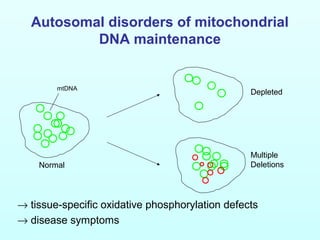
Autosomal disorders of mitochondrial
DNA maintenance
Normal
Depleted
Multiple
Deletions
mtDNA
→ tissue-specific oxidative phosphorylation defects
→ disease symptoms
Disorders associated with multiple
mtDNA deletions:
• Progressive external ophthalmoplegia with mitochondrial DNA
deletions
– Autosomal dominant
• PEOA1 – POLG (2001)
• PEOA2 – ANT1 (2000)
• PEOA3 – Twinkle (PEO1) (2001)
• PEOA4 – POLG2 (2006)
– Autosomal recessive
• PEOB1 – POLG (2001)
[note: POLG can cause AD or AR disease; any given mutation is
either associated with AD or AR disease]
• Other:
– MIRAS – POLG (2005)
– SANDO – POLG (2003)
– MNGIE – ECGF1 (thymidine phosphorylase) (1999)
– MNGIE without leukoencephalopathy – POLG (2003)
– Optic Atrophy ‘plus’ – OPA1 (2007)
Disorders associated with
mtDNA depletion:
• Alpers syndrome
– POLG (2004)
• Hepatocerebral form
– DGUOK (2002)
– MPV17 (2006)
– PEO1 (2007)
• Encephalomyopathic form
– SUCLA2 (2005)
– RRM2B (2007)
• Myopathic form
– TK2 (2001)
[All autosomal recessive]
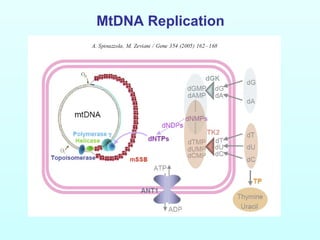
MtDNA Replication
Diagnosis of autosomal disorders of
mtDNA maintenance
• 2 complementary approaches -
Analysis of secondary mitochondrial DNA defects:
• Multiple mtDNA deletions:
– Testing of muscle DNA
– Long range PCR
– Southern blotting
• MtDNA depletion:
– Testing of muscle or liver DNA
– Real-time PCR assay to compare mtDNA copy number to that for an
autosomal nuclear gene
– Results are compared to normal controls
BUT availability of affected tissue can be a problem
Diagnosis of autosomal disorders of
mtDNA maintenance
Analysis of primary nuclear gene defects:
• Any DNA sample is suitable
• POLG analysis:
– Restriction digest PCR analysis for 3 particularly common POLG
mutations: p.A467T, p.W748S, p.G848S.
– If appropriate, DNA sequencing of the entire coding region of POLG is
undertaken
• PEO1 (Twinkle) analysis
– DNA sequencing of part of coding region
• ANT1 analysis
– DNA sequencing of coding region
Overview of Results
• Mutations in the POLG gene are a major cause of
autosomal disorders of mtDNA maintenance, accounting
for 25% of patients with PEO with mtDNA deletions and
67% of patients with a possible diagnosis of Alpers
syndrome in our cohort.
• Most POLG gene mutations are associated with
recessive disease, and there are several common
founder mutations.
• There appear to be genotype:phenotype correlations
associated with some POLG mutations.
Overview of Results
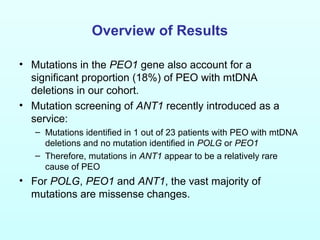
• Mutations in the PEO1 gene also account for a
significant proportion (18%) of PEO with mtDNA
deletions in our cohort.
• Mutation screening of ANT1 recently introduced as a
service:
– Mutations identified in 1 out of 23 patients with PEO with mtDNA
deletions and no mutation identified in POLG or PEO1
– Therefore, mutations in ANT1 appear to be a relatively rare
cause of PEO
• For POLG, PEO1 and ANT1, the vast majority of
mutations are missense changes.
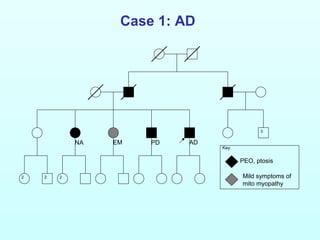
Case 1: AD
3
22 2
NA PDEM AD
PEO, ptosis
Mild symptoms of
mito myopathy
Key:
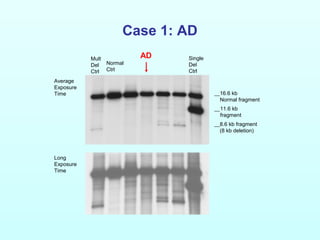
Case 1: AD
Single
Del
Ctrl
Normal
Ctrl
16.6 kb
Normal fragment
8.6 kb fragment
(8 kb deletion)
Average
Exposure
Time
Long
Exposure
Time
11.6 kb
fragment
Mult
Del
Ctrl
AD
Case 1: AD
NA PDEM AD
[R227W]+
[T251I;P587L]
[T251I;P587L]+
[T251I;P587L]
Inferred
[T251I;P587L] het
Inferred
[R227W]+[T251I;P587L]
[R227W]+
[T251I;P587L]
[R227W]+
[T251I;P587L]
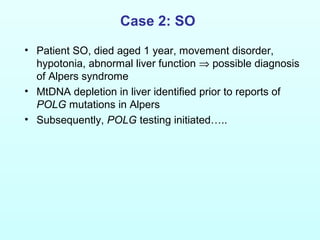
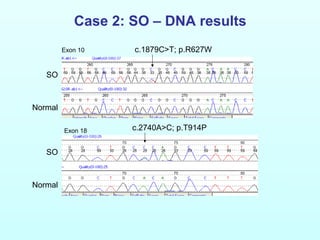
Case 2: SO
• Patient SO, died aged 1 year, movement disorder,
hypotonia, abnormal liver function ⇒ possible diagnosis
of Alpers syndrome
• MtDNA depletion in liver identified prior to reports of
POLG mutations in Alpers
• Subsequently, POLG testing initiated…..
Case 2: SO – DNA results
SO
Normal
SO
Normal
c.2740A>C; p.T914P
c.1879C>T; p.R627WExon 10
Exon 18
Case 2: SO – DNA results (contd)
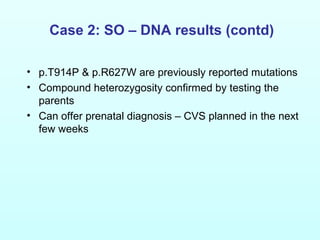
• p.T914P & p.R627W are previously reported mutations
• Compound heterozygosity confirmed by testing the
parents
• Can offer prenatal diagnosis – CVS planned in the next
few weeks
Summary
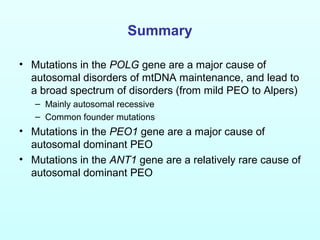
• Mutations in the POLG gene are a major cause of
autosomal disorders of mtDNA maintenance, and lead to
a broad spectrum of disorders (from mild PEO to Alpers)
– Mainly autosomal recessive
– Common founder mutations
• Mutations in the PEO1 gene are a major cause of
autosomal dominant PEO
• Mutations in the ANT1 gene are a relatively rare cause of
autosomal dominant PEO
Acknowledgements
• Molecular Genetics Lab, The Churchill:
– Conrad Smith
– Julie Evans
– Anthony O’Rourke
– Iain Dow
– Helen Lord
– Anneke Seller
• NDOG, John Radcliffe Hospital:
– Prof Jo Poulton

Fri t13 carl_fratter_3.15

  • 1.
    Mitochondrial DNA maintenance disorders CarlFratter Oxford Medical Genetics Labs
  • 2.
    Autosomal disorders ofmitochondrial DNA maintenance • Unique group of disorders involving defects in both of the genomes within human cells – Primary nuclear gene defect in a gene that affects mitochondrial DNA replication – Secondary mitochondrial DNA defect – tissue-specific
  • 3.
    Autosomal disorders ofmitochondrial DNA maintenance Normal Depleted Multiple Deletions mtDNA → tissue-specific oxidative phosphorylation defects → disease symptoms
  • 4.
    Disorders associated withmultiple mtDNA deletions: • Progressive external ophthalmoplegia with mitochondrial DNA deletions – Autosomal dominant • PEOA1 – POLG (2001) • PEOA2 – ANT1 (2000) • PEOA3 – Twinkle (PEO1) (2001) • PEOA4 – POLG2 (2006) – Autosomal recessive • PEOB1 – POLG (2001) [note: POLG can cause AD or AR disease; any given mutation is either associated with AD or AR disease] • Other: – MIRAS – POLG (2005) – SANDO – POLG (2003) – MNGIE – ECGF1 (thymidine phosphorylase) (1999) – MNGIE without leukoencephalopathy – POLG (2003) – Optic Atrophy ‘plus’ – OPA1 (2007)
  • 5.
    Disorders associated with mtDNAdepletion: • Alpers syndrome – POLG (2004) • Hepatocerebral form – DGUOK (2002) – MPV17 (2006) – PEO1 (2007) • Encephalomyopathic form – SUCLA2 (2005) – RRM2B (2007) • Myopathic form – TK2 (2001) [All autosomal recessive]
  • 6.
  • 7.
    Diagnosis of autosomaldisorders of mtDNA maintenance • 2 complementary approaches - Analysis of secondary mitochondrial DNA defects: • Multiple mtDNA deletions: – Testing of muscle DNA – Long range PCR – Southern blotting • MtDNA depletion: – Testing of muscle or liver DNA – Real-time PCR assay to compare mtDNA copy number to that for an autosomal nuclear gene – Results are compared to normal controls BUT availability of affected tissue can be a problem
  • 8.
    Diagnosis of autosomaldisorders of mtDNA maintenance Analysis of primary nuclear gene defects: • Any DNA sample is suitable • POLG analysis: – Restriction digest PCR analysis for 3 particularly common POLG mutations: p.A467T, p.W748S, p.G848S. – If appropriate, DNA sequencing of the entire coding region of POLG is undertaken • PEO1 (Twinkle) analysis – DNA sequencing of part of coding region • ANT1 analysis – DNA sequencing of coding region
  • 9.
    Overview of Results •Mutations in the POLG gene are a major cause of autosomal disorders of mtDNA maintenance, accounting for 25% of patients with PEO with mtDNA deletions and 67% of patients with a possible diagnosis of Alpers syndrome in our cohort. • Most POLG gene mutations are associated with recessive disease, and there are several common founder mutations. • There appear to be genotype:phenotype correlations associated with some POLG mutations.
  • 10.
    Overview of Results •Mutations in the PEO1 gene also account for a significant proportion (18%) of PEO with mtDNA deletions in our cohort. • Mutation screening of ANT1 recently introduced as a service: – Mutations identified in 1 out of 23 patients with PEO with mtDNA deletions and no mutation identified in POLG or PEO1 – Therefore, mutations in ANT1 appear to be a relatively rare cause of PEO • For POLG, PEO1 and ANT1, the vast majority of mutations are missense changes.
  • 11.
    Case 1: AD 3 222 NA PDEM AD PEO, ptosis Mild symptoms of mito myopathy Key:
  • 12.
    Case 1: AD Single Del Ctrl Normal Ctrl 16.6kb Normal fragment 8.6 kb fragment (8 kb deletion) Average Exposure Time Long Exposure Time 11.6 kb fragment Mult Del Ctrl AD
  • 13.
    Case 1: AD NAPDEM AD [R227W]+ [T251I;P587L] [T251I;P587L]+ [T251I;P587L] Inferred [T251I;P587L] het Inferred [R227W]+[T251I;P587L] [R227W]+ [T251I;P587L] [R227W]+ [T251I;P587L]
  • 14.
    Case 2: SO •Patient SO, died aged 1 year, movement disorder, hypotonia, abnormal liver function ⇒ possible diagnosis of Alpers syndrome • MtDNA depletion in liver identified prior to reports of POLG mutations in Alpers • Subsequently, POLG testing initiated…..
  • 15.
    Case 2: SO– DNA results SO Normal SO Normal c.2740A>C; p.T914P c.1879C>T; p.R627WExon 10 Exon 18
  • 16.
    Case 2: SO– DNA results (contd) • p.T914P & p.R627W are previously reported mutations • Compound heterozygosity confirmed by testing the parents • Can offer prenatal diagnosis – CVS planned in the next few weeks
  • 17.
    Summary • Mutations inthe POLG gene are a major cause of autosomal disorders of mtDNA maintenance, and lead to a broad spectrum of disorders (from mild PEO to Alpers) – Mainly autosomal recessive – Common founder mutations • Mutations in the PEO1 gene are a major cause of autosomal dominant PEO • Mutations in the ANT1 gene are a relatively rare cause of autosomal dominant PEO
  • 18.
    Acknowledgements • Molecular GeneticsLab, The Churchill: – Conrad Smith – Julie Evans – Anthony O’Rourke – Iain Dow – Helen Lord – Anneke Seller • NDOG, John Radcliffe Hospital: – Prof Jo Poulton