Cholera
Ahsan SAQI
Introduction:
 Cholera is an acute infectious disease of intestinal
track characterized by sudden onset of severe
diarrhea & vomiting leading to rapid dehydration
often resulting in death of the patient.
 It is both endemic and epidemic dieseas.
 Occurs in summer & autumn and generally
fades away with the onset of winter.
 Affects all ages , mainly people with poor
personal and environmental hygiene.
 Causative agent:
Cholera is caused by two types of Vibrios:
a) Classical cholera vibrios
b) El Tor vibrios
 Mode of spread:
i) Municipal water supplies.
ii)Ice made from municipal water.
iii)Foods and drinks sold by street vendors.
iv)Vegetables grown with water containing human
wastes.
v)Raw or undercooked fish and seafood caught in
waters polluted with sewage.
vi)By ingestion of contaminated water,
food,milk,milk products or drink with discharges of
the patient.
vii)By careless handling of fomites of infected
person and not washing the hands properly thus
contaminating the food and drinks themselves.
viii)Flies act as mechanical carriers.
 When a person consumes the contaminated food
or water, the bacteria release a toxin in the
intestines that produces severe diarrhea.
 It is not likely you will catch cholera just from
casual contact with an infected person.
 Incubation period:
few hours to 5 days, (usually 1-2 days).
 Sign & Symptoms:
 Begin as soon as a few hours or as long as five days
after infection.
 Often symptoms are mild. But sometimes they are
very serious.
 About one in 20 people infected have severe
watery diarrhea accompanied by vomiting, which can
quickly lead to dehydration.
 Although many infected people may have minimal or
no symptoms, they can still contribute to spread of
the infection.
Signs and symptoms of dehydration include:
 Rapid heart rate
 Loss of skin elasticity (the ability to return to
original position quickly if pinched)
 Dry mucous membranes, including the inside of
the mouth, throat, nose, and eyelids
 Low blood pressure
 Thirst
 Muscle cramps
 If not treated, dehydration can lead to shock and
death in a matter of hours.
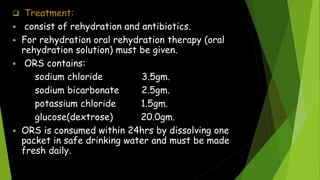
 Treatment:
 consist of rehydration and antibiotics.
 For rehydration oral rehydration therapy (oral
rehydration solution) must be given.
 ORS contains:
sodium chloride 3.5gm.
sodium bicarbonate 2.5gm.
potassium chloride 1.5gm.
glucose(dextrose) 20.0gm.
 ORS is consumed within 24hrs by dissolving one
packet in safe drinking water and must be made
fresh daily.
 If ORS is not available then a simpl mixture of
common salt(5gm) & sugar pr gurr (20gm) is
dissolved in 1litr of water and give to patient.
 For I.V therapy Ringer’s lactate solution is used
in case of severe dehydration.
 Antibiotics are given along with rehydration
therapy to cut short duration illness.
Eg: tetracycline.
 Although there is vaccine against cholera, the
CDC and World Health Organization don't
normally recommend it because it may not
protect up to half of the people who receive it
and it lasts only a few months.
 The only way to avoid cholera is use of safe and
chemically disinfected water for
drinking,making ice creams,cookng food, washind
face and hands, washing food and utensils,
brushing teeth.
Typhoid
Introduction:
 Typhoid fever is an acute communicable disease
caused by Salmonella typhi .
 Enteric fever include both typhoid and
paratyphoid fever.
 Occur in all part of the World and throughout
the year but more in summer & rainy season.
 Affects all ages but more common b/w 10-30yrs
 An attack of typhoid fever gives a fairly lasting
immunity but second attack may also occur.
 Causative Organism:
 typhoid fever is caused by Salmonella typhi
 parathphoid fever is caused by Salmonella
paratyphoid A,B,C.
 Mode of spread:
 Poor sanitation, open air defecation & urination;
low standard of living, unhygienic food,
contaminated milk and water,illiteracy and health
ignorance are responsibl for the spread of this
disease.
 Disease can occur in healthy persons when they
take water,milk & food or by their hands or
fingers contaminated with stool and urine of
patient.
 Incubation Period:
7-28 days (average 14 days).
 Sign & symptoms:
 nausea,vomiting,diarrhea or constipation,cough,
headache,slow pulse rate and fever.
 In second week the fever rises,1degree every
dayand reaches to 39˚C- 40˚C which continues
from 2-4 weeks.
 Patient feels weakness,tired,weight loss,poor
appetite,abdominal pain and spleen enlargement.
 Prevention and Control:
i) Water must be protected from contamination
with faeces urine and sewage.
ii) Water and milk should be consumed only after
proper boiling.
iii) Human excrera and urine should be disposed of
in a sanitary way.
iv) Strict sanitation control should be observed in
and around the houses.
v) All eatables should be protected from flies.
vi) Raw vegetables & fruits should be washed
properly before consuming.
vii)Antiflies measures should be taken.
viii) Public should be educated for sanitation and
personal hygiene.
ix) All acute cases should be detected,notified
and isolated at earliest stage.
x) Public should be immunized with TAB vaccine
which contain S.typhi, paratyphi A, S.paratyphi B.
 Immunisation is based on 2 doses each of 0.5ml
at an interval of 7-10 days.
 Booster doses are required to be given every
thierd year.
 After injection TAB vaccine causes local
reaction, pain,headache, mild fever and swelling.
 Treatment:
i) Give complete rest to patient.
ii) Give nourishing diet to the patient.
iii) Stools & urine should be passed in a closed
container containing some disinfectant and then
should be cleaned immediately.
iv) All bedsheets,towel,pillow covers and other
articles used by patient should be thoroughly
disinfected.
v) Chloramphenicol is the drug of choice.
HookWorm Infection
(Ancyclostomiasis)
Introduction:
 Hookworms are parasites. This means they live off
other living things.
 Hookworms affect your lungs and small intestine.
 Humans contact hookworms through roundworm eggs
and larvae found in dirt contaminated by feces.
 According to the Centers for Disease Control and
Prevention (CDC), hookworm infections occur in an
estimated 576 to 740 million people worldwide (CDC,
2010).
 It mainly affects people in developing nations in the
tropics and subtropics due to poor sanitation. These
infections rarely occur in the United States.
 Causative agent:
a) Ancylostoma duodenale
b) Necator americanus
 anterior end of these worms is bent dorsally,
hence named as hook worm.
 A typical hook worm is almost cylindrical and
threadlike with conical head.
 Large oval mouth having 4 hook like teeth on the
upper side & 2 knob like teeth on lower side of
the buccal cavity, which the worm fixes itself to
mucous membrane of the intestine.
 Mode of Transmission:
 A single female worm may lay 10,000 – 20,000 eggs
per day which are passed in feces.
 When they laid on warm moist soil the egg hatch into
larvae(in about 5 days) outside the human body in the
soil where they latter grow and develop into infective
larvae.
 When a person walks bare foot on the contaminated
soil, the infective larvae penetrate the skin.
 Skin blood stream heart lungs
trachea & pharynx swallowing stomach
small intestine developed into mature
worms and start laying eggs in about 6 weeks.
Sign and symptoms:
 A healthy prson who eat foods with plenty of
iron have no symptoms from the infection.
 If a person experience symptoms, they
generally start with itchiness and a small rash
caused by an allergic reaction as the larvae
enters your skin generally followed by diarrhea
as the hookworms grow in intestine.
 Other symptoms include:
abdominal pain,colic (cramping and excessive
crying in infants),intestinal cramps, nausea,fever,
blood in stool , appetite loss,itchy rash.
 Adverse effects:
 The ill-effects include iron deficiency anaemia,
joint pains, abdominal pain,oedema,general
weakness,loss of body resistance & decline in
capacity to do hard work.
 Children who have frequent hookworm infections
can experience slow growth and mental development
from losing a lot of iron and protein.
 Prevention:
i) Defecation in the open should be discouraged.
ii) Night soil should be properly disposed of specially
in rural and slum areas where chances of infection are
more.
iii) Habit of walking bare-footed should be
avoided
iv) A peasant working in the fields should wear
shoes & gloves.
v) Source of water supply should be protected
from contamination with human excreta.
vi) People should be educated about sanitary
measures and personal hygiene,(washing hand
after defecation and before meal).
Treatment:
i) improve nutrition
ii) various drugs such as mebendazole, albendazole
and pyrantal are quite effective against
hookworm.(1 -3 days)
iii)Along with medication iron supplements are also
used in case of hookworm anemia.
iv) In case of ascites,additional protein in diet are
added.
v) Area where hookworm infections are prevalent,
community-oriented chemotherapy may be
necessary.
Referance:
 Health Education and Community Pharmacy
 wikipedia
Cholera
Cholera

Cholera

  • 1.
  • 2.
  • 3.
    Introduction:  Cholera isan acute infectious disease of intestinal track characterized by sudden onset of severe diarrhea & vomiting leading to rapid dehydration often resulting in death of the patient.
  • 4.
     It isboth endemic and epidemic dieseas.  Occurs in summer & autumn and generally fades away with the onset of winter.  Affects all ages , mainly people with poor personal and environmental hygiene.
  • 5.
     Causative agent: Cholerais caused by two types of Vibrios: a) Classical cholera vibrios b) El Tor vibrios  Mode of spread: i) Municipal water supplies. ii)Ice made from municipal water. iii)Foods and drinks sold by street vendors. iv)Vegetables grown with water containing human wastes. v)Raw or undercooked fish and seafood caught in waters polluted with sewage.
  • 6.
    vi)By ingestion ofcontaminated water, food,milk,milk products or drink with discharges of the patient. vii)By careless handling of fomites of infected person and not washing the hands properly thus contaminating the food and drinks themselves. viii)Flies act as mechanical carriers.  When a person consumes the contaminated food or water, the bacteria release a toxin in the intestines that produces severe diarrhea.  It is not likely you will catch cholera just from casual contact with an infected person.
  • 7.
     Incubation period: fewhours to 5 days, (usually 1-2 days).  Sign & Symptoms:  Begin as soon as a few hours or as long as five days after infection.  Often symptoms are mild. But sometimes they are very serious.  About one in 20 people infected have severe watery diarrhea accompanied by vomiting, which can quickly lead to dehydration.  Although many infected people may have minimal or no symptoms, they can still contribute to spread of the infection.
  • 8.
    Signs and symptomsof dehydration include:  Rapid heart rate  Loss of skin elasticity (the ability to return to original position quickly if pinched)  Dry mucous membranes, including the inside of the mouth, throat, nose, and eyelids  Low blood pressure  Thirst  Muscle cramps  If not treated, dehydration can lead to shock and death in a matter of hours.
  • 9.
     Treatment:  consistof rehydration and antibiotics.  For rehydration oral rehydration therapy (oral rehydration solution) must be given.  ORS contains: sodium chloride 3.5gm. sodium bicarbonate 2.5gm. potassium chloride 1.5gm. glucose(dextrose) 20.0gm.  ORS is consumed within 24hrs by dissolving one packet in safe drinking water and must be made fresh daily.
  • 10.
     If ORSis not available then a simpl mixture of common salt(5gm) & sugar pr gurr (20gm) is dissolved in 1litr of water and give to patient.  For I.V therapy Ringer’s lactate solution is used in case of severe dehydration.  Antibiotics are given along with rehydration therapy to cut short duration illness. Eg: tetracycline.  Although there is vaccine against cholera, the CDC and World Health Organization don't normally recommend it because it may not protect up to half of the people who receive it and it lasts only a few months.
  • 11.
     The onlyway to avoid cholera is use of safe and chemically disinfected water for drinking,making ice creams,cookng food, washind face and hands, washing food and utensils, brushing teeth.
  • 12.
  • 13.
    Introduction:  Typhoid feveris an acute communicable disease caused by Salmonella typhi .  Enteric fever include both typhoid and paratyphoid fever.  Occur in all part of the World and throughout the year but more in summer & rainy season.  Affects all ages but more common b/w 10-30yrs  An attack of typhoid fever gives a fairly lasting immunity but second attack may also occur.
  • 14.
     Causative Organism: typhoid fever is caused by Salmonella typhi  parathphoid fever is caused by Salmonella paratyphoid A,B,C.  Mode of spread:  Poor sanitation, open air defecation & urination; low standard of living, unhygienic food, contaminated milk and water,illiteracy and health ignorance are responsibl for the spread of this disease.  Disease can occur in healthy persons when they take water,milk & food or by their hands or fingers contaminated with stool and urine of patient.
  • 15.
     Incubation Period: 7-28days (average 14 days).  Sign & symptoms:  nausea,vomiting,diarrhea or constipation,cough, headache,slow pulse rate and fever.  In second week the fever rises,1degree every dayand reaches to 39˚C- 40˚C which continues from 2-4 weeks.  Patient feels weakness,tired,weight loss,poor appetite,abdominal pain and spleen enlargement.
  • 16.
     Prevention andControl: i) Water must be protected from contamination with faeces urine and sewage. ii) Water and milk should be consumed only after proper boiling. iii) Human excrera and urine should be disposed of in a sanitary way. iv) Strict sanitation control should be observed in and around the houses. v) All eatables should be protected from flies. vi) Raw vegetables & fruits should be washed properly before consuming.
  • 17.
    vii)Antiflies measures shouldbe taken. viii) Public should be educated for sanitation and personal hygiene. ix) All acute cases should be detected,notified and isolated at earliest stage. x) Public should be immunized with TAB vaccine which contain S.typhi, paratyphi A, S.paratyphi B.  Immunisation is based on 2 doses each of 0.5ml at an interval of 7-10 days.  Booster doses are required to be given every thierd year.  After injection TAB vaccine causes local reaction, pain,headache, mild fever and swelling.
  • 18.
     Treatment: i) Givecomplete rest to patient. ii) Give nourishing diet to the patient. iii) Stools & urine should be passed in a closed container containing some disinfectant and then should be cleaned immediately. iv) All bedsheets,towel,pillow covers and other articles used by patient should be thoroughly disinfected. v) Chloramphenicol is the drug of choice.
  • 19.
  • 20.
    Introduction:  Hookworms areparasites. This means they live off other living things.  Hookworms affect your lungs and small intestine.  Humans contact hookworms through roundworm eggs and larvae found in dirt contaminated by feces.  According to the Centers for Disease Control and Prevention (CDC), hookworm infections occur in an estimated 576 to 740 million people worldwide (CDC, 2010).  It mainly affects people in developing nations in the tropics and subtropics due to poor sanitation. These infections rarely occur in the United States.
  • 21.
     Causative agent: a)Ancylostoma duodenale b) Necator americanus  anterior end of these worms is bent dorsally, hence named as hook worm.  A typical hook worm is almost cylindrical and threadlike with conical head.  Large oval mouth having 4 hook like teeth on the upper side & 2 knob like teeth on lower side of the buccal cavity, which the worm fixes itself to mucous membrane of the intestine.
  • 22.
     Mode ofTransmission:  A single female worm may lay 10,000 – 20,000 eggs per day which are passed in feces.  When they laid on warm moist soil the egg hatch into larvae(in about 5 days) outside the human body in the soil where they latter grow and develop into infective larvae.  When a person walks bare foot on the contaminated soil, the infective larvae penetrate the skin.  Skin blood stream heart lungs trachea & pharynx swallowing stomach small intestine developed into mature worms and start laying eggs in about 6 weeks.
  • 23.
    Sign and symptoms: A healthy prson who eat foods with plenty of iron have no symptoms from the infection.  If a person experience symptoms, they generally start with itchiness and a small rash caused by an allergic reaction as the larvae enters your skin generally followed by diarrhea as the hookworms grow in intestine.  Other symptoms include: abdominal pain,colic (cramping and excessive crying in infants),intestinal cramps, nausea,fever, blood in stool , appetite loss,itchy rash.
  • 24.
     Adverse effects: The ill-effects include iron deficiency anaemia, joint pains, abdominal pain,oedema,general weakness,loss of body resistance & decline in capacity to do hard work.  Children who have frequent hookworm infections can experience slow growth and mental development from losing a lot of iron and protein.  Prevention: i) Defecation in the open should be discouraged. ii) Night soil should be properly disposed of specially in rural and slum areas where chances of infection are more.
  • 25.
    iii) Habit ofwalking bare-footed should be avoided iv) A peasant working in the fields should wear shoes & gloves. v) Source of water supply should be protected from contamination with human excreta. vi) People should be educated about sanitary measures and personal hygiene,(washing hand after defecation and before meal).
  • 26.
    Treatment: i) improve nutrition ii)various drugs such as mebendazole, albendazole and pyrantal are quite effective against hookworm.(1 -3 days) iii)Along with medication iron supplements are also used in case of hookworm anemia. iv) In case of ascites,additional protein in diet are added. v) Area where hookworm infections are prevalent, community-oriented chemotherapy may be necessary.
  • 27.
    Referance:  Health Educationand Community Pharmacy  wikipedia