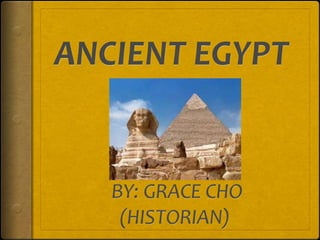
The civilization of ancient Egypt existed from about
2800BC up to the time of Christ’s birth. It could be
found close to river Nile and the Mediterranean Sea. It
is still interesting to learn about the society, clothing,
architecture and writing of ancient Egypt.
SOCIETY
In ancient Egypt, society was structured from the Pharaohs at the highest level to
slaves at the lowest. It was like a pyramid. The Pharaoh and Queen were at the top
and they were the most rich and powerful. Pharaoh means someone who helps
and the Egyptians believed the Pharaoh would give help when they needed it. He
looked like a god, more than a person. Egyptians always had a Pharaoh unless
they were fighting each other in wars. Underneath the Pharaohs came the nobles,
grand viziers of upper and lower Egypt, high priests and high priestesses. At the
next level were the governors and the grand viziers. Craftsmen, artists, scribes and
tax gatherers, were in the middle of society. Some scribes were more important
than others because their job was to check the food supplies. Builders, farmers
and wabs were at the lower level. Least important were the slaves. As you can see,
there were many different levels in society in Ancient Egypt.
CLOTHING
The Egyptians wore different clothing depending on whether you were a man, woman or
child. Egyptian clothing was nearly always white, and they dressed in patterned fabric. The
fabric was made from a crop called flax. Men wore loin-cloths, kilts and tunic style outfits.
Women wore simple clothing, ankle length sheath dresses, shawls and cloaks.
However, children wore nothing. The clothing also depended on whether people were rich or
poor. Rich people owned jewellery and used make-up, such as black eye paint and green eye
shadow. Some priests even wore leopard skin on their shoulders to show their importance.
Most Egyptians put oils on their skin, to protect them from the harsh desert winds. They paid
great attention to their heads, used face cream and usually cut their hair short. Egyptians wore
sandals on their feet, with hieroglyphs representing their enemies. Egyptians wore beautiful
clothing but it is very different from modern times.
ARCHITECTURE
In ancient Egypt, most people lived close to the river Nile. Egypt’s most famous
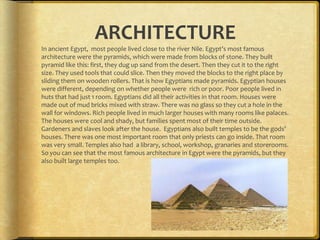
architecture were the pyramids, which were made from blocks of stone. They built
pyramid like this: first, they dug up sand from the desert. Then they cut it to the right
size. They used tools that could slice. Then they moved the blocks to the right place by
sliding them on wooden rollers. That is how Egyptians made pyramids. Egyptian houses
were different, depending on whether people were rich or poor. Poor people lived in
huts that had just 1 room. Egyptians did all their activities in that room. Houses were
made out of mud bricks mixed with straw. There was no glass so they cut a hole in the
wall for windows. Rich people lived in much larger houses with many rooms like palaces.
The houses were cool and shady, but families spent most of their time outside.
Gardeners and slaves look after the house. Egyptians also built temples to be the gods’
houses. There was one most important room that only priests can go inside. That room
was very small. Temples also had a library, school, workshop, granaries and storerooms.
So you can see that the most famous architecture in Egypt were the pyramids, but they
also built large temples too.
WRITING
Writing in ancient Egypt is very different from our writing today. The
Egyptians were the first civilization to invent writing. It started with
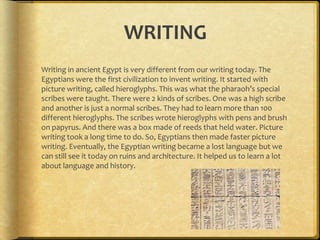
picture writing, called hieroglyphs. This was what the pharaoh’s special
scribes were taught. There were 2 kinds of scribes. One was a high scribe
and another is just a normal scribes. They had to learn more than 100
different hieroglyphs. The scribes wrote hieroglyphs with pens and brush
on papyrus. And there was a box made of reeds that held water. Picture
writing took a long time to do. So, Egyptians then made faster picture
writing. Eventually, the Egyptian writing became a lost language but we
can still see it today on ruins and architecture. It helped us to learn a lot
about language and history.
In conclusion this report has described the
society, clothing, architecture and writing of ancient
Egypt. It is clear that this is an interesting civilization
because their writing was so important to the world. I
learned a lot about more about ancient Egypt while
writing this report.
REFERENCE LIST
Author                Date                             Title

Tim wood            1997                         Ancient wonders

Claire Forbes      1997                          Ancient people

George hart        1990                          Ancient Egypt

Fiona Macdonald    1997               The world in the time of Tutankhamen

James Mason           1991                 Ancient Egypt Resource Book

Jane Shuter        1991                     The Ancient Egyptians

Richard Balkwill     1999                       Ancient Egypt

Tony Allan           1997                    Pharaoh & Pyramid

James Mason          1991                  The Tomb of Tutankhamen

Date visited                Online

2011.10.18                   http://grade4.biss.wikispaces.net/

Ancient egypt ^.^

  • 2.
    The civilization ofancient Egypt existed from about 2800BC up to the time of Christ’s birth. It could be found close to river Nile and the Mediterranean Sea. It is still interesting to learn about the society, clothing, architecture and writing of ancient Egypt.
  • 3.
    SOCIETY In ancient Egypt,society was structured from the Pharaohs at the highest level to slaves at the lowest. It was like a pyramid. The Pharaoh and Queen were at the top and they were the most rich and powerful. Pharaoh means someone who helps and the Egyptians believed the Pharaoh would give help when they needed it. He looked like a god, more than a person. Egyptians always had a Pharaoh unless they were fighting each other in wars. Underneath the Pharaohs came the nobles, grand viziers of upper and lower Egypt, high priests and high priestesses. At the next level were the governors and the grand viziers. Craftsmen, artists, scribes and tax gatherers, were in the middle of society. Some scribes were more important than others because their job was to check the food supplies. Builders, farmers and wabs were at the lower level. Least important were the slaves. As you can see, there were many different levels in society in Ancient Egypt.
  • 4.
    CLOTHING The Egyptians woredifferent clothing depending on whether you were a man, woman or child. Egyptian clothing was nearly always white, and they dressed in patterned fabric. The fabric was made from a crop called flax. Men wore loin-cloths, kilts and tunic style outfits. Women wore simple clothing, ankle length sheath dresses, shawls and cloaks. However, children wore nothing. The clothing also depended on whether people were rich or poor. Rich people owned jewellery and used make-up, such as black eye paint and green eye shadow. Some priests even wore leopard skin on their shoulders to show their importance. Most Egyptians put oils on their skin, to protect them from the harsh desert winds. They paid great attention to their heads, used face cream and usually cut their hair short. Egyptians wore sandals on their feet, with hieroglyphs representing their enemies. Egyptians wore beautiful clothing but it is very different from modern times.
  • 5.
    ARCHITECTURE In ancient Egypt,most people lived close to the river Nile. Egypt’s most famous architecture were the pyramids, which were made from blocks of stone. They built pyramid like this: first, they dug up sand from the desert. Then they cut it to the right size. They used tools that could slice. Then they moved the blocks to the right place by sliding them on wooden rollers. That is how Egyptians made pyramids. Egyptian houses were different, depending on whether people were rich or poor. Poor people lived in huts that had just 1 room. Egyptians did all their activities in that room. Houses were made out of mud bricks mixed with straw. There was no glass so they cut a hole in the wall for windows. Rich people lived in much larger houses with many rooms like palaces. The houses were cool and shady, but families spent most of their time outside. Gardeners and slaves look after the house. Egyptians also built temples to be the gods’ houses. There was one most important room that only priests can go inside. That room was very small. Temples also had a library, school, workshop, granaries and storerooms. So you can see that the most famous architecture in Egypt were the pyramids, but they also built large temples too.
  • 6.
    WRITING Writing in ancientEgypt is very different from our writing today. The Egyptians were the first civilization to invent writing. It started with picture writing, called hieroglyphs. This was what the pharaoh’s special scribes were taught. There were 2 kinds of scribes. One was a high scribe and another is just a normal scribes. They had to learn more than 100 different hieroglyphs. The scribes wrote hieroglyphs with pens and brush on papyrus. And there was a box made of reeds that held water. Picture writing took a long time to do. So, Egyptians then made faster picture writing. Eventually, the Egyptian writing became a lost language but we can still see it today on ruins and architecture. It helped us to learn a lot about language and history.
  • 7.
    In conclusion thisreport has described the society, clothing, architecture and writing of ancient Egypt. It is clear that this is an interesting civilization because their writing was so important to the world. I learned a lot about more about ancient Egypt while writing this report.
  • 8.
    REFERENCE LIST Author Date Title Tim wood 1997 Ancient wonders Claire Forbes 1997 Ancient people George hart 1990 Ancient Egypt Fiona Macdonald 1997 The world in the time of Tutankhamen James Mason 1991 Ancient Egypt Resource Book Jane Shuter 1991 The Ancient Egyptians Richard Balkwill 1999 Ancient Egypt Tony Allan 1997 Pharaoh & Pyramid James Mason 1991 The Tomb of Tutankhamen Date visited Online 2011.10.18 http://grade4.biss.wikispaces.net/