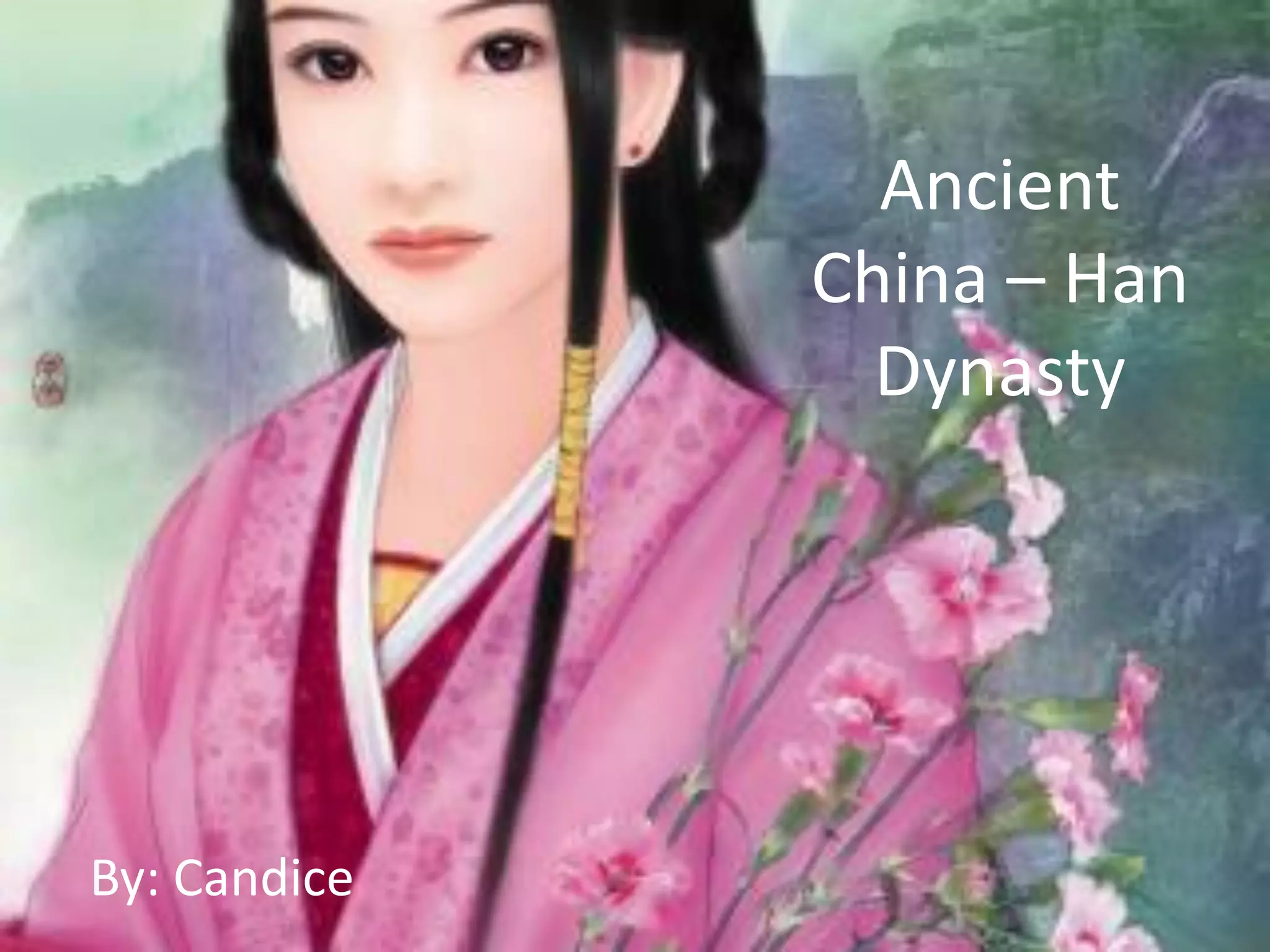
Ancient
              China – Han
                Dynasty


By: Candice
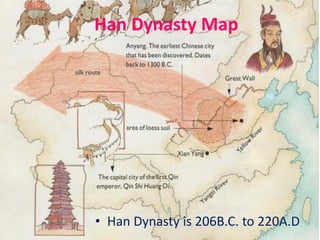
Han Dynasty Map


• Han Dynasty is 206B.C. to 220A.D
Background
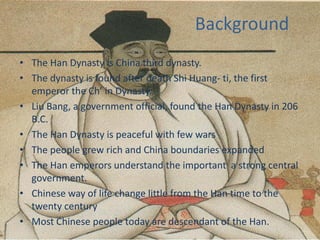
• The Han Dynasty is China third dynasty.
• The dynasty is found after death Shi Huang- ti, the first
  emperor the Ch’ in Dynasty.
• Liu Bang, a government official, found the Han Dynasty in 206
  B.C.
• The Han Dynasty is peaceful with few wars
• The people grew rich and China boundaries expanded
• The Han emperors understand the important a strong central
  government.
• Chinese way of life change little from the Han time to the
  twenty century
• Most Chinese people today are descendant of the Han.
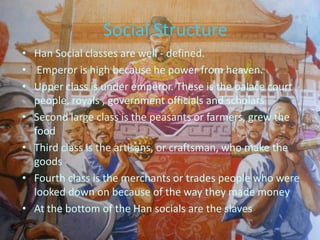
Social Structure
• Han Social classes are well - defined.
• Emperor is high because he power from heaven.
• Upper class is under emperor. These is the palace court
  people, royals , government officials and scholars
• Second large class is the peasants or farmers, grew the
  food
• Third class is the artisans, or craftsman, who make the
  goods
• Fourth class is the merchants or trades people who were
  looked down on because of the way they made money
• At the bottom of the Han socials are the slaves
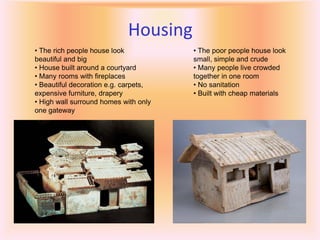
Housing
• The rich people house look           • The poor people house look
beautiful and big                      small, simple and crude
• House built around a courtyard       • Many people live crowded
• Many rooms with fireplaces           together in one room
• Beautiful decoration e.g. carpets,   • No sanitation
expensive furniture, drapery           • Built with cheap materials
• High wall surround homes with only
one gateway
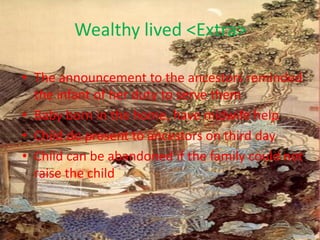
Wealthy lived <Extra>

• The announcement to the ancestors reminded
  the infant of her duty to serve them
• Baby born in the home, have midwife help
• Child do present to ancestors on third day
• Child can be abandoned if the family could not
  raise the child
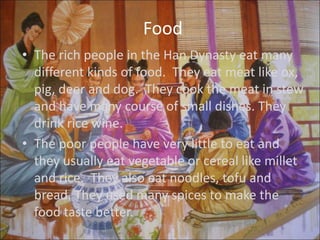
Food
• The rich people in the Han Dynasty eat many
  different kinds of food. They eat meat like ox,
  pig, deer and dog. They cook the meat in stew
  and have many course of small dishes. They
  drink rice wine.
• The poor people have very little to eat and
  they usually eat vegetable or cereal like millet
  and rice. They also eat noodles, tofu and
  bread. They used many spices to make the
  food taste better.
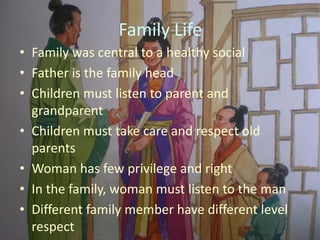
Family Life
• Family was central to a healthy social
• Father is the family head
• Children must listen to parent and
  grandparent
• Children must take care and respect old
  parents
• Woman has few privilege and right
• In the family, woman must listen to the man
• Different family member have different level
  respect
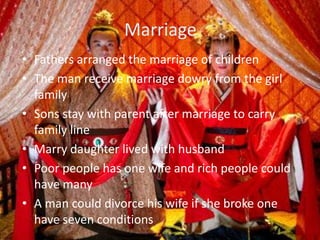
Marriage
• Fathers arranged the marriage of children
• The man receive marriage dowry from the girl
  family
• Sons stay with parent after marriage to carry
  family line
• Marry daughter lived with husband
• Poor people has one wife and rich people could
  have many
• A man could divorce his wife if she broke one
  have seven conditions
Extra
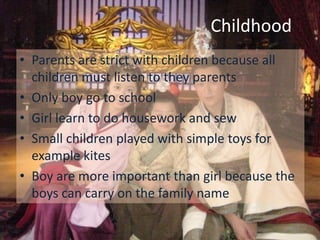
Childhood
• Parents are strict with children because all
  children must listen to they parents
• Only boy go to school
• Girl learn to do housework and sew
• Small children played with simple toys for
  example kites
• Boy are more important than girl because the
  boys can carry on the family name
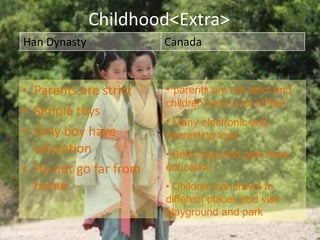
Childhood<Extra>
Han Dynasty            Canada


• Parents are strict   • parents are not strict and
                       children have a lot of free
• Simple toys
                       • Many electronic and
• Only boy have        interesting toys
  education            • Both boys and girls have
• Do not go far from   education
  home                 • Children can travel to
                       different places and visit
                       playground and park
Education
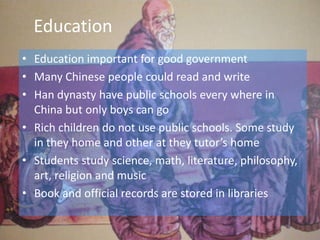
• Education important for good government
• Many Chinese people could read and write
• Han dynasty have public schools every where in
  China but only boys can go
• Rich children do not use public schools. Some study
  in they home and other at they tutor’s home
• Students study science, math, literature, philosophy,
  art, religion and music
• Book and official records are stored in libraries
Religion

• The Han people believe in many different gods and
  spirits
• They offered sacrificed animals and foodstuffs to
  gods, spirits and ancestors
• The emperor acts as the high priest because he is the
  son of heaven
• Buddhism is introduced to China during the middle
  of the Han dynasty
• They believe in being born again and again
Extra
Clothing
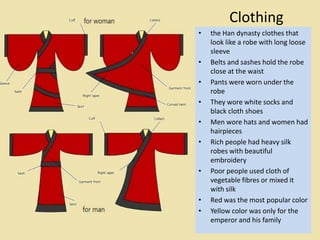
•   the Han dynasty clothes that
    look like a robe with long loose
    sleeve
•   Belts and sashes hold the robe
    close at the waist
•   Pants were worn under the
    robe
•   They wore white socks and
    black cloth shoes
•   Men wore hats and women had
    hairpieces
•   Rich people had heavy silk
    robes with beautiful
    embroidery
•   Poor people used cloth of
    vegetable fibres or mixed it
    with silk
•   Red was the most popular color
•   Yellow color was only for the
    emperor and his family
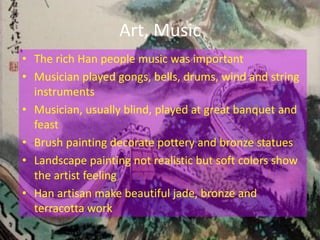
Art, Music
• The rich Han people music was important
• Musician played gongs, bells, drums, wind and string
  instruments
• Musician, usually blind, played at great banquet and
  feast
• Brush painting decorate pottery and bronze statues
• Landscape painting not realistic but soft colors show
  the artist feeling
• Han artisan make beautiful jade, bronze and
  terracotta work
Festival <Extra>

• Chinese New Year is the most important festival
  because it marked the beginning of the farming year
• People offered thanks to gods for good harvest
• People celebrated with processions and dancing in
  the streets
• People decorate their doors and windows with red
  paper cutouts
• All the food eaten have symbolic meanings, for
  example, noodles mean long life
Conclusion
• The Han dynasty was a rich and peaceful time in
  China history
• It lasted from 206 B.C. to 220A.D.
• Many arts and crafts, such as jade carving, reached
  its height at this time
• The Silk Road was started and many expeditions
  were made to Central Asia
• After the fall of the Han dynasty, China was not
  united again until 618 A.D.
• The Han dynasty was the best period in China’s
  history so most Chinese people call themselves Han
Information bibliography
•   Empires of China – Han Dynasty on Slideshare.net
    http://www.slideshare.net/kkatz/han-dynasty-presentation-894040
•   Han Dynasty of clothing – from wikipedia.org
    http://en.wikipedia.org/wiki/Han_Chinese_clothing
•   Han Dynasty of education and housing – from mrdonn.org http://china.mrdonn.org/han.html
•   Han Dynasty of education – from wikipedia.org      http://en.wikipedia.org/wiki/Han_dynasty
•   Han Dynasty of marriage – from wikipedia.org
    http://en.wikipedia.org/wiki/Han_dynasty#Marriage.2C_gender.2C_and_kinship
•   Han Dynasty of clothing – from wikipedia.org
    http://en.wikipedia.org/wiki/Han_Chinese_clothing
•   Han dynasty of Festival – from about,com
    http://chinesefood.about.com/od/chinesenewyear/a/newyearlegends_2.htm
    http://gochina.about.com/od/chinesenewyear/p/CNY_Origins.htm
    http://www.squidoo.com/2011-chinese-new-year#module142110931
•   Han Dynasty of wealthy lived – from asiafinest.com
    http://www.asiafinest.com/forum/lofiversion/index.php/t214608.html
Picture bibliography
Slide 1: http://www.chinaassistor.com/FCKeditor/UserFiles/Image/20081218_135136_0.jpg
Slide 2: This picture is from Ancient China book page 4 by Robert Nicholson and Claire Watts
Slide 3: This picture is from Ancient Civilizations China book page 6 by chelseahouse.com
Slide 4: This picture is from Ancient China book page 10 by Robert Nicholson and Claire
    Watts
Slide 5: http://www.trocadero.com/brianpage/items/991502/picture2.jpg and
    http://history.cultural-china.com/chinaWH/upload/upfiles/2009 -
    04/24/burial_objects_in_the_han_dynasty__house_and_its_facilitiesfef095bf32b0bc3b
    a775.jpg
Slide 6: Extra
    http://images.china.cn/attachement/jpg/site1000/20100125/001ec949f8470cc72eb705
    .jpg
Slide 7: This picture is from Ancient China book page 22 by Robert Nicholson and Claire
    Watts
Slide 8: This picture is from Ancient China book page 24 by Robert Nicholson and Claire
    Watts
Slide 9: http://img2.mtime.com/up/182/1192182/1e8d2771-1060-4bba-ad86-
    abd623dec432_500.jpg
Picture bibliography2
Slide 10: Extra
Slide 11: http://www.qhnews.compic0001807180785_461737.jpg
Slide 12: Extra     http://blog.dgw.cc/images/upload/bokedm-
    2720%2871%29.jpg
Slide 13: This picture is from Life in Ancient China book page 17 by Paul Challe
Slide 14: http://2.bp.blogspot.com/-oruO1LWqkCQ/TVqLmP-
    F2QI/AAAAAAAAAAk/hk38NVaaYI0/s1600/yinyang.jpg
Slide 15: Extra
Slide16: http://en.wikipedia.org/wiki/Han_Chinese_clothing
Slide 17: http://a.ooi1.com/usa/n3015.jpg
Slide 18: http://blog.huayuworld.org/gallery/7739/Moon%20festival-
    %20moon%20lady.gif
Slide 19: http://www.bookchinaonline.com/blog/wp-
    content/pushups/2010/11/Chinese-painting.jpg

Candice socials

  • 1.
    Ancient China – Han Dynasty By: Candice
  • 2.
    Han Dynasty Map •Han Dynasty is 206B.C. to 220A.D
  • 3.
    Background • The HanDynasty is China third dynasty. • The dynasty is found after death Shi Huang- ti, the first emperor the Ch’ in Dynasty. • Liu Bang, a government official, found the Han Dynasty in 206 B.C. • The Han Dynasty is peaceful with few wars • The people grew rich and China boundaries expanded • The Han emperors understand the important a strong central government. • Chinese way of life change little from the Han time to the twenty century • Most Chinese people today are descendant of the Han.
  • 4.
    Social Structure • HanSocial classes are well - defined. • Emperor is high because he power from heaven. • Upper class is under emperor. These is the palace court people, royals , government officials and scholars • Second large class is the peasants or farmers, grew the food • Third class is the artisans, or craftsman, who make the goods • Fourth class is the merchants or trades people who were looked down on because of the way they made money • At the bottom of the Han socials are the slaves
  • 5.
    Housing • The richpeople house look • The poor people house look beautiful and big small, simple and crude • House built around a courtyard • Many people live crowded • Many rooms with fireplaces together in one room • Beautiful decoration e.g. carpets, • No sanitation expensive furniture, drapery • Built with cheap materials • High wall surround homes with only one gateway
  • 6.
    Wealthy lived <Extra> •The announcement to the ancestors reminded the infant of her duty to serve them • Baby born in the home, have midwife help • Child do present to ancestors on third day • Child can be abandoned if the family could not raise the child
  • 7.
    Food • The richpeople in the Han Dynasty eat many different kinds of food. They eat meat like ox, pig, deer and dog. They cook the meat in stew and have many course of small dishes. They drink rice wine. • The poor people have very little to eat and they usually eat vegetable or cereal like millet and rice. They also eat noodles, tofu and bread. They used many spices to make the food taste better.
  • 8.
    Family Life • Familywas central to a healthy social • Father is the family head • Children must listen to parent and grandparent • Children must take care and respect old parents • Woman has few privilege and right • In the family, woman must listen to the man • Different family member have different level respect
  • 9.
    Marriage • Fathers arrangedthe marriage of children • The man receive marriage dowry from the girl family • Sons stay with parent after marriage to carry family line • Marry daughter lived with husband • Poor people has one wife and rich people could have many • A man could divorce his wife if she broke one have seven conditions
  • 10.
  • 11.
    Childhood • Parents arestrict with children because all children must listen to they parents • Only boy go to school • Girl learn to do housework and sew • Small children played with simple toys for example kites • Boy are more important than girl because the boys can carry on the family name
  • 12.
    Childhood<Extra> Han Dynasty Canada • Parents are strict • parents are not strict and children have a lot of free • Simple toys • Many electronic and • Only boy have interesting toys education • Both boys and girls have • Do not go far from education home • Children can travel to different places and visit playground and park
  • 13.
    Education • Education importantfor good government • Many Chinese people could read and write • Han dynasty have public schools every where in China but only boys can go • Rich children do not use public schools. Some study in they home and other at they tutor’s home • Students study science, math, literature, philosophy, art, religion and music • Book and official records are stored in libraries
  • 14.
    Religion • The Hanpeople believe in many different gods and spirits • They offered sacrificed animals and foodstuffs to gods, spirits and ancestors • The emperor acts as the high priest because he is the son of heaven • Buddhism is introduced to China during the middle of the Han dynasty • They believe in being born again and again
  • 15.
  • 16.
    Clothing • the Han dynasty clothes that look like a robe with long loose sleeve • Belts and sashes hold the robe close at the waist • Pants were worn under the robe • They wore white socks and black cloth shoes • Men wore hats and women had hairpieces • Rich people had heavy silk robes with beautiful embroidery • Poor people used cloth of vegetable fibres or mixed it with silk • Red was the most popular color • Yellow color was only for the emperor and his family
  • 17.
    Art, Music • Therich Han people music was important • Musician played gongs, bells, drums, wind and string instruments • Musician, usually blind, played at great banquet and feast • Brush painting decorate pottery and bronze statues • Landscape painting not realistic but soft colors show the artist feeling • Han artisan make beautiful jade, bronze and terracotta work
  • 18.
    Festival <Extra> • ChineseNew Year is the most important festival because it marked the beginning of the farming year • People offered thanks to gods for good harvest • People celebrated with processions and dancing in the streets • People decorate their doors and windows with red paper cutouts • All the food eaten have symbolic meanings, for example, noodles mean long life
  • 19.
    Conclusion • The Handynasty was a rich and peaceful time in China history • It lasted from 206 B.C. to 220A.D. • Many arts and crafts, such as jade carving, reached its height at this time • The Silk Road was started and many expeditions were made to Central Asia • After the fall of the Han dynasty, China was not united again until 618 A.D. • The Han dynasty was the best period in China’s history so most Chinese people call themselves Han
  • 20.
    Information bibliography • Empires of China – Han Dynasty on Slideshare.net http://www.slideshare.net/kkatz/han-dynasty-presentation-894040 • Han Dynasty of clothing – from wikipedia.org http://en.wikipedia.org/wiki/Han_Chinese_clothing • Han Dynasty of education and housing – from mrdonn.org http://china.mrdonn.org/han.html • Han Dynasty of education – from wikipedia.org http://en.wikipedia.org/wiki/Han_dynasty • Han Dynasty of marriage – from wikipedia.org http://en.wikipedia.org/wiki/Han_dynasty#Marriage.2C_gender.2C_and_kinship • Han Dynasty of clothing – from wikipedia.org http://en.wikipedia.org/wiki/Han_Chinese_clothing • Han dynasty of Festival – from about,com http://chinesefood.about.com/od/chinesenewyear/a/newyearlegends_2.htm http://gochina.about.com/od/chinesenewyear/p/CNY_Origins.htm http://www.squidoo.com/2011-chinese-new-year#module142110931 • Han Dynasty of wealthy lived – from asiafinest.com http://www.asiafinest.com/forum/lofiversion/index.php/t214608.html
  • 21.
    Picture bibliography Slide 1:http://www.chinaassistor.com/FCKeditor/UserFiles/Image/20081218_135136_0.jpg Slide 2: This picture is from Ancient China book page 4 by Robert Nicholson and Claire Watts Slide 3: This picture is from Ancient Civilizations China book page 6 by chelseahouse.com Slide 4: This picture is from Ancient China book page 10 by Robert Nicholson and Claire Watts Slide 5: http://www.trocadero.com/brianpage/items/991502/picture2.jpg and http://history.cultural-china.com/chinaWH/upload/upfiles/2009 - 04/24/burial_objects_in_the_han_dynasty__house_and_its_facilitiesfef095bf32b0bc3b a775.jpg Slide 6: Extra http://images.china.cn/attachement/jpg/site1000/20100125/001ec949f8470cc72eb705 .jpg Slide 7: This picture is from Ancient China book page 22 by Robert Nicholson and Claire Watts Slide 8: This picture is from Ancient China book page 24 by Robert Nicholson and Claire Watts Slide 9: http://img2.mtime.com/up/182/1192182/1e8d2771-1060-4bba-ad86- abd623dec432_500.jpg
  • 22.
    Picture bibliography2 Slide 10:Extra Slide 11: http://www.qhnews.compic0001807180785_461737.jpg Slide 12: Extra http://blog.dgw.cc/images/upload/bokedm- 2720%2871%29.jpg Slide 13: This picture is from Life in Ancient China book page 17 by Paul Challe Slide 14: http://2.bp.blogspot.com/-oruO1LWqkCQ/TVqLmP- F2QI/AAAAAAAAAAk/hk38NVaaYI0/s1600/yinyang.jpg Slide 15: Extra Slide16: http://en.wikipedia.org/wiki/Han_Chinese_clothing Slide 17: http://a.ooi1.com/usa/n3015.jpg Slide 18: http://blog.huayuworld.org/gallery/7739/Moon%20festival- %20moon%20lady.gif Slide 19: http://www.bookchinaonline.com/blog/wp- content/pushups/2010/11/Chinese-painting.jpg