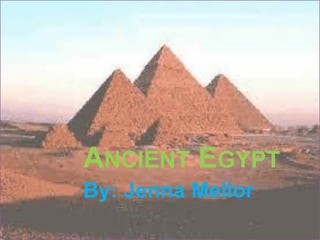
ANCIENT EGYPT
By: Jenna Mellor
MAP OF ANCIENT EGYPT
During this time frame,
ancient Egypt was divided
into Upper and Lower
Egypt. Lower Egypt was
farther north and Upper
Egypt was farther south.
However,     Upper    and
Lower Egypt split between
1000 and 1100 B.C. This
civilization lasted from
3100 B.C. to 30 B.C. This
is equivalent to the first
Dynasty to the Ptolemaic
Dynasty.
Pyramids
BACKGROUND                                  of Giza


                                                        Hieroglyphic script

   The civilization of ancient Egypt that I chose lasted from 3100
   B.C. to 30 B.C. (the first Dynasty to the Ptolemaic Dynasty). 3100
   B.C. is when the Hieroglyphic script was invented and Upper and
   Lower Egypt were unified. In 30 B.C., Cleopatra VII died. In
   between this long period of time, many important events
   happened such as the pyramids of Giza were built, various kings
   ruled Egypt, the temple of Karnak was built, and Upper and
   Lower Egypt split. There have been many events that have
   occurred in Ancient Egypt that have made history.


                                                           Temple of
           Cleopatra VII                                    Karnak
SOCIAL STRUCTURE
The Social Pyramid is a metaphorical way of showing which
individual is in a higher class than another. In this case, the
Pharaoh is the most important. Then come the viziers, who are
the Pharaoh's most trusted advisors. The high
priests and nobles are next, the officials and
scribes were the only people who knew how
to read and write, the skilled craftsmen were
below the high priests and nobles, and at the
bottom of the Social Pyramid are the slaves,
labourers, and the peasants. The position of
each of these individuals was dependent on
their class, gender, race, and occupation.
Mud bricks       The average house in ancient Egypt had four
                                                rooms; small rooms joined to a central room.
                                                The central room was often higher than the
                                                others and used for sleeping. The other three
   H   OUSING                                   rooms were usually a kitchen, a storage
                                                room or extra bedroom, and an entry room
                                                that led to the central room. However, the
In ancient Egypt, the houses were mainly wealthy people usually had ten rooms and
made out of mud bricks. Brick makers would the poor people only had one.
let the mud bake in the sun after placing them
in wooden moulds. The mud bricks would be
stacked to make houses as soon as they                                                Ancient
hardened. After the annual flood, there was a                                         Egyptian
lot of mud in ancient Egypt, especially around                                        house
the Nile River. For the wealthier people, the
houses were made out of double thick walls
and the poor people lived in houses made out
of walls that were only one brick thick.                                              Tiles in a
The floor in a poor person‟s home was dug
                                                                                      rich
beneath the ground. The floor of a wealthy Every rich person‟s home had a
person‟s home was tiled. The roof of a house garden with a swimming pool. person‟s
was made out of timber and was covered with Except for the poor, most people house
thatch and matting. Reeds and straw bound had furniture in their home. The
together is thatch and it was layered with mud richer the person, the more furniture
plaster. Because the inside of a house was they had. The wealthiest homes
dimly lit, people often used the roof as living even had painted walls; usually blue
space.                                          or yellow with coloured ceilings.
Wheat

  FOOD                                                 Salmon


  Most Egyptian food came from the Nile River. Because of the Nile River,
  Egypt had extremely fertile soil around the area which was great for growing
  crops. The river produced enough fish to supply the people with their daily
  recommended amount of fish and meat, seeing as how it is difficult for
  ancient Egypt to raise livestock. Since there is very fertile soil around the Nile
  River, people would grow wheat to make many food recipes or be fermented
  and ground into different things, vegetables including peas, beans, onions,
  garlic, leeks, lettuce, cabbages, and turnips, and fruits including figs, dates,
  and grapes which could be used to make wine for those who could afford it.
  The wealthy people could afford to eat coconuts, olives, and meat on
  occasion. The poor people could only afford to eat wheat and whatever fruits
  and vegetables they could grow in a garden.
Lettuce                                                Figs


                           Turnips                                               Grapes
Egyptian Trading


     FAMILY LIFE

                                                                              Egyptian Family
In the poor ancient Egyptian families, the mother raised the children. In the richer
families, hired servants and slaves would help take care of the children and provide
them with their basic needs. Whether rich or poor, ancient Egyptians thought of
children as a blessing and a treasure. Surprisingly, men and women were treated
equally and had the same rights for the most part; however, the women were still taught      Egyptian
and expected to obey their fathers and husbands. In fact, the wives and mothers of the
pharaohs were known to have the „real‟ ruling power. In the absence of their husbands
                                                                                             Acrobat
or sons, women could run farms and businesses. People hired women in courts and
temples to work as acrobats, singers, dancers and musicians. Women worked as
maids and nannies for the rich families and also could become priests if they were
noblewomen. Also, women sometimes worked as perfume makers and professional
mourners. Trading and crafting was the job of a young boy; they learned these skills
from their fathers or an artisan. Young girls learned their training from their mothers at
home. If a family was wealthy enough, they would send their son to school to study
religion, reading, arithmetic, and writing at about seven years old. Too bad that it was
against the law for girls to go to school. All children were intended to look after their
parents if they were elderly. If the parents died, the son would take over the land and
the girl would inherit all of the household goods. Although if there were no sons, the
land would become the daughter‟s.
MARRIAGE


Ancient Egyptian
   marriage

                   Egyptian
                   Jewellery
CHILDBIRTH PRACTICES (EXTRA)


                                  Egyptian
                                 woman with
                                   baby


Birth Stool
CHILDHOOD


            Most ancient Egyptian children had brothers and sisters. It
            was very rare for parents to let their children die if they were
            too poor to look after them because whether rich or poor,
            children were highly valued and loved. It made it easier for
            poor families because most children didn‟t need clothes until
            they left babyhood. Before the children were old enough to
            play outside, their mother looked after them. Wealthy
            parents owned servants to look after the babies, whereas
            working mothers took their babies wherever they had to go.
            If a child‟s mother was a slave, there is a chance that the
            child may become a slave as well. As a slave, people get
            beaten or sold, although if you did your job well, your owner
            may reward you with freedom. A lot of foreigners were quite
            surprised with the fact that children were loved very much
            for the most part because in other countries, people would
            take their children for granted.
Reading and writing;
                                                    Hieroglyphics
EDUCATION
When the boys were four years old, their father would start to teach them
everything they needed to know. The son would usually follow in his
fathers footsteps, so if a father traded goods, he would teach his son the
rules of trading so he could become a trader one day. Some children
attended a school in a village, whereas other children went to school that
was meant for a particular career such as a scribe or priest. The schools
mainly taught reading, writing, math, sports, morals, and manners. The
higher branch of education called “Instruction of Wisdom” taught
morality, ethics, and knowledge needed to become a doctor or scribe.
When a boy was fourteen, he would join his father in his career. Although
schools were not open for girls, they could train to be dancers, bakers,
entertainers, and weavers. Girls were usually trained by their mothers on
motherhood and learning how to be a good wife. Only the wealthiest
families could afford their daughters getting education in reading and
writing.
                                     Egyptian
                                      school
Ba (left) and ka
                                                   (right)
RELIGION
   The ancient Egyptians had around 2000 gods and goddesses; some of them were
   worshiped by everybody, and others worshiped by certain citizens and ethnic groups.
   Quite a few gods and goddesses were shown and represented as part animal and part
   human. It was believed that a person had the ba or soul of a bird with a human head and
   every ancient Egyptian had a twin called a ka. The ka would make trips to the world
   where gods and goddesses of the dead lived and the ba kept in touch with family and
   friends from the dead. The ka and ba always lived in the body of its person forever, even
   in his or her tombstone. If the ka and ba couldn‟t find its person, the Egyptian would not
   live forever and it was mummified so the ba and ka could locate it. For a person to live
   forever, he or she had to be honest. Egyptian god Anubis would weigh a person‟s heart
   with the feather of truth to decipher whether or not that person was honest. If the heart
   weighed more than the feather of truth, the person wasn‟t honest and his or her heart
   would be eaten by an animal that was part alligator, part cheetah, and part lion called the
   devourer, and if the feather weighed more than the heart, the person was honest and
   would live forever. There were many different theories on how the world started including
   the ocean started in darkness. After, dry land rose up and the sun god appeared and he
   created light and all things. There were many temples in ancient Egypt, as they were the
   dwelling places for the gods. When a pharaoh died, he became a god. All in all, religion
   was a big part in Egyptian lives.

         Weighing the
         heart with the                            Devourer
        feather of truth
CLEOPATRA VII                      She was the Queen of
                                   Egypt from 51 B.C. until
(EXTRA)                            she died in 30 B.C. The
                                   people of Egypt idolized
                                   her for her original
                                   statements with her style
                                   and ways to govern the
                                   country.


Cleopatra VII was a part of the
Ptolemaic Dynasty. She was
born in late 69 B.C. and died in
30 B.C. She ruled Egypt after
Alexander the Great. She
refused to speak Egyptian and
therefore spoke Greek.
Egyptian
                                 Tunic                    wigs


CLOTHING
                 Loincloth                  Sandals                    Jewellery

Clothing has hardly changed over the course of a hundred years. Almost
always, the ancient Egyptian clothes were made out of linen, which they
wove from fibres of the flax plant. The workers wore loincloths or tunic
dresses; although when they were on the job, they would often work
naked and the servant girls just wore a belt. Wealthy people wore
transparent white cloth that was pleated, draped, then tied to fit them. On
their heads they wore black wool wigs and makeup on their eyes and lips.
Before being clothed, each person had to be washed. This means that
water is poured over you and the rich people had tiled washing areas to
be washed on. After an Egyptian was washed, he or she would put
scented oil all over his or her body. Each women would wear rings,
necklaces, and earrings out of gold or beads, whether rich or poor.
Ancient Egyptians wore sandals out of plaited papyrus, leather, and palm
fibre, although they were only worn when they were necessary and
carried around otherwise. Loincloths and tunic dresses were made using
a spindle and a stripper and wigs were made out of human hair.
ART AND MUSIC
Art                                                           Flute (left)
                                                             and cymbals
Ancient Egyptian art consisted of painting,
sculpting, architecture, papyrus, pottery,
                                                                 (left)
hieroglyphs, and literature. Animals were
very symbolic in Egyptian art and the            Music
colours used were very expressive. When
                                                 In ancient Egypt, music was
painting humans, it was typical to have the
head facing the side, showing the person‟s       significant in every day life. Music
portrait, the torso facing front, and the legs   occurred in festivals, entertainment,
and feet facing the side. Sculptures mainly      dancing,        temples,     workshops,
represented       Egyptian       gods      and   palaces, farms, battlefields, and
goddesses. Architects used sun dried and
                                                 tombs. Egyptian god Osiris brought
kiln baked brick to build. The buildings
were then decorated from top to bottom.          music into everyday life. Throughout
Papyrus means paper. Crafting papyrus            the Predynastic period, Old Kingdom,
had to be done with precision. Pottery was       and Middle Kingdom, harps, flutes,
steatite or soapstone carved into vases,         double           clarinets,    percussion
deities, or animals. Hieroglyphs are an
                                                 instruments, lyres, lutes, and cymbals
Egyptian form of writing. Literature was
almost always written on papyrus and             were brought into civilization. In
included elements of Egyptian art.               ancient Egypt, there was folk music,
                                                 coptic music, and saidi music. All in
            Painting (left)
                                                 all, music was a large part of
            and sculpture
                                                 civilization in ancient Egypt.
               (right)
There were often festivals of the gods. They
                    were holidays that would sometimes even last
                    for several days. Throughout festivals, there is
FESTIVALS (EXTRA)   singing, dancing, lots of noise in the streets,
                    eating, and drinking. The Beautiful Festival of
                    the Valley was celebrated in the Middle
                    Kingdom period and later. This was in the 12th
                    Dynasty. This festival was celebrated every
                    year for the second month of Shomu
                    (beginning of summer; harvest season). This
                    festival represented the land of the dead and
                    the Thebes that dated in the Middle Kingdom.
Egyptian children
                           playing (left) and
                           religion- ka (left)
CONCLUSION


             Elders were
              respected
INFORMATION BIBLIOGRAPHY
Websites:
   Ancient Egypt http://www.woodlandsjunior.kent.sch.uk/homework/egypt/Hierarchy.html
   Ancient Egyptian Food http://www.ancient-egypt-online.com/ancient-egyptian-food.htm
   Ancient Egyptian Religion http://www2.sptimes.com/Egypt/EgyptCredit.4.3.html
   Art of Ancient Egypt http://en.wikipedia.org/wiki/Art_of_ancient_Egypt
   A Timeline of Ancient Egyptian History http://www.ancientegypt.co.uk/time/explore/main.html
   Cleopatra VII http://en.wikipedia.org/wiki/Cleopatra_VII
   Education in Ancient Egypt http://historylink101.net/egypt_1/a-education.htm
   Egypt: Daily Life http://www2.sptimes.com/Egypt/EgyptCredit.4.2.html
   Houses of Ancient Egypt http://www.dragonstrike.com/egypt/house.htm
   Housing in Ancient Egypt http://historylink101.net/egypt_1/a-housing.htm
   Music in Ancient Egypt
    http://www.umich.edu/~kelseydb/Exhibits/MIRE/Introduction/AncientEgypt/AncientEgypt.html
   Religion http://www.site-ology.com/egypt/RELIG.HTM
   Social Structures of Ancient Egypt http://www.all-about-egypt.com/social-structures-of-
    ancient-egypt.html
   The Middle Eastern Dowry http://www.suite101.com/article.cfm/gift_giving_customs/77199
INFORMATION BIBLIOGRAPHY #2


Books:

   Clare, John D. Pyramids of Ancient Pyramids. San Diego:
    Harcourt, 1992.

   Morley, Jaqueline. How Would You Survive as an Ancient
    Egyptian? Belgium: Franklin Watts, 1995.
PICTURE BIBLIOGRAPHY
   http://schools.tdsb.on.ca/silverthornjps/egypt/index.htm Pyramids. Slide 1.
   http://www.bible-history.com/geography/maps/map_pharaonic_egypt.html Map of ancient Egypt. Slide 1.
   http://www.ancientegypt.co.uk/time/explore/tihie.html Hieroglyphic Script. Slide 3.
   http://tigerx.com/history/people/cleopatra.htm Cleopatra VII. Slide 3.
   http://www.places-to-visit.us/category/Egypt.html Pyramids of Giza. Slide 3.
   http://www.wayfaring.info/2006/10/30/the-astonishing-temple-of-karnak-in-luxor-spiritual-center-of-the-
    ancient-egyptians/ Temple of Karnak. Slide 3.
   http://www.woodlands-junior.kent.sch.uk/homework/egypt/Hierarchy.html Social structure of ancient Egypt.
    Slide 4.
   http://historylink101.net/egypt_1/a-housing.htm Ancient Egyptian House. Slide 5.
   http://www.dragonstrike.com/egypt/house.htm Mud bricks and tile floor. Slide 5.
   http://www.khalilpakistan.com/trading.html Wheat. Slide 6.
   http://www.victorialodging.com/recreation/fishing Salmon. Slide 6.
   http://www.foodpoisonjournal.com/foodborne-illness-outbreaks/the-uglier-side-of-lettuce/ Lettuce. Slide 6.
   http://www.sheknows.com/food-and-recipes/articles/805855/turnips-and-red-kidney-beans Turnips. Slide 6.
   http://www.justfruitsandexotics.com/Figs.htm Figs. Slide 6.
   http://www.free-extras.com/images/grapes-5432.htm Grapes. Slide 6.
   http://www.fathom.com/course/21701778/session2.html Egyptian family. Slide 7.
   http://www.mediastorehouse.com/trade_ancient_egypt/print/585699.html Egyptian trading. Slide 7.
   http://www.thekeep.org/~kunoichi/kunoichi/themestream/egypt_soul.html Egyptian Acrobat. Slide 7.
   http://www.adornmentsatthefactory.net/tag/gemology/ Ancient Egyptian marriage. Slide 8.
   http://fashionweekblog.blog.com/ Ancient Egyptian Jewellery. Slide 8.
   http://www.fourmums.com/just-us-two/06-02-2011/one-yanked-out-every-minute-under-bright-hallogen-lights/ Birth
    Stool. Slide 9.
   http://www.ancient-egypt-history.com/2011/02/ancient-egyptian-womens-health-and.html Egyptian woman with baby.
    Slide 9.
PICTURE BIBLIOGRAPHY #2
   http://pc.ign.com/dor/objects/669069/immortal-cities-children-of-the-nile/images/immortal-cities-
    children-of-the-nile-20040623042954236.html Children playing. Slide 10 & 17.
   http://oldegypt.wikispaces.com/Hieroglyphics+Symbols Hieroglyphics. Slide 11.
   http://ancientegyptmoberly.pbworks.com/w/page/12830337/Ancient-Egypt-Education Ancient
    Egyptian school. Slide 11.
   http://www.andrewgough.co.uk/forum/viewtopic.php?f=7&t=3360 Bird with human head. Slide 12.
   http://www.touregypt.net/featurestories/ka.htm Egyptian ka. Slide 12 & 17.
   http://www.stencilkingdom.com/catalogue/catalogue.php?page=egypt/catalogue_body_egypt_egypt
    44.php Heart and feather of truth. Slide 12.
   http://www.egyptiandreams.co.uk/ammit.php The devourer. Slide 12.
   http://sastha-knowyourledge.blogspot.com/2011/02/all-of-historys-most-scandalous-woman.html
    Cleopatra VII. Slide 13.
   http://www.modthesims.info/download.php?t=163398 Loincloth. Slide 14.
   http://www.costumecraze.com/Couples-Costumes-p7.html Tunic. Slide 14.
   http://christianimageresource.org/catalog2.html Sandals. Slide 14.
   http://theafrostory.blogspot.com/2009/11/do-i-perpetuate-self-hatred-because-i.html Wigs. Slide 14.
   http://ancientegyptmoberly.pbworks.com/w/page/12830342/Ancient-Egyptian-Fashion-Legacy
    Egyptian jewellery. Slide 14.
   http://www.oldandsold.com/articles20/painting-methods-1.shtml Egyptian painting. Slide 15.
   http://www.pleasantmorningbuzz.com/arts/ Egyptian sculpture. Slide 15.
   http://www.ancient-egypt-online.com/egyptian-music.html Flute. Slide 15.
   http://christianimageresource.org/catalog5.html Cymbals. Slide 15.
   http://en.wikipedia.org/wiki/Beautiful_Festival_of_the_Valley Festival of the Valley. Slide 16.
   http://www.tau.ac.il/humanities/archaeology/projects/proj_past_elder.html Egyptian elders. Slide 17.

Jenna socials

  • 1.
  • 2.
    MAP OF ANCIENTEGYPT During this time frame, ancient Egypt was divided into Upper and Lower Egypt. Lower Egypt was farther north and Upper Egypt was farther south. However, Upper and Lower Egypt split between 1000 and 1100 B.C. This civilization lasted from 3100 B.C. to 30 B.C. This is equivalent to the first Dynasty to the Ptolemaic Dynasty.
  • 3.
    Pyramids BACKGROUND of Giza Hieroglyphic script The civilization of ancient Egypt that I chose lasted from 3100 B.C. to 30 B.C. (the first Dynasty to the Ptolemaic Dynasty). 3100 B.C. is when the Hieroglyphic script was invented and Upper and Lower Egypt were unified. In 30 B.C., Cleopatra VII died. In between this long period of time, many important events happened such as the pyramids of Giza were built, various kings ruled Egypt, the temple of Karnak was built, and Upper and Lower Egypt split. There have been many events that have occurred in Ancient Egypt that have made history. Temple of Cleopatra VII Karnak
  • 4.
    SOCIAL STRUCTURE The SocialPyramid is a metaphorical way of showing which individual is in a higher class than another. In this case, the Pharaoh is the most important. Then come the viziers, who are the Pharaoh's most trusted advisors. The high priests and nobles are next, the officials and scribes were the only people who knew how to read and write, the skilled craftsmen were below the high priests and nobles, and at the bottom of the Social Pyramid are the slaves, labourers, and the peasants. The position of each of these individuals was dependent on their class, gender, race, and occupation.
  • 5.
    Mud bricks The average house in ancient Egypt had four rooms; small rooms joined to a central room. The central room was often higher than the others and used for sleeping. The other three H OUSING rooms were usually a kitchen, a storage room or extra bedroom, and an entry room that led to the central room. However, the In ancient Egypt, the houses were mainly wealthy people usually had ten rooms and made out of mud bricks. Brick makers would the poor people only had one. let the mud bake in the sun after placing them in wooden moulds. The mud bricks would be stacked to make houses as soon as they Ancient hardened. After the annual flood, there was a Egyptian lot of mud in ancient Egypt, especially around house the Nile River. For the wealthier people, the houses were made out of double thick walls and the poor people lived in houses made out of walls that were only one brick thick. Tiles in a The floor in a poor person‟s home was dug rich beneath the ground. The floor of a wealthy Every rich person‟s home had a person‟s home was tiled. The roof of a house garden with a swimming pool. person‟s was made out of timber and was covered with Except for the poor, most people house thatch and matting. Reeds and straw bound had furniture in their home. The together is thatch and it was layered with mud richer the person, the more furniture plaster. Because the inside of a house was they had. The wealthiest homes dimly lit, people often used the roof as living even had painted walls; usually blue space. or yellow with coloured ceilings.
  • 6.
    Wheat FOOD Salmon Most Egyptian food came from the Nile River. Because of the Nile River, Egypt had extremely fertile soil around the area which was great for growing crops. The river produced enough fish to supply the people with their daily recommended amount of fish and meat, seeing as how it is difficult for ancient Egypt to raise livestock. Since there is very fertile soil around the Nile River, people would grow wheat to make many food recipes or be fermented and ground into different things, vegetables including peas, beans, onions, garlic, leeks, lettuce, cabbages, and turnips, and fruits including figs, dates, and grapes which could be used to make wine for those who could afford it. The wealthy people could afford to eat coconuts, olives, and meat on occasion. The poor people could only afford to eat wheat and whatever fruits and vegetables they could grow in a garden. Lettuce Figs Turnips Grapes
  • 7.
    Egyptian Trading FAMILY LIFE Egyptian Family In the poor ancient Egyptian families, the mother raised the children. In the richer families, hired servants and slaves would help take care of the children and provide them with their basic needs. Whether rich or poor, ancient Egyptians thought of children as a blessing and a treasure. Surprisingly, men and women were treated equally and had the same rights for the most part; however, the women were still taught Egyptian and expected to obey their fathers and husbands. In fact, the wives and mothers of the pharaohs were known to have the „real‟ ruling power. In the absence of their husbands Acrobat or sons, women could run farms and businesses. People hired women in courts and temples to work as acrobats, singers, dancers and musicians. Women worked as maids and nannies for the rich families and also could become priests if they were noblewomen. Also, women sometimes worked as perfume makers and professional mourners. Trading and crafting was the job of a young boy; they learned these skills from their fathers or an artisan. Young girls learned their training from their mothers at home. If a family was wealthy enough, they would send their son to school to study religion, reading, arithmetic, and writing at about seven years old. Too bad that it was against the law for girls to go to school. All children were intended to look after their parents if they were elderly. If the parents died, the son would take over the land and the girl would inherit all of the household goods. Although if there were no sons, the land would become the daughter‟s.
  • 8.
    MARRIAGE Ancient Egyptian marriage Egyptian Jewellery
  • 9.
    CHILDBIRTH PRACTICES (EXTRA) Egyptian woman with baby Birth Stool
  • 10.
    CHILDHOOD Most ancient Egyptian children had brothers and sisters. It was very rare for parents to let their children die if they were too poor to look after them because whether rich or poor, children were highly valued and loved. It made it easier for poor families because most children didn‟t need clothes until they left babyhood. Before the children were old enough to play outside, their mother looked after them. Wealthy parents owned servants to look after the babies, whereas working mothers took their babies wherever they had to go. If a child‟s mother was a slave, there is a chance that the child may become a slave as well. As a slave, people get beaten or sold, although if you did your job well, your owner may reward you with freedom. A lot of foreigners were quite surprised with the fact that children were loved very much for the most part because in other countries, people would take their children for granted.
  • 11.
    Reading and writing; Hieroglyphics EDUCATION When the boys were four years old, their father would start to teach them everything they needed to know. The son would usually follow in his fathers footsteps, so if a father traded goods, he would teach his son the rules of trading so he could become a trader one day. Some children attended a school in a village, whereas other children went to school that was meant for a particular career such as a scribe or priest. The schools mainly taught reading, writing, math, sports, morals, and manners. The higher branch of education called “Instruction of Wisdom” taught morality, ethics, and knowledge needed to become a doctor or scribe. When a boy was fourteen, he would join his father in his career. Although schools were not open for girls, they could train to be dancers, bakers, entertainers, and weavers. Girls were usually trained by their mothers on motherhood and learning how to be a good wife. Only the wealthiest families could afford their daughters getting education in reading and writing. Egyptian school
  • 12.
    Ba (left) andka (right) RELIGION The ancient Egyptians had around 2000 gods and goddesses; some of them were worshiped by everybody, and others worshiped by certain citizens and ethnic groups. Quite a few gods and goddesses were shown and represented as part animal and part human. It was believed that a person had the ba or soul of a bird with a human head and every ancient Egyptian had a twin called a ka. The ka would make trips to the world where gods and goddesses of the dead lived and the ba kept in touch with family and friends from the dead. The ka and ba always lived in the body of its person forever, even in his or her tombstone. If the ka and ba couldn‟t find its person, the Egyptian would not live forever and it was mummified so the ba and ka could locate it. For a person to live forever, he or she had to be honest. Egyptian god Anubis would weigh a person‟s heart with the feather of truth to decipher whether or not that person was honest. If the heart weighed more than the feather of truth, the person wasn‟t honest and his or her heart would be eaten by an animal that was part alligator, part cheetah, and part lion called the devourer, and if the feather weighed more than the heart, the person was honest and would live forever. There were many different theories on how the world started including the ocean started in darkness. After, dry land rose up and the sun god appeared and he created light and all things. There were many temples in ancient Egypt, as they were the dwelling places for the gods. When a pharaoh died, he became a god. All in all, religion was a big part in Egyptian lives. Weighing the heart with the Devourer feather of truth
  • 13.
    CLEOPATRA VII She was the Queen of Egypt from 51 B.C. until (EXTRA) she died in 30 B.C. The people of Egypt idolized her for her original statements with her style and ways to govern the country. Cleopatra VII was a part of the Ptolemaic Dynasty. She was born in late 69 B.C. and died in 30 B.C. She ruled Egypt after Alexander the Great. She refused to speak Egyptian and therefore spoke Greek.
  • 14.
    Egyptian Tunic wigs CLOTHING Loincloth Sandals Jewellery Clothing has hardly changed over the course of a hundred years. Almost always, the ancient Egyptian clothes were made out of linen, which they wove from fibres of the flax plant. The workers wore loincloths or tunic dresses; although when they were on the job, they would often work naked and the servant girls just wore a belt. Wealthy people wore transparent white cloth that was pleated, draped, then tied to fit them. On their heads they wore black wool wigs and makeup on their eyes and lips. Before being clothed, each person had to be washed. This means that water is poured over you and the rich people had tiled washing areas to be washed on. After an Egyptian was washed, he or she would put scented oil all over his or her body. Each women would wear rings, necklaces, and earrings out of gold or beads, whether rich or poor. Ancient Egyptians wore sandals out of plaited papyrus, leather, and palm fibre, although they were only worn when they were necessary and carried around otherwise. Loincloths and tunic dresses were made using a spindle and a stripper and wigs were made out of human hair.
  • 15.
    ART AND MUSIC Art Flute (left) and cymbals Ancient Egyptian art consisted of painting, sculpting, architecture, papyrus, pottery, (left) hieroglyphs, and literature. Animals were very symbolic in Egyptian art and the Music colours used were very expressive. When In ancient Egypt, music was painting humans, it was typical to have the head facing the side, showing the person‟s significant in every day life. Music portrait, the torso facing front, and the legs occurred in festivals, entertainment, and feet facing the side. Sculptures mainly dancing, temples, workshops, represented Egyptian gods and palaces, farms, battlefields, and goddesses. Architects used sun dried and tombs. Egyptian god Osiris brought kiln baked brick to build. The buildings were then decorated from top to bottom. music into everyday life. Throughout Papyrus means paper. Crafting papyrus the Predynastic period, Old Kingdom, had to be done with precision. Pottery was and Middle Kingdom, harps, flutes, steatite or soapstone carved into vases, double clarinets, percussion deities, or animals. Hieroglyphs are an instruments, lyres, lutes, and cymbals Egyptian form of writing. Literature was almost always written on papyrus and were brought into civilization. In included elements of Egyptian art. ancient Egypt, there was folk music, coptic music, and saidi music. All in Painting (left) all, music was a large part of and sculpture civilization in ancient Egypt. (right)
  • 16.
    There were oftenfestivals of the gods. They were holidays that would sometimes even last for several days. Throughout festivals, there is FESTIVALS (EXTRA) singing, dancing, lots of noise in the streets, eating, and drinking. The Beautiful Festival of the Valley was celebrated in the Middle Kingdom period and later. This was in the 12th Dynasty. This festival was celebrated every year for the second month of Shomu (beginning of summer; harvest season). This festival represented the land of the dead and the Thebes that dated in the Middle Kingdom.
  • 17.
    Egyptian children playing (left) and religion- ka (left) CONCLUSION Elders were respected
  • 18.
    INFORMATION BIBLIOGRAPHY Websites:  Ancient Egypt http://www.woodlandsjunior.kent.sch.uk/homework/egypt/Hierarchy.html  Ancient Egyptian Food http://www.ancient-egypt-online.com/ancient-egyptian-food.htm  Ancient Egyptian Religion http://www2.sptimes.com/Egypt/EgyptCredit.4.3.html  Art of Ancient Egypt http://en.wikipedia.org/wiki/Art_of_ancient_Egypt  A Timeline of Ancient Egyptian History http://www.ancientegypt.co.uk/time/explore/main.html  Cleopatra VII http://en.wikipedia.org/wiki/Cleopatra_VII  Education in Ancient Egypt http://historylink101.net/egypt_1/a-education.htm  Egypt: Daily Life http://www2.sptimes.com/Egypt/EgyptCredit.4.2.html  Houses of Ancient Egypt http://www.dragonstrike.com/egypt/house.htm  Housing in Ancient Egypt http://historylink101.net/egypt_1/a-housing.htm  Music in Ancient Egypt http://www.umich.edu/~kelseydb/Exhibits/MIRE/Introduction/AncientEgypt/AncientEgypt.html  Religion http://www.site-ology.com/egypt/RELIG.HTM  Social Structures of Ancient Egypt http://www.all-about-egypt.com/social-structures-of- ancient-egypt.html  The Middle Eastern Dowry http://www.suite101.com/article.cfm/gift_giving_customs/77199
  • 19.
    INFORMATION BIBLIOGRAPHY #2 Books:  Clare, John D. Pyramids of Ancient Pyramids. San Diego: Harcourt, 1992.  Morley, Jaqueline. How Would You Survive as an Ancient Egyptian? Belgium: Franklin Watts, 1995.
  • 20.
    PICTURE BIBLIOGRAPHY  http://schools.tdsb.on.ca/silverthornjps/egypt/index.htm Pyramids. Slide 1.  http://www.bible-history.com/geography/maps/map_pharaonic_egypt.html Map of ancient Egypt. Slide 1.  http://www.ancientegypt.co.uk/time/explore/tihie.html Hieroglyphic Script. Slide 3.  http://tigerx.com/history/people/cleopatra.htm Cleopatra VII. Slide 3.  http://www.places-to-visit.us/category/Egypt.html Pyramids of Giza. Slide 3.  http://www.wayfaring.info/2006/10/30/the-astonishing-temple-of-karnak-in-luxor-spiritual-center-of-the- ancient-egyptians/ Temple of Karnak. Slide 3.  http://www.woodlands-junior.kent.sch.uk/homework/egypt/Hierarchy.html Social structure of ancient Egypt. Slide 4.  http://historylink101.net/egypt_1/a-housing.htm Ancient Egyptian House. Slide 5.  http://www.dragonstrike.com/egypt/house.htm Mud bricks and tile floor. Slide 5.  http://www.khalilpakistan.com/trading.html Wheat. Slide 6.  http://www.victorialodging.com/recreation/fishing Salmon. Slide 6.  http://www.foodpoisonjournal.com/foodborne-illness-outbreaks/the-uglier-side-of-lettuce/ Lettuce. Slide 6.  http://www.sheknows.com/food-and-recipes/articles/805855/turnips-and-red-kidney-beans Turnips. Slide 6.  http://www.justfruitsandexotics.com/Figs.htm Figs. Slide 6.  http://www.free-extras.com/images/grapes-5432.htm Grapes. Slide 6.  http://www.fathom.com/course/21701778/session2.html Egyptian family. Slide 7.  http://www.mediastorehouse.com/trade_ancient_egypt/print/585699.html Egyptian trading. Slide 7.  http://www.thekeep.org/~kunoichi/kunoichi/themestream/egypt_soul.html Egyptian Acrobat. Slide 7.  http://www.adornmentsatthefactory.net/tag/gemology/ Ancient Egyptian marriage. Slide 8.  http://fashionweekblog.blog.com/ Ancient Egyptian Jewellery. Slide 8.  http://www.fourmums.com/just-us-two/06-02-2011/one-yanked-out-every-minute-under-bright-hallogen-lights/ Birth Stool. Slide 9.  http://www.ancient-egypt-history.com/2011/02/ancient-egyptian-womens-health-and.html Egyptian woman with baby. Slide 9.
  • 21.
    PICTURE BIBLIOGRAPHY #2  http://pc.ign.com/dor/objects/669069/immortal-cities-children-of-the-nile/images/immortal-cities- children-of-the-nile-20040623042954236.html Children playing. Slide 10 & 17.  http://oldegypt.wikispaces.com/Hieroglyphics+Symbols Hieroglyphics. Slide 11.  http://ancientegyptmoberly.pbworks.com/w/page/12830337/Ancient-Egypt-Education Ancient Egyptian school. Slide 11.  http://www.andrewgough.co.uk/forum/viewtopic.php?f=7&t=3360 Bird with human head. Slide 12.  http://www.touregypt.net/featurestories/ka.htm Egyptian ka. Slide 12 & 17.  http://www.stencilkingdom.com/catalogue/catalogue.php?page=egypt/catalogue_body_egypt_egypt 44.php Heart and feather of truth. Slide 12.  http://www.egyptiandreams.co.uk/ammit.php The devourer. Slide 12.  http://sastha-knowyourledge.blogspot.com/2011/02/all-of-historys-most-scandalous-woman.html Cleopatra VII. Slide 13.  http://www.modthesims.info/download.php?t=163398 Loincloth. Slide 14.  http://www.costumecraze.com/Couples-Costumes-p7.html Tunic. Slide 14.  http://christianimageresource.org/catalog2.html Sandals. Slide 14.  http://theafrostory.blogspot.com/2009/11/do-i-perpetuate-self-hatred-because-i.html Wigs. Slide 14.  http://ancientegyptmoberly.pbworks.com/w/page/12830342/Ancient-Egyptian-Fashion-Legacy Egyptian jewellery. Slide 14.  http://www.oldandsold.com/articles20/painting-methods-1.shtml Egyptian painting. Slide 15.  http://www.pleasantmorningbuzz.com/arts/ Egyptian sculpture. Slide 15.  http://www.ancient-egypt-online.com/egyptian-music.html Flute. Slide 15.  http://christianimageresource.org/catalog5.html Cymbals. Slide 15.  http://en.wikipedia.org/wiki/Beautiful_Festival_of_the_Valley Festival of the Valley. Slide 16.  http://www.tau.ac.il/humanities/archaeology/projects/proj_past_elder.html Egyptian elders. Slide 17.