Best Practice
Strategies for
Teaching Students
with Dyslexia
Benita Ranzon
DECD Senior Psychologist
BA(Soc Sci), BA(Hons)Psych,
B.Ed. (Middle/Secondary)
benita.ranzon@sa.gov.au
What is dyslexia?
(International Dyslexia Association, 2002)
 Inaccurate and/or
slow word recognition and
decoding, and poor spelling abilities.
 A deficit in the phonological component of language
despite adequate cognitive abilities and effective
classroom instruction.
 Secondary consequences - reduced reading
experience can affect growth of vocabulary and
general knowledge, and may affect comprehension
in some students.
What is it like to have dyslexia?
How does it feel? Tim’s story
How is Dyslexia diagnosed?
1. A cognitive test. Dyslexic students commonly
show deficits in working memory and/or
processing speed.
2. Tests of phonological knowledge and word
attack skills
(segmentation and
blending), and sometimes
rapid automatic naming.
3. Tests of reading and
spelling accuracy.
4. Test of reading comprehension.
Co-Occurring Conditions
Students can have more than one difficulty at once.
Disorders most commonly co-occurring with dyslexia:
 Attention Deficit Hyperactivity Disorder
 Auditory Processing Disorder
 Dysgraphia
ADHD and APD may also be confused with dyslexia due
to working memory component.
Students with dyslexia can also have high intellectual
ability in some or all cognitive areas (ie. giftedness).
The all-pervasive effects of working memory deficits
There are two main components to WM:
 Capacity (size of memory) – Digit Span
 Working memory (holding and using)
The lower the scores on WM subtests, the bigger the impact, but an
issue for most dyslexic students to some degree.
 Written expression – quantity, sentence structure, sequencing.
 Copying from the board
 Organisation and time management
 Retention and recall, eg:
 verbal instructions
 information in oral recounting
 content when reading
 phonics and spelling rules
 maths facts and processes
 Information in tests
Lack of Effort or Lack of Skills?
- Don’t assume, ask questions!
 Didn’t follow an instruction – “Can you tell me in
your own words what you need to do?”
 Wrote very little on the topic – “How did you go
thinking of ideas to write about?”, “Can you tell me
how you planned what you were going to write?”
 Had lots of errors in the finished assignment –
“Can you tell me how you went about proof-reading
your work and correcting errors?”
Myth #1: Dyslexia does not exist / all
students benefit from the same strategies
Fact: There has been over 30 years of documented,
scientific evidence and research proving the existence of
dyslexia. It is one of the most common learning
disabilities to affect children.
Students with dyslexia need a very specific kind of
remedial instruction, and often do not respond to the
programs offered in schools (Reading Recovery, Leveled
Literacy Intervention (LLI), Guided Reading, Accelerated
Literacy).
Read: ‘Overcoming Dyslexia’ by Dr Sally Shaywitz
Myth #2: It’s a boy thing.
Fact: Boys with dyslexia are more frequently
identified in schools. But dyslexia affects both
genders in nearly equal numbers. Researchers
found that girls tend to quietly muddle through,
while boys more often act out their frustrations.
Boys’ behavioral difficulties draw the teacher’s
attention to them.
Myth #3: If students don’t reverse
letters it’s not dyslexia.
Fact: Dyslexia makes it challenging to break
down words. Symptoms sometimes include
flipping letters around. But reversing letters isn’t
always a sign of dyslexia. Young kids who don’t
have dyslexia often do this too. Many students
with dyslexia do not reverse letters or read
words backwards.
Myth #4: If the parents spent more time
with their child on reading and spelling,
he/she would quickly catch up.
Fact: Children with dyslexia process literacy
information differently, and do not catch up
simply by doing the teacher-recommended
amounts of reading and spelling practice. And
many families of dyslexic children spend far
more time on homework than expected.
Myth #5: Dyslexia can’t be diagnosed
before 8 years.
Fact: Psychologists with extensive experience in
diagnosis can identify dyslexia much earlier.
 a family history of dyslexia
 difficulties in phonological awareness.
 Slower than expected reading and spelling
progress despite good teaching.
But need evidence of exposure to good teaching
methods and regular attendance.
The sooner a diagnosis is made, the quicker
the child can get help.
Myth #6 Reading more will improve a
dyslexic child’s spelling
Fact: Dyslexic students do not pick up spelling by
seeing words spelled correctly. They need to be
specifically taught the spelling of words in order to
improve their spelling.
Words need to be taught using phonics, spelling
rules, and whole word spelling of irregular words.
Lots of repetition and revision are needed to
retain them.
Myth #7: It will help a dyslexic student to
repeat a year level.
Fact: Dyslexic students are smart, and can
intellectually handle the curriculum at their year level.
Dyslexia is a lifelong disability, and many students with
the disorder never catch up with their peers in literacy
skills.
There is rarely any benefit in repeating a year, and it
can do damage to self-esteem and friendships. These
students need strategies in place to accommodate
their difficulties with reading and writing at their year
level.
Myth #8: Classroom accommodations are
a crutch, and the student will become
lazy.
Fact: Accommodations are an attempt to level
the playing field. Fair doesn't mean everyone
gets the same thing; fair means everyone gets
what he or she needs to be successful (eg. use
of a computer and spell-checker, extra time on
a test).
Myth #9: Only children with an NEP can get
learning support
Fact: Teachers can give classroom
accommodations to any student, regardless of
whether that student has an NEP or not. Most
classroom accommodations do not cost anything.
Myth #10: There is not enough money in the
school budget to pay for support.
Fact: Each school is given specific funding in
their RES for students with learning difficulties. It
is up to the school to decide how the money is
used.
The Disability Discrimination Act covers students
with dyslexia (DDA 1992, Section F), and
requires schools to provide adequate
remediation and support.
What interventions are needed?
 Students with dyslexia are like
snowflakes – so each needs an
individual plan.
 Remedial instruction.
 Accommodations.
 Develop independence.
 There is no one off-the-shelf
program that will fix dyslexia.
Teacher training is more important than investing
school resources in one big program.
 Dyslexia is a lifelong disability needing a big picture
plan by the school, as well as a year-by-year plan
with the teacher.
Family Context Impacts on Interventions Chosen
 Resources can be emotional, financial,
interpersonal, educational.
 Teachers can work collaboratively
with both groups with high motivation,
regardless of resources.
 High resources and low motivation –
families often willing to pay for private
services.
 Low resources and low motivation –
families have limited capacity to work
collaboratively with the teacher to support
their child’s learning. Intervention needs to be
done at school.
High
Resources
High
Motivation
High
Resources
Low
Motivation
Low
Resources
High
Motivation
Low
Resources
Low
Motivation
Interventions in Junior Primary
Explicit Instruction
 ‘Practice makes permanent’
 Phonological awareness –
Ability to hear rhyme, segment sounds
in words (cat = c-a-t), and play with
sounds in words (say ‘nest’ without ‘s’).
 Systematic phonics based (Jolly Phonics, Word Shark).
 Lots of handwriting practice. Use grotto grip. Apps that
teach formation.
 Mastery-based approach – success on multiple
occasions, slow increase in difficulty level.
 Phonics readers: Dandelion, SPELD free readers.
JP Phonological Awareness
Activities
 Say words and get students to identify
specific sounds (beginning, middle, end).
 Practice hearing and writing the sounds
in words using both real and nonsense words
(eg. –ot and –ag words (hot, pot, tot, lot / bag, sag, lag,
tag).
Teach the student how to write the focus sounds first,
then read out a jumbled list of these words and ask the
student to write them down.
 Practice sound segmentation with 3 then 4 letter
words (see example over).
Example sound segmentation activity
Stretch out the words then write the letters in
the boxes.
Explicit Instruction in Sound Blending
Just because students can say the individual letter
sounds in a word, does not mean they will be able to
blend them to decode the word.
 Teach students how to slide the sounds together.
 Repeat sounds several times at increasing speed.
This is essential in order to keep sounds in memory.
 ‘Slippery dip’ analogy.
 www.readingrockets.org/strategies/blending_games
Phonics Readers
 Children with dyslexia struggle to
spot the patterns in words. They
may decode a word on one line,
and then not recognise it on the
next line.
 Readers that structure the
introduction of sounds help teach
that pattern recognition.
 All struggling readers should be
swapped to phonics readers as
soon as difficulties are spotted.
 This can be done at no cost.
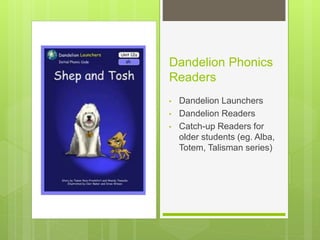
Dandelion Phonics
Readers
• Dandelion Launchers
• Dandelion Readers
• Catch-up Readers for
older students (eg. Alba,
Totem, Talisman series)
Fitzroy Phonics Readers
Each story features:
 a specific sound (e.g. oy)
 a few sight words (e.g. said)
 a revision word list
 an extension word list.
Many schools have at least
one set of Fitzroy readers,
often kept with the special
education resources.
SPELD SA Free Phonics
Readers
 Use the Jolly Phonics
teaching order
 Can be used on iPad
 Are free!
 Currently 187 phonic
books and 128 sets of
worksheets to
complement the books.
How to use Phonics Readers
 First teach the focus sound
explicitly (eg. using Jolly
Phonics).
 Select the phonics reader
that covers that sound.
 Get the student to first
separately practice
recognition of the sight
words in the reader.
 Get the student to read the
reader several times over a
week until she/he can read
it fluently.
 Link the reader to spelling
activities, such as tracing
or writing the words in the
reader, and building words
using plastic letters.
More Useful Phonics Activities
 Practice with sound flash cards.
 Build words using letter cards
(starting with cvc, then blends). Start
with only the letters the student needs,
then add in
letters very different in look
and sound, then letters that are
similar in sound (d/t, s/f).
 Computer programs – Word Shark,
Reading Eggs.
 Group programs for JP – Jolly
Phonics, Jolly Grammar
Sound and Rule Flash Cards
 Make cards as sounds are taught. Link to a trigger word (eg. ship
‘sh’).
 Make cards for phonics rules (eg. bossy ‘e’). Put a prompt on the
front and the full rule on the back.
 Where possible, cards should travel between home and school.
But either way, they should be practiced daily.
 Keep cards in until the student is automatic in recalling them,
and can apply them to reading and spelling.
 Practice them in the morning with a small group. Boys are often
keen to compete as to who is fastest, and can be asked to pair
up and time each other with the aim of beating their last
personal best. (Remove timing if anxious).
 Prompt students to recall sounds or rules from their cards when
struggling to read or spell words.
Examples of Flash Cards (from Hickey Multisensory Program)
Sound Cards
(front and back)
Rule Cards (front
and back)
Spelling program structure for
young dyslexic students
 Around 8 – 10 words grouped by
phonic family and 2 – 4 irregular words.
 Don’t move past cvc words until the student is able to
record the sounds just from listening.
 Then, teach words with a single blend. Start with
beginning blends, then end blends. If teaching two at a
time, they should look and sound very different (br-, sc- /
-nk, -st).
 After blends, teach digraphs.
 The sounds in their spelling program should match the
sounds in their reading program.
Spelling program (cont.)
 LSCWC practice (5 times for each word, 4 days a
week). Eg. 2x school, 3x home each day.
 Practice in writing the target sound as well as
words with the sound in it. Eg. “write all the ways
you’ve learned to spell ē” (e, ee, ea).
 Avoid traditional ‘spelling contracts’. Activities
should focus purely on learning the phonics and
spelling. Limit the number of activities, as spelling
homework takes dyslexic students much longer.
 Spelling City is great for practice
www.spellingcity.com
What if you are using phonics and they are
still not getting it?
The most likely explanations:
 Too many skills at once
(ee, e-e, ea).
 Not long enough on each skill.
 Not incorporating ongoing
revision.
 Not directly practicing the phonics skills in
reading and writing to generalise them as
they are learned.
 Expecting too much too soon. Progress
takes time, lots of time. And lots of effort.
Interventions in Junior Primary
 Break up instructions.
 Provide visual cues (eg. ‘bed’ visual
for b and d).
 Modified spelling and reading
program (build from current skills).
 Word banks for writing.
 No copying from the board.
 Extra time for tasks.
 Provide alternative formats, eg. dictate to a scribe, voice
record, create a comic strip, type on computer, assistive
apps (Clicker Sentences, Clicker Docs).
Accommodations
Custom Soundboard and Voice
Memo Recorder
by Tomato Interactive LLC
Create numbered voice
recordings.
 Can be used by the teacher for
task instructions, test questions,
etc.
 Can be used by students for
recording spelling words and
testing themselves.
Alternative formats
Book Creator
(can add voice clips)
Comic strips
(Google ‘blank
comic strips’)
 Some remedial
instruction may still
needed.
 More focus on
accommodations.
 Access to assistive
technology.
 Explicitly teach skills for
independence in high
school, eg:
 planning
 written expression
(structure, sequence,
sentence structure)
 editing/proof-reading
 organisation and time
management
Supports for
Middle Primary to
Secondary
The main goal is to allow
students’ knowledge and
skills to show through
effectively in their work
despite their dyslexia.
Reading Supports
 Text-to-Speech (eg. iPad, Word Q, Natural
Reader)
 Easier books on topics (eg. JP non-fiction).
 Rip Rap novels (NZ) from SPELD SA
 Barrington Stoke novels – high interest / low
reading level (ages are based on UK norms, so
add a year).
 Audio books
eg. www.loyalbooks.com
Writing Supports
 Provide planning templates, eg. Persuasion Map,
Venn Diagram, Compare-Contrast table, Timeline
(www.readwritethink.org).
 Teach how to create free-form concept maps to
group ideas and develop detail.
Eye have a spelling chequer, It came with my Pea
Sea. It plane lee marks four my revue Miss Steaks I
can knot sea.
Eye strike the quays and type a whirred And weight
four it two say Weather eye am write oar wrong It
tells me straight a weigh.
Eye ran this poem threw it, Your shore real glad two
no. Its vary polished in its weigh. My chequer tolled
me sew.
Poem: “I have a spelling checker”
Writing Supports (cont.)
 Typing using word prediction software
(Word Q6 UK, Clicker 7). Create topic word banks.
 Dictation software: speakQ, Dragon Naturally Speaking
 Voice recording: voice clips in PowerPoint, oral essay
using Audacity free software.
 Structured proof-reading approach
(use a checklist!).
 Proof-read with text-to-speech (eg. Word Q).
 Feedback on drafts (dot points to
aid memory).
 Mark content not spelling.
 No copying from the board – student takes
photo, teacher provides notes.
iPad Supports
 Turn on ‘speak selection’ in the Accessibility
settings, You can slow the speech rate.
 Turn off ‘auto correction’ in keyboard settings.
 Concept mapping – iThoughtsHD app
 Word prediction apps
(iWordQ UK,
WriteOnline)
Time Management/Organisation Skills
 Visual cues (checklist,
timer).
 Break larger tasks down, set
mini deadlines.
 Teach student to plan time
in diary for each step.
 Reduce distractions (seating
location/direction, ear plugs
etc).
 Homework/assignment info
accessible from home.
 Compendium folder.
 Colour-code subject materials.
 Teach and reward the effective
use of a diary (paper or
electronic).
Maths
Some students with dyslexia have problems with
the memorisation and mental calculation aspects
of maths (the lower the Working Memory score,
the more likely).
They need:
 Connections to real life
 Experiential activities (hands-on)
 Extra time to practice (don’t move on too
quickly)
 Homework practice is essential!
 Regularly re-visit concepts (eg. one night a
week for revision).
Maths (cont.)
 Create cue cards for
process steps.
 Explicitly teach how to
convert word problems
into sums and work them out using the
HTU method.
 Encourage the use of working out
paper - students with a memory
weakness are inaccurate with mental
calculations.
Final thoughts…
 Students with dyslexia are bright and capable in a wide
range of areas.
 Students with dyslexia need teachers to make adjustments
and provide support in order to achieve their potential.
 Students with dyslexia have difficulties with memory, which
can make them forgetful and disorganised. There is no cure
for a weak memory. They need to be taught good habits
and strategies to manage this.
 It is important to show dyslexic students that you see their
strengths and that you are there to support them in the
areas they struggle. They need to trust their teachers in
order to show what they are capable of.
Degrees of Severity (Junior Primary)
Mild Dyslexia Moderate Dyslexia Severe Dyslexia
• Slow to learn
individual letter
sounds and
formation, and very
slow to learn
phonograms.
• Often resistant to
practicing reading.
• Relies on sounding
out, and lots of
guessing.
• Confidence affected.
• Still struggling to
recognise basic
sight words (is,
and, go).
• Spelling still not
capturing all
sounds (van/vnt).
• Very poor retention
of irregular words.
• Lots of negative
self-talk – “I’m
dumb”.
• Cannot retain
letter-sound
relationships,
cannot write all of
alphabet.
• As a result, not yet
able to read or
write
independently.
• Significant issues
with learning
confidence and
self-esteem
Degrees of Severity (Middle/Upper Primary)
Mild Moderate Severe
• Cannot read same
books as friends,
chooses easier books
and still lacks fluency,
but gets by in class
(eg. worksheets).
• Written work tends to
be brief. Lots of
spelling errors with
basic words. Prefers
to type work rather
than handwrite.
• Reading 2 or more
years below age.
• Can’t read curriculum
materials accurately
(worksheets, etc).
• Spelling highly
phonetic.
• Not able to copy info or
homework instructions
reliably.
• Not independent in
completing written
work.
• Can read very
simple text only.
• Reliant on sounding
out each word;
reading lacks
fluency. Poor
comprehension.
• Very poor whole
word recognition.
• Very poor spelling,
bigger words not
spelled phonetically.
Writing not legible.
What to expect in class…
Junior Primary Middle Primary Upper Primary
Slow to learn letter-
sound relationships
and letter formation
Slow and inaccurate reader Slow and inaccurate reader
Good oral vocabulary If not a keen reader,
vocabulary may start to
weaken
May have a weak vocabulary
affecting comprehension and
written expression
Difficulty writing
independently
Writing lacks detail and
complexity
Difficulty structuring written
work, low on detail, simple
sentences and vocabulary.
Difficulty capturing and
sequencing sounds in
spelling
Difficulty with remembering
spelling patterns and
irregular words, and with
grammar and punctuation.
Many errors in written work,
including spelling, grammar,
and punctuation.
What to expect(cont.)…
Junior Primary Middle Primary Upper Primary
Difficulty counting
without visuals (fingers,
counters)
Difficulty retaining
number facts
Poor number fact and times
table recall
Often good at hands-on
maths and real world
problem-solving. Works
well in a group.
Slow to grasp new
learning, and forgetful of
learned processes and
concepts.
Gaps in math knowledge
affect the ability to build on
new knowledge and skills.
Often appears confused.
Difficulty retaining verbal
instructions – only does
part of what was asked,
does something different
to what was asked,
looks vague and off task.
Difficulty retaining
instructions – asks for
tasks and instructions to
be re-explained and
repeated. Checks what
others are doing and
tries to imitate.
Difficulty retaining verbally
presented information – only
catches part of what is said,
completely forgets what was
said by the next day, needs
extra explanation of tasks.

Special Ed Expo - dyslexia presentation

  • 1.
    Best Practice Strategies for TeachingStudents with Dyslexia Benita Ranzon DECD Senior Psychologist BA(Soc Sci), BA(Hons)Psych, B.Ed. (Middle/Secondary) benita.ranzon@sa.gov.au
  • 2.
    What is dyslexia? (InternationalDyslexia Association, 2002)  Inaccurate and/or slow word recognition and decoding, and poor spelling abilities.  A deficit in the phonological component of language despite adequate cognitive abilities and effective classroom instruction.  Secondary consequences - reduced reading experience can affect growth of vocabulary and general knowledge, and may affect comprehension in some students.
  • 3.
    What is itlike to have dyslexia? How does it feel? Tim’s story
  • 4.
    How is Dyslexiadiagnosed? 1. A cognitive test. Dyslexic students commonly show deficits in working memory and/or processing speed. 2. Tests of phonological knowledge and word attack skills (segmentation and blending), and sometimes rapid automatic naming. 3. Tests of reading and spelling accuracy. 4. Test of reading comprehension.
  • 5.
    Co-Occurring Conditions Students canhave more than one difficulty at once. Disorders most commonly co-occurring with dyslexia:  Attention Deficit Hyperactivity Disorder  Auditory Processing Disorder  Dysgraphia ADHD and APD may also be confused with dyslexia due to working memory component. Students with dyslexia can also have high intellectual ability in some or all cognitive areas (ie. giftedness).
  • 6.
    The all-pervasive effectsof working memory deficits There are two main components to WM:  Capacity (size of memory) – Digit Span  Working memory (holding and using) The lower the scores on WM subtests, the bigger the impact, but an issue for most dyslexic students to some degree.  Written expression – quantity, sentence structure, sequencing.  Copying from the board  Organisation and time management  Retention and recall, eg:  verbal instructions  information in oral recounting  content when reading  phonics and spelling rules  maths facts and processes  Information in tests
  • 7.
    Lack of Effortor Lack of Skills? - Don’t assume, ask questions!  Didn’t follow an instruction – “Can you tell me in your own words what you need to do?”  Wrote very little on the topic – “How did you go thinking of ideas to write about?”, “Can you tell me how you planned what you were going to write?”  Had lots of errors in the finished assignment – “Can you tell me how you went about proof-reading your work and correcting errors?”
  • 8.
    Myth #1: Dyslexiadoes not exist / all students benefit from the same strategies Fact: There has been over 30 years of documented, scientific evidence and research proving the existence of dyslexia. It is one of the most common learning disabilities to affect children. Students with dyslexia need a very specific kind of remedial instruction, and often do not respond to the programs offered in schools (Reading Recovery, Leveled Literacy Intervention (LLI), Guided Reading, Accelerated Literacy). Read: ‘Overcoming Dyslexia’ by Dr Sally Shaywitz
  • 9.
    Myth #2: It’sa boy thing. Fact: Boys with dyslexia are more frequently identified in schools. But dyslexia affects both genders in nearly equal numbers. Researchers found that girls tend to quietly muddle through, while boys more often act out their frustrations. Boys’ behavioral difficulties draw the teacher’s attention to them.
  • 10.
    Myth #3: Ifstudents don’t reverse letters it’s not dyslexia. Fact: Dyslexia makes it challenging to break down words. Symptoms sometimes include flipping letters around. But reversing letters isn’t always a sign of dyslexia. Young kids who don’t have dyslexia often do this too. Many students with dyslexia do not reverse letters or read words backwards.
  • 11.
    Myth #4: Ifthe parents spent more time with their child on reading and spelling, he/she would quickly catch up. Fact: Children with dyslexia process literacy information differently, and do not catch up simply by doing the teacher-recommended amounts of reading and spelling practice. And many families of dyslexic children spend far more time on homework than expected.
  • 12.
    Myth #5: Dyslexiacan’t be diagnosed before 8 years. Fact: Psychologists with extensive experience in diagnosis can identify dyslexia much earlier.  a family history of dyslexia  difficulties in phonological awareness.  Slower than expected reading and spelling progress despite good teaching. But need evidence of exposure to good teaching methods and regular attendance. The sooner a diagnosis is made, the quicker the child can get help.
  • 13.
    Myth #6 Readingmore will improve a dyslexic child’s spelling Fact: Dyslexic students do not pick up spelling by seeing words spelled correctly. They need to be specifically taught the spelling of words in order to improve their spelling. Words need to be taught using phonics, spelling rules, and whole word spelling of irregular words. Lots of repetition and revision are needed to retain them.
  • 14.
    Myth #7: Itwill help a dyslexic student to repeat a year level. Fact: Dyslexic students are smart, and can intellectually handle the curriculum at their year level. Dyslexia is a lifelong disability, and many students with the disorder never catch up with their peers in literacy skills. There is rarely any benefit in repeating a year, and it can do damage to self-esteem and friendships. These students need strategies in place to accommodate their difficulties with reading and writing at their year level.
  • 15.
    Myth #8: Classroomaccommodations are a crutch, and the student will become lazy. Fact: Accommodations are an attempt to level the playing field. Fair doesn't mean everyone gets the same thing; fair means everyone gets what he or she needs to be successful (eg. use of a computer and spell-checker, extra time on a test).
  • 16.
    Myth #9: Onlychildren with an NEP can get learning support Fact: Teachers can give classroom accommodations to any student, regardless of whether that student has an NEP or not. Most classroom accommodations do not cost anything.
  • 17.
    Myth #10: Thereis not enough money in the school budget to pay for support. Fact: Each school is given specific funding in their RES for students with learning difficulties. It is up to the school to decide how the money is used. The Disability Discrimination Act covers students with dyslexia (DDA 1992, Section F), and requires schools to provide adequate remediation and support.
  • 18.
    What interventions areneeded?  Students with dyslexia are like snowflakes – so each needs an individual plan.  Remedial instruction.  Accommodations.  Develop independence.  There is no one off-the-shelf program that will fix dyslexia. Teacher training is more important than investing school resources in one big program.  Dyslexia is a lifelong disability needing a big picture plan by the school, as well as a year-by-year plan with the teacher.
  • 19.
    Family Context Impactson Interventions Chosen  Resources can be emotional, financial, interpersonal, educational.  Teachers can work collaboratively with both groups with high motivation, regardless of resources.  High resources and low motivation – families often willing to pay for private services.  Low resources and low motivation – families have limited capacity to work collaboratively with the teacher to support their child’s learning. Intervention needs to be done at school. High Resources High Motivation High Resources Low Motivation Low Resources High Motivation Low Resources Low Motivation
  • 20.
    Interventions in JuniorPrimary Explicit Instruction  ‘Practice makes permanent’  Phonological awareness – Ability to hear rhyme, segment sounds in words (cat = c-a-t), and play with sounds in words (say ‘nest’ without ‘s’).  Systematic phonics based (Jolly Phonics, Word Shark).  Lots of handwriting practice. Use grotto grip. Apps that teach formation.  Mastery-based approach – success on multiple occasions, slow increase in difficulty level.  Phonics readers: Dandelion, SPELD free readers.
  • 21.
    JP Phonological Awareness Activities Say words and get students to identify specific sounds (beginning, middle, end).  Practice hearing and writing the sounds in words using both real and nonsense words (eg. –ot and –ag words (hot, pot, tot, lot / bag, sag, lag, tag). Teach the student how to write the focus sounds first, then read out a jumbled list of these words and ask the student to write them down.  Practice sound segmentation with 3 then 4 letter words (see example over).
  • 22.
    Example sound segmentationactivity Stretch out the words then write the letters in the boxes.
  • 23.
    Explicit Instruction inSound Blending Just because students can say the individual letter sounds in a word, does not mean they will be able to blend them to decode the word.  Teach students how to slide the sounds together.  Repeat sounds several times at increasing speed. This is essential in order to keep sounds in memory.  ‘Slippery dip’ analogy.  www.readingrockets.org/strategies/blending_games
  • 24.
    Phonics Readers  Childrenwith dyslexia struggle to spot the patterns in words. They may decode a word on one line, and then not recognise it on the next line.  Readers that structure the introduction of sounds help teach that pattern recognition.  All struggling readers should be swapped to phonics readers as soon as difficulties are spotted.  This can be done at no cost.
  • 25.
    Dandelion Phonics Readers • DandelionLaunchers • Dandelion Readers • Catch-up Readers for older students (eg. Alba, Totem, Talisman series)
  • 26.
    Fitzroy Phonics Readers Eachstory features:  a specific sound (e.g. oy)  a few sight words (e.g. said)  a revision word list  an extension word list. Many schools have at least one set of Fitzroy readers, often kept with the special education resources.
  • 27.
    SPELD SA FreePhonics Readers  Use the Jolly Phonics teaching order  Can be used on iPad  Are free!  Currently 187 phonic books and 128 sets of worksheets to complement the books.
  • 28.
    How to usePhonics Readers  First teach the focus sound explicitly (eg. using Jolly Phonics).  Select the phonics reader that covers that sound.  Get the student to first separately practice recognition of the sight words in the reader.  Get the student to read the reader several times over a week until she/he can read it fluently.  Link the reader to spelling activities, such as tracing or writing the words in the reader, and building words using plastic letters.
  • 29.
    More Useful PhonicsActivities  Practice with sound flash cards.  Build words using letter cards (starting with cvc, then blends). Start with only the letters the student needs, then add in letters very different in look and sound, then letters that are similar in sound (d/t, s/f).  Computer programs – Word Shark, Reading Eggs.  Group programs for JP – Jolly Phonics, Jolly Grammar
  • 30.
    Sound and RuleFlash Cards  Make cards as sounds are taught. Link to a trigger word (eg. ship ‘sh’).  Make cards for phonics rules (eg. bossy ‘e’). Put a prompt on the front and the full rule on the back.  Where possible, cards should travel between home and school. But either way, they should be practiced daily.  Keep cards in until the student is automatic in recalling them, and can apply them to reading and spelling.  Practice them in the morning with a small group. Boys are often keen to compete as to who is fastest, and can be asked to pair up and time each other with the aim of beating their last personal best. (Remove timing if anxious).  Prompt students to recall sounds or rules from their cards when struggling to read or spell words.
  • 31.
    Examples of FlashCards (from Hickey Multisensory Program) Sound Cards (front and back) Rule Cards (front and back)
  • 32.
    Spelling program structurefor young dyslexic students  Around 8 – 10 words grouped by phonic family and 2 – 4 irregular words.  Don’t move past cvc words until the student is able to record the sounds just from listening.  Then, teach words with a single blend. Start with beginning blends, then end blends. If teaching two at a time, they should look and sound very different (br-, sc- / -nk, -st).  After blends, teach digraphs.  The sounds in their spelling program should match the sounds in their reading program.
  • 33.
    Spelling program (cont.) LSCWC practice (5 times for each word, 4 days a week). Eg. 2x school, 3x home each day.  Practice in writing the target sound as well as words with the sound in it. Eg. “write all the ways you’ve learned to spell ē” (e, ee, ea).  Avoid traditional ‘spelling contracts’. Activities should focus purely on learning the phonics and spelling. Limit the number of activities, as spelling homework takes dyslexic students much longer.  Spelling City is great for practice www.spellingcity.com
  • 34.
    What if youare using phonics and they are still not getting it? The most likely explanations:  Too many skills at once (ee, e-e, ea).  Not long enough on each skill.  Not incorporating ongoing revision.  Not directly practicing the phonics skills in reading and writing to generalise them as they are learned.  Expecting too much too soon. Progress takes time, lots of time. And lots of effort.
  • 35.
    Interventions in JuniorPrimary  Break up instructions.  Provide visual cues (eg. ‘bed’ visual for b and d).  Modified spelling and reading program (build from current skills).  Word banks for writing.  No copying from the board.  Extra time for tasks.  Provide alternative formats, eg. dictate to a scribe, voice record, create a comic strip, type on computer, assistive apps (Clicker Sentences, Clicker Docs). Accommodations
  • 36.
    Custom Soundboard andVoice Memo Recorder by Tomato Interactive LLC Create numbered voice recordings.  Can be used by the teacher for task instructions, test questions, etc.  Can be used by students for recording spelling words and testing themselves.
  • 37.
    Alternative formats Book Creator (canadd voice clips) Comic strips (Google ‘blank comic strips’)
  • 38.
     Some remedial instructionmay still needed.  More focus on accommodations.  Access to assistive technology.  Explicitly teach skills for independence in high school, eg:  planning  written expression (structure, sequence, sentence structure)  editing/proof-reading  organisation and time management Supports for Middle Primary to Secondary The main goal is to allow students’ knowledge and skills to show through effectively in their work despite their dyslexia.
  • 39.
    Reading Supports  Text-to-Speech(eg. iPad, Word Q, Natural Reader)  Easier books on topics (eg. JP non-fiction).  Rip Rap novels (NZ) from SPELD SA  Barrington Stoke novels – high interest / low reading level (ages are based on UK norms, so add a year).  Audio books eg. www.loyalbooks.com
  • 40.
    Writing Supports  Provideplanning templates, eg. Persuasion Map, Venn Diagram, Compare-Contrast table, Timeline (www.readwritethink.org).  Teach how to create free-form concept maps to group ideas and develop detail.
  • 41.
    Eye have aspelling chequer, It came with my Pea Sea. It plane lee marks four my revue Miss Steaks I can knot sea. Eye strike the quays and type a whirred And weight four it two say Weather eye am write oar wrong It tells me straight a weigh. Eye ran this poem threw it, Your shore real glad two no. Its vary polished in its weigh. My chequer tolled me sew. Poem: “I have a spelling checker”
  • 42.
    Writing Supports (cont.) Typing using word prediction software (Word Q6 UK, Clicker 7). Create topic word banks.  Dictation software: speakQ, Dragon Naturally Speaking  Voice recording: voice clips in PowerPoint, oral essay using Audacity free software.  Structured proof-reading approach (use a checklist!).  Proof-read with text-to-speech (eg. Word Q).  Feedback on drafts (dot points to aid memory).  Mark content not spelling.  No copying from the board – student takes photo, teacher provides notes.
  • 43.
    iPad Supports  Turnon ‘speak selection’ in the Accessibility settings, You can slow the speech rate.  Turn off ‘auto correction’ in keyboard settings.  Concept mapping – iThoughtsHD app  Word prediction apps (iWordQ UK, WriteOnline)
  • 44.
    Time Management/Organisation Skills Visual cues (checklist, timer).  Break larger tasks down, set mini deadlines.  Teach student to plan time in diary for each step.  Reduce distractions (seating location/direction, ear plugs etc).  Homework/assignment info accessible from home.  Compendium folder.  Colour-code subject materials.  Teach and reward the effective use of a diary (paper or electronic).
  • 45.
    Maths Some students withdyslexia have problems with the memorisation and mental calculation aspects of maths (the lower the Working Memory score, the more likely). They need:  Connections to real life  Experiential activities (hands-on)  Extra time to practice (don’t move on too quickly)  Homework practice is essential!  Regularly re-visit concepts (eg. one night a week for revision).
  • 46.
    Maths (cont.)  Createcue cards for process steps.  Explicitly teach how to convert word problems into sums and work them out using the HTU method.  Encourage the use of working out paper - students with a memory weakness are inaccurate with mental calculations.
  • 47.
    Final thoughts…  Studentswith dyslexia are bright and capable in a wide range of areas.  Students with dyslexia need teachers to make adjustments and provide support in order to achieve their potential.  Students with dyslexia have difficulties with memory, which can make them forgetful and disorganised. There is no cure for a weak memory. They need to be taught good habits and strategies to manage this.  It is important to show dyslexic students that you see their strengths and that you are there to support them in the areas they struggle. They need to trust their teachers in order to show what they are capable of.
  • 48.
    Degrees of Severity(Junior Primary) Mild Dyslexia Moderate Dyslexia Severe Dyslexia • Slow to learn individual letter sounds and formation, and very slow to learn phonograms. • Often resistant to practicing reading. • Relies on sounding out, and lots of guessing. • Confidence affected. • Still struggling to recognise basic sight words (is, and, go). • Spelling still not capturing all sounds (van/vnt). • Very poor retention of irregular words. • Lots of negative self-talk – “I’m dumb”. • Cannot retain letter-sound relationships, cannot write all of alphabet. • As a result, not yet able to read or write independently. • Significant issues with learning confidence and self-esteem
  • 49.
    Degrees of Severity(Middle/Upper Primary) Mild Moderate Severe • Cannot read same books as friends, chooses easier books and still lacks fluency, but gets by in class (eg. worksheets). • Written work tends to be brief. Lots of spelling errors with basic words. Prefers to type work rather than handwrite. • Reading 2 or more years below age. • Can’t read curriculum materials accurately (worksheets, etc). • Spelling highly phonetic. • Not able to copy info or homework instructions reliably. • Not independent in completing written work. • Can read very simple text only. • Reliant on sounding out each word; reading lacks fluency. Poor comprehension. • Very poor whole word recognition. • Very poor spelling, bigger words not spelled phonetically. Writing not legible.
  • 50.
    What to expectin class… Junior Primary Middle Primary Upper Primary Slow to learn letter- sound relationships and letter formation Slow and inaccurate reader Slow and inaccurate reader Good oral vocabulary If not a keen reader, vocabulary may start to weaken May have a weak vocabulary affecting comprehension and written expression Difficulty writing independently Writing lacks detail and complexity Difficulty structuring written work, low on detail, simple sentences and vocabulary. Difficulty capturing and sequencing sounds in spelling Difficulty with remembering spelling patterns and irregular words, and with grammar and punctuation. Many errors in written work, including spelling, grammar, and punctuation.
  • 51.
    What to expect(cont.)… JuniorPrimary Middle Primary Upper Primary Difficulty counting without visuals (fingers, counters) Difficulty retaining number facts Poor number fact and times table recall Often good at hands-on maths and real world problem-solving. Works well in a group. Slow to grasp new learning, and forgetful of learned processes and concepts. Gaps in math knowledge affect the ability to build on new knowledge and skills. Often appears confused. Difficulty retaining verbal instructions – only does part of what was asked, does something different to what was asked, looks vague and off task. Difficulty retaining instructions – asks for tasks and instructions to be re-explained and repeated. Checks what others are doing and tries to imitate. Difficulty retaining verbally presented information – only catches part of what is said, completely forgets what was said by the next day, needs extra explanation of tasks.

Editor's Notes

  • #4 How does it feel 3:30 Tim’s story 2:40