Stern Center for Language and Learning
Dysgraphia
Williston, Vermont
183 Talcott Road | Suite 101
Williston, VT | 05495
Toll free | 800-544-4863
Phone | 802-878-2332
Fax |802-878-0230
West Lebanon, New Hampshire
1 Oak Ridge Rd., Unit 9B
West Lebanon, NH | 03784
Phone | 603-276-3165
Fax | 603-653-5606
BECAUSE ALL GREAT MINDS DON’T THINK ALIKE
Melissa Farrall, Ph.D.
mfarrall@sterncenter.org
Stern Center for Language and Learning
www.sterncenter.org
• It is not language that separates us from the animal
kingdom, it is print.
• Written expression is the most cognitively
demanding task that humans perform. It stresses
our language system, our spatial system, working
memory, and our fine-motor skills.
Writing & the Human Brain
Stern Center for Language and Learning
www.sterncenter.org
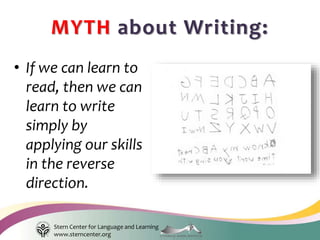
• If we can learn to
read, then we can
learn to write
simply by
applying our skills
in the reverse
direction.
MYTH about Writing:
Stern Center for Language and Learning
www.sterncenter.org
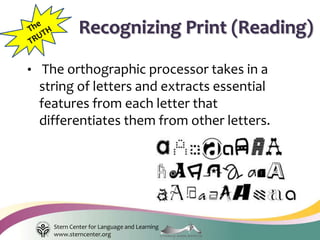
• The orthographic processor takes in a
string of letters and extracts essential
features from each letter that
differentiates them from other letters.
Recognizing Print (Reading)
Stern Center for Language and Learning
www.sterncenter.org
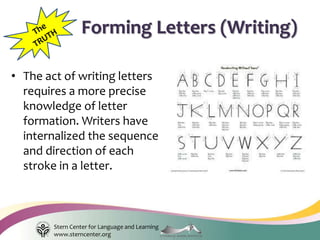
• The act of writing letters
requires a more precise
knowledge of letter
formation. Writers have
internalized the sequence
and direction of each
stroke in a letter.
Forming Letters (Writing)
Stern Center for Language and Learning
www.sterncenter.org
• Writing forces us to make connections,
organize our thoughts, and think them
through with sequence and logic.
• When we write about science, history, and
language arts, we learn. We think deeply
about our subject.
• Literacy is not just about reading; it is about
writing.
What do good writers do?
Stern Center for Language and Learning
www.sterncenter.org
• Chall (1983) said that we move from
“learning to read to reading to learn.”
The same is true of written expression.
• Writing is a tool for learning.
Why Do We Teach Writing?
Stern Center for Language and Learning
www.sterncenter.org
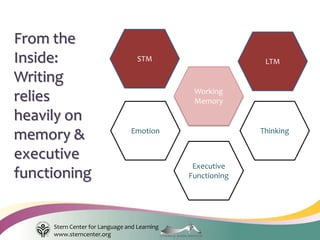
Working
Memory
Emotion Thinking
STM LTM
Executive
Functioning
From the
Inside:
Writing
relies
heavily on
memory &
executive
functioning
Stern Center for Language and Learning
www.sterncenter.org
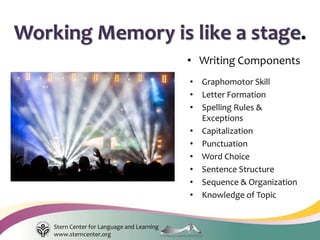
• Writing Components
• Graphomotor Skill
• Letter Formation
• Spelling Rules &
Exceptions
• Capitalization
• Punctuation
• Word Choice
• Sentence Structure
• Sequence & Organization
• Knowledge of Topic
Working Memory is like a stage.
Stern Center for Language and Learning
www.sterncenter.org
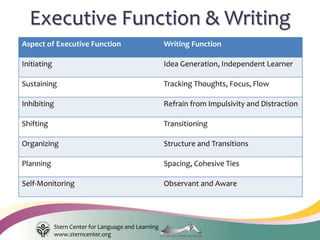
Aspect of Executive Function Writing Function
Initiating Idea Generation, Independent Learner
Sustaining Tracking Thoughts, Focus, Flow
Inhibiting Refrain from Impulsivity and Distraction
Shifting Transitioning
Organizing Structure and Transitions
Planning Spacing, Cohesive Ties
Self-Monitoring Observant and Aware
Executive Function & Writing
Stern Center for Language and Learning
www.sterncenter.org
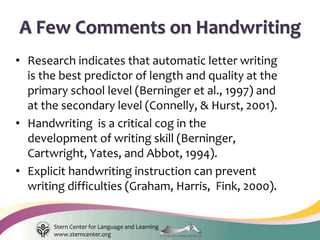
• Research indicates that automatic letter writing
is the best predictor of length and quality at the
primary school level (Berninger et al., 1997) and
at the secondary level (Connelly, & Hurst, 2001).
• Handwriting is a critical cog in the
development of writing skill (Berninger,
Cartwright, Yates, and Abbot, 1994).
• Explicit handwriting instruction can prevent
writing difficulties (Graham, Harris, Fink, 2000).
A Few Comments on Handwriting
Stern Center for Language and Learning
www.sterncenter.org
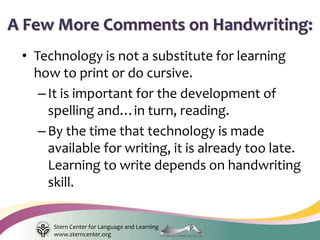
• Technology is not a substitute for learning
how to print or do cursive.
–It is important for the development of
spelling and…in turn, reading.
–By the time that technology is made
available for writing, it is already too late.
Learning to write depends on handwriting
skill.
A Few More Comments on Handwriting:
Stern Center for Language and Learning
www.sterncenter.org
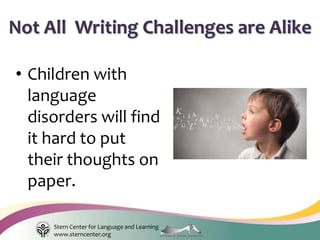
• Children with
language
disorders will find
it hard to put
their thoughts on
paper.
Not All Writing Challenges are Alike
Stern Center for Language and Learning
www.sterncenter.org
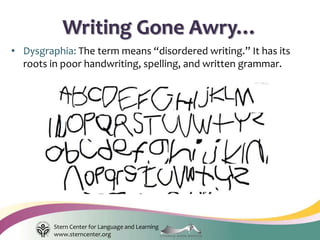
• Dysgraphia: The term means “disordered writing.” It has its
roots in poor handwriting, spelling, and written grammar.
Writing Gone Awry…
Stern Center for Language and Learning
www.sterncenter.org
According to IDEA, SLD is:
– a disorder in one or more of the basic psychological processes
involved in understanding or in using language, spoken or
written, which disorder may manifest itself in the imperfect
ability to listen, think, speak, read, write, spell, or do
mathematical calculations. Such term includes such conditions
as perceptual disabilities, brain injury, minimal brain
dysfunction, dyslexia, and developmental aphasia. Such term
does not include a learning problem that is primarily the result
of visual, hearing, or motor disabilities, of mental retardation*,
of emotional disturbance, or of environmental, cultural, or
economic disadvantage.” (20 U.S.C. § 1401 (30)) *Now known as
intellectual disability
Specific Learning Disability
Stern Center for Language and Learning
www.sterncenter.org
• Difficulties learning and using academic skills, as indicated
by the presence of al least one of the following symptoms
that have persisted for at least 6 months, despite the
provision of interventions that target those difficulties:
• Difficulties with spelling (e.g. may add, omit, or
substitute vowels or consonants)
• Difficulties with written expression (e.g. makes
multiple grammatical or punctuation errors within
sentences; employs poor paragraph organization;
written expression of ideas lacks clarity)
DSM-5 Definition:
Specific Learning Disorder
Stern Center for Language and Learning
www.sterncenter.org
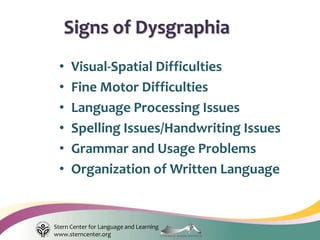
• Visual-Spatial Difficulties
• Fine Motor Difficulties
• Language Processing Issues
• Spelling Issues/Handwriting Issues
• Grammar and Usage Problems
• Organization of Written Language
Signs of Dysgraphia
Stern Center for Language and Learning
www.sterncenter.org
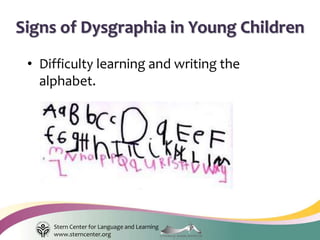
• Difficulty learning and writing the
alphabet.
Signs of Dysgraphia in Young Children
Stern Center for Language and Learning
www.sterncenter.org
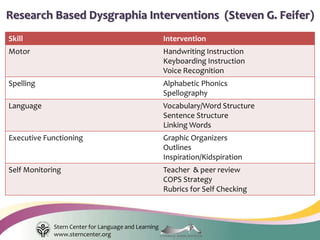
Skill Intervention
Motor Handwriting Instruction
Keyboarding Instruction
Voice Recognition
Spelling Alphabetic Phonics
Spellography
Language Vocabulary/Word Structure
Sentence Structure
Linking Words
Executive Functioning Graphic Organizers
Outlines
Inspiration/Kidspiration
Self Monitoring Teacher & peer review
COPS Strategy
Rubrics for Self Checking
Research Based Dysgraphia Interventions (Steven G. Feifer)
Stern Center for Language and Learning
www.sterncenter.org
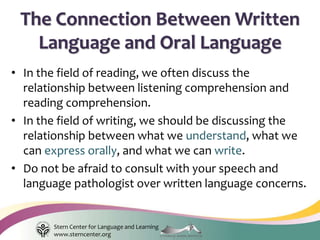
• In the field of reading, we often discuss the
relationship between listening comprehension and
reading comprehension.
• In the field of writing, we should be discussing the
relationship between what we understand, what we
can express orally, and what we can write.
• Do not be afraid to consult with your speech and
language pathologist over written language concerns.
The Connection Between Written
Language and Oral Language
Stern Center for Language and Learning
www.sterncenter.org
• Written language piggybacks on the oral
language system. When students have difficulty
formulating sentences and when they write
with a poor written vocabulary, they may be
showing signs of a speech and language
impairment. Written language has a way of
taxing the oral language system in ways Mother
Nature never imagined. Sometimes the
treatment of the written language problem also
includes work in oral language.
Final Thoughts
Stern Center for Language and Learning
www.sterncenter.org
Thank You!
Melissa Farrall, Ph.D.
mfarrall@sterncenter.org
Director of Evaluation
Stern Center for Language and Learning
www.sterncenter.org | 802-878-2332

Writing, Dysgraphia and the Human Brain

  • 1.
    Stern Center forLanguage and Learning Dysgraphia Williston, Vermont 183 Talcott Road | Suite 101 Williston, VT | 05495 Toll free | 800-544-4863 Phone | 802-878-2332 Fax |802-878-0230 West Lebanon, New Hampshire 1 Oak Ridge Rd., Unit 9B West Lebanon, NH | 03784 Phone | 603-276-3165 Fax | 603-653-5606 BECAUSE ALL GREAT MINDS DON’T THINK ALIKE Melissa Farrall, Ph.D. mfarrall@sterncenter.org
  • 2.
    Stern Center forLanguage and Learning www.sterncenter.org • It is not language that separates us from the animal kingdom, it is print. • Written expression is the most cognitively demanding task that humans perform. It stresses our language system, our spatial system, working memory, and our fine-motor skills. Writing & the Human Brain
  • 3.
    Stern Center forLanguage and Learning www.sterncenter.org • If we can learn to read, then we can learn to write simply by applying our skills in the reverse direction. MYTH about Writing:
  • 4.
    Stern Center forLanguage and Learning www.sterncenter.org • The orthographic processor takes in a string of letters and extracts essential features from each letter that differentiates them from other letters. Recognizing Print (Reading)
  • 5.
    Stern Center forLanguage and Learning www.sterncenter.org • The act of writing letters requires a more precise knowledge of letter formation. Writers have internalized the sequence and direction of each stroke in a letter. Forming Letters (Writing)
  • 6.
    Stern Center forLanguage and Learning www.sterncenter.org • Writing forces us to make connections, organize our thoughts, and think them through with sequence and logic. • When we write about science, history, and language arts, we learn. We think deeply about our subject. • Literacy is not just about reading; it is about writing. What do good writers do?
  • 7.
    Stern Center forLanguage and Learning www.sterncenter.org • Chall (1983) said that we move from “learning to read to reading to learn.” The same is true of written expression. • Writing is a tool for learning. Why Do We Teach Writing?
  • 8.
    Stern Center forLanguage and Learning www.sterncenter.org Working Memory Emotion Thinking STM LTM Executive Functioning From the Inside: Writing relies heavily on memory & executive functioning
  • 9.
    Stern Center forLanguage and Learning www.sterncenter.org • Writing Components • Graphomotor Skill • Letter Formation • Spelling Rules & Exceptions • Capitalization • Punctuation • Word Choice • Sentence Structure • Sequence & Organization • Knowledge of Topic Working Memory is like a stage.
  • 10.
    Stern Center forLanguage and Learning www.sterncenter.org Aspect of Executive Function Writing Function Initiating Idea Generation, Independent Learner Sustaining Tracking Thoughts, Focus, Flow Inhibiting Refrain from Impulsivity and Distraction Shifting Transitioning Organizing Structure and Transitions Planning Spacing, Cohesive Ties Self-Monitoring Observant and Aware Executive Function & Writing
  • 11.
    Stern Center forLanguage and Learning www.sterncenter.org • Research indicates that automatic letter writing is the best predictor of length and quality at the primary school level (Berninger et al., 1997) and at the secondary level (Connelly, & Hurst, 2001). • Handwriting is a critical cog in the development of writing skill (Berninger, Cartwright, Yates, and Abbot, 1994). • Explicit handwriting instruction can prevent writing difficulties (Graham, Harris, Fink, 2000). A Few Comments on Handwriting
  • 12.
    Stern Center forLanguage and Learning www.sterncenter.org • Technology is not a substitute for learning how to print or do cursive. –It is important for the development of spelling and…in turn, reading. –By the time that technology is made available for writing, it is already too late. Learning to write depends on handwriting skill. A Few More Comments on Handwriting:
  • 13.
    Stern Center forLanguage and Learning www.sterncenter.org • Children with language disorders will find it hard to put their thoughts on paper. Not All Writing Challenges are Alike
  • 14.
    Stern Center forLanguage and Learning www.sterncenter.org • Dysgraphia: The term means “disordered writing.” It has its roots in poor handwriting, spelling, and written grammar. Writing Gone Awry…
  • 15.
    Stern Center forLanguage and Learning www.sterncenter.org According to IDEA, SLD is: – a disorder in one or more of the basic psychological processes involved in understanding or in using language, spoken or written, which disorder may manifest itself in the imperfect ability to listen, think, speak, read, write, spell, or do mathematical calculations. Such term includes such conditions as perceptual disabilities, brain injury, minimal brain dysfunction, dyslexia, and developmental aphasia. Such term does not include a learning problem that is primarily the result of visual, hearing, or motor disabilities, of mental retardation*, of emotional disturbance, or of environmental, cultural, or economic disadvantage.” (20 U.S.C. § 1401 (30)) *Now known as intellectual disability Specific Learning Disability
  • 16.
    Stern Center forLanguage and Learning www.sterncenter.org • Difficulties learning and using academic skills, as indicated by the presence of al least one of the following symptoms that have persisted for at least 6 months, despite the provision of interventions that target those difficulties: • Difficulties with spelling (e.g. may add, omit, or substitute vowels or consonants) • Difficulties with written expression (e.g. makes multiple grammatical or punctuation errors within sentences; employs poor paragraph organization; written expression of ideas lacks clarity) DSM-5 Definition: Specific Learning Disorder
  • 17.
    Stern Center forLanguage and Learning www.sterncenter.org • Visual-Spatial Difficulties • Fine Motor Difficulties • Language Processing Issues • Spelling Issues/Handwriting Issues • Grammar and Usage Problems • Organization of Written Language Signs of Dysgraphia
  • 18.
    Stern Center forLanguage and Learning www.sterncenter.org • Difficulty learning and writing the alphabet. Signs of Dysgraphia in Young Children
  • 19.
    Stern Center forLanguage and Learning www.sterncenter.org Skill Intervention Motor Handwriting Instruction Keyboarding Instruction Voice Recognition Spelling Alphabetic Phonics Spellography Language Vocabulary/Word Structure Sentence Structure Linking Words Executive Functioning Graphic Organizers Outlines Inspiration/Kidspiration Self Monitoring Teacher & peer review COPS Strategy Rubrics for Self Checking Research Based Dysgraphia Interventions (Steven G. Feifer)
  • 20.
    Stern Center forLanguage and Learning www.sterncenter.org • In the field of reading, we often discuss the relationship between listening comprehension and reading comprehension. • In the field of writing, we should be discussing the relationship between what we understand, what we can express orally, and what we can write. • Do not be afraid to consult with your speech and language pathologist over written language concerns. The Connection Between Written Language and Oral Language
  • 21.
    Stern Center forLanguage and Learning www.sterncenter.org • Written language piggybacks on the oral language system. When students have difficulty formulating sentences and when they write with a poor written vocabulary, they may be showing signs of a speech and language impairment. Written language has a way of taxing the oral language system in ways Mother Nature never imagined. Sometimes the treatment of the written language problem also includes work in oral language. Final Thoughts
  • 22.
    Stern Center forLanguage and Learning www.sterncenter.org Thank You! Melissa Farrall, Ph.D. mfarrall@sterncenter.org Director of Evaluation Stern Center for Language and Learning www.sterncenter.org | 802-878-2332