Meeting Children With Special Needs
     Student Name: Amna Mohammed Nur

Course Name: Inclusion of Children with Special
                    Needs

        Course Code: ECEP-2330-064
Table of Content
   Tile page
   Case study
   My Observation on Avery
   What I think Avery needs
   Learning disability
   Video
   Types of learning disability
   Dyslexia
   Sign and symptoms
   What is the cause of Dyslexia
   What is the side effect of dyslexia
   Modification
   Strategies
   agency
Case Study


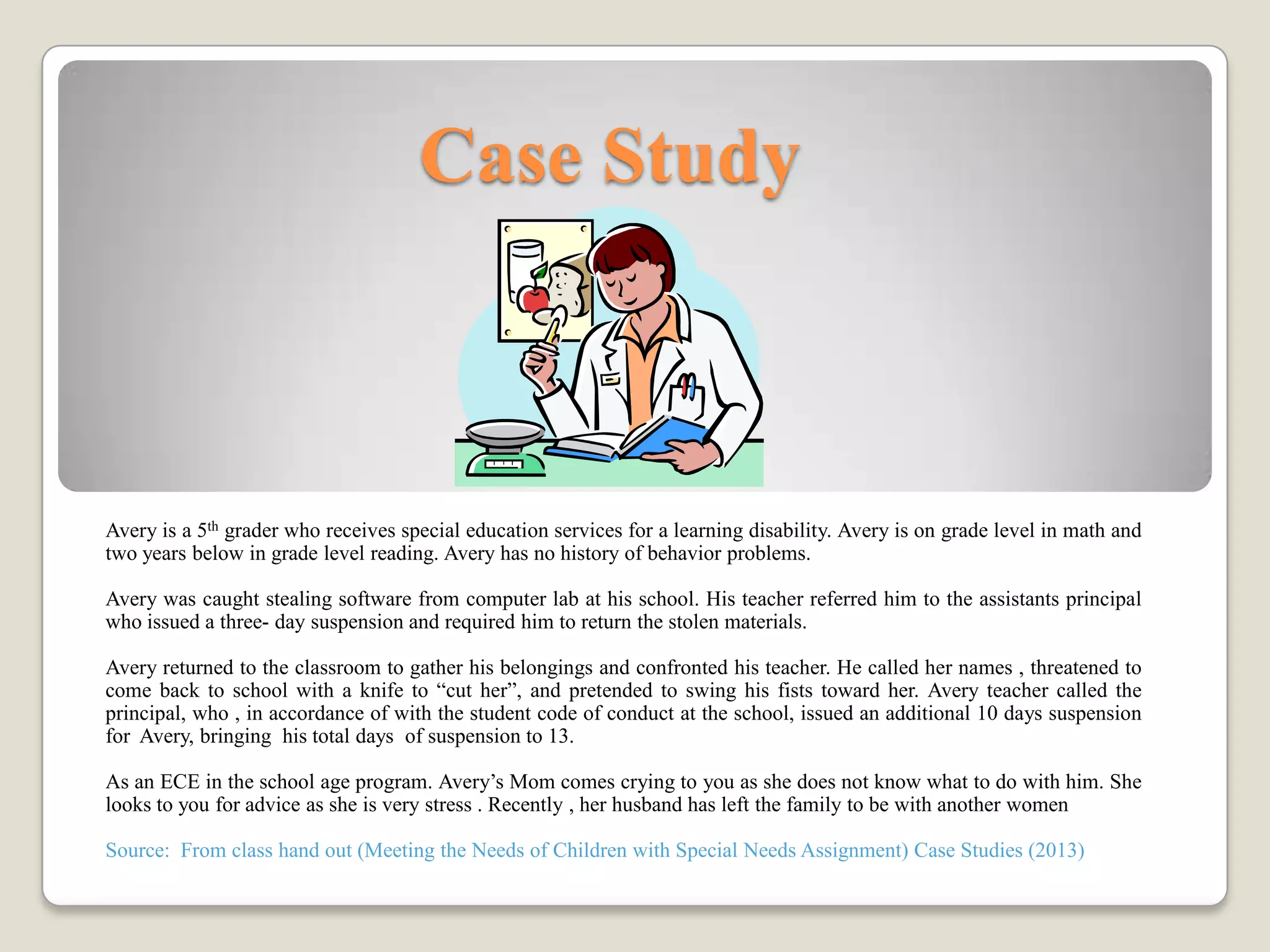
Avery is a 5th grader who receives special education services for a learning disability. Avery is on grade level in math and
two years below in grade level reading. Avery has no history of behavior problems.

Avery was caught stealing software from computer lab at his school. His teacher referred him to the assistants principal
who issued a three- day suspension and required him to return the stolen materials.

Avery returned to the classroom to gather his belongings and confronted his teacher. He called her names , threatened to
come back to school with a knife to “cut her”, and pretended to swing his fists toward her. Avery teacher called the
principal, who , in accordance of with the student code of conduct at the school, issued an additional 10 days suspension
for Avery, bringing his total days of suspension to 13.

As an ECE in the school age program. Avery’s Mom comes crying to you as she does not know what to do with him. She
looks to you for advice as she is very stress . Recently , her husband has left the family to be with another women

Source: From class hand out (Meeting the Needs of Children with Special Needs Assignment) Case Studies (2013)
My Observation on Avery Case
Avery is going through a rough time at home now , because, both of his parents are breaking up. His dad is leaving the house to
be with another women, this issue has left the mother with a lot of emotional stress . Which have caused the mother to break
down into tears to the teacher after Avery's situation and ask for help . This incident show how the mother needs some agency
that could help her with supporting Avery's learning. And some information that could guide her through her relationship with
Avery .but, since this issue has started Avery’s behavior has changed . According to the case study “Avery has no history of
behavior problems”. This shows how he never had any pervious history of behavior problem even though he had his learning
disability. So these behavior are new symptoms caused by his family problem. Also, he is having some challenge with his
reading skill. That’s why he is two grade below his reading level.

Avery change of behavior include:

   He started to show signs of aggression
   He tried to steal a software from the computer lab
   He threatened to cut his teacher with a knife

Avery learning disability

   There is so many types of learning disability, but, I believe Avery’s learning disability is dyslexia ,because, he is having
    challenges with his reading. According to the case study “Avery is a 5th grader who receives special education services for a
    learning disability. Avery is on grade level in math and two years below in grade level reading.”
What I Think Avery Needs
   From my observation I notice that Avery is two grade below in his reading level. And I think he needs more support through
    his reading to help him understand what he is learning better.

   I Also think Avery needs someone one he could trust , and have this strong one to one relationship in order to help reduce
    his stress, and resolve the problem with his teacher in school.

   Avery needs a safe environment where he could feel comfortable to learn and explore.

   I believe in this stage Avery really needs his parents support to give him the encouragement and confidence to pursue school.

   Avery needs his teachers to be more understanding to his situation and try to get down to
     his level in order to reduce any inappropriate behavior.

   I believe the teacher should provide appropriate activity that help Avery's with his challenges.

   The teacher should use different guidance strategies in order to ensure positive behavior.

   Finally, he needs the environment to be modified to meet his needs.
Learning disability
What is learning disability?

Learning disability doesn’t mean children are incompetence, dumb, or not smart. But, it means that children who suffer
from learning disability are unable to store, recall, receive , and process information comparing to other children who are
not effected by learning disability. These challenges could effect on the children performance in school and their ability to
understand content. However, learning disability has so many different types that interfere with children reading, writing,
spelling, math, and focus.

What is the types of learning disability

•   Dyslexia

•   Dyscalculia

•   Dysgraphia

•   Auditory and Visual Processing Disorders

•   Nonverbal Learning Disabilities


Reference

http://kidshealth.org/teen/diseases_conditions/learning/learning_disabilities.html

http://www.ldonline.org/ldbasics/whatisld
Video
                     http://www.youtube.com/watch?v=GoM5HcfQBwE


Reference
www.youtube.com
Types of learning disability
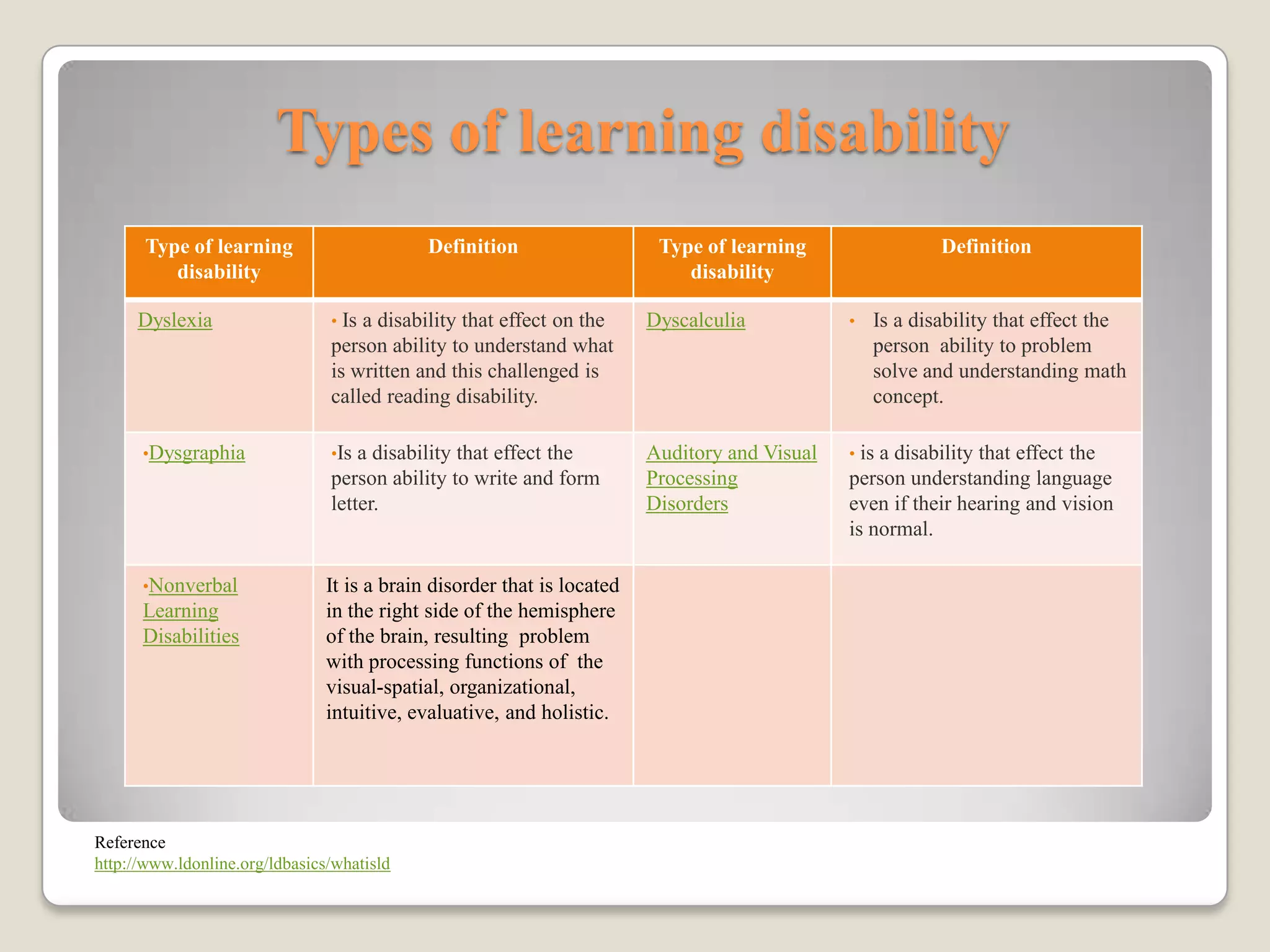
       Type of learning                      Definition                   Type of learning                 Definition
          disability                                                         disability

     Dyslexia                   • Isa disability that effect on the      Dyscalculia           •   Is a disability that effect the
                                person ability to understand what                                  person ability to problem
                                is written and this challenged is                                  solve and understanding math
                                called reading disability.                                         concept.

      •Dysgraphia               •Is a disability that effect the         Auditory and Visual   • isa disability that effect the
                                person ability to write and form         Processing            person understanding language
                                letter.                                  Disorders             even if their hearing and vision
                                                                                               is normal.

      •Nonverbal                It is a brain disorder that is located
      Learning                  in the right side of the hemisphere
      Disabilities              of the brain, resulting problem
                                with processing functions of the
                                visual-spatial, organizational,
                                intuitive, evaluative, and holistic.


Reference
http://www.ldonline.org/ldbasics/whatisld
Dyslexia

What is Dyslexia?

    Dyslexia Is a learning disability that cause people have specific challenges with their reading skills. In addition, children who
     suffer from dyslexia usually experience difficulties with their language skills. Dyslexia can have a huge impact on the children
     life, because, it makes the learning in academically environment becomes very hard for the children to succeed. However,
     children who have any type of learning disability are qualified for a special education to support their needs.

How is it diagnosed?

    There is a model called (RTI) Response to Intervention. This intervention helps finding out if a child may have any learning
     disability. The school go through the RTI process with the children who don’t show any signs of progress in school. When the
     children complete the RTI test and they don’t reach the established grad level they rule out any other developmental disorder.
     But, they will be identified with a learning disability in reading. When they’re learning disability is identified they will be
     qualified for especial education services. Schools are trying to begin their screening from kindergarten in order to identify the
     children with potential signs of learning disability.

    For the children or adult who don’t go through the RTI test process, they will need to do an evaluation to diagnose dyslexia. The
     process will provide academic, intellectual, and language skills that are directly linked to dyslexia. The assessment will include
     listening, phonological skills, phonemic awareness, and expressive language. If any characteristic of dyslexia start to show
     during the test then the child or adult will have an individual plan developed for him to accommodate or extend time.


Reference
http://www.ldonline.org/article/Dyslexia_Basics
Signs and Symptoms
    Individuals who are suffering with dyslexia will have difficulties remembering sound, symbols, letter, and forming
     memories for the words they want to use. However, the following list of symptoms is not enough to confirm that a person is
     suffering with dyslexia. The child or adult must go through a formal test in order to confirm.

Other symptoms would include:

      They might have problem with learning to speak.
      They will have challenge with organizing spoken and written language.
      They will have trouble with memorizing information or fact.
      They will have difficulties with reading quickly to understand.
      They will experience spelling problem.
      They will have hard time learning new languages.
      They will have more of challenge to understand long reading projects.
      They might have some challenge with doing math operation correctly.


Reference
http://www.ldonline.org/article/Dyslexia_Basics
What Is The Cause of Dyslexia
What is the cause of dyslexia?

    There isn’t any exact cause to dyslexia, but, there is brain imagery, anatomical studies shows the different way of
     brain function between a person without dyslexia and person with dyslexia. These studies have found that people
     who are suffering from dyslexia will experience problem with Identifying speech sound, letter representation to the
     sound, and these issue have strong effect on their abilities to read. But, with the positive way of teaching style a
     person with dyslexia can succeed in school.


How is dyslexia treated?

    There is no cure that can treat dyslexia, however, the appropriate help a lot of people managed to overcome their
     challenge, and they learned how to read and write very well. The best thing for any person who suffers from
     dyslexia is the early identification of the learning disability. This way the person could get all the help he/she need
     to successes in school and life.

Reference
http://www.ldonline.org/article/Dyslexia_Basics
What Is The Side Effect of Dyslexia
        What are the effects of dyslexia?

       The impact of dyslexia differ from person to person based on their condition, and the support they could get from their
       surrounding.


       Some dyslexics may have more difficulties as the task require more complex skills.


       They will have a challenge with their recognising words, spelling, writing, and reading.


       People with dyslexia could have problems with spoken language even after the excellent support in school or home.


       People with dyslexia could have trouble with expressing themselves or understand others.


       Dyslexia could affect the child or adult self-image.


       Student most likely would feel low about themselves


       Student with dyslexia might experience a lot of stress because of their academic challenges, that could result the student to
       drop out of school.

Reference
http://www.ldonline.org/article/Dyslexia_Basics
Parents tips
   Always have high expectation for your children in order to motivate them to work harder and learn.

   Make sure to evaluate your children performance in school if you are not convinced with their grade.

   Get involved and learn about your child learning disability in order to help him reach his potential.

   Ensure to reflect diversity and inclusiveness in the child environments.

   Help your child to understand his disability ,while ensuring to make him know that there is nothing that he cant
    do if he works hard.

   Always believe in your child and provide him with all the emotional support he needs.

   Be patient with your child and encourage him throughout his learning journey because it will be hard and
    frustrating with all the challenges he has to over come.

Reference

http://www.pbs.org/newshour/rundown/2012/03/advice-to-students-and-parents-with-learning-disabilities.html
Environment Modification
   The environment for the children with dyslexia is really important because it could support their learning or destroy it,
    Since they have so many challenges with their listening, hearing, concentrating, writing, and reading. It is really important
    to provide an environment that could meet their needs.

   Arrange the setting of the class room so the child with dyslexia could sit in the front.

   Arrange for a group of children with dyslexia to sit beside each other for motivation.

   Arrange for children with a ‘study buddy’ so they can ask each other for clarification about instruction.

   Set up the environment to provide enough space for movement , and avoid any distraction from the backgrounds during
    class.

   Ensure every area in the room is labelled and accessible for the children.

   Provide the children with extra time through class task.

   Provide materials to manipulate that could support their learning such as listening to books on tape

    Use a text reading computer programs to help children recognize letter and sound

   Bring in computers or I pad for the children to practice writing.

Refrence

http://www.bdadyslexia.org.uk/files/dfs_pack_English.pdf
Strategies

    ensure to have high expectation for their learning while keeping in mind to put reasonable expectation for their writing
     skills.

    make sure to repeat and explain things so many times in different ways.

     When I mark a child work make sure to use two different colours.

    When marking a child work try to look at it from their prospective to understand the reason for the mistakes. Also, provide
     them with the chance to explain themselves.

    avoid over loading the children with a lot of work since dyslexic children always over work themselves.

     While giving out instruction make sure to be clear, slow, and allow time to promote success in task.

    When you say word to the children, try to ask them to explain it to you to make sure they understood the right meaning.

Refrence

http://www.bdadyslexia.org.uk/files/dfs_pack_English.pdf
Strategies
   Use multi-sensory activities to provide effective learning experience through all senses.

   Provide opportunity for children to share their interest and knowledge through writing even though it is challenging.

   Guide the children with dyslexia through task that other children have picked up already like putting toys away.

   continue to observe the children during process to avoid drop of self-esteem.

   Use Flashcards which can teach the children new things such as opposites meaning, words has the same start, and the same
    end.

   Teach writing with small group or one to one using the cursive writing that will keep their on the paper throughout the
    practice. This activity could enhance the children memory with their motor memory.

   Try practice writing on the sand, air, and computers.

   ensure to check if the children are keeping up with the instruction, and they are not just sitting without understanding.

   Provide children with dyslexia a text that they are reading in class a week before so they can practice.

    Help children with dyslexic to understand the text they are reading by continuously referring to the meaning of the content
    they are reading.

   Read each passage, word, sentence twice while reading aloud, and explain every sentence meaning.

Refrence

http://www.bdadyslexia.org.uk/files/dfs_pack_English.pdf
Agencies


http://www.ldatd.on.ca/contact/
Vision
    LDATD This is an association to help the people with learning disability, and ADHD disorder reach their fullest potential.

Mission
  To accommodate and support the children education , while advocating, researching for services that could increase the full
   participation of people with special needs.

Services learning disability association of Toronto District


     Give out written hand out and verbal information about (ADHD), and learning disability.

     Provide referral to professionals tutors to help people with disability.

     They operate a resource center, and provide materials such as books, video, and other stuff for all.

     Help parents and guardian regarding their children school and rights.
Continue Agencies


Services the learning disability association of Toronto District

      They advocate for adult and children with special needs

      They try to promote awareness about LD and ADHD.

      Give out updated newsletter 3 times a year.

      Provide Presentations to school, community group, and conferences

      Hold free public events on various aspects of learning disabilities;

      Provide helpful programs

      They provide Fundraising for these services and programs.

Reference
http://www.ldatd.on.ca/contact/

Avery case study assignment

  • 1.
    Meeting Children WithSpecial Needs Student Name: Amna Mohammed Nur Course Name: Inclusion of Children with Special Needs Course Code: ECEP-2330-064
  • 2.
    Table of Content  Tile page  Case study  My Observation on Avery  What I think Avery needs  Learning disability  Video  Types of learning disability  Dyslexia  Sign and symptoms  What is the cause of Dyslexia  What is the side effect of dyslexia  Modification  Strategies  agency
  • 3.
    Case Study Avery isa 5th grader who receives special education services for a learning disability. Avery is on grade level in math and two years below in grade level reading. Avery has no history of behavior problems. Avery was caught stealing software from computer lab at his school. His teacher referred him to the assistants principal who issued a three- day suspension and required him to return the stolen materials. Avery returned to the classroom to gather his belongings and confronted his teacher. He called her names , threatened to come back to school with a knife to “cut her”, and pretended to swing his fists toward her. Avery teacher called the principal, who , in accordance of with the student code of conduct at the school, issued an additional 10 days suspension for Avery, bringing his total days of suspension to 13. As an ECE in the school age program. Avery’s Mom comes crying to you as she does not know what to do with him. She looks to you for advice as she is very stress . Recently , her husband has left the family to be with another women Source: From class hand out (Meeting the Needs of Children with Special Needs Assignment) Case Studies (2013)
  • 4.
    My Observation onAvery Case Avery is going through a rough time at home now , because, both of his parents are breaking up. His dad is leaving the house to be with another women, this issue has left the mother with a lot of emotional stress . Which have caused the mother to break down into tears to the teacher after Avery's situation and ask for help . This incident show how the mother needs some agency that could help her with supporting Avery's learning. And some information that could guide her through her relationship with Avery .but, since this issue has started Avery’s behavior has changed . According to the case study “Avery has no history of behavior problems”. This shows how he never had any pervious history of behavior problem even though he had his learning disability. So these behavior are new symptoms caused by his family problem. Also, he is having some challenge with his reading skill. That’s why he is two grade below his reading level. Avery change of behavior include:  He started to show signs of aggression  He tried to steal a software from the computer lab  He threatened to cut his teacher with a knife Avery learning disability  There is so many types of learning disability, but, I believe Avery’s learning disability is dyslexia ,because, he is having challenges with his reading. According to the case study “Avery is a 5th grader who receives special education services for a learning disability. Avery is on grade level in math and two years below in grade level reading.”
  • 5.
    What I ThinkAvery Needs  From my observation I notice that Avery is two grade below in his reading level. And I think he needs more support through his reading to help him understand what he is learning better.  I Also think Avery needs someone one he could trust , and have this strong one to one relationship in order to help reduce his stress, and resolve the problem with his teacher in school.  Avery needs a safe environment where he could feel comfortable to learn and explore.  I believe in this stage Avery really needs his parents support to give him the encouragement and confidence to pursue school.  Avery needs his teachers to be more understanding to his situation and try to get down to his level in order to reduce any inappropriate behavior.  I believe the teacher should provide appropriate activity that help Avery's with his challenges.  The teacher should use different guidance strategies in order to ensure positive behavior.  Finally, he needs the environment to be modified to meet his needs.
  • 6.
    Learning disability What islearning disability? Learning disability doesn’t mean children are incompetence, dumb, or not smart. But, it means that children who suffer from learning disability are unable to store, recall, receive , and process information comparing to other children who are not effected by learning disability. These challenges could effect on the children performance in school and their ability to understand content. However, learning disability has so many different types that interfere with children reading, writing, spelling, math, and focus. What is the types of learning disability • Dyslexia • Dyscalculia • Dysgraphia • Auditory and Visual Processing Disorders • Nonverbal Learning Disabilities Reference http://kidshealth.org/teen/diseases_conditions/learning/learning_disabilities.html http://www.ldonline.org/ldbasics/whatisld
  • 7.
    Video  http://www.youtube.com/watch?v=GoM5HcfQBwE Reference www.youtube.com
  • 8.
    Types of learningdisability Type of learning Definition Type of learning Definition disability disability Dyslexia • Isa disability that effect on the Dyscalculia • Is a disability that effect the person ability to understand what person ability to problem is written and this challenged is solve and understanding math called reading disability. concept. •Dysgraphia •Is a disability that effect the Auditory and Visual • isa disability that effect the person ability to write and form Processing person understanding language letter. Disorders even if their hearing and vision is normal. •Nonverbal It is a brain disorder that is located Learning in the right side of the hemisphere Disabilities of the brain, resulting problem with processing functions of the visual-spatial, organizational, intuitive, evaluative, and holistic. Reference http://www.ldonline.org/ldbasics/whatisld
  • 9.
    Dyslexia What is Dyslexia?  Dyslexia Is a learning disability that cause people have specific challenges with their reading skills. In addition, children who suffer from dyslexia usually experience difficulties with their language skills. Dyslexia can have a huge impact on the children life, because, it makes the learning in academically environment becomes very hard for the children to succeed. However, children who have any type of learning disability are qualified for a special education to support their needs. How is it diagnosed?  There is a model called (RTI) Response to Intervention. This intervention helps finding out if a child may have any learning disability. The school go through the RTI process with the children who don’t show any signs of progress in school. When the children complete the RTI test and they don’t reach the established grad level they rule out any other developmental disorder. But, they will be identified with a learning disability in reading. When they’re learning disability is identified they will be qualified for especial education services. Schools are trying to begin their screening from kindergarten in order to identify the children with potential signs of learning disability.  For the children or adult who don’t go through the RTI test process, they will need to do an evaluation to diagnose dyslexia. The process will provide academic, intellectual, and language skills that are directly linked to dyslexia. The assessment will include listening, phonological skills, phonemic awareness, and expressive language. If any characteristic of dyslexia start to show during the test then the child or adult will have an individual plan developed for him to accommodate or extend time. Reference http://www.ldonline.org/article/Dyslexia_Basics
  • 10.
    Signs and Symptoms  Individuals who are suffering with dyslexia will have difficulties remembering sound, symbols, letter, and forming memories for the words they want to use. However, the following list of symptoms is not enough to confirm that a person is suffering with dyslexia. The child or adult must go through a formal test in order to confirm. Other symptoms would include: They might have problem with learning to speak. They will have challenge with organizing spoken and written language. They will have trouble with memorizing information or fact. They will have difficulties with reading quickly to understand. They will experience spelling problem. They will have hard time learning new languages. They will have more of challenge to understand long reading projects. They might have some challenge with doing math operation correctly. Reference http://www.ldonline.org/article/Dyslexia_Basics
  • 11.
    What Is TheCause of Dyslexia What is the cause of dyslexia?  There isn’t any exact cause to dyslexia, but, there is brain imagery, anatomical studies shows the different way of brain function between a person without dyslexia and person with dyslexia. These studies have found that people who are suffering from dyslexia will experience problem with Identifying speech sound, letter representation to the sound, and these issue have strong effect on their abilities to read. But, with the positive way of teaching style a person with dyslexia can succeed in school. How is dyslexia treated?  There is no cure that can treat dyslexia, however, the appropriate help a lot of people managed to overcome their challenge, and they learned how to read and write very well. The best thing for any person who suffers from dyslexia is the early identification of the learning disability. This way the person could get all the help he/she need to successes in school and life. Reference http://www.ldonline.org/article/Dyslexia_Basics
  • 12.
    What Is TheSide Effect of Dyslexia What are the effects of dyslexia? The impact of dyslexia differ from person to person based on their condition, and the support they could get from their surrounding. Some dyslexics may have more difficulties as the task require more complex skills. They will have a challenge with their recognising words, spelling, writing, and reading. People with dyslexia could have problems with spoken language even after the excellent support in school or home. People with dyslexia could have trouble with expressing themselves or understand others. Dyslexia could affect the child or adult self-image. Student most likely would feel low about themselves Student with dyslexia might experience a lot of stress because of their academic challenges, that could result the student to drop out of school. Reference http://www.ldonline.org/article/Dyslexia_Basics
  • 13.
    Parents tips  Always have high expectation for your children in order to motivate them to work harder and learn.  Make sure to evaluate your children performance in school if you are not convinced with their grade.  Get involved and learn about your child learning disability in order to help him reach his potential.  Ensure to reflect diversity and inclusiveness in the child environments.  Help your child to understand his disability ,while ensuring to make him know that there is nothing that he cant do if he works hard.  Always believe in your child and provide him with all the emotional support he needs.  Be patient with your child and encourage him throughout his learning journey because it will be hard and frustrating with all the challenges he has to over come. Reference http://www.pbs.org/newshour/rundown/2012/03/advice-to-students-and-parents-with-learning-disabilities.html
  • 14.
    Environment Modification  The environment for the children with dyslexia is really important because it could support their learning or destroy it, Since they have so many challenges with their listening, hearing, concentrating, writing, and reading. It is really important to provide an environment that could meet their needs.  Arrange the setting of the class room so the child with dyslexia could sit in the front.  Arrange for a group of children with dyslexia to sit beside each other for motivation.  Arrange for children with a ‘study buddy’ so they can ask each other for clarification about instruction.  Set up the environment to provide enough space for movement , and avoid any distraction from the backgrounds during class.  Ensure every area in the room is labelled and accessible for the children.  Provide the children with extra time through class task.  Provide materials to manipulate that could support their learning such as listening to books on tape  Use a text reading computer programs to help children recognize letter and sound  Bring in computers or I pad for the children to practice writing. Refrence http://www.bdadyslexia.org.uk/files/dfs_pack_English.pdf
  • 15.
    Strategies  ensure to have high expectation for their learning while keeping in mind to put reasonable expectation for their writing skills.  make sure to repeat and explain things so many times in different ways.  When I mark a child work make sure to use two different colours.  When marking a child work try to look at it from their prospective to understand the reason for the mistakes. Also, provide them with the chance to explain themselves.  avoid over loading the children with a lot of work since dyslexic children always over work themselves.  While giving out instruction make sure to be clear, slow, and allow time to promote success in task.  When you say word to the children, try to ask them to explain it to you to make sure they understood the right meaning. Refrence http://www.bdadyslexia.org.uk/files/dfs_pack_English.pdf
  • 16.
    Strategies  Use multi-sensory activities to provide effective learning experience through all senses.  Provide opportunity for children to share their interest and knowledge through writing even though it is challenging.  Guide the children with dyslexia through task that other children have picked up already like putting toys away.  continue to observe the children during process to avoid drop of self-esteem.  Use Flashcards which can teach the children new things such as opposites meaning, words has the same start, and the same end.  Teach writing with small group or one to one using the cursive writing that will keep their on the paper throughout the practice. This activity could enhance the children memory with their motor memory.  Try practice writing on the sand, air, and computers.  ensure to check if the children are keeping up with the instruction, and they are not just sitting without understanding.  Provide children with dyslexia a text that they are reading in class a week before so they can practice.  Help children with dyslexic to understand the text they are reading by continuously referring to the meaning of the content they are reading.  Read each passage, word, sentence twice while reading aloud, and explain every sentence meaning. Refrence http://www.bdadyslexia.org.uk/files/dfs_pack_English.pdf
  • 17.
    Agencies http://www.ldatd.on.ca/contact/ Vision  LDATD This is an association to help the people with learning disability, and ADHD disorder reach their fullest potential. Mission  To accommodate and support the children education , while advocating, researching for services that could increase the full participation of people with special needs. Services learning disability association of Toronto District Give out written hand out and verbal information about (ADHD), and learning disability. Provide referral to professionals tutors to help people with disability. They operate a resource center, and provide materials such as books, video, and other stuff for all. Help parents and guardian regarding their children school and rights.
  • 18.
    Continue Agencies Services thelearning disability association of Toronto District They advocate for adult and children with special needs They try to promote awareness about LD and ADHD. Give out updated newsletter 3 times a year. Provide Presentations to school, community group, and conferences Hold free public events on various aspects of learning disabilities; Provide helpful programs They provide Fundraising for these services and programs. Reference http://www.ldatd.on.ca/contact/