Childhood Anxiety and Fear
University of Rwanda
Rebecca L White, MSN, FPMHNP-BC, FNP-BC
Objectives
• Recognize the difference between anxiety & fear in
children and adolescents
• Identify anxiety levels that are at risk for becoming
pathological
• Apply Cognitive behavioral therapy basic to children
suffering from fear and anxiety
• Express a working knowledge and have the ability to
educate parents in basic CBT skills with their children
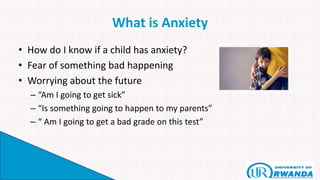
What is Anxiety
• How do I know if a child has anxiety?
• Fear of something bad happening
• Worrying about the future
– “Am I going to get sick”
– “Is something going to happen to my parents”
– “ Am I going to get a bad grade on this test”
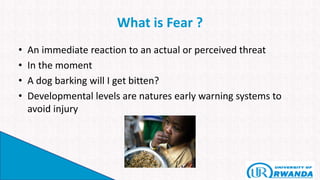
What is Fear ?
• An immediate reaction to an actual or perceived threat
• In the moment
• A dog barking will I get bitten?
• Developmental levels are natures early warning systems to
avoid injury
Normal Developmental Fears
• Infancy-strangers, loud noises
– Able to differentiate
• Early childhood-separation
monsters
– See normal fears
– Separation anxiety
• Middle childhood-real-world
dangers and new challenges
– Attending school
– Meeting other kids, going out into
world
– Earthquake fires,
– Worry about school
• Adolescence- social status, social
group performance.
– Peer attention
– Social
Anxiety
• Mild fears are common in children
• Fears decline with age
• Girls report a greater number of fears than boys in general
• Problematic anxiety
– Similar in girls and boys until puberty then the rate of anxiety in girls
is almost double that of boys
Expression of Anxiety &
Depression in Children-Cognitive Development
• Emotional & cognitive development - how children
express fear and anxiety
– Small child clinging, crying , tantrums, stomach aches
• Fears change
– Concrete fears-monsters, the dark, illness
– Abstract “what about my future?” ”what will happen about the
world?” “will they like me? “
• Focus changes over time-specific fears decrease over the
course of childhood
• Social anxiety increases with age
– Phobias may be present
Anxiety
• Short term anxiety is common and normal
• Related to events Going to a new school
• Oral report , teasing at school
• Overshadowed by cumulative effect of positive reinforcement
Normal versus Problematic Anxiety
• Intensity of fear
– is it within expected limits or out of proportion to the actual
threat screaming yelling?
• Frequency of fears-
– does it continue for longer than normal despite being
supported to reassured?
• Is fear focused on an inappropriate situation such as fear
of dogs but it is a picture of a dog?
• Does the fear occur spontaneously ? (no reason)
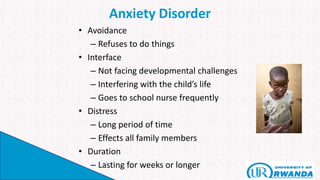
Anxiety Disorder
• Avoidance
– Refuses to do things
• Interface
– Not facing developmental challenges
– Interfering with the child’s life
– Goes to school nurse frequently
• Distress
– Long period of time
– Effects all family members
• Duration
– Lasting for weeks or longer
Prevalence of Anxiety
• 12 to 20 % of children suffer from anxiety
– severe enough to interferes with functioning
• Most Common 5 %
– Generalized Anxiety disorder
– Separation Anxiety Disorder
– Social Phobia
– Specific Phobia
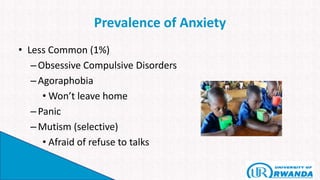
Prevalence of Anxiety
• Less Common (1%)
–Obsessive Compulsive Disorders
–Agoraphobia
• Won’t leave home
–Panic
–Mutism (selective)
• Afraid of refuse to talks
Separation Anxiety
3 or more of the following :
• Distress when separation occurs
• Worry about harm may occur to
others
• Worry something will happen &
separation will occur
• Refusal to go to school
• Fear or reluctance to be alone
• Refusal to sleep away from
parents
• Nightmares
• Physical complaints at
separation
Separation Anxiety Symptoms
• Ages 5-8- fear of harm befalling attachment figures,
nightmares, school refusal
• Ages 9-12- excessive distress at separation
– Tantrums
• Ages 13 -16- somatic complaints & school refusal
– Can even occur in adults
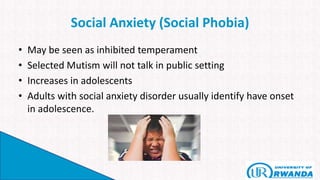
Social Anxiety (Social Phobia)
• May be seen as inhibited temperament
• Selected Mutism will not talk in public setting
• Increases in adolescents
• Adults with social anxiety disorder usually identify have onset
in adolescence.
Name some commonly avoided situations
• Birthday parties
• Meeting new people
• Talking to adults
• Entering a group of peers
• Talking one on one
• Being assertive
• Performances
• Class participation
• Public speaking
• Public or shared Restrooms
• Playing sports
• Dating
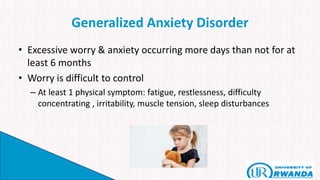
Generalized Anxiety Disorder
• Excessive worry & anxiety occurring more days than not for at
least 6 months
• Worry is difficult to control
– At least 1 physical symptom: fatigue, restlessness, difficulty
concentrating , irritability, muscle tension, sleep disturbances
Generalized Anxiety Disorder
• Self conscious and require frequent reassurance
– “What if ????”
• Worry about low frequency events
– Intensity of worry differentiates youth with Generalized Anxiety
Disorder from those without the disorder
Anxiety Issues at School
• Generalized Anxiety Disorder
– Excessive worry about school work, friendships
– Needs for reassurance
– May ask repeated questions
• Social Phobia
– Avoidance or extreme discomfort
– R/T doing or performing in groups or in front of others
• Separation Anxiety Disorder
– Worries about something happening to parent
– Wants to call parent, wants to go home
Refusal to Attend School
• Identify underlying reason for refusal to go to school
– Separation fears
– Social anxiety
– Test anxiety
– Boredom
– Bullying or being teased
– Learning problems or disability
Warning Signs for Anxiety
• Shyness (extreme)
• Isolation
• Avoidance of social situations
• Extreme discomfort when the center of attention
• Avoids schoolwork for fear of making a mistake
Warning Signs for Anxiety
• Expecting bad things to happen
• Excessive worries about upsetting others
• Frequent questions
• Perfectionism
• Excessive worries about failure
• High strung, shaky, unable to relax
• Lacking self-confidence
Somatic Physical Symptoms
• Shortness of breath
• Stomach aches
• Headaches
• Nausea
• Sweating
• Dizziness, fainting, light headed
• Increased heart rate
• Shaking or jittery
– + reinforcement
Screening for Anxiety
• Does your child worry or ask for parental reassurance almost
every day?
• Does your child consistently avoid certain age-appropriate
situations or activities, or avoid doing them without a parent?
• Does your child frequently complain of a stomach ache,
headache or have times or episodes of hyperventilating ?
• Does your child have daily repetitive rituals?
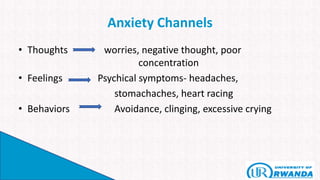
Anxiety Channels
• Thoughts worries, negative thought, poor
concentration
• Feelings Psychical symptoms- headaches,
stomachaches, heart racing
• Behaviors Avoidance, clinging, excessive crying
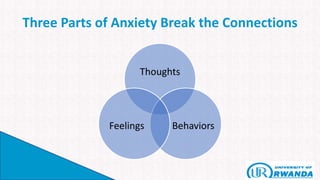
Three Parts of Anxiety Break the Connections
Thoughts
BehaviorsFeelings
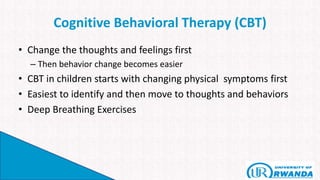
Cognitive Behavioral Therapy (CBT)
• Change the thoughts and feelings first
– Then behavior change becomes easier
• CBT in children starts with changing physical symptoms first
• Easiest to identify and then move to thoughts and behaviors
• Deep Breathing Exercises
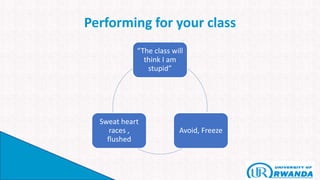
Performing for your class
“The class will
think I am
stupid”
Avoid, Freeze
Sweat heart
races ,
flushed
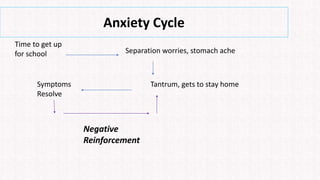
Anxiety Cycle
Time to get up
for school Separation worries, stomach ache
Tantrum, gets to stay homeSymptoms
Resolve
Negative
Reinforcement
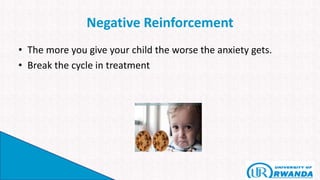
Negative Reinforcement
• The more you give your child the worse the anxiety gets.
• Break the cycle in treatment
Parenting Strategy
• Reward courageous behaviors
– Avoid giving in to your child's fear behavior
• Don’t give in to the child’s attempts to avoid things they should
be doing
– like school or activities
• Teach your child to communicate, cope and problem solve
• Control your anxiety as a parent
How To Win the Avoidance Battle
• Disengage or ignore
– at the earliest possible point
• Do not engage in back and forth arguing
• Maintain a calm emotional reaction
– Avoid punishment
– Calmest person wins !!!
• As soon as child calms down even briefly, engage in a
different activities
– Positive reinforcement of appropriate behaviors
– This can include discussion of the event
References
• Cohen, J. A., Berliner, L., & Mannarino, A. (2010). Trauma focused CBT for
children with co-occurring trauma and behavior problems. Child abu
• Cook, A., Spinazzola, J., Ford, J., Lanktree, C., Blaustein, M., Cloitre, M., ... &
Mallah, K. (2017). Complex trauma in children and adolescents. Psychiatric
annals, 35(5), 390-398.
• Stallard, P. (2005). A clinician's guide to think good-feel good: Using CBT
with children and young people. John Wiley & Sons.se & neglect, 34(4),
215-224.
• Vigerland, S., Ljótsson, B., Thulin, U., Öst, L. G., Andersson, G., &
Serlachius, E. (2016). Internet-delivered cognitive behavioural therapy for
children with anxiety disorders: a randomised controlled trial. Behaviour
Research and Therapy, 76, 47-56.

Childanixiety

  • 1.
    Childhood Anxiety andFear University of Rwanda Rebecca L White, MSN, FPMHNP-BC, FNP-BC
  • 2.
    Objectives • Recognize thedifference between anxiety & fear in children and adolescents • Identify anxiety levels that are at risk for becoming pathological • Apply Cognitive behavioral therapy basic to children suffering from fear and anxiety • Express a working knowledge and have the ability to educate parents in basic CBT skills with their children
  • 3.
    What is Anxiety •How do I know if a child has anxiety? • Fear of something bad happening • Worrying about the future – “Am I going to get sick” – “Is something going to happen to my parents” – “ Am I going to get a bad grade on this test”
  • 4.
    What is Fear? • An immediate reaction to an actual or perceived threat • In the moment • A dog barking will I get bitten? • Developmental levels are natures early warning systems to avoid injury
  • 5.
    Normal Developmental Fears •Infancy-strangers, loud noises – Able to differentiate • Early childhood-separation monsters – See normal fears – Separation anxiety • Middle childhood-real-world dangers and new challenges – Attending school – Meeting other kids, going out into world – Earthquake fires, – Worry about school • Adolescence- social status, social group performance. – Peer attention – Social
  • 6.
    Anxiety • Mild fearsare common in children • Fears decline with age • Girls report a greater number of fears than boys in general • Problematic anxiety – Similar in girls and boys until puberty then the rate of anxiety in girls is almost double that of boys
  • 7.
    Expression of Anxiety& Depression in Children-Cognitive Development • Emotional & cognitive development - how children express fear and anxiety – Small child clinging, crying , tantrums, stomach aches • Fears change – Concrete fears-monsters, the dark, illness – Abstract “what about my future?” ”what will happen about the world?” “will they like me? “ • Focus changes over time-specific fears decrease over the course of childhood • Social anxiety increases with age – Phobias may be present
  • 8.
    Anxiety • Short termanxiety is common and normal • Related to events Going to a new school • Oral report , teasing at school • Overshadowed by cumulative effect of positive reinforcement
  • 9.
    Normal versus ProblematicAnxiety • Intensity of fear – is it within expected limits or out of proportion to the actual threat screaming yelling? • Frequency of fears- – does it continue for longer than normal despite being supported to reassured? • Is fear focused on an inappropriate situation such as fear of dogs but it is a picture of a dog? • Does the fear occur spontaneously ? (no reason)
  • 10.
    Anxiety Disorder • Avoidance –Refuses to do things • Interface – Not facing developmental challenges – Interfering with the child’s life – Goes to school nurse frequently • Distress – Long period of time – Effects all family members • Duration – Lasting for weeks or longer
  • 11.
    Prevalence of Anxiety •12 to 20 % of children suffer from anxiety – severe enough to interferes with functioning • Most Common 5 % – Generalized Anxiety disorder – Separation Anxiety Disorder – Social Phobia – Specific Phobia
  • 12.
    Prevalence of Anxiety •Less Common (1%) –Obsessive Compulsive Disorders –Agoraphobia • Won’t leave home –Panic –Mutism (selective) • Afraid of refuse to talks
  • 13.
    Separation Anxiety 3 ormore of the following : • Distress when separation occurs • Worry about harm may occur to others • Worry something will happen & separation will occur • Refusal to go to school • Fear or reluctance to be alone • Refusal to sleep away from parents • Nightmares • Physical complaints at separation
  • 14.
    Separation Anxiety Symptoms •Ages 5-8- fear of harm befalling attachment figures, nightmares, school refusal • Ages 9-12- excessive distress at separation – Tantrums • Ages 13 -16- somatic complaints & school refusal – Can even occur in adults
  • 15.
    Social Anxiety (SocialPhobia) • May be seen as inhibited temperament • Selected Mutism will not talk in public setting • Increases in adolescents • Adults with social anxiety disorder usually identify have onset in adolescence.
  • 16.
    Name some commonlyavoided situations • Birthday parties • Meeting new people • Talking to adults • Entering a group of peers • Talking one on one • Being assertive • Performances • Class participation • Public speaking • Public or shared Restrooms • Playing sports • Dating
  • 17.
    Generalized Anxiety Disorder •Excessive worry & anxiety occurring more days than not for at least 6 months • Worry is difficult to control – At least 1 physical symptom: fatigue, restlessness, difficulty concentrating , irritability, muscle tension, sleep disturbances
  • 18.
    Generalized Anxiety Disorder •Self conscious and require frequent reassurance – “What if ????” • Worry about low frequency events – Intensity of worry differentiates youth with Generalized Anxiety Disorder from those without the disorder
  • 19.
    Anxiety Issues atSchool • Generalized Anxiety Disorder – Excessive worry about school work, friendships – Needs for reassurance – May ask repeated questions • Social Phobia – Avoidance or extreme discomfort – R/T doing or performing in groups or in front of others • Separation Anxiety Disorder – Worries about something happening to parent – Wants to call parent, wants to go home
  • 20.
    Refusal to AttendSchool • Identify underlying reason for refusal to go to school – Separation fears – Social anxiety – Test anxiety – Boredom – Bullying or being teased – Learning problems or disability
  • 21.
    Warning Signs forAnxiety • Shyness (extreme) • Isolation • Avoidance of social situations • Extreme discomfort when the center of attention • Avoids schoolwork for fear of making a mistake
  • 22.
    Warning Signs forAnxiety • Expecting bad things to happen • Excessive worries about upsetting others • Frequent questions • Perfectionism • Excessive worries about failure • High strung, shaky, unable to relax • Lacking self-confidence
  • 23.
    Somatic Physical Symptoms •Shortness of breath • Stomach aches • Headaches • Nausea • Sweating • Dizziness, fainting, light headed • Increased heart rate • Shaking or jittery – + reinforcement
  • 24.
    Screening for Anxiety •Does your child worry or ask for parental reassurance almost every day? • Does your child consistently avoid certain age-appropriate situations or activities, or avoid doing them without a parent? • Does your child frequently complain of a stomach ache, headache or have times or episodes of hyperventilating ? • Does your child have daily repetitive rituals?
  • 25.
    Anxiety Channels • Thoughtsworries, negative thought, poor concentration • Feelings Psychical symptoms- headaches, stomachaches, heart racing • Behaviors Avoidance, clinging, excessive crying
  • 26.
    Three Parts ofAnxiety Break the Connections Thoughts BehaviorsFeelings
  • 27.
    Cognitive Behavioral Therapy(CBT) • Change the thoughts and feelings first – Then behavior change becomes easier • CBT in children starts with changing physical symptoms first • Easiest to identify and then move to thoughts and behaviors • Deep Breathing Exercises
  • 28.
    Performing for yourclass “The class will think I am stupid” Avoid, Freeze Sweat heart races , flushed
  • 29.
    Anxiety Cycle Time toget up for school Separation worries, stomach ache Tantrum, gets to stay homeSymptoms Resolve Negative Reinforcement
  • 30.
    Negative Reinforcement • Themore you give your child the worse the anxiety gets. • Break the cycle in treatment
  • 31.
    Parenting Strategy • Rewardcourageous behaviors – Avoid giving in to your child's fear behavior • Don’t give in to the child’s attempts to avoid things they should be doing – like school or activities • Teach your child to communicate, cope and problem solve • Control your anxiety as a parent
  • 32.
    How To Winthe Avoidance Battle • Disengage or ignore – at the earliest possible point • Do not engage in back and forth arguing • Maintain a calm emotional reaction – Avoid punishment – Calmest person wins !!! • As soon as child calms down even briefly, engage in a different activities – Positive reinforcement of appropriate behaviors – This can include discussion of the event
  • 33.
    References • Cohen, J.A., Berliner, L., & Mannarino, A. (2010). Trauma focused CBT for children with co-occurring trauma and behavior problems. Child abu • Cook, A., Spinazzola, J., Ford, J., Lanktree, C., Blaustein, M., Cloitre, M., ... & Mallah, K. (2017). Complex trauma in children and adolescents. Psychiatric annals, 35(5), 390-398. • Stallard, P. (2005). A clinician's guide to think good-feel good: Using CBT with children and young people. John Wiley & Sons.se & neglect, 34(4), 215-224. • Vigerland, S., Ljótsson, B., Thulin, U., Öst, L. G., Andersson, G., & Serlachius, E. (2016). Internet-delivered cognitive behavioural therapy for children with anxiety disorders: a randomised controlled trial. Behaviour Research and Therapy, 76, 47-56.