ATTACHMENT
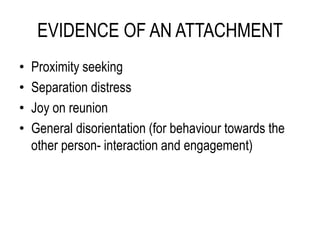
EVIDENCE OF AN ATTACHMENT
• Proximity seeking
• Separation distress
• Joy on reunion
• General disorientation (for behaviour towards the
other person- interaction and engagement)
THE LEARNING THEORY
• Classical conditioning
– The person that feeds the infant becomes associated with
the food, bringing pleasure; association between the
individual and pleasure leads to an attachment bond
– Pavlov’s dog study
• Operant conditioning
– A type of learning that takes place because of actions and
rewards that would reinforce the behaviour
• Social learning
– Role models
BOWLBY’S EVOLUTIONARY THEORY
• Survival
– Babies form attachments in order to survive; infants require adults to
feed, care for and protect them, and humans have evolved so that
babies have innate tendencies to form attachments
• Monotropy
– A single attachment to one person who is most important to the baby
• Internal working model
– Attachments at a young age provide a template for all future
relationships
• Sensitive/critical period
– If attachments are not formed within the first 3 years of a child’s life, it
can have serious consequences for future relationships, as attachments
will not form outside of this period
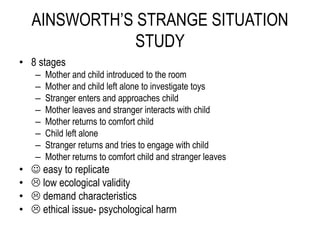
AINSWORTH’S STRANGE SITUATION
STUDY
• 8 stages
– Mother and child introduced to the room
– Mother and child left alone to investigate toys
– Stranger enters and approaches child
– Mother leaves and stranger interacts with child
– Mother returns to comfort child
– Child left alone
– Stranger returns and tries to engage with child
– Mother returns to comfort child and stranger leaves
•  easy to replicate
•  low ecological validity
•  demand characteristics
•  ethical issue- psychological harm
AINSWORTH’S TYPES OF ATTACHMENT
• Secure (70%)
– Baby uses mother as a safe base and is happy to explore
– Gets distressed with mother leaves
– When mother returns, baby quickly settles down and plays again
• Insecure-avoidant (15%)
– Baby shows some distress when mother leaves
– Doesn’t seek comfort on reunion; can be comforted by strangers
• Insecure-resistant (15%)
– Easily distressed when mother leaves
– On reunion, baby alternates between seeking comfort and
rejecting it
COLLECTIVIST VS. INDIVIDUALIST
• Van Ijzendoorn & Kroonenberg
– Most common = secure
– Non-Western countries- more collectivist
– Western countries- insecure-avoidant
– China- 50/50 split between two insecure types
•  based on strange situation study, so there is potential for having
all variables controlled in the same way, meaning that results can
be compared with other researchers
•  mixture of collectivist and individualist cultures
•  each study that was compared were slightly different to each
other, so comparisons may not be reliable
•  ethical issues- distress to infants
•  small sample- only one study in the UK, Sweden and China
DISRUPTION OF ATTACHMENT
• Separation- child is away from the caregiver they are
attached to for a relatively short time, just hours or days.
• Deprivation- the loss of something that is wanted or needed,
a long-term or even permanent loss
• Stages of disruption
– Protest- few hours, crying, panicking etc.
– Despair- day or two, withdrawn, eat/sleep less
– Detachment- alert, ‘recovered’, possible permanent damage to
attachment
• Robertson & Robertson
– Short term separation can have very bad effects or possible
permanent damage to an attachment
THE PDD MODEL
• PDD Model
– Separating a child from its caregivers should be avoided
– Children in foster care do better than those in an
institutionalised setting; they can cope with the
separation if they still receive one-on-one emotional
support
– Many factors influence a child’s reaction to separation
which might not necessarily produce the PDD effects
BOWLBY- 44 JUVENILE THEIVES
• Bowlby
– 44 teens who were convicted of stealing, 44 teens who
had never stolen anything but were still ‘emotionally
disturbed’
– 17 thieves had frequent separation before the age of 2
from the convicted group, but only 2 from the control
group
– Deprivation has harmful long-term consequences
•  cannot determine cause/effect or explain any
extraneous variables
LONG TERM EFFECTS OF SEPARATION
• Affectionless psychopathology
– As seen in the 44 juvenile thieves
• Anaclitic depression
– Appetite loss, sleeplessness, impaired social and
intellectual development
• Deprivation dwarfism
– Physically underdeveloped
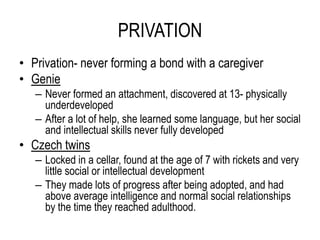
PRIVATION
• Privation- never forming a bond with a caregiver
• Genie
– Never formed an attachment, discovered at 13- physically
underdeveloped
– After a lot of help, she learned some language, but her social
and intellectual skills never fully developed
• Czech twins
– Locked in a cellar, found at the age of 7 with rickets and very
little social or intellectual development
– They made lots of progress after being adopted, and had
above average intelligence and normal social relationships
by the time they reached adulthood.
GENIE VS. CZECH TWINS
• Length/Age
– Czech twins had more time to develop because they were found at a
younger age
• Experiences
– Twins were kept together so they became attached to each other but
Genie was alone
• Quality of care
– The twins were adopted but Genie was put in an institution so it would
have been harder to form attachments there
•  cannot generalise findings
•  mixed results
•  more controlled, scientific evidence needed, but ethically wrong
to put children in situations of privation
HODGES & TIZARD
• Hodges & Tizard
– 65 children in residential nursery before they were 4 months old
– They had no chance to form close attachments
– By the age of 4, some were adopted, some stayed at the nursery and
some were returned to their mothers
– Children can recover from early privation if they are in a good quality,
loving environment, although their social development is not as good as
children without privation
– The adopted children showed strong family relationships, where others
showed poorer relationships
•  natural experiment- high ecological validity
•  supported by Rutter (Romanian orphans)- adopted have a
better chance than those not adopted
•  small sample- hard to generalise results
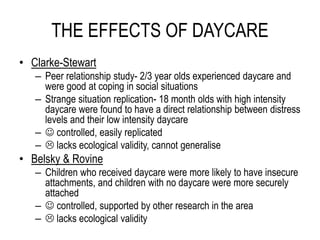
THE EFFECTS OF DAYCARE
• Clarke-Stewart
– Peer relationship study- 2/3 year olds experienced daycare and
were good at coping in social situations
– Strange situation replication- 18 month olds with high intensity
daycare were found to have a direct relationship between distress
levels and their low intensity daycare
–  controlled, easily replicated
–  lacks ecological validity, cannot generalise
• Belsky & Rovine
– Children who received daycare were more likely to have insecure
attachments, and children with no daycare were more securely
attached
–  controlled, supported by other research in the area
–  lacks ecological validity
WHAT IS GOOD DAYCARE?
• Good staff training
• Adequate space
• Appropriate toys and activities
• Good ratio of staff to children
• Minimal turnover so that children form stable
attachments with the carers

Attachment

  • 1.
  • 2.
    EVIDENCE OF ANATTACHMENT • Proximity seeking • Separation distress • Joy on reunion • General disorientation (for behaviour towards the other person- interaction and engagement)
  • 3.
    THE LEARNING THEORY •Classical conditioning – The person that feeds the infant becomes associated with the food, bringing pleasure; association between the individual and pleasure leads to an attachment bond – Pavlov’s dog study • Operant conditioning – A type of learning that takes place because of actions and rewards that would reinforce the behaviour • Social learning – Role models
  • 4.
    BOWLBY’S EVOLUTIONARY THEORY •Survival – Babies form attachments in order to survive; infants require adults to feed, care for and protect them, and humans have evolved so that babies have innate tendencies to form attachments • Monotropy – A single attachment to one person who is most important to the baby • Internal working model – Attachments at a young age provide a template for all future relationships • Sensitive/critical period – If attachments are not formed within the first 3 years of a child’s life, it can have serious consequences for future relationships, as attachments will not form outside of this period
  • 5.
    AINSWORTH’S STRANGE SITUATION STUDY •8 stages – Mother and child introduced to the room – Mother and child left alone to investigate toys – Stranger enters and approaches child – Mother leaves and stranger interacts with child – Mother returns to comfort child – Child left alone – Stranger returns and tries to engage with child – Mother returns to comfort child and stranger leaves •  easy to replicate •  low ecological validity •  demand characteristics •  ethical issue- psychological harm
  • 6.
    AINSWORTH’S TYPES OFATTACHMENT • Secure (70%) – Baby uses mother as a safe base and is happy to explore – Gets distressed with mother leaves – When mother returns, baby quickly settles down and plays again • Insecure-avoidant (15%) – Baby shows some distress when mother leaves – Doesn’t seek comfort on reunion; can be comforted by strangers • Insecure-resistant (15%) – Easily distressed when mother leaves – On reunion, baby alternates between seeking comfort and rejecting it
  • 7.
    COLLECTIVIST VS. INDIVIDUALIST •Van Ijzendoorn & Kroonenberg – Most common = secure – Non-Western countries- more collectivist – Western countries- insecure-avoidant – China- 50/50 split between two insecure types •  based on strange situation study, so there is potential for having all variables controlled in the same way, meaning that results can be compared with other researchers •  mixture of collectivist and individualist cultures •  each study that was compared were slightly different to each other, so comparisons may not be reliable •  ethical issues- distress to infants •  small sample- only one study in the UK, Sweden and China
  • 8.
    DISRUPTION OF ATTACHMENT •Separation- child is away from the caregiver they are attached to for a relatively short time, just hours or days. • Deprivation- the loss of something that is wanted or needed, a long-term or even permanent loss • Stages of disruption – Protest- few hours, crying, panicking etc. – Despair- day or two, withdrawn, eat/sleep less – Detachment- alert, ‘recovered’, possible permanent damage to attachment • Robertson & Robertson – Short term separation can have very bad effects or possible permanent damage to an attachment
  • 9.
    THE PDD MODEL •PDD Model – Separating a child from its caregivers should be avoided – Children in foster care do better than those in an institutionalised setting; they can cope with the separation if they still receive one-on-one emotional support – Many factors influence a child’s reaction to separation which might not necessarily produce the PDD effects
  • 10.
    BOWLBY- 44 JUVENILETHEIVES • Bowlby – 44 teens who were convicted of stealing, 44 teens who had never stolen anything but were still ‘emotionally disturbed’ – 17 thieves had frequent separation before the age of 2 from the convicted group, but only 2 from the control group – Deprivation has harmful long-term consequences •  cannot determine cause/effect or explain any extraneous variables
  • 11.
    LONG TERM EFFECTSOF SEPARATION • Affectionless psychopathology – As seen in the 44 juvenile thieves • Anaclitic depression – Appetite loss, sleeplessness, impaired social and intellectual development • Deprivation dwarfism – Physically underdeveloped
  • 12.
    PRIVATION • Privation- neverforming a bond with a caregiver • Genie – Never formed an attachment, discovered at 13- physically underdeveloped – After a lot of help, she learned some language, but her social and intellectual skills never fully developed • Czech twins – Locked in a cellar, found at the age of 7 with rickets and very little social or intellectual development – They made lots of progress after being adopted, and had above average intelligence and normal social relationships by the time they reached adulthood.
  • 13.
    GENIE VS. CZECHTWINS • Length/Age – Czech twins had more time to develop because they were found at a younger age • Experiences – Twins were kept together so they became attached to each other but Genie was alone • Quality of care – The twins were adopted but Genie was put in an institution so it would have been harder to form attachments there •  cannot generalise findings •  mixed results •  more controlled, scientific evidence needed, but ethically wrong to put children in situations of privation
  • 14.
    HODGES & TIZARD •Hodges & Tizard – 65 children in residential nursery before they were 4 months old – They had no chance to form close attachments – By the age of 4, some were adopted, some stayed at the nursery and some were returned to their mothers – Children can recover from early privation if they are in a good quality, loving environment, although their social development is not as good as children without privation – The adopted children showed strong family relationships, where others showed poorer relationships •  natural experiment- high ecological validity •  supported by Rutter (Romanian orphans)- adopted have a better chance than those not adopted •  small sample- hard to generalise results
  • 15.
    THE EFFECTS OFDAYCARE • Clarke-Stewart – Peer relationship study- 2/3 year olds experienced daycare and were good at coping in social situations – Strange situation replication- 18 month olds with high intensity daycare were found to have a direct relationship between distress levels and their low intensity daycare –  controlled, easily replicated –  lacks ecological validity, cannot generalise • Belsky & Rovine – Children who received daycare were more likely to have insecure attachments, and children with no daycare were more securely attached –  controlled, supported by other research in the area –  lacks ecological validity
  • 16.
    WHAT IS GOODDAYCARE? • Good staff training • Adequate space • Appropriate toys and activities • Good ratio of staff to children • Minimal turnover so that children form stable attachments with the carers