David Wall-Jones
Senior Mental Health Promotion
Specialist
Education Bradford & Bradford & Airedale PCT
Mental Health and Emotional
Wellbeing
Exercise
• Talk to person sitting next to you and briefly
describe a child who you know or who you
believe is leading a emotionally, mentally and
healthy life.
• What are the key characteristics of this child?
Please display these as thoughts or behaviours
on the sheet provided.
Learning Together –
• Understand and respect others
• Maintain confidentiality
• Taking equality and diversity seriously
• Commitment to learning
• Time out
n
• In 2004 one in ten children in
Great Britain aged 5-16 had a
clinically recognisable mental
disorder. This is the same
proportion recorded in
1999.
• Mental illness
disproportionately affects
children in low income
households, large families,
step families or single parent
families.
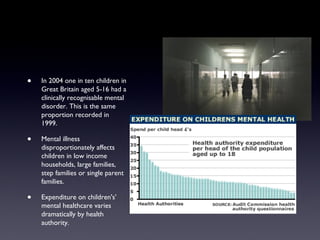
• Expenditure on children's’
mental healthcare varies
dramatically by health
authority.
Definition of Mental
HealthMental health is …having the capacities of:
•The ability to develop psychologically,
emotionally, intellectually and spiritually
•The ability to initiate, develop and sustain
mutually satisfying personal relationships
•The ability to become aware of others and
empathise with them
•The ability to use psychological distress as a
developmental process.(HAS, 1995)
Another Definition of
Mental HealthWhen looking at mental health we need to take into
account emotional well-being; happiness; integrity &
creativity; the capacity to cope with stress and
difficulty.
Mental health, in effect refers to the capacity to live a
full, productive life as well as the flexibility to deal with
its ups and downs. In children and young people it is
especially about the capacity to learn, enjoy friendships,
to meet challenges, to develop talents and capabilities.
(YoungMinds, 1996)
Young People’s View of
Mental HealthThe young people identified four main factors as contributing to mental
health:
• Family and friends
• Having people to talk to
• Personal achievement, and
• Feeling good about yourself
• Pets, presents and having fun were also mentioned.
Friends and family were seen as making young people feel secure,
supported and wanted and conversely as preventing feelings of
isolation.
Prevalence of mental health
problems in children and young
people
Distinction needs to be made between mental health
problems and disorders
The former are seen to encompass a very broad range
of emotional and behavioural difficulties which may
cause concern or distress. They are relatively
common. The latter however are more severe and
persistent and usually defined using fairly clear
diagnostic criteria.
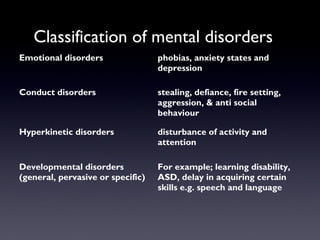
Classification of mental disorders
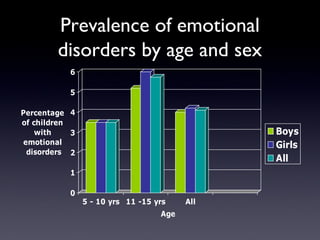
Emotional disorders phobias, anxiety states and
depression
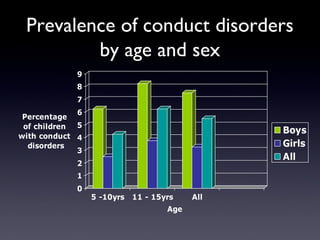
Conduct disorders stealing, defiance, fire setting,
aggression, & anti social
behaviour
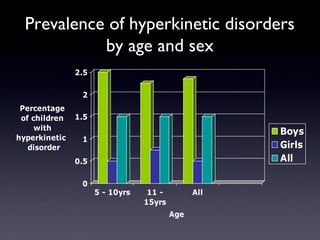
Hyperkinetic disorders disturbance of activity and
attention
Developmental disorders
(general, pervasive or specific)
For example; learning disability,
ASD, delay in acquiring certain
skills e.g. speech and language
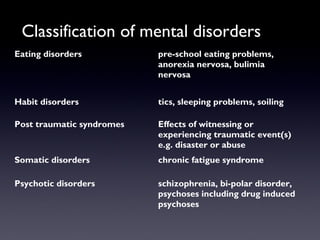
Classification of mental disorders
Eating disorders pre-school eating problems,
anorexia nervosa, bulimia
nervosa
Habit disorders tics, sleeping problems, soiling
Post traumatic syndromes Effects of witnessing or
experiencing traumatic event(s)
e.g. disaster or abuse
Somatic disorders chronic fatigue syndrome
Psychotic disorders schizophrenia, bi-polar disorder,
psychoses including drug induced
psychoses
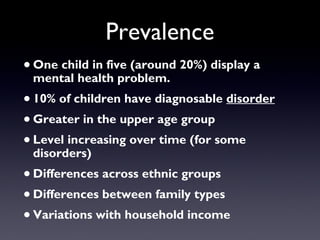
Prevalence
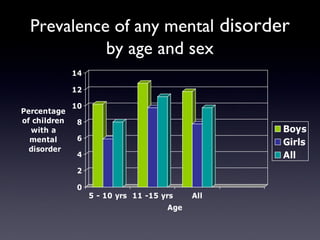
•One child in five (around 20%) display a
mental health problem.
•10% of children have diagnosable disorder
•Greater in the upper age group
•Level increasing over time (for some
disorders)
•Differences across ethnic groups
•Differences between family types
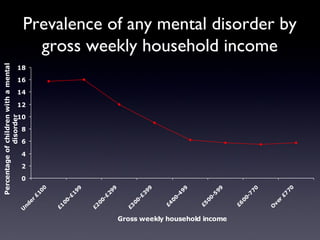
•Variations with household income
Prevalence of any mental disorder
by age and sex
0
2
4
6
8
10
12
14
Percentage
of children
with a
mental
disorder
5 - 10 yrs 11 -15 yrs All
Age
Boys
Girls
All
Prevalence of emotional
disorders by age and sex
0
1
2
3
4
5
6
Percentage
of children
with
emotional
disorders
5 - 10 yrs 11 -15 yrs All
Age
Boys
Girls
All
Prevalence of conduct disorders
by age and sex
0
1
2
3
4
5
6
7
8
9
Percentage
of children
with conduct
disorders
5 -10yrs 11 - 15yrs All
Age
Boys
Girls
All
Prevalence of hyperkinetic disorders
by age and sex
0
0.5
1
1.5
2
2.5
Percentage
of children
with
hyperkinetic
disorder
5 - 10yrs 11 -
15yrs
All
Age
Boys
Girls
All
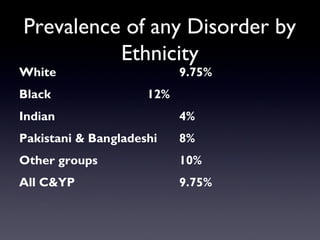
Prevalence of any Disorder by
Ethnicity
White 9.75%
Black 12%
Indian 4%
Pakistani & Bangladeshi 8%
Other groups 10%
All C&YP 9.75%
Prevalence of any mental disorder by
gross weekly household income
0
2
4
6
8
10
12
14
16
18
U
nder
£
100
£1
00-£
199
£2
00-£
299
£3
00-£
399
£4
00-4
99
£5
00-5
99
£6
00-7
70
O
ver
£7
70
Gross weekly household income
Percentageofchildrenwithamental
disorder
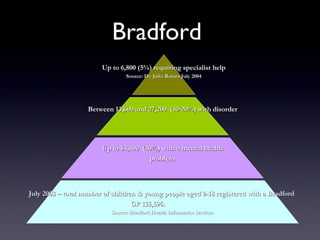
Bradford
Up to 6,800 (5%) requiring specialist helpUp to 6,800 (5%) requiring specialist help
Source: Dr. Julia Raines July 2004Source: Dr. Julia Raines July 2004
Between 13,600 and 27,200 (10-20%) with disorderBetween 13,600 and 27,200 (10-20%) with disorder
Up to 54,400 (40%) with a mental healthUp to 54,400 (40%) with a mental health
problemproblem
July 2003 – total number of children & young people aged 0-18 registered with a BradfordJuly 2003 – total number of children & young people aged 0-18 registered with a Bradford
GP 135,596.GP 135,596.
Source: Bradford Health Informatics ServicesSource: Bradford Health Informatics Services
Exercise
Case Studies1) What do you think are the issues in this case study?
2) Do you think there is a mental health problem?
3) What are the key factors that you feel need to be
considered?
4) What further information would you like to have to
be clearer about what to do next?
5) Suggest a specific intervention.
6) Do you think this case requires specialist?
What helps - Anxiety
• Prevention - A number of causes of general anxiety in childhood can be
prevented by sensible handling
• For illogical fears that are not quite phobias, simple explanations and
reassurance will help many children gradually get over them
• Detailed interview with child and family
• Look to other agencies for interventions eg Educational Psychologists or
Education Socal Workers if anxiety is about school, social workers if
about home life
What helps - Anxiety
• Talking to or helping children and parents to understand how
the problem has developed
• Specific fears are usually treated by helping children confront
their fear in a way and at a pace that they can manage eg
carefully planning a gradual return to school if the anxiety is
school based
• Teaching relaxation
• Help children talk through their anxieties using drawing or
play
What helps - Depression
• About 10% of children and young people with depression recover
spontaneously within 3 months
• Be able to determine, recognise and assess those with depression
• Ensure timely information is available on the nature, cause and treatment
in all local languages
(NICE, 2005)
• Ask sympathetically how they are and listen to the response
• Encourage them to remain active
• Praise all efforts
(Royal College of Psychiatrists, 1999; YoungMinds)
What helps - Hyperactivity
• Learn about hyperactivity and what it means
• Give structure and encourage regular routine
• Give clear instructions, sufficient time to complete tasks
• Provide a variety of physical activity
• Reward any achievements
(HASCAS, 2004)
What helps – conduct
disorder
• All approaches are grounded in respect for the child
• Empathy, attention and involvement, play, problem-solving, listening,
talking.
• Praise any achievements and reward them
• Encouragement
• Clear limits and consistent rules with consistent follow-through
• Ignore negative behaviour, distract from negative behaviour (positive
verbal redirection) and use re-engagement strategies
• Remind of expected behaviour and warn of consequences
• Use consequences
What else helps children’s and young
people’s mental health?
• Adults being self-aware
• Feeling helpless/angry/rejected
• Learn from your experiences
• Respect their view even if an alternative adult view is presented
• Understanding
• Them
• Their peer group
• Their developmental stage/age
• Their life circumstances
What else helps children’s and young
people’s mental health?
• Listening
• Actively
• Open questions
• Warmth and empathy
• Take account of cultural issues
• Never promise to keep a secret
• Child protection procedures
• Emotional language
What else helps children’s and
young people’s mental health?
• Boundaries
•Knowing what they can and can’t do
•Be consistent
•Expect challenge
• Skill Development
•Enabling children and young people to improve
their mastery of stressful situations
What else helps children’s and
young people’s mental health?
• Being there
•Links with attachment
•Even if they don’t talk to you, the main thing is
not to put them off talking to someone in the
future
•Doing what you promise – don’t let them down!
Beginnings
• Where do you begin?
Resilience
Resilience involves several related elements.
Firstly, a sense of self-esteem and confidence;
Secondly a belief in one’s own self-efficacy and ability to deal
with change and adaptation;
Thirdly, a repertoire of social problem solving approaches’ (Rutter 1985)
Resilience Factors -Child
• Secure early relationships
• Being female
• Higher intelligence
• Easy temperament when an infant
• Positive attitude, problem-solving approach
• Good communication skills
• Planner, belief in control
• Humour
• Religious faith
Capacity to reflect
Resilience Factors - Family
• At least one good parent-child relationship
• Affection
• Clear, firm and consistent discipline
• Support for education
• Supportive long-term relationship/absence of
severe discord
Resilience Factors -
Community• Wider supportive network
• Good housing
• High standard of living
• High morale school with positive policies for
behaviour, attitude and anti-bullying
• Schools with strong academic and non-
academic opportunities
• Range of sport/leisure opportunities
Promoting resilience in relationships
• Increase warmth and pleasure parent feels for the
child
• Foster concern/interest as this helps to develop self-
esteem
• Foster ability to predict child’s needs
• Use activities which foster connectedness
• Help parents and children to do funny things
together
• Build parental confidence and skills
Outcome
• Be healthy
• Stay safe
• Enjoy and achieve
• Make a positive contribution
• Achieve economic well being
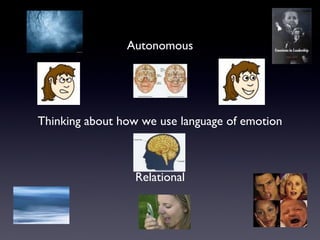
Emotional Presupposing
Thinking about how we use language of emotion
Relational
Autonomous
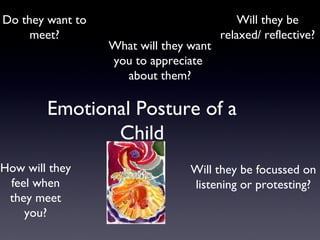
Emotional Posture of a
Child
Do they want to
meet?
How will they
feel when
they meet
you?
Will they be
relaxed/ reflective?
Will they be focussed on
listening or protesting?
What will they want
you to appreciate
about them?
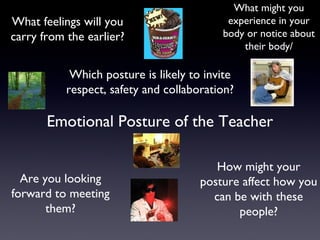
Emotional Posture of the Teacher
Are you looking
forward to meeting
them?
What might you
experience in your
body or notice about
their body/
What feelings will you
carry from the earlier?
How might your
posture affect how you
can be with these
people?
Which posture is likely to invite
respect, safety and collaboration?
How would you like to be with this child?
Presuppose the postion
of the child, family, school, community and ourselves
Who might they ask
you to be?
How might they invite
you to act?
What might you need to do?
What position
do you prefer
to offer?
What is your
storyline?
Extend your repertoire of postions
If you did something
different what would
happen?
What other postions
might you invite?
Cpd  (dwj 11.07)  presentation copy

Cpd (dwj 11.07) presentation copy

  • 1.
    David Wall-Jones Senior MentalHealth Promotion Specialist Education Bradford & Bradford & Airedale PCT Mental Health and Emotional Wellbeing
  • 2.
    Exercise • Talk toperson sitting next to you and briefly describe a child who you know or who you believe is leading a emotionally, mentally and healthy life. • What are the key characteristics of this child? Please display these as thoughts or behaviours on the sheet provided.
  • 3.
    Learning Together – •Understand and respect others • Maintain confidentiality • Taking equality and diversity seriously • Commitment to learning • Time out
  • 4.
    n • In 2004one in ten children in Great Britain aged 5-16 had a clinically recognisable mental disorder. This is the same proportion recorded in 1999. • Mental illness disproportionately affects children in low income households, large families, step families or single parent families. • Expenditure on children's’ mental healthcare varies dramatically by health authority.
  • 5.
    Definition of Mental HealthMentalhealth is …having the capacities of: •The ability to develop psychologically, emotionally, intellectually and spiritually •The ability to initiate, develop and sustain mutually satisfying personal relationships •The ability to become aware of others and empathise with them •The ability to use psychological distress as a developmental process.(HAS, 1995)
  • 6.
    Another Definition of MentalHealthWhen looking at mental health we need to take into account emotional well-being; happiness; integrity & creativity; the capacity to cope with stress and difficulty. Mental health, in effect refers to the capacity to live a full, productive life as well as the flexibility to deal with its ups and downs. In children and young people it is especially about the capacity to learn, enjoy friendships, to meet challenges, to develop talents and capabilities. (YoungMinds, 1996)
  • 7.
    Young People’s Viewof Mental HealthThe young people identified four main factors as contributing to mental health: • Family and friends • Having people to talk to • Personal achievement, and • Feeling good about yourself • Pets, presents and having fun were also mentioned. Friends and family were seen as making young people feel secure, supported and wanted and conversely as preventing feelings of isolation.
  • 8.
    Prevalence of mentalhealth problems in children and young people Distinction needs to be made between mental health problems and disorders The former are seen to encompass a very broad range of emotional and behavioural difficulties which may cause concern or distress. They are relatively common. The latter however are more severe and persistent and usually defined using fairly clear diagnostic criteria.
  • 9.
    Classification of mentaldisorders Emotional disorders phobias, anxiety states and depression Conduct disorders stealing, defiance, fire setting, aggression, & anti social behaviour Hyperkinetic disorders disturbance of activity and attention Developmental disorders (general, pervasive or specific) For example; learning disability, ASD, delay in acquiring certain skills e.g. speech and language
  • 10.
    Classification of mentaldisorders Eating disorders pre-school eating problems, anorexia nervosa, bulimia nervosa Habit disorders tics, sleeping problems, soiling Post traumatic syndromes Effects of witnessing or experiencing traumatic event(s) e.g. disaster or abuse Somatic disorders chronic fatigue syndrome Psychotic disorders schizophrenia, bi-polar disorder, psychoses including drug induced psychoses
  • 11.
    Prevalence •One child infive (around 20%) display a mental health problem. •10% of children have diagnosable disorder •Greater in the upper age group •Level increasing over time (for some disorders) •Differences across ethnic groups •Differences between family types •Variations with household income
  • 12.
    Prevalence of anymental disorder by age and sex 0 2 4 6 8 10 12 14 Percentage of children with a mental disorder 5 - 10 yrs 11 -15 yrs All Age Boys Girls All
  • 13.
    Prevalence of emotional disordersby age and sex 0 1 2 3 4 5 6 Percentage of children with emotional disorders 5 - 10 yrs 11 -15 yrs All Age Boys Girls All
  • 14.
    Prevalence of conductdisorders by age and sex 0 1 2 3 4 5 6 7 8 9 Percentage of children with conduct disorders 5 -10yrs 11 - 15yrs All Age Boys Girls All
  • 15.
    Prevalence of hyperkineticdisorders by age and sex 0 0.5 1 1.5 2 2.5 Percentage of children with hyperkinetic disorder 5 - 10yrs 11 - 15yrs All Age Boys Girls All
  • 16.
    Prevalence of anyDisorder by Ethnicity White 9.75% Black 12% Indian 4% Pakistani & Bangladeshi 8% Other groups 10% All C&YP 9.75%
  • 17.
    Prevalence of anymental disorder by gross weekly household income 0 2 4 6 8 10 12 14 16 18 U nder £ 100 £1 00-£ 199 £2 00-£ 299 £3 00-£ 399 £4 00-4 99 £5 00-5 99 £6 00-7 70 O ver £7 70 Gross weekly household income Percentageofchildrenwithamental disorder
  • 18.
    Bradford Up to 6,800(5%) requiring specialist helpUp to 6,800 (5%) requiring specialist help Source: Dr. Julia Raines July 2004Source: Dr. Julia Raines July 2004 Between 13,600 and 27,200 (10-20%) with disorderBetween 13,600 and 27,200 (10-20%) with disorder Up to 54,400 (40%) with a mental healthUp to 54,400 (40%) with a mental health problemproblem July 2003 – total number of children & young people aged 0-18 registered with a BradfordJuly 2003 – total number of children & young people aged 0-18 registered with a Bradford GP 135,596.GP 135,596. Source: Bradford Health Informatics ServicesSource: Bradford Health Informatics Services
  • 20.
    Exercise Case Studies1) Whatdo you think are the issues in this case study? 2) Do you think there is a mental health problem? 3) What are the key factors that you feel need to be considered? 4) What further information would you like to have to be clearer about what to do next? 5) Suggest a specific intervention. 6) Do you think this case requires specialist?
  • 21.
    What helps -Anxiety • Prevention - A number of causes of general anxiety in childhood can be prevented by sensible handling • For illogical fears that are not quite phobias, simple explanations and reassurance will help many children gradually get over them • Detailed interview with child and family • Look to other agencies for interventions eg Educational Psychologists or Education Socal Workers if anxiety is about school, social workers if about home life
  • 22.
    What helps -Anxiety • Talking to or helping children and parents to understand how the problem has developed • Specific fears are usually treated by helping children confront their fear in a way and at a pace that they can manage eg carefully planning a gradual return to school if the anxiety is school based • Teaching relaxation • Help children talk through their anxieties using drawing or play
  • 23.
    What helps -Depression • About 10% of children and young people with depression recover spontaneously within 3 months • Be able to determine, recognise and assess those with depression • Ensure timely information is available on the nature, cause and treatment in all local languages (NICE, 2005) • Ask sympathetically how they are and listen to the response • Encourage them to remain active • Praise all efforts (Royal College of Psychiatrists, 1999; YoungMinds)
  • 24.
    What helps -Hyperactivity • Learn about hyperactivity and what it means • Give structure and encourage regular routine • Give clear instructions, sufficient time to complete tasks • Provide a variety of physical activity • Reward any achievements (HASCAS, 2004)
  • 25.
    What helps –conduct disorder • All approaches are grounded in respect for the child • Empathy, attention and involvement, play, problem-solving, listening, talking. • Praise any achievements and reward them • Encouragement • Clear limits and consistent rules with consistent follow-through • Ignore negative behaviour, distract from negative behaviour (positive verbal redirection) and use re-engagement strategies • Remind of expected behaviour and warn of consequences • Use consequences
  • 26.
    What else helpschildren’s and young people’s mental health? • Adults being self-aware • Feeling helpless/angry/rejected • Learn from your experiences • Respect their view even if an alternative adult view is presented • Understanding • Them • Their peer group • Their developmental stage/age • Their life circumstances
  • 27.
    What else helpschildren’s and young people’s mental health? • Listening • Actively • Open questions • Warmth and empathy • Take account of cultural issues • Never promise to keep a secret • Child protection procedures • Emotional language
  • 28.
    What else helpschildren’s and young people’s mental health? • Boundaries •Knowing what they can and can’t do •Be consistent •Expect challenge • Skill Development •Enabling children and young people to improve their mastery of stressful situations
  • 29.
    What else helpschildren’s and young people’s mental health? • Being there •Links with attachment •Even if they don’t talk to you, the main thing is not to put them off talking to someone in the future •Doing what you promise – don’t let them down!
  • 30.
  • 31.
    Resilience Resilience involves severalrelated elements. Firstly, a sense of self-esteem and confidence; Secondly a belief in one’s own self-efficacy and ability to deal with change and adaptation; Thirdly, a repertoire of social problem solving approaches’ (Rutter 1985)
  • 32.
    Resilience Factors -Child •Secure early relationships • Being female • Higher intelligence • Easy temperament when an infant • Positive attitude, problem-solving approach • Good communication skills • Planner, belief in control • Humour • Religious faith Capacity to reflect
  • 33.
    Resilience Factors -Family • At least one good parent-child relationship • Affection • Clear, firm and consistent discipline • Support for education • Supportive long-term relationship/absence of severe discord
  • 34.
    Resilience Factors - Community•Wider supportive network • Good housing • High standard of living • High morale school with positive policies for behaviour, attitude and anti-bullying • Schools with strong academic and non- academic opportunities • Range of sport/leisure opportunities
  • 35.
    Promoting resilience inrelationships • Increase warmth and pleasure parent feels for the child • Foster concern/interest as this helps to develop self- esteem • Foster ability to predict child’s needs • Use activities which foster connectedness • Help parents and children to do funny things together • Build parental confidence and skills
  • 36.
    Outcome • Be healthy •Stay safe • Enjoy and achieve • Make a positive contribution • Achieve economic well being
  • 37.
  • 38.
    Thinking about howwe use language of emotion Relational Autonomous
  • 39.
    Emotional Posture ofa Child Do they want to meet? How will they feel when they meet you? Will they be relaxed/ reflective? Will they be focussed on listening or protesting? What will they want you to appreciate about them?
  • 40.
    Emotional Posture ofthe Teacher Are you looking forward to meeting them? What might you experience in your body or notice about their body/ What feelings will you carry from the earlier? How might your posture affect how you can be with these people? Which posture is likely to invite respect, safety and collaboration?
  • 41.
    How would youlike to be with this child?
  • 42.
    Presuppose the postion ofthe child, family, school, community and ourselves Who might they ask you to be? How might they invite you to act? What might you need to do? What position do you prefer to offer? What is your storyline?
  • 43.
    Extend your repertoireof postions If you did something different what would happen? What other postions might you invite?

Editor's Notes

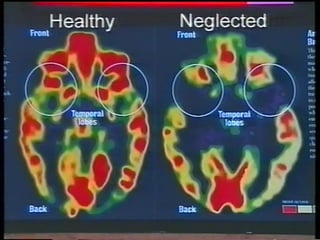
  • #38 The witnessing of violence and violation, events that fall on a continuum from the ordinary to the extraordinary, jolts us into a response I call common shock. While some react with obvious physical symptoms, many of us respond as if coated with Teflon; nothing sticks. That is the paradox of common shock. The more we witness, the less we register. Violence and violation become like the wallpaper, just there.