ANXIETY DISORDER
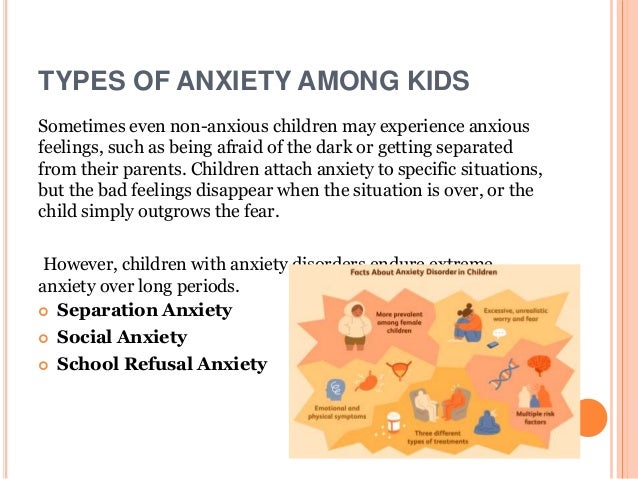
TYPES OF ANXIETY AMONG KIDS
Sometimes even non-anxious children may experience anxious
feelings, such as being afraid of the dark or getting separated
from their parents. Children attach anxiety to specific situations,
but the bad feelings disappear when the situation is over, or the
child simply outgrows the fear.
However, children with anxiety disorders endure extreme
anxiety over long periods.
 Separation Anxiety
 Social Anxiety
 School Refusal Anxiety
WHAT ARE THE SIGNS OF
ANXIOUSNESS IN A CHILD?
As a parent, we generally stress assuming our kid's ailment
is ordinary or something else. A youngster's way of
behaving can here and there be befuddling and troubling
to guardians.
Answering the below question will help you identify if your
child suffers from anxiety disorder:
 Stress or feel terrified unreasonably or without a valid
justification?
 Have many worries about the scholar or social
execution?
 Need an extreme measure of consolation?
 Have actual protests like migraines or stomachaches
while feeling anxious?
 Become humiliated without any problem?
OTHER WAYS TO TREAT YOUR
CHILD’S ANXIETY
As you understand your child is battling genuine anxiety,
converse with a pediatrician. You ought to likewise carry it to the
consideration of your youngster's educator and school advisor.
 Be Supportive: Make your youngster feel open to discussing
anxiety and proposition consolation. Whenever a kid can
communicate fears to her folks, she encounters a lessening in
anxiety.
 Be School Positive: Indulge your child in the fun aspects of
including playing with buddies and engaging in new activities.
 Allow for Downtime: Similar to adults, youngsters need
decompress. Try not to over-plan your kid with such a large
number of exercises. Make sure they have unstructured
recess, which diminishes the effect of anxiety.
 Encourage Exercise: Youngsters should get an hour of
daily.5 Exercise helps cut levels of the pressure chemical
cortisol and lift levels of the disposition improving synapses
dopamine and serotonin. It has been seen that youngsters
associated with group activities report less anxiety, and it is
particularly useful for youngsters with social anxiety issues.
 Website : https://zenithdfw.com
 Phone No : 972-210-0033
 Email Id : info@zenithdfw.com
THANK YOU

ANXIETY DISORDER.pptx

  • 1.
  • 2.
    TYPES OF ANXIETYAMONG KIDS Sometimes even non-anxious children may experience anxious feelings, such as being afraid of the dark or getting separated from their parents. Children attach anxiety to specific situations, but the bad feelings disappear when the situation is over, or the child simply outgrows the fear. However, children with anxiety disorders endure extreme anxiety over long periods.  Separation Anxiety  Social Anxiety  School Refusal Anxiety
  • 3.
    WHAT ARE THESIGNS OF ANXIOUSNESS IN A CHILD? As a parent, we generally stress assuming our kid's ailment is ordinary or something else. A youngster's way of behaving can here and there be befuddling and troubling to guardians. Answering the below question will help you identify if your child suffers from anxiety disorder:  Stress or feel terrified unreasonably or without a valid justification?  Have many worries about the scholar or social execution?  Need an extreme measure of consolation?  Have actual protests like migraines or stomachaches while feeling anxious?  Become humiliated without any problem?
  • 4.
    OTHER WAYS TOTREAT YOUR CHILD’S ANXIETY As you understand your child is battling genuine anxiety, converse with a pediatrician. You ought to likewise carry it to the consideration of your youngster's educator and school advisor.  Be Supportive: Make your youngster feel open to discussing anxiety and proposition consolation. Whenever a kid can communicate fears to her folks, she encounters a lessening in anxiety.  Be School Positive: Indulge your child in the fun aspects of including playing with buddies and engaging in new activities.  Allow for Downtime: Similar to adults, youngsters need decompress. Try not to over-plan your kid with such a large number of exercises. Make sure they have unstructured recess, which diminishes the effect of anxiety.  Encourage Exercise: Youngsters should get an hour of daily.5 Exercise helps cut levels of the pressure chemical cortisol and lift levels of the disposition improving synapses dopamine and serotonin. It has been seen that youngsters associated with group activities report less anxiety, and it is particularly useful for youngsters with social anxiety issues.
  • 5.
     Website :https://zenithdfw.com  Phone No : 972-210-0033  Email Id : info@zenithdfw.com
  • 6.