conference report 
trauma triggered 
behaviour in looked after 
and adopted children 
Workshop by Helen Oakwater, adopter, trainer and author 
Organised by St Francis Children’s Society 
Venue: Milton Keynes 
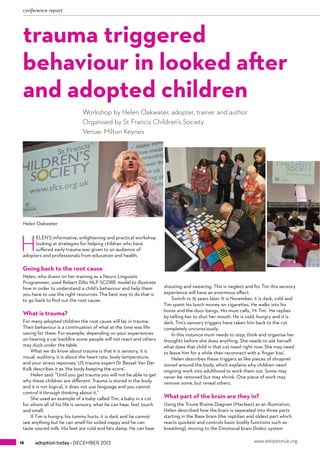
Helen Oakwater 
HELEN’S informative, enlightening and practical workshop 
looking at strategies for helping children who have 
suffered early trauma was given to an audience of 
adopters and professionals from education and health. 
Going back to the root cause 
Helen, who draws on her training as a Neuro Linguistic 
Programmer, used Robert Dilts NLP SCORE model to illustrate 
how in order to understand a child’s behaviour and help them 
you have to use the right resources. The best way to do that is 
to go back to find out the root cause. 
What is trauma? 
For many adopted children the root cause will lay in trauma. 
Their behaviour is a continuation of what at the time was life 
saving for them. For example, depending on your experiences 
on hearing a car backfire some people will not react and others 
may duck under the table. 
What we do know about trauma is that it is sensory, it is 
visual, auditory, it is about the heart rate, body temperature, 
and your stress reponses. US trauma expert Dr Bessel Van Der 
Kolk describes it as ‘the body keeping the score’. 
Helen said: “Until you get trauma you will not be able to get 
why these children are different. Trauma is stored in the body 
and it is not logical, it does not use language and you cannot 
control it through thinking about it.” 
She used an example of a baby called Tim, a baby in a cot 
for whom all of his life is sensory, what he can hear, feel, touch 
and smell. 
If Tim is hungry, his tummy hurts, it is dark and he cannot 
see anything but he can smell his soiled nappy and he can 
taste soured milk. His feet are cold and he’s damp. He can hear 
shouting and swearing. This is neglect and for Tim this sensory 
experience will have an enormous effect. 
Switch to 15 years later. It is November, it is dark, cold and 
Tim spent his lunch money on cigarettes. He walks into his 
home and the door bangs. His mum calls, ‘Hi Tim’. He replies 
by telling her to shut her mouth. He is cold, hungry and it is 
dark. Tim’s sensory triggers have taken him back to the cot 
completely unconsciously. 
In this instance mum needs to stop, think and organise her 
thoughts before she does anything. She needs to ask herself 
what does that child in that cot need right now. She may need 
to leave him for a while then reconnect with a ‘finger kiss’. 
Helen describes these triggers as like pieces of shrapnel 
stored around the body, which explains why children need 
ongoing work into adulthood to work them out. Some may 
never be removed but may shrink. One piece of work may 
remove some, but reveal others. 
What part of the brain are they in? 
Using the Triune Braine Diagram (Maclean) as an illustration, 
Helen described how the brain is separated into three parts 
starting in the Base brain (the reptilian and oldest part which 
reacts quickest and controls basic bodily functions such as 
breathing), moving to the Emotional brain (limbic system 
16 adoption today ™DECEMBER 2013 www.adoptionuk.org
conference report 
which is the area where emotions are stored) and finally to 
the Thinking brain (the neocortex which is where we can use 
reason). 
She asked the audience to ‘take a bet’ on where a child, like 
Tim, was in their brain at the time of behaving in a certain way. 
Arousal development 
Our window of tolerance is something we develop from 
childhood as we experience events and a caregiver regulates 
our feelings around them. For example, we all tolerate 
situations for certain lengths of time or to a certain level until 
we are hyperaroused or hypoaroused when all we can do is 
feel. In order to be able to feel and think about events we need 
to be somewhere in the middle. 
With good enough caregiving and over time this window 
of tolerance gets wider and wider. But if you don’t get that 
regulation because you were neglected the window of 
tolerance remains narrow and on one side you are vigilant, 
resistant and defiant leading up to aggression – on the other 
you are avoidant, compliant, disassociated, which can lead 
to fainting. 
The body keeps the score (Bessel van der Kolk) 
Our implicit memory is formed from birth up to 18 months or 
more. It is sensory and chaotic. Our explicit memory, which we 
can recall is more organised. We also have an internal video 
recorder, which we use to interpret our place in the world 
and how we view the world and think it views us – also known 
as our internal working model. Up to the age of seven this 
video has no filter and the child cannot filter what comes in. If 
someone describes them as a ‘stupid fool’, the child will say ‘I’m 
a stupid fool’. 
From the age of seven to 14 there will be more thinking 
involved and more observation of what people do, not just 
what they say. This is why modelling good behaviour gains 
such importance. From 14 to 21, the socialisation stage, what 
happens outside the family gains much more significance. 
Action replays 
Helen described one NLP technique to help young people 
see other people’s points of view was to stand next to them 
and imagine you are both viewing a cinema screen showing 
an event which had happened. The key is not to comment but 
to ask the questions ‘what did you notice?’ and ‘what did you 
learn?’ It helps a child to stand in someone else’s shoes, develop 
empathy and mindsight. 
“You can do it with a positive event, perhaps they got a 
certificate at school or do it by modelling and get them curious 
about what you are doing,” said Helen. 
Belief formation 
A neglected child may believe they were worthless because 
they were neglected. A securely attached child whose mother 
responded to his needs developed trust and began to view the 
world as somewhere he was safe, loved and that he had a 
place in. 
By contrast the neglected child will believe he’s unsafe, 
unlovable, alone and bad and the world is a dangerous one 
where he has no place. 
These beliefs shape our behaviour. They lurk beneath the 
surface affecting how we react to situations. 
Typically traumatised children won’t be able to control their 
emotions, will be hypervigilant, have poor impulse control, have 
multiple sensory triggers and will be working in their primitive 
brain and not able to do cause and effect thinking, living only in 
the now. 
The behaviours may manifest as being in control, crazy lying, 
hoarding food, unable to make eye contact and unable to form 
healthy relationships. 
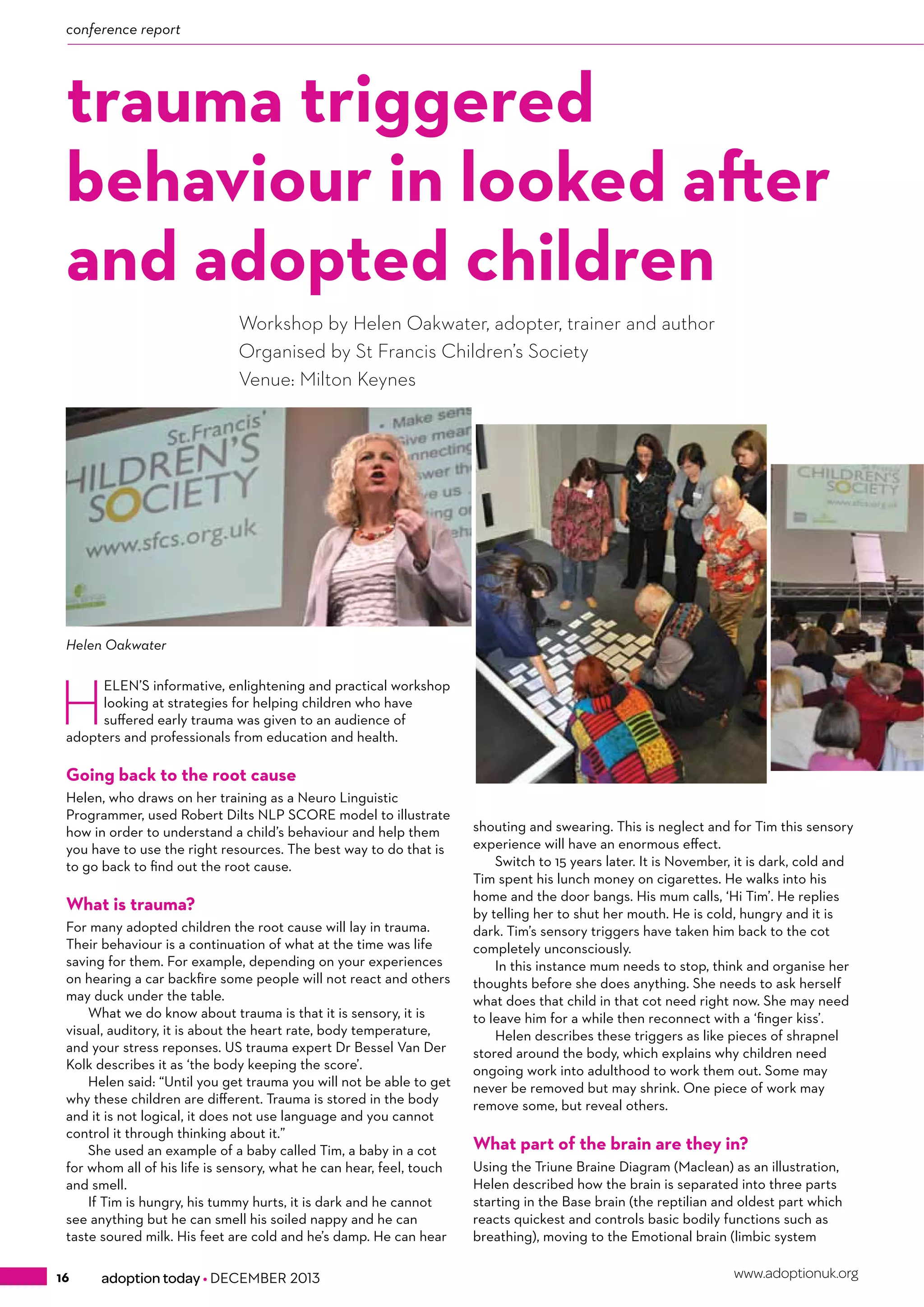
Wall exercise 
As part of the interactive part of the workshop the audience 
was divided into groups and each asked to create a wall using 
cards they had written on describing what a healthy baby 
and child needed over the years. By placing the cards on the 
floor you could see where the weaknesses or holes in the wall 
created by different circumstances affecting the family, such 
as violence or drugs, might appear. The audience then went 
back to the wall and was asked how certain circumstances may 
affect different stages of development, illustrating the gaps that 
would further weaken the wall leading to its possible collapse. 
Helen said: “Therapeutic parenting is about filling in those 
gaps, undoing the damage. Think about the wall and what you 
can do to put in a bit more mortar, fill in a missing brick.” 
What do traumatised children need? 
They need therapeutic reparenting or developmental parenting. 
They also need their truth told to them sensitively and ideally 
by a third party with the parents or carers present. Helen 
described providing age-appropriate information as the Jigsaw 
of Truth. So at the age of seven you may tell your child that 
Uncle Fred was not nice and sometimes he hurt children. By the 
age of 13 you can give a bit more information about how he hurt 
them. If at aged 14 your child gets contact from Uncle Fred he is 
more likely to be cautious and less likely to hook up. z 
Further information 
Helen is the author of 
Bubble Wrapped Children. 
For more information you 
can visit her website at 
www.bubblewrappedchildren.co.uk 
or www.helenoakwater.co.uk 
For more information about St Francis’ Children’s Society visit their website at www.sfcs.org.uk 
Helpline 0844 848 7900 DECEMBER 2013 ™VYdei^dcidYVn 17

Trauma Triggered Behaviour Article

  • 1.
    conference report traumatriggered behaviour in looked after and adopted children Workshop by Helen Oakwater, adopter, trainer and author Organised by St Francis Children’s Society Venue: Milton Keynes Helen Oakwater HELEN’S informative, enlightening and practical workshop looking at strategies for helping children who have suffered early trauma was given to an audience of adopters and professionals from education and health. Going back to the root cause Helen, who draws on her training as a Neuro Linguistic Programmer, used Robert Dilts NLP SCORE model to illustrate how in order to understand a child’s behaviour and help them you have to use the right resources. The best way to do that is to go back to find out the root cause. What is trauma? For many adopted children the root cause will lay in trauma. Their behaviour is a continuation of what at the time was life saving for them. For example, depending on your experiences on hearing a car backfire some people will not react and others may duck under the table. What we do know about trauma is that it is sensory, it is visual, auditory, it is about the heart rate, body temperature, and your stress reponses. US trauma expert Dr Bessel Van Der Kolk describes it as ‘the body keeping the score’. Helen said: “Until you get trauma you will not be able to get why these children are different. Trauma is stored in the body and it is not logical, it does not use language and you cannot control it through thinking about it.” She used an example of a baby called Tim, a baby in a cot for whom all of his life is sensory, what he can hear, feel, touch and smell. If Tim is hungry, his tummy hurts, it is dark and he cannot see anything but he can smell his soiled nappy and he can taste soured milk. His feet are cold and he’s damp. He can hear shouting and swearing. This is neglect and for Tim this sensory experience will have an enormous effect. Switch to 15 years later. It is November, it is dark, cold and Tim spent his lunch money on cigarettes. He walks into his home and the door bangs. His mum calls, ‘Hi Tim’. He replies by telling her to shut her mouth. He is cold, hungry and it is dark. Tim’s sensory triggers have taken him back to the cot completely unconsciously. In this instance mum needs to stop, think and organise her thoughts before she does anything. She needs to ask herself what does that child in that cot need right now. She may need to leave him for a while then reconnect with a ‘finger kiss’. Helen describes these triggers as like pieces of shrapnel stored around the body, which explains why children need ongoing work into adulthood to work them out. Some may never be removed but may shrink. One piece of work may remove some, but reveal others. What part of the brain are they in? Using the Triune Braine Diagram (Maclean) as an illustration, Helen described how the brain is separated into three parts starting in the Base brain (the reptilian and oldest part which reacts quickest and controls basic bodily functions such as breathing), moving to the Emotional brain (limbic system 16 adoption today ™DECEMBER 2013 www.adoptionuk.org
  • 2.
    conference report whichis the area where emotions are stored) and finally to the Thinking brain (the neocortex which is where we can use reason). She asked the audience to ‘take a bet’ on where a child, like Tim, was in their brain at the time of behaving in a certain way. Arousal development Our window of tolerance is something we develop from childhood as we experience events and a caregiver regulates our feelings around them. For example, we all tolerate situations for certain lengths of time or to a certain level until we are hyperaroused or hypoaroused when all we can do is feel. In order to be able to feel and think about events we need to be somewhere in the middle. With good enough caregiving and over time this window of tolerance gets wider and wider. But if you don’t get that regulation because you were neglected the window of tolerance remains narrow and on one side you are vigilant, resistant and defiant leading up to aggression – on the other you are avoidant, compliant, disassociated, which can lead to fainting. The body keeps the score (Bessel van der Kolk) Our implicit memory is formed from birth up to 18 months or more. It is sensory and chaotic. Our explicit memory, which we can recall is more organised. We also have an internal video recorder, which we use to interpret our place in the world and how we view the world and think it views us – also known as our internal working model. Up to the age of seven this video has no filter and the child cannot filter what comes in. If someone describes them as a ‘stupid fool’, the child will say ‘I’m a stupid fool’. From the age of seven to 14 there will be more thinking involved and more observation of what people do, not just what they say. This is why modelling good behaviour gains such importance. From 14 to 21, the socialisation stage, what happens outside the family gains much more significance. Action replays Helen described one NLP technique to help young people see other people’s points of view was to stand next to them and imagine you are both viewing a cinema screen showing an event which had happened. The key is not to comment but to ask the questions ‘what did you notice?’ and ‘what did you learn?’ It helps a child to stand in someone else’s shoes, develop empathy and mindsight. “You can do it with a positive event, perhaps they got a certificate at school or do it by modelling and get them curious about what you are doing,” said Helen. Belief formation A neglected child may believe they were worthless because they were neglected. A securely attached child whose mother responded to his needs developed trust and began to view the world as somewhere he was safe, loved and that he had a place in. By contrast the neglected child will believe he’s unsafe, unlovable, alone and bad and the world is a dangerous one where he has no place. These beliefs shape our behaviour. They lurk beneath the surface affecting how we react to situations. Typically traumatised children won’t be able to control their emotions, will be hypervigilant, have poor impulse control, have multiple sensory triggers and will be working in their primitive brain and not able to do cause and effect thinking, living only in the now. The behaviours may manifest as being in control, crazy lying, hoarding food, unable to make eye contact and unable to form healthy relationships. Wall exercise As part of the interactive part of the workshop the audience was divided into groups and each asked to create a wall using cards they had written on describing what a healthy baby and child needed over the years. By placing the cards on the floor you could see where the weaknesses or holes in the wall created by different circumstances affecting the family, such as violence or drugs, might appear. The audience then went back to the wall and was asked how certain circumstances may affect different stages of development, illustrating the gaps that would further weaken the wall leading to its possible collapse. Helen said: “Therapeutic parenting is about filling in those gaps, undoing the damage. Think about the wall and what you can do to put in a bit more mortar, fill in a missing brick.” What do traumatised children need? They need therapeutic reparenting or developmental parenting. They also need their truth told to them sensitively and ideally by a third party with the parents or carers present. Helen described providing age-appropriate information as the Jigsaw of Truth. So at the age of seven you may tell your child that Uncle Fred was not nice and sometimes he hurt children. By the age of 13 you can give a bit more information about how he hurt them. If at aged 14 your child gets contact from Uncle Fred he is more likely to be cautious and less likely to hook up. z Further information Helen is the author of Bubble Wrapped Children. For more information you can visit her website at www.bubblewrappedchildren.co.uk or www.helenoakwater.co.uk For more information about St Francis’ Children’s Society visit their website at www.sfcs.org.uk Helpline 0844 848 7900 DECEMBER 2013 ™VYdei^dcidYVn 17