Dr. Usha.
DEFINATION
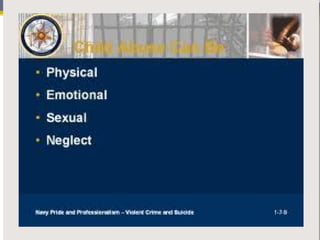
TYPES OF CHILD ABUSE
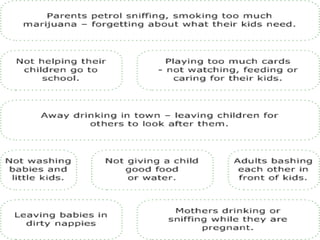
NEGLECT
PREVALENCE
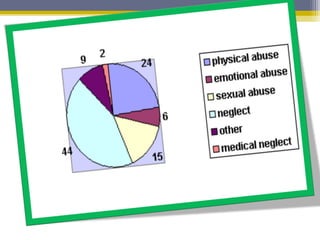
STATISTICS
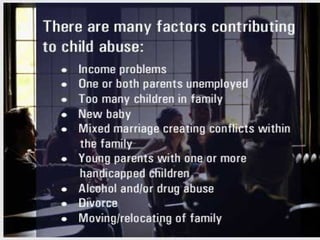
PROBABLE FACTORS
EFFECTS
RECORDING OF CHILD ABUSE / NEGLECT
EXAMINING OF CHILD ABUSE / NEGLECT
PARENT ‘S CONSULTATION
INFECTED BRUISES
CHILD PROTECTIVE AGENCIES
Child abuse is defined as non accidental physical injury,Child abuse is defined as non accidental physical injury,
minimal or Fatal , inflicted upon children by the personminimal or Fatal , inflicted upon children by the person
caring for them.It is an overt act of commission of acaring for them.It is an overt act of commission of a
caretaker – physical , emotional or sexual.caretaker – physical , emotional or sexual.
Neglected child is a one who shows evidence of physicalNeglected child is a one who shows evidence of physical
and mental ill health primarily due to failure on theand mental ill health primarily due to failure on the
part of the parent or the caretaker to providepart of the parent or the caretaker to provide
adequately for the child’s need.adequately for the child’s need.
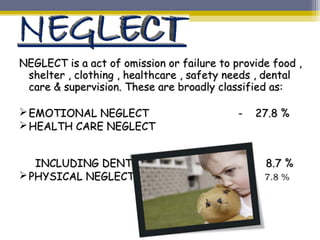
NEGLECT is a act of omission or failure to provide food ,NEGLECT is a act of omission or failure to provide food ,
shelter , clothing , healthcare , safety needs , dentalshelter , clothing , healthcare , safety needs , dental
care & supervision. These are broadly classified as:care & supervision. These are broadly classified as:
EMOTIONAL NEGLECT - 27.8 %EMOTIONAL NEGLECT - 27.8 %
HEALTH CARE NEGLECTHEALTH CARE NEGLECT
INCLUDING DENTAL NEGLECT - 8.7 %INCLUDING DENTAL NEGLECT - 8.7 %
PHYSICAL NEGLECTPHYSICAL NEGLECT - 7.8 %7.8 %
A UNICEF report on child’s well being stated that:A UNICEF report on child’s well being stated that:
USA & UK rank lowest among industrialist nation with respect toUSA & UK rank lowest among industrialist nation with respect to
child’s well being.child’s well being.
Child abuse and neglect are more common in single parent familiesChild abuse and neglect are more common in single parent families
INDIAN SCENARIOINDIAN SCENARIO
Child abuse is more common in remote and tribal areas.Child abuse is more common in remote and tribal areas.
50 % of the cases aren’t reported50 % of the cases aren’t reported
Out of 3.8 % cases reported , majority of girls are prime victim for theOut of 3.8 % cases reported , majority of girls are prime victim for the
sexual abuse and boys for physical abuse.sexual abuse and boys for physical abuse.
At least 60% cases remain undetectedAt least 60% cases remain undetected
The average age of detection of child abuse andThe average age of detection of child abuse and
neglect is 7.4yrsneglect is 7.4yrs
Reported case in female is 54% and in male isReported case in female is 54% and in male is
49%49%
No age, sex, gender or socioeconomic status isNo age, sex, gender or socioeconomic status is
spaced by child abuse.spaced by child abuse.
The condition attributed to parents – stressesThe condition attributed to parents – stresses
The condition attributed to the child – ego weaknessesThe condition attributed to the child – ego weaknesses
The conditions attributed to social , cultural & religiousThe conditions attributed to social , cultural & religious
practices –vectorspractices –vectors
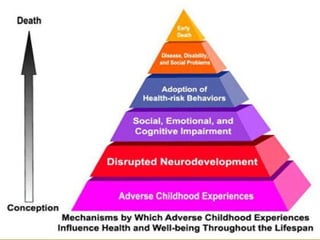
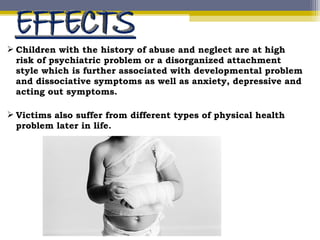
 Children with the history of abuse and neglect are at high
risk of psychiatric problem or a disorganized attachment
style which is further associated with developmental problem
and dissociative symptoms as well as anxiety, depressive and
acting out symptoms.
 Victims also suffer from different types of physical health
problem later in life.
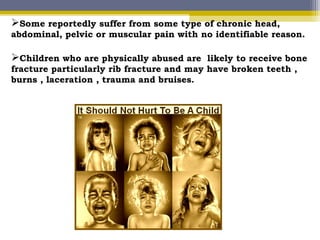
Children who are physically abused are likely to receive bone
fracture particularly rib fracture and may have broken teeth ,
burns , laceration , trauma and bruises.
Some reportedly suffer from some type of chronic head,
abdominal, pelvic or muscular pain with no identifiable reason.
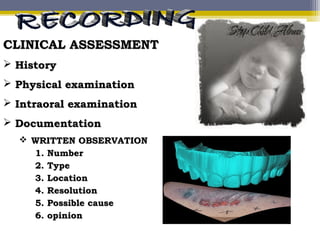
CLINICAL ASSESSMENTCLINICAL ASSESSMENT
 HistoryHistory
 Physical examinationPhysical examination
 Intraoral examinationIntraoral examination
 DocumentationDocumentation
 WRITTEN OBSERVATIONWRITTEN OBSERVATION
1.1. NumberNumber
2.2. TypeType
3.3. LocationLocation
4.4. ResolutionResolution
5.5. Possible causePossible cause
6.6. opinionopinion
 PHOTOGRAPHSPHOTOGRAPHS
1.1. 35 mm colour photograph35 mm colour photograph
2.2. Various viewsVarious views
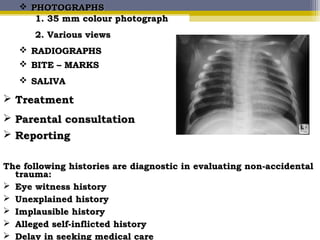
 RADIOGRAPHSRADIOGRAPHS
 BITE – MARKSBITE – MARKS
 SALIVASALIVA
 TreatmentTreatment
 Parental consultationParental consultation
 ReportingReporting
The following histories are diagnostic in evaluating non-accidentalThe following histories are diagnostic in evaluating non-accidental
trauma:trauma:
 Eye witness historyEye witness history
 Unexplained historyUnexplained history
 Implausible historyImplausible history
 Alleged self-inflicted historyAlleged self-inflicted history
 Delay in seeking medical careDelay in seeking medical care
COMMON SITES TO BE OBSERVED AND EXAMINEDCOMMON SITES TO BE OBSERVED AND EXAMINED
Many abused or neglected children due to fear may appear overlyMany abused or neglected children due to fear may appear overly
vigilant or display a “frozen watchfulness" staring constantly. There arevigilant or display a “frozen watchfulness" staring constantly. There are
no spontaneous smiles and almost no eye contact.no spontaneous smiles and almost no eye contact.
The dentist should observe the child for lack of cleanliness , for smallThe dentist should observe the child for lack of cleanliness , for small
stature with respect to age and for evidence of malnutrition.stature with respect to age and for evidence of malnutrition.
Overdressed children should also be noted , long sleeves and highOverdressed children should also be noted , long sleeves and high
necked shirts or blouses during hot summer months may be worn tonecked shirts or blouses during hot summer months may be worn to
cover signs of physical abuse.cover signs of physical abuse.
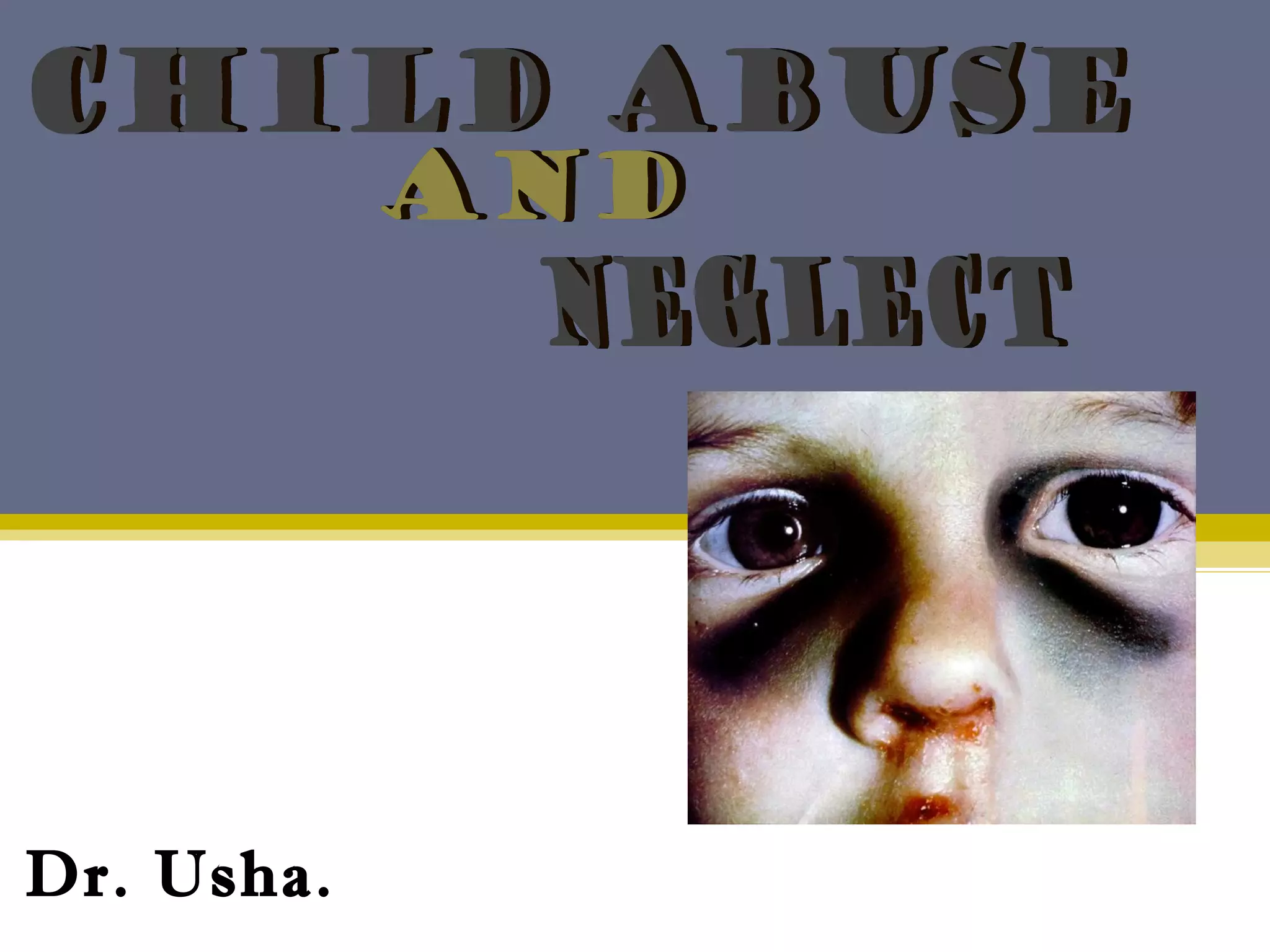
Face and neck should be examined for periorbital ecchymosis ,Face and neck should be examined for periorbital ecchymosis ,
cigarette burn marks and hand slap marks.cigarette burn marks and hand slap marks.
Corners of the mouth are reported with blinding marks .Corners of the mouth are reported with blinding marks .
If moving a child up in the dental chair in a supine position or liftingIf moving a child up in the dental chair in a supine position or lifting
up motion results in pain , trauma is to be suspected.up motion results in pain , trauma is to be suspected.
DEFINITIVE CN/CA EXAMINATIONDEFINITIVE CN/CA EXAMINATION
Following areas should be examined carefully:Following areas should be examined carefully:
Detailed examination and palpation of the skull looking forDetailed examination and palpation of the skull looking for
hematomas and cephalomatomas .hematomas and cephalomatomas .
Positive sign of any battle like laceration , scar , bruisesPositive sign of any battle like laceration , scar , bruises
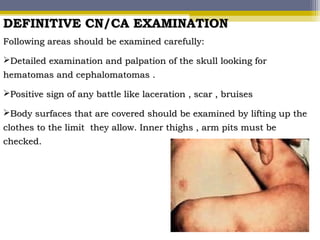
Body surfaces that are covered should be examined by lifting up theBody surfaces that are covered should be examined by lifting up the
clothes to the limit they allow. Inner thighs , arm pits must beclothes to the limit they allow. Inner thighs , arm pits must be
checked.checked.
Once the suspicion is confirmed , the parent should be informed that
the injury has been noticed. The parental explanation of the cause of
the injury should be understood carefully by the dentist. If the findings
and explanation are not compatible , or suspicion still exists , the
dentist is mandated by the law to contact the appropriate authority or
any child protecting agency.
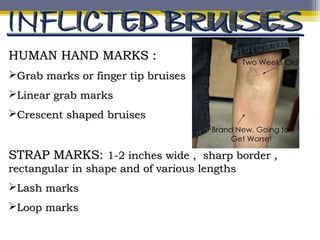
HUMAN HAND MARKS :HUMAN HAND MARKS :
Grab marks or finger tip bruisesGrab marks or finger tip bruises
Linear grab marksLinear grab marks
Crescent shaped bruisesCrescent shaped bruises
STRAP MARKS:STRAP MARKS: 1-2 inches wide , sharp border ,1-2 inches wide , sharp border ,
rectangular in shape and of various lengthsrectangular in shape and of various lengths
Lash marksLash marks
Loop marksLoop marks
BIZARRE MARKS : Bizarre shaped bruises with borders are nearlyBIZARRE MARKS : Bizarre shaped bruises with borders are nearly
always infected when a blunt instrument is usedalways infected when a blunt instrument is used
Circumferential tie marksCircumferential tie marks
Gagging abrasionGagging abrasion
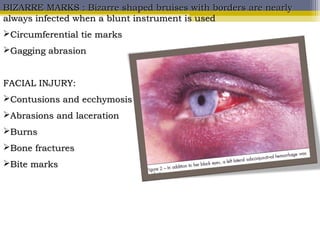
FACIAL INJURY:FACIAL INJURY:
Contusions and ecchymosisContusions and ecchymosis
Abrasions and lacerationAbrasions and laceration
BurnsBurns
Bone fracturesBone fractures
Bite marksBite marks
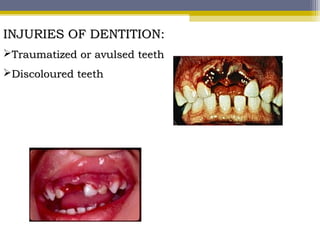
INJURIES OF DENTITION:INJURIES OF DENTITION:
Traumatized or avulsed teethTraumatized or avulsed teeth
Discoloured teethDiscoloured teeth
INDIAN LAWS FOR CHILD ABUSE:INDIAN LAWS FOR CHILD ABUSE:
PHYSICAL ABUSE: Indian Penal Code IPC 323 / IPC 324PHYSICAL ABUSE: Indian Penal Code IPC 323 / IPC 324
SEXUAL ABUSE: Girls- statutory rape IPC 376SEXUAL ABUSE: Girls- statutory rape IPC 376
Boys- unnatural sexual offence IPC 377Boys- unnatural sexual offence IPC 377
GOVERNMENT ORGANISATIONS (GO) AND NON-GOVERNMENT ORGANISATIONS (GO) AND NON-
GOVERNMENTAL ORGANISATION (NGO)GOVERNMENTAL ORGANISATION (NGO)
The United Nations International Children’s Education FundThe United Nations International Children’s Education Fund
(UNICEF)(UNICEF)
Ummid Sanstha , New DelhiUmmid Sanstha , New Delhi
Shakti , KolkataShakti , Kolkata
National Human Rights Commission , GOI , New DelhiNational Human Rights Commission , GOI , New Delhi
Asha Sevabhavi Sansthan , MumbaiAsha Sevabhavi Sansthan , Mumbai
Child Relief And You ( CRY )Child Relief And You ( CRY )
1.1. www.wikipedia.orgwww.wikipedia.org
2.2. Textbook Of Pedodontics By Shobha TandonTextbook Of Pedodontics By Shobha Tandon
3.3. Pediatric Dentistry- Infancy ThroughPediatric Dentistry- Infancy Through
AdolescenceAdolescence
4.4. NIKHIL MARWAH….NIKHIL MARWAH….
Child abuse & neglect

Child abuse & neglect

  • 1.
  • 2.
    DEFINATION TYPES OF CHILDABUSE NEGLECT PREVALENCE STATISTICS PROBABLE FACTORS EFFECTS RECORDING OF CHILD ABUSE / NEGLECT EXAMINING OF CHILD ABUSE / NEGLECT PARENT ‘S CONSULTATION INFECTED BRUISES CHILD PROTECTIVE AGENCIES
  • 3.
    Child abuse isdefined as non accidental physical injury,Child abuse is defined as non accidental physical injury, minimal or Fatal , inflicted upon children by the personminimal or Fatal , inflicted upon children by the person caring for them.It is an overt act of commission of acaring for them.It is an overt act of commission of a caretaker – physical , emotional or sexual.caretaker – physical , emotional or sexual. Neglected child is a one who shows evidence of physicalNeglected child is a one who shows evidence of physical and mental ill health primarily due to failure on theand mental ill health primarily due to failure on the part of the parent or the caretaker to providepart of the parent or the caretaker to provide adequately for the child’s need.adequately for the child’s need.
  • 6.
    NEGLECT is aact of omission or failure to provide food ,NEGLECT is a act of omission or failure to provide food , shelter , clothing , healthcare , safety needs , dentalshelter , clothing , healthcare , safety needs , dental care & supervision. These are broadly classified as:care & supervision. These are broadly classified as: EMOTIONAL NEGLECT - 27.8 %EMOTIONAL NEGLECT - 27.8 % HEALTH CARE NEGLECTHEALTH CARE NEGLECT INCLUDING DENTAL NEGLECT - 8.7 %INCLUDING DENTAL NEGLECT - 8.7 % PHYSICAL NEGLECTPHYSICAL NEGLECT - 7.8 %7.8 %
  • 8.
    A UNICEF reporton child’s well being stated that:A UNICEF report on child’s well being stated that: USA & UK rank lowest among industrialist nation with respect toUSA & UK rank lowest among industrialist nation with respect to child’s well being.child’s well being. Child abuse and neglect are more common in single parent familiesChild abuse and neglect are more common in single parent families INDIAN SCENARIOINDIAN SCENARIO Child abuse is more common in remote and tribal areas.Child abuse is more common in remote and tribal areas. 50 % of the cases aren’t reported50 % of the cases aren’t reported Out of 3.8 % cases reported , majority of girls are prime victim for theOut of 3.8 % cases reported , majority of girls are prime victim for the sexual abuse and boys for physical abuse.sexual abuse and boys for physical abuse.
  • 9.
    At least 60%cases remain undetectedAt least 60% cases remain undetected The average age of detection of child abuse andThe average age of detection of child abuse and neglect is 7.4yrsneglect is 7.4yrs Reported case in female is 54% and in male isReported case in female is 54% and in male is 49%49% No age, sex, gender or socioeconomic status isNo age, sex, gender or socioeconomic status is spaced by child abuse.spaced by child abuse.
  • 11.
    The condition attributedto parents – stressesThe condition attributed to parents – stresses The condition attributed to the child – ego weaknessesThe condition attributed to the child – ego weaknesses The conditions attributed to social , cultural & religiousThe conditions attributed to social , cultural & religious practices –vectorspractices –vectors
  • 14.
     Children withthe history of abuse and neglect are at high risk of psychiatric problem or a disorganized attachment style which is further associated with developmental problem and dissociative symptoms as well as anxiety, depressive and acting out symptoms.  Victims also suffer from different types of physical health problem later in life.
  • 16.
    Children who arephysically abused are likely to receive bone fracture particularly rib fracture and may have broken teeth , burns , laceration , trauma and bruises. Some reportedly suffer from some type of chronic head, abdominal, pelvic or muscular pain with no identifiable reason.
  • 17.
    CLINICAL ASSESSMENTCLINICAL ASSESSMENT HistoryHistory  Physical examinationPhysical examination  Intraoral examinationIntraoral examination  DocumentationDocumentation  WRITTEN OBSERVATIONWRITTEN OBSERVATION 1.1. NumberNumber 2.2. TypeType 3.3. LocationLocation 4.4. ResolutionResolution 5.5. Possible causePossible cause 6.6. opinionopinion
  • 18.
     PHOTOGRAPHSPHOTOGRAPHS 1.1. 35mm colour photograph35 mm colour photograph 2.2. Various viewsVarious views  RADIOGRAPHSRADIOGRAPHS  BITE – MARKSBITE – MARKS  SALIVASALIVA  TreatmentTreatment  Parental consultationParental consultation  ReportingReporting The following histories are diagnostic in evaluating non-accidentalThe following histories are diagnostic in evaluating non-accidental trauma:trauma:  Eye witness historyEye witness history  Unexplained historyUnexplained history  Implausible historyImplausible history  Alleged self-inflicted historyAlleged self-inflicted history  Delay in seeking medical careDelay in seeking medical care
  • 19.
    COMMON SITES TOBE OBSERVED AND EXAMINEDCOMMON SITES TO BE OBSERVED AND EXAMINED Many abused or neglected children due to fear may appear overlyMany abused or neglected children due to fear may appear overly vigilant or display a “frozen watchfulness" staring constantly. There arevigilant or display a “frozen watchfulness" staring constantly. There are no spontaneous smiles and almost no eye contact.no spontaneous smiles and almost no eye contact. The dentist should observe the child for lack of cleanliness , for smallThe dentist should observe the child for lack of cleanliness , for small stature with respect to age and for evidence of malnutrition.stature with respect to age and for evidence of malnutrition. Overdressed children should also be noted , long sleeves and highOverdressed children should also be noted , long sleeves and high necked shirts or blouses during hot summer months may be worn tonecked shirts or blouses during hot summer months may be worn to cover signs of physical abuse.cover signs of physical abuse. Face and neck should be examined for periorbital ecchymosis ,Face and neck should be examined for periorbital ecchymosis , cigarette burn marks and hand slap marks.cigarette burn marks and hand slap marks. Corners of the mouth are reported with blinding marks .Corners of the mouth are reported with blinding marks . If moving a child up in the dental chair in a supine position or liftingIf moving a child up in the dental chair in a supine position or lifting up motion results in pain , trauma is to be suspected.up motion results in pain , trauma is to be suspected.
  • 20.
    DEFINITIVE CN/CA EXAMINATIONDEFINITIVECN/CA EXAMINATION Following areas should be examined carefully:Following areas should be examined carefully: Detailed examination and palpation of the skull looking forDetailed examination and palpation of the skull looking for hematomas and cephalomatomas .hematomas and cephalomatomas . Positive sign of any battle like laceration , scar , bruisesPositive sign of any battle like laceration , scar , bruises Body surfaces that are covered should be examined by lifting up theBody surfaces that are covered should be examined by lifting up the clothes to the limit they allow. Inner thighs , arm pits must beclothes to the limit they allow. Inner thighs , arm pits must be checked.checked.
  • 21.
    Once the suspicionis confirmed , the parent should be informed that the injury has been noticed. The parental explanation of the cause of the injury should be understood carefully by the dentist. If the findings and explanation are not compatible , or suspicion still exists , the dentist is mandated by the law to contact the appropriate authority or any child protecting agency.
  • 22.
    HUMAN HAND MARKS:HUMAN HAND MARKS : Grab marks or finger tip bruisesGrab marks or finger tip bruises Linear grab marksLinear grab marks Crescent shaped bruisesCrescent shaped bruises STRAP MARKS:STRAP MARKS: 1-2 inches wide , sharp border ,1-2 inches wide , sharp border , rectangular in shape and of various lengthsrectangular in shape and of various lengths Lash marksLash marks Loop marksLoop marks
  • 23.
    BIZARRE MARKS :Bizarre shaped bruises with borders are nearlyBIZARRE MARKS : Bizarre shaped bruises with borders are nearly always infected when a blunt instrument is usedalways infected when a blunt instrument is used Circumferential tie marksCircumferential tie marks Gagging abrasionGagging abrasion FACIAL INJURY:FACIAL INJURY: Contusions and ecchymosisContusions and ecchymosis Abrasions and lacerationAbrasions and laceration BurnsBurns Bone fracturesBone fractures Bite marksBite marks
  • 24.
    INJURIES OF DENTITION:INJURIESOF DENTITION: Traumatized or avulsed teethTraumatized or avulsed teeth Discoloured teethDiscoloured teeth
  • 26.
    INDIAN LAWS FORCHILD ABUSE:INDIAN LAWS FOR CHILD ABUSE: PHYSICAL ABUSE: Indian Penal Code IPC 323 / IPC 324PHYSICAL ABUSE: Indian Penal Code IPC 323 / IPC 324 SEXUAL ABUSE: Girls- statutory rape IPC 376SEXUAL ABUSE: Girls- statutory rape IPC 376 Boys- unnatural sexual offence IPC 377Boys- unnatural sexual offence IPC 377
  • 27.
    GOVERNMENT ORGANISATIONS (GO)AND NON-GOVERNMENT ORGANISATIONS (GO) AND NON- GOVERNMENTAL ORGANISATION (NGO)GOVERNMENTAL ORGANISATION (NGO) The United Nations International Children’s Education FundThe United Nations International Children’s Education Fund (UNICEF)(UNICEF) Ummid Sanstha , New DelhiUmmid Sanstha , New Delhi Shakti , KolkataShakti , Kolkata National Human Rights Commission , GOI , New DelhiNational Human Rights Commission , GOI , New Delhi Asha Sevabhavi Sansthan , MumbaiAsha Sevabhavi Sansthan , Mumbai Child Relief And You ( CRY )Child Relief And You ( CRY )
  • 30.
    1.1. www.wikipedia.orgwww.wikipedia.org 2.2. TextbookOf Pedodontics By Shobha TandonTextbook Of Pedodontics By Shobha Tandon 3.3. Pediatric Dentistry- Infancy ThroughPediatric Dentistry- Infancy Through AdolescenceAdolescence 4.4. NIKHIL MARWAH….NIKHIL MARWAH….