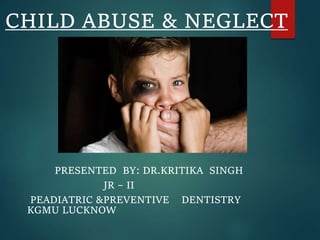
CHILD ABUSE & NEGLECT
PRESENTED BY: DR.KRITIKA SINGH
JR – II
PEADIATRIC &PREVENTIVE DENTISTRY
KGMU LUCKNOW
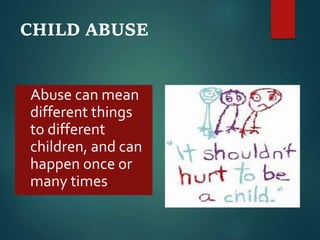
CHILD ABUSE
Abuse can mean
different things
to different
children, and can
happen once or
many times.
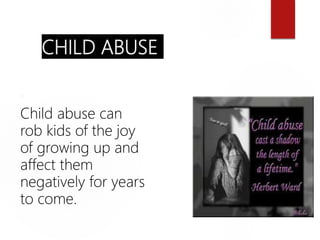
CHILD ABUSE

Child abuse can
rob kids of the joy
of growing up and
affect them
negatively for years
to come.
DEFINITIONS
The World Health Organization ((WHO)
defines child abuse and child maltreatment as "all
forms of physical and/or emotional ill-treatment,
sexual abuse, neglect or negligent treatment or
commercial or other exploitation, resulting in
actual or potential harm to the child's health,
survival, development or dignity in the context
of a relationship of responsibility, trust or
power’’.
DEFINITIONS
The United States federal Child Abuse
Prevention and Treatment Act defines child
abuse and neglect as, at minimum, "any recent
"any recent act or failure to act on the part of
a parent or caretaker which results in death,
serious physical or emotional harm, sexual
abuse or exploitation" and/or "an act or failure
to act which presents an imminent risk of
serious harm’’.
WHO IS ABUSED?
 Children from all
walks of life may be
victims of child abuse
or neglect.
 No age, race, gender,
or socioeconomic
level is spared.
STATISTICS
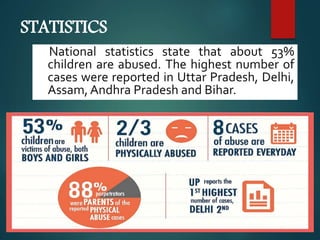
National statistics state that about 53%
children are abused. The highest number of
cases were reported in Uttar Pradesh, Delhi,
Assam, Andhra Pradesh and Bihar.
TYPES OF CHILD MALTREATMENT
The World Health Organization
distinguishes four types of child
maltreatment:
 Physical Abuse
 Sexual Abuse
 Emotional/Psychological Abuse
 Neglect
EXAMINETION OF ABUSED
CHILD IN DENTAL CLINIC
Screening OR Examination
The examination for CA should be incorporated
with the routine dental examination :
1. Dentist and staff should be educated to get a visual impression
of the child as he enters the reception room.
2.They should note the child and guardian have appropriate
interaction or not.
3. Many abused and neglected children are fearful for further
abuse and display several reactions.They may appear overly
vigilant, or display a "frozen watchfulness," staring constantly.
4.Their eyes constantly scan the environment for
danger, while at the same time their faces are
immobile.
There are no spontaneous smiles and almost no eye
contact.It is as , they think that by not looking
someone in the eye, they make themselves invisible
and therefore safe from attack.
5. The dentist and staff should observe the child ;
Lack of cleanliness small stature with respect to age
Evidence of malnutrition- Typical signs of
include a posture of fatigue with rounded shoulder
,flat chest, the face is pale, muddy and lacks luster.
child’s clothing, which should be appropriate for the
climactic conditions.
Failure to provide adequate clothing for protection from
rain, cold, or snow may constitute child neglect.
Overdressed children also should be noted; long
sleeves and highnecked shirts or blouses during hot
summer months may be worn to cover the signs of
physical abuse.
Be observant for physical problems, such as a limp,
difficulty climbing into the dental chair, poor
or abnormal positioning of the limbs.
Oral examination :
 A variety of orofacial injuries occurs in 50% or more of
abused children,these are ;
 Fractured, missing, displaced, or discolored teeth;
 Scars of the lips and mucosa
 Slap marks
 Torn or scarred maxillary midline, or sublingual
frenaum, deviated, or scarred tongue.
 These injuries may result from a parent’s attempt to
silence a child with a gag, hand slap, or punch ,Or a
spoon or fork applied with enough force .
CA may be initiated at any
age, a notation should be
recorded on the chart at
every recall to indicate that a
CA screening was done, and
that the findings were
negative. If the screening
examination leads to
questionable or suspicious
findings, a more thorough
examination is warranted.
PHYSICAL ABUSE
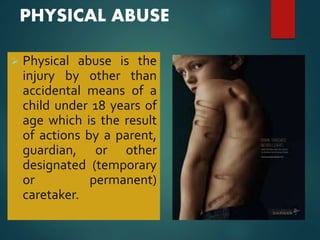
 Physical abuse is the
injury by other than
accidental means of a
child under 18 years of
age which is the result
of actions by a parent,
guardian, or other
designated (temporary
or permanent)
caretaker.
PHYSICAL ABUSE
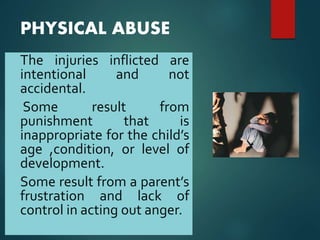
• The injuries inflicted are
intentional and not
accidental.
• Some result from
punishment that is
inappropriate for the child’s
age ,condition, or level of
development.
• Some result from a parent’s
frustration and lack of
control in acting out anger.
BATTERED CHILD SYNDROME
• A severe form of physical abuse.
• First described by Kempe in 1962.
• Battered child syndrome is the
collection of injuries sustained by a
child as a result of repeated
mistreatment or beating.
BATTERED CHILD SYNDROME
• Bruises, lacerations , burns and fractures
are commonly inflicted injuries.
• The major trait of the caretakers is either
a lack of an explanation for critical injuries
or explanations that does not account for
the severity of injuries.
MUNCHAUSEN SYNDROME
 MUNCHAUSEN SYNDROME is a
psychological disorder in which the
person fabricates the symptoms or injury
in order to undergo medical tests,
hospitalization or even medical or surgical
treatment , when she/he is not really sick.
 Described by Dr. Richard Asher in 1951.
MUNCHAUSEN SYNDROME
BY PROXY
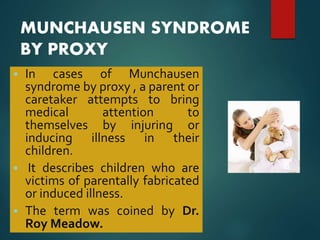
 In cases of Munchausen
syndrome by proxy , a parent or
caretaker attempts to bring
medical attention to
themselves by injuring or
inducing illness in their
children.
 It describes children who are
victims of parentally fabricated
or induced illness.
 The term was coined by Dr.
Roy Meadow.
MUNCHAUSEN SYNDROME
BY PROXY
• It is the most difficult
form of child
maltreatment to
identify and treat.
SHAKEN BABY SYNDROME
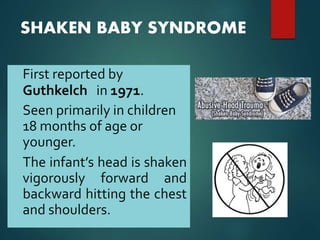
• First reported by
Guthkelch in 1971.
• Seen primarily in children
18 months of age or
younger.
• The infant’s head is shaken
vigorously forward and
backward hitting the chest
and shoulders.
SHAKEN BABY SYNDROME
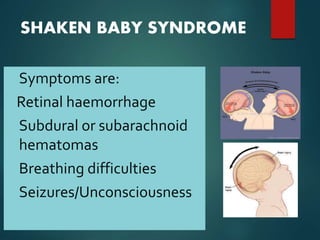
• Symptoms are:
Retinal haemorrhage
o Subdural or subarachnoid
hematomas
o Breathing difficulties
o Seizures/Unconsciousness
SEXUAL ABUSE
CHILD SEXUAL ABUSE
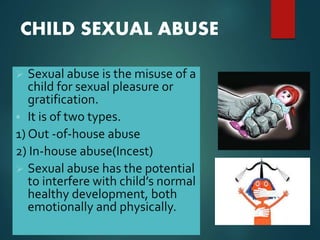
 Sexual abuse is the misuse of a
child for sexual pleasure or
gratification.
 It is of two types.
1) Out -of-house abuse
2) In-house abuse(Incest)
 Sexual abuse has the potential
to interfere with child’s normal
healthy development, both
emotionally and physically.
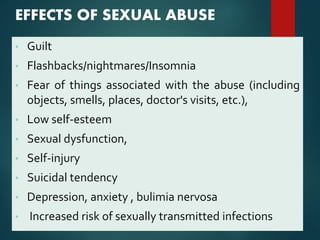
EFFECTS OF SEXUAL ABUSE
• Guilt
• Flashbacks/nightmares/Insomnia
• Fear of things associated with the abuse (including
objects, smells, places, doctor's visits, etc.),
• Low self-esteem
• Sexual dysfunction,
• Self-injury
• Suicidal tendency
• Depression, anxiety , bulimia nervosa
• Increased risk of sexually transmitted infections
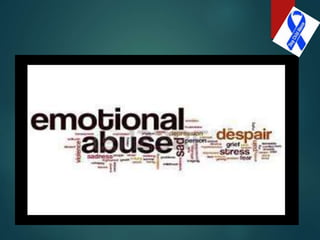
EMOTIONAL ABUSE
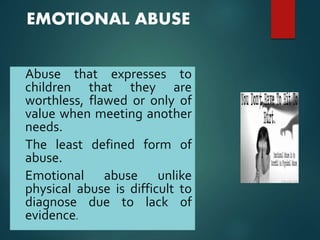
• Abuse that expresses to
children that they are
worthless, flawed or only of
value when meeting another
needs.
• The least defined form of
abuse.
• Emotional abuse unlike
physical abuse is difficult to
diagnose due to lack of
evidence.
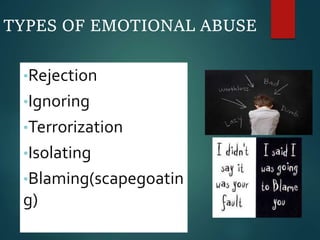
TYPES OF EMOTIONAL ABUSE
•Rejection
•Ignoring
•Terrorization
•Isolating
•Blaming(scapegoatin
g)
NEGLECT
 It is the failure or lack of prudent care for a child's well-
being through lack of adequate supervision, food, clothing,
shelter, education or medical care.
 It may not produce visible signs, and it usually occurs over a
period of time.
 Physical abuse tends to be episodic, neglect tends to be
chronic. ABUSE IS AN ACT OF COMMISSION,NEGLECT IS AN
ACT OF OMISSION
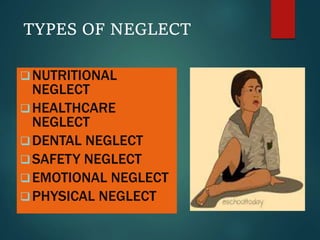
TYPES OF NEGLECT
NUTRITIONAL
NEGLECT
HEALTHCARE
NEGLECT
DENTAL NEGLECT
SAFETY NEGLECT
EMOTIONAL NEGLECT
PHYSICAL NEGLECT
Nutritional Neglect
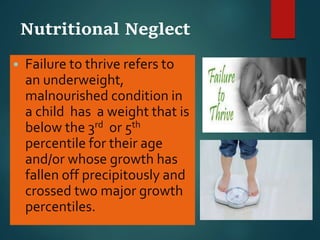
 Failure to thrive refers to
an underweight,
malnourished condition in
a child has a weight that is
below the 3rd or 5th
percentile for their age
and/or whose growth has
fallen off precipitously and
crossed two major growth
percentiles.
FAILURE TO THRIVE
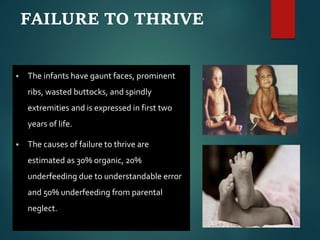
 The infants have gaunt faces, prominent
ribs, wasted buttocks, and spindly
extremities and is expressed in first two
years of life.
 The causes of failure to thrive are
estimated as 30% organic, 20%
underfeeding due to understandable error
and 50% underfeeding from parental
neglect.
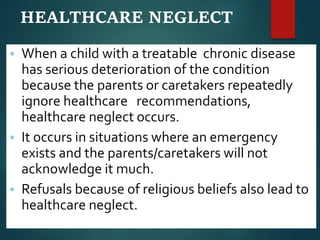
HEALTHCARE NEGLECT
 When a child with a treatable chronic disease
has serious deterioration of the condition
because the parents or caretakers repeatedly
ignore healthcare recommendations,
healthcare neglect occurs.
 It occurs in situations where an emergency
exists and the parents/caretakers will not
acknowledge it much.
 Refusals because of religious beliefs also lead to
healthcare neglect.
DENTAL NEGLECT
 Dental neglect, as defined by the American
Academy of Paediatric Dentistry(2003), is
the “ failure of parent or guardian to seek
and follow through with treatment
necessary to ensure a level of oral health
essential for adequate function and freedom
from pain and infection.”
DENTAL NEGLECT
 Dental caries, periodontal diseases, and
other oral conditions, if left untreated, can
lead to pain, infection, and loss of function.
 These undesirable outcomes can adversely
affect learning, communication, nutrition,
and other activities necessary for normal
growth and development.
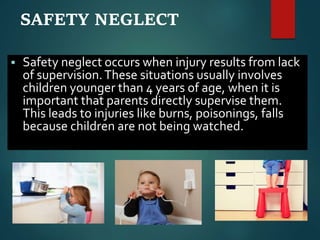
SAFETY NEGLECT
 Safety neglect occurs when injury results from lack
of supervision.These situations usually involves
children younger than 4 years of age, when it is
important that parents directly supervise them.
This leads to injuries like burns, poisonings, falls
because children are not being watched.
EMOTIONAL NEGLECT
 Emotional neglect is a failure to notice,
attend to, or respond appropriately to a
child's feelings.
 It is ,in some ways, the opposite of
mistreatment and abuse.Whereas
mistreatment and abuse are parental
acts, emotional neglect is a parent's failure
to act.
PHYSICAL NEGLECT
 Failure to care for children according to
accepted or appreciated standard.
 This is usually coaxial with physical abuse
and involves presentation of child with
unkempt hair, dirty or insufficient
clothing, incomplete immunization,
unsanitary home environment and
inadequate after-school supervision.
IDENTIFICATION OF CHILD ABUSE
 While some forms of
abuse or neglect are
more difficult to detect
than others, there are
always signs or indicators
which, may suggest a
child is in need of help.
INDICATORS OF PHYSICAL ABUSE
• Injuries unusual for a specific age group (e.g.,
fractures in an infant ).
• Lacerations and Abrasions - on lips, eye, any
portion of an infant’s face, on gum tissues (from
forced feeding).
• Specific bruising patterns such as cigarette
burns, belt buckle mark, finger imprints, etc.
• Bruises on the body, in unusual patterns, in
various stages of healing.
INDICATORS OF
EMOTIONAL ABUSE
• Poor self-esteem
• Destructive behaviour
• Angry acts
• Withdrawal ,poor
development of basic skills
• Alcohol or drug abuse
• Difficulty in forming
relationships
INDICATORS OF SEXUAL ABUSE
PHYSICAL INDICATORS
• Difficulty in walking or
sitting
• Bruises or bleeding from
external genitalia, or
presence of semen.
• Torn, stained or bloody
underclothes.
• Pain or itching in the
genital area
• Positive tests for sexually
transmitted diseases
• Pregnancy
BEHAVIOURALINDICATORS
• Poor peer relationships
• Regression
• Aggressiveness or
delinquency
• Reluctance to participate
in recreational activities
• Preoccupations with the
genital area.
MEDICOLEGAL
ASPECTS
MEDICOLEGAL CONSIDERATIONS
 A separate doctrine ‘ Parens Patriae ’ (father of
the country) was developed to understand laws
made to protect children.
 In the Constitution Bench decision of Supreme
Court in 1990, the doctrine was passed. It
stated that parens patriae is the inherent
power and authority of a legislature to provide
protection to the person and property of
persons such as minor, insane, and
incompetent person.
MEDICOLEGAL
CONSIDERATIONS
 Dentists should know the definitions
of child abuse and related laws
proposed under the Draft Model Child
Protection Act 1977, to protect
themselves and apply it correctly in
such cases.
REPORTING
 Dentists are mandated to
report based on
“reasonable suspicion,”
and they are not
responsible for an further
investigations.
REPORTING
 The same laws that mandate dentists to report
suspected abuse often also protect them from
legal litigations, often brought by angry or
vengeful parents. This law also makes the
dentist liable for any damage to child caused by
the failure to report abuse.
 Although the laws vary, generally the dentist
who fails to report such case is considered
guilty of misdemeanour and is subject to a fine
or jail sentence , usually 30 days in length.
WHERE TO MAKE A COMPLAINT
• A complaint alleging the commission of any
act amounting to abuse of a child can be
made to the police.
• The Police helpline number is 100.
• In case the police fails to register a FIR or
does not investigate the case, then the
aggrieved party can write an application to
the Superintendent of Police under Section
154(3) of Criminal Procedure Code (CrPC).
WHERE TO MAKE A COMPLAINT
 Even if there is failure on the part of the
Superintendent of police to take action, or that
even after registering it no proper investigation
is held, the aggrieved party can file an
application under Section 156(3) of CrPC before
the learned Magistrate concerned.
 In such cases the Magistrate can direct the FIR
to be registered and also can direct a proper
investigation to be made.
WHERE TO MAKE A
COMPLAINT
• An online complaint can be made at the website of
the National Commission for Protection of
Children’s Rights(NCPCR) by clicking on the
following link:
http://ncpcronline.info/OnlineForm/onlineform.asp
x
• Online complaint can also be made at the website
of the National Commission of Human Rights by
clicking on following link :http://nhrc.nic.in/
WHERE TO MAKE A
COMPLAINT
• A complaint can also be addressed to:
Chairperson National Commission for Protection of
Child Rights,
5th Floor, Chanderlok Building, 36, Janpath,
New Delhi - 110 001
(E-Mail: complaints.ncpcr@gmail.com)
• A call can be made to CHILDLINE , a 24 hours free
telephone helpline service at the number 1098.
The most
effective strategy
for the
management of
child abuse in its
various forms is
prevention and
awareness.
PREVENTION OF CHILD ABUSE
Some of the preventive
measures are:
 Dental Professionals Against
Violence(DPAV)
 Prevent Abuse and Neglect
through Dental Awareness
(PANDA)
 National Plan of Action for
Children (NPAC)
Dental professionals against
violence(DPAV)
 Dental professionals against violence was
initiated by Californian Dental Association
in 2001.
 It consists both Train the trainer and direct
provider training programs designed to
assist dental professionals and their teams
in recognizing and responding to child
abuse and neglect, intimate partner
violence and elder abuse and neglect.
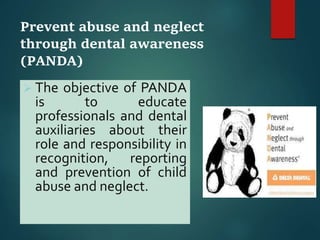
Prevent abuse and neglect
through dental awareness
(PANDA)
 The objective of PANDA
is to educate
professionals and dental
auxiliaries about their
role and responsibility in
recognition, reporting
and prevention of child
abuse and neglect.
National plan of action for
children (NPAC)
 The National Plan of Action for Children was
formulated by the then Department of
Women and Child Development {now,
Ministry of Women and Child Development
(MWCD)} in 2005.
 It aims at ensuring all rights to children up to
18 years of age.
 It also aims at creating an enabling
environment to ensure protection of child
rights.
CHILD RIGHTS
The National
Commission for
Protection of Child
Rights (NCPCR) was set
up in March, 2007 under
the Commission for
Protection of Child
Rights Act, 2005, an Act
of Parliament (December
2005).
CHILD RIGHTS
• The Protection of Children from
Sexual Offences(POCSO)Act,
2012, was passed by the Lok
Sabha, 22nd May, 2012. The Bill
was earlier passed by the Rajya
Sabha on 10th May, 2012.
National Policies
 The Constitution of India contains a number of
provisions for the protection and welfare of the
children. It has empowered the legislature to make
special laws and policies to safeguard the rights of
the children.
 Articles 14, 15, 15(3), 19(1) (a), 21, 21A- Right to
Education, 23, 24-Prohibition Of Employment Of
Children, 39(e) 39(f) of the Constitution of India
contain provisions for the protection, safety, security
and well-being of children.
conclusion
more than 50% of child abuse injuries occur to the face and oral cavity, the dentist has a unique
opportunity to identify and report suspicious cases, thus lessening the high mortality rate.
Fifty per cent of the severely abused children will die of recurrent abuse if proper therapeutic
measures are not introduced.
The best thing that can be done for an abused or neglected child is to report suspicions to the
appropriate authority immediately.
Thousands of children die from child abuse each year.
Thirty-five per cent of the victims of nonfatal abuse will be abused again within a 1-year period.
REFERENCES
 McDonald and Avery’s Dentistry for the child and the
Adolescent, 9th edition
 Textbook of Paediatric Dentistry , Nikhil Marwah,3rd
edition
 Paediatric Dentistry Principles & Practice, MS Muthu,2nd
edition
 Guideline on Oral and Dental Aspects of Child Abuse and
Neglect(2010)
 Reporting child abuse and neglect ,Kentucky Guidelines.

Child abuse & Neglect

  • 1.
    CHILD ABUSE &NEGLECT PRESENTED BY: DR.KRITIKA SINGH JR – II PEADIATRIC &PREVENTIVE DENTISTRY KGMU LUCKNOW
  • 2.
    CHILD ABUSE Abuse canmean different things to different children, and can happen once or many times.
  • 3.
    CHILD ABUSE  Child abusecan rob kids of the joy of growing up and affect them negatively for years to come.
  • 5.
    DEFINITIONS The World HealthOrganization ((WHO) defines child abuse and child maltreatment as "all forms of physical and/or emotional ill-treatment, sexual abuse, neglect or negligent treatment or commercial or other exploitation, resulting in actual or potential harm to the child's health, survival, development or dignity in the context of a relationship of responsibility, trust or power’’.
  • 6.
    DEFINITIONS The United Statesfederal Child Abuse Prevention and Treatment Act defines child abuse and neglect as, at minimum, "any recent "any recent act or failure to act on the part of a parent or caretaker which results in death, serious physical or emotional harm, sexual abuse or exploitation" and/or "an act or failure to act which presents an imminent risk of serious harm’’.
  • 7.
    WHO IS ABUSED? Children from all walks of life may be victims of child abuse or neglect.  No age, race, gender, or socioeconomic level is spared.
  • 8.
    STATISTICS National statistics statethat about 53% children are abused. The highest number of cases were reported in Uttar Pradesh, Delhi, Assam, Andhra Pradesh and Bihar.
  • 9.
    TYPES OF CHILDMALTREATMENT The World Health Organization distinguishes four types of child maltreatment:  Physical Abuse  Sexual Abuse  Emotional/Psychological Abuse  Neglect
  • 10.
    EXAMINETION OF ABUSED CHILDIN DENTAL CLINIC Screening OR Examination
  • 11.
    The examination forCA should be incorporated with the routine dental examination : 1. Dentist and staff should be educated to get a visual impression of the child as he enters the reception room. 2.They should note the child and guardian have appropriate interaction or not. 3. Many abused and neglected children are fearful for further abuse and display several reactions.They may appear overly vigilant, or display a "frozen watchfulness," staring constantly. 4.Their eyes constantly scan the environment for danger, while at the same time their faces are immobile. There are no spontaneous smiles and almost no eye contact.It is as , they think that by not looking someone in the eye, they make themselves invisible and therefore safe from attack.
  • 12.
    5. The dentistand staff should observe the child ; Lack of cleanliness small stature with respect to age Evidence of malnutrition- Typical signs of include a posture of fatigue with rounded shoulder ,flat chest, the face is pale, muddy and lacks luster. child’s clothing, which should be appropriate for the climactic conditions. Failure to provide adequate clothing for protection from rain, cold, or snow may constitute child neglect. Overdressed children also should be noted; long sleeves and highnecked shirts or blouses during hot summer months may be worn to cover the signs of physical abuse. Be observant for physical problems, such as a limp, difficulty climbing into the dental chair, poor or abnormal positioning of the limbs.
  • 13.
    Oral examination : A variety of orofacial injuries occurs in 50% or more of abused children,these are ;  Fractured, missing, displaced, or discolored teeth;  Scars of the lips and mucosa  Slap marks  Torn or scarred maxillary midline, or sublingual frenaum, deviated, or scarred tongue.  These injuries may result from a parent’s attempt to silence a child with a gag, hand slap, or punch ,Or a spoon or fork applied with enough force .
  • 14.
    CA may beinitiated at any age, a notation should be recorded on the chart at every recall to indicate that a CA screening was done, and that the findings were negative. If the screening examination leads to questionable or suspicious findings, a more thorough examination is warranted.
  • 16.
    PHYSICAL ABUSE  Physicalabuse is the injury by other than accidental means of a child under 18 years of age which is the result of actions by a parent, guardian, or other designated (temporary or permanent) caretaker.
  • 17.
    PHYSICAL ABUSE • Theinjuries inflicted are intentional and not accidental. • Some result from punishment that is inappropriate for the child’s age ,condition, or level of development. • Some result from a parent’s frustration and lack of control in acting out anger.
  • 18.
    BATTERED CHILD SYNDROME •A severe form of physical abuse. • First described by Kempe in 1962. • Battered child syndrome is the collection of injuries sustained by a child as a result of repeated mistreatment or beating.
  • 19.
    BATTERED CHILD SYNDROME •Bruises, lacerations , burns and fractures are commonly inflicted injuries. • The major trait of the caretakers is either a lack of an explanation for critical injuries or explanations that does not account for the severity of injuries.
  • 20.
    MUNCHAUSEN SYNDROME  MUNCHAUSENSYNDROME is a psychological disorder in which the person fabricates the symptoms or injury in order to undergo medical tests, hospitalization or even medical or surgical treatment , when she/he is not really sick.  Described by Dr. Richard Asher in 1951.
  • 21.
    MUNCHAUSEN SYNDROME BY PROXY In cases of Munchausen syndrome by proxy , a parent or caretaker attempts to bring medical attention to themselves by injuring or inducing illness in their children.  It describes children who are victims of parentally fabricated or induced illness.  The term was coined by Dr. Roy Meadow.
  • 22.
    MUNCHAUSEN SYNDROME BY PROXY •It is the most difficult form of child maltreatment to identify and treat.
  • 23.
    SHAKEN BABY SYNDROME •First reported by Guthkelch in 1971. • Seen primarily in children 18 months of age or younger. • The infant’s head is shaken vigorously forward and backward hitting the chest and shoulders.
  • 24.
    SHAKEN BABY SYNDROME •Symptoms are: Retinal haemorrhage o Subdural or subarachnoid hematomas o Breathing difficulties o Seizures/Unconsciousness
  • 25.
  • 26.
    CHILD SEXUAL ABUSE Sexual abuse is the misuse of a child for sexual pleasure or gratification.  It is of two types. 1) Out -of-house abuse 2) In-house abuse(Incest)  Sexual abuse has the potential to interfere with child’s normal healthy development, both emotionally and physically.
  • 27.
    EFFECTS OF SEXUALABUSE • Guilt • Flashbacks/nightmares/Insomnia • Fear of things associated with the abuse (including objects, smells, places, doctor's visits, etc.), • Low self-esteem • Sexual dysfunction, • Self-injury • Suicidal tendency • Depression, anxiety , bulimia nervosa • Increased risk of sexually transmitted infections
  • 29.
    EMOTIONAL ABUSE • Abusethat expresses to children that they are worthless, flawed or only of value when meeting another needs. • The least defined form of abuse. • Emotional abuse unlike physical abuse is difficult to diagnose due to lack of evidence.
  • 30.
    TYPES OF EMOTIONALABUSE •Rejection •Ignoring •Terrorization •Isolating •Blaming(scapegoatin g)
  • 31.
    NEGLECT  It isthe failure or lack of prudent care for a child's well- being through lack of adequate supervision, food, clothing, shelter, education or medical care.  It may not produce visible signs, and it usually occurs over a period of time.  Physical abuse tends to be episodic, neglect tends to be chronic. ABUSE IS AN ACT OF COMMISSION,NEGLECT IS AN ACT OF OMISSION
  • 32.
    TYPES OF NEGLECT NUTRITIONAL NEGLECT HEALTHCARE NEGLECT DENTALNEGLECT SAFETY NEGLECT EMOTIONAL NEGLECT PHYSICAL NEGLECT
  • 33.
    Nutritional Neglect  Failureto thrive refers to an underweight, malnourished condition in a child has a weight that is below the 3rd or 5th percentile for their age and/or whose growth has fallen off precipitously and crossed two major growth percentiles.
  • 34.
    FAILURE TO THRIVE The infants have gaunt faces, prominent ribs, wasted buttocks, and spindly extremities and is expressed in first two years of life.  The causes of failure to thrive are estimated as 30% organic, 20% underfeeding due to understandable error and 50% underfeeding from parental neglect.
  • 35.
    HEALTHCARE NEGLECT  Whena child with a treatable chronic disease has serious deterioration of the condition because the parents or caretakers repeatedly ignore healthcare recommendations, healthcare neglect occurs.  It occurs in situations where an emergency exists and the parents/caretakers will not acknowledge it much.  Refusals because of religious beliefs also lead to healthcare neglect.
  • 36.
    DENTAL NEGLECT  Dentalneglect, as defined by the American Academy of Paediatric Dentistry(2003), is the “ failure of parent or guardian to seek and follow through with treatment necessary to ensure a level of oral health essential for adequate function and freedom from pain and infection.”
  • 37.
    DENTAL NEGLECT  Dentalcaries, periodontal diseases, and other oral conditions, if left untreated, can lead to pain, infection, and loss of function.  These undesirable outcomes can adversely affect learning, communication, nutrition, and other activities necessary for normal growth and development.
  • 38.
    SAFETY NEGLECT  Safetyneglect occurs when injury results from lack of supervision.These situations usually involves children younger than 4 years of age, when it is important that parents directly supervise them. This leads to injuries like burns, poisonings, falls because children are not being watched.
  • 39.
    EMOTIONAL NEGLECT  Emotionalneglect is a failure to notice, attend to, or respond appropriately to a child's feelings.  It is ,in some ways, the opposite of mistreatment and abuse.Whereas mistreatment and abuse are parental acts, emotional neglect is a parent's failure to act.
  • 40.
    PHYSICAL NEGLECT  Failureto care for children according to accepted or appreciated standard.  This is usually coaxial with physical abuse and involves presentation of child with unkempt hair, dirty or insufficient clothing, incomplete immunization, unsanitary home environment and inadequate after-school supervision.
  • 41.
    IDENTIFICATION OF CHILDABUSE  While some forms of abuse or neglect are more difficult to detect than others, there are always signs or indicators which, may suggest a child is in need of help.
  • 42.
    INDICATORS OF PHYSICALABUSE • Injuries unusual for a specific age group (e.g., fractures in an infant ). • Lacerations and Abrasions - on lips, eye, any portion of an infant’s face, on gum tissues (from forced feeding). • Specific bruising patterns such as cigarette burns, belt buckle mark, finger imprints, etc. • Bruises on the body, in unusual patterns, in various stages of healing.
  • 43.
    INDICATORS OF EMOTIONAL ABUSE •Poor self-esteem • Destructive behaviour • Angry acts • Withdrawal ,poor development of basic skills • Alcohol or drug abuse • Difficulty in forming relationships
  • 44.
    INDICATORS OF SEXUALABUSE PHYSICAL INDICATORS • Difficulty in walking or sitting • Bruises or bleeding from external genitalia, or presence of semen. • Torn, stained or bloody underclothes. • Pain or itching in the genital area • Positive tests for sexually transmitted diseases • Pregnancy BEHAVIOURALINDICATORS • Poor peer relationships • Regression • Aggressiveness or delinquency • Reluctance to participate in recreational activities • Preoccupations with the genital area.
  • 45.
  • 46.
    MEDICOLEGAL CONSIDERATIONS  Aseparate doctrine ‘ Parens Patriae ’ (father of the country) was developed to understand laws made to protect children.  In the Constitution Bench decision of Supreme Court in 1990, the doctrine was passed. It stated that parens patriae is the inherent power and authority of a legislature to provide protection to the person and property of persons such as minor, insane, and incompetent person.
  • 47.
    MEDICOLEGAL CONSIDERATIONS  Dentists shouldknow the definitions of child abuse and related laws proposed under the Draft Model Child Protection Act 1977, to protect themselves and apply it correctly in such cases.
  • 48.
    REPORTING  Dentists aremandated to report based on “reasonable suspicion,” and they are not responsible for an further investigations.
  • 49.
    REPORTING  The samelaws that mandate dentists to report suspected abuse often also protect them from legal litigations, often brought by angry or vengeful parents. This law also makes the dentist liable for any damage to child caused by the failure to report abuse.  Although the laws vary, generally the dentist who fails to report such case is considered guilty of misdemeanour and is subject to a fine or jail sentence , usually 30 days in length.
  • 50.
    WHERE TO MAKEA COMPLAINT • A complaint alleging the commission of any act amounting to abuse of a child can be made to the police. • The Police helpline number is 100. • In case the police fails to register a FIR or does not investigate the case, then the aggrieved party can write an application to the Superintendent of Police under Section 154(3) of Criminal Procedure Code (CrPC).
  • 51.
    WHERE TO MAKEA COMPLAINT  Even if there is failure on the part of the Superintendent of police to take action, or that even after registering it no proper investigation is held, the aggrieved party can file an application under Section 156(3) of CrPC before the learned Magistrate concerned.  In such cases the Magistrate can direct the FIR to be registered and also can direct a proper investigation to be made.
  • 52.
    WHERE TO MAKEA COMPLAINT • An online complaint can be made at the website of the National Commission for Protection of Children’s Rights(NCPCR) by clicking on the following link: http://ncpcronline.info/OnlineForm/onlineform.asp x • Online complaint can also be made at the website of the National Commission of Human Rights by clicking on following link :http://nhrc.nic.in/
  • 53.
    WHERE TO MAKEA COMPLAINT • A complaint can also be addressed to: Chairperson National Commission for Protection of Child Rights, 5th Floor, Chanderlok Building, 36, Janpath, New Delhi - 110 001 (E-Mail: complaints.ncpcr@gmail.com) • A call can be made to CHILDLINE , a 24 hours free telephone helpline service at the number 1098.
  • 55.
    The most effective strategy forthe management of child abuse in its various forms is prevention and awareness.
  • 56.
    PREVENTION OF CHILDABUSE Some of the preventive measures are:  Dental Professionals Against Violence(DPAV)  Prevent Abuse and Neglect through Dental Awareness (PANDA)  National Plan of Action for Children (NPAC)
  • 57.
    Dental professionals against violence(DPAV) Dental professionals against violence was initiated by Californian Dental Association in 2001.  It consists both Train the trainer and direct provider training programs designed to assist dental professionals and their teams in recognizing and responding to child abuse and neglect, intimate partner violence and elder abuse and neglect.
  • 58.
    Prevent abuse andneglect through dental awareness (PANDA)  The objective of PANDA is to educate professionals and dental auxiliaries about their role and responsibility in recognition, reporting and prevention of child abuse and neglect.
  • 59.
    National plan ofaction for children (NPAC)  The National Plan of Action for Children was formulated by the then Department of Women and Child Development {now, Ministry of Women and Child Development (MWCD)} in 2005.  It aims at ensuring all rights to children up to 18 years of age.  It also aims at creating an enabling environment to ensure protection of child rights.
  • 60.
    CHILD RIGHTS The National Commissionfor Protection of Child Rights (NCPCR) was set up in March, 2007 under the Commission for Protection of Child Rights Act, 2005, an Act of Parliament (December 2005).
  • 61.
    CHILD RIGHTS • TheProtection of Children from Sexual Offences(POCSO)Act, 2012, was passed by the Lok Sabha, 22nd May, 2012. The Bill was earlier passed by the Rajya Sabha on 10th May, 2012.
  • 62.
    National Policies  TheConstitution of India contains a number of provisions for the protection and welfare of the children. It has empowered the legislature to make special laws and policies to safeguard the rights of the children.  Articles 14, 15, 15(3), 19(1) (a), 21, 21A- Right to Education, 23, 24-Prohibition Of Employment Of Children, 39(e) 39(f) of the Constitution of India contain provisions for the protection, safety, security and well-being of children.
  • 63.
    conclusion more than 50%of child abuse injuries occur to the face and oral cavity, the dentist has a unique opportunity to identify and report suspicious cases, thus lessening the high mortality rate. Fifty per cent of the severely abused children will die of recurrent abuse if proper therapeutic measures are not introduced. The best thing that can be done for an abused or neglected child is to report suspicions to the appropriate authority immediately. Thousands of children die from child abuse each year. Thirty-five per cent of the victims of nonfatal abuse will be abused again within a 1-year period.
  • 66.
    REFERENCES  McDonald andAvery’s Dentistry for the child and the Adolescent, 9th edition  Textbook of Paediatric Dentistry , Nikhil Marwah,3rd edition  Paediatric Dentistry Principles & Practice, MS Muthu,2nd edition  Guideline on Oral and Dental Aspects of Child Abuse and Neglect(2010)  Reporting child abuse and neglect ,Kentucky Guidelines.