Child Labor
and
Related Issues
Dr. SAIF
Roster 44
OBC 81 AMC/AEC
Captain, Bangladesh Army
AIM
To know the reasons behind child labor and
how it affects society, present situation of child
labor in Bangladesh, measures available to
stop it, and other related issues.
Scope
Who is Child ? What is Child Labor ?
Why Child Labor persists ?
What are the forms of Child Labor ?
Distribution of Child Labor depending on
geography, culture, gender.
Child Labor condition in Bangladesh.
How can we eliminate and prevent Child Labor ?
Recommendation and Conclusion.
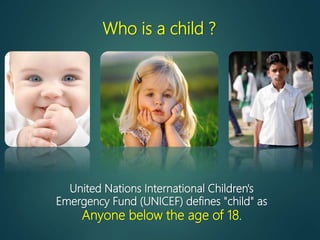
Who is a child ?
United Nations International Children's
Emergency Fund (UNICEF) defines "child" as
Anyone below the age of 18.
What is child labor ?
"Child labor" is, work by children that harms them in
some way (physically, mentally, morally, or by blocking
access to education).
According UNICEF
“Child labor is work that exceeds
a minimum number of hours,
depending on the age of a child
and on the type of work. Such
work is considered harmful to the
child and should therefore be
eliminated.”
The International Labor
Organization (ILO) defines
child Labor as:
 When a child is working
during early age.
 He overworks or gives over
time to Labor.
 He works due to the psychologically, socially, and
materialistic pressure.
 He becomes ready to Labor on a very low pay.
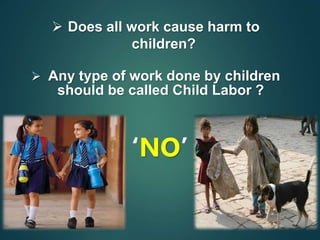
 Does all work cause harm to
children?
 Any type of work done by children
should be called Child Labor ?
‘NO’
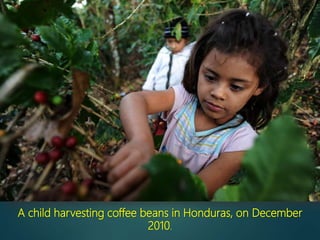
A child harvesting coffee beans in Honduras, on December
2010.
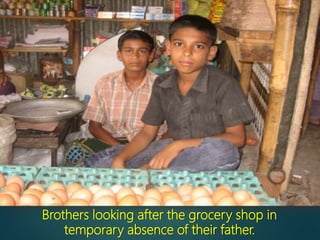
Brothers looking after the grocery shop in
temporary absence of their father.
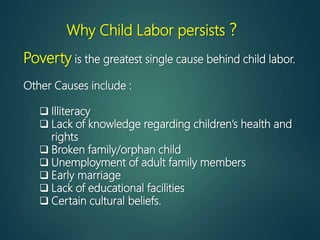
Why Child Labor persists ?
Poverty is the greatest single cause behind child labor.
Other Causes include :
 Illiteracy
 Lack of knowledge regarding children’s health and
rights
 Broken family/orphan child
 Unemployment of adult family members
 Early marriage
 Lack of educational facilities
 Certain cultural beliefs.
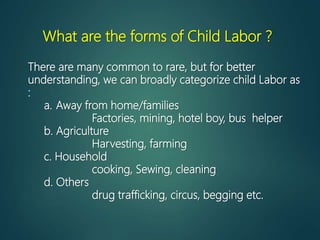
What are the forms of Child Labor ?
There are many common to rare, but for better
understanding, we can broadly categorize child Labor as
:
a. Away from home/families
Factories, mining, hotel boy, bus helper
b. Agriculture
Harvesting, farming
c. Household
cooking, Sewing, cleaning
d. Others
drug trafficking, circus, begging etc.
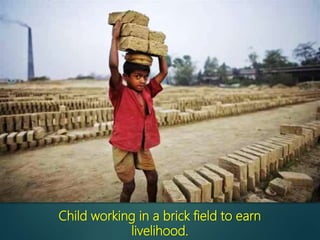
Child working in a brick field to earn
livelihood.
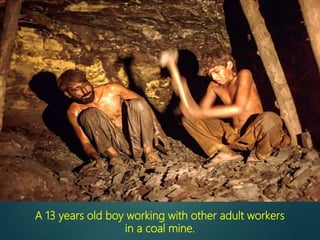
A 13 years old boy working with other adult workers
in a coal mine.
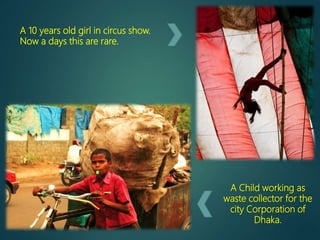
A 10 years old girl in circus show.
Now a days this are rare.
A Child working as
waste collector for the
city Corporation of
Dhaka.
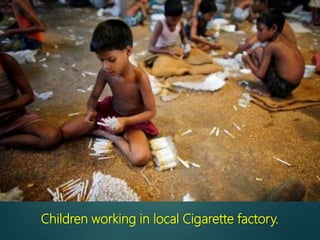
Children working in local Cigarette factory.
Distribution of Child Labor varies greatly
depending on :
 Geography
 Culture and Religion
 Gender
 Economic condition etc.
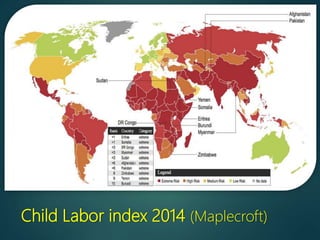
Child Labor index 2014 (Maplecroft)
Few works involves male child,
such as mining, bus helper, metal
and dye factory, tannery, garage.
On the other hand, female child
commonly works as housemaid,
garments factory and child prostitution.
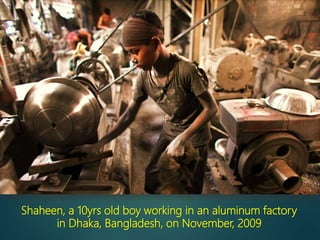
Shaheen, a 10yrs old boy working in an aluminum factory
in Dhaka, Bangladesh, on November, 2009
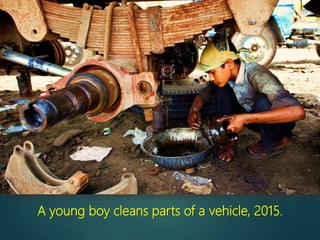
A young boy cleans parts of a vehicle, 2015.
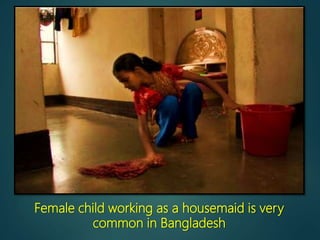
Female child working as a housemaid is very
common in Bangladesh
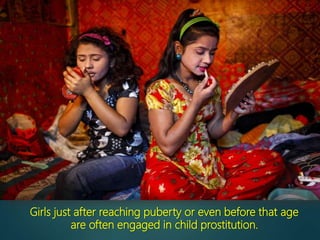
Girls just after reaching puberty or even before that age
are often engaged in child prostitution.
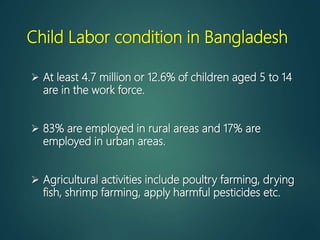
Child Labor condition in Bangladesh
 At least 4.7 million or 12.6% of children aged 5 to 14
are in the work force.
 83% are employed in rural areas and 17% are
employed in urban areas.
 Agricultural activities include poultry farming, drying
fish, shrimp farming, apply harmful pesticides etc.
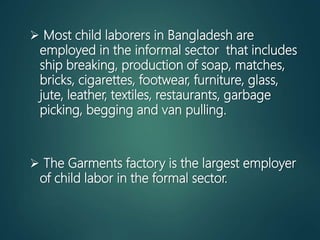
 Most child laborers in Bangladesh are
employed in the informal sector that includes
ship breaking, production of soap, matches,
bricks, cigarettes, footwear, furniture, glass,
jute, leather, textiles, restaurants, garbage
picking, begging and van pulling.
 The Garments factory is the largest employer
of child labor in the formal sector.
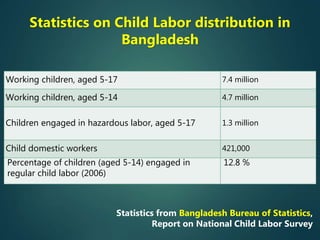
Working children, aged 5-17 7.4 million
Working children, aged 5-14 4.7 million
Children engaged in hazardous labor, aged 5-17 1.3 million
Child domestic workers 421,000
Percentage of children (aged 5-14) engaged in
regular child labor (2006)
12.8 %
Statistics on Child Labor distribution in
Bangladesh
Statistics from Bangladesh Bureau of Statistics,
Report on National Child Labor Survey
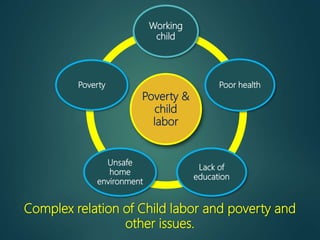
Complex relation of Child labor and poverty and
other issues.
Poverty &
child
labor
Working
child
Poor health
Lack of
education
Unsafe
home
environment
Poverty
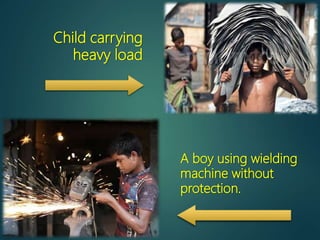
Child carrying
heavy load
A boy using wielding
machine without
protection.
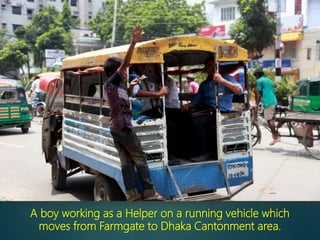
A boy working as a Helper on a running vehicle which
moves from Farmgate to Dhaka Cantonment area.
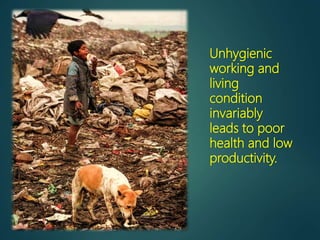
Unhygienic
working and
living
condition
invariably
leads to poor
health and low
productivity.
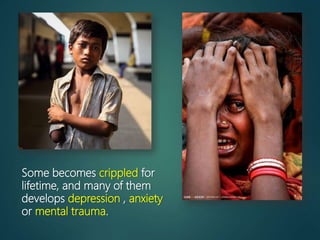
Some becomes crippled for
lifetime, and many of them
develops depression , anxiety
or mental trauma.
How can we eliminate and prevent
Child Labor ?
 Policy makers of the Government have to take the
issue seriously, and eradicate poverty and illiteracy.
 Employees would not involve a child for any work
which might deny the child of a normal childhood.
 Various Plans for child welfare and Laws against child
labor are implemented properly.
Things that can be done :
Child Labor Laws in Bangladesh
a. The Employment of Children Act 1975
This act allowed for children aged 15 or up to work in the
railway industry and in transporting goods in port jobs.
b. The Factories Act 1965
This act prohibited children under 14 to work in or
be present in factories.
This act prohibits children under the age of 12 from
working in any establishment.
c. Shops and Establishment Act 1965
d. The Constitution of People's Republic of
Bangladesh
It prohibits all forms of forced labor under Article 34.
e. The Children Act 2013
It focuses on different aspects of child welfare.
f. Labor Act 2006 (Bangladesh)
Sets the minimum age for work to 14 years & 18 years for
hazardous work.
What ‘We’ can do as a person to stop child
labor ?
 Rising awareness about children rights, thus
changing view of the society.
 Making people aware about the benefits of
education and Providing free education for the
orphans and poor children.
 Running Campaign against child labor.
 Participating directly or Donating in child
welfare funds eg. in NGOs working for the
rehabilitation of street children.
 Contacting NGOs and informing them about
child labor happening around us. We can also
report to authority.
World Day Against Child Labor
12 June
“Child labor has no place in well-functioning and well
regulated markets, or in any supply chain. The message
that we must act now to stop child labor once and for all
has been affirmed by the Sustainable Development
Goals. Acting together, it is within our means to make the
future of work a future without child labor."
Guy Ryder, ILO Director-General
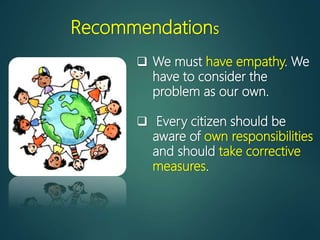
 We must have empathy. We
have to consider the
problem as our own.
 Every citizen should be
aware of own responsibilities
and should take corrective
measures.
Recommendations
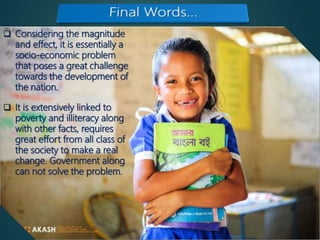
Final words Considering the magnitude
and effect, it is essentially a
socio-economic problem
that poses a great challenge
towards the development of
the nation.
 It is extensively linked to
poverty and illiteracy along
with other facts, requires
great effort from all class of
the society to make a real
change. Government along
can not solve the problem.
Together we can make the world
better.
?

Child Labour

  • 1.
    Child Labor and Related Issues Dr.SAIF Roster 44 OBC 81 AMC/AEC Captain, Bangladesh Army
  • 2.
    AIM To know thereasons behind child labor and how it affects society, present situation of child labor in Bangladesh, measures available to stop it, and other related issues.
  • 3.
    Scope Who is Child? What is Child Labor ? Why Child Labor persists ? What are the forms of Child Labor ? Distribution of Child Labor depending on geography, culture, gender. Child Labor condition in Bangladesh. How can we eliminate and prevent Child Labor ? Recommendation and Conclusion.
  • 4.
    Who is achild ? United Nations International Children's Emergency Fund (UNICEF) defines "child" as Anyone below the age of 18.
  • 5.
    What is childlabor ? "Child labor" is, work by children that harms them in some way (physically, mentally, morally, or by blocking access to education). According UNICEF “Child labor is work that exceeds a minimum number of hours, depending on the age of a child and on the type of work. Such work is considered harmful to the child and should therefore be eliminated.”
  • 6.
    The International Labor Organization(ILO) defines child Labor as:  When a child is working during early age.  He overworks or gives over time to Labor.  He works due to the psychologically, socially, and materialistic pressure.  He becomes ready to Labor on a very low pay.
  • 7.
     Does allwork cause harm to children?  Any type of work done by children should be called Child Labor ? ‘NO’
  • 8.
    A child harvestingcoffee beans in Honduras, on December 2010.
  • 9.
    Brothers looking afterthe grocery shop in temporary absence of their father.
  • 10.
    Why Child Laborpersists ? Poverty is the greatest single cause behind child labor. Other Causes include :  Illiteracy  Lack of knowledge regarding children’s health and rights  Broken family/orphan child  Unemployment of adult family members  Early marriage  Lack of educational facilities  Certain cultural beliefs.
  • 11.
    What are theforms of Child Labor ? There are many common to rare, but for better understanding, we can broadly categorize child Labor as : a. Away from home/families Factories, mining, hotel boy, bus helper b. Agriculture Harvesting, farming c. Household cooking, Sewing, cleaning d. Others drug trafficking, circus, begging etc.
  • 12.
    Child working ina brick field to earn livelihood.
  • 13.
    A 13 yearsold boy working with other adult workers in a coal mine.
  • 14.
    A 10 yearsold girl in circus show. Now a days this are rare. A Child working as waste collector for the city Corporation of Dhaka.
  • 15.
    Children working inlocal Cigarette factory.
  • 16.
    Distribution of ChildLabor varies greatly depending on :  Geography  Culture and Religion  Gender  Economic condition etc.
  • 17.
    Child Labor index2014 (Maplecroft)
  • 18.
    Few works involvesmale child, such as mining, bus helper, metal and dye factory, tannery, garage. On the other hand, female child commonly works as housemaid, garments factory and child prostitution.
  • 19.
    Shaheen, a 10yrsold boy working in an aluminum factory in Dhaka, Bangladesh, on November, 2009
  • 20.
    A young boycleans parts of a vehicle, 2015.
  • 21.
    Female child workingas a housemaid is very common in Bangladesh
  • 22.
    Girls just afterreaching puberty or even before that age are often engaged in child prostitution.
  • 23.
    Child Labor conditionin Bangladesh  At least 4.7 million or 12.6% of children aged 5 to 14 are in the work force.  83% are employed in rural areas and 17% are employed in urban areas.  Agricultural activities include poultry farming, drying fish, shrimp farming, apply harmful pesticides etc.
  • 24.
     Most childlaborers in Bangladesh are employed in the informal sector that includes ship breaking, production of soap, matches, bricks, cigarettes, footwear, furniture, glass, jute, leather, textiles, restaurants, garbage picking, begging and van pulling.  The Garments factory is the largest employer of child labor in the formal sector.
  • 25.
    Working children, aged5-17 7.4 million Working children, aged 5-14 4.7 million Children engaged in hazardous labor, aged 5-17 1.3 million Child domestic workers 421,000 Percentage of children (aged 5-14) engaged in regular child labor (2006) 12.8 % Statistics on Child Labor distribution in Bangladesh Statistics from Bangladesh Bureau of Statistics, Report on National Child Labor Survey
  • 26.
    Complex relation ofChild labor and poverty and other issues. Poverty & child labor Working child Poor health Lack of education Unsafe home environment Poverty
  • 27.
    Child carrying heavy load Aboy using wielding machine without protection.
  • 28.
    A boy workingas a Helper on a running vehicle which moves from Farmgate to Dhaka Cantonment area.
  • 29.
  • 30.
    Some becomes crippledfor lifetime, and many of them develops depression , anxiety or mental trauma.
  • 31.
    How can weeliminate and prevent Child Labor ?  Policy makers of the Government have to take the issue seriously, and eradicate poverty and illiteracy.  Employees would not involve a child for any work which might deny the child of a normal childhood.  Various Plans for child welfare and Laws against child labor are implemented properly. Things that can be done :
  • 32.
    Child Labor Lawsin Bangladesh a. The Employment of Children Act 1975 This act allowed for children aged 15 or up to work in the railway industry and in transporting goods in port jobs. b. The Factories Act 1965 This act prohibited children under 14 to work in or be present in factories. This act prohibits children under the age of 12 from working in any establishment. c. Shops and Establishment Act 1965
  • 33.
    d. The Constitutionof People's Republic of Bangladesh It prohibits all forms of forced labor under Article 34. e. The Children Act 2013 It focuses on different aspects of child welfare. f. Labor Act 2006 (Bangladesh) Sets the minimum age for work to 14 years & 18 years for hazardous work.
  • 34.
    What ‘We’ cando as a person to stop child labor ?  Rising awareness about children rights, thus changing view of the society.  Making people aware about the benefits of education and Providing free education for the orphans and poor children.
  • 35.
     Running Campaignagainst child labor.  Participating directly or Donating in child welfare funds eg. in NGOs working for the rehabilitation of street children.  Contacting NGOs and informing them about child labor happening around us. We can also report to authority.
  • 36.
    World Day AgainstChild Labor 12 June “Child labor has no place in well-functioning and well regulated markets, or in any supply chain. The message that we must act now to stop child labor once and for all has been affirmed by the Sustainable Development Goals. Acting together, it is within our means to make the future of work a future without child labor." Guy Ryder, ILO Director-General
  • 37.
     We musthave empathy. We have to consider the problem as our own.  Every citizen should be aware of own responsibilities and should take corrective measures. Recommendations
  • 38.
    Final words Consideringthe magnitude and effect, it is essentially a socio-economic problem that poses a great challenge towards the development of the nation.  It is extensively linked to poverty and illiteracy along with other facts, requires great effort from all class of the society to make a real change. Government along can not solve the problem.
  • 39.
    Together we canmake the world better. ?