Child Abuse
By: Josh Quintanilla
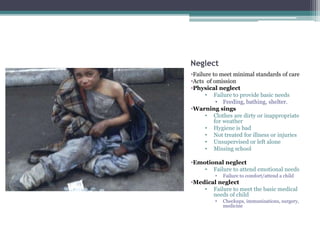
Neglect
•Failure to meet minimal standards of care
•Acts of omission
•Physical neglect
• Failure to provide basic needs
• Feeding, bathing, shelter.
•Warning sings
• Clothes are dirty or inappropriate
for weather
• Hygiene is bad
• Not treated for illness or injuries
• Unsupervised or left alone
• Missing school
•Emotional neglect
• Failure to attend emotional needs
• Failure to comfort/attend a child
•Medical neglect
• Failure to meet the basic medical
needs of child
• Checkups, immunizations, surgery,
medicine
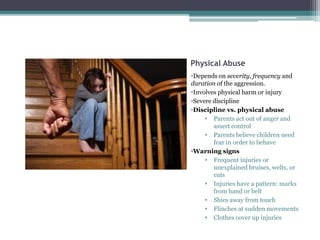
Physical Abuse
•Depends on severity, frequency and
duration of the aggression.
•Involves physical harm or injury
•Severe discipline
•Discipline vs. physical abuse
• Parents act out of anger and
assert control
• Parents believe children need
fear in order to behave
•Warning signs
• Frequent injuries or
unexplained bruises, welts, or
cuts
• Injuries have a pattern: marks
from hand or belt
• Shies away from touch
• Flinches at sudden movements
• Clothes cover up injuries
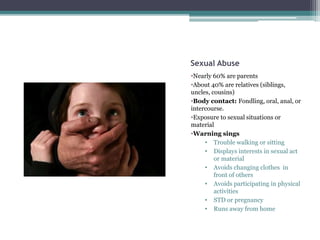
Sexual Abuse
•Nearly 60% are parents
•About 40% are relatives (siblings,
uncles, cousins)
•Body contact: Fondling, oral, anal, or
intercourse.
•Exposure to sexual situations or
material
•Warning sings
• Trouble walking or sitting
• Displays interests in sexual act
or material
• Avoids changing clothes in
front of others
• Avoids participating in physical
activities
• STD or pregnancy
• Runs away from home
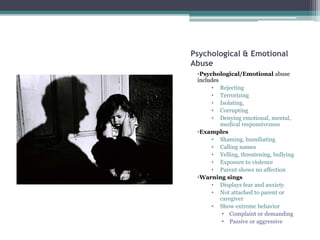
Psychological & Emotional
Abuse
•Psychological/Emotional abuse
includes
• Rejecting
• Terrorizing
• Isolating,
• Corrupting
• Denying emotional, mental,
medical responsiveness
•Examples
• Shaming, humiliating
• Calling names
• Yelling, threatening, bullying
• Exposure to violence
• Parent shows no affection
•Warning sings
• Displays fear and anxiety
• Not attached to parent or
caregiver
• Show extreme behavior
• Complaint or demanding
• Passive or aggressive
Conclusion
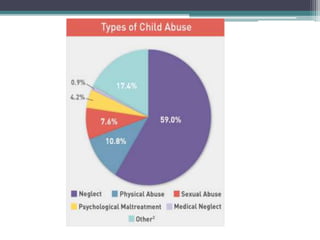
•There are five types of abuse: negligence, physical,
sexual, physiological/emotional abuse.
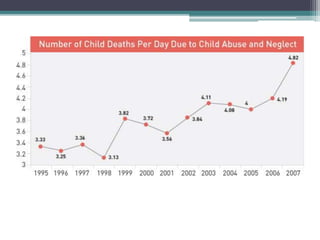
•Cases of child abuse are still dramatically
increasing in the U.S.
•There are many challenges to end the abuse.
•The first step is to educate the families.
•We now know how to recognize child maltreatment
•Are you going to intervene?
•Break the cycle?
•Report it?

Child abuse presentation

  • 1.
  • 4.
    Neglect •Failure to meetminimal standards of care •Acts of omission •Physical neglect • Failure to provide basic needs • Feeding, bathing, shelter. •Warning sings • Clothes are dirty or inappropriate for weather • Hygiene is bad • Not treated for illness or injuries • Unsupervised or left alone • Missing school •Emotional neglect • Failure to attend emotional needs • Failure to comfort/attend a child •Medical neglect • Failure to meet the basic medical needs of child • Checkups, immunizations, surgery, medicine
  • 5.
    Physical Abuse •Depends onseverity, frequency and duration of the aggression. •Involves physical harm or injury •Severe discipline •Discipline vs. physical abuse • Parents act out of anger and assert control • Parents believe children need fear in order to behave •Warning signs • Frequent injuries or unexplained bruises, welts, or cuts • Injuries have a pattern: marks from hand or belt • Shies away from touch • Flinches at sudden movements • Clothes cover up injuries
  • 6.
    Sexual Abuse •Nearly 60%are parents •About 40% are relatives (siblings, uncles, cousins) •Body contact: Fondling, oral, anal, or intercourse. •Exposure to sexual situations or material •Warning sings • Trouble walking or sitting • Displays interests in sexual act or material • Avoids changing clothes in front of others • Avoids participating in physical activities • STD or pregnancy • Runs away from home
  • 7.
    Psychological & Emotional Abuse •Psychological/Emotionalabuse includes • Rejecting • Terrorizing • Isolating, • Corrupting • Denying emotional, mental, medical responsiveness •Examples • Shaming, humiliating • Calling names • Yelling, threatening, bullying • Exposure to violence • Parent shows no affection •Warning sings • Displays fear and anxiety • Not attached to parent or caregiver • Show extreme behavior • Complaint or demanding • Passive or aggressive
  • 8.
    Conclusion •There are fivetypes of abuse: negligence, physical, sexual, physiological/emotional abuse. •Cases of child abuse are still dramatically increasing in the U.S. •There are many challenges to end the abuse. •The first step is to educate the families. •We now know how to recognize child maltreatment •Are you going to intervene? •Break the cycle? •Report it?