NAVODAYA DENTAL COLLEGE
DEPARTMENT OF PEDODONTICS
STAFF NAME – Dr VINOD KUMAR
Professor and Head of department
TOPIC NAME –Child Abuse and neglect
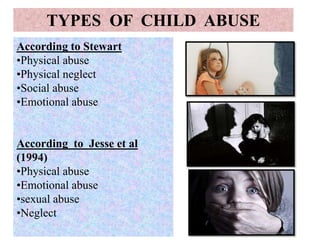
According to Stewart
•Physical abuse
•Physical neglect
•Social abuse
•Emotional abuse
According to Jesse et al
(1994)
•Physical abuse
•Emotional abuse
•sexual abuse
•Neglect
TYPES OF CHILD ABUSE
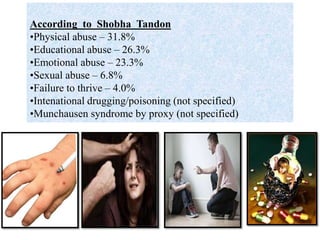
According to Shobha Tandon
•Physical abuse – 31.8%
•Educational abuse – 26.3%
•Emotional abuse – 23.3%
•Sexual abuse – 6.8%
•Failure to thrive – 4.0%
•Intenational drugging/poisoning (not specified)
•Munchausen syndrome by proxy (not specified)
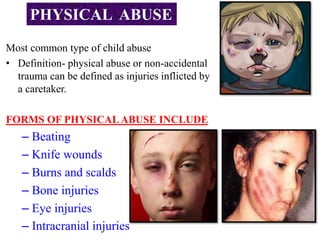
Most common type of child abuse
• Definition- physical abuse or non-accidental
trauma can be defined as injuries inflicted by
a caretaker.
FORMS OF PHYSICALABUSE INCLUDE
– Beating
– Knife wounds
– Burns and scalds
– Bone injuries
– Eye injuries
– Intracranial injuries
PHYSICAL ABUSE
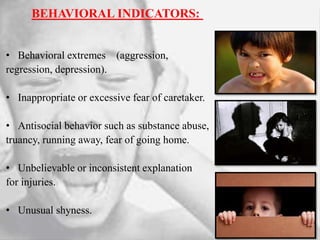
• Behavioral extremes (aggression,
regression, depression).
• Inappropriate or excessive fear of caretaker.
• Antisocial behavior such as substance abuse,
truancy, running away, fear of going home.
• Unbelievable or inconsistent explanation
for injuries.
• Unusual shyness.
BEHAVIORAL INDICATORS:
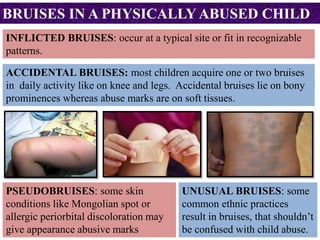
BRUISES IN A PHYSICALLY ABUSED CHILD
INFLICTED BRUISES: occur at a typical site or fit in recognizable
patterns.
ACCIDENTAL BRUISES: most children acquire one or two bruises
in daily activity like on knee and legs. Accidental bruises lie on bony
prominences whereas abuse marks are on soft tissues.
UNUSUAL BRUISES: some
common ethnic practices
result in bruises, that shouldn’t
be confused with child abuse.
PSEUDOBRUISES: some skin
conditions like Mongolian spot or
allergic periorbital discoloration may
give appearance abusive marks
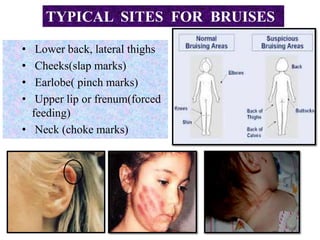
• Lower back, lateral thighs
• Cheeks(slap marks)
• Earlobe( pinch marks)
• Upper lip or frenum(forced
feeding)
• Neck (choke marks)
TYPICAL SITES FOR BRUISES
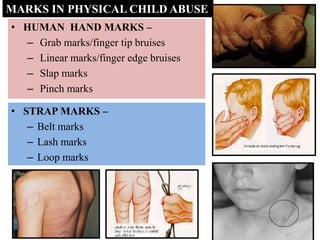
• HUMAN HAND MARKS –
– Grab marks/finger tip bruises
– Linear marks/finger edge bruises
– Slap marks
– Pinch marks
MARKS IN PHYSICAL CHILD ABUSE
• STRAP MARKS –
– Belt marks
– Lash marks
– Loop marks
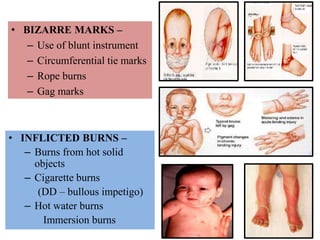
• BIZARRE MARKS –
– Use of blunt instrument
– Circumferential tie marks
– Rope burns
– Gag marks
• INFLICTED BURNS –
– Burns from hot solid
objects
– Cigarette burns
(DD – bullous impetigo)
– Hot water burns
Immersion burns
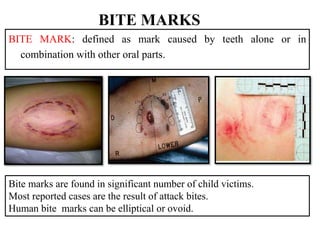
BITE MARKS
BITE MARK: defined as mark caused by teeth alone or in
combination with other oral parts.
Bite marks are found in significant number of child victims.
Most reported cases are the result of attack bites.
Human bite marks can be elliptical or ovoid.
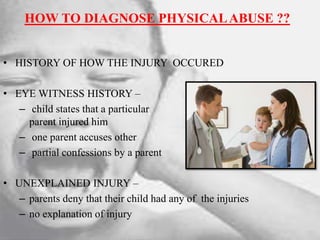
HOW TO DIAGNOSE PHYSICALABUSE ??
• HISTORY OF HOW THE INJURY OCCURED
• EYE WITNESS HISTORY –
– child states that a particular
parent injured him
– one parent accuses other
– partial confessions by a parent
• UNEXPLAINED INJURY –
– parents deny that their child had any of the injuries
– no explanation of injury
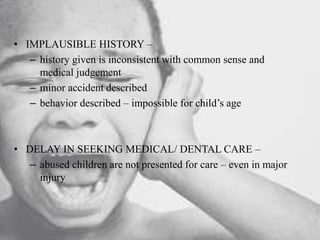
• IMPLAUSIBLE HISTORY –
– history given is inconsistent with common sense and
medical judgement
– minor accident described
– behavior described – impossible for child’s age
• DELAY IN SEEKING MEDICAL/ DENTAL CARE –
– abused children are not presented for care – even in major
injury
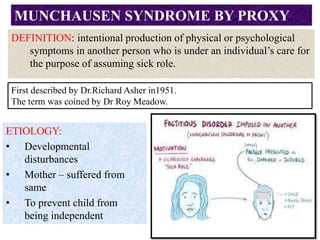
DEFINITION: intentional production of physical or psychological
symptoms in another person who is under an individual’s care for
the purpose of assuming sick role.
MUNCHAUSEN SYNDROME BY PROXY
ETIOLOGY:
• Developmental
disturbances
• Mother – suffered from
same
• To prevent child from
being independent
First described by Dr.Richard Asher in1951.
The term was coined by Dr Roy Meadow.
• SYMPTOMS:
– Bleeding from various sites
– Recurrent sepsis- from injecting contaminated fluids
– Chronic diarrhea- from laxatives
– Fever
– Rashes- from rubbing skin/ applying caustic substances
• WARNING SIGNS:
– Recurrent illness that cannot be explained
– Discrepancy b/w clinical findings and history
– Over protective Caretaker
– Child seen by multiple hospitals and physician
SIGNS AND SYMPTOMS DO NOT OCCUR WHEN
CARETAKER IS AWAY FROM CHILD.
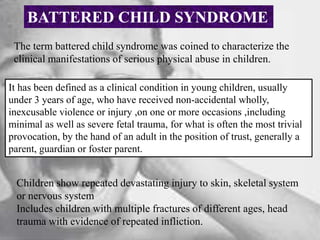
BATTERED CHILD SYNDROME
The term battered child syndrome was coined to characterize the
clinical manifestations of serious physical abuse in children.
It has been defined as a clinical condition in young children, usually
under 3 years of age, who have received non-accidental wholly,
inexcusable violence or injury ,on one or more occasions ,including
minimal as well as severe fetal trauma, for what is often the most trivial
provocation, by the hand of an adult in the position of trust, generally a
parent, guardian or foster parent.
Children show repeated devastating injury to skin, skeletal system
or nervous system
Includes children with multiple fractures of different ages, head
trauma with evidence of repeated infliction.
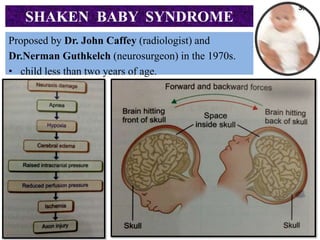
SHAKEN BABY SYNDROME
Proposed by Dr. John Caffey (radiologist) and
Dr.Nerman Guthkelch (neurosurgeon) in the 1970s.
• child less than two years of age.
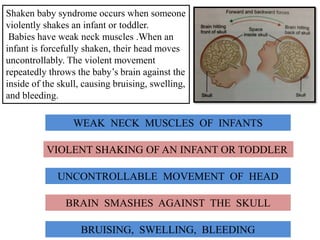
Shaken baby syndrome occurs when someone
violently shakes an infant or toddler.
Babies have weak neck muscles .When an
infant is forcefully shaken, their head moves
uncontrollably. The violent movement
repeatedly throws the baby’s brain against the
inside of the skull, causing bruising, swelling,
and bleeding.
VIOLENT SHAKING OF AN INFANT OR TODDLER
WEAK NECK MUSCLES OF INFANTS
UNCONTROLLABLE MOVEMENT OF HEAD
BRAIN SMASHES AGAINST THE SKULL
BRUISING, SWELLING, BLEEDING
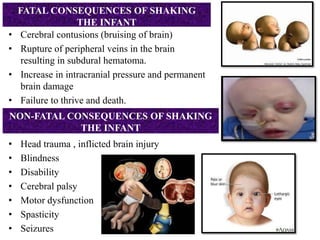
FATAL CONSEQUENCES OF SHAKING
THE INFANT
• Cerebral contusions (bruising of brain)
• Rupture of peripheral veins in the brain
resulting in subdural hematoma.
• Increase in intracranial pressure and permanent
brain damage
• Failure to thrive and death.
NON-FATAL CONSEQUENCES OF SHAKING
THE INFANT
• Head trauma , inflicted brain injury
• Blindness
• Disability
• Cerebral palsy
• Motor dysfunction
• Spasticity
• Seizures
CHILD NEGLECT
WHO – Child Neglect is the failure to provide for the development
of the child in all spheres of health , education, emotional
development , nutrition , shelter and safe living conditions, in the
context of resources reasonably available to the family or care taker
and causes harm to the child's health or physical , mental &social
development .
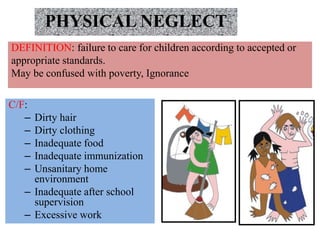
PHYSICAL NEGLECT
DEFINITION: failure to care for children according to accepted or
appropriate standards.
May be confused with poverty, Ignorance
C/F:
– Dirty hair
– Dirty clothing
– Inadequate food
– Inadequate immunization
– Unsanitary home
environment
– Inadequate after school
supervision
– Excessive work
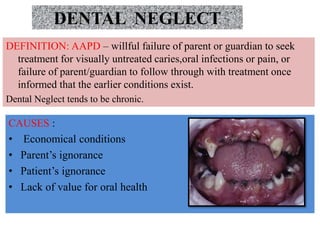
DENTAL NEGLECT
CAUSES :
• Economical conditions
• Parent’s ignorance
• Patient’s ignorance
• Lack of value for oral health
DEFINITION: AAPD – willful failure of parent or guardian to seek
treatment for visually untreated caries,oral infections or pain, or
failure of parent/guardian to follow through with treatment once
informed that the earlier conditions exist.
Dental Neglect tends to be chronic.
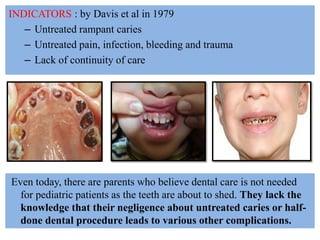
INDICATORS : by Davis et al in 1979
– Untreated rampant caries
– Untreated pain, infection, bleeding and trauma
– Lack of continuity of care
Even today, there are parents who believe dental care is not needed
for pediatric patients as the teeth are about to shed. They lack the
knowledge that their negligence about untreated caries or half-
done dental procedure leads to various other complications.
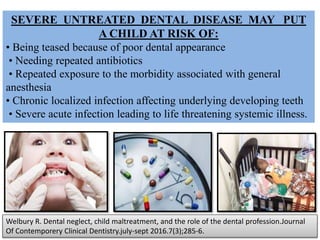
SEVERE UNTREATED DENTAL DISEASE MAY PUT
A CHILD AT RISK OF:
• Being teased because of poor dental appearance
• Needing repeated antibiotics
• Repeated exposure to the morbidity associated with general
anesthesia
• Chronic localized infection affecting underlying developing teeth
• Severe acute infection leading to life threatening systemic illness.
Welbury R. Dental neglect, child maltreatment, and the role of the dental profession.Journal
Of Contemporery Clinical Dentistry.july-sept 2016.7(3);285-6.

Child abuse and Neglect.pptx

  • 1.
    NAVODAYA DENTAL COLLEGE DEPARTMENTOF PEDODONTICS STAFF NAME – Dr VINOD KUMAR Professor and Head of department TOPIC NAME –Child Abuse and neglect
  • 2.
    According to Stewart •Physicalabuse •Physical neglect •Social abuse •Emotional abuse According to Jesse et al (1994) •Physical abuse •Emotional abuse •sexual abuse •Neglect TYPES OF CHILD ABUSE
  • 3.
    According to ShobhaTandon •Physical abuse – 31.8% •Educational abuse – 26.3% •Emotional abuse – 23.3% •Sexual abuse – 6.8% •Failure to thrive – 4.0% •Intenational drugging/poisoning (not specified) •Munchausen syndrome by proxy (not specified)
  • 4.
    Most common typeof child abuse • Definition- physical abuse or non-accidental trauma can be defined as injuries inflicted by a caretaker. FORMS OF PHYSICALABUSE INCLUDE – Beating – Knife wounds – Burns and scalds – Bone injuries – Eye injuries – Intracranial injuries PHYSICAL ABUSE
  • 5.
    • Behavioral extremes(aggression, regression, depression). • Inappropriate or excessive fear of caretaker. • Antisocial behavior such as substance abuse, truancy, running away, fear of going home. • Unbelievable or inconsistent explanation for injuries. • Unusual shyness. BEHAVIORAL INDICATORS:
  • 6.
    BRUISES IN APHYSICALLY ABUSED CHILD INFLICTED BRUISES: occur at a typical site or fit in recognizable patterns. ACCIDENTAL BRUISES: most children acquire one or two bruises in daily activity like on knee and legs. Accidental bruises lie on bony prominences whereas abuse marks are on soft tissues. UNUSUAL BRUISES: some common ethnic practices result in bruises, that shouldn’t be confused with child abuse. PSEUDOBRUISES: some skin conditions like Mongolian spot or allergic periorbital discoloration may give appearance abusive marks
  • 7.
    • Lower back,lateral thighs • Cheeks(slap marks) • Earlobe( pinch marks) • Upper lip or frenum(forced feeding) • Neck (choke marks) TYPICAL SITES FOR BRUISES
  • 8.
    • HUMAN HANDMARKS – – Grab marks/finger tip bruises – Linear marks/finger edge bruises – Slap marks – Pinch marks MARKS IN PHYSICAL CHILD ABUSE • STRAP MARKS – – Belt marks – Lash marks – Loop marks
  • 9.
    • BIZARRE MARKS– – Use of blunt instrument – Circumferential tie marks – Rope burns – Gag marks • INFLICTED BURNS – – Burns from hot solid objects – Cigarette burns (DD – bullous impetigo) – Hot water burns Immersion burns
  • 10.
    BITE MARKS BITE MARK:defined as mark caused by teeth alone or in combination with other oral parts. Bite marks are found in significant number of child victims. Most reported cases are the result of attack bites. Human bite marks can be elliptical or ovoid.
  • 11.
    HOW TO DIAGNOSEPHYSICALABUSE ?? • HISTORY OF HOW THE INJURY OCCURED • EYE WITNESS HISTORY – – child states that a particular parent injured him – one parent accuses other – partial confessions by a parent • UNEXPLAINED INJURY – – parents deny that their child had any of the injuries – no explanation of injury
  • 12.
    • IMPLAUSIBLE HISTORY– – history given is inconsistent with common sense and medical judgement – minor accident described – behavior described – impossible for child’s age • DELAY IN SEEKING MEDICAL/ DENTAL CARE – – abused children are not presented for care – even in major injury
  • 13.
    DEFINITION: intentional productionof physical or psychological symptoms in another person who is under an individual’s care for the purpose of assuming sick role. MUNCHAUSEN SYNDROME BY PROXY ETIOLOGY: • Developmental disturbances • Mother – suffered from same • To prevent child from being independent First described by Dr.Richard Asher in1951. The term was coined by Dr Roy Meadow.
  • 14.
    • SYMPTOMS: – Bleedingfrom various sites – Recurrent sepsis- from injecting contaminated fluids – Chronic diarrhea- from laxatives – Fever – Rashes- from rubbing skin/ applying caustic substances • WARNING SIGNS: – Recurrent illness that cannot be explained – Discrepancy b/w clinical findings and history – Over protective Caretaker – Child seen by multiple hospitals and physician SIGNS AND SYMPTOMS DO NOT OCCUR WHEN CARETAKER IS AWAY FROM CHILD.
  • 15.
    BATTERED CHILD SYNDROME Theterm battered child syndrome was coined to characterize the clinical manifestations of serious physical abuse in children. It has been defined as a clinical condition in young children, usually under 3 years of age, who have received non-accidental wholly, inexcusable violence or injury ,on one or more occasions ,including minimal as well as severe fetal trauma, for what is often the most trivial provocation, by the hand of an adult in the position of trust, generally a parent, guardian or foster parent. Children show repeated devastating injury to skin, skeletal system or nervous system Includes children with multiple fractures of different ages, head trauma with evidence of repeated infliction.
  • 16.
    SHAKEN BABY SYNDROME Proposedby Dr. John Caffey (radiologist) and Dr.Nerman Guthkelch (neurosurgeon) in the 1970s. • child less than two years of age.
  • 17.
    Shaken baby syndromeoccurs when someone violently shakes an infant or toddler. Babies have weak neck muscles .When an infant is forcefully shaken, their head moves uncontrollably. The violent movement repeatedly throws the baby’s brain against the inside of the skull, causing bruising, swelling, and bleeding. VIOLENT SHAKING OF AN INFANT OR TODDLER WEAK NECK MUSCLES OF INFANTS UNCONTROLLABLE MOVEMENT OF HEAD BRAIN SMASHES AGAINST THE SKULL BRUISING, SWELLING, BLEEDING
  • 18.
    FATAL CONSEQUENCES OFSHAKING THE INFANT • Cerebral contusions (bruising of brain) • Rupture of peripheral veins in the brain resulting in subdural hematoma. • Increase in intracranial pressure and permanent brain damage • Failure to thrive and death. NON-FATAL CONSEQUENCES OF SHAKING THE INFANT • Head trauma , inflicted brain injury • Blindness • Disability • Cerebral palsy • Motor dysfunction • Spasticity • Seizures
  • 19.
    CHILD NEGLECT WHO –Child Neglect is the failure to provide for the development of the child in all spheres of health , education, emotional development , nutrition , shelter and safe living conditions, in the context of resources reasonably available to the family or care taker and causes harm to the child's health or physical , mental &social development .
  • 20.
    PHYSICAL NEGLECT DEFINITION: failureto care for children according to accepted or appropriate standards. May be confused with poverty, Ignorance C/F: – Dirty hair – Dirty clothing – Inadequate food – Inadequate immunization – Unsanitary home environment – Inadequate after school supervision – Excessive work
  • 21.
    DENTAL NEGLECT CAUSES : •Economical conditions • Parent’s ignorance • Patient’s ignorance • Lack of value for oral health DEFINITION: AAPD – willful failure of parent or guardian to seek treatment for visually untreated caries,oral infections or pain, or failure of parent/guardian to follow through with treatment once informed that the earlier conditions exist. Dental Neglect tends to be chronic.
  • 22.
    INDICATORS : byDavis et al in 1979 – Untreated rampant caries – Untreated pain, infection, bleeding and trauma – Lack of continuity of care Even today, there are parents who believe dental care is not needed for pediatric patients as the teeth are about to shed. They lack the knowledge that their negligence about untreated caries or half- done dental procedure leads to various other complications.
  • 23.
    SEVERE UNTREATED DENTALDISEASE MAY PUT A CHILD AT RISK OF: • Being teased because of poor dental appearance • Needing repeated antibiotics • Repeated exposure to the morbidity associated with general anesthesia • Chronic localized infection affecting underlying developing teeth • Severe acute infection leading to life threatening systemic illness. Welbury R. Dental neglect, child maltreatment, and the role of the dental profession.Journal Of Contemporery Clinical Dentistry.july-sept 2016.7(3);285-6.

Editor's Notes

  • #11 It is of main concern to us and has a major role in forensic odontology.
  • #13 These may be characteristics of an abused child. From these, we might get a clue that something is not right
  • #15 THIS IS THE CLASSIC FEATUR OF THE SYNDROME.
  • #20 It is nothing but, Neglecting the basic needs of the child, including food, education, shelter and protection.
  • #22 Even after informing about he poor oral health, the caregiver fails to do the needful.
  • #24 This also form a part of dental neglect