CHILD MALTREATMENT
Dr. M.Aden
Registrar-MH
MUSOM
OUTLINE
1. INTRODUCTION
2. Definitions of terms
3. Epidemiology
4. Clinical presentation
5. Contributing factors to child maltreatment.
6. Consequences of maltreatment.
Introduction.
Child maltreatment is a huge global problem with a serious impact on
the victims’ physical and mental health, well-being and development
throughout their lives and by extension, on society in general.
(WHO & INTERNATIONAL SOCIETY FOR PREVENTION OF CHILD ABUSE AND Neglect)
Abused children returned to an abusive environment without
intervention are highly likely to be maltreated again and are at an
increased risk for death (Deans et al 2013)
Clinicians may miss many physical abuse injuries at first presentation
and based upon observational studies, can demonstrate significant
detection biases based upon the patient's ethnicity or socioeconomic
status (Thorpe et al 2014)
Definitions.
• Child maltreatment is any act or series of acts of commission or
omission by a parent or other caregiver ,that results in harm,
potential for harm, or threat of harm to a child.
• Commission (child abuse)- Words or overt actions that cause harm,
potential harm, or threat of harm.
•Physical abuse
•Sexual abuse
•Psychological abuse
Acts of omission ( Neglect)
• Failure to provide needs or to protect from harm or potential harm
•Physical neglect
•Emotional neglect
•Medical and dental neglect
•Educational neglect
•Inadequate supervision
•Exposure to violent environments
Epidemiology.
• Every year up to 1 billion children experience physical, sexual or
psychological violence. (WHO Guidelines for the health sector response to child maltreatment)
• Approximately 5 children die every day because of child abuse.
• 1 out of 3 girls and 1 out of 5 boys will be sexually abused before
they reach age 18.
• Approximately 20% of girls and 5–10% of boys report being sexually
abused globally.
• In 2014, the WHO estimated that 23% of children worldwide were
physically abused
Clinical presentation.
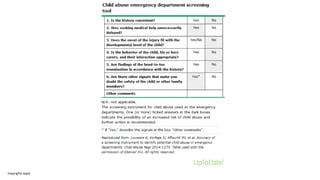
Health care providers should:-
• Be alert for an implausible, inadequate or inconsistent explanation for any
of the alerting features. All of them can be a sign for child maltreatment
however none of them provides sufficient proof for the occurrence of child
maltreatment.
• Consider child maltreatment when maltreatment is one possible
explanation for the alerting feature or is included in the differential
diagnosis.
• Suspect child maltreatment when there is a serious level of concern about
the possibility of child maltreatment.
• Exclude maltreatment when a suitable explanation is found for alerting
features.
ALERTING FEATURES
Physical abuse
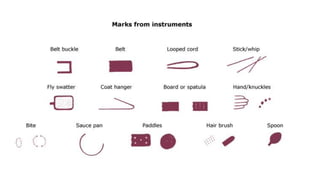
Bruises, lacerations, abrasions or scars
• Multiple bruises or injuries to the skin
• Bruises in a child who is not independently mobile
• Bruises in the shape of an implement used e.g. hand, stick
• Multiple bruises of a similar shape and size
• Bruises on any non-bony part of the body including the cheeks, trunk, eyes,
ears and buttocks (accidental bruises are generally over bony areas on the
front of the body e.g. shins, knees)
•
Bites
• A human bite mark that is thought unlikely to have been caused by a young child
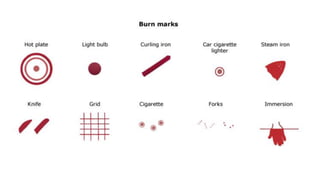
Burns and scalds
• If the child is not independently mobile or
• Burn anywhere that would not be expected to come into contact with a hot object in an
accident (e.g. the buttocks, trunk, upper arms)
• Burns in the shape of an implement (e.g. cigarette, iron) or
• Scalds that indicate forced immersion, e.g.
o To buttocks, perineum and lower limbs
o To limbs in a glove or stocking distribution
o To limbs with symmetrical distribution
o With sharply delineated borders
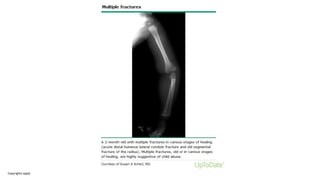
Fractures
• If a non-mobile infant has one or more fractures in the absence of a
medical condition that predisposes to fragile bones (for example,
osteogenesis imperfecta, osteopenia of prematurity)
• If x-ray have been undertaken
o Occult fractures (fractures identified on X-rays that were not clinically
evident) e.g. rib fractures in infants
o Fractures of different ages, showing different stages of healing
Copyrights apply
Neurological injury, head injury (intra cranial identified on CT scan or MRI)
• An intracranial injury in the absence of confirmed major accidental trauma
or known medical cause.
• If the child is aged under 3 years and there are also:
o Retinal haemorrhages or
o Rib or long bone fractures or
o Other associated inflicted injuries
o There are multiple subdural haemorrhages with or without
subarachnoid haemorrhage with or without hypoxic ischaemic damage to
the brain.
Other possible clinical presentations
Apparent life-threatening event (ALTE):
• Combination of apnea (central or obstructive), colour change (cyanotic,
pallid, erythematous or plethoric) change in muscle tone (usually
diminished), and choking or gagging)
Poisoning
• With prescribed and non-prescribed drugs or household substance (e.g.
bleach)
Non-fatal submersion injury
• Near drowning
Fabricated or induced illness (FII) (munchausen by proxy)
• Unusual attendance at medical services
• Reported symptoms and signs only appear or reappear and reported when the parent or
carer is present
• An inexplicably poor response to prescribed medication or other treatment
• New symptoms are reported as soon as previous ones have resolved
• There is a history of events that is biologically unlikely (e.g. infants with a history of very
large blood losses who do not become unwell or anaemic)
• Despite a definitive clinical opinion being reached, multiple opinions from other
healthcare agencies are sought and disputed by the parent or carer and the child continues
to be presented for investigation and treatment with a range of signs and symptoms
• The child's normal daily activities (for example, school attendance) are being
compromised, or the child is using aids to daily living (for example wheelchairs) more than
would be expected for any medical condition that the child has.
Sexual abuse
• Ano-genital signs and symptoms
• A genital, anal or perianal injury (e.g. bruising, laceration, swelling or
abrasion)
• A persistent or recurrent genital or anal symptom (for example,
bleeding, dysuria or discharge) that is associated with behavioural or
emotional change and that has no medical explanation.
• Foreign bodies in the vagina or anus. (Foreign bodies in the vagina
may be indicated by offensive vaginal discharge).
Sexually transmitted infections
• Including symptoms in the mouths or rarely in infected joints
(gonorrhoeal septic arthritis).
• Pregnancy in a child or young teen
• Sexualized behavior
• Unusual and age inappropriate interest in sexual matters.
Emotional abuse
• Adverse parent child interactions
o Negativity or hostility towards the child.
o Rejection or scapegoating of the child.
• Developmentally inappropriate expectations of or interactions with a child, including inappropriate threats or
methods of disciplining.
• Exposure to frightening or traumatic experiences.
• Using the child for the fulfilment of the adult's needs (e.g. in marital disputes).
• Failure to promote the child's appropriate socialisation (e.g. involving children in unlawful activities, isolation,
not providing stimulation or education).
• Parents or carers punish a child for wetting or soiling despite professional advice that the symptom is
involuntary
• Emotional unavailability and unresponsiveness from the parent or carer towards a child or young person and
in particular towards an infant.
• If a parent or carer refuses to allow a child to speak to a healthcare worker on their own when it is necessary
for the assessment of the child.
• Emotional, behavioural, interpersonal and social functioning
• Any form of maltreatment may be associated with
• Marked change in behaviour or emotional state
• Recurrent nightmares containing similar themes
• Extreme distress
• Markedly oppositional behaviour
• Withdrawal of communication
• Withdrawn
• Some of these features may also be seen in a wide range of adolescents for
other reasons, including use of drugs.
Neglect
• Basic needs are not provided (e.g. food, appropriate clothing)
• Faltering growth because of lack of provision of an adequate or
appropriate diet
• Persistent infestations, such as scabies or head lice.
• Inappropriately explained poor school attendance
• Access to appropriate medical care or treatment not ensured (e.g.
failure to immunise)
• Failure to administer recommended treatment or medication
• Malnutrition
• Persistently poor hygiene
• Inappropriate supervision
• Cold injuries
• Abandoned children
• Unsafe living environment
• Lack of supervision; may present as repeated accidental injury.
Contributing Factors to Child Maltreatment
• It’s complicated and it is usually the result of an interaction of
personal, interpersonal and environmental stressors.
• Factors are different in each family
• Each family has inherent strengths and capabilities that can be
developed to prevent future maltreatment.
1.Personal characteristics of the parent or primary caregiver,
2.The lack of resources and support systems,
3.Special or unusual needs or characteristics of the child
4.Excessive stress in the family and surrounding environment
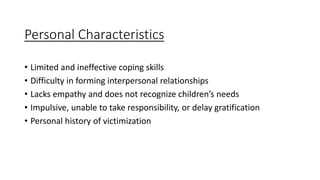
Personal Characteristics
• Limited and ineffective coping skills
• Difficulty in forming interpersonal relationships
• Lacks empathy and does not recognize children’s needs
• Impulsive, unable to take responsibility, or delay gratification
• Personal history of victimization
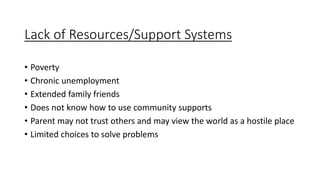
Lack of Resources/Support Systems
• Poverty
• Chronic unemployment
• Extended family friends
• Does not know how to use community supports
• Parent may not trust others and may view the world as a hostile place
• Limited choices to solve problems
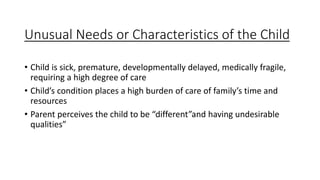
Unusual Needs or Characteristics of the Child
• Child is sick, premature, developmentally delayed, medically fragile,
requiring a high degree of care
• Child’s condition places a high burden of care of family’s time and
resources
• Parent perceives the child to be “different”and having undesirable
qualities”
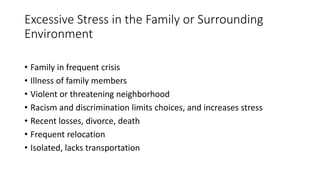
Excessive Stress in the Family or Surrounding
Environment
• Family in frequent crisis
• Illness of family members
• Violent or threatening neighborhood
• Racism and discrimination limits choices, and increases stress
• Recent losses, divorce, death
• Frequent relocation
• Isolated, lacks transportation
Consequences of maltreatment
• Child maltreatment causes suffering to children and families and can have
long-term consequences.
• Maltreatment causes stress that is associated with disruption in early brain
development. Extreme stress can impair the development of the nervous
and immune systems.
• Victims of child maltreatment are at higher risk of depression, anxiety,
post-traumatic stress disorder and suicidal behaviour throughout their lives
• Child maltreatment thus places a heavy strain on health and criminal
justice systems and social and welfare services.
• The cost of child maltreatment has been estimated to $3.59 trillion
globally, or 4.21% of the world’s GDP.
Consequently, as adults, maltreated children are at increased risk for
behavioral, physical and mental health problems such as:
• perpetrating or being a victim of violence
• depression
• smoking
• obesity
• high-risk sexual behaviours
• unintended pregnancy
• alcohol and drug misuse.
Copyrights apply
References.
WHO
https://www.who.int/news-room/fact-sheets/detail/child-maltreatment
UPTODATE
https://www.uptodate.com/contents/physical-child-abuse-
recognition?search=child%20abuse&source=search_result&selectedTitle=2~150&usage_ty
pe=default&display_rank=2
Deans KJ, Thackeray J, Askegard-Giesmann JR, Earley E, Groner JI, Minneci PC. Mortality
increases with recurrent episodes of nonaccidental trauma in children. J Trauma Acute Care
Surg. 2013 Jul;75(1):161-5. doi: 10.1097/ta.0b013e3182984831. PMID: 23940863.
Thorpe EL, Zuckerbraun NS, Wolford JE, Berger RP. Missed opportunities to diagnose child
physical abuse. Pediatr Emerg Care. 2014 Nov;30(11):771-6. doi:
10.1097/PEC.0000000000000257. PMID: 25343739.
Child maltreatment 2021

Child maltreatment 2021

  • 1.
  • 2.
    OUTLINE 1. INTRODUCTION 2. Definitionsof terms 3. Epidemiology 4. Clinical presentation 5. Contributing factors to child maltreatment. 6. Consequences of maltreatment.
  • 3.
    Introduction. Child maltreatment isa huge global problem with a serious impact on the victims’ physical and mental health, well-being and development throughout their lives and by extension, on society in general. (WHO & INTERNATIONAL SOCIETY FOR PREVENTION OF CHILD ABUSE AND Neglect) Abused children returned to an abusive environment without intervention are highly likely to be maltreated again and are at an increased risk for death (Deans et al 2013) Clinicians may miss many physical abuse injuries at first presentation and based upon observational studies, can demonstrate significant detection biases based upon the patient's ethnicity or socioeconomic status (Thorpe et al 2014)
  • 4.
    Definitions. • Child maltreatmentis any act or series of acts of commission or omission by a parent or other caregiver ,that results in harm, potential for harm, or threat of harm to a child. • Commission (child abuse)- Words or overt actions that cause harm, potential harm, or threat of harm. •Physical abuse •Sexual abuse •Psychological abuse
  • 5.
    Acts of omission( Neglect) • Failure to provide needs or to protect from harm or potential harm •Physical neglect •Emotional neglect •Medical and dental neglect •Educational neglect •Inadequate supervision •Exposure to violent environments
  • 6.
    Epidemiology. • Every yearup to 1 billion children experience physical, sexual or psychological violence. (WHO Guidelines for the health sector response to child maltreatment) • Approximately 5 children die every day because of child abuse. • 1 out of 3 girls and 1 out of 5 boys will be sexually abused before they reach age 18. • Approximately 20% of girls and 5–10% of boys report being sexually abused globally. • In 2014, the WHO estimated that 23% of children worldwide were physically abused
  • 7.
    Clinical presentation. Health careproviders should:- • Be alert for an implausible, inadequate or inconsistent explanation for any of the alerting features. All of them can be a sign for child maltreatment however none of them provides sufficient proof for the occurrence of child maltreatment. • Consider child maltreatment when maltreatment is one possible explanation for the alerting feature or is included in the differential diagnosis. • Suspect child maltreatment when there is a serious level of concern about the possibility of child maltreatment. • Exclude maltreatment when a suitable explanation is found for alerting features.
  • 8.
    ALERTING FEATURES Physical abuse Bruises,lacerations, abrasions or scars • Multiple bruises or injuries to the skin • Bruises in a child who is not independently mobile • Bruises in the shape of an implement used e.g. hand, stick • Multiple bruises of a similar shape and size • Bruises on any non-bony part of the body including the cheeks, trunk, eyes, ears and buttocks (accidental bruises are generally over bony areas on the front of the body e.g. shins, knees) •
  • 10.
    Bites • A humanbite mark that is thought unlikely to have been caused by a young child Burns and scalds • If the child is not independently mobile or • Burn anywhere that would not be expected to come into contact with a hot object in an accident (e.g. the buttocks, trunk, upper arms) • Burns in the shape of an implement (e.g. cigarette, iron) or • Scalds that indicate forced immersion, e.g. o To buttocks, perineum and lower limbs o To limbs in a glove or stocking distribution o To limbs with symmetrical distribution o With sharply delineated borders
  • 12.
    Fractures • If anon-mobile infant has one or more fractures in the absence of a medical condition that predisposes to fragile bones (for example, osteogenesis imperfecta, osteopenia of prematurity) • If x-ray have been undertaken o Occult fractures (fractures identified on X-rays that were not clinically evident) e.g. rib fractures in infants o Fractures of different ages, showing different stages of healing
  • 13.
  • 14.
    Neurological injury, headinjury (intra cranial identified on CT scan or MRI) • An intracranial injury in the absence of confirmed major accidental trauma or known medical cause. • If the child is aged under 3 years and there are also: o Retinal haemorrhages or o Rib or long bone fractures or o Other associated inflicted injuries o There are multiple subdural haemorrhages with or without subarachnoid haemorrhage with or without hypoxic ischaemic damage to the brain.
  • 15.
    Other possible clinicalpresentations Apparent life-threatening event (ALTE): • Combination of apnea (central or obstructive), colour change (cyanotic, pallid, erythematous or plethoric) change in muscle tone (usually diminished), and choking or gagging) Poisoning • With prescribed and non-prescribed drugs or household substance (e.g. bleach) Non-fatal submersion injury • Near drowning
  • 16.
    Fabricated or inducedillness (FII) (munchausen by proxy) • Unusual attendance at medical services • Reported symptoms and signs only appear or reappear and reported when the parent or carer is present • An inexplicably poor response to prescribed medication or other treatment • New symptoms are reported as soon as previous ones have resolved • There is a history of events that is biologically unlikely (e.g. infants with a history of very large blood losses who do not become unwell or anaemic) • Despite a definitive clinical opinion being reached, multiple opinions from other healthcare agencies are sought and disputed by the parent or carer and the child continues to be presented for investigation and treatment with a range of signs and symptoms • The child's normal daily activities (for example, school attendance) are being compromised, or the child is using aids to daily living (for example wheelchairs) more than would be expected for any medical condition that the child has.
  • 17.
    Sexual abuse • Ano-genitalsigns and symptoms • A genital, anal or perianal injury (e.g. bruising, laceration, swelling or abrasion) • A persistent or recurrent genital or anal symptom (for example, bleeding, dysuria or discharge) that is associated with behavioural or emotional change and that has no medical explanation. • Foreign bodies in the vagina or anus. (Foreign bodies in the vagina may be indicated by offensive vaginal discharge).
  • 18.
    Sexually transmitted infections •Including symptoms in the mouths or rarely in infected joints (gonorrhoeal septic arthritis). • Pregnancy in a child or young teen • Sexualized behavior • Unusual and age inappropriate interest in sexual matters.
  • 19.
    Emotional abuse • Adverseparent child interactions o Negativity or hostility towards the child. o Rejection or scapegoating of the child. • Developmentally inappropriate expectations of or interactions with a child, including inappropriate threats or methods of disciplining. • Exposure to frightening or traumatic experiences. • Using the child for the fulfilment of the adult's needs (e.g. in marital disputes). • Failure to promote the child's appropriate socialisation (e.g. involving children in unlawful activities, isolation, not providing stimulation or education). • Parents or carers punish a child for wetting or soiling despite professional advice that the symptom is involuntary • Emotional unavailability and unresponsiveness from the parent or carer towards a child or young person and in particular towards an infant. • If a parent or carer refuses to allow a child to speak to a healthcare worker on their own when it is necessary for the assessment of the child.
  • 20.
    • Emotional, behavioural,interpersonal and social functioning • Any form of maltreatment may be associated with • Marked change in behaviour or emotional state • Recurrent nightmares containing similar themes • Extreme distress • Markedly oppositional behaviour • Withdrawal of communication • Withdrawn • Some of these features may also be seen in a wide range of adolescents for other reasons, including use of drugs.
  • 21.
    Neglect • Basic needsare not provided (e.g. food, appropriate clothing) • Faltering growth because of lack of provision of an adequate or appropriate diet • Persistent infestations, such as scabies or head lice. • Inappropriately explained poor school attendance • Access to appropriate medical care or treatment not ensured (e.g. failure to immunise) • Failure to administer recommended treatment or medication • Malnutrition
  • 22.
    • Persistently poorhygiene • Inappropriate supervision • Cold injuries • Abandoned children • Unsafe living environment • Lack of supervision; may present as repeated accidental injury.
  • 23.
    Contributing Factors toChild Maltreatment • It’s complicated and it is usually the result of an interaction of personal, interpersonal and environmental stressors. • Factors are different in each family • Each family has inherent strengths and capabilities that can be developed to prevent future maltreatment.
  • 24.
    1.Personal characteristics ofthe parent or primary caregiver, 2.The lack of resources and support systems, 3.Special or unusual needs or characteristics of the child 4.Excessive stress in the family and surrounding environment
  • 25.
    Personal Characteristics • Limitedand ineffective coping skills • Difficulty in forming interpersonal relationships • Lacks empathy and does not recognize children’s needs • Impulsive, unable to take responsibility, or delay gratification • Personal history of victimization
  • 26.
    Lack of Resources/SupportSystems • Poverty • Chronic unemployment • Extended family friends • Does not know how to use community supports • Parent may not trust others and may view the world as a hostile place • Limited choices to solve problems
  • 27.
    Unusual Needs orCharacteristics of the Child • Child is sick, premature, developmentally delayed, medically fragile, requiring a high degree of care • Child’s condition places a high burden of care of family’s time and resources • Parent perceives the child to be “different”and having undesirable qualities”
  • 28.
    Excessive Stress inthe Family or Surrounding Environment • Family in frequent crisis • Illness of family members • Violent or threatening neighborhood • Racism and discrimination limits choices, and increases stress • Recent losses, divorce, death • Frequent relocation • Isolated, lacks transportation
  • 29.
    Consequences of maltreatment •Child maltreatment causes suffering to children and families and can have long-term consequences. • Maltreatment causes stress that is associated with disruption in early brain development. Extreme stress can impair the development of the nervous and immune systems. • Victims of child maltreatment are at higher risk of depression, anxiety, post-traumatic stress disorder and suicidal behaviour throughout their lives • Child maltreatment thus places a heavy strain on health and criminal justice systems and social and welfare services. • The cost of child maltreatment has been estimated to $3.59 trillion globally, or 4.21% of the world’s GDP.
  • 30.
    Consequently, as adults,maltreated children are at increased risk for behavioral, physical and mental health problems such as: • perpetrating or being a victim of violence • depression • smoking • obesity • high-risk sexual behaviours • unintended pregnancy • alcohol and drug misuse.
  • 31.
  • 32.
    References. WHO https://www.who.int/news-room/fact-sheets/detail/child-maltreatment UPTODATE https://www.uptodate.com/contents/physical-child-abuse- recognition?search=child%20abuse&source=search_result&selectedTitle=2~150&usage_ty pe=default&display_rank=2 Deans KJ, ThackerayJ, Askegard-Giesmann JR, Earley E, Groner JI, Minneci PC. Mortality increases with recurrent episodes of nonaccidental trauma in children. J Trauma Acute Care Surg. 2013 Jul;75(1):161-5. doi: 10.1097/ta.0b013e3182984831. PMID: 23940863. Thorpe EL, Zuckerbraun NS, Wolford JE, Berger RP. Missed opportunities to diagnose child physical abuse. Pediatr Emerg Care. 2014 Nov;30(11):771-6. doi: 10.1097/PEC.0000000000000257. PMID: 25343739.