1
7/24/2022
CHEST
PHYSIOTHERAPY
PREPARED BY:
RN Arpana Bhusal
BNS
2
7/24/2022
CONTENTS
• DEFINITION
• INDICATIONS
• CONTRA- INDICATIONS
• PATIENT’S ASSESSMENT FOR CPT
• CPT TECHNIQUES
– PERCUSSION
– VIBRATION
– POSTURAL DRAINAGE
• NURSING CONSIDERATIONS FOR CPT
3
7/24/2022
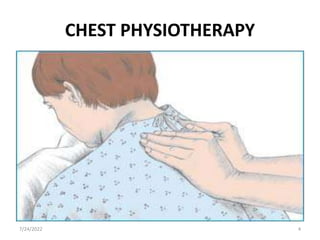
CHEST PHYSIOTHERAPY
4
7/24/2022
Definition
• Chest physiotherapy (CPT) is a technique
used to mobilize or loosen secretions in the
lungs and respiratory tract.
• This is especially helpful for patients with
large amount of secretions or ineffective
cough.
5
7/24/2022
Contd…..
• Chest physiotherapy consists of external
mechanical maneuvers; such as chest
percussion, postural drainage, vibration to
augment mobilization and clearance of airway
secretions, diaphragmatic breathing with
pursed-lips, coughing and controlled coughing.
6
7/24/2022
Indications
• It is indicated for patients in whom cough is
insufficient to clear; thick, tenacious, or
localized secretions. Examples include:
Cystic fibrosis
Bronchiectasis
Atlectasis
Lung abscess
Neuromuscular diseases
Pneumonias in dependent lung regions.
7
7/24/2022
Contraindications
• Increased ICP
• Unstable head or neck injury
• Active hemorrhage with hemodynamic
instability or hemoptysis
• Recent spinal injury or injury
• Empyema
8
7/24/2022
Contd….
• Broncho-plueral fistula
• Rib fracture
• Uncontrolled hypertension
• Anticoagulation
• Osteoporosis
9
7/24/2022
Patient’s assessment for CPT
Nursing care and selection of CPT skills are based on
specific assessment findings.
The following are the assessment criteria:
• Know the normal range of patient’s vital signs.
Conditions requiring CPT; such as atelectasis and
pneumonia etc affects vital signs.
• Know the patient’s medications. Certain medications,
particularly diuretics, antihypertensive drugs causes
fluid and hemodynamic changes. These decrease
patient’s tolerance to positional changes and postural
drainage.
10
7/24/2022
Cont..
• Know the patient’s medical history; certain
conditions such as increased ICP, spinal cord injuries
contraindicate the positional change to postural
drainage.
• Thoracic trauma and chest surgeries also
contraindicate percussion and vibration.
• Know the patient’s cognitive level of functioning.
Participating in controlled cough techniques requires
the patient to follow instructions.
• Beware of patient’s exercise tolerance. CPT
maneuvers are fatiguing.
11
7/24/2022
TECHNIQUES
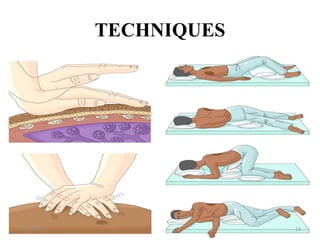
Chest physiotherapy consists of three techniques:
1. Percussion/Clapping/Cupping
2. Vibration
3. Postural drainage
12
7/24/2022
TECHNIQUES
13
7/24/2022
PERCUSSION
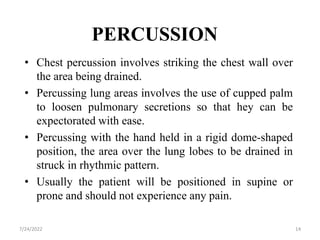
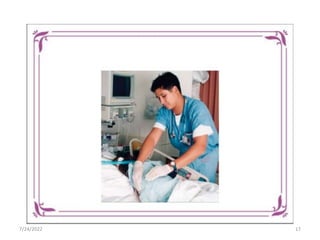
• Chest percussion involves striking the chest wall over
the area being drained.
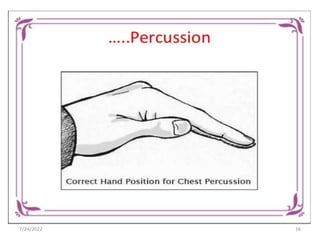
• Percussing lung areas involves the use of cupped palm
to loosen pulmonary secretions so that hey can be
expectorated with ease.
• Percussing with the hand held in a rigid dome-shaped
position, the area over the lung lobes to be drained in
struck in rhythmic pattern.
• Usually the patient will be positioned in supine or
prone and should not experience any pain.
14
7/24/2022
Cont..
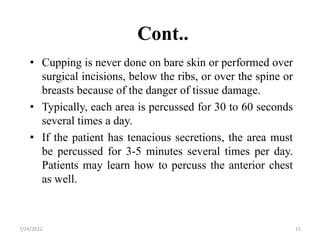
• Cupping is never done on bare skin or performed over
surgical incisions, below the ribs, or over the spine or
breasts because of the danger of tissue damage.
• Typically, each area is percussed for 30 to 60 seconds
several times a day.
• If the patient has tenacious secretions, the area must
be percussed for 3-5 minutes several times per day.
Patients may learn how to percuss the anterior chest
as well.
15
7/24/2022
16
7/24/2022
17
7/24/2022
VIBRATION
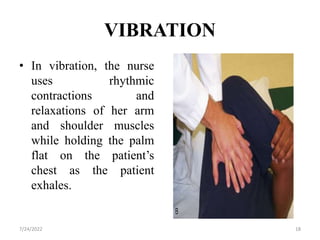
• In vibration, the nurse
uses rhythmic
contractions and
relaxations of her arm
and shoulder muscles
while holding the palm
flat on the patient’s
chest as the patient
exhales.
18
7/24/2022
Contd….
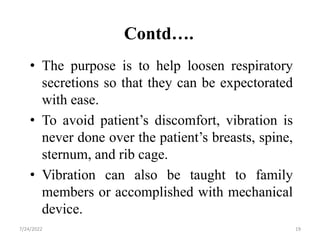
• The purpose is to help loosen respiratory
secretions so that they can be expectorated
with ease.
• To avoid patient’s discomfort, vibration is
never done over the patient’s breasts, spine,
sternum, and rib cage.
• Vibration can also be taught to family
members or accomplished with mechanical
device.
19
7/24/2022
Procedure for percussion & vibration
• Instruct the patient use diaphragmatic breathing.
• Position the patient in prescribed postural drainage
positions. Spine should be straight to promote rib
cage expansion.
• Percuss with cupped hands on chest wall for 5
minutes over each segment (5 minutes for cystic
fibrosis and 1-2 minutes for other conditions).
• Instruct the patient to inhale slowly and deeply.
Vibrate the chest wall as the patient exhales slowly
through the pursed lips.
• Place one hand on top of the other over affected area
or place one hand on each side of the rib cage.
20
7/24/2022
Cont..
• Tense the muscles of the hands while applying
moderate pressure downward and vibrate arms
and hands.
• Relieve pressure on the thorax as the patient
inhales.
• Encourage the patient to cough, using abdominal
muscles, after three or four vibrations.
• Allow the patient rest several times.
• Listen with stethoscope for changes in breath
sounds.
• Repeat the percussion and vibration cycle
according to the patient’s tolerance and clinical
response: usually 15-30 minutes.
21
7/24/2022
22
7/24/2022
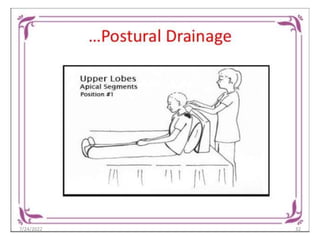
POSTURAL DRAINAGE
• Postural drainage is the positioning
techniques that drain secretions from specific
segments of the lungs and bronchi into the
trachea.
• Because some patients do not require
postural drainage for all lung segments, the
procedure must be based on the clinical
findings.
23
7/24/2022
Contd….
• In postural drainage, the person is tilted or
propped at an angle to help drain secretions
from the lungs.
• Also, the chest or back may be clapped with a
cupped hand to help loosen secretions- the
technique called chest percussion.
24
7/24/2022
Cont..
• Postural drainage cannot be used for people who
are:
 unable to tolerate the position required,
 are taking anticoagulation drugs,
 have recently vomited up blood,
 have had a recent rib or vertebral fracture, or
 Have severe osteoporosis.
• Postural drainage also cannot be used for people
who are unable to produce any secretions
(because when this happens, further attempts at
postural drainage may lower the level of oxygen
in the blood).
25
7/24/2022
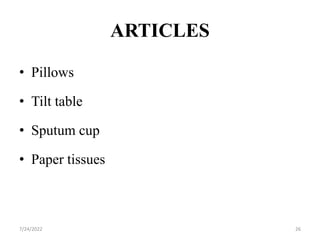
ARTICLES
• Pillows
• Tilt table
• Sputum cup
• Paper tissues
26
7/24/2022
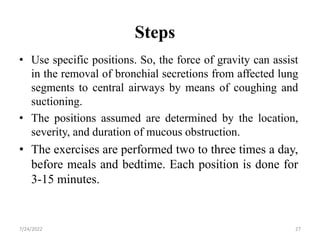
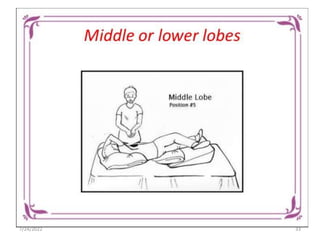
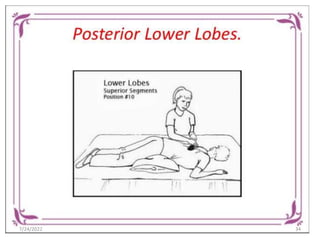
Steps
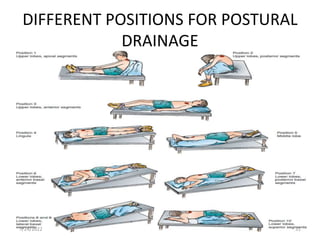
• Use specific positions. So, the force of gravity can assist
in the removal of bronchial secretions from affected lung
segments to central airways by means of coughing and
suctioning.
• The positions assumed are determined by the location,
severity, and duration of mucous obstruction.
• The exercises are performed two to three times a day,
before meals and bedtime. Each position is done for
3-15 minutes.
27
7/24/2022
Contd….
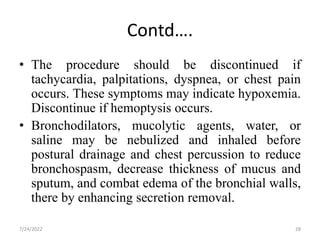
• The procedure should be discontinued if
tachycardia, palpitations, dyspnea, or chest pain
occurs. These symptoms may indicate hypoxemia.
Discontinue if hemoptysis occurs.
• Bronchodilators, mucolytic agents, water, or
saline may be nebulized and inhaled before
postural drainage and chest percussion to reduce
bronchospasm, decrease thickness of mucus and
sputum, and combat edema of the bronchial walls,
there by enhancing secretion removal.
28
7/24/2022
Cont..
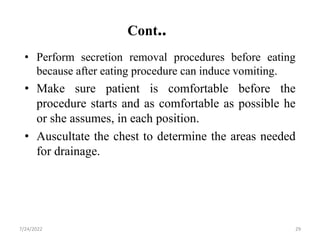
• Perform secretion removal procedures before eating
because after eating procedure can induce vomiting.
• Make sure patient is comfortable before the
procedure starts and as comfortable as possible he
or she assumes, in each position.
• Auscultate the chest to determine the areas needed
for drainage.
29
7/24/2022
Cont..
• Encourage the patient to deep breath and cough after
spending the allotted time in each position.
• Encourage diaphragmatic breathing throughout postural
drainage: this helps widen airways so secretions can be
drained.
30
7/24/2022
DIFFERENT POSITIONS FOR POSTURAL
DRAINAGE
31
7/24/2022
32
7/24/2022
33
7/24/2022
34
7/24/2022
Coughing
• Coughing is a common reflex action that clears your
throat of mucus or foreign irritants.
• Coughing gently or making short grunting noises with
the mouth slightly open will help loosen the mucus.
• Do this periodically throughout the drainage procedure.
35
7/24/2022
Controlled coughing technique
• Controlled coughing is one of the essential techniques
in good respiratory care.
• Patient performs this maneuver after each drainage
position and often throughout the day.
• The abdominal muscles are very powerful muscles
used in coughing and exhaling.
• Inhale deeply through the nose.
• Pause.
• Cough 2 to 3 sharp staccato cough with proper
hand/arm placement.
• Breathe in easily through the nose.
36
7/24/2022
Nursing considerations for chest
physiotherapy
1. Assess baseline breath sounds, oxygen
saturation, and ability to tolerate procedure.
2. Administer prescribed bronchodilators,
mucolytics and analgesics.
3. Position client:
a. Fowler position for incentive spirometry and to
drain upper lungs.
b. Side lying and prone position for postural
drainage.
37
7/24/2022
Contd…..
4. Teach the use of incentive spirometer.
a. after exhaling, form seal around the
mouthpiece with lips.
b. take slow, continuous deep breath and hold
indicator afloat for several seconds before
exhaling.
c. Repeat 10 times per hour or as per protocol.
5. Perform percussion and vibration for several
minutes over affected areas being managed with
postural drainage.
38
7/24/2022
Contd….
6. Encourage coughing and expectoration of
secretions. Provide tissue and appropriate
receptacle.
7.Provide rest periods as needed; avoid
scheduling near meal time.
8. Evaluate color and amount of secretions and
quality of breath sounds after procedure.
9. Encourage a 2- 3 L fluid intake daily to
liquefy secretions.
39
7/24/2022
Documentation
• Following chest physiotherapy, the nurse should auscultate
the client’s lungs, compare the findings to the baseline data,
and document the amount, color, and character of
expectorated secretions.
40
7/24/2022
Complications
Complications are unusual but include:
• Position-related hypoxia
• Aspiration of secretions in other lung
regions
• Headache, dizziness etc.
41
7/24/2022
REFERENCE
• Mandal G.N, Textbook of medical surgical
nursing (adult nursing) published by Makalu
publication house, 3rd edition.
• Brunner and siddarth, Textbook of Medical-
Surgical Nursing, 13th edition.
• https://www.slideshare.net/sivanandareddy5
2/cpt-postural-drainage
42
7/24/2022
43
7/24/2022

Chest physiotherapy and postural drainage

  • 1.
  • 2.
  • 3.
    CONTENTS • DEFINITION • INDICATIONS •CONTRA- INDICATIONS • PATIENT’S ASSESSMENT FOR CPT • CPT TECHNIQUES – PERCUSSION – VIBRATION – POSTURAL DRAINAGE • NURSING CONSIDERATIONS FOR CPT 3 7/24/2022
  • 4.
  • 5.
    Definition • Chest physiotherapy(CPT) is a technique used to mobilize or loosen secretions in the lungs and respiratory tract. • This is especially helpful for patients with large amount of secretions or ineffective cough. 5 7/24/2022
  • 6.
    Contd….. • Chest physiotherapyconsists of external mechanical maneuvers; such as chest percussion, postural drainage, vibration to augment mobilization and clearance of airway secretions, diaphragmatic breathing with pursed-lips, coughing and controlled coughing. 6 7/24/2022
  • 7.
    Indications • It isindicated for patients in whom cough is insufficient to clear; thick, tenacious, or localized secretions. Examples include: Cystic fibrosis Bronchiectasis Atlectasis Lung abscess Neuromuscular diseases Pneumonias in dependent lung regions. 7 7/24/2022
  • 8.
    Contraindications • Increased ICP •Unstable head or neck injury • Active hemorrhage with hemodynamic instability or hemoptysis • Recent spinal injury or injury • Empyema 8 7/24/2022
  • 9.
    Contd…. • Broncho-plueral fistula •Rib fracture • Uncontrolled hypertension • Anticoagulation • Osteoporosis 9 7/24/2022
  • 10.
    Patient’s assessment forCPT Nursing care and selection of CPT skills are based on specific assessment findings. The following are the assessment criteria: • Know the normal range of patient’s vital signs. Conditions requiring CPT; such as atelectasis and pneumonia etc affects vital signs. • Know the patient’s medications. Certain medications, particularly diuretics, antihypertensive drugs causes fluid and hemodynamic changes. These decrease patient’s tolerance to positional changes and postural drainage. 10 7/24/2022
  • 11.
    Cont.. • Know thepatient’s medical history; certain conditions such as increased ICP, spinal cord injuries contraindicate the positional change to postural drainage. • Thoracic trauma and chest surgeries also contraindicate percussion and vibration. • Know the patient’s cognitive level of functioning. Participating in controlled cough techniques requires the patient to follow instructions. • Beware of patient’s exercise tolerance. CPT maneuvers are fatiguing. 11 7/24/2022
  • 12.
    TECHNIQUES Chest physiotherapy consistsof three techniques: 1. Percussion/Clapping/Cupping 2. Vibration 3. Postural drainage 12 7/24/2022
  • 13.
  • 14.
    PERCUSSION • Chest percussioninvolves striking the chest wall over the area being drained. • Percussing lung areas involves the use of cupped palm to loosen pulmonary secretions so that hey can be expectorated with ease. • Percussing with the hand held in a rigid dome-shaped position, the area over the lung lobes to be drained in struck in rhythmic pattern. • Usually the patient will be positioned in supine or prone and should not experience any pain. 14 7/24/2022
  • 15.
    Cont.. • Cupping isnever done on bare skin or performed over surgical incisions, below the ribs, or over the spine or breasts because of the danger of tissue damage. • Typically, each area is percussed for 30 to 60 seconds several times a day. • If the patient has tenacious secretions, the area must be percussed for 3-5 minutes several times per day. Patients may learn how to percuss the anterior chest as well. 15 7/24/2022
  • 16.
  • 17.
  • 18.
    VIBRATION • In vibration,the nurse uses rhythmic contractions and relaxations of her arm and shoulder muscles while holding the palm flat on the patient’s chest as the patient exhales. 18 7/24/2022
  • 19.
    Contd…. • The purposeis to help loosen respiratory secretions so that they can be expectorated with ease. • To avoid patient’s discomfort, vibration is never done over the patient’s breasts, spine, sternum, and rib cage. • Vibration can also be taught to family members or accomplished with mechanical device. 19 7/24/2022
  • 20.
    Procedure for percussion& vibration • Instruct the patient use diaphragmatic breathing. • Position the patient in prescribed postural drainage positions. Spine should be straight to promote rib cage expansion. • Percuss with cupped hands on chest wall for 5 minutes over each segment (5 minutes for cystic fibrosis and 1-2 minutes for other conditions). • Instruct the patient to inhale slowly and deeply. Vibrate the chest wall as the patient exhales slowly through the pursed lips. • Place one hand on top of the other over affected area or place one hand on each side of the rib cage. 20 7/24/2022
  • 21.
    Cont.. • Tense themuscles of the hands while applying moderate pressure downward and vibrate arms and hands. • Relieve pressure on the thorax as the patient inhales. • Encourage the patient to cough, using abdominal muscles, after three or four vibrations. • Allow the patient rest several times. • Listen with stethoscope for changes in breath sounds. • Repeat the percussion and vibration cycle according to the patient’s tolerance and clinical response: usually 15-30 minutes. 21 7/24/2022
  • 22.
  • 23.
    POSTURAL DRAINAGE • Posturaldrainage is the positioning techniques that drain secretions from specific segments of the lungs and bronchi into the trachea. • Because some patients do not require postural drainage for all lung segments, the procedure must be based on the clinical findings. 23 7/24/2022
  • 24.
    Contd…. • In posturaldrainage, the person is tilted or propped at an angle to help drain secretions from the lungs. • Also, the chest or back may be clapped with a cupped hand to help loosen secretions- the technique called chest percussion. 24 7/24/2022
  • 25.
    Cont.. • Postural drainagecannot be used for people who are:  unable to tolerate the position required,  are taking anticoagulation drugs,  have recently vomited up blood,  have had a recent rib or vertebral fracture, or  Have severe osteoporosis. • Postural drainage also cannot be used for people who are unable to produce any secretions (because when this happens, further attempts at postural drainage may lower the level of oxygen in the blood). 25 7/24/2022
  • 26.
    ARTICLES • Pillows • Tilttable • Sputum cup • Paper tissues 26 7/24/2022
  • 27.
    Steps • Use specificpositions. So, the force of gravity can assist in the removal of bronchial secretions from affected lung segments to central airways by means of coughing and suctioning. • The positions assumed are determined by the location, severity, and duration of mucous obstruction. • The exercises are performed two to three times a day, before meals and bedtime. Each position is done for 3-15 minutes. 27 7/24/2022
  • 28.
    Contd…. • The procedureshould be discontinued if tachycardia, palpitations, dyspnea, or chest pain occurs. These symptoms may indicate hypoxemia. Discontinue if hemoptysis occurs. • Bronchodilators, mucolytic agents, water, or saline may be nebulized and inhaled before postural drainage and chest percussion to reduce bronchospasm, decrease thickness of mucus and sputum, and combat edema of the bronchial walls, there by enhancing secretion removal. 28 7/24/2022
  • 29.
    Cont.. • Perform secretionremoval procedures before eating because after eating procedure can induce vomiting. • Make sure patient is comfortable before the procedure starts and as comfortable as possible he or she assumes, in each position. • Auscultate the chest to determine the areas needed for drainage. 29 7/24/2022
  • 30.
    Cont.. • Encourage thepatient to deep breath and cough after spending the allotted time in each position. • Encourage diaphragmatic breathing throughout postural drainage: this helps widen airways so secretions can be drained. 30 7/24/2022
  • 31.
    DIFFERENT POSITIONS FORPOSTURAL DRAINAGE 31 7/24/2022
  • 32.
  • 33.
  • 34.
  • 35.
    Coughing • Coughing isa common reflex action that clears your throat of mucus or foreign irritants. • Coughing gently or making short grunting noises with the mouth slightly open will help loosen the mucus. • Do this periodically throughout the drainage procedure. 35 7/24/2022
  • 36.
    Controlled coughing technique •Controlled coughing is one of the essential techniques in good respiratory care. • Patient performs this maneuver after each drainage position and often throughout the day. • The abdominal muscles are very powerful muscles used in coughing and exhaling. • Inhale deeply through the nose. • Pause. • Cough 2 to 3 sharp staccato cough with proper hand/arm placement. • Breathe in easily through the nose. 36 7/24/2022
  • 37.
    Nursing considerations forchest physiotherapy 1. Assess baseline breath sounds, oxygen saturation, and ability to tolerate procedure. 2. Administer prescribed bronchodilators, mucolytics and analgesics. 3. Position client: a. Fowler position for incentive spirometry and to drain upper lungs. b. Side lying and prone position for postural drainage. 37 7/24/2022
  • 38.
    Contd….. 4. Teach theuse of incentive spirometer. a. after exhaling, form seal around the mouthpiece with lips. b. take slow, continuous deep breath and hold indicator afloat for several seconds before exhaling. c. Repeat 10 times per hour or as per protocol. 5. Perform percussion and vibration for several minutes over affected areas being managed with postural drainage. 38 7/24/2022
  • 39.
    Contd…. 6. Encourage coughingand expectoration of secretions. Provide tissue and appropriate receptacle. 7.Provide rest periods as needed; avoid scheduling near meal time. 8. Evaluate color and amount of secretions and quality of breath sounds after procedure. 9. Encourage a 2- 3 L fluid intake daily to liquefy secretions. 39 7/24/2022
  • 40.
    Documentation • Following chestphysiotherapy, the nurse should auscultate the client’s lungs, compare the findings to the baseline data, and document the amount, color, and character of expectorated secretions. 40 7/24/2022
  • 41.
    Complications Complications are unusualbut include: • Position-related hypoxia • Aspiration of secretions in other lung regions • Headache, dizziness etc. 41 7/24/2022
  • 42.
    REFERENCE • Mandal G.N,Textbook of medical surgical nursing (adult nursing) published by Makalu publication house, 3rd edition. • Brunner and siddarth, Textbook of Medical- Surgical Nursing, 13th edition. • https://www.slideshare.net/sivanandareddy5 2/cpt-postural-drainage 42 7/24/2022
  • 43.