PRE S E NTE D BY
Ganesh kumar subudhi
BPT,MPT(Neurology) Asst. Prof.
Sri Jagannath college of physiotherapy, Odisha
Postural drainage
Postural drainage
 Postural drainage consists of positioning the patient
to allow gravity to assist the drainage of secretions
from specific areas of the lungs.
 It may be necessary to spend an average of 15 to 20
minutes in each position to allow adequate drainage.
 A recent radiograph, or bronchogram if available, is a
useful adjunct in isolating the affected areas.
G K Subudhi
 Postural drainage can only be carried out effectively
if the patient takes an active part in his treatment.
 It should never be carried out immediately before or
after a meal.
 It include the manual techniques such as percussion,
shaking, vibration and voluntary coughing.
G K Subudhi
Positions
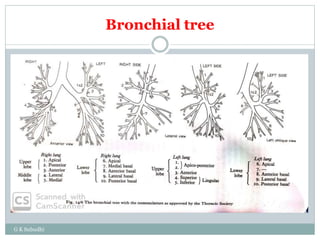
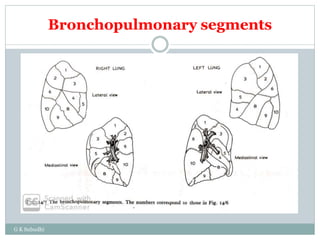
 Positions are based on the anatomy of the lungs and the
tracheobronchial tree.
 The patient may be positioned on a:
 Postural drainage table that can be elevated at one end
eg;Tilt table
 A small child can be positioned on the physiotherapist’s
lap.
G K Subudhi
Bronchial tree
G K Subudhi
Bronchopulmonary segments
G K Subudhi
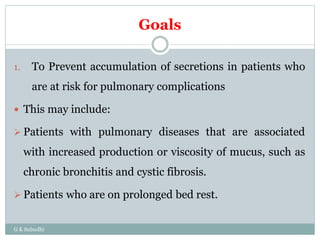
Goals
1. To Prevent accumulation of secretions in patients who
are at risk for pulmonary complications
 This may include:
 Patients with pulmonary diseases that are associated
with increased production or viscosity of mucus, such as
chronic bronchitis and cystic fibrosis.
 Patients who are on prolonged bed rest.
G K Subudhi
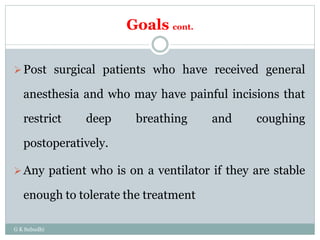
Goals cont.
Post surgical patients who have received general
anesthesia and who may have painful incisions that
restrict deep breathing and coughing
postoperatively.
Any patient who is on a ventilator if they are stable
enough to tolerate the treatment
G K Subudhi
Goals cont.
2. To Remove secretions already accumulated in the
lungs of:
Patients with acute or chronic lung disease, such as
pneumonia, Atelectasis, acute lung infections, and
COPD.
Patients who are generally very weak or are elderly.
G K Subudhi
Indications
 Cystic fibrosis
 Bronchiectasis
 Atelectasis
 Lung abscess
 Pneumonias
 Acute lung disease
 COPD –emphysema, chronic bronchitis
 For patients with a high spinal cord lesion/ spinal cord injury,
myopathies etc.
G K Subudhi
Indications cont.
 After surgeries (thoracic or abdominal surgery)
 On prolonged bed rest
 Patient received general anesthesia and have painful
incision that restrict deep breathing and coughing
postoperatively
 Who is on ventilator (if stable enough to tolerate PD)
 Patient who is generally weak or old
G K Subudhi
Contraindications
 Increased ICP
 Unstable head or neck injury
 Active hemorrhage
 Hemoptysis
 Recent spinal injury
 Empyema
 Bronchoplueral fistula
G K Subudhi
Contraindications cont.
G K Subudhi
 Flail chest
 Uncontrolled hypertension
 Rib or vertebral fractures
 Tuberculosis
 Pulmonary embolism.
 aged, confused, or anxious patients who don't
tolerate position changes
Preparations
G K Subudhi
 Loosen the dress
 Sputum cup
 Pillows
 Explain the Rx and teach the patient deep breathing
and cough
Procedure
G K Subudhi
 Determine segments
 Vital signs
 Position the patient
 Stand in front of pt
 Maintain position
 Apply manual techniques
 Do coughing or suctioning
Manual techniques
G K Subudhi
 Percussion
 Vibration
 shaking
G K Subudhi
Segments
Upper lobe (Apical segment)
G K Subudhi
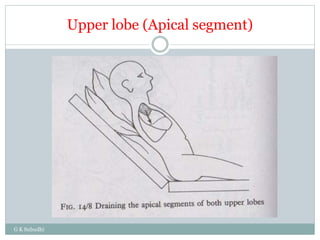
 To drain mucus from the upper lobe apical segments, the
patient sits in a comfortable position on a bed or flat
surface and leans on a back rest.
 The PT percusses and vibrates over the muscular area
between the collar bone and very top of the shoulder
blades on both sides for 3 to 5 minutes.
 Encourage the patient to take a deep breath and cough
during percussion in order to help the airways clearance
Upper lobe (Apical segment)
G K Subudhi
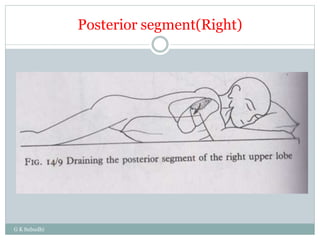
Posterior segment(Right)
G K Subudhi
 The patient lie on his left side and then turn 45º on
to his face , resting against a pillow with an another
pillow supporting his head
 The left arm should kept comfortably behind his
back with right arm resting on a pillow, the right
knee should be flexed
Posterior segment(Right)
G K Subudhi
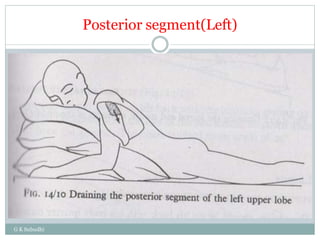
Posterior segment(Left)
G K Subudhi
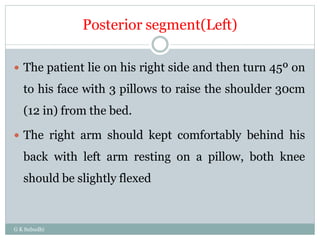
 The patient lie on his right side and then turn 45º on
to his face with 3 pillows to raise the shoulder 30cm
(12 in) from the bed.
 The right arm should kept comfortably behind his
back with left arm resting on a pillow, both knee
should be slightly flexed
Posterior segment(Left)
G K Subudhi
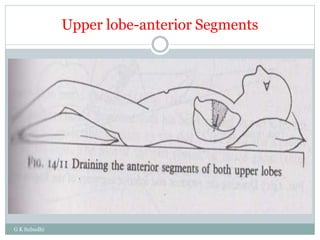
Upper lobe-anterior Segments
G K Subudhi
 The patient lies flat on the bed or table with a pillow
under his head and legs and arms relaxed by his side.
 The chest PT is given to right and left sides of the
front of the chest, between the collar bone and
nipple.
Upper lobe-anterior Segments
G K Subudhi
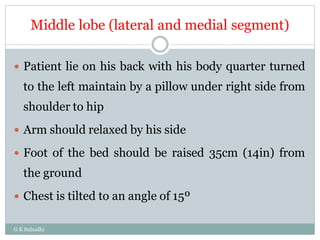
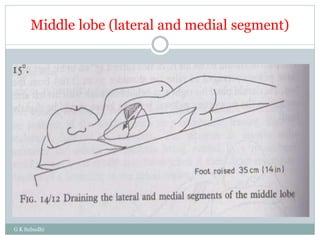
Middle lobe (lateral and medial segment)
G K Subudhi
 Patient lie on his back with his body quarter turned
to the left maintain by a pillow under right side from
shoulder to hip
 Arm should relaxed by his side
 Foot of the bed should be raised 35cm (14in) from
the ground
 Chest is tilted to an angle of 15º
Middle lobe (lateral and medial segment)
G K Subudhi
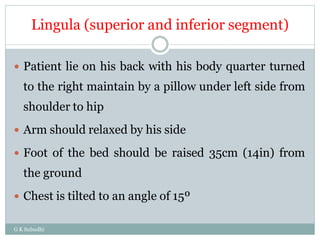
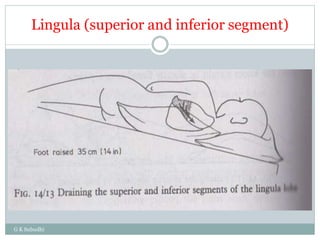
Lingula (superior and inferior segment)
G K Subudhi
 Patient lie on his back with his body quarter turned
to the right maintain by a pillow under left side from
shoulder to hip
 Arm should relaxed by his side
 Foot of the bed should be raised 35cm (14in) from
the ground
 Chest is tilted to an angle of 15º
Lingula (superior and inferior segment)
G K Subudhi
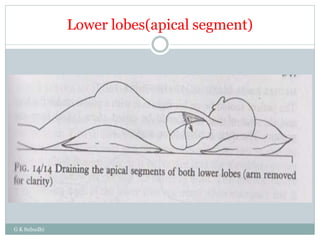
Lower lobes(apical segment)
G K Subudhi
 Patient lie prone with the head turned to one side
 Arm relaxed in a comfortable position by the side
 A pillow under his hips
Lower lobes(apical segment)
G K Subudhi
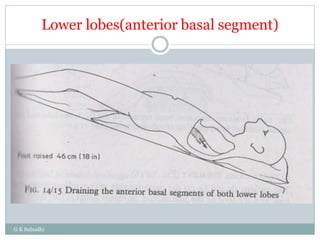
Lower lobes(anterior basal segment)
G K Subudhi
 Patient lie flat on his back with the buttocks resting
on a pillow and knees are flexed
 The foot of the bed is elevated 46cm (18 in) from the
ground
 The chest is tilted to an angle of 20º
Lower lobes(anterior basal segment)
G K Subudhi
Lower lobes(posterior basal segments)
G K Subudhi
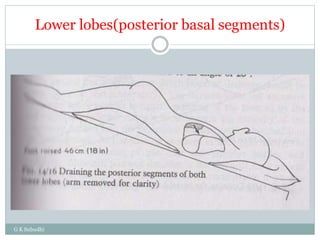
 Patient lie prone with his head turned to one side
 Arms in a comfortable position by the side
 A pillow under his hip
 The foot of the bed is elevated 46cm (18 in) from the
ground
 The chest is tilted to an angle of 20º
Lower lobes(posterior basal segments)
G K Subudhi
Lower lobes(medial basal orcardiac segment)
G K Subudhi
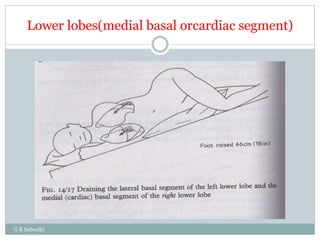
 Patient lie on his right side with a pillow under his
hips
 The foot end is raised 46cm (18in) from the ground
 The chest is tilted to an angle of 20º
Lower lobes(medial basal orcardiac segment)
G K Subudhi
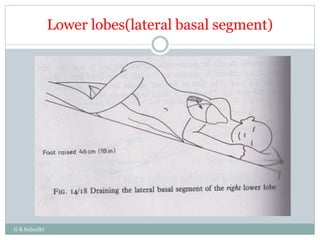
Lower lobes(lateral basal segment)
G K Subudhi
 Patient lie on his left side with a pillow under his
hips
 The foot end is raised 46cm (18in) from the ground
 The chest is tilted to an angle of 20º
Lower lobes(lateral basal segment)
G K Subudhi
Percussion
G K Subudhi
 This is used to mobilize secretions by mechanically
dislodging viscous or adherent mucus from the lungs
 It is done by the cupped hand over the lung segments
being drained
 Here the PTs cupped hand alternatively strikes the
patients chest wall in a rhythmic fashion to help
loosen thick secretions
G K Subudhi
 The PT should try to keep his shoulder elbow and
wrist loose and mobile during the maneuver
 The procedure should not be painful
 To prevent irritation patient wear a light gown or
shirt
Contraindications of percussion
G K Subudhi
 Over #
 Osteoporotic bone
 Spinal fusion
 Over tumor area
 Pulmonary embolus
 Condition in which hemorrhage could easily occur (low platelet
count ,anticoagulation therapy)
 Patient with unstable angina
 Case of chest wall pain (after any surgery CABG or trauma
vibration
G K Subudhi
 This is done in conjunction with percussion
 It is applied only during expiration
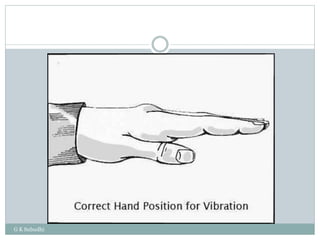
 It is applied by placing both hands directly over the chest
wall or one hand on top of other and gently compressing
 The therapist stiffen his arm and shoulder and apply
light pressure and rapidly vibrating the chest wall as the
patient breaths out
G K Subudhi
 The vibrating action is achieved by the PT isometrically
contracting the muscles of the upper extremity from
shoulder to hand
 Ask the patient to breathe in deeply and exhale slowly
and completely.
 Taking a deep breath and then exhaling slowly and
forcefully without straining will hopefully stimulate a
productive cough
G K Subudhi
Shaking
G K Subudhi
 It is a more vigorous form of vibration which is applied
during exhalation using an intermittent bouncing
maneuver coupled with wide movements of the PTs hand
 The PTs thumb are locked together the open hands are
placed directly over the patients chest the fingers are
wrapped around the chest wall
 The PT simultaneously compress and shake the chest
wall
Reference
G K Subudhi
 Cash’s textbook of chest, heart & vascular disorders
for physiotherapists, 4th edition, Edited by Patricia A.
Downie
Thank U
G K Subudhi

Postural drainage

  • 1.
    PRE S ENTE D BY Ganesh kumar subudhi BPT,MPT(Neurology) Asst. Prof. Sri Jagannath college of physiotherapy, Odisha Postural drainage
  • 2.
    Postural drainage  Posturaldrainage consists of positioning the patient to allow gravity to assist the drainage of secretions from specific areas of the lungs.  It may be necessary to spend an average of 15 to 20 minutes in each position to allow adequate drainage.  A recent radiograph, or bronchogram if available, is a useful adjunct in isolating the affected areas. G K Subudhi
  • 3.
     Postural drainagecan only be carried out effectively if the patient takes an active part in his treatment.  It should never be carried out immediately before or after a meal.  It include the manual techniques such as percussion, shaking, vibration and voluntary coughing. G K Subudhi
  • 4.
    Positions  Positions arebased on the anatomy of the lungs and the tracheobronchial tree.  The patient may be positioned on a:  Postural drainage table that can be elevated at one end eg;Tilt table  A small child can be positioned on the physiotherapist’s lap. G K Subudhi
  • 5.
  • 6.
  • 7.
    Goals 1. To Preventaccumulation of secretions in patients who are at risk for pulmonary complications  This may include:  Patients with pulmonary diseases that are associated with increased production or viscosity of mucus, such as chronic bronchitis and cystic fibrosis.  Patients who are on prolonged bed rest. G K Subudhi
  • 8.
    Goals cont. Post surgicalpatients who have received general anesthesia and who may have painful incisions that restrict deep breathing and coughing postoperatively. Any patient who is on a ventilator if they are stable enough to tolerate the treatment G K Subudhi
  • 9.
    Goals cont. 2. ToRemove secretions already accumulated in the lungs of: Patients with acute or chronic lung disease, such as pneumonia, Atelectasis, acute lung infections, and COPD. Patients who are generally very weak or are elderly. G K Subudhi
  • 10.
    Indications  Cystic fibrosis Bronchiectasis  Atelectasis  Lung abscess  Pneumonias  Acute lung disease  COPD –emphysema, chronic bronchitis  For patients with a high spinal cord lesion/ spinal cord injury, myopathies etc. G K Subudhi
  • 11.
    Indications cont.  Aftersurgeries (thoracic or abdominal surgery)  On prolonged bed rest  Patient received general anesthesia and have painful incision that restrict deep breathing and coughing postoperatively  Who is on ventilator (if stable enough to tolerate PD)  Patient who is generally weak or old G K Subudhi
  • 12.
    Contraindications  Increased ICP Unstable head or neck injury  Active hemorrhage  Hemoptysis  Recent spinal injury  Empyema  Bronchoplueral fistula G K Subudhi
  • 13.
    Contraindications cont. G KSubudhi  Flail chest  Uncontrolled hypertension  Rib or vertebral fractures  Tuberculosis  Pulmonary embolism.  aged, confused, or anxious patients who don't tolerate position changes
  • 14.
    Preparations G K Subudhi Loosen the dress  Sputum cup  Pillows  Explain the Rx and teach the patient deep breathing and cough
  • 15.
    Procedure G K Subudhi Determine segments  Vital signs  Position the patient  Stand in front of pt  Maintain position  Apply manual techniques  Do coughing or suctioning
  • 16.
    Manual techniques G KSubudhi  Percussion  Vibration  shaking
  • 17.
  • 18.
    Upper lobe (Apicalsegment) G K Subudhi  To drain mucus from the upper lobe apical segments, the patient sits in a comfortable position on a bed or flat surface and leans on a back rest.  The PT percusses and vibrates over the muscular area between the collar bone and very top of the shoulder blades on both sides for 3 to 5 minutes.  Encourage the patient to take a deep breath and cough during percussion in order to help the airways clearance
  • 19.
    Upper lobe (Apicalsegment) G K Subudhi
  • 20.
    Posterior segment(Right) G KSubudhi  The patient lie on his left side and then turn 45º on to his face , resting against a pillow with an another pillow supporting his head  The left arm should kept comfortably behind his back with right arm resting on a pillow, the right knee should be flexed
  • 21.
  • 22.
    Posterior segment(Left) G KSubudhi  The patient lie on his right side and then turn 45º on to his face with 3 pillows to raise the shoulder 30cm (12 in) from the bed.  The right arm should kept comfortably behind his back with left arm resting on a pillow, both knee should be slightly flexed
  • 23.
  • 24.
    Upper lobe-anterior Segments GK Subudhi  The patient lies flat on the bed or table with a pillow under his head and legs and arms relaxed by his side.  The chest PT is given to right and left sides of the front of the chest, between the collar bone and nipple.
  • 25.
  • 26.
    Middle lobe (lateraland medial segment) G K Subudhi  Patient lie on his back with his body quarter turned to the left maintain by a pillow under right side from shoulder to hip  Arm should relaxed by his side  Foot of the bed should be raised 35cm (14in) from the ground  Chest is tilted to an angle of 15º
  • 27.
    Middle lobe (lateraland medial segment) G K Subudhi
  • 28.
    Lingula (superior andinferior segment) G K Subudhi  Patient lie on his back with his body quarter turned to the right maintain by a pillow under left side from shoulder to hip  Arm should relaxed by his side  Foot of the bed should be raised 35cm (14in) from the ground  Chest is tilted to an angle of 15º
  • 29.
    Lingula (superior andinferior segment) G K Subudhi
  • 30.
    Lower lobes(apical segment) GK Subudhi  Patient lie prone with the head turned to one side  Arm relaxed in a comfortable position by the side  A pillow under his hips
  • 31.
  • 32.
    Lower lobes(anterior basalsegment) G K Subudhi  Patient lie flat on his back with the buttocks resting on a pillow and knees are flexed  The foot of the bed is elevated 46cm (18 in) from the ground  The chest is tilted to an angle of 20º
  • 33.
    Lower lobes(anterior basalsegment) G K Subudhi
  • 34.
    Lower lobes(posterior basalsegments) G K Subudhi  Patient lie prone with his head turned to one side  Arms in a comfortable position by the side  A pillow under his hip  The foot of the bed is elevated 46cm (18 in) from the ground  The chest is tilted to an angle of 20º
  • 35.
    Lower lobes(posterior basalsegments) G K Subudhi
  • 36.
    Lower lobes(medial basalorcardiac segment) G K Subudhi  Patient lie on his right side with a pillow under his hips  The foot end is raised 46cm (18in) from the ground  The chest is tilted to an angle of 20º
  • 37.
    Lower lobes(medial basalorcardiac segment) G K Subudhi
  • 38.
    Lower lobes(lateral basalsegment) G K Subudhi  Patient lie on his left side with a pillow under his hips  The foot end is raised 46cm (18in) from the ground  The chest is tilted to an angle of 20º
  • 39.
    Lower lobes(lateral basalsegment) G K Subudhi
  • 40.
    Percussion G K Subudhi This is used to mobilize secretions by mechanically dislodging viscous or adherent mucus from the lungs  It is done by the cupped hand over the lung segments being drained  Here the PTs cupped hand alternatively strikes the patients chest wall in a rhythmic fashion to help loosen thick secretions
  • 41.
    G K Subudhi The PT should try to keep his shoulder elbow and wrist loose and mobile during the maneuver  The procedure should not be painful  To prevent irritation patient wear a light gown or shirt
  • 42.
    Contraindications of percussion GK Subudhi  Over #  Osteoporotic bone  Spinal fusion  Over tumor area  Pulmonary embolus  Condition in which hemorrhage could easily occur (low platelet count ,anticoagulation therapy)  Patient with unstable angina  Case of chest wall pain (after any surgery CABG or trauma
  • 43.
    vibration G K Subudhi This is done in conjunction with percussion  It is applied only during expiration  It is applied by placing both hands directly over the chest wall or one hand on top of other and gently compressing  The therapist stiffen his arm and shoulder and apply light pressure and rapidly vibrating the chest wall as the patient breaths out
  • 44.
    G K Subudhi The vibrating action is achieved by the PT isometrically contracting the muscles of the upper extremity from shoulder to hand  Ask the patient to breathe in deeply and exhale slowly and completely.  Taking a deep breath and then exhaling slowly and forcefully without straining will hopefully stimulate a productive cough
  • 45.
  • 46.
    Shaking G K Subudhi It is a more vigorous form of vibration which is applied during exhalation using an intermittent bouncing maneuver coupled with wide movements of the PTs hand  The PTs thumb are locked together the open hands are placed directly over the patients chest the fingers are wrapped around the chest wall  The PT simultaneously compress and shake the chest wall
  • 47.
    Reference G K Subudhi Cash’s textbook of chest, heart & vascular disorders for physiotherapists, 4th edition, Edited by Patricia A. Downie
  • 48.
    Thank U G KSubudhi