Charmaine Kei . Palomar RN
ASSESSMENT
OF ABDOMEN
OBJECTIVES
2
At the end of this class, the student will be
able to:
1. Review the Anatomy and Physiology of the
abdomen.
2.Identify quadrants, regions and landmarks
for the abdominal assessment.
3. Correctly perform techniques of inspection,
auscultation, percussion and palpation.
4. Differentiate normal from abnormal
findings.
5. Document findings.
3
Anatomy
Process of Digestion and Elimination
1. Mouth
2. Esophagus
3. Stomach
4. Small intestines
5. Large intestines
6. Rectum
7. Anus
4
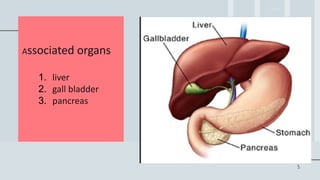
Associated organs
1. liver
2. gall bladder
3. pancreas
5
Regions of the Abdomen
Epigastric
Umbilical
Suprapubic or hypogastric:
6
7
8
9
QUADRANTS OF
10
11
❖ Inspection
❖ Auscultation
❖ Palpation
❖ percussion
12
ASSESSMENT TECHNIQUES FOR ABDOMENS
13
SITES OF REFERRED ABDOMINAL PAINAbdominal Pain
Sites of Referred Abdominal Pain
14
Subjective Data: (Health history questions)
• Change in appetite
• Usual weight; Changes in usual weight Difficulty swallowing
• Are there any foods you have difficulty tolerating?
• Have you felt nauseated?
• Have you vomited (emesis)?
• Experience indigestion?
• Heart burn (pyrosis) or Belching (eructation) Use antacids, if so, how often?
• Abdomen feel bloated after eating (distension) Abdominal pain? Associated with
eating?
• Alcohol use?
• Medications?
15
Bowel habits
Usual color and consistency
Any diarrhea/constipation/
excessive flatulence
Any recent change
Use of laxatives…
Past abdominal history
• GI problems: ulcer, hepatitis, jaundice,
appendicitis, colitis, hernia
• Surgical history of abdomen Surgical
problems in the past
• Abdominal x-rays, sonograms, CT results,
colonoscopy results, etc..
Skin changes
Umbilicus
Contour
Observable masses
Movement
17
Assessment Abdomen
18
PERFORMANCE
1. PREPARATION
1. Prior to performing
the procedure, check
the doctor's order
for the need to
perform the
assessment.
2. Perform hand hygiene,
Apply gloves, and observes
other appropriate infection
prevention procedures.
Prepare equipment needed
for the assessment.
3. Introduce self and verifies the
client's identity using agency
protocol.
Explain the procedure to the
client, and how he or she can
participate, especially about the
need to assume several positions
for this examination.
19
4. Ask the client to empty the
bladder before beginning the
examination.
Ensure that the room is
warm.
Instruct the client to remove
clothes and to put on a
gown.
5. Help the client to lie supine with
the arms folded across the chest or
sides.
Place a flat pillow under the client's
head for comfort.
Slightly flex the client's legs by
placing a pillow or rolled blanket
under the client's knees.
6. Drape the client with
sheets so that the
abdomen is visible from
the lower rib cage to the
pubic area.
20
7. Instruct the client
to breathe
through the
mouth
.
Advise to take slow,
deep breaths
8. Provide privacy
21
ASSESSING THE ABDOMEN
Ask if the client has any history of the following:
• Incidence of abdominal pain
• Tender areas
• Location
• Onset
• Sequence
• Quality
• Frequency
• Associated symptoms
• Constipation or diarrhea
• Change in appetite,
• Food intolerances, and foods ingested in past 24 hours.
22
10. Assist the client to a supine position, with the arms
placed comfortably at the sides.
Place small pillows beneath the knees.
23
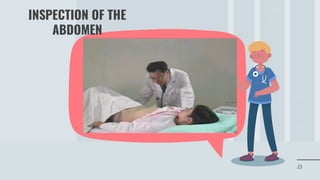
INSPECTION OF THE
ABDOMEN
24
11. Inspect the abdomen for skin
integrity, coloration of the skin,
vascularity of the abdominal skin, any
striae, scars, lesions and rashes.
NORMAL FINDINGS:
*Unblemished skin
*Uniform color
*Silver-white striae (stretch marks) or
surgical scars
11. Inspect the abdomen for skin
integrity, coloration of the skin,
vascularity of the abdominal skin,
any striae, scars, lesions and
rashes.
NORMAL FINDINGS:
*Unblemished skin
*Uniform color
*Silver-white striae (stretch
marks) or surgical scars
25
Contour
Symmetry
Umbilicus
Skin
26
• Presence of rash or other lesions
Tense, glistening skin (may
indicate ascites, edema)
• Purple striae (associated with
Cushing’s disease or rapid weight
gain and loss)
DEVIATIONS FROM NORMAL:
27
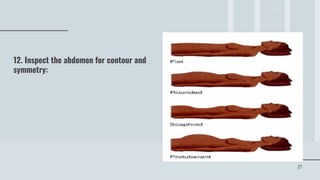
12. Inspect the abdomen for contour and
symmetry:
28
NORMAL:
Flat, rounded (convex), or scaphoid (concave)
DEVIATION FROM NORMAL:
- Distended
14. Ask the client to take a deep breath and to hold it.
Normal findings:
No evidence of enlargement of liver or
spleen
Deviation from normal:
Evidence of enlargement of liver
(Hepatomegaly) or spleen
(Splenomegaly)
29
15. Assess the symmetry of contour while standing at the foot of the bed.
Normal: Symmetric contour
Deviations from normal:Asymmetric contour
e.g., localized protrusions around umbilicus, inguinal ligaments, or scars
(possible hernia or tumor)
16. If distention is present, measure the abdominal girth by placing a tape
around the abdomen at the level of the umbilicus.
30
17. Inspect abdominal movement when the client breathes in (respiratory movements),
observe aortic pulsations, and observe for peristaltic waves.
Normal findings:
- Symmetric movements caused by respiration
- Visible peristalsis in very lean people Aortic pulsations in thin people at epigastric
area.
Deviation from Normal:
- Limited movement due to pain or disease process
- No Visible peristalsis (possible bowel obstruction)
- Marked aortic pulsations
31
18. Observes the vascular pattern.
Normal findings:
- No visible vascular pattern
Deviation from Normal:
- Visible venous pattern (dilated veins) is
associated with liver disease, ascites, and venocaval obstruction
AUSCULTATION OF THE
ABDOMEN
3
2
33
19. Auscultate the abdomen for
bowel sounds, vascular sounds, and
peritoneal friction rubs. Warm the
hands and the stethoscope
diaphragms.
34
• Normal finding:
- Audible bowel sounds
• Deviations from Nomal:
❑ Hypoactive,
❑ Hyperactive
❑ Decreased or absent
35
FOR BOWEL SOUNDS
-Use the flat-disk diaphragm.
• Intestinal sounds are relatively
high pitched and best
accentuated by the diaphragm.
Light pressure with the
stethoscope is adequate.
- Ask when the client the last time
he/she ate.
36
21. Place diaphragm of
the stethoscope in each of
the four quadrants of the
abdomen.
37
22. Listen for active bowel
sounds. irregular gurgling
noises occurring about every
5 to 20 seconds.
38
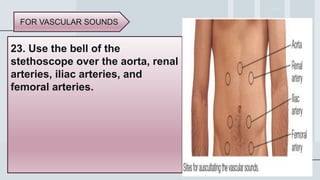
23. Use the bell of the
stethoscope over the aorta, renal
arteries, iliac arteries, and
femoral arteries.
FOR VASCULAR SOUNDS
39
24. Listen for bruits
Normal:
- Absence of arterial bruits
Deviations from Normal:
-Loud bruit over aortic area (possible
aneurysm)
4
0
25. Peritoneal Friction Rubs
26. Peritoneal friction rubs are rough, grating
sounds like two pieces of leather rubbing
together.
Normal finding:
- Absence of friction rub
Deviation from normal:
- Friction rub
41
26. Percuss several
areas in each of the
four quadrants to
determine presence of
tympany and dullness.
Use a systematic
pattern.
PERCUSSION OF THE ABDOMEN
42
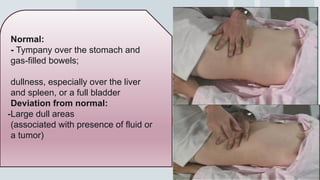
Normal:
- Tympany over the stomach and
gas-filled bowels;
dullness, especially over the liver
and spleen, or a full bladder
Deviation from normal:
-Large dull areas
(associated with presence of fluid or
a tumor)
43
44
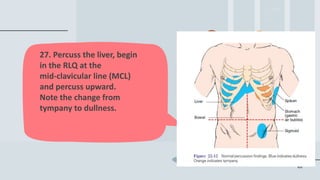
27. Percuss the liver, begin
in the RLQ at the
mid-clavicular line (MCL)
and percuss upward.
Note the change from
tympany to dullness.
45
29. Perform blunt percussion
on the liver.
Percuss the liver by placing
the left hand flat against
the lower right anterior rib
cage.
Use the ulnar side of the
right fist to strike the
left hand.
46
28. Percuss the
spleen. Begin
posterior to the
left mid-axillary
line (MAL), and
percuss downward
47
https://www.youtube.com
/watch?v=DBif1jjAfKk
4
8
30. Instruct the client to sit with
his or her back to you.
Perform blunt percussion on the
kidneys by placing the left hand
flat at the costovertebral angles
(CVA) over the twelfth rib and
using the ulnar side of the right
fist to strike the left hand.
49
https://www.youtube.com
/watch?v=4HNCLLozdVU
50
PALPATION OF THE ABDOMEN
51
31. Place the patient back to supine
position and perform light
palpation over the quadrants of the
abdomen.
52
32. Perform light palpation first to
detect areas of tenderness and/or
muscle guarding.
Systematically explore all four
quadrants.
53
33. Light Palpation
a. Holds the palm of your hand slightly
above the client’s abdomen, with
your fingers parallel to the abdomen
b. Depresses the abdominal wall
lightly, about 1 cm or to the depth of
the subcutaneous tissue, with the
pads of your fingers.
c. Moves the finger pads in a slight
circular motion
54
Light Palpation
d. Notes areas of tenderness or superficial
pain, masses, and muscle guarding. To
determine areas of tenderness, ask the
client to tell you about them and watch for
changes in the client’s facial expressions.
e. If the client is excessively ticklish, begin
by pressing your hand on top of the
client’s hand while pressing lightly. Then
slide your hand off the client’s and onto
the abdomen to continue the examination
55
(a) Stand at the client's
right side, reach over the
abdomen with your left
arm, and place your hand
under the posterior lower
ribs. Pull up gently.
34. Palpate the spleen:
56
(b) Place your right hand
below the left costal
margin with the fingers
pointing toward the
client's head.
57
(c) Asks the client to inhale and press
inward and upward as you
provide support with your other
hand. Be sure to palpate with
your fingers below the costal
margin so you do not miss the
lower edge of an enlarged spleen.
58
59
https://www.youtube.com
/watch?v=rKsqO1tAKvs
6
0
(a) To palpate the right
kidney, support the
right posterior flank
with your left hand and
place your right hand in
the RUQ just below the
costal margin at the
MCL.
35. Palpate the kidneys:
61
(b) To capture the
kidney, ask the
client to inhale.
Then compress your
fingers deeply
during peak
inspiration.
62
(c) Ask the client to exhale
and hold the breath briefly.
Gradually release the
pressure of your right hand.
If you have captured the
kidney, you will feel it slip
beneath your fingers.
(d) To palpate the left
kidney, reverse the
procedure.
63
https://www.youtube.com
/watch?v=n75RgtItLcg
64
https://www.youtube.com
/watch?v=az7IkXCwfyM
65
TEST FOR APPENDICITIS/PERITONEAL
IRRITATION
6
6
Palpate deeply at 90
degrees into the
abdomen halfway
between the umbilicus
and the anterior iliac
crest. Then suddenly
release pressure.
39. Assessing for
rebound tenderness:
67
Palpate deeply in the
LLQ and quickly release
pressure.
40. Test for referred rebound tenderness.
6
8
❑ (a)Asks the client to lie
on the left side.
❑ (b) Hyperextends the
client's right leg. Place
the patient on a supine
position afterwards.
41. Assess for Psoas sign:
6
9
https://www.youtube.com
/watch?v=m4ldpvIYEDM
70
❑ (a)Supports the client's right
knee and ankle.
(b) Flexes the hip and knee, and
rotate the leg internally and
externally.
42. Assess for Obturator sign:
71
72
https://www.youtube.com
/watch?v=8aPz8UP9G58
73
43. Perform Hypersensitivity test:
After ensuring that the patient is
in a supine, neutral position,
stroke the abdomen with a sharp
object
74
TEST FOR
CHOLECYSTIT
TEST FOR CHOLECYSTITIS
44. Press your fingertips under the liver
border at the right costal margin and ask the
client to inhale deeply.
PALPATION OF THE BLADDER
45. Palpate the area above the pubic
symphysis if the client’s history indicates
possible urinary retention
75
46. Inform the client about the
end of assessment.
Show gratitude for the
participation and cooperation of
the patient and ensures the
patient is in a stable condition
before leaving the patient's room.
47. Perform hand hygiene.
76
48. Document findings in the client record
using printed or electronic forms or
checklists supplemented by narrative notes
when appropriate.
Inform Health Care Provider (HCP) for any
untoward findings.
77
78
79
THANKS
Charmaine Kei Palomar

Abdominal Assessment

  • 1.
    Charmaine Kei .Palomar RN ASSESSMENT OF ABDOMEN
  • 2.
    OBJECTIVES 2 At the endof this class, the student will be able to: 1. Review the Anatomy and Physiology of the abdomen. 2.Identify quadrants, regions and landmarks for the abdominal assessment. 3. Correctly perform techniques of inspection, auscultation, percussion and palpation. 4. Differentiate normal from abnormal findings. 5. Document findings.
  • 3.
  • 4.
    Process of Digestionand Elimination 1. Mouth 2. Esophagus 3. Stomach 4. Small intestines 5. Large intestines 6. Rectum 7. Anus 4
  • 5.
    Associated organs 1. liver 2.gall bladder 3. pancreas 5
  • 6.
    Regions of theAbdomen Epigastric Umbilical Suprapubic or hypogastric: 6
  • 7.
  • 8.
  • 9.
  • 10.
  • 11.
  • 12.
    ❖ Inspection ❖ Auscultation ❖Palpation ❖ percussion 12 ASSESSMENT TECHNIQUES FOR ABDOMENS
  • 13.
    13 SITES OF REFERREDABDOMINAL PAINAbdominal Pain Sites of Referred Abdominal Pain
  • 14.
    14 Subjective Data: (Healthhistory questions) • Change in appetite • Usual weight; Changes in usual weight Difficulty swallowing • Are there any foods you have difficulty tolerating? • Have you felt nauseated? • Have you vomited (emesis)? • Experience indigestion? • Heart burn (pyrosis) or Belching (eructation) Use antacids, if so, how often? • Abdomen feel bloated after eating (distension) Abdominal pain? Associated with eating? • Alcohol use? • Medications?
  • 15.
    15 Bowel habits Usual colorand consistency Any diarrhea/constipation/ excessive flatulence Any recent change Use of laxatives…
  • 16.
    Past abdominal history •GI problems: ulcer, hepatitis, jaundice, appendicitis, colitis, hernia • Surgical history of abdomen Surgical problems in the past • Abdominal x-rays, sonograms, CT results, colonoscopy results, etc..
  • 17.
  • 18.
    18 PERFORMANCE 1. PREPARATION 1. Priorto performing the procedure, check the doctor's order for the need to perform the assessment. 2. Perform hand hygiene, Apply gloves, and observes other appropriate infection prevention procedures. Prepare equipment needed for the assessment. 3. Introduce self and verifies the client's identity using agency protocol. Explain the procedure to the client, and how he or she can participate, especially about the need to assume several positions for this examination.
  • 19.
    19 4. Ask theclient to empty the bladder before beginning the examination. Ensure that the room is warm. Instruct the client to remove clothes and to put on a gown. 5. Help the client to lie supine with the arms folded across the chest or sides. Place a flat pillow under the client's head for comfort. Slightly flex the client's legs by placing a pillow or rolled blanket under the client's knees. 6. Drape the client with sheets so that the abdomen is visible from the lower rib cage to the pubic area.
  • 20.
    20 7. Instruct theclient to breathe through the mouth . Advise to take slow, deep breaths 8. Provide privacy
  • 21.
    21 ASSESSING THE ABDOMEN Askif the client has any history of the following: • Incidence of abdominal pain • Tender areas • Location • Onset • Sequence • Quality • Frequency • Associated symptoms • Constipation or diarrhea • Change in appetite, • Food intolerances, and foods ingested in past 24 hours.
  • 22.
    22 10. Assist theclient to a supine position, with the arms placed comfortably at the sides. Place small pillows beneath the knees.
  • 23.
  • 24.
    24 11. Inspect theabdomen for skin integrity, coloration of the skin, vascularity of the abdominal skin, any striae, scars, lesions and rashes. NORMAL FINDINGS: *Unblemished skin *Uniform color *Silver-white striae (stretch marks) or surgical scars 11. Inspect the abdomen for skin integrity, coloration of the skin, vascularity of the abdominal skin, any striae, scars, lesions and rashes. NORMAL FINDINGS: *Unblemished skin *Uniform color *Silver-white striae (stretch marks) or surgical scars
  • 25.
  • 26.
    26 • Presence ofrash or other lesions Tense, glistening skin (may indicate ascites, edema) • Purple striae (associated with Cushing’s disease or rapid weight gain and loss) DEVIATIONS FROM NORMAL:
  • 27.
    27 12. Inspect theabdomen for contour and symmetry:
  • 28.
    28 NORMAL: Flat, rounded (convex),or scaphoid (concave) DEVIATION FROM NORMAL: - Distended 14. Ask the client to take a deep breath and to hold it. Normal findings: No evidence of enlargement of liver or spleen Deviation from normal: Evidence of enlargement of liver (Hepatomegaly) or spleen (Splenomegaly)
  • 29.
    29 15. Assess thesymmetry of contour while standing at the foot of the bed. Normal: Symmetric contour Deviations from normal:Asymmetric contour e.g., localized protrusions around umbilicus, inguinal ligaments, or scars (possible hernia or tumor) 16. If distention is present, measure the abdominal girth by placing a tape around the abdomen at the level of the umbilicus.
  • 30.
    30 17. Inspect abdominalmovement when the client breathes in (respiratory movements), observe aortic pulsations, and observe for peristaltic waves. Normal findings: - Symmetric movements caused by respiration - Visible peristalsis in very lean people Aortic pulsations in thin people at epigastric area. Deviation from Normal: - Limited movement due to pain or disease process - No Visible peristalsis (possible bowel obstruction) - Marked aortic pulsations
  • 31.
    31 18. Observes thevascular pattern. Normal findings: - No visible vascular pattern Deviation from Normal: - Visible venous pattern (dilated veins) is associated with liver disease, ascites, and venocaval obstruction
  • 32.
  • 33.
    33 19. Auscultate theabdomen for bowel sounds, vascular sounds, and peritoneal friction rubs. Warm the hands and the stethoscope diaphragms.
  • 34.
    34 • Normal finding: -Audible bowel sounds • Deviations from Nomal: ❑ Hypoactive, ❑ Hyperactive ❑ Decreased or absent
  • 35.
    35 FOR BOWEL SOUNDS -Usethe flat-disk diaphragm. • Intestinal sounds are relatively high pitched and best accentuated by the diaphragm. Light pressure with the stethoscope is adequate. - Ask when the client the last time he/she ate.
  • 36.
    36 21. Place diaphragmof the stethoscope in each of the four quadrants of the abdomen.
  • 37.
    37 22. Listen foractive bowel sounds. irregular gurgling noises occurring about every 5 to 20 seconds.
  • 38.
    38 23. Use thebell of the stethoscope over the aorta, renal arteries, iliac arteries, and femoral arteries. FOR VASCULAR SOUNDS
  • 39.
    39 24. Listen forbruits Normal: - Absence of arterial bruits Deviations from Normal: -Loud bruit over aortic area (possible aneurysm)
  • 40.
    4 0 25. Peritoneal FrictionRubs 26. Peritoneal friction rubs are rough, grating sounds like two pieces of leather rubbing together. Normal finding: - Absence of friction rub Deviation from normal: - Friction rub
  • 41.
    41 26. Percuss several areasin each of the four quadrants to determine presence of tympany and dullness. Use a systematic pattern. PERCUSSION OF THE ABDOMEN
  • 42.
    42 Normal: - Tympany overthe stomach and gas-filled bowels; dullness, especially over the liver and spleen, or a full bladder Deviation from normal: -Large dull areas (associated with presence of fluid or a tumor)
  • 43.
  • 44.
    44 27. Percuss theliver, begin in the RLQ at the mid-clavicular line (MCL) and percuss upward. Note the change from tympany to dullness.
  • 45.
    45 29. Perform bluntpercussion on the liver. Percuss the liver by placing the left hand flat against the lower right anterior rib cage. Use the ulnar side of the right fist to strike the left hand.
  • 46.
    46 28. Percuss the spleen.Begin posterior to the left mid-axillary line (MAL), and percuss downward
  • 47.
  • 48.
    4 8 30. Instruct theclient to sit with his or her back to you. Perform blunt percussion on the kidneys by placing the left hand flat at the costovertebral angles (CVA) over the twelfth rib and using the ulnar side of the right fist to strike the left hand.
  • 49.
  • 50.
  • 51.
    51 31. Place thepatient back to supine position and perform light palpation over the quadrants of the abdomen.
  • 52.
    52 32. Perform lightpalpation first to detect areas of tenderness and/or muscle guarding. Systematically explore all four quadrants.
  • 53.
    53 33. Light Palpation a.Holds the palm of your hand slightly above the client’s abdomen, with your fingers parallel to the abdomen b. Depresses the abdominal wall lightly, about 1 cm or to the depth of the subcutaneous tissue, with the pads of your fingers. c. Moves the finger pads in a slight circular motion
  • 54.
    54 Light Palpation d. Notesareas of tenderness or superficial pain, masses, and muscle guarding. To determine areas of tenderness, ask the client to tell you about them and watch for changes in the client’s facial expressions. e. If the client is excessively ticklish, begin by pressing your hand on top of the client’s hand while pressing lightly. Then slide your hand off the client’s and onto the abdomen to continue the examination
  • 55.
    55 (a) Stand atthe client's right side, reach over the abdomen with your left arm, and place your hand under the posterior lower ribs. Pull up gently. 34. Palpate the spleen:
  • 56.
    56 (b) Place yourright hand below the left costal margin with the fingers pointing toward the client's head.
  • 57.
    57 (c) Asks theclient to inhale and press inward and upward as you provide support with your other hand. Be sure to palpate with your fingers below the costal margin so you do not miss the lower edge of an enlarged spleen.
  • 58.
  • 59.
  • 60.
    6 0 (a) To palpatethe right kidney, support the right posterior flank with your left hand and place your right hand in the RUQ just below the costal margin at the MCL. 35. Palpate the kidneys:
  • 61.
    61 (b) To capturethe kidney, ask the client to inhale. Then compress your fingers deeply during peak inspiration.
  • 62.
    62 (c) Ask theclient to exhale and hold the breath briefly. Gradually release the pressure of your right hand. If you have captured the kidney, you will feel it slip beneath your fingers. (d) To palpate the left kidney, reverse the procedure.
  • 63.
  • 64.
  • 65.
  • 66.
    6 6 Palpate deeply at90 degrees into the abdomen halfway between the umbilicus and the anterior iliac crest. Then suddenly release pressure. 39. Assessing for rebound tenderness:
  • 67.
    67 Palpate deeply inthe LLQ and quickly release pressure. 40. Test for referred rebound tenderness.
  • 68.
    6 8 ❑ (a)Asks theclient to lie on the left side. ❑ (b) Hyperextends the client's right leg. Place the patient on a supine position afterwards. 41. Assess for Psoas sign:
  • 69.
  • 70.
    70 ❑ (a)Supports theclient's right knee and ankle. (b) Flexes the hip and knee, and rotate the leg internally and externally. 42. Assess for Obturator sign:
  • 71.
  • 72.
  • 73.
    73 43. Perform Hypersensitivitytest: After ensuring that the patient is in a supine, neutral position, stroke the abdomen with a sharp object
  • 74.
    74 TEST FOR CHOLECYSTIT TEST FORCHOLECYSTITIS 44. Press your fingertips under the liver border at the right costal margin and ask the client to inhale deeply. PALPATION OF THE BLADDER 45. Palpate the area above the pubic symphysis if the client’s history indicates possible urinary retention
  • 75.
    75 46. Inform theclient about the end of assessment. Show gratitude for the participation and cooperation of the patient and ensures the patient is in a stable condition before leaving the patient's room. 47. Perform hand hygiene.
  • 76.
    76 48. Document findingsin the client record using printed or electronic forms or checklists supplemented by narrative notes when appropriate. Inform Health Care Provider (HCP) for any untoward findings.
  • 77.
  • 78.
  • 79.