Lesson 10.1: Nuclear Chemistry
Nuclear Chemistry - The branch of chemistry which deals with the study
of the composition of atomic nucleus, nuclear forces, nuclear reactions
and radioactive materials is called nuclear chemistry.
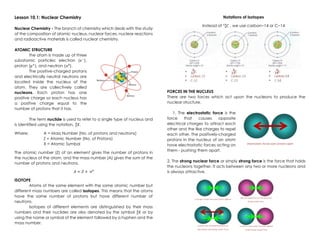
ATOMIC STRUCTURE
the atom is made up of three
subatomic particles: electron (𝑒−
),
proton (𝑝+
), and neutron (𝑛0
).
The positive-charged protons
and electrically neutral neutrons are
located inside the nucleus of the
atom. They are collectively called
nucleons. Each proton has one
positive charge so each nucleus has
a positive charge equal to the
number of protons that it has.
The term nuclide is used to refer to a single type of nucleus and
is identified using the notation, 𝑋
𝑍
𝐴
.
Where; A = Mass Number (No. of protons and neutrons)
Z = Atomic Number (No. of Protons)
X = Atomic Symbol
The atomic number (Z) of an element gives the number of protons in
the nucleus of the atom, and the mass number (A) gives the sum of the
number of protons and neutrons.
𝐴 = 𝑍 + 𝑛0
ISOTOPE
Atoms of the same element with the same atomic number but
different mass numbers are called isotopes. This means that the atoms
have the same number of protons but have different number of
neutrons.
Isotopes of different elements are distinguished by their mass
numbers and their nuclides are also denoted by the symbol 𝑋
𝑍
𝐴
or by
using the name or symbol of the element followed by a hyphen and the
mass number.
Notations of Isotopes
Instead of 𝐶
6
14
, we use carbon−14 or C−14
FORCES IN THE NUCLEUS
There are two forces which act upon the nucleons to produce the
nuclear structure.
1. The electrostatic force is the
force that causes opposite
electrical charges to attract each
other and the like charges to repel
each other. The positively-charged
protons in the nucleus of an atom
have electrostatic forces acting on
them - pushing them apart.
2. The strong nuclear force or simply strong force is the force that holds
the nucleons together. It acts between any two or more nucleons and
is always attractive.
Deals with the nucleus, forces,
reactions, and radioactivity
protons
protons + neutrons only neutrons
will change
and protons is
unaffected
reverse
proton proton
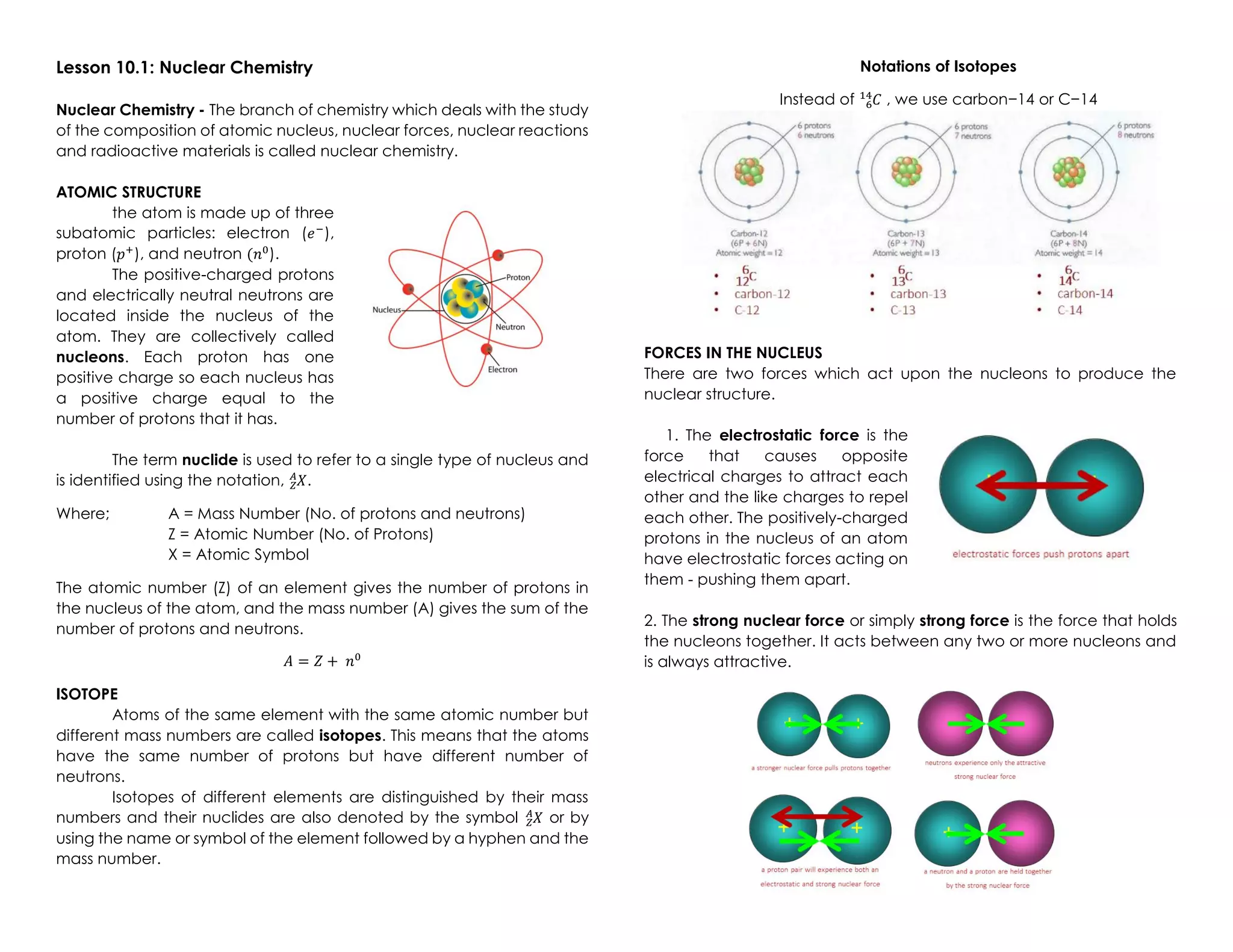
IMPORTANCE OF NEUTRONS
All nucleons, both protons and neutrons, attract one another by the
strong nuclear force. Only protons repel one another by the
electrostatic force.
Despite the strong repulsive electrostatic forces among protons, all
nucleons remain bound and intact in the dense nucleus because of the
strong nuclear force. However, this strong nuclear force acts and works
only on subatomic particles that are extremely close to each other.
Small Nucleus
In a small nucleus, the particles are close together so that the
strong force holds the protons and neutrons tightly together.
Large Nucleus
In a large nucleus, the
strong force holds together
only the particles that are
closest to one another. Since
there are many protons in a
large nucleus, the electric
force repels protons that are
far apart. This increased
repulsive force causes
particles in a large nucleus to
be held less tightly than those
in a small nucleus.
The presence of neutrons adds an attractive force within the
nucleus due to the fact that there are repulsive forces among protons
but there are only attractive forces between neutrons and between
protons and neutrons. This means that neutrons are important to
balance the electrostatic and strong nuclear forces in a nucleus.
RADIOACTIVITY
- Radioactivity is the result of a natural change of a radioactive isotope
of one element into an isotope of a different element.
The nucleus of an atom is considered stable if the forces among
the particles that makeup the nucleus are balanced. It is unstable if
these forces are unbalanced.
Nuclei that are unstable exhibit radioactivity and are called
radioactive nuclides or radionuclides. Atoms containing these
radionuclides are called radioisotopes. They occur either naturally or
artificially prepared in the laboratory.
The instability of the nucleus of an atom may result from an
excess of either neutrons or protons. It will seek or attempt to reach
stability by undergoing radioactive decay. In this process, the unstable
nucleus breaks apart, is converted to a more stable isotope, emits
nucleons and nuclear radiation and releases energy in other forms.
The unstable nuclide that undergoes decay is called the parent nucleus
and the more stable nuclide produced is called the daughter nucleus.
The daughter nucleus could already be stable or may still be unstable
which would undergo further decay. Radioactive decay will only stop
if the daughter nucleus is already stable.
parent nucleus is more unstable than the daughter nucleus
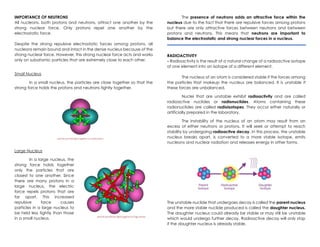
NUCLEAR STABILITY
A stable (nonradioactive) nucleus does not undergo radioactive
decay, therefore, cannot be transformed into another isotope without
adding energy from outside. Of the thousands of nuclides that exist,
only about 250 are stable.
The stability of a nucleus depends on the balance between the
repulsive electrostatic forces and attractive strong forces and,
therefore, depends on the ratio of the number of neutrons and protons
in a nucleus.
A plot of the number of neutrons
versus the number of protons for
stable nuclei reveals that the
stable isotopes fall into a narrow
band called the belt of stability.
When a radionuclide undergoes
decay, it releases radiation in
such a way that the daughter
nucleus produced lies closer to
the band of stability than the par
ent nucleus. Therefore, the kind
of decay that a radionuclide will
undergo can be predicted
depending on its location
relative to the band of stability.
Based on the belt of stability, we
can interpret that:
1. Nuclei containing more than 83 protons are unstable. In other
words, no element beyond bismuth has a stable isotope.
2. Nuclei with an even number of nucleons, either proton or
neutron, tend to be more stable than those with an odd number
of nuclear particles.
3. Certain number of protons or neutrons show exceptional
stability: 2, 8, 20, 28, 50, 82, 126.
NUCLEAR REACTIONS
Chemical changes in matter that originate in the nucleus of an atom
are called nuclear reactions or transmutations. These reactions involve
changes of nuclei that result in changes in their atomic numbers, mass
numbers, or energy states.
In a chemical change, the atoms in molecules and ions are rearranged,
but atoms are neither created nor destroyed: The number of atoms
remains the same. In a nuclear reaction, the total number of nucleons
remains the same. During a nuclear reaction, one nucleon can change
into a different nucleon along with the release of energy. A proton can
change to a neutron or a neutron can change to a proton, but the total
number of nucleons remains the same.
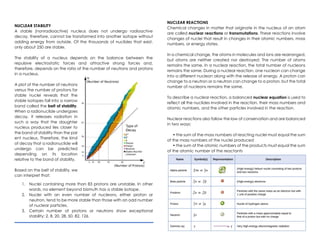
To describe a nuclear reaction, a balanced nuclear equation is used to
reflect all the nuclides involved in the reaction, their mass numbers and
atomic numbers, and the other particles involved in the reaction.
Nuclear reactions also follow the law of conservation and are balanced
in two ways:
• the sum of the mass numbers of reacting nuclei must equal the sum
of the mass numbers of the nuclei produced
• the sum of the atomic numbers of the products must equal the sum
of the atomic number of the reactants
end bismuth and starting polonium
helium, oxygen, calcium, nickel, tin, lead, atomic number 126
beta decay
ALPHA DECAY
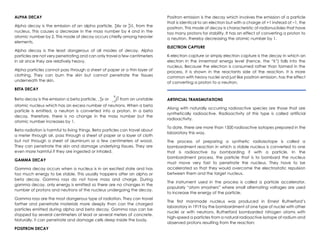
Alpha decay is the emission of an alpha particle, 𝐻𝑒
2
4
or α
2
4
, from the
nucleus. This causes a decrease in the mass number by 4 and in the
atomic number by 2. This mode of decay occurs chiefly among heavier
elements.
Alpha decay is the least dangerous of all modes of decay. Alpha
particles are not very penetrating and can only travel a few centimeters
in air since they are relatively heavy.
Alpha particles cannot pass through a sheet of paper or a thin layer of
clothing. They can burn the skin but cannot penetrate the tissues
underneath the skin.
BETA DECAY
Beta decay is the emission a beta particle, 𝑒
−1
0
or 𝛽
−1
0
from an unstable
atomic nucleus which has an excess number of neutrons. When a beta
particle is emitted, a neutron is converted into a proton. In a beta
decay, therefore, there is no change in the mass number but the
atomic number increases by 1.
Beta radiation is harmful to living things. Beta particles can travel about
a meter through air, pass through a sheet of paper or a layer of cloth
but not through a sheet of aluminum or a few centimeters of wood.
They can penetrate the skin and damage underlying tissues. They are
even more harmful if they are ingested or inhaled.
GAMMA DECAY
Gamma decay occurs when a nucleus is in an excited state and has
too much energy to be stable. This usually happens after an alpha or
beta decay. Gamma rays do not have mass and charge. During
gamma decay, only energy is emitted so there are no changes in the
number of protons and neutrons of the nucleus undergoing the decay.
Gamma rays are the most dangerous type of radiation. They can travel
farther and penetrate materials more deeply than can the charged
particles emitted during alpha and beta decay. Gamma rays can be
stopped by several centimeters of lead or several meters of concrete.
Naturally, it can penetrate and damage cells deep inside the body.
POSITRON DECAY
Positron emission is the decay which involves the emission of a particle
that is identical to an electron but with a charge of +1 instead of –1, the
positron. This mode of decay is characteristic of radionuclides that have
too many protons for stability. It has an effect of converting a proton to
a neutron, thereby decreasing the atomic number by 1.
ELECTRON CAPTURE
K-electron capture or simply electron capture is the decay in which an
electron in the innermost energy level (hence, the “k”) falls into the
nucleus. Because the electron is consumed rather than formed in the
process, it is shown in the reactants side of the reaction. It is more
common with heavy nuclei and just like positron emission, has the effect
of converting a proton to a neutron.
ARTIFICIAL TRANSMUTATIONS
Along with naturally occurring radioactive species are those that are
synthetically radioactive. Radioactivity of this type is called artificial
radioactivity.
To date, there are more than 1500 radioactive isotopes prepared in the
laboratory this way.
The process of preparing a synthetic radioisotope is called a
bombardment reaction in which a stable nucleus is converted to one
that is radioactive by bombarding it with a particle. In the
bombardment process, the particle that is to bombard the nucleus
must move very fast to penetrate the nucleus. They have to be
accelerated so that they would overcome the electrostatic repulsion
between them and the target nucleus.
The instrument used in the process is called a particle accelerator,
popularly “atom smashers” where small alternating voltages are used
to increase the energy of the particle.
The first manmade nucleus was produced in Ernest Rutherford’s
laboratory in 1919 by the bombardment of one type of nuclei with other
nuclei or with neutrons. Rutherford bombarded nitrogen atoms with
high-speed α particles from a natural radioactive isotope of radium and
observed protons resulting from the reaction:
but atomic mass
has no change
Since then, the process has allowed scientist to synthesize hundred of
radioisotopes in the laboratory. But the first radioactive isotope to be
made in the laboratory were prepared in 1934 by Irene Curie and her
husband, Frederic Joliot. They bombarded certain stable isotopes with
high-energy alpha particles.
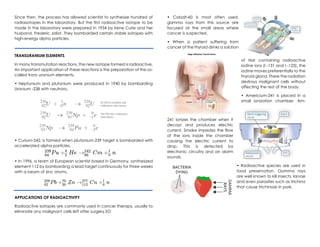
TRANSURANIUM ELEMENTS
In many transmutation reactions, the new isotope formed is radioactive.
An important application of these reactions is the preparation of the so-
called trans uranium elements.
• Neptunium and plutonium were produced in 1940 by bombarding
Uranium -238 with neutrons.
• Curium-242, is formed when plutonium-239 target is bombarded with
accelerated alpha particles.
• In 1996, a team of European scientist based in Germany, synthesized
element 112 by bombarding a lead target continuously for three weeks
with a beam of zinc atoms.
APPLICATIONS OF RADIOACTIVITY
Radioactive isotopes are commonly used in cancer therapy, usually to
eliminate any malignant cells left after surgery.SO
• Cobalt-60 is most often used,
gamma rays from this source are
focused at the small areas where
cancer is suspected.
• When a patient suffering from
cancer of the thyroid drinks a solution
of NaI containing radioactive
iodine ions (I -131 and I -123), the
iodine moves preferentially to the
thyroid gland. There the radiation
destroys malignant cells without
affecting the rest of the body.
• Americium-241 is placed in a
small ionization chamber. Am-
241 ionizes the chamber when it
decays and produces electric
current. Smoke impedes the flow
of the ions inside the chamber
causing the electric current to
drop. This is detected by
electronic circuitry and an alarm
sounds.
• Radioactive species are used in
food preservation. Gamma rays
are well known to kill insects, larvae
and even parasites such as trichina
that cause trichinosis in pork.
Lesson 10.2: Rates of Radioactive Decay
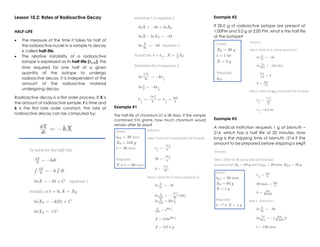
HALF-LIFE
 The measure of the time it takes for half of
the radioactive nuclei in a sample to decay
is called half-life.
 The relative instability of a radioactive
isotope is expressed as its half-life (𝒕𝟏/𝟐), the
time required for one half of a given
quantity of the isotope to undergo
radioactive decay. It is independent of the
amount of the radioactive material
undergoing decay.
Radioactive decay is a first order process. If X is
the amount of radioactive sample, t is time and
k is the first rate order constant, the rate of
radioactive decay can be computed by:
Example #1
The half-life of chromium-51 is 28 days. If the sample
contained 510 grams, how much chromium would
remain after 56 days?
Example #2
If 20.0 g of radioactive isotope are present at
1:00PM and 5.0 g at 2:00 PM, what is the half life
of the isotope?
Example #3
A medical institution requests 1 g of bismuth –
214, which has a half life of 20 minutes. How
long is the shipping time of bismuth -214 if the
amount to be prepared before shipping is 64g?
half life formula
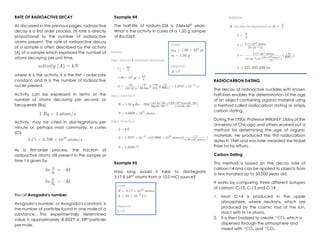
RATE OF RADIOACTIVE DECAY
As discussed in the previous pages, radioactive
decay is a first order process. Its rate is directly
proportional to the number of radioactive
atoms present. The rate of radioactive decay
of a sample is often described by the activity
(A) of a sample which expresses the number of
atoms decaying per unit time.
where A is the activity, k is the first – order rate
constant, and N is the number of radioactive
nuclei present.
Activity can be expressed in terms of the
number of atoms decaying per second, or
becquerels (Bq).
Activity, may be cited in disintegrations per
minute or, perhaps most commonly, in curies
(Ci)
As a first-order process, the fraction of
radioactive atoms still present in the sample at
time t is given by
Recall Avogadro's number:
Avogadro's number, or Avogadro's constant, is
the number of particles found in one mole of a
substance. This experimentally determined
value is approximately 6.0221 x 10²³
particles
per mole.
Example #4
The half-life of radium-226 is 1.60𝑥103
years.
What is the activity in curies of a 1.50 g sample
of Ra-226?
Example #5
How long would it take to disintegrate
3.17 𝑋 1017
atoms from a 10.0 mCi source?
RADIOCARBON DATING
The decay of radioactive nuclides with known
half-lives enables the determination of the age
of an object containing organic material using
a method called radiocarbon dating or simply
carbon dating.
During the 1950s, Professor Willard F. Libby of the
University of Chicago and others worked out a
method for determining the age of organic
materials. He produced the first radiocarbon
dates in 1949 and was later awarded the Nobel
Prize for his efforts.
Carbon Dating
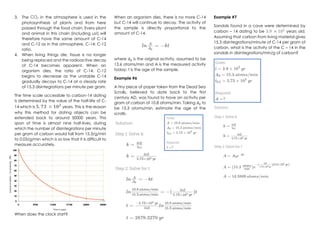
This method is based on the decay rate of
carbon-14 and can be applied to objects from
a few hundred up to 50,000 years old.
It works by comparing three different isotopes
of carbon: C-12, C-13 and C-14:
1. Most C-14 is produced in the upper
atmosphere, where neutrons, which are
produced by the cosmic rays of the sun,
react with N-14 atoms.
2. It is then oxidized to create 14
CO2 which is
dispersed through the atmosphere and
mixed with 13
CO2 and 12
CO2.
3. The CO2 in the atmosphere is used in the
photosynthesis of plants and from here
passed through the food chain. Every plant
and animal in this chain (including us!) will
therefore have the same amount of C-14
and C-12 as in the atmosphere, C-14: C-12
ratio.
4. When living things die, tissue is no longer
being replaced and the radioactive decay
of C-14 becomes apparent. When an
organism dies, the ratio of C-14: C-12
begins to decrease as the unstable C-14
gradually decays to C-14 at a steady rate
of 15.3 disintegrations per minute per gram.
The time scale accessible to carbon-14 dating
is determined by the value of the half-life of C-
14 which is 𝟓. 𝟕𝟑 × 𝟏𝟎𝟑
years. This is the reason
why this method for dating objects can be
extended back to around 50000 years. This
span of time is almost nine half-lives, during
which the number of disintegrations per minute
per gram of carbon would fall from 15.3/g/min
to 0.03/g/min which is so low that it is difficult to
measure accurately.
When does the clock start?
When an organism dies, there is no more C-14
but C-14 will continue to decay. The activity of
the sample is directly proportional to the
amount of C-14.
where 𝐴0 is the original activity, assumed to be
13.6 atoms/min and A is the measured activity
today; t is the age of the sample.
Example #6
A tiny piece of paper taken from the Dead Sea
Scrolls, believed to date back to the first
century AD, was found to have an activity per
gram of carbon of 10.8 atoms/min. Taking 𝐴0 to
be 15.3 atoms/min, estimate the age of the
scrolls.
Example #7
Sandals found in a cave were determined by
carbon – 14 dating to be 3.9 × 10²
years old.
Assuming that carbon from living material gives
15.3 disintegrations/minute of C-14 per gram of
carbon, what is the activity of the C – 14 in the
sandals in disintegrations/min/g of carbon?
Lesson 10.3: Nuclear Mass-Energy Relations
When radioactive nuclei undergo changes, there are corresponding
energy changes. The energies associated with nuclear reactions can
be considered with the aid of Einstein’s celebrated equation relating
mass and energy:
Where;
∆m = change in mass = mass of products – mass reactants (kg)
∆E = change in energy = energy products – energy reactants (J)
c = speed of light = 2.998 x 10⁸ m/s
This equation can be used to find the amount of energy that results
when matter is converted to energy.
*the change in masses can readily be calculated from a table of
nuclear masses
NUCLEAR BINDING ENERGY
We have learned that the nucleus of the atom is very small yet each
nucleus can hold up to 83 protons before becoming unstable. Protons
are all positively-charged and they repel each other. This tells us of a
very strong force that holds the nucleus together and overcomes the
electrostatic repulsive forces.
A measure of the force holding the nucleus together is the nuclear
binding energy, the energy change that occurs if the protons and
neutrons in a nucleus are completely separated.
The nucleus has a mass and the protons and neutrons have individual
masses. However, the summation of the masses of the nucleons does
not equal to the mass of the nucleus itself. The nucleus always weighs
less than the total mass of the nucleons.
This mass difference between a nucleus and its constituent nucleons is
called the mass defect. This mass defect corresponds to an energy
difference referred to as binding energy.
NUCLEAR STABILITY
If the nuclear binding energy is the energy required to separate a
nucleus into its individual nucleons, in a sense, it is also a measure of the
stability of the nucleus.
The greater the binding energy, the more difficult it would be to
decompose the nucleus into protons and neutrons. As the nucleus gets
heavier, the binding energy increases.
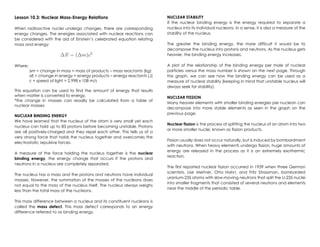
A plot of the relationship of the binding energy per mole of nuclear
particles versus the mass number is shown on the next page. Through
this graph, we can see how the binding energy can be used as a
measure of nuclear stability (keeping in mind that unstable nucleus will
always seek for stability).
NUCLEAR FISSION
Many heavier elements with smaller binding energies per nucleon can
decompose into more stable elements as seen in the graph on the
previous page.
Nuclear fission is the process of splitting the nucleus of an atom into two
or more smaller nuclei, known as fission products.
Fission usually does not occur naturally, but is induced by bombardment
with neutrons. When heavy elements undergo fission, huge amounts of
energy are released in the process as it is an extremely exothermic
reaction.
The first reported nuclear fission occurred in 1939 when three German
scientists, Lise Meitner, Otto Hahn, and Fritz Strassman, bombarded
uranium-235 atoms with slow-moving neutrons that split the U-235 nuclei
into smaller fragments that consisted of several neutrons and elements
near the middle of the periodic table.
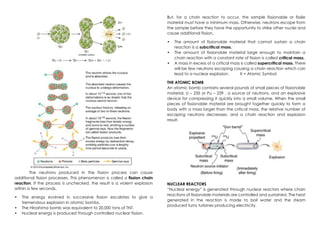
The neutrons produced in the fission process can cause
additional fission processes. This phenomenon is called a fission chain
reaction. If the process is unchecked, the result is a violent explosion
within a few seconds.
• The energy evolved in successive fission escalates to give a
tremendous explosion in atomic bombs.
• The Hiroshima bomb was equivalent to 20,000 tons of TNT.
• Nuclear energy is produced through controlled nuclear fission.
But, for a chain reaction to occur, the sample fissionable or fissile
material must have a minimum mass. Otherwise, neutrons escape from
the sample before they have the opportunity to strike other nuclei and
cause additional fission.
• The amount of fissionable material that cannot sustain a chain
reaction is a subcritical mass.
• The amount of fissionable material large enough to maintain a
chain reaction with a constant rate of fission is called critical mass.
• A mass in excess of a critical mass is called supercritical mass. There
will be few neutrons escaping causing a chain reaction which can
lead to a nuclear explosion. X = Atomic Symbol
THE ATOMIC BOMB
An atomic bomb contains several pounds of small pieces of fissionable
material, U – 235 or Pu – 239 , a source of neutrons, and an explosive
device for compressing it quickly into a small volume. When the small
pieces of fissionable material are brought together quickly to form a
body with a mass larger than the critical mass, the relative number of
escaping neutrons decreases, and a chain reaction and explosion
result.
NUCLEAR REACTORS
“Nuclear energy” is generated through nuclear reactors where chain
reactions of fissionable materials are controlled and sustained. The heat
generated in the reaction is made to boil water and the steam
produced turns turbines producing electricity.
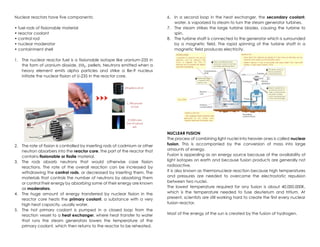
Nuclear reactors have five components:
• fuel rods of fissionable material
• reactor coolant
• control rod
• nuclear moderator
• containment shell
1. The nuclear reactor fuel is a fissionable isotope like uranium-235 in
the form of uranium dioxide, 𝑈𝑂2, pellets. Neutrons emitted when a
heavy element emits alpha particles and strike a Be-9 nucleus
initiate the nuclear fission of U-235 in the reactor core.
2. The rate of fission is controlled by inserting rods of cadmium or other
neutron absorbers into the reactor core, the part of the reactor that
contains fissionable or fissile material.
3. The rods absorb neutrons that would otherwise case fission
reactions. The rate of the overall reaction can be increased by
withdrawing the control rods, or decreased by inserting them. The
materials that controls the number of neutrons by absorbing them
or control their energy by absorbing some of their energy are known
as moderators.
4. The huge amount of energy transferred by nuclear fission in the
reactor core heats the primary coolant, a substance with a very
high heat capacity, usually water.
5. The hot primary coolant is pumped in a closed loop from the
reaction vessel to a heat exchanger, where heat transfer to water
that runs the steam generators lowers the temperature of the
primary coolant, which then returns to the reactor to be reheated.
6. In a second loop in the heat exchanger, the secondary coolant,
water, is vaporized to steam to turn the steam generator turbines.
7. The steam strikes the large turbine blades, causing the turbine to
spin.
8. The turbine shaft is connected to the generator which is surrounded
by a magnetic field. The rapid spinning of the turbine shaft in a
magnetic field produces electricity.
NUCLEAR FUSION
The process of combining light nuclei into heavier ones is called nuclear
fusion. This is accompanied by the conversion of mass into large
amounts of energy.
Fusion is appealing as an energy source because of the availability of
light isotopes on earth and because fusion products are generally not
radioactive.
It is also known as thermonuclear reaction because high temperatures
and pressures are needed to overcome the electrostatic repulsion
between two nuclei.
The lowest temperature required for any fusion is about 40,000,000K,
which is the temperature needed to fuse deuterium and tritium. At
present, scientists are still working hard to create the first every nuclear
fusion reactor.
Most of the energy of the sun is created by the fusion of hydrogen.

LESSON-10-COMPILATION.pdf

  • 1.
    Lesson 10.1: NuclearChemistry Nuclear Chemistry - The branch of chemistry which deals with the study of the composition of atomic nucleus, nuclear forces, nuclear reactions and radioactive materials is called nuclear chemistry. ATOMIC STRUCTURE the atom is made up of three subatomic particles: electron (𝑒− ), proton (𝑝+ ), and neutron (𝑛0 ). The positive-charged protons and electrically neutral neutrons are located inside the nucleus of the atom. They are collectively called nucleons. Each proton has one positive charge so each nucleus has a positive charge equal to the number of protons that it has. The term nuclide is used to refer to a single type of nucleus and is identified using the notation, 𝑋 𝑍 𝐴 . Where; A = Mass Number (No. of protons and neutrons) Z = Atomic Number (No. of Protons) X = Atomic Symbol The atomic number (Z) of an element gives the number of protons in the nucleus of the atom, and the mass number (A) gives the sum of the number of protons and neutrons. 𝐴 = 𝑍 + 𝑛0 ISOTOPE Atoms of the same element with the same atomic number but different mass numbers are called isotopes. This means that the atoms have the same number of protons but have different number of neutrons. Isotopes of different elements are distinguished by their mass numbers and their nuclides are also denoted by the symbol 𝑋 𝑍 𝐴 or by using the name or symbol of the element followed by a hyphen and the mass number. Notations of Isotopes Instead of 𝐶 6 14 , we use carbon−14 or C−14 FORCES IN THE NUCLEUS There are two forces which act upon the nucleons to produce the nuclear structure. 1. The electrostatic force is the force that causes opposite electrical charges to attract each other and the like charges to repel each other. The positively-charged protons in the nucleus of an atom have electrostatic forces acting on them - pushing them apart. 2. The strong nuclear force or simply strong force is the force that holds the nucleons together. It acts between any two or more nucleons and is always attractive. Deals with the nucleus, forces, reactions, and radioactivity protons protons + neutrons only neutrons will change and protons is unaffected reverse proton proton
  • 2.
    IMPORTANCE OF NEUTRONS Allnucleons, both protons and neutrons, attract one another by the strong nuclear force. Only protons repel one another by the electrostatic force. Despite the strong repulsive electrostatic forces among protons, all nucleons remain bound and intact in the dense nucleus because of the strong nuclear force. However, this strong nuclear force acts and works only on subatomic particles that are extremely close to each other. Small Nucleus In a small nucleus, the particles are close together so that the strong force holds the protons and neutrons tightly together. Large Nucleus In a large nucleus, the strong force holds together only the particles that are closest to one another. Since there are many protons in a large nucleus, the electric force repels protons that are far apart. This increased repulsive force causes particles in a large nucleus to be held less tightly than those in a small nucleus. The presence of neutrons adds an attractive force within the nucleus due to the fact that there are repulsive forces among protons but there are only attractive forces between neutrons and between protons and neutrons. This means that neutrons are important to balance the electrostatic and strong nuclear forces in a nucleus. RADIOACTIVITY - Radioactivity is the result of a natural change of a radioactive isotope of one element into an isotope of a different element. The nucleus of an atom is considered stable if the forces among the particles that makeup the nucleus are balanced. It is unstable if these forces are unbalanced. Nuclei that are unstable exhibit radioactivity and are called radioactive nuclides or radionuclides. Atoms containing these radionuclides are called radioisotopes. They occur either naturally or artificially prepared in the laboratory. The instability of the nucleus of an atom may result from an excess of either neutrons or protons. It will seek or attempt to reach stability by undergoing radioactive decay. In this process, the unstable nucleus breaks apart, is converted to a more stable isotope, emits nucleons and nuclear radiation and releases energy in other forms. The unstable nuclide that undergoes decay is called the parent nucleus and the more stable nuclide produced is called the daughter nucleus. The daughter nucleus could already be stable or may still be unstable which would undergo further decay. Radioactive decay will only stop if the daughter nucleus is already stable. parent nucleus is more unstable than the daughter nucleus
  • 3.
    NUCLEAR STABILITY A stable(nonradioactive) nucleus does not undergo radioactive decay, therefore, cannot be transformed into another isotope without adding energy from outside. Of the thousands of nuclides that exist, only about 250 are stable. The stability of a nucleus depends on the balance between the repulsive electrostatic forces and attractive strong forces and, therefore, depends on the ratio of the number of neutrons and protons in a nucleus. A plot of the number of neutrons versus the number of protons for stable nuclei reveals that the stable isotopes fall into a narrow band called the belt of stability. When a radionuclide undergoes decay, it releases radiation in such a way that the daughter nucleus produced lies closer to the band of stability than the par ent nucleus. Therefore, the kind of decay that a radionuclide will undergo can be predicted depending on its location relative to the band of stability. Based on the belt of stability, we can interpret that: 1. Nuclei containing more than 83 protons are unstable. In other words, no element beyond bismuth has a stable isotope. 2. Nuclei with an even number of nucleons, either proton or neutron, tend to be more stable than those with an odd number of nuclear particles. 3. Certain number of protons or neutrons show exceptional stability: 2, 8, 20, 28, 50, 82, 126. NUCLEAR REACTIONS Chemical changes in matter that originate in the nucleus of an atom are called nuclear reactions or transmutations. These reactions involve changes of nuclei that result in changes in their atomic numbers, mass numbers, or energy states. In a chemical change, the atoms in molecules and ions are rearranged, but atoms are neither created nor destroyed: The number of atoms remains the same. In a nuclear reaction, the total number of nucleons remains the same. During a nuclear reaction, one nucleon can change into a different nucleon along with the release of energy. A proton can change to a neutron or a neutron can change to a proton, but the total number of nucleons remains the same. To describe a nuclear reaction, a balanced nuclear equation is used to reflect all the nuclides involved in the reaction, their mass numbers and atomic numbers, and the other particles involved in the reaction. Nuclear reactions also follow the law of conservation and are balanced in two ways: • the sum of the mass numbers of reacting nuclei must equal the sum of the mass numbers of the nuclei produced • the sum of the atomic numbers of the products must equal the sum of the atomic number of the reactants end bismuth and starting polonium helium, oxygen, calcium, nickel, tin, lead, atomic number 126 beta decay
  • 4.
    ALPHA DECAY Alpha decayis the emission of an alpha particle, 𝐻𝑒 2 4 or α 2 4 , from the nucleus. This causes a decrease in the mass number by 4 and in the atomic number by 2. This mode of decay occurs chiefly among heavier elements. Alpha decay is the least dangerous of all modes of decay. Alpha particles are not very penetrating and can only travel a few centimeters in air since they are relatively heavy. Alpha particles cannot pass through a sheet of paper or a thin layer of clothing. They can burn the skin but cannot penetrate the tissues underneath the skin. BETA DECAY Beta decay is the emission a beta particle, 𝑒 −1 0 or 𝛽 −1 0 from an unstable atomic nucleus which has an excess number of neutrons. When a beta particle is emitted, a neutron is converted into a proton. In a beta decay, therefore, there is no change in the mass number but the atomic number increases by 1. Beta radiation is harmful to living things. Beta particles can travel about a meter through air, pass through a sheet of paper or a layer of cloth but not through a sheet of aluminum or a few centimeters of wood. They can penetrate the skin and damage underlying tissues. They are even more harmful if they are ingested or inhaled. GAMMA DECAY Gamma decay occurs when a nucleus is in an excited state and has too much energy to be stable. This usually happens after an alpha or beta decay. Gamma rays do not have mass and charge. During gamma decay, only energy is emitted so there are no changes in the number of protons and neutrons of the nucleus undergoing the decay. Gamma rays are the most dangerous type of radiation. They can travel farther and penetrate materials more deeply than can the charged particles emitted during alpha and beta decay. Gamma rays can be stopped by several centimeters of lead or several meters of concrete. Naturally, it can penetrate and damage cells deep inside the body. POSITRON DECAY Positron emission is the decay which involves the emission of a particle that is identical to an electron but with a charge of +1 instead of –1, the positron. This mode of decay is characteristic of radionuclides that have too many protons for stability. It has an effect of converting a proton to a neutron, thereby decreasing the atomic number by 1. ELECTRON CAPTURE K-electron capture or simply electron capture is the decay in which an electron in the innermost energy level (hence, the “k”) falls into the nucleus. Because the electron is consumed rather than formed in the process, it is shown in the reactants side of the reaction. It is more common with heavy nuclei and just like positron emission, has the effect of converting a proton to a neutron. ARTIFICIAL TRANSMUTATIONS Along with naturally occurring radioactive species are those that are synthetically radioactive. Radioactivity of this type is called artificial radioactivity. To date, there are more than 1500 radioactive isotopes prepared in the laboratory this way. The process of preparing a synthetic radioisotope is called a bombardment reaction in which a stable nucleus is converted to one that is radioactive by bombarding it with a particle. In the bombardment process, the particle that is to bombard the nucleus must move very fast to penetrate the nucleus. They have to be accelerated so that they would overcome the electrostatic repulsion between them and the target nucleus. The instrument used in the process is called a particle accelerator, popularly “atom smashers” where small alternating voltages are used to increase the energy of the particle. The first manmade nucleus was produced in Ernest Rutherford’s laboratory in 1919 by the bombardment of one type of nuclei with other nuclei or with neutrons. Rutherford bombarded nitrogen atoms with high-speed α particles from a natural radioactive isotope of radium and observed protons resulting from the reaction: but atomic mass has no change
  • 5.
    Since then, theprocess has allowed scientist to synthesize hundred of radioisotopes in the laboratory. But the first radioactive isotope to be made in the laboratory were prepared in 1934 by Irene Curie and her husband, Frederic Joliot. They bombarded certain stable isotopes with high-energy alpha particles. TRANSURANIUM ELEMENTS In many transmutation reactions, the new isotope formed is radioactive. An important application of these reactions is the preparation of the so- called trans uranium elements. • Neptunium and plutonium were produced in 1940 by bombarding Uranium -238 with neutrons. • Curium-242, is formed when plutonium-239 target is bombarded with accelerated alpha particles. • In 1996, a team of European scientist based in Germany, synthesized element 112 by bombarding a lead target continuously for three weeks with a beam of zinc atoms. APPLICATIONS OF RADIOACTIVITY Radioactive isotopes are commonly used in cancer therapy, usually to eliminate any malignant cells left after surgery.SO • Cobalt-60 is most often used, gamma rays from this source are focused at the small areas where cancer is suspected. • When a patient suffering from cancer of the thyroid drinks a solution of NaI containing radioactive iodine ions (I -131 and I -123), the iodine moves preferentially to the thyroid gland. There the radiation destroys malignant cells without affecting the rest of the body. • Americium-241 is placed in a small ionization chamber. Am- 241 ionizes the chamber when it decays and produces electric current. Smoke impedes the flow of the ions inside the chamber causing the electric current to drop. This is detected by electronic circuitry and an alarm sounds. • Radioactive species are used in food preservation. Gamma rays are well known to kill insects, larvae and even parasites such as trichina that cause trichinosis in pork.
  • 6.
    Lesson 10.2: Ratesof Radioactive Decay HALF-LIFE  The measure of the time it takes for half of the radioactive nuclei in a sample to decay is called half-life.  The relative instability of a radioactive isotope is expressed as its half-life (𝒕𝟏/𝟐), the time required for one half of a given quantity of the isotope to undergo radioactive decay. It is independent of the amount of the radioactive material undergoing decay. Radioactive decay is a first order process. If X is the amount of radioactive sample, t is time and k is the first rate order constant, the rate of radioactive decay can be computed by: Example #1 The half-life of chromium-51 is 28 days. If the sample contained 510 grams, how much chromium would remain after 56 days? Example #2 If 20.0 g of radioactive isotope are present at 1:00PM and 5.0 g at 2:00 PM, what is the half life of the isotope? Example #3 A medical institution requests 1 g of bismuth – 214, which has a half life of 20 minutes. How long is the shipping time of bismuth -214 if the amount to be prepared before shipping is 64g? half life formula
  • 7.
    RATE OF RADIOACTIVEDECAY As discussed in the previous pages, radioactive decay is a first order process. Its rate is directly proportional to the number of radioactive atoms present. The rate of radioactive decay of a sample is often described by the activity (A) of a sample which expresses the number of atoms decaying per unit time. where A is the activity, k is the first – order rate constant, and N is the number of radioactive nuclei present. Activity can be expressed in terms of the number of atoms decaying per second, or becquerels (Bq). Activity, may be cited in disintegrations per minute or, perhaps most commonly, in curies (Ci) As a first-order process, the fraction of radioactive atoms still present in the sample at time t is given by Recall Avogadro's number: Avogadro's number, or Avogadro's constant, is the number of particles found in one mole of a substance. This experimentally determined value is approximately 6.0221 x 10²³ particles per mole. Example #4 The half-life of radium-226 is 1.60𝑥103 years. What is the activity in curies of a 1.50 g sample of Ra-226? Example #5 How long would it take to disintegrate 3.17 𝑋 1017 atoms from a 10.0 mCi source? RADIOCARBON DATING The decay of radioactive nuclides with known half-lives enables the determination of the age of an object containing organic material using a method called radiocarbon dating or simply carbon dating. During the 1950s, Professor Willard F. Libby of the University of Chicago and others worked out a method for determining the age of organic materials. He produced the first radiocarbon dates in 1949 and was later awarded the Nobel Prize for his efforts. Carbon Dating This method is based on the decay rate of carbon-14 and can be applied to objects from a few hundred up to 50,000 years old. It works by comparing three different isotopes of carbon: C-12, C-13 and C-14: 1. Most C-14 is produced in the upper atmosphere, where neutrons, which are produced by the cosmic rays of the sun, react with N-14 atoms. 2. It is then oxidized to create 14 CO2 which is dispersed through the atmosphere and mixed with 13 CO2 and 12 CO2.
  • 8.
    3. The CO2in the atmosphere is used in the photosynthesis of plants and from here passed through the food chain. Every plant and animal in this chain (including us!) will therefore have the same amount of C-14 and C-12 as in the atmosphere, C-14: C-12 ratio. 4. When living things die, tissue is no longer being replaced and the radioactive decay of C-14 becomes apparent. When an organism dies, the ratio of C-14: C-12 begins to decrease as the unstable C-14 gradually decays to C-14 at a steady rate of 15.3 disintegrations per minute per gram. The time scale accessible to carbon-14 dating is determined by the value of the half-life of C- 14 which is 𝟓. 𝟕𝟑 × 𝟏𝟎𝟑 years. This is the reason why this method for dating objects can be extended back to around 50000 years. This span of time is almost nine half-lives, during which the number of disintegrations per minute per gram of carbon would fall from 15.3/g/min to 0.03/g/min which is so low that it is difficult to measure accurately. When does the clock start? When an organism dies, there is no more C-14 but C-14 will continue to decay. The activity of the sample is directly proportional to the amount of C-14. where 𝐴0 is the original activity, assumed to be 13.6 atoms/min and A is the measured activity today; t is the age of the sample. Example #6 A tiny piece of paper taken from the Dead Sea Scrolls, believed to date back to the first century AD, was found to have an activity per gram of carbon of 10.8 atoms/min. Taking 𝐴0 to be 15.3 atoms/min, estimate the age of the scrolls. Example #7 Sandals found in a cave were determined by carbon – 14 dating to be 3.9 × 10² years old. Assuming that carbon from living material gives 15.3 disintegrations/minute of C-14 per gram of carbon, what is the activity of the C – 14 in the sandals in disintegrations/min/g of carbon?
  • 9.
    Lesson 10.3: NuclearMass-Energy Relations When radioactive nuclei undergo changes, there are corresponding energy changes. The energies associated with nuclear reactions can be considered with the aid of Einstein’s celebrated equation relating mass and energy: Where; ∆m = change in mass = mass of products – mass reactants (kg) ∆E = change in energy = energy products – energy reactants (J) c = speed of light = 2.998 x 10⁸ m/s This equation can be used to find the amount of energy that results when matter is converted to energy. *the change in masses can readily be calculated from a table of nuclear masses NUCLEAR BINDING ENERGY We have learned that the nucleus of the atom is very small yet each nucleus can hold up to 83 protons before becoming unstable. Protons are all positively-charged and they repel each other. This tells us of a very strong force that holds the nucleus together and overcomes the electrostatic repulsive forces. A measure of the force holding the nucleus together is the nuclear binding energy, the energy change that occurs if the protons and neutrons in a nucleus are completely separated. The nucleus has a mass and the protons and neutrons have individual masses. However, the summation of the masses of the nucleons does not equal to the mass of the nucleus itself. The nucleus always weighs less than the total mass of the nucleons. This mass difference between a nucleus and its constituent nucleons is called the mass defect. This mass defect corresponds to an energy difference referred to as binding energy. NUCLEAR STABILITY If the nuclear binding energy is the energy required to separate a nucleus into its individual nucleons, in a sense, it is also a measure of the stability of the nucleus. The greater the binding energy, the more difficult it would be to decompose the nucleus into protons and neutrons. As the nucleus gets heavier, the binding energy increases. A plot of the relationship of the binding energy per mole of nuclear particles versus the mass number is shown on the next page. Through this graph, we can see how the binding energy can be used as a measure of nuclear stability (keeping in mind that unstable nucleus will always seek for stability). NUCLEAR FISSION Many heavier elements with smaller binding energies per nucleon can decompose into more stable elements as seen in the graph on the previous page. Nuclear fission is the process of splitting the nucleus of an atom into two or more smaller nuclei, known as fission products. Fission usually does not occur naturally, but is induced by bombardment with neutrons. When heavy elements undergo fission, huge amounts of energy are released in the process as it is an extremely exothermic reaction. The first reported nuclear fission occurred in 1939 when three German scientists, Lise Meitner, Otto Hahn, and Fritz Strassman, bombarded uranium-235 atoms with slow-moving neutrons that split the U-235 nuclei into smaller fragments that consisted of several neutrons and elements near the middle of the periodic table.
  • 10.
    The neutrons producedin the fission process can cause additional fission processes. This phenomenon is called a fission chain reaction. If the process is unchecked, the result is a violent explosion within a few seconds. • The energy evolved in successive fission escalates to give a tremendous explosion in atomic bombs. • The Hiroshima bomb was equivalent to 20,000 tons of TNT. • Nuclear energy is produced through controlled nuclear fission. But, for a chain reaction to occur, the sample fissionable or fissile material must have a minimum mass. Otherwise, neutrons escape from the sample before they have the opportunity to strike other nuclei and cause additional fission. • The amount of fissionable material that cannot sustain a chain reaction is a subcritical mass. • The amount of fissionable material large enough to maintain a chain reaction with a constant rate of fission is called critical mass. • A mass in excess of a critical mass is called supercritical mass. There will be few neutrons escaping causing a chain reaction which can lead to a nuclear explosion. X = Atomic Symbol THE ATOMIC BOMB An atomic bomb contains several pounds of small pieces of fissionable material, U – 235 or Pu – 239 , a source of neutrons, and an explosive device for compressing it quickly into a small volume. When the small pieces of fissionable material are brought together quickly to form a body with a mass larger than the critical mass, the relative number of escaping neutrons decreases, and a chain reaction and explosion result. NUCLEAR REACTORS “Nuclear energy” is generated through nuclear reactors where chain reactions of fissionable materials are controlled and sustained. The heat generated in the reaction is made to boil water and the steam produced turns turbines producing electricity.
  • 11.
    Nuclear reactors havefive components: • fuel rods of fissionable material • reactor coolant • control rod • nuclear moderator • containment shell 1. The nuclear reactor fuel is a fissionable isotope like uranium-235 in the form of uranium dioxide, 𝑈𝑂2, pellets. Neutrons emitted when a heavy element emits alpha particles and strike a Be-9 nucleus initiate the nuclear fission of U-235 in the reactor core. 2. The rate of fission is controlled by inserting rods of cadmium or other neutron absorbers into the reactor core, the part of the reactor that contains fissionable or fissile material. 3. The rods absorb neutrons that would otherwise case fission reactions. The rate of the overall reaction can be increased by withdrawing the control rods, or decreased by inserting them. The materials that controls the number of neutrons by absorbing them or control their energy by absorbing some of their energy are known as moderators. 4. The huge amount of energy transferred by nuclear fission in the reactor core heats the primary coolant, a substance with a very high heat capacity, usually water. 5. The hot primary coolant is pumped in a closed loop from the reaction vessel to a heat exchanger, where heat transfer to water that runs the steam generators lowers the temperature of the primary coolant, which then returns to the reactor to be reheated. 6. In a second loop in the heat exchanger, the secondary coolant, water, is vaporized to steam to turn the steam generator turbines. 7. The steam strikes the large turbine blades, causing the turbine to spin. 8. The turbine shaft is connected to the generator which is surrounded by a magnetic field. The rapid spinning of the turbine shaft in a magnetic field produces electricity. NUCLEAR FUSION The process of combining light nuclei into heavier ones is called nuclear fusion. This is accompanied by the conversion of mass into large amounts of energy. Fusion is appealing as an energy source because of the availability of light isotopes on earth and because fusion products are generally not radioactive. It is also known as thermonuclear reaction because high temperatures and pressures are needed to overcome the electrostatic repulsion between two nuclei. The lowest temperature required for any fusion is about 40,000,000K, which is the temperature needed to fuse deuterium and tritium. At present, scientists are still working hard to create the first every nuclear fusion reactor. Most of the energy of the sun is created by the fusion of hydrogen.