GHC@copyright
G. H. CHEN
Department of Chemistry
University of Hong Kong
Intermediate Physical Chemistry
GHC@copyright
Intermediate Physical Chemistry
Contents:
Distribution of Molecular States
Perfect Gas
Fundamental Relations
Diatomic Molecular Gas
GHC@copyright
Distribution of Molecular States
Configurations and Weights
Boltzmann Distribution, and Physical
Meanings of 
Molecular Partition Function and its
Interpretation
The Internal Energy and the Entropy
Independent Molecular and their
Partition Function
GHC@copyright
Perfect Gas
Partition Function
Energy
Heat Capacity
Pressure and the gas law
GHC@copyright
Diatomic Molecular Gas
Factorization of Partition Function
Rotational Partition Function
Vibrational Partition Function
Electronic Partition Function
Mean Energy and Heat Capacity
GHC@copyright
Fundamental Relations
Helmholtz Energy
Pressure
Enthalpy
Gibbs Energy
GHC@copyright
Statistical Mechanics provides the link between the
microscopic properties of matter and its bulk
properties.
Statistical Mechanics:
GHC@copyright
THE DISTRIBUTION OF MOLECULAR STATES
Consider a system composed of N molecules,
and its total energy E is a constant. These
molecules are independent, i.e. no interactions
exist among the molecules. Countless collisions
occur. It is hopeless to keep track positions,
momenta, and internal energies of all molecules.
GHC@copyright
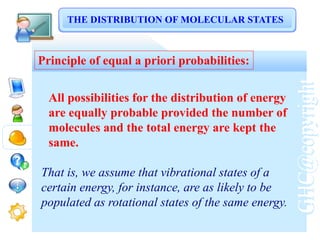
Principle of equal a priori probabilities:
All possibilities for the distribution of energy
are equally probable provided the number of
molecules and the total energy are kept the
same.
That is, we assume that vibrational states of a
certain energy, for instance, are as likely to be
populated as rotational states of the same energy.
THE DISTRIBUTION OF MOLECULAR STATES
GHC@copyright
For instance, four molecules in a three-level
system: the following two conformations have
the same probability.
---------l-l-------- 2 ---------l--------- 2
---------l----------  ---------1-1-1---- 
---------l---------- 0 ------------------- 0
THE DISTRIBUTION OF MOLECULAR STATES
GHC@copyright
Configurations and Weights
Imagine that there are total N molecules among
which n0 molecules with energy 0, n1 with
energy 1, n2 with energy 2, and so on, where 0
< 1 < 2 < .... are the energies of different states.
The specific distribution of molecules is called
configuration of the system, denoted as { n0, n1,
n2, ......}
THE DISTRIBUTION OF MOLECULAR STATES
GHC@copyright
For instance, a system with 17 molecules,
and each molecule has four states.
1
2
3
4
5
6
7
8
9
10
11
12
13
14
15
16 17
1
2
3
4
STATE
The above configuration is thus, { 4, 6, 4, 3 }
THE DISTRIBUTION OF MOLECULAR STATES
GHC@copyright
{N, 0, 0, ......} corresponds that every molecule
is in the ground state, there is only one way to
achieve this configuration; {N-2, 2, 0, ......}
corresponds that two molecule is in the first
excited state, and the rest in the ground state,
and can be achieved in N(N-1)/2 ways.
A configuration { n0, n1, n2, ......} can be achieved in W
different ways, where W is called the weight of the
configuration. And W can be evaluated as follows,
W = N! / (n0! n1! n2! ...)
THE DISTRIBUTION OF MOLECULAR STATES
GHC@copyright
Justification
1. N! different ways to arrange N molecules;
2. ni! arrangements of ni molecules with energy i
correspond to the same configuration;
THE DISTRIBUTION OF MOLECULAR STATES
GHC@copyright
1. Calculate the number of ways of distributing
3 objects a, b and c into two boxes with the
arrangement {1, 2}.
Answer:
| a | b c |, | b | c a |, | c | a b |.
Therefore, there are three ways 3! / 1! 2!
Example:
THE DISTRIBUTION OF MOLECULAR STATES
| a | c b |, | b | a c |, | c | b a |
To eliminate overcounting of these configurations
GHC@copyright
2. Calculate the number of ways of distributing
20 objects into six boxes with the
arrangement {1, 0, 3, 5, 10, 1}.
Answer:
20! / 1! 0! 3! 5! 10! 1! = 931170240
note: 0! = 1
Example:
THE DISTRIBUTION OF MOLECULAR STATES
GHC@copyright
Stirlings Approximation:
When x is large, ln x!  x ln x - x
x ln x! x ln x - x ln A
1 0.000 -1.000 0.081
2 0.693 -0.614 0.652
4 3.178 1.545 3.157
6 6.579 4.751 6.566
8 10.605 8.636 10.595
10 15.104 13.026 15.096
THE DISTRIBUTION OF MOLECULAR STATES
Note: A = (2)1/2 (x+1/2)x e-x
GHC@copyright
Therefore,
ln W  ( N ln N - N ) -  ( ni ln ni - ni )
= N ln N -  ni ln ni
x ln x! x ln x - x ln A
12 19.987 17.819 19.980
16 30.672 28.361 30.666
20 42.336 39.915 42.332
30 74.658 72.036 74.656
Stirlings approximation(cont’d):
THE DISTRIBUTION OF MOLECULAR STATES
GHC@copyright
The Dominating Configuration
Imagine that N molecules distribute among
two states. {N, 0}, {N-1, 1}, ..., {N-k, k}, ... ,
{1, N-1}, {0, N} are possible configurations,
and their weights are 1, N, ... , N! / (N-k)! k!,
... , N, 1, respectively. For instance, N=8, the
weight distribution is then
GHC@copyright
0 1 2 3 4 5 6 7 8
0
20
40
60 N = 8
W
k
The Dominating Configuration
GHC@copyright
0 1 2 3 4 5 6 7 8 9 10111213141516
0
2000
4000
6000
8000
10000
12000
N =16
W
k
The Dominating Configuration
GHC@copyright
0 4 8 12 16 20 24 28 32
0.00E+000
1.00E+008
2.00E+008
3.00E+008
4.00E+008
5.00E+008
6.00E+008
N = 32
k
The Dominating Configuration
GHC@copyright
When N is even, the weight is maximum at k = N/2,
i.e.
Wk=N/2 = N! / [N/2)!]2.
When N is odd, the maximum is at k = N/2  1
As N increases, the maximum becomes sharper!
The weight for k = N/4 is
Wk=N/4 = N! / [(N/4)! (3N/4)!]
The Dominating Configuration
GHC@copyright
| N | 4 | 8 | 16 | 32 | 256 | 6.0 x 10²³
|R(N) | 1.5 | 2.5 | 7.1 | 57.1 | 3.5 x 10¹⁴ | 2.6 x 10³e+22
Therefore, for a macroscopic molecular system
( N ~ 1023 ), there are dominating configurations
so that the system is almost always found in or
near the dominating configurations, i.e. Equilibrium
The ratio of the two weights is equal to
R(N) Wk=N/2 / Wk=N/4
=(N/4)! (3N/4)! / [(N/2)!]2
The Dominating Configuration
If the system has more states, would we reach the same
conclusion as above? Why?
GHC@copyright
1. The total energy is a constant, i.e.
 ni i = E = constant
2. The total number of molecules is conserved,
i.e.
 ni = N = constant
How to maximize W or lnW under
these constraints?
Two constraints for the system
GHC@copyright
The Boltzmann Distribution
ni / N = Pi = exp ( - i )
Interpretation of Boltzmann Distribution
Meaning of : ensure total probability is ONE
1 = i ni / N = i exp( -i)
exp( ) = 1 / i exp(-i)
 = - ln [i exp(-i)]
1 /  = kT
GHC@copyright
Starting from the principle of equal a priori
probabilities, we evaluate the probabilities of
different configurations by simple counting,
and find that the dominating configuration
whose population obeys the Boltzmann
distribution which relates the macroscopic
observables to the microscopic molecular
properties, and is capable of explaining the
equilibrium properties of all materials.
The Boltzmann Distribution
Summary
GHC@copyright
To find the most important configuration, we vary { ni } to
seek the maximum value of W. But how?
E.g. One-Dimensional Function: F(x) = x2
dF/dx = 0
The Dominating Configuration
Enough?
GHC@copyright
Two-Dimensional Case: for instance, finding the
minimum point of the surface of a half water
melon F(x,y).
F/x = 0,
F/y = 0.
Multi-Dimensional Function: F(x1, x2, …, xn)
F/xi = 0, i = 1,2,…,n
To find the maximum value of W or lnW,
 lnW / ni = 0, i=1,2,3,...
The Dominating Configuration
GHC@copyright
Let’s investigate the water melon’s surface:
cutting the watermelon
how to find the minimum or maximum
of F(x, y) under a constraint x = a ?
L = F(x, y) -  x
 L /  x = 0
 L /  y = 0
x = a
The method of Lagrange Multipliers
GHC@copyright
Generally, to minimize or maximize a function
F(x1, x2, …, xn) under constraints,
C1(x1, x2, …, xn) = Constant1
C2(x1, x2, …, xn) = Constant2
.
.
.
Cm(x1, x2, …, xn) = Constantm
L = F(x1, x2, …, xn) - i iCi(x1, x2, …, xn)
L/xi = 0, i=1,2, ..., n
The Dominating Configuration
The method of Lagrange Multipliers
GHC@copyright
JUSTIFICATION
dL = dF - i i dCi
under the constraints, dCi = 0, thus
dF = 0
i.e., F is at its maximum or minimum.
The Dominating Configuration
The method of Lagrange Multipliers
GHC@copyright
The method of Lagrangian Multiplier
Procedure
Construct a new function L,
L = lnW +  i ni -  i ni i
Finding the maximum of L by varying { ni }, 
and  is equivalent to finding the maximum of
W under the two constraints, i.e.,
L/ni = lnW/ni +  -i = 0
GHC@copyright
Since
ln W  ( N ln N - N ) - i ( ni ln ni - ni )
= N ln N - i ni ln ni
lnW/ni = (N ln N)/ni - (ni ln ni)/ ni
= - ln (ni/N)
Therefore,
ln (ni / N) +  -i = 0
ni / N = exp( -i)
The method of Lagrangian Multiplier
GHC@copyright
Therefore, E = N <  > = 3N/2, where <  > is
the average kinetic energy of a molecule.
Therefore,
<  > = <mv2/2> = 3/2.
On the other hand, according to the Maxwell
distribution of speed, the average kinetic energy
of a molecule at an equilibrium,
The Boltzmann Distribution
GHC@copyright
This is the physical meaning of , the reciprocal
temperature.
1 /  = kT
where k is the Boltzmann constant. Thus,
<mv2>/2 = 3kT/2
(This is actually the definition of the temperature)
The Boltzmann Distribution
GHC@copyright
Two friends A and B are drinking beer in a pub one
night. Out of boredom, the two start to play
“fifteen-twenty”. A mutual friend C steps in, and the
three play together. Of course, this time one hand is
used by each. A is quite smart, and studies chemistry
in HKU. He figures out a winning strategy. Before
long, B and C are quite drunk while A is still pretty
much sober. Now, what is A’s winning strategy?
When A plays with B and try the same strategy, he
finds that the strategy is not as successful. Why?
Example 1:
The Boltzmann Distribution
GHC@copyright
Example 2:
Consider a molecular whose ground state energy is
-10.0 eV, the first excited state energy -9.5 eV, the
second excited state energy -1.0 eV, and etc.
Calculate the probability of finding the molecule in
its first excited state T = 300, 1000, and 5000 K.
The Boltzmann Distribution
GHC@copyright
The summation is over all possible states
(not the energy levels).
If the energy level is gi-fold degenerate, then the
molecular partition function can be rewritten as
The Molecular Partition Function
The Boltzmann distribution can be written as
pi = exp(-i) / q
where pi is the probability of a molecule being found
in a state i with energy i. q is called the molecular
partition function,
q = i exp(-i)
q = i gi exp(-i)
GHC@copyright
As T  0, q  g0,
i.e. at T = 0, the partition function is equal to the
degeneracy of the ground state.
As T  , q  the total number of states.
Therefore, the molecular partition function gives an
indication of the average number of states that are
thermally accessible to a molecule at the temperature of
the system. The larger the value of the partition function
is, the more the number of thermally accessible states is.
The relationship between q and :
exp() = q-1
Interpretation of the partition function
GHC@copyright
Consider a proton in a magnetic field B. The proton’s
spin (S=1/2) has two states: spin parallel to B and spin
anti-parallel to B. The energy difference between the
two states is  = pB where p is proton’s magneton.
Calculate the partition function q of the proton.
The Boltzmann Distribution
Example 3
Example 4
Calculate the partition function for a uniform ladder
of energy levels
Calculate the proportion of I2 molecules in their ground,
first excited, and second excited vibrational states at
25oC. The vibrational wavenumber is 214.6 cm-1.
Example 5
GHC@copyright
Partition function contains all the thermodynamic
information!
Statistical Thermodynamics
The Internal Energy, the Heat Capacity & the Entropy
The relation between U and q
If we set the ground state energy 0 to zero, E
should be interpreted as the relative energy to
the internal energy of the system at T = 0,
E = i ni i = i Nexp(-i) i / q = - Ndlnq/d.
GHC@copyright
Therefore, the internal energy U may be expressed as
The Internal Energy, the Heat Capacity & the Entropy
Statistical Thermodynamics
U = U(0) + E = U(0) - N (lnq/)V
Where, U(0) is the internal energy of the system at
T = 0. The above equation provides the energy as
a function of various properties of the molecular
system (for instance, temperature, volume), and
may be used to evaluate the internal energy.
GHC@copyright
Statistical Thermodynamics
The relation between CV and q
Cv is the constant-volume heat capacity which measures
the ability of a system to store energy. It is defined as the
rate of internal energy change as the temperature T
varies while the volume is kept constant:
Cv  (U/T)V = N(1/kT2) (2lnq/2)V
Note that, d/dT = (d/dT) d/d = -(1/kT2) d/d
GHC@copyright
Example 6:
Calculate the constant-volume heat capacity of a
monatomic gas assuming that the gas is an ideal gas.
U = U(0) + 3N / 2 = U(0) + 3NkT / 2
Statistical Thermodynamics
where N is the number of atoms, and k is the Boltzmann constant.
Cv  (U/T)V = 3Nk / 2 =3nNAk/2= 3nR/2
where, n is the number of moles, R  NAk is the gas constant, and
NA = 6.02 x 10²³ mol-1 is the Avogadro constant
GHC@copyright
The relation between S and the partition function q
Statistical Thermodynamics
The Statistical Entropy
According to thermodynamics, entropy S is
some measurement of heat q. The change of
entropy S is proportional to the heat absorbed
by the system:
dS = dq / T
The above expression is the definition of thermodynamic entropy.
GHC@copyright
Boltzmann Formula for the entropy
Statistical Thermodynamics
S = k lnW
where, W is the weight of the most probable configuration of the system.
Boltzmann Formula
(1) indicates that the entropy is a measurement of the weight
(i.e. the number of ways to achieve the equilibrium
conformation), and thus a measurement of randomness,
(2) relates the macroscopic thermodynamic entropy of a system
to its distribution of molecules among its microscopic states,
(3) can be used to evaluate the entropy from the microscopic
properties of a system; and
(4) is the definition of the Statistical Entropy.
GHC@copyright
JUSTIFICATION
Statistical Thermodynamics
The energy of a molecular system U can be expressed as,
U = U(0) + i nii
where, U(0) is the internal energy of the system at T=0,
ni is the number of molecules which are in the state with
its energy equal to i
Now let’s imagine that the system is being heated while
the volume V is kept the same. Then the change of U
may be written as,
dU = dU(0) + i nidi + i idni = i idni
[dU(0) = 0 because U(0) is a constant; di = 0 because i
does not change as the temperature of the system arises.]
GHC@copyright
According to the First Law of thermodynamics, the
change of internal energy U is equal to the heat
absorbed (q) and work received (w), i.e.,
dU = dq + dw
dq = TdS
(thermodynamic definition of entropy; or more the heat
absorbed, the more random the system)
dw = -PdV = -Force * distance
(as the system shrinks, it receives work from the environment)
Statistical Thermodynamics
GHC@copyright
dU = TdS - PdV = TdS (dV = 0)
dS = dU/T = k i idni
= k i (lnW/ni)dni + k i dni
= k i (lnW/ni)dni
= k dlnW
( lnW/ni = - ln (ni/N) = - +  i )
d(S - lnW) = 0
S = k lnW + constant
What is the constant?
Statistical Thermodynamics
GHC@copyright
According to the Third Law of thermodynamics,
as T  0, S  0;
as T  0, W  1 since usually there is only one ground state,
and therefore,
constant = 0.
Statistical Thermodynamics
GHC@copyright
Relation between S and the Boltzmann distribution pi
Statistical Thermodynamics
S = k lnW = k ( N lnN -i ni lnni )
= k i ( ni lnN - ni lnni )
= - k i ni ln(ni /N)
= - Nk i (ni /N)ln(ni /N)
= - Nk i pi ln pi
since the probability pi = ni /N.
The above relation is often used to calculate the
entropy of a system from its distribution function.
GHC@copyright
The relation between S and the partition function q
Statistical Thermodynamics
According to the Boltzmann distribution,
ln pi = - i - ln q
Therefore,
S = - Nk i pi (- i - ln q)
= k i ni i + Nk ln qi pi
= E / T + Nk ln q
= [U-U(0)] / T + Nk ln q
This relation may be used to calculate S from the known entropy q
GHC@copyright
Independent Molecules
Statistical Thermodynamics
Consider a system which is composed of N identical molecules.
We may generalize the molecular partition function q to the
partition function of the system Q
Q = i exp(-Ei)
where Ei is the energy of a state i of the system, and summation
is over all the states. Ei can be expressed as assuming there is no
interaction among molecules,
Ei = i(1) + i(2) +i(3) + … + i(N)
where i(j) is the energy of molecule j in a molecular state i
GHC@copyright
The partition function Q
Q = i exp[-i(1) - i(2) - i(3) - … -i(N)]
= {i exp[-i(1)]}{i exp[-i(2)]} … {i exp[-i(N)]}
= {i exp(-i)}N
= qN
where q  i exp(-i) is the molecular partition function. The
second equality is satisfied because the molecules are independent
of each other.
Statistical Thermodynamics
GHC@copyright
The relation between U and the partition function Q
U = U(0) - (lnQ/)V
The relation between S and the partition function Q
S = [U-U(0)] / T + k ln Q
The above two equations are general because they not only apply to
independent molecules but also general interacting systems.
Statistical Thermodynamics
GHC@copyright
Perfect Gas
Perfect gas is an idealized gas where an individual molecule is
treated as a point mass and no interaction exists among molecules.
Real gases may be approximated as perfect gases when the
temperature is very high or the pressure is very low.
The energy of a molecule i in a perfect gas includes only
its kinetic energy, i.e.,
i = i
T
q = qT
Statistical Thermodynamics
i.e., there are only translational contribution to the energy
and the partition function.
GHC@copyright
Translational Partition Function of a molecule qT
Although usually a molecule moves in a three-dimensional space,
we consider first one-dimensional case. Imagine a molecule of mass
m. It is free to move along the x direction between x = 0 and x = X,
but confined in the y- and z-direction. We are to calculate its
partition function qx.
The energy levels are given by the following expression,
En = n2h2 / (8mX2) n = 1, 2, …
Statistical Thermodynamics
GHC@copyright
Setting the lowest energy to zero, the relative energies
can then be expressed as,
qx = 1 dn exp [ -(n2-1) ] = 1 dn exp [ -(n2-1) ]
= 0 dn exp [ -n2 ] = (2m/h22)1/2 X
n = (n2-1) with  = h2 / (8mX2)
qx = n exp [ -(n2-1) ]
 is very small, then
Statistical Thermodynamics
GHC@copyright
Now consider a molecule of mass m free to move in a
container of volume V=XYZ. Its partition function qT
may be expressed as
qT = qx qy qz
= (2m/h22)1/2 X (2m/h22)1/2 Y (2m/h22)1/2 Z
= (2m/h22)3/2 XYZ = (2m/h22)3/2 V
= V/3
where,  = h(/2m)1/2, the thermal wavelength. The thermal
wavelength is small compared with the linear dimension of the
container. Noted that qT  as T . qT  2 x 1028 for an O2 in
a vessel of volume 100 cm3,  = 71 x 10-12 m @ T=300 K
Statistical Thermodynamics
GHC@copyright
Partition function of a perfect gas,
Q = (qT) N = VN / 3N
Energy
E = - (lnQ/)V = 3/2 nRT
where n is the number of moles, and R is the gas constant
Heat Capacity
Cv = (E/T)V = 3/2 nR
Statistical Thermodynamics
GHC@copyright
Fundamental Thermodynamic Relationships
Consider an equilibrium system which is consistent of N
interacting molecules. These molecules may or may not
be the same.
Relation between energy and partition function
Statistical Thermodynamics
U = U(0) + E = U(0) - (lnQ/)V
Relation between the entropy S and the partition function Q
S = [U-U(0)] / T + k lnQ
GHC@copyright
Helmholtz energy
The Helmholtz free energy A  U - TS. At constant temperature
and volume, a chemical system changes spontaneously to the
states of lower Helmholtz free energy, i.e., dA  0, if possible.
Therefore, the Helmholtz free energy can be employed to assess
whether a chemical reaction may occur spontaneously. A system
at constant temperature and volume reaches its equilibrium when
A is minimum, i.e., dA=0. The relation between the Helmholtz
energy and the partition function may be expressed as,
A - A(0) = -kT ln Q
Statistical Thermodynamics
GHC@copyright
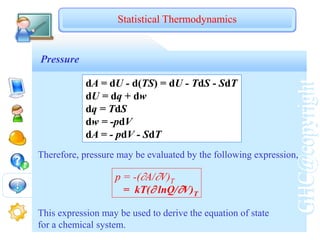
Pressure
dA = dU - d(TS) = dU - TdS - SdT
dU = dq + dw
dq = TdS
dw = -pdV
dA = - pdV - SdT
Therefore, pressure may be evaluated by the following expression,
p = -(A/V)T
= kT( lnQ/V)T
This expression may be used to derive the equation of state
for a chemical system.
Statistical Thermodynamics
GHC@copyright
Consider a perfect gas with N molecules. Its partition
function Q is evaluate as
Q = (1/N!) (V / 3)N
the pressure p is then
p = kT( lnQ/V)T
= kT N ( lnV/V)T
= NkT / V
pV = NkT = nNAkT = nRT
which is the equation of the state for the perfect gas.
Statistical Thermodynamics
GHC@copyright
The enthalpy
During a chemical reaction, the change in internal energy is
not only equal to the heat absorbed or released. Usually, there
is a volume change when the reaction occurs, which leads
work performed on or by the surroundings. To quantify the
heat involved in the reaction, a thermodynamic function, the
enthalpy H, is introduced as follows,
H  U + pV
Therefore,
H - H(0) = -( lnQ/)V + kTV( lnQ/V)T
Statistical Thermodynamics
GHC@copyright
The Gibbs energy
Usually chemical reactions occur under constant temperature. A
new thermodynamic function, the Gibbs energy, is introduced.
G  A + pV
At constant temperature and pressure, a chemical system changes
spontaneously to the states of lower Gibbs energy, i.e., dG  0, if
possible. Therefore, the Gibbs free energy can be employed to
access whether a chemical reaction may occur spontaneously. A
system at constant temperature and pressure reaches its
equilibrium when G is minimum, i.e., dG = 0. The relation
between the Helmholtz energy and the partition function may be
expressed as,
G - G(0) = - kT ln Q + kTV( lnQ/V)T
Statistical Thermodynamics
GHC@copyright
Example 7
Calculate the translational partition function of an H2 molecule
confined to a 100-cm3 container at 25o
C
Example 8
Calculate the entropy of a collection of N independent harmonic
oscillators, and evaluate the molar vibraitional partition function
of I2 at 25o
C. The vibrational wavenumber of I2 is 214.6 cm-1
Example 9
What are the relative populations of the states of a two-level system
when the temperature is infinite?
Example 10
Evaluate the entropy of N two-level systems. What is the entropy
when the two states are equally thermally accessible?
Statistical Thermodynamics
GHC@copyright
Example 11
Calculate the ratio of the translational partition functions of D2 and
H2 at the same temperature and volume.
Example 12
A sample consisting of five molecules has a total energy 5. Each
molecule is able to occupy states of energy j with j = 0, 1, 2, ….
(a) Calculate the weight of the configuration in which the molecules
share the energy equally. (b) Draw up a table with columns headed
by the energy of the states and write beneath then all configurations
that are consistent with the total energy. Calculate the weight of
each configuration and identify the most probable configuration.
Example 14
Given that a typical value of the vibrational partition function of one
normal mode is about 1.1, estimate the overall vibrational partition
function of a NH3.
Statistical Thermodynamics
GHC@copyright
Example 15
Consider Stirling’s approximation for lnN! In the derivation of
the Boltzmann distribution. What difference would it make if
the following improved approximation is used ?
x! = (2)1/2 (x+1/2)x e-x
Example 16
Consider N molecules in a cube of size a.
(a) Assuming molecules are moving with the same speed v
along one of three axises (x-, y-, or z-axis). The motion may be
along the positive or negative direction of an axis. On the
average, how many molecules move parallel to the positive x
direction?
Statistical Thermodynamics
GHC@copyright
(b)When a molecule collides with one of six sides of the
cube, it is reflected. The reflected molecule has the same
speed v but moves in the opposite direction. How many
molecules are reflected from the side within a time interval
t ? What is the corresponding momentum change of these
molecules?
(c) Force equals the rate of momentum change. Calculate the
force that one side of the cube experiences.
Pressure is simply the force acting on a unit area. What is
the pressure of the gas? Assuming the average kinetic energy
of a molecule is 3kT/2, derive the equation of state for the
system.
Statistical Thermodynamics
GHC@copyright
!
/ N
q
Q N

Diatomic Gas
Consider a diatomic gas with N identical molecules. A molecule is
made of two atoms A and B. A and B may be the same or different.
When A and B are he same, the molecule is a homonuclear diatomic
molecule; when A and B are different, the molecule is a heteronuclear
diatomic molecule. The mass of a diatomic molecule is M. These
molecules are indistinguishable. Thus, the partition function of the gas
Q may be expressed in terms of the molecular partition function q,
The molecular partition q
where, i is the energy of a molecular state i, β=1/kT, and ì is the
summation over all the molecular states.
 
 i i
q )
exp( 
Statistical Thermodynamics
GHC@copyright
Statistical Thermodynamics
GHC@copyright
where T denotes translation, R rotation, V vibration, and E the
electronic contribution. Translation is decoupled from other
modes. The separation of the electronic and vibrational motions
is justified by different time scales of electronic and atomic
dynamics. The separation of the vibrational and rotational
modes is valid to the extent that the molecule can be treated as a
rigid rotor.
)
(
)
(
)
(
)
(
)
( j
j
j
j
j E
V
R
T




 



Factorization of Molecular Partition Function
The energy of a molecule j is the sum of contributions from its
different modes of motion:
Statistical Thermodynamics
GHC@copyright
Statistical Thermodynamics
Factorization of Molecular Partition Function

 





 i
E
i
V
i
R
i
T
i
i i
q )]
(
exp[
)
exp( 





    



 i i i i
E
i
V
i
R
i
T
i )]
exp(
)][
exp(
)][
exp(
)][
exp(
[ 



E
V
R
T
q
q
q
q

GHC@copyright
R
V
T
q
q
q
q 
1
/ 
E
q
w
3
/ 
 V
qT
2
/
1
)
2
/
( M
h 



kT
/
1


where
Statistical Thermodynamics
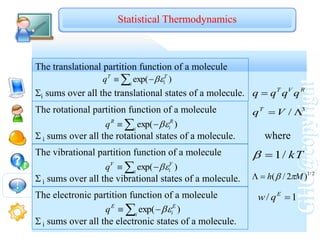
The translational partition function of a molecule
ì sums over all the translational states of a molecule.
The electronic partition function of a molecule
 ì sums over all the electronic states of a molecule.
 
 i
T
i
T
q )
exp( 
The rotational partition function of a molecule
 ì sums over all the rotational states of a molecule.
The vibrational partition function of a molecule
 ì sums over all the vibrational states of a molecule.
 
 i
R
i
R
q )
exp( 
 
 i
V
i
V
q )
exp( 
 
 i
E
i
E
q )
exp( 
GHC@copyright
5--------------5hv
4--------------4hv
3--------------3hv
2--------------2hv
1--------------hv
0--------------0
hv
n
V
n )
2
/
1
( 


nhv
V
n 

n= 0, 1, 2, …….
kT hv


Vibrational Partition Function
Two atoms vibrate along an axis connecting the two atoms.
The vibrational energy levels:
If we set the ground state energy to zero or measure energy
from the ground state energy level, the relative energy levels
can be expressed as
GHC@copyright
Then the molecular partition function can be evaluated

 





 n
n n
v
hv
hv
n
q )]
exp(
1
/[
1
)
exp(
)
exp( 


...
1 3
2 

 





 e
e
e
qv
1
....
3
2





 


 v
v
q
e
e
e
q
e 



hv
v
e
e
q 







1
1
)
1
/(
1
Consider the high temperature situation where kT >>hv, i.e.,
hv
kT
hv
hv v
/
/
1
q
,
1 

 

Vibrational temperature v
High temperature means that T>>v
hv
k v 




h
e hv



1

I2 F2 HCl H2
v/K 309 1280 4300 6330
v/cm-1 215 892 2990 4400
m
k
v 
where
Therefore,
Vibrational Partition Function
GHC@copyright
where B is the rotational constant. J =0, 1, 2, 3,…
)
1
( 
 J
hcBJ
R
J

 
 states
rotational
all
]
exp[ R
J
R
q 
 
 levels
energy
rotational
all
]
exp[ R
J
J
g 
 


 J
)]
1
(
exp[
)
1
2
( J
hcBJ
J 






0
)]
1
(
exp[
)
1
2
( dJ
J
hcBJ
J
qR

dJ
/
)]}
1
(
{exp[
)
/
1
(
0
dJ
J
hcBJ
d
hcB 


 







 0
]}
1
(
){exp[
/
1
( l
J
hcBJ
hcB 

Bh/8cI2
c: speed of light
I: moment of Inertia

i
i
r m I
i
2
hcB<<1
where gJ is the degeneracy of rotational energy level εJ
R
Usually hcB is much less than kT,
Note: kT>>hcB
Rotational Partition Function
If we may treat a heteronulcear diatomic molecule as a rigid rod,
besides its vibration the two atoms rotates. The rotational energy
=kT/hcB
GHC@copyright
For a homonuclear diatomic molecule
Generally, the rotational contribution to the molecular partition
function,
Where  is the symmetry number.
Rotational temperature R
hcB
kT
qR
2
/

hcB
kT
qR

/

12
CH
3
NH
2
4
3
2O
H
hcB
k R 


Rotational Partition Function
GHC@copyright
where, gE = g0 is the degeneracy of the electronic ground state,
and the ground state energy 0
E is set to zero.
If there is only one electronic ground state qE = 1, the partition
function of a diatomic gas,
]
exp[
]
exp[
states
electronic
all energies
electronic
all
E
j
j
E
j
E
g
q 

  



]
exp[ 0
0
E
g 


N
hv
N
N
e
hcB
kT
V
N
Q 



 )
1
(
)
/
(
)
/
)(
!
/
1
( 3 

At room temperature, the molecule is always in its ground state
Electronic Partition Function
=g0
=gE
GHC@copyright
The internal energy of a diatomic gas (with N molecules)
v
e
n
N
N
n
N
U
U hv
v
v ]
/
)
1
(
1
[
)
/
ln
(
)
/
1
(
3
)
0
( 


 











 
)
1
/(
/
1
/
1
)
2
/
3
( 


 hv
e
Nhv
N
N 


)
1
/(
)
2
/
5
( 

 hv
e
Nhv
NkT 
kT
N
)
2
/
7
(

qV = kT/hv
qR = kT/hcB
The rule: at high temperature, the contribution of one
degree of freedom to the kinetic energy of a molecule
(1/2)kT
Mean Energy and Heat Capacity
(T>>1)
GHC@copyright
the constant-volume heat capacity
(T>>1)
Contribution of a molecular to the heat capacity
Translational contribution
(1/2) k x 3 = (3/2) k
Rotational contribution
(1/2) k x 3 = k
Vibrational contribution
(1/2) k + (1/2) k = k
kinetic potential
Thus, the total contribution of a molecule to the heat capacity is (7/2) k
v
v T
U
C )
/
( 


2
2
)
1
/(
hv)
(
K
N
k
)
2
/
5
( 

 hv
hv
e
e
N 


k
)
2
/
7
( N

Mean Energy and Heat Capacity
GHC@copyright
Translational energy
2
2
2
2
2
1
8
mVx
mx
h
n
T
n 


mx
h
n
Vx
2


where n = 1, 2, …
n is a measurement of the speed of the molecule
mx
50h
mx
h
2mx
h
Vx
....
100
....
2
1
n
sec
/
10
9
.
1
2
5
m
mx
h 


Quantum Classical
for a H in a one-dimonsional box x= 1cm
Mean Energy and Heat Capacity
GHC@copyright
Vibrational energy
2
2
1
)
2
1
( kA
hV
n
v
n




Quantum Classical
A is the amplitude of the vibration
k
hv
n
k
hv
n
A )
1
2
(
)
2
1
(
2 



Here the vibrational quantum number n is a measurement
of the vibrational amplitude.
Mean Energy and Heat Capacity
GHC@copyright
 





mj
J J
R
e
e
q
R
J
R
J
J
,
)
1
2
( 
 

mj=-J,-J+1…….
Mean Energy and Heat Capacity
Rotational energy
2
2
1
)
1
( 
 I
J
hcBJ
R
J



Quantum Classical
 is the rotational angulor velocity
)
1
(
2

 J
J
I
h


J is a measurement of angular velocity
mJ is a measurement of the projection of the angular velocity of the z-
axis. i.e. a measurement of the rotation’s orientation.
GHC@copyright
Molecule with N atoms
Degree of freedom:
Translation: 3
Rotation: 3 nonlinear
2 linear
vibration: 3N – 6 nonlinear
3N – 5 linear
Diatomic Molecule A-B
Symmetry  =
Supplementary note
0 if A  B
1 if A = B
GHC@copyright
Summary
Principle of equal a priori probabilities:
All possibilities for the distribution of energy are equally
probable provided the number of molecules and the total
energy are kept the same.
A configuration { n0, n1, n2, ......} can be achieved in W
different ways or the weight of the configuration
Dominating Configuration vs Equilibrium
The Boltzmann Distribution
Pi = exp (-i ) / q
W = N! / (n0! n1! n2! ...)
GHC@copyright
q = i exp(-i) = j gjexp(-j) Q = i exp(-Ei)
Partition Function
Energy
E= N i pi i = U - U(0) = - (lnQ/)V
Heat Capacity
CV = (E/T)V = k2 (2lnQ/2)V
Entropy
S = k lnW = - Nk i pi ln pi = k lnQ + E / T
A= A(0) - kT lnQ
Helmholtz energy
Summary
GHC@copyright
H = H(0) - (lnQ/)V + kTV (lnQ/V)T
Q = qN or (1/N!)qN
q = qTqRqVqE
Enthalpy
Molecular partition function
Factorization of Molecular Partition Function
Summary

chem2503_oct05.ppt

  • 1.
    GHC@copyright G. H. CHEN Departmentof Chemistry University of Hong Kong Intermediate Physical Chemistry
  • 2.
    GHC@copyright Intermediate Physical Chemistry Contents: Distributionof Molecular States Perfect Gas Fundamental Relations Diatomic Molecular Gas
  • 3.
    GHC@copyright Distribution of MolecularStates Configurations and Weights Boltzmann Distribution, and Physical Meanings of  Molecular Partition Function and its Interpretation The Internal Energy and the Entropy Independent Molecular and their Partition Function
  • 4.
  • 5.
    GHC@copyright Diatomic Molecular Gas Factorizationof Partition Function Rotational Partition Function Vibrational Partition Function Electronic Partition Function Mean Energy and Heat Capacity
  • 6.
  • 7.
    GHC@copyright Statistical Mechanics providesthe link between the microscopic properties of matter and its bulk properties. Statistical Mechanics:
  • 8.
    GHC@copyright THE DISTRIBUTION OFMOLECULAR STATES Consider a system composed of N molecules, and its total energy E is a constant. These molecules are independent, i.e. no interactions exist among the molecules. Countless collisions occur. It is hopeless to keep track positions, momenta, and internal energies of all molecules.
  • 9.
    GHC@copyright Principle of equala priori probabilities: All possibilities for the distribution of energy are equally probable provided the number of molecules and the total energy are kept the same. That is, we assume that vibrational states of a certain energy, for instance, are as likely to be populated as rotational states of the same energy. THE DISTRIBUTION OF MOLECULAR STATES
  • 10.
    GHC@copyright For instance, fourmolecules in a three-level system: the following two conformations have the same probability. ---------l-l-------- 2 ---------l--------- 2 ---------l----------  ---------1-1-1----  ---------l---------- 0 ------------------- 0 THE DISTRIBUTION OF MOLECULAR STATES
  • 11.
    GHC@copyright Configurations and Weights Imaginethat there are total N molecules among which n0 molecules with energy 0, n1 with energy 1, n2 with energy 2, and so on, where 0 < 1 < 2 < .... are the energies of different states. The specific distribution of molecules is called configuration of the system, denoted as { n0, n1, n2, ......} THE DISTRIBUTION OF MOLECULAR STATES
  • 12.
    GHC@copyright For instance, asystem with 17 molecules, and each molecule has four states. 1 2 3 4 5 6 7 8 9 10 11 12 13 14 15 16 17 1 2 3 4 STATE The above configuration is thus, { 4, 6, 4, 3 } THE DISTRIBUTION OF MOLECULAR STATES
  • 13.
    GHC@copyright {N, 0, 0,......} corresponds that every molecule is in the ground state, there is only one way to achieve this configuration; {N-2, 2, 0, ......} corresponds that two molecule is in the first excited state, and the rest in the ground state, and can be achieved in N(N-1)/2 ways. A configuration { n0, n1, n2, ......} can be achieved in W different ways, where W is called the weight of the configuration. And W can be evaluated as follows, W = N! / (n0! n1! n2! ...) THE DISTRIBUTION OF MOLECULAR STATES
  • 14.
    GHC@copyright Justification 1. N! differentways to arrange N molecules; 2. ni! arrangements of ni molecules with energy i correspond to the same configuration; THE DISTRIBUTION OF MOLECULAR STATES
  • 15.
    GHC@copyright 1. Calculate thenumber of ways of distributing 3 objects a, b and c into two boxes with the arrangement {1, 2}. Answer: | a | b c |, | b | c a |, | c | a b |. Therefore, there are three ways 3! / 1! 2! Example: THE DISTRIBUTION OF MOLECULAR STATES | a | c b |, | b | a c |, | c | b a | To eliminate overcounting of these configurations
  • 16.
    GHC@copyright 2. Calculate thenumber of ways of distributing 20 objects into six boxes with the arrangement {1, 0, 3, 5, 10, 1}. Answer: 20! / 1! 0! 3! 5! 10! 1! = 931170240 note: 0! = 1 Example: THE DISTRIBUTION OF MOLECULAR STATES
  • 17.
    GHC@copyright Stirlings Approximation: When xis large, ln x!  x ln x - x x ln x! x ln x - x ln A 1 0.000 -1.000 0.081 2 0.693 -0.614 0.652 4 3.178 1.545 3.157 6 6.579 4.751 6.566 8 10.605 8.636 10.595 10 15.104 13.026 15.096 THE DISTRIBUTION OF MOLECULAR STATES Note: A = (2)1/2 (x+1/2)x e-x
  • 18.
    GHC@copyright Therefore, ln W ( N ln N - N ) -  ( ni ln ni - ni ) = N ln N -  ni ln ni x ln x! x ln x - x ln A 12 19.987 17.819 19.980 16 30.672 28.361 30.666 20 42.336 39.915 42.332 30 74.658 72.036 74.656 Stirlings approximation(cont’d): THE DISTRIBUTION OF MOLECULAR STATES
  • 19.
    GHC@copyright The Dominating Configuration Imaginethat N molecules distribute among two states. {N, 0}, {N-1, 1}, ..., {N-k, k}, ... , {1, N-1}, {0, N} are possible configurations, and their weights are 1, N, ... , N! / (N-k)! k!, ... , N, 1, respectively. For instance, N=8, the weight distribution is then
  • 20.
    GHC@copyright 0 1 23 4 5 6 7 8 0 20 40 60 N = 8 W k The Dominating Configuration
  • 21.
    GHC@copyright 0 1 23 4 5 6 7 8 9 10111213141516 0 2000 4000 6000 8000 10000 12000 N =16 W k The Dominating Configuration
  • 22.
    GHC@copyright 0 4 812 16 20 24 28 32 0.00E+000 1.00E+008 2.00E+008 3.00E+008 4.00E+008 5.00E+008 6.00E+008 N = 32 k The Dominating Configuration
  • 23.
    GHC@copyright When N iseven, the weight is maximum at k = N/2, i.e. Wk=N/2 = N! / [N/2)!]2. When N is odd, the maximum is at k = N/2  1 As N increases, the maximum becomes sharper! The weight for k = N/4 is Wk=N/4 = N! / [(N/4)! (3N/4)!] The Dominating Configuration
  • 24.
    GHC@copyright | N |4 | 8 | 16 | 32 | 256 | 6.0 x 10²³ |R(N) | 1.5 | 2.5 | 7.1 | 57.1 | 3.5 x 10¹⁴ | 2.6 x 10³e+22 Therefore, for a macroscopic molecular system ( N ~ 1023 ), there are dominating configurations so that the system is almost always found in or near the dominating configurations, i.e. Equilibrium The ratio of the two weights is equal to R(N) Wk=N/2 / Wk=N/4 =(N/4)! (3N/4)! / [(N/2)!]2 The Dominating Configuration If the system has more states, would we reach the same conclusion as above? Why?
  • 25.
    GHC@copyright 1. The totalenergy is a constant, i.e.  ni i = E = constant 2. The total number of molecules is conserved, i.e.  ni = N = constant How to maximize W or lnW under these constraints? Two constraints for the system
  • 26.
    GHC@copyright The Boltzmann Distribution ni/ N = Pi = exp ( - i ) Interpretation of Boltzmann Distribution Meaning of : ensure total probability is ONE 1 = i ni / N = i exp( -i) exp( ) = 1 / i exp(-i)  = - ln [i exp(-i)] 1 /  = kT
  • 27.
    GHC@copyright Starting from theprinciple of equal a priori probabilities, we evaluate the probabilities of different configurations by simple counting, and find that the dominating configuration whose population obeys the Boltzmann distribution which relates the macroscopic observables to the microscopic molecular properties, and is capable of explaining the equilibrium properties of all materials. The Boltzmann Distribution Summary
  • 28.
    GHC@copyright To find themost important configuration, we vary { ni } to seek the maximum value of W. But how? E.g. One-Dimensional Function: F(x) = x2 dF/dx = 0 The Dominating Configuration Enough?
  • 29.
    GHC@copyright Two-Dimensional Case: forinstance, finding the minimum point of the surface of a half water melon F(x,y). F/x = 0, F/y = 0. Multi-Dimensional Function: F(x1, x2, …, xn) F/xi = 0, i = 1,2,…,n To find the maximum value of W or lnW,  lnW / ni = 0, i=1,2,3,... The Dominating Configuration
  • 30.
    GHC@copyright Let’s investigate thewater melon’s surface: cutting the watermelon how to find the minimum or maximum of F(x, y) under a constraint x = a ? L = F(x, y) -  x  L /  x = 0  L /  y = 0 x = a The method of Lagrange Multipliers
  • 31.
    GHC@copyright Generally, to minimizeor maximize a function F(x1, x2, …, xn) under constraints, C1(x1, x2, …, xn) = Constant1 C2(x1, x2, …, xn) = Constant2 . . . Cm(x1, x2, …, xn) = Constantm L = F(x1, x2, …, xn) - i iCi(x1, x2, …, xn) L/xi = 0, i=1,2, ..., n The Dominating Configuration The method of Lagrange Multipliers
  • 32.
    GHC@copyright JUSTIFICATION dL = dF- i i dCi under the constraints, dCi = 0, thus dF = 0 i.e., F is at its maximum or minimum. The Dominating Configuration The method of Lagrange Multipliers
  • 33.
    GHC@copyright The method ofLagrangian Multiplier Procedure Construct a new function L, L = lnW +  i ni -  i ni i Finding the maximum of L by varying { ni },  and  is equivalent to finding the maximum of W under the two constraints, i.e., L/ni = lnW/ni +  -i = 0
  • 34.
    GHC@copyright Since ln W ( N ln N - N ) - i ( ni ln ni - ni ) = N ln N - i ni ln ni lnW/ni = (N ln N)/ni - (ni ln ni)/ ni = - ln (ni/N) Therefore, ln (ni / N) +  -i = 0 ni / N = exp( -i) The method of Lagrangian Multiplier
  • 35.
    GHC@copyright Therefore, E =N <  > = 3N/2, where <  > is the average kinetic energy of a molecule. Therefore, <  > = <mv2/2> = 3/2. On the other hand, according to the Maxwell distribution of speed, the average kinetic energy of a molecule at an equilibrium, The Boltzmann Distribution
  • 36.
    GHC@copyright This is thephysical meaning of , the reciprocal temperature. 1 /  = kT where k is the Boltzmann constant. Thus, <mv2>/2 = 3kT/2 (This is actually the definition of the temperature) The Boltzmann Distribution
  • 37.
    GHC@copyright Two friends Aand B are drinking beer in a pub one night. Out of boredom, the two start to play “fifteen-twenty”. A mutual friend C steps in, and the three play together. Of course, this time one hand is used by each. A is quite smart, and studies chemistry in HKU. He figures out a winning strategy. Before long, B and C are quite drunk while A is still pretty much sober. Now, what is A’s winning strategy? When A plays with B and try the same strategy, he finds that the strategy is not as successful. Why? Example 1: The Boltzmann Distribution
  • 38.
    GHC@copyright Example 2: Consider amolecular whose ground state energy is -10.0 eV, the first excited state energy -9.5 eV, the second excited state energy -1.0 eV, and etc. Calculate the probability of finding the molecule in its first excited state T = 300, 1000, and 5000 K. The Boltzmann Distribution
  • 39.
    GHC@copyright The summation isover all possible states (not the energy levels). If the energy level is gi-fold degenerate, then the molecular partition function can be rewritten as The Molecular Partition Function The Boltzmann distribution can be written as pi = exp(-i) / q where pi is the probability of a molecule being found in a state i with energy i. q is called the molecular partition function, q = i exp(-i) q = i gi exp(-i)
  • 40.
    GHC@copyright As T 0, q  g0, i.e. at T = 0, the partition function is equal to the degeneracy of the ground state. As T  , q  the total number of states. Therefore, the molecular partition function gives an indication of the average number of states that are thermally accessible to a molecule at the temperature of the system. The larger the value of the partition function is, the more the number of thermally accessible states is. The relationship between q and : exp() = q-1 Interpretation of the partition function
  • 41.
    GHC@copyright Consider a protonin a magnetic field B. The proton’s spin (S=1/2) has two states: spin parallel to B and spin anti-parallel to B. The energy difference between the two states is  = pB where p is proton’s magneton. Calculate the partition function q of the proton. The Boltzmann Distribution Example 3 Example 4 Calculate the partition function for a uniform ladder of energy levels Calculate the proportion of I2 molecules in their ground, first excited, and second excited vibrational states at 25oC. The vibrational wavenumber is 214.6 cm-1. Example 5
  • 42.
    GHC@copyright Partition function containsall the thermodynamic information! Statistical Thermodynamics The Internal Energy, the Heat Capacity & the Entropy The relation between U and q If we set the ground state energy 0 to zero, E should be interpreted as the relative energy to the internal energy of the system at T = 0, E = i ni i = i Nexp(-i) i / q = - Ndlnq/d.
  • 43.
    GHC@copyright Therefore, the internalenergy U may be expressed as The Internal Energy, the Heat Capacity & the Entropy Statistical Thermodynamics U = U(0) + E = U(0) - N (lnq/)V Where, U(0) is the internal energy of the system at T = 0. The above equation provides the energy as a function of various properties of the molecular system (for instance, temperature, volume), and may be used to evaluate the internal energy.
  • 44.
    GHC@copyright Statistical Thermodynamics The relationbetween CV and q Cv is the constant-volume heat capacity which measures the ability of a system to store energy. It is defined as the rate of internal energy change as the temperature T varies while the volume is kept constant: Cv  (U/T)V = N(1/kT2) (2lnq/2)V Note that, d/dT = (d/dT) d/d = -(1/kT2) d/d
  • 45.
    GHC@copyright Example 6: Calculate theconstant-volume heat capacity of a monatomic gas assuming that the gas is an ideal gas. U = U(0) + 3N / 2 = U(0) + 3NkT / 2 Statistical Thermodynamics where N is the number of atoms, and k is the Boltzmann constant. Cv  (U/T)V = 3Nk / 2 =3nNAk/2= 3nR/2 where, n is the number of moles, R  NAk is the gas constant, and NA = 6.02 x 10²³ mol-1 is the Avogadro constant
  • 46.
    GHC@copyright The relation betweenS and the partition function q Statistical Thermodynamics The Statistical Entropy According to thermodynamics, entropy S is some measurement of heat q. The change of entropy S is proportional to the heat absorbed by the system: dS = dq / T The above expression is the definition of thermodynamic entropy.
  • 47.
    GHC@copyright Boltzmann Formula forthe entropy Statistical Thermodynamics S = k lnW where, W is the weight of the most probable configuration of the system. Boltzmann Formula (1) indicates that the entropy is a measurement of the weight (i.e. the number of ways to achieve the equilibrium conformation), and thus a measurement of randomness, (2) relates the macroscopic thermodynamic entropy of a system to its distribution of molecules among its microscopic states, (3) can be used to evaluate the entropy from the microscopic properties of a system; and (4) is the definition of the Statistical Entropy.
  • 48.
    GHC@copyright JUSTIFICATION Statistical Thermodynamics The energyof a molecular system U can be expressed as, U = U(0) + i nii where, U(0) is the internal energy of the system at T=0, ni is the number of molecules which are in the state with its energy equal to i Now let’s imagine that the system is being heated while the volume V is kept the same. Then the change of U may be written as, dU = dU(0) + i nidi + i idni = i idni [dU(0) = 0 because U(0) is a constant; di = 0 because i does not change as the temperature of the system arises.]
  • 49.
    GHC@copyright According to theFirst Law of thermodynamics, the change of internal energy U is equal to the heat absorbed (q) and work received (w), i.e., dU = dq + dw dq = TdS (thermodynamic definition of entropy; or more the heat absorbed, the more random the system) dw = -PdV = -Force * distance (as the system shrinks, it receives work from the environment) Statistical Thermodynamics
  • 50.
    GHC@copyright dU = TdS- PdV = TdS (dV = 0) dS = dU/T = k i idni = k i (lnW/ni)dni + k i dni = k i (lnW/ni)dni = k dlnW ( lnW/ni = - ln (ni/N) = - +  i ) d(S - lnW) = 0 S = k lnW + constant What is the constant? Statistical Thermodynamics
  • 51.
    GHC@copyright According to theThird Law of thermodynamics, as T  0, S  0; as T  0, W  1 since usually there is only one ground state, and therefore, constant = 0. Statistical Thermodynamics
  • 52.
    GHC@copyright Relation between Sand the Boltzmann distribution pi Statistical Thermodynamics S = k lnW = k ( N lnN -i ni lnni ) = k i ( ni lnN - ni lnni ) = - k i ni ln(ni /N) = - Nk i (ni /N)ln(ni /N) = - Nk i pi ln pi since the probability pi = ni /N. The above relation is often used to calculate the entropy of a system from its distribution function.
  • 53.
    GHC@copyright The relation betweenS and the partition function q Statistical Thermodynamics According to the Boltzmann distribution, ln pi = - i - ln q Therefore, S = - Nk i pi (- i - ln q) = k i ni i + Nk ln qi pi = E / T + Nk ln q = [U-U(0)] / T + Nk ln q This relation may be used to calculate S from the known entropy q
  • 54.
    GHC@copyright Independent Molecules Statistical Thermodynamics Considera system which is composed of N identical molecules. We may generalize the molecular partition function q to the partition function of the system Q Q = i exp(-Ei) where Ei is the energy of a state i of the system, and summation is over all the states. Ei can be expressed as assuming there is no interaction among molecules, Ei = i(1) + i(2) +i(3) + … + i(N) where i(j) is the energy of molecule j in a molecular state i
  • 55.
    GHC@copyright The partition functionQ Q = i exp[-i(1) - i(2) - i(3) - … -i(N)] = {i exp[-i(1)]}{i exp[-i(2)]} … {i exp[-i(N)]} = {i exp(-i)}N = qN where q  i exp(-i) is the molecular partition function. The second equality is satisfied because the molecules are independent of each other. Statistical Thermodynamics
  • 56.
    GHC@copyright The relation betweenU and the partition function Q U = U(0) - (lnQ/)V The relation between S and the partition function Q S = [U-U(0)] / T + k ln Q The above two equations are general because they not only apply to independent molecules but also general interacting systems. Statistical Thermodynamics
  • 57.
    GHC@copyright Perfect Gas Perfect gasis an idealized gas where an individual molecule is treated as a point mass and no interaction exists among molecules. Real gases may be approximated as perfect gases when the temperature is very high or the pressure is very low. The energy of a molecule i in a perfect gas includes only its kinetic energy, i.e., i = i T q = qT Statistical Thermodynamics i.e., there are only translational contribution to the energy and the partition function.
  • 58.
    GHC@copyright Translational Partition Functionof a molecule qT Although usually a molecule moves in a three-dimensional space, we consider first one-dimensional case. Imagine a molecule of mass m. It is free to move along the x direction between x = 0 and x = X, but confined in the y- and z-direction. We are to calculate its partition function qx. The energy levels are given by the following expression, En = n2h2 / (8mX2) n = 1, 2, … Statistical Thermodynamics
  • 59.
    GHC@copyright Setting the lowestenergy to zero, the relative energies can then be expressed as, qx = 1 dn exp [ -(n2-1) ] = 1 dn exp [ -(n2-1) ] = 0 dn exp [ -n2 ] = (2m/h22)1/2 X n = (n2-1) with  = h2 / (8mX2) qx = n exp [ -(n2-1) ]  is very small, then Statistical Thermodynamics
  • 60.
    GHC@copyright Now consider amolecule of mass m free to move in a container of volume V=XYZ. Its partition function qT may be expressed as qT = qx qy qz = (2m/h22)1/2 X (2m/h22)1/2 Y (2m/h22)1/2 Z = (2m/h22)3/2 XYZ = (2m/h22)3/2 V = V/3 where,  = h(/2m)1/2, the thermal wavelength. The thermal wavelength is small compared with the linear dimension of the container. Noted that qT  as T . qT  2 x 1028 for an O2 in a vessel of volume 100 cm3,  = 71 x 10-12 m @ T=300 K Statistical Thermodynamics
  • 61.
    GHC@copyright Partition function ofa perfect gas, Q = (qT) N = VN / 3N Energy E = - (lnQ/)V = 3/2 nRT where n is the number of moles, and R is the gas constant Heat Capacity Cv = (E/T)V = 3/2 nR Statistical Thermodynamics
  • 62.
    GHC@copyright Fundamental Thermodynamic Relationships Consideran equilibrium system which is consistent of N interacting molecules. These molecules may or may not be the same. Relation between energy and partition function Statistical Thermodynamics U = U(0) + E = U(0) - (lnQ/)V Relation between the entropy S and the partition function Q S = [U-U(0)] / T + k lnQ
  • 63.
    GHC@copyright Helmholtz energy The Helmholtzfree energy A  U - TS. At constant temperature and volume, a chemical system changes spontaneously to the states of lower Helmholtz free energy, i.e., dA  0, if possible. Therefore, the Helmholtz free energy can be employed to assess whether a chemical reaction may occur spontaneously. A system at constant temperature and volume reaches its equilibrium when A is minimum, i.e., dA=0. The relation between the Helmholtz energy and the partition function may be expressed as, A - A(0) = -kT ln Q Statistical Thermodynamics
  • 64.
    GHC@copyright Pressure dA = dU- d(TS) = dU - TdS - SdT dU = dq + dw dq = TdS dw = -pdV dA = - pdV - SdT Therefore, pressure may be evaluated by the following expression, p = -(A/V)T = kT( lnQ/V)T This expression may be used to derive the equation of state for a chemical system. Statistical Thermodynamics
  • 65.
    GHC@copyright Consider a perfectgas with N molecules. Its partition function Q is evaluate as Q = (1/N!) (V / 3)N the pressure p is then p = kT( lnQ/V)T = kT N ( lnV/V)T = NkT / V pV = NkT = nNAkT = nRT which is the equation of the state for the perfect gas. Statistical Thermodynamics
  • 66.
    GHC@copyright The enthalpy During achemical reaction, the change in internal energy is not only equal to the heat absorbed or released. Usually, there is a volume change when the reaction occurs, which leads work performed on or by the surroundings. To quantify the heat involved in the reaction, a thermodynamic function, the enthalpy H, is introduced as follows, H  U + pV Therefore, H - H(0) = -( lnQ/)V + kTV( lnQ/V)T Statistical Thermodynamics
  • 67.
    GHC@copyright The Gibbs energy Usuallychemical reactions occur under constant temperature. A new thermodynamic function, the Gibbs energy, is introduced. G  A + pV At constant temperature and pressure, a chemical system changes spontaneously to the states of lower Gibbs energy, i.e., dG  0, if possible. Therefore, the Gibbs free energy can be employed to access whether a chemical reaction may occur spontaneously. A system at constant temperature and pressure reaches its equilibrium when G is minimum, i.e., dG = 0. The relation between the Helmholtz energy and the partition function may be expressed as, G - G(0) = - kT ln Q + kTV( lnQ/V)T Statistical Thermodynamics
  • 68.
    GHC@copyright Example 7 Calculate thetranslational partition function of an H2 molecule confined to a 100-cm3 container at 25o C Example 8 Calculate the entropy of a collection of N independent harmonic oscillators, and evaluate the molar vibraitional partition function of I2 at 25o C. The vibrational wavenumber of I2 is 214.6 cm-1 Example 9 What are the relative populations of the states of a two-level system when the temperature is infinite? Example 10 Evaluate the entropy of N two-level systems. What is the entropy when the two states are equally thermally accessible? Statistical Thermodynamics
  • 69.
    GHC@copyright Example 11 Calculate theratio of the translational partition functions of D2 and H2 at the same temperature and volume. Example 12 A sample consisting of five molecules has a total energy 5. Each molecule is able to occupy states of energy j with j = 0, 1, 2, …. (a) Calculate the weight of the configuration in which the molecules share the energy equally. (b) Draw up a table with columns headed by the energy of the states and write beneath then all configurations that are consistent with the total energy. Calculate the weight of each configuration and identify the most probable configuration. Example 14 Given that a typical value of the vibrational partition function of one normal mode is about 1.1, estimate the overall vibrational partition function of a NH3. Statistical Thermodynamics
  • 70.
    GHC@copyright Example 15 Consider Stirling’sapproximation for lnN! In the derivation of the Boltzmann distribution. What difference would it make if the following improved approximation is used ? x! = (2)1/2 (x+1/2)x e-x Example 16 Consider N molecules in a cube of size a. (a) Assuming molecules are moving with the same speed v along one of three axises (x-, y-, or z-axis). The motion may be along the positive or negative direction of an axis. On the average, how many molecules move parallel to the positive x direction? Statistical Thermodynamics
  • 71.
    GHC@copyright (b)When a moleculecollides with one of six sides of the cube, it is reflected. The reflected molecule has the same speed v but moves in the opposite direction. How many molecules are reflected from the side within a time interval t ? What is the corresponding momentum change of these molecules? (c) Force equals the rate of momentum change. Calculate the force that one side of the cube experiences. Pressure is simply the force acting on a unit area. What is the pressure of the gas? Assuming the average kinetic energy of a molecule is 3kT/2, derive the equation of state for the system. Statistical Thermodynamics
  • 72.
    GHC@copyright ! / N q Q N  DiatomicGas Consider a diatomic gas with N identical molecules. A molecule is made of two atoms A and B. A and B may be the same or different. When A and B are he same, the molecule is a homonuclear diatomic molecule; when A and B are different, the molecule is a heteronuclear diatomic molecule. The mass of a diatomic molecule is M. These molecules are indistinguishable. Thus, the partition function of the gas Q may be expressed in terms of the molecular partition function q, The molecular partition q where, i is the energy of a molecular state i, β=1/kT, and ì is the summation over all the molecular states.    i i q ) exp(  Statistical Thermodynamics
  • 73.
  • 74.
    GHC@copyright where T denotestranslation, R rotation, V vibration, and E the electronic contribution. Translation is decoupled from other modes. The separation of the electronic and vibrational motions is justified by different time scales of electronic and atomic dynamics. The separation of the vibrational and rotational modes is valid to the extent that the molecule can be treated as a rigid rotor. ) ( ) ( ) ( ) ( ) ( j j j j j E V R T          Factorization of Molecular Partition Function The energy of a molecule j is the sum of contributions from its different modes of motion: Statistical Thermodynamics
  • 75.
    GHC@copyright Statistical Thermodynamics Factorization ofMolecular Partition Function          i E i V i R i T i i i q )] ( exp[ ) exp(                i i i i E i V i R i T i )] exp( )][ exp( )][ exp( )][ exp( [     E V R T q q q q 
  • 76.
    GHC@copyright R V T q q q q  1 /  E q w 3 /  V qT 2 / 1 ) 2 / ( M h     kT / 1   where Statistical Thermodynamics The translational partition function of a molecule ì sums over all the translational states of a molecule. The electronic partition function of a molecule  ì sums over all the electronic states of a molecule.    i T i T q ) exp(  The rotational partition function of a molecule  ì sums over all the rotational states of a molecule. The vibrational partition function of a molecule  ì sums over all the vibrational states of a molecule.    i R i R q ) exp(     i V i V q ) exp(     i E i E q ) exp( 
  • 77.
    GHC@copyright 5--------------5hv 4--------------4hv 3--------------3hv 2--------------2hv 1--------------hv 0--------------0 hv n V n ) 2 / 1 (    nhv V n  n= 0, 1, 2, ……. kT hv   Vibrational Partition Function Two atoms vibrate along an axis connecting the two atoms. The vibrational energy levels: If we set the ground state energy to zero or measure energy from the ground state energy level, the relative energy levels can be expressed as
  • 78.
    GHC@copyright Then the molecularpartition function can be evaluated          n n n v hv hv n q )] exp( 1 /[ 1 ) exp( ) exp(    ... 1 3 2           e e e qv 1 .... 3 2           v v q e e e q e     hv v e e q         1 1 ) 1 /( 1 Consider the high temperature situation where kT >>hv, i.e., hv kT hv hv v / / 1 q , 1      Vibrational temperature v High temperature means that T>>v hv k v      h e hv    1  I2 F2 HCl H2 v/K 309 1280 4300 6330 v/cm-1 215 892 2990 4400 m k v  where Therefore, Vibrational Partition Function
  • 79.
    GHC@copyright where B isthe rotational constant. J =0, 1, 2, 3,… ) 1 (   J hcBJ R J     states rotational all ] exp[ R J R q     levels energy rotational all ] exp[ R J J g       J )] 1 ( exp[ ) 1 2 ( J hcBJ J        0 )] 1 ( exp[ ) 1 2 ( dJ J hcBJ J qR  dJ / )]} 1 ( {exp[ ) / 1 ( 0 dJ J hcBJ d hcB              0 ]} 1 ( ){exp[ / 1 ( l J hcBJ hcB   Bh/8cI2 c: speed of light I: moment of Inertia  i i r m I i 2 hcB<<1 where gJ is the degeneracy of rotational energy level εJ R Usually hcB is much less than kT, Note: kT>>hcB Rotational Partition Function If we may treat a heteronulcear diatomic molecule as a rigid rod, besides its vibration the two atoms rotates. The rotational energy =kT/hcB
  • 80.
    GHC@copyright For a homonucleardiatomic molecule Generally, the rotational contribution to the molecular partition function, Where  is the symmetry number. Rotational temperature R hcB kT qR 2 /  hcB kT qR  /  12 CH 3 NH 2 4 3 2O H hcB k R    Rotational Partition Function
  • 81.
    GHC@copyright where, gE =g0 is the degeneracy of the electronic ground state, and the ground state energy 0 E is set to zero. If there is only one electronic ground state qE = 1, the partition function of a diatomic gas, ] exp[ ] exp[ states electronic all energies electronic all E j j E j E g q         ] exp[ 0 0 E g    N hv N N e hcB kT V N Q      ) 1 ( ) / ( ) / )( ! / 1 ( 3   At room temperature, the molecule is always in its ground state Electronic Partition Function =g0 =gE
  • 82.
    GHC@copyright The internal energyof a diatomic gas (with N molecules) v e n N N n N U U hv v v ] / ) 1 ( 1 [ ) / ln ( ) / 1 ( 3 ) 0 (                   ) 1 /( / 1 / 1 ) 2 / 3 (     hv e Nhv N N    ) 1 /( ) 2 / 5 (    hv e Nhv NkT  kT N ) 2 / 7 (  qV = kT/hv qR = kT/hcB The rule: at high temperature, the contribution of one degree of freedom to the kinetic energy of a molecule (1/2)kT Mean Energy and Heat Capacity (T>>1)
  • 83.
    GHC@copyright the constant-volume heatcapacity (T>>1) Contribution of a molecular to the heat capacity Translational contribution (1/2) k x 3 = (3/2) k Rotational contribution (1/2) k x 3 = k Vibrational contribution (1/2) k + (1/2) k = k kinetic potential Thus, the total contribution of a molecule to the heat capacity is (7/2) k v v T U C ) / (    2 2 ) 1 /( hv) ( K N k ) 2 / 5 (    hv hv e e N    k ) 2 / 7 ( N  Mean Energy and Heat Capacity
  • 84.
    GHC@copyright Translational energy 2 2 2 2 2 1 8 mVx mx h n T n    mx h n Vx 2   wheren = 1, 2, … n is a measurement of the speed of the molecule mx 50h mx h 2mx h Vx .... 100 .... 2 1 n sec / 10 9 . 1 2 5 m mx h    Quantum Classical for a H in a one-dimonsional box x= 1cm Mean Energy and Heat Capacity
  • 85.
    GHC@copyright Vibrational energy 2 2 1 ) 2 1 ( kA hV n v n     QuantumClassical A is the amplitude of the vibration k hv n k hv n A ) 1 2 ( ) 2 1 ( 2     Here the vibrational quantum number n is a measurement of the vibrational amplitude. Mean Energy and Heat Capacity
  • 86.
    GHC@copyright        mj J J R e e q R J R J J , ) 1 2 (    mj=-J,-J+1……. Mean Energy and Heat Capacity Rotational energy 2 2 1 ) 1 (   I J hcBJ R J    Quantum Classical  is the rotational angulor velocity ) 1 ( 2   J J I h   J is a measurement of angular velocity mJ is a measurement of the projection of the angular velocity of the z- axis. i.e. a measurement of the rotation’s orientation.
  • 87.
    GHC@copyright Molecule with Natoms Degree of freedom: Translation: 3 Rotation: 3 nonlinear 2 linear vibration: 3N – 6 nonlinear 3N – 5 linear Diatomic Molecule A-B Symmetry  = Supplementary note 0 if A  B 1 if A = B
  • 88.
    GHC@copyright Summary Principle of equala priori probabilities: All possibilities for the distribution of energy are equally probable provided the number of molecules and the total energy are kept the same. A configuration { n0, n1, n2, ......} can be achieved in W different ways or the weight of the configuration Dominating Configuration vs Equilibrium The Boltzmann Distribution Pi = exp (-i ) / q W = N! / (n0! n1! n2! ...)
  • 89.
    GHC@copyright q = iexp(-i) = j gjexp(-j) Q = i exp(-Ei) Partition Function Energy E= N i pi i = U - U(0) = - (lnQ/)V Heat Capacity CV = (E/T)V = k2 (2lnQ/2)V Entropy S = k lnW = - Nk i pi ln pi = k lnQ + E / T A= A(0) - kT lnQ Helmholtz energy Summary
  • 90.
    GHC@copyright H = H(0)- (lnQ/)V + kTV (lnQ/V)T Q = qN or (1/N!)qN q = qTqRqVqE Enthalpy Molecular partition function Factorization of Molecular Partition Function Summary