1
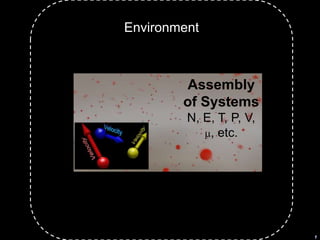
Assembly
of Systems
N, E, T, P, V,
m, etc.
Environment
2
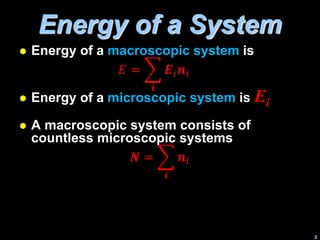
Energy of a System
 Energy of a macroscopic system is
𝐸 =
𝒊
𝑬𝑖𝒏𝑖
 Energy of a microscopic system is Ei
 A macroscopic system consists of
countless microscopic systems
𝑵 =
𝒊
𝒏𝑖
The Distribution of Molecular States
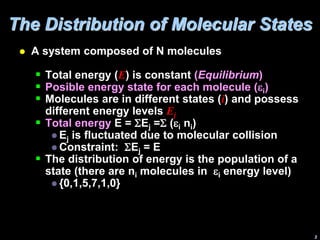
 A system composed of N molecules
 Total energy (E) is constant (Equilibrium)
 Posible energy state for each molecule (ei)
 Molecules are in different states (i) and possess
different energy levels Ej
 Total energy E = Ej = (ei ni)
 Ej is fluctuated due to molecular collision
 Constraint: Ej = E
 The distribution of energy is the population of a
state (there are ni molecules in ei energy level)
 {0,1,5,7,1,0}
3
4
5
The Dominating Configuration
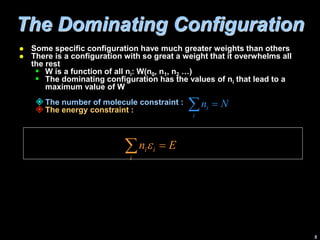
 Some specific configuration have much greater weights than others
 There is a configuration with so great a weight that it overwhelms all
the rest
 W is a function of all ni: W(n0, n1, n2 …)
 The dominating configuration has the values of ni that lead to a
maximum value of W
 The number of molecule constraint :
 The energy constraint :
E
n
i
i
i 
 e
N
n
i
i 

6
aximum & Minimum Poi
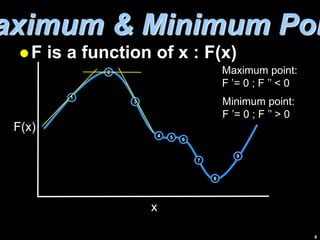
 F is a function of x : F(x)
Maximum point:
F ’= 0 ; F ’’ < 0
Minimum point:
F ’= 0 ; F ’’ > 0
1
2
3
4 5 6
7
8
9
F(x)
x
7
Maximum Value of W{ni}
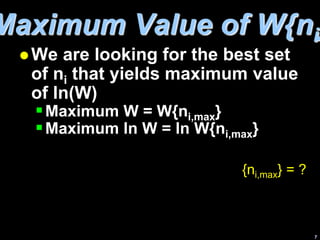
 We are looking for the best set
of ni that yields maximum value
of ln(W)
Maximum W = W{ni,max}
Maximum ln W = ln W{ni,max}
{ni,max} = ?
8
Maximum Value of W{ni }
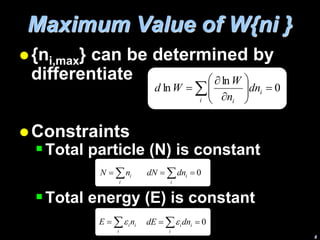
 {ni,max} can be determined by
differentiate
 Constraints
Total particle (N) is constant
Total energy (E) is constant
0
ln
ln 










 
i
i
i
dn
n
W
W
d


i
i
in
E e 0

 
i
i
idn
dE e


i
i
n
N 0

 
i
i
dn
dN
9
Maximum Value of W{ni
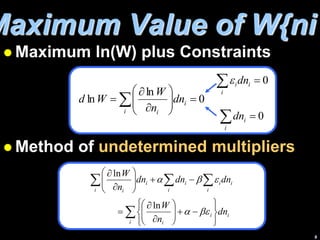
 Maximum ln(W) plus Constraints
 Method of undetermined multipliers
0
ln
ln 










 
i
i
i
dn
n
W
W
d
0


i
i
idn
e
0


i
i
dn



































i
i
i
i
i
i
i
i
i
i
i
i
dn
n
W
dn
dn
dn
n
W
e

e


ln
ln
10
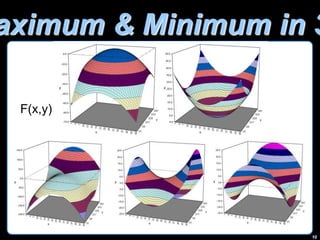
aximum & Minimum in 3
F(x,y)

Boltzmann statistical distribution law.pptx

  • 1.
    1 Assembly of Systems N, E,T, P, V, m, etc. Environment
  • 2.
    2 Energy of aSystem  Energy of a macroscopic system is 𝐸 = 𝒊 𝑬𝑖𝒏𝑖  Energy of a microscopic system is Ei  A macroscopic system consists of countless microscopic systems 𝑵 = 𝒊 𝒏𝑖
  • 3.
    The Distribution ofMolecular States  A system composed of N molecules  Total energy (E) is constant (Equilibrium)  Posible energy state for each molecule (ei)  Molecules are in different states (i) and possess different energy levels Ej  Total energy E = Ej = (ei ni)  Ej is fluctuated due to molecular collision  Constraint: Ej = E  The distribution of energy is the population of a state (there are ni molecules in ei energy level)  {0,1,5,7,1,0} 3
  • 4.
  • 5.
    5 The Dominating Configuration Some specific configuration have much greater weights than others  There is a configuration with so great a weight that it overwhelms all the rest  W is a function of all ni: W(n0, n1, n2 …)  The dominating configuration has the values of ni that lead to a maximum value of W  The number of molecule constraint :  The energy constraint : E n i i i   e N n i i  
  • 6.
    6 aximum & MinimumPoi  F is a function of x : F(x) Maximum point: F ’= 0 ; F ’’ < 0 Minimum point: F ’= 0 ; F ’’ > 0 1 2 3 4 5 6 7 8 9 F(x) x
  • 7.
    7 Maximum Value ofW{ni}  We are looking for the best set of ni that yields maximum value of ln(W) Maximum W = W{ni,max} Maximum ln W = ln W{ni,max} {ni,max} = ?
  • 8.
    8 Maximum Value ofW{ni }  {ni,max} can be determined by differentiate  Constraints Total particle (N) is constant Total energy (E) is constant 0 ln ln              i i i dn n W W d   i i in E e 0    i i idn dE e   i i n N 0    i i dn dN
  • 9.
    9 Maximum Value ofW{ni  Maximum ln(W) plus Constraints  Method of undetermined multipliers 0 ln ln              i i i dn n W W d 0   i i idn e 0   i i dn                                    i i i i i i i i i i i i dn n W dn dn dn n W e  e   ln ln
  • 10.