Chem 115: Basic Physiological
           Chemistry
                Dr. Kathryn Huisinga
               khuisinga@malone.edu
                       X 8356
Text:
General, Organic, and Biochemistry, 7th ed., by Denniston,
Topping, and Caret http://www.mhhe.com/denniston

A Laboratory Manual for General, Organic, and Biochemistry,
7th ed., by Henrickson

www.saplinglearning.com
Minute paper
• Name, Major, year
• Where you are from?

• What science and math classes you have taken
  before (HS or college level)?
• What do you hope to learn in Chem 115?

• How do you think studying chemistry can teach
  you something about God?
• Anything else you want me to know
Syllabus
• Online access- Malone e-companion and
  saplinglearning.com
• Communication outside of class will be via e-
  mail and posting on companion site(s).
• Instructional Methods:
  – Attendance & Participation
  – Homework Problem Sets: saplinglearning.com
  – Quizes
  – Exams
  – Lab (more details during lab this week)
Syllabus
• Attendance
  – Lecture
  – Lab
  – Exams
• Grading Scale
• Course Requirements & Classroom Procedures
  – Cell Phones- NOT ALLOWED
  – Calculators- NEEDED
  – Electronic note-taking devices- Your choice
     • i.e. – Laptop or ipad
Syllabus
• Disability Accommodations
  – Center for Student Success
  – Your responsibility to communicate this to me
• Academic Integrity
  – Taken Very Seriously
  – If you aren’t sure if something is allowed, ask.
  – Plagiarism, Cheating on Exams, copying homework
    or labs
     • If you are copying something, from anywhere, it is not
       OK!
• Subject-to-change
• Study Tips
  –   SQ3R+
  –   Repetition
  –   Frequency
  –   Teach each other
  –   Environment of learning
• Peer Tutoring:
  – Jennifer Peters
  – Monday, 6:00 p.m.
       • in the tutoring room (Library Seminar F)
• Communicate problems to me
  – I can’t help you if I don’t know you are having
    problems
       • Or if I don’t know until after the exam!!
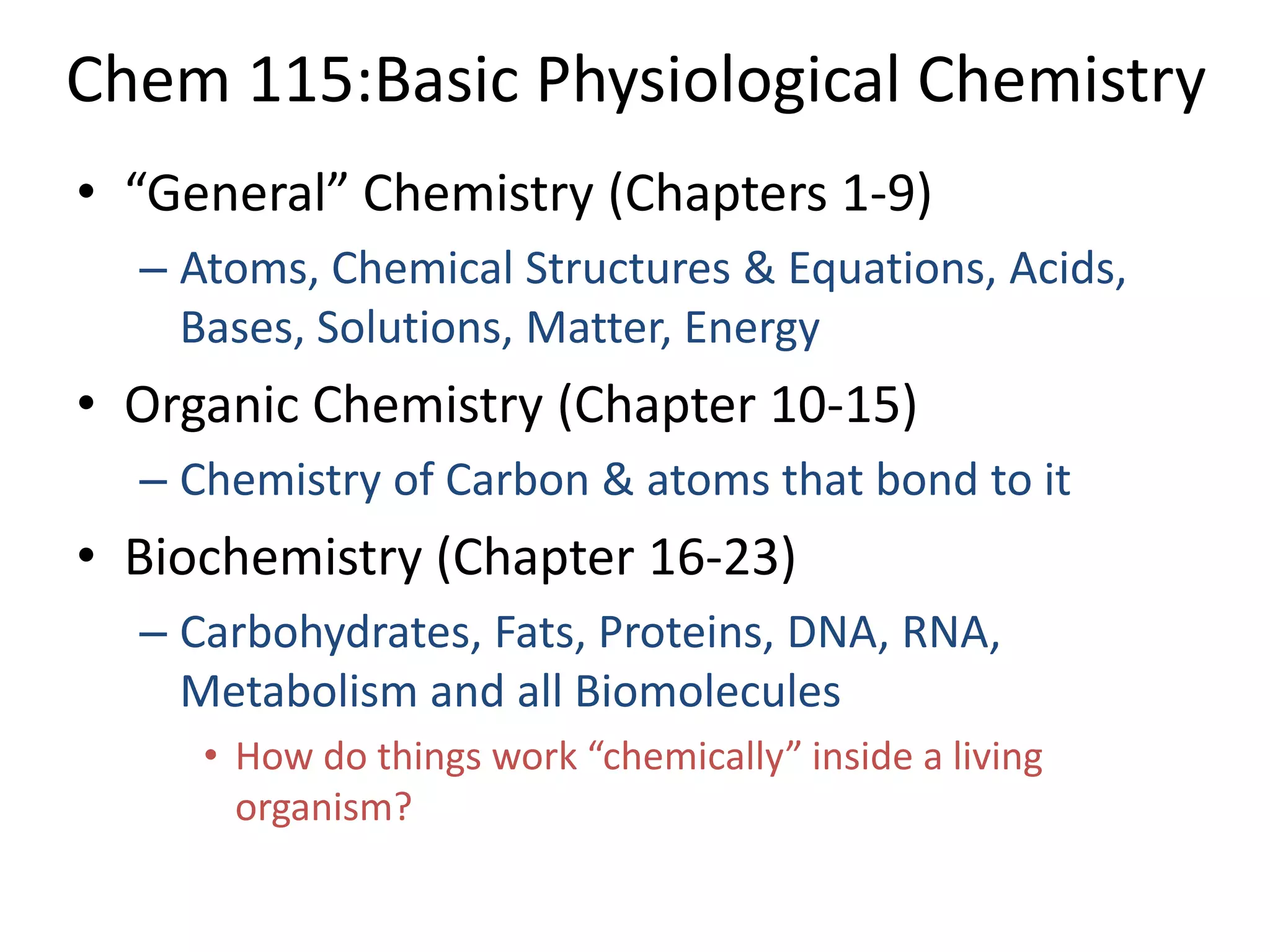
Chem 115:Basic Physiological Chemistry
• “General” Chemistry (Chapters 1-9)
  – Atoms, Chemical Structures & Equations, Acids,
    Bases, Solutions, Matter, Energy
• Organic Chemistry (Chapter 10-15)
  – Chemistry of Carbon & atoms that bond to it
• Biochemistry (Chapter 16-23)
  – Carbohydrates, Fats, Proteins, DNA, RNA,
    Metabolism and all Biomolecules
     • How do things work “chemically” inside a living
       organism?
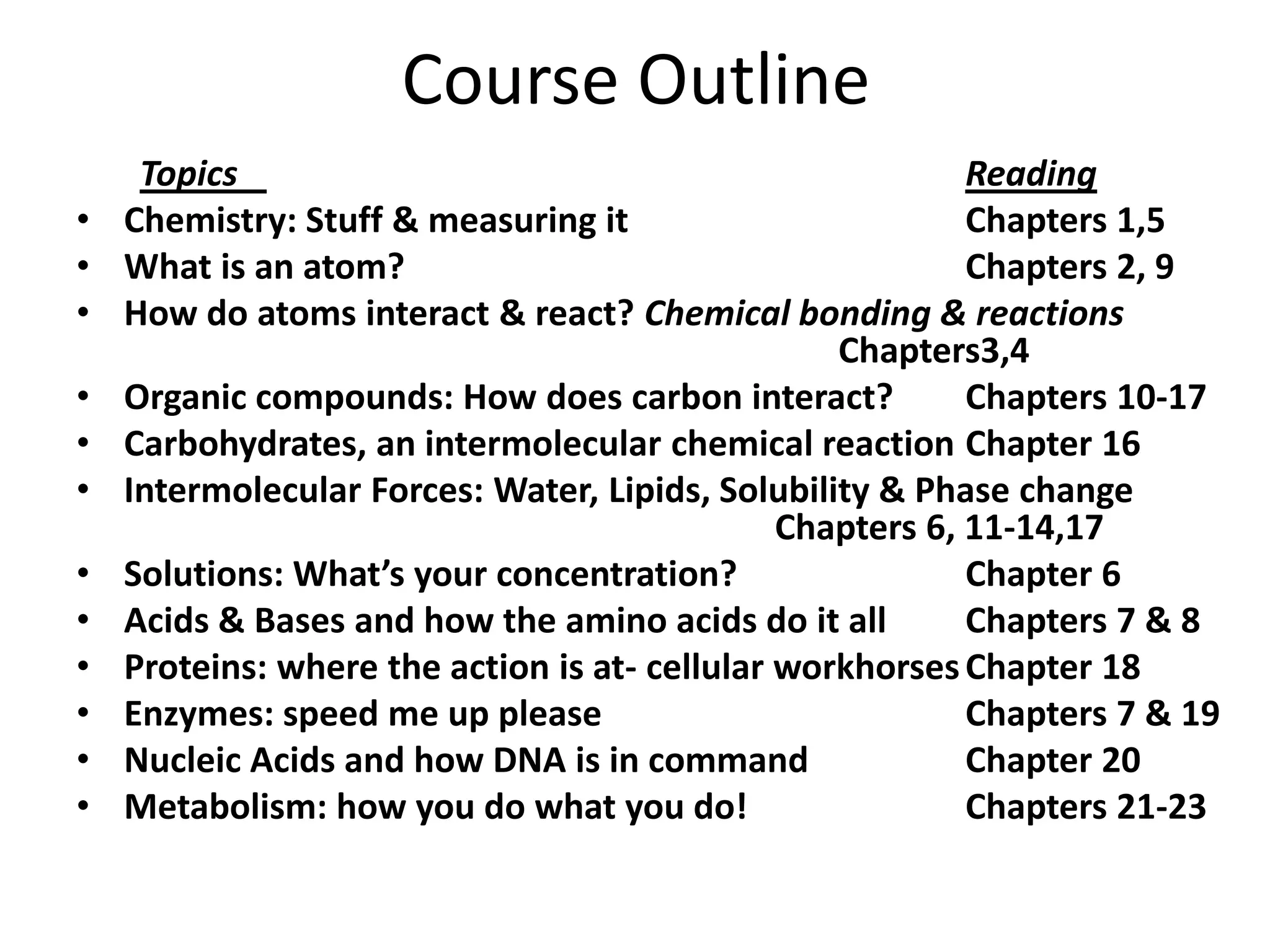
Course Outline
     Topics                                                Reading
•   Chemistry: Stuff & measuring it                        Chapters 1,5
•   What is an atom?                                       Chapters 2, 9
•   How do atoms interact & react? Chemical bonding & reactions
                                                  Chapters3,4
•   Organic compounds: How does carbon interact?           Chapters 10-17
•   Carbohydrates, an intermolecular chemical reaction Chapter 16
•   Intermolecular Forces: Water, Lipids, Solubility & Phase change
                                               Chapters 6, 11-14,17
•   Solutions: What’s your concentration?                  Chapter 6
•   Acids & Bases and how the amino acids do it all        Chapters 7 & 8
•   Proteins: where the action is at- cellular workhorses Chapter 18
•   Enzymes: speed me up please                            Chapters 7 & 19
•   Nucleic Acids and how DNA is in command                Chapter 20
•   Metabolism: how you do what you do!                    Chapters 21-23
Chemistry
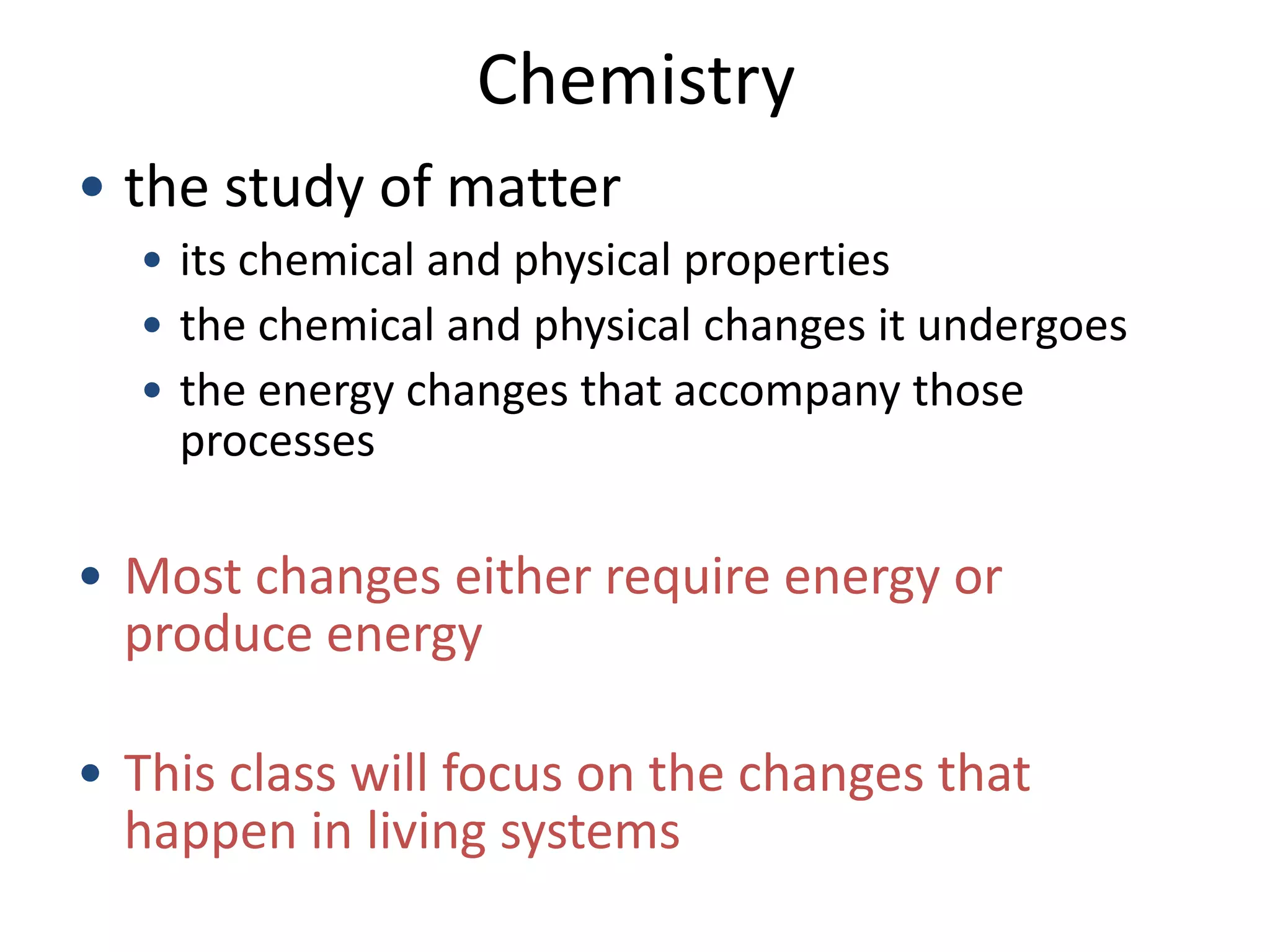
• the study of matter
  • its chemical and physical properties
  • the chemical and physical changes it undergoes
  • the energy changes that accompany those
    processes

• Most changes either require energy or
  produce energy

• This class will focus on the changes that
  happen in living systems
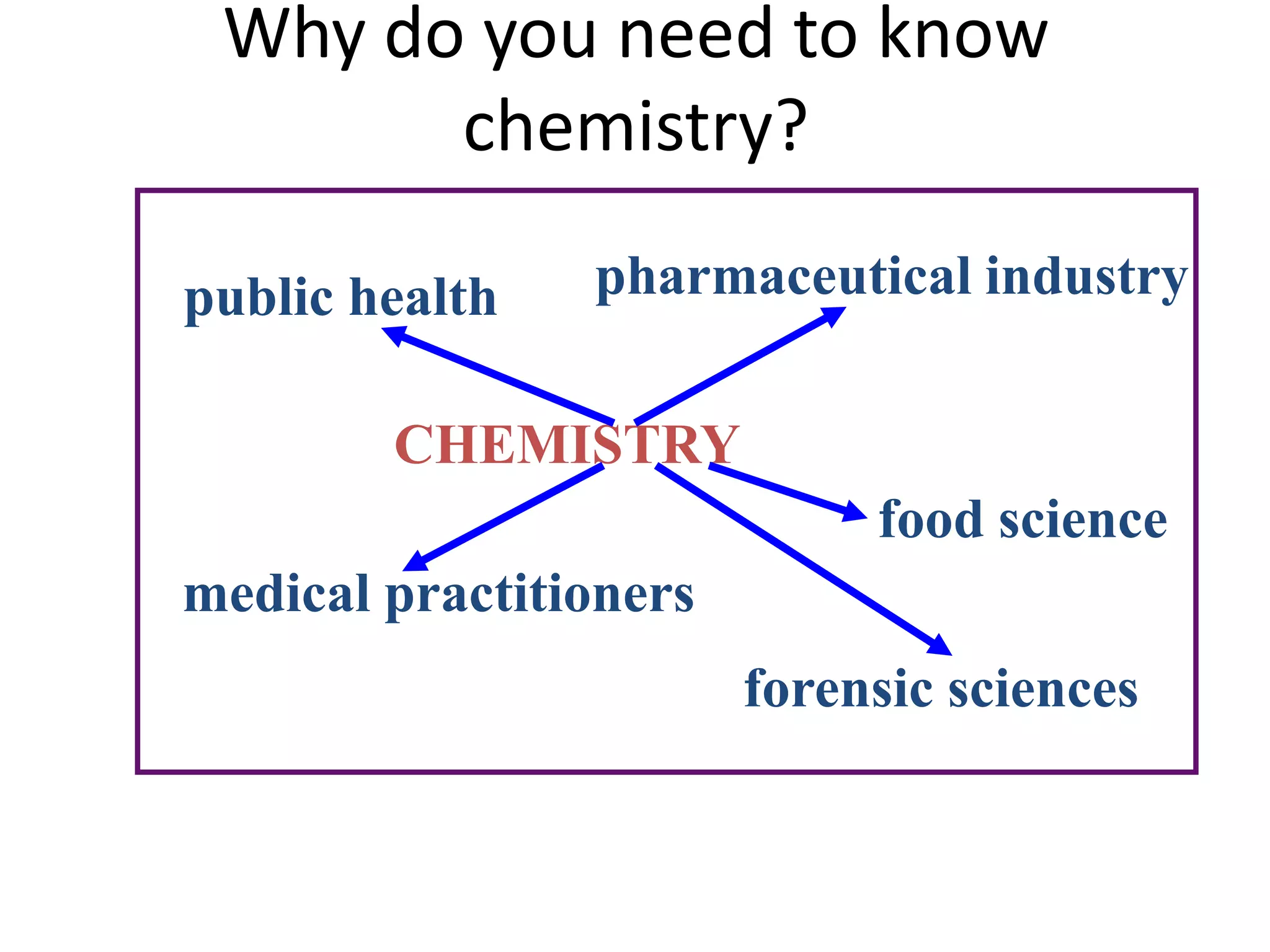
Why do you need to know
       chemistry?

public health   pharmaceutical industry

        CHEMISTRY
                             food science
medical practitioners
                        forensic sciences
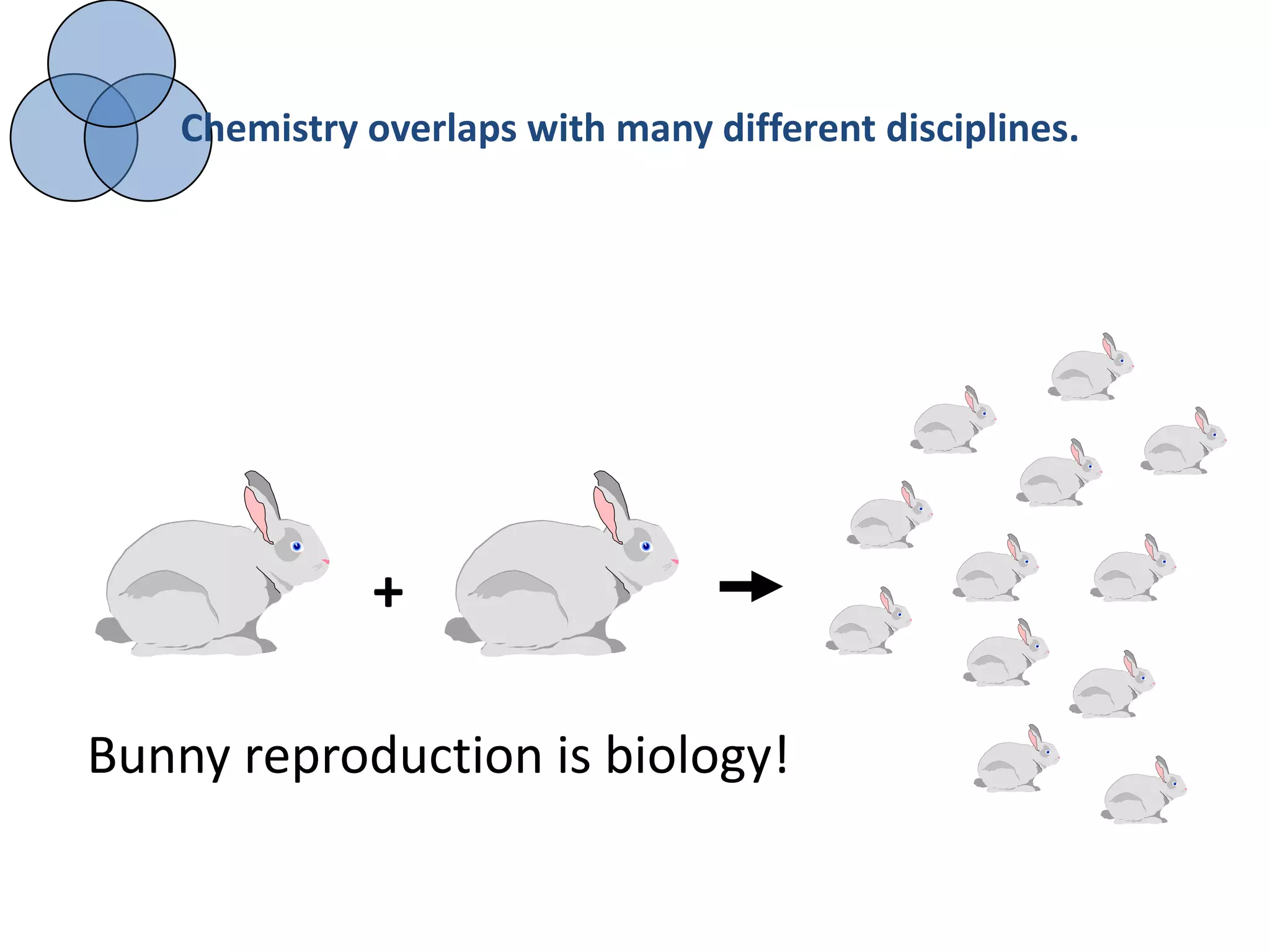
Chemistry overlaps with many different disciplines.


             +

Bunny reproduction is biology!
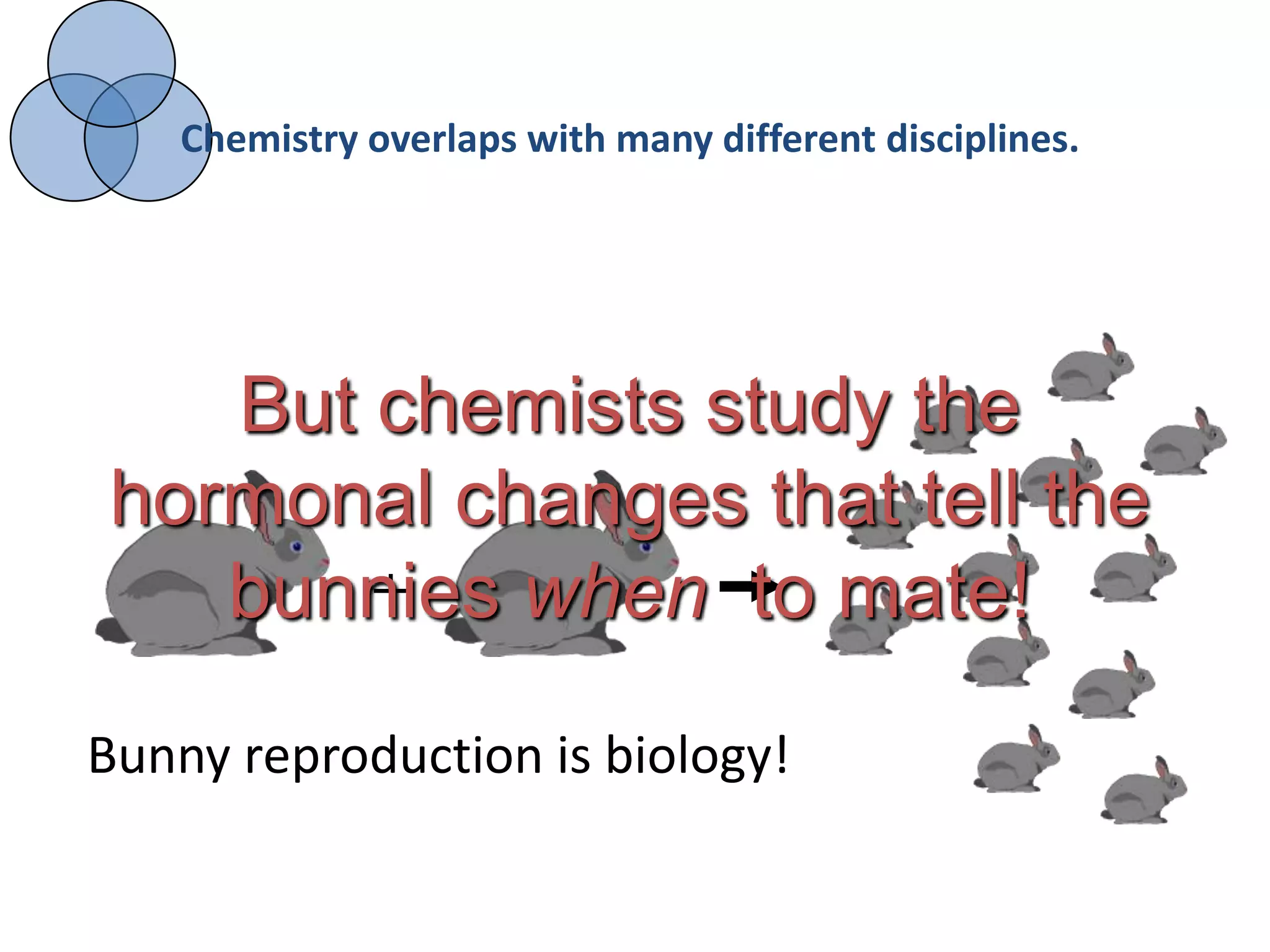
Chemistry overlaps with many different disciplines.


   But chemists study the
hormonal changes that tell the
   bunnies when to mate!
       +

Bunny reproduction is biology!
Chemistry overlaps with many different disciplines.


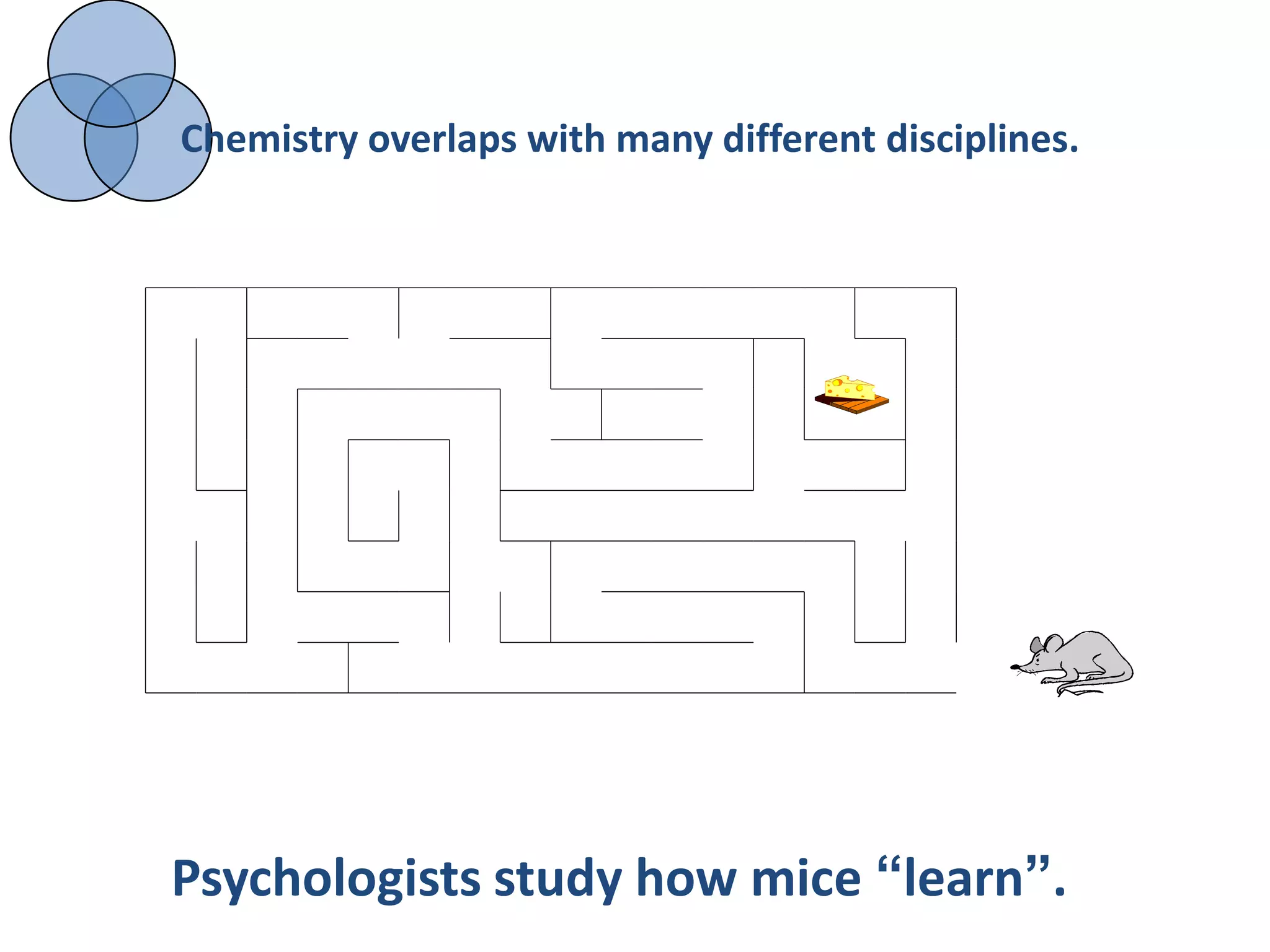
Psychologists study how mice “learn”.
Chemistry overlaps with many different disciplines.


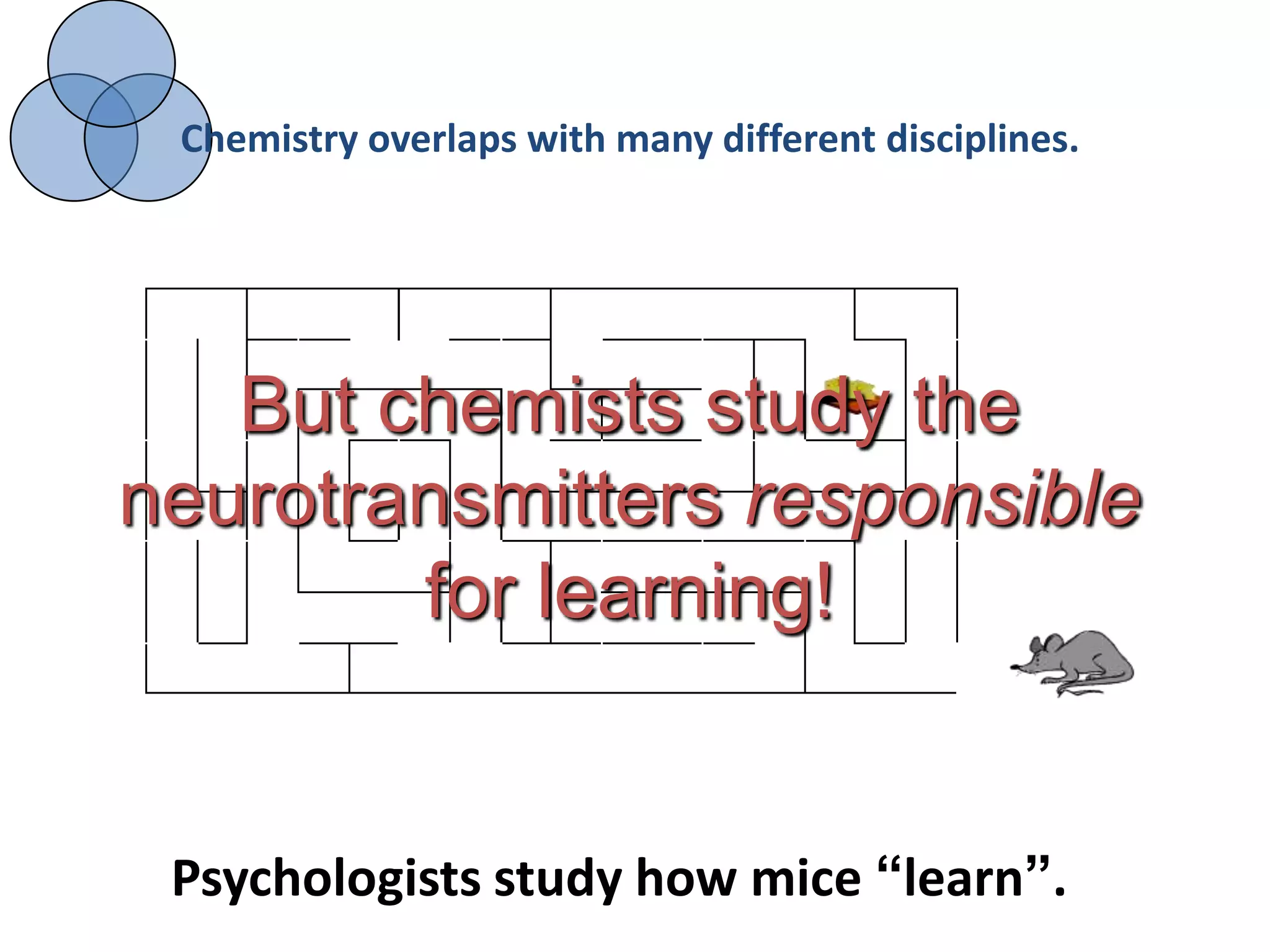
   But chemists study the
neurotransmitters responsible
        for learning!


 Psychologists study how mice “learn”.
Chemistry overlaps with many different disciplines.


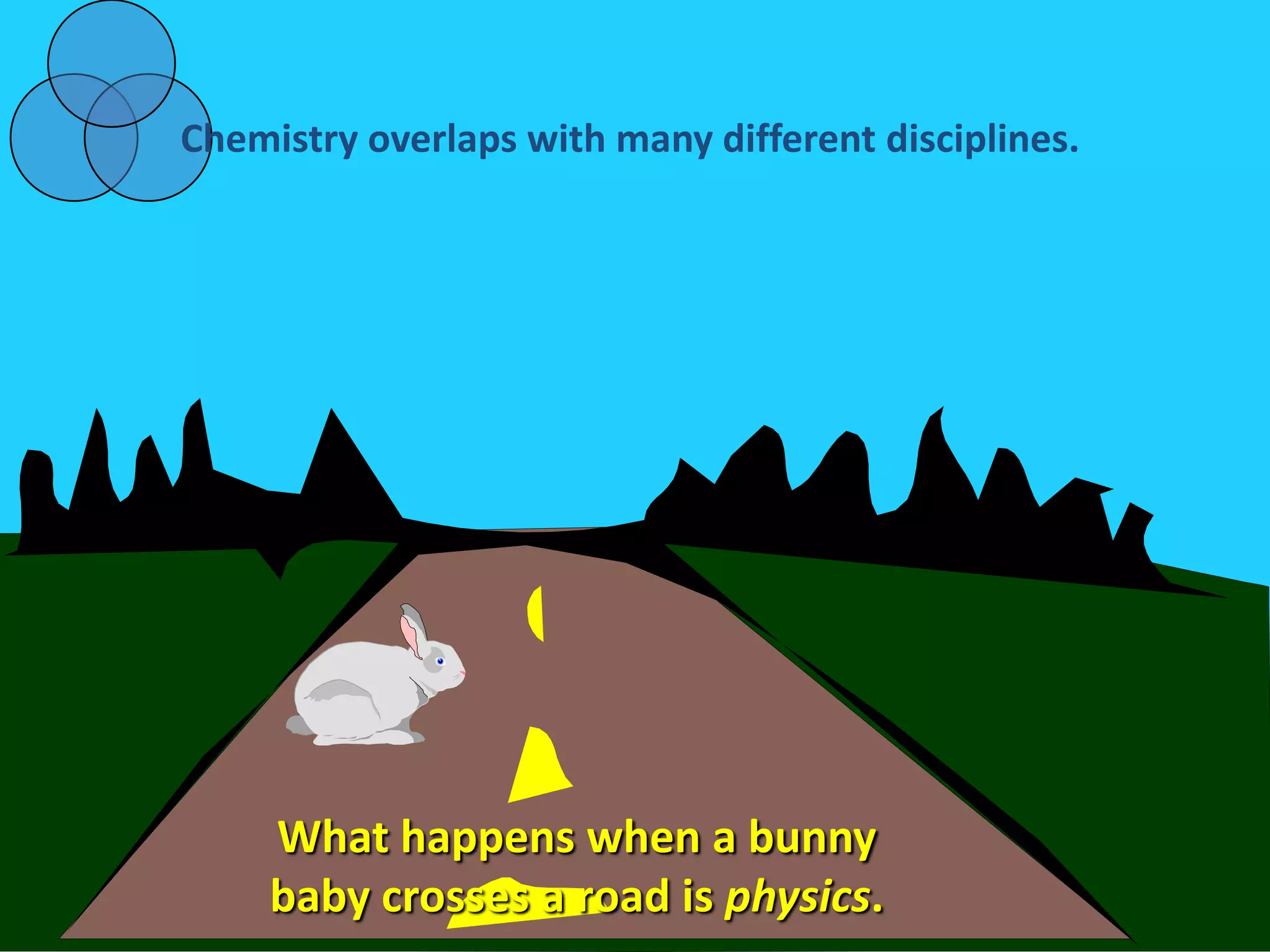
     What happens when a bunny
     baby crosses a road is physics.
Chemistry overlaps with many different disciplines.


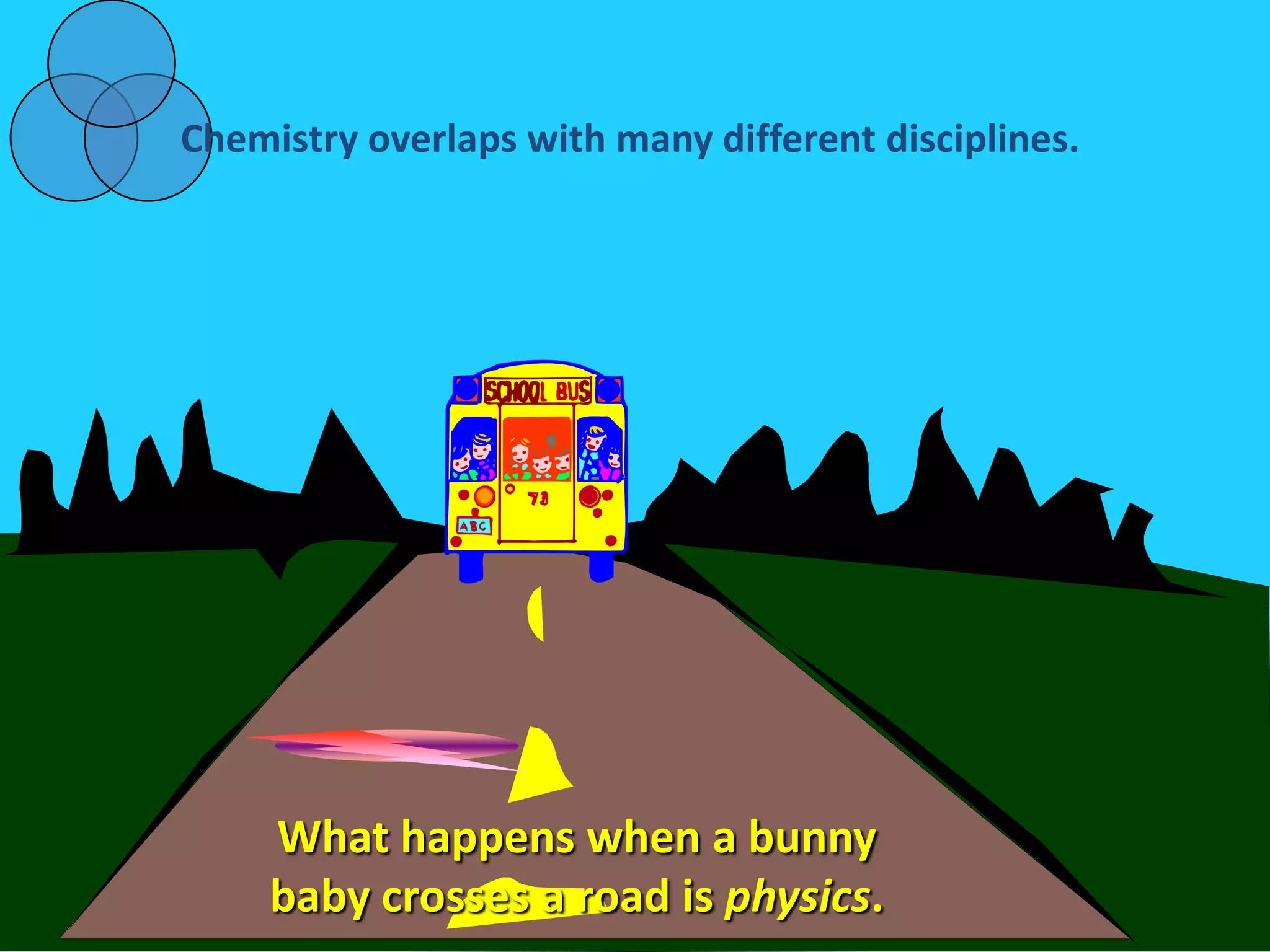
     What happens when a bunny
     baby crosses a road is physics.
Chemistry overlaps with many different disciplines.


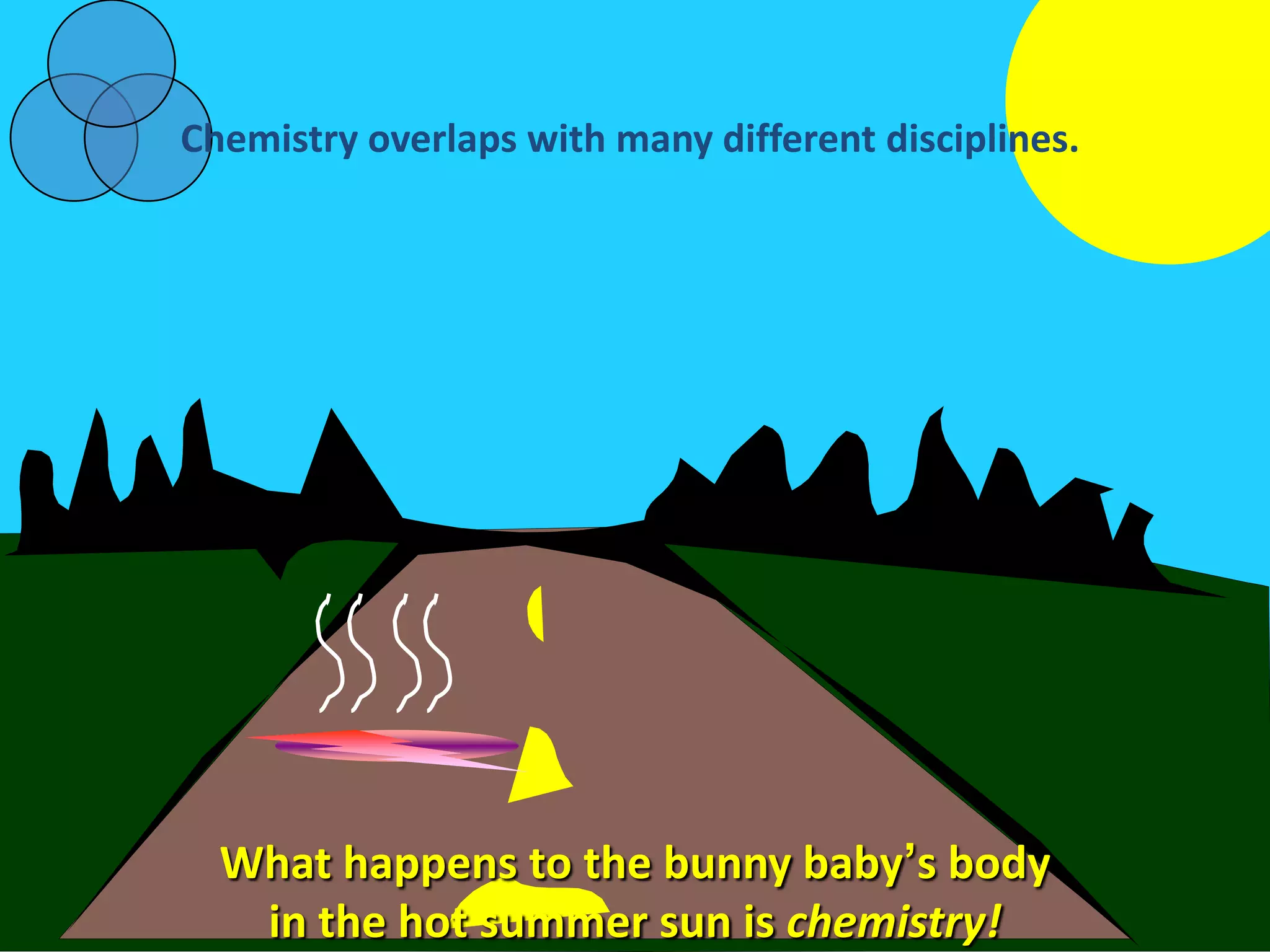
  What happens to the bunny baby‟s body
   in the hot summer sun is chemistry!
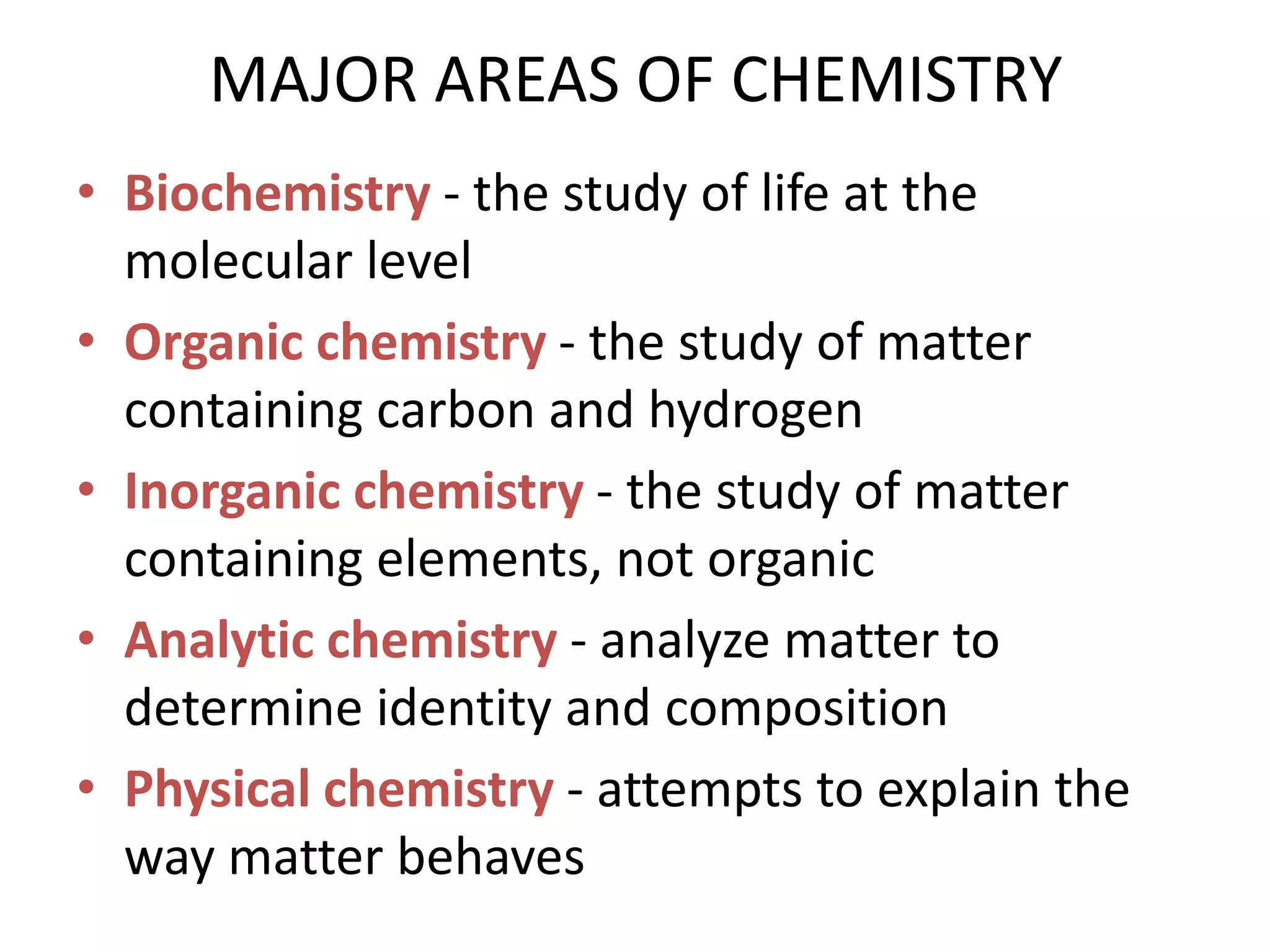
MAJOR AREAS OF CHEMISTRY
• Biochemistry - the study of life at the
  molecular level
• Organic chemistry - the study of matter
  containing carbon and hydrogen
• Inorganic chemistry - the study of matter
  containing elements, not organic
• Analytic chemistry - analyze matter to
  determine identity and composition
• Physical chemistry - attempts to explain the
  way matter behaves
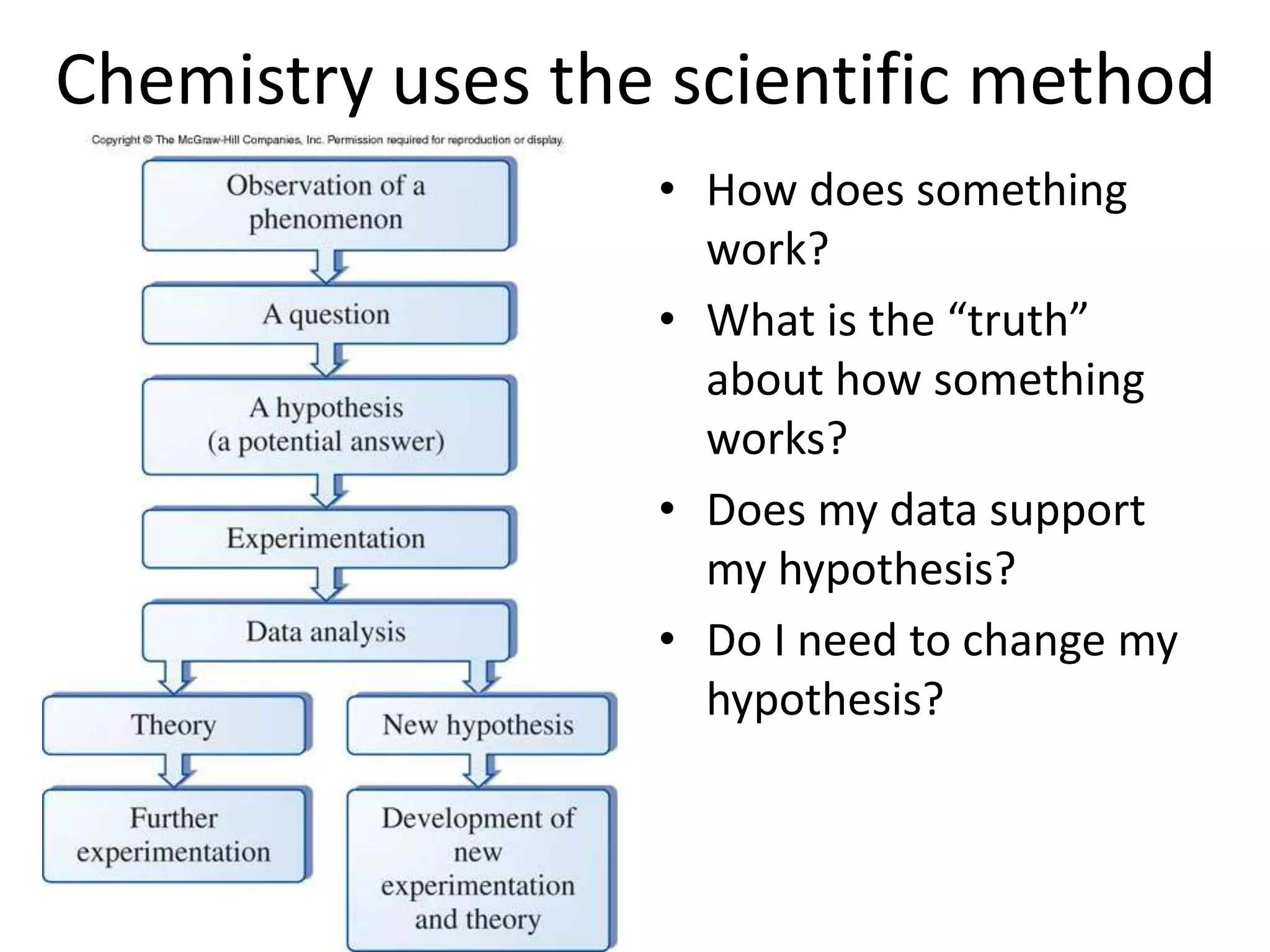
Chemistry uses the scientific method
                  • How does something
                    work?
                  • What is the “truth”
                    about how something
                    works?
                  • Does my data support
                    my hypothesis?
                  • Do I need to change my
                    hypothesis?
Experimental methods
• Experiments produce DATA & RESULTS
• DATA:
  – Recorded observations or measurements
     • Mass, Time, Temp, volume, energy


• RESULTS:
  – Outcome of experiment
  – Conclusions drawn from observations
  – Usually several pieces of data form a result
CHEMISTRY
the study of matter
  and its changes
      . . . but what is matter?
CHEMISTRY
 the study of matter
   and its changes

       Matter is “stuff ”
(anything with mass and volume)
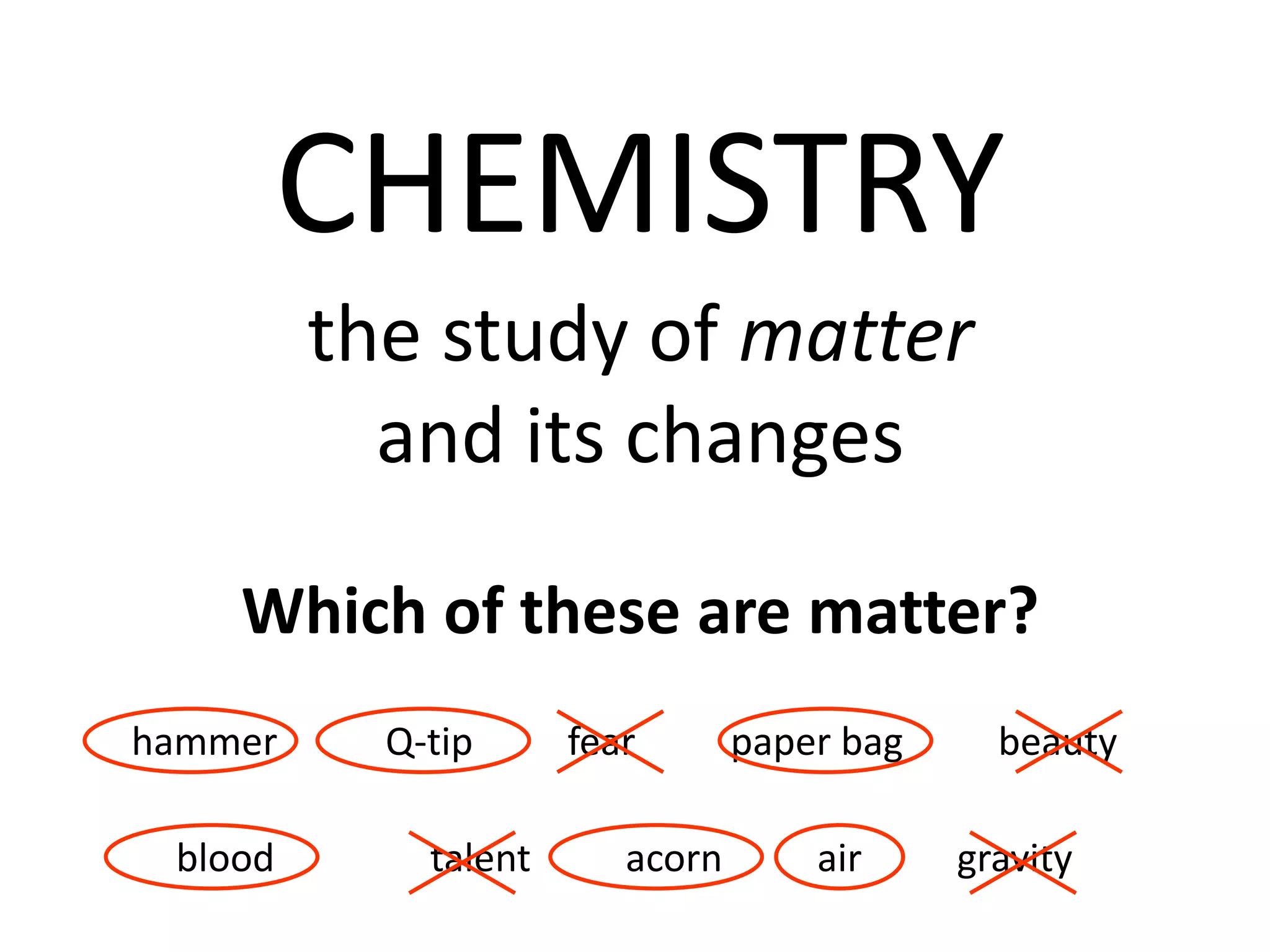
CHEMISTRY
         the study of matter
           and its changes

    Which of these are matter?
hammer     Q-tip      fear       paper bag     beauty

 blood       talent      acorn       air     gravity
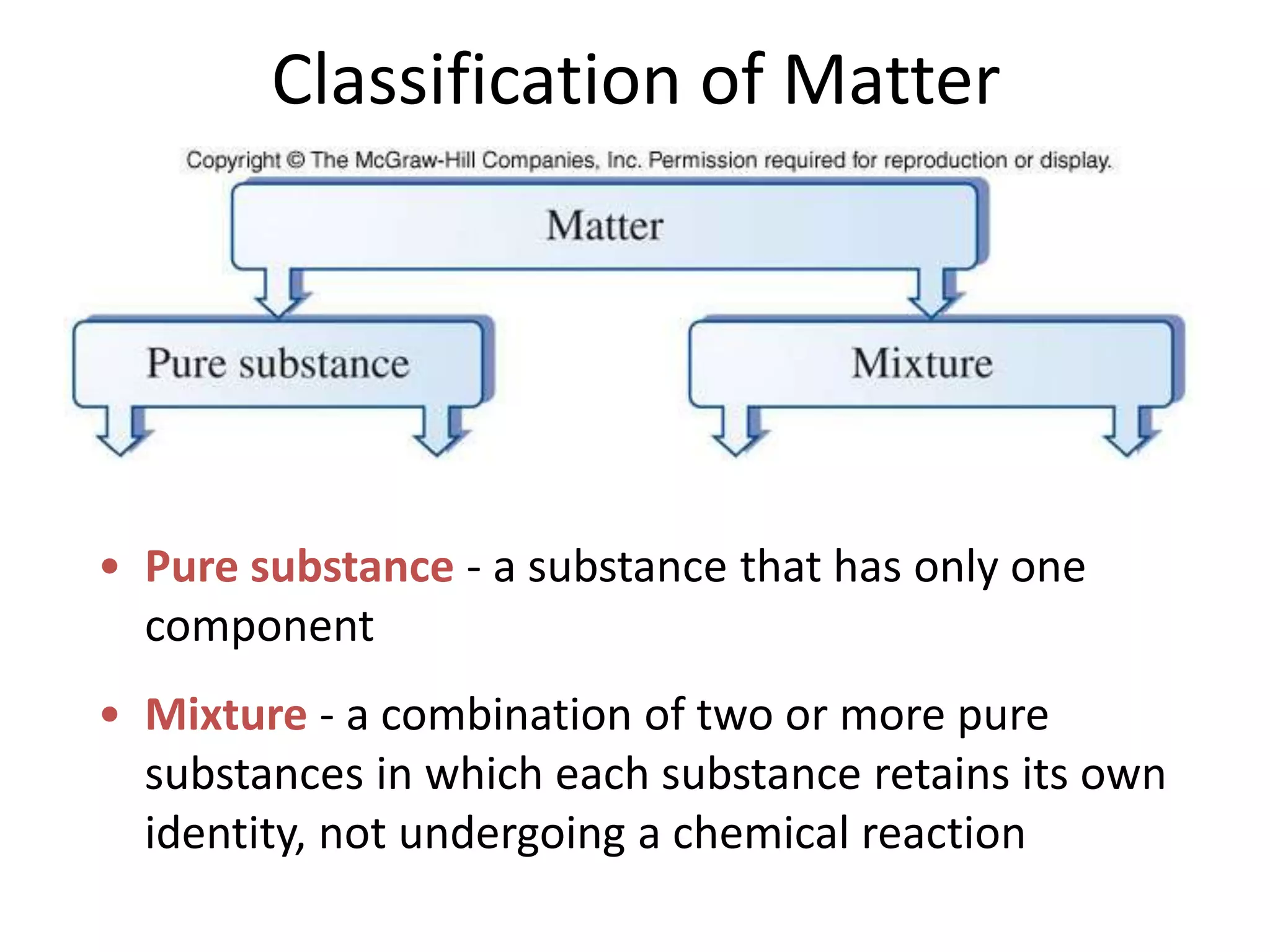
Classification of Matter


• Pure substance - a substance that has only one
  component
• Mixture - a combination of two or more pure
  substances in which each substance retains its own
  identity, not undergoing a chemical reaction
Classification of Matter


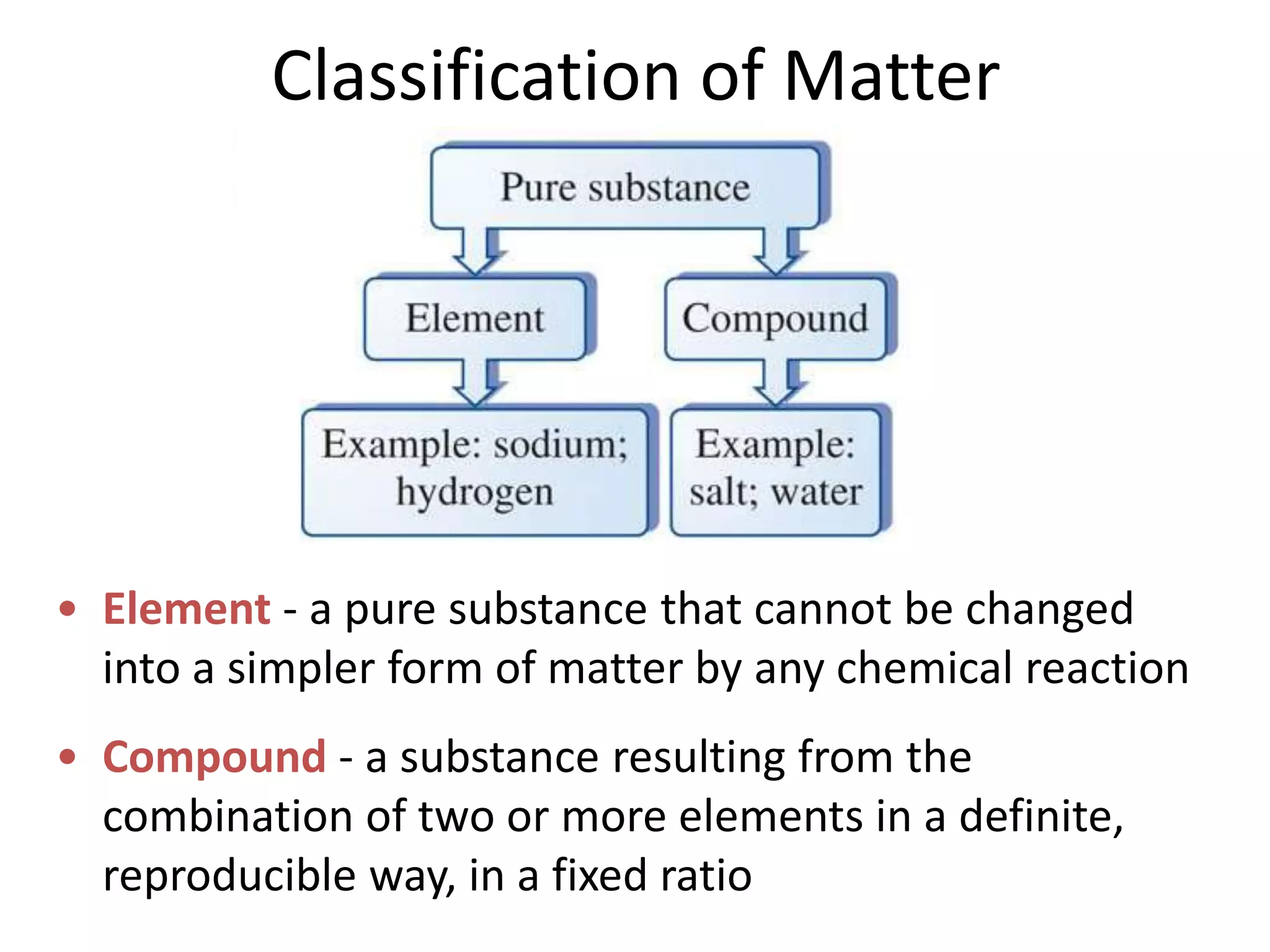
• Element - a pure substance that cannot be changed
  into a simpler form of matter by any chemical reaction
• Compound - a substance resulting from the
  combination of two or more elements in a definite,
  reproducible way, in a fixed ratio
Classification of Matter


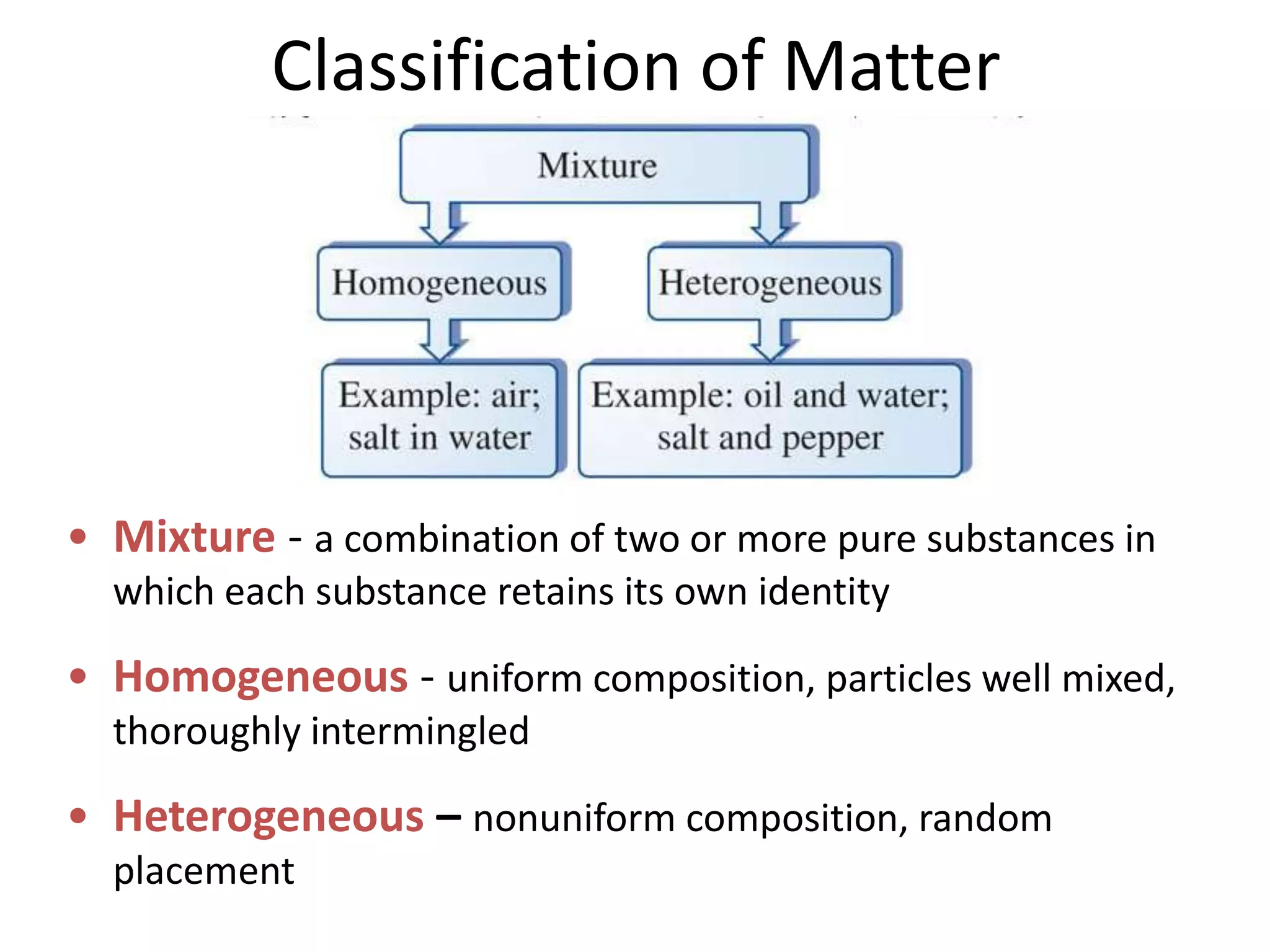
• Mixture - a combination of two or more pure substances in
  which each substance retains its own identity

• Homogeneous - uniform composition, particles well mixed,
  thoroughly intermingled

• Heterogeneous – nonuniform composition, random
  placement
Classification of Matter
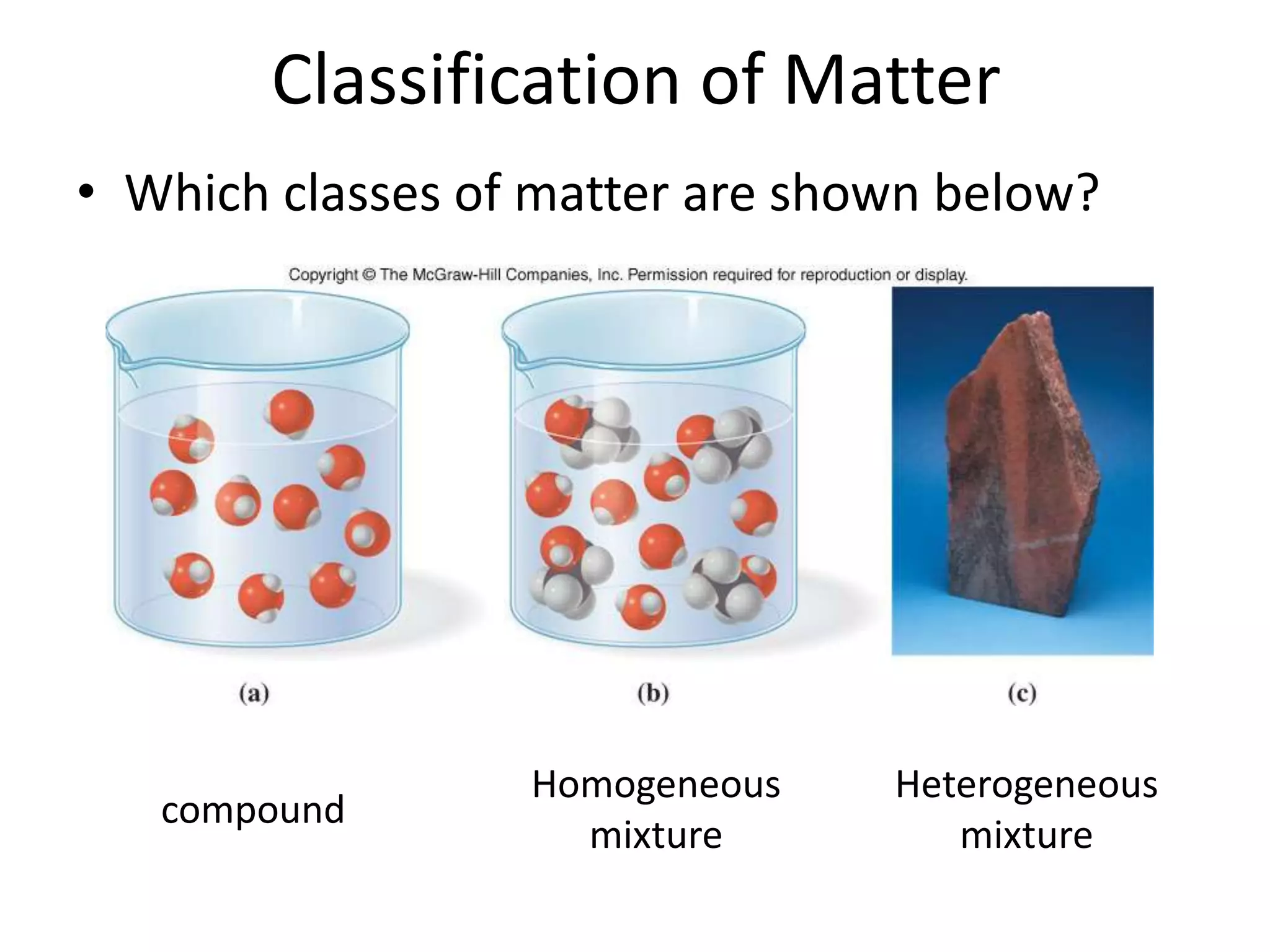
• Which classes of matter are shown below?


                  Homogeneous    Heterogeneous
   compound
                    mixture         mixture
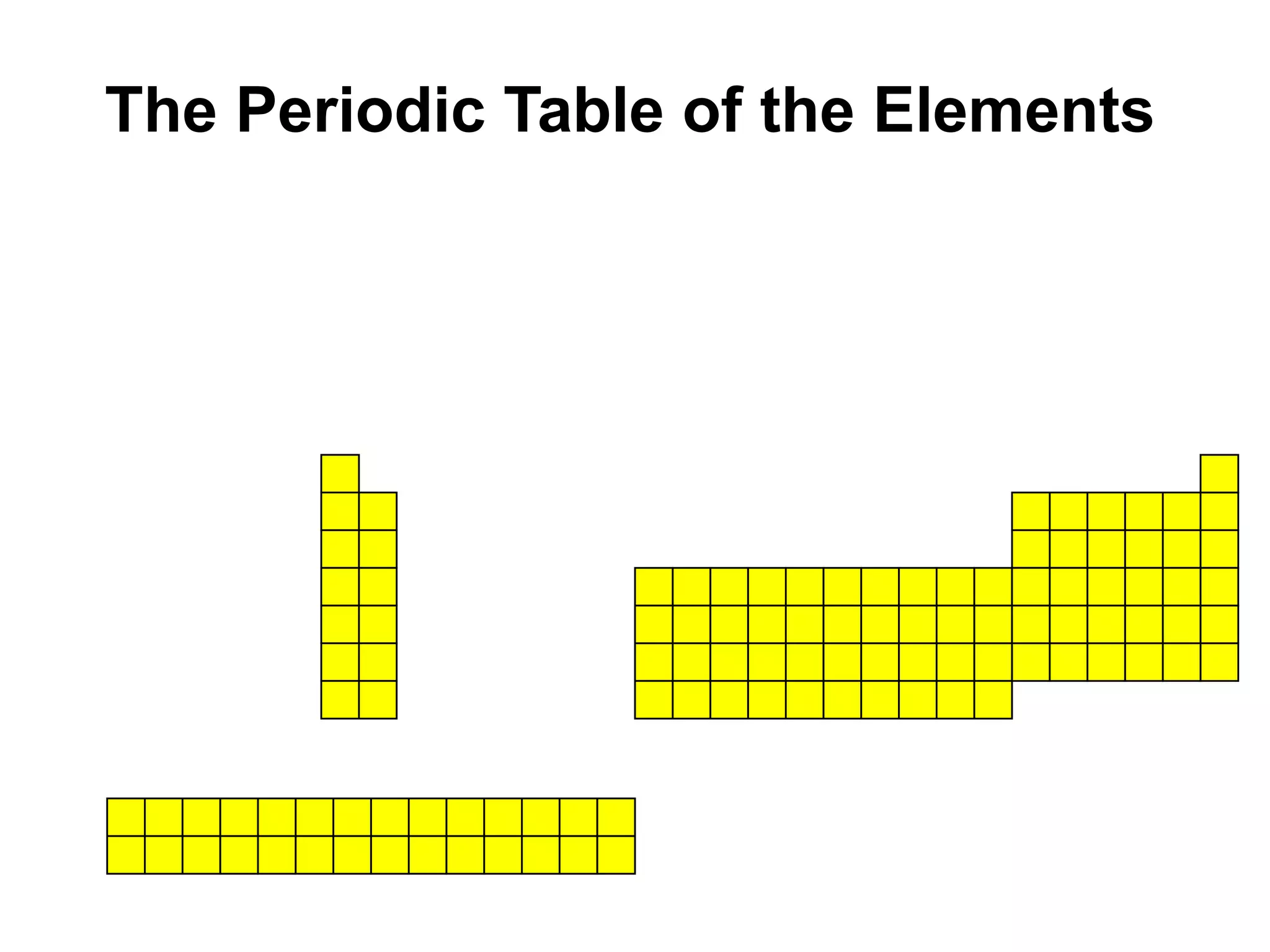
The Periodic Table of
   the Elements
The Periodic Table of the Elements
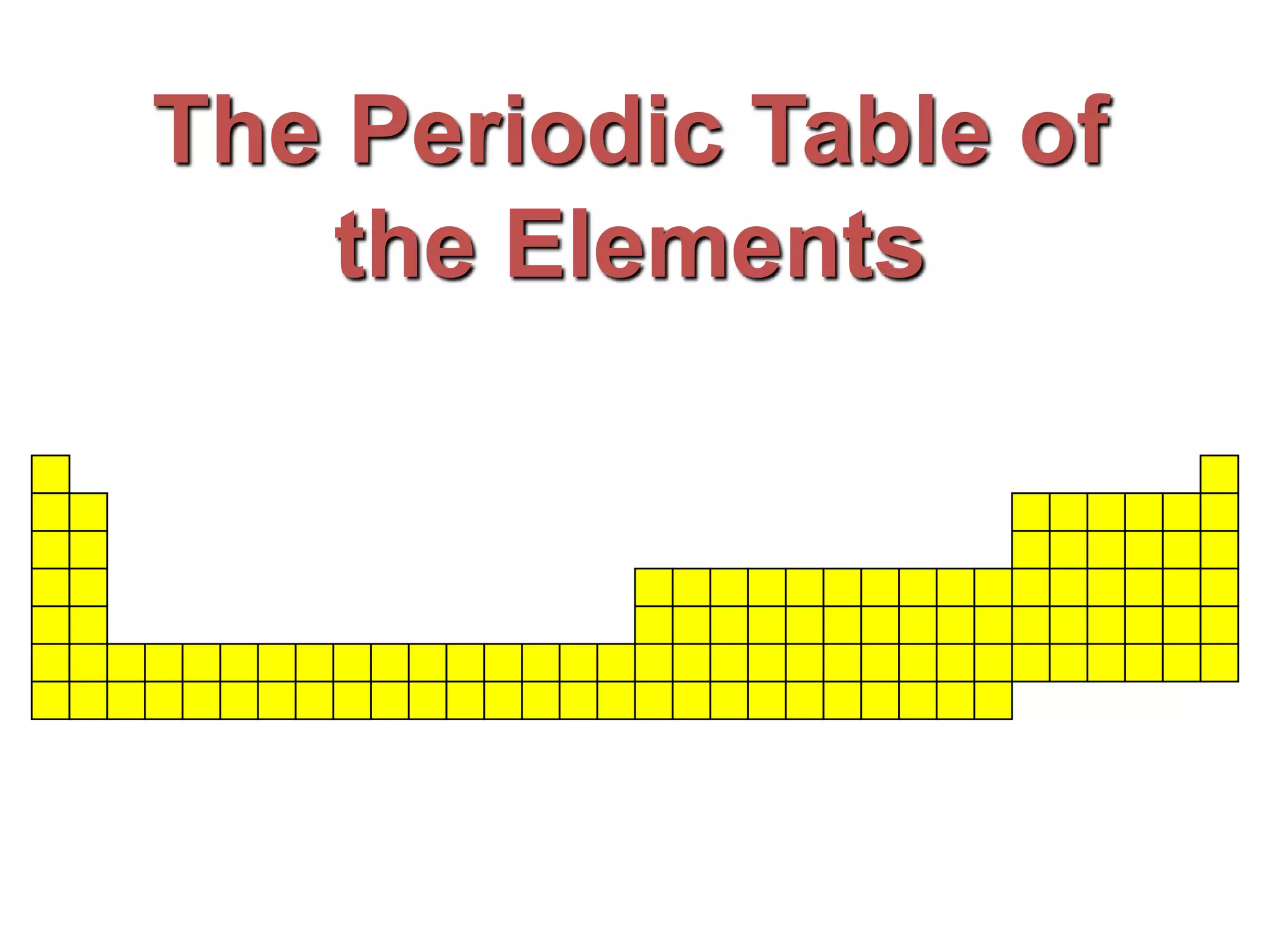
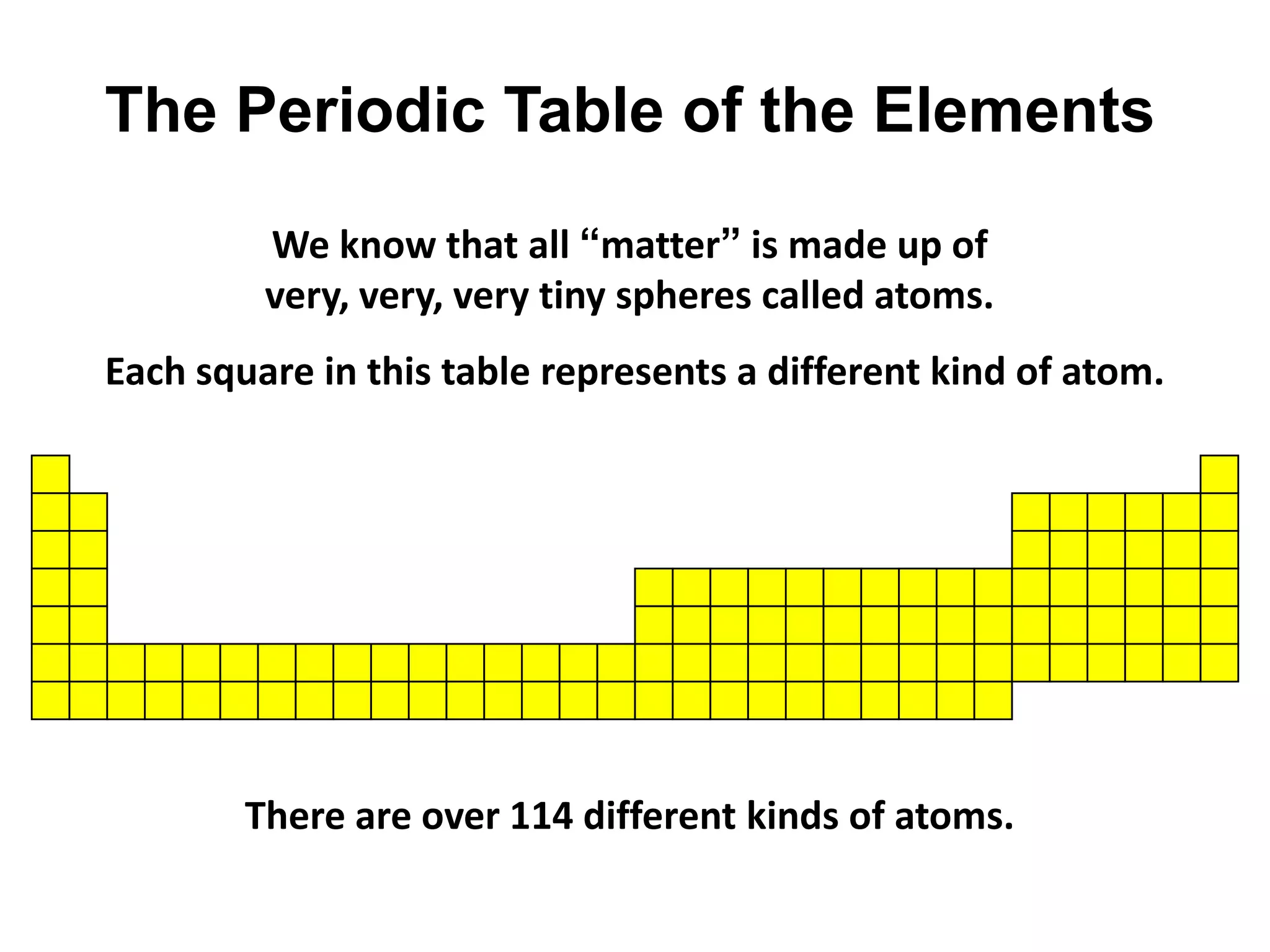
         We know that all “matter” is made up of
         very, very, very tiny spheres called atoms.
Each square in this table represents a different kind of atom.


        There are over 114 different kinds of atoms.
The Periodic Table of the Elements
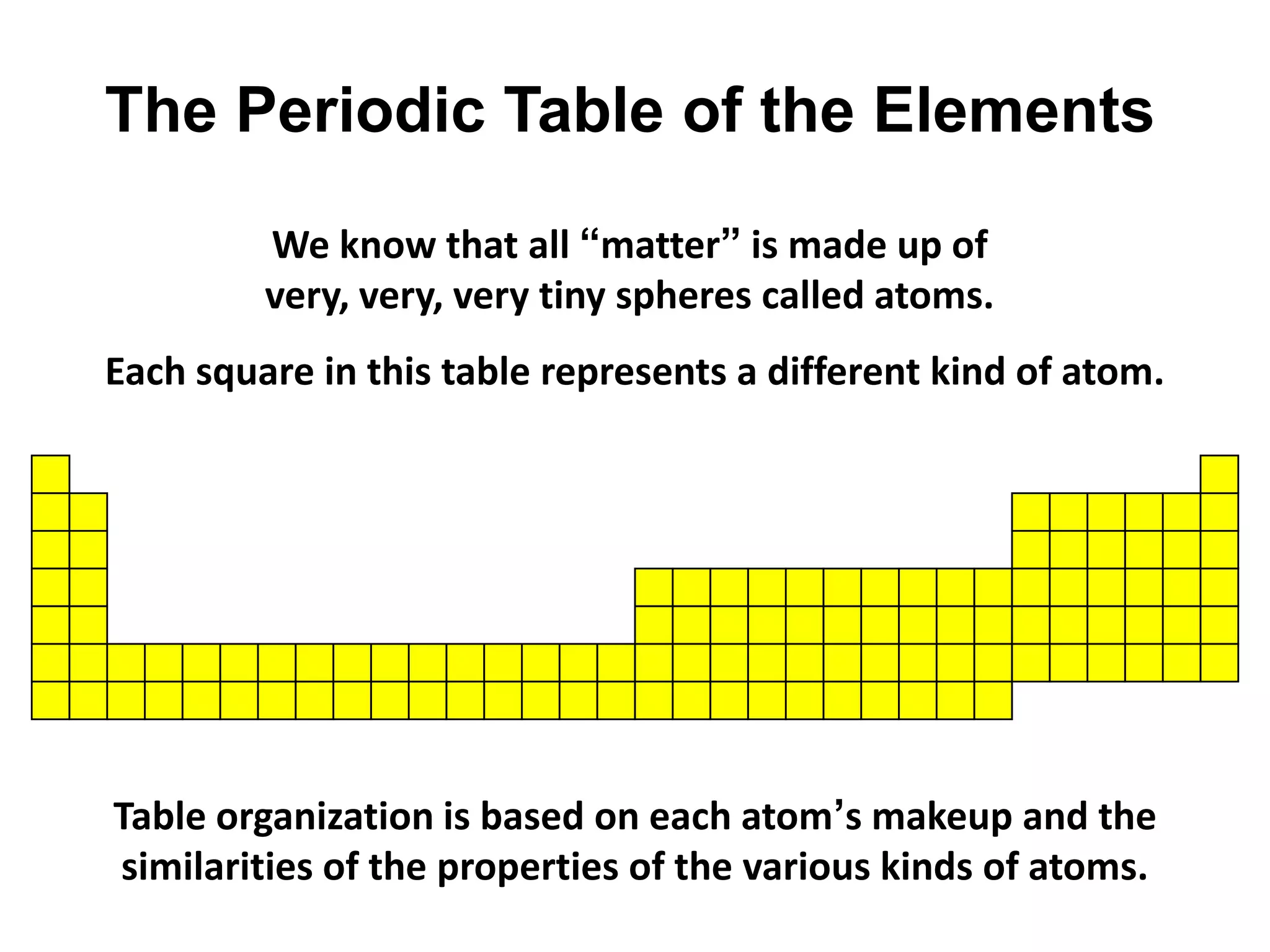
         We know that all “matter” is made up of
         very, very, very tiny spheres called atoms.
Each square in this table represents a different kind of atom.


Table organization is based on each atom‟s makeup and the
similarities of the properties of the various kinds of atoms.
The Periodic Table of the Elements

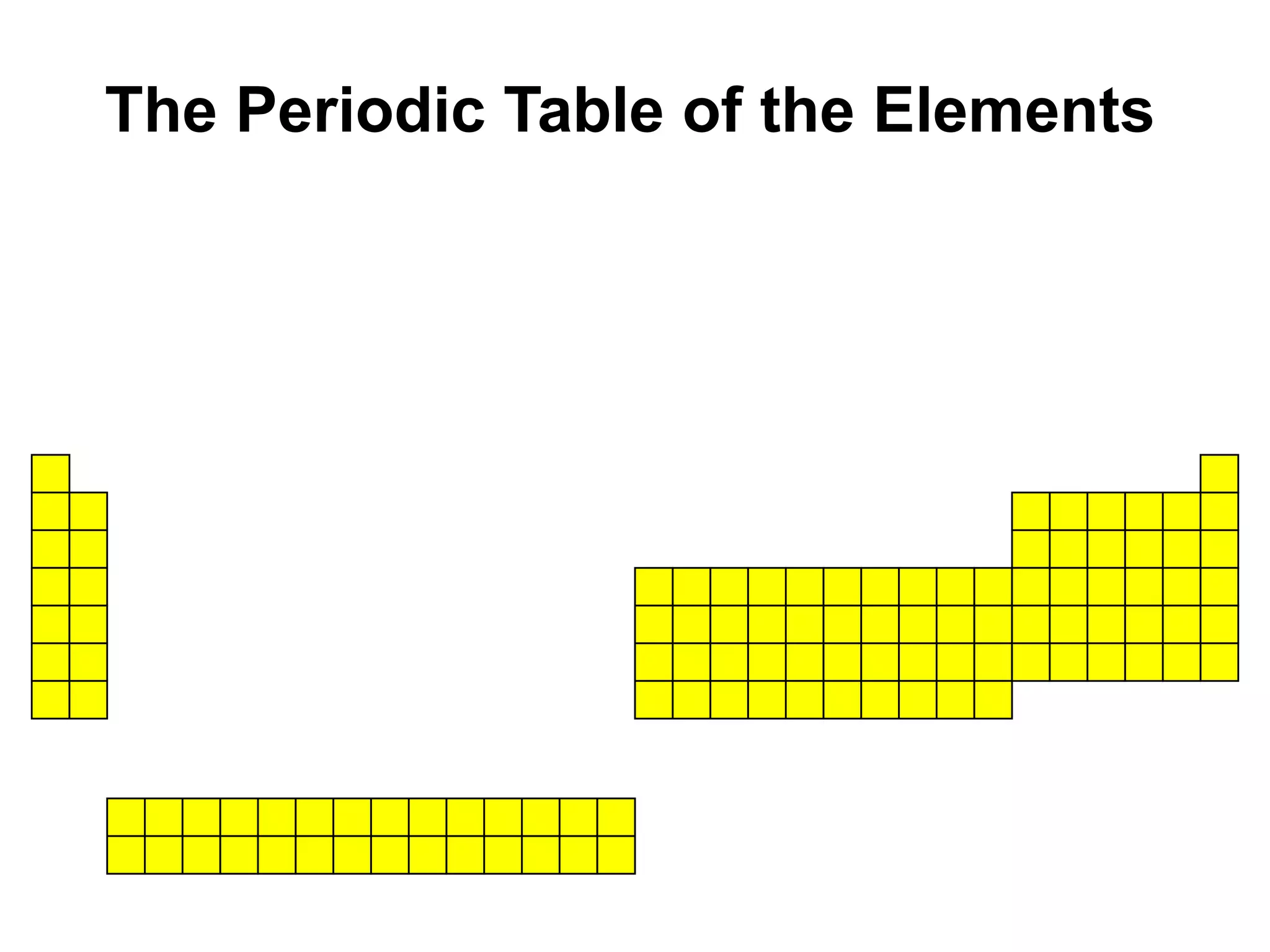
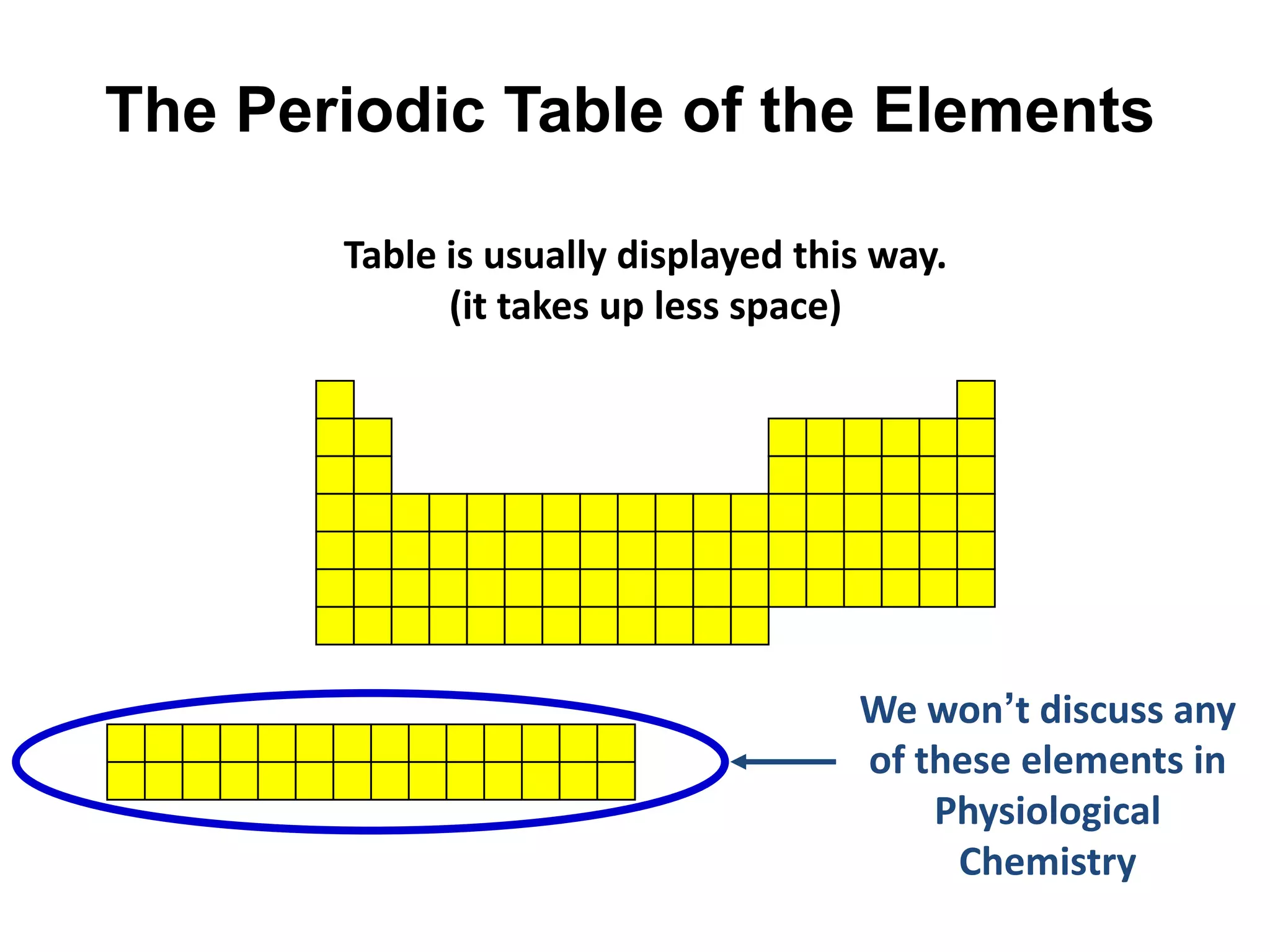
       Table is usually displayed this way.
             (it takes up less space)


                                     We won‟t discuss any
                                     of these elements in
                                         Physiological
                                          Chemistry
The Periodic Table of the Elements
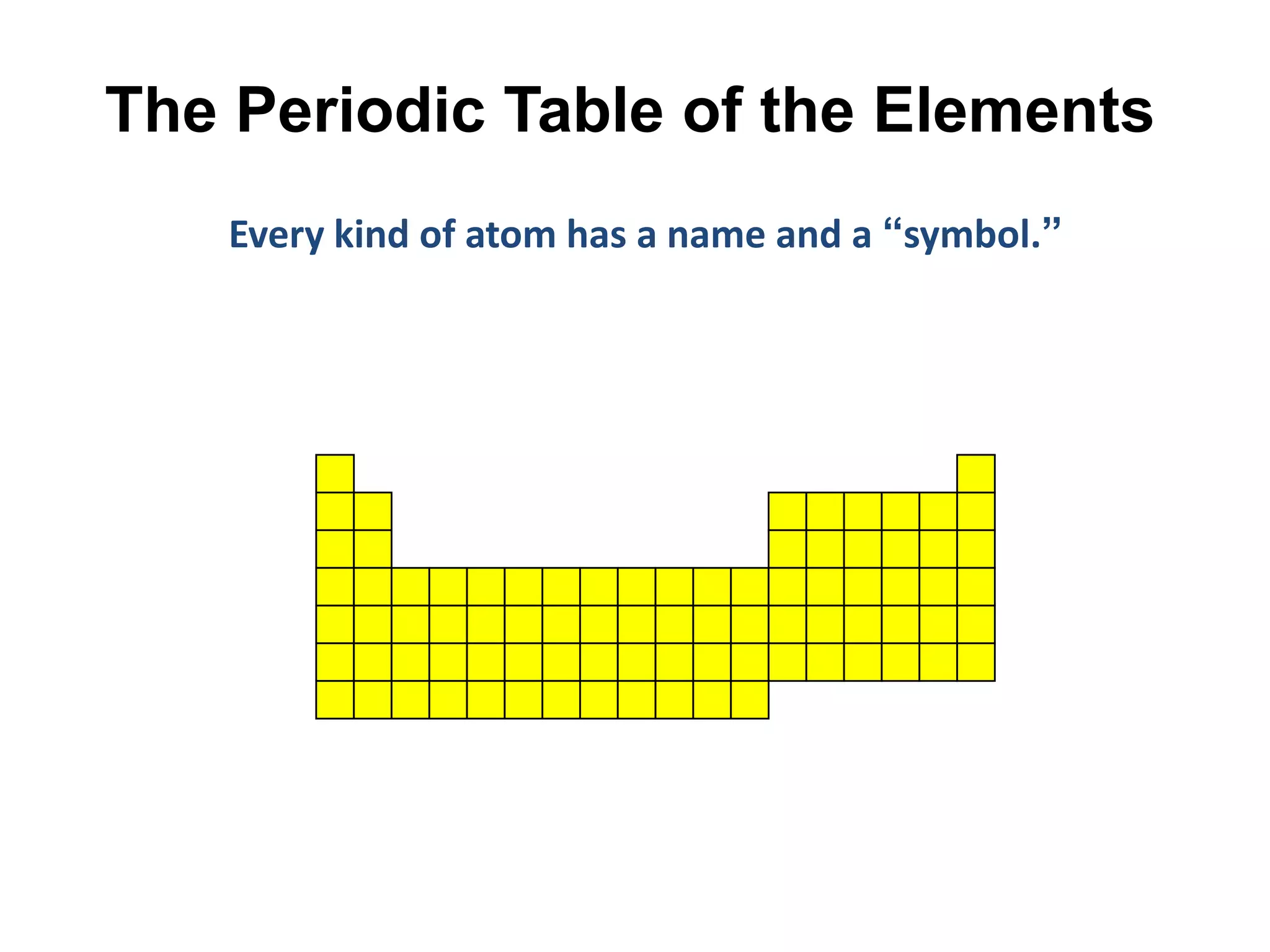
    Every kind of atom has a name and a “symbol.”
The Periodic Table of the Elements
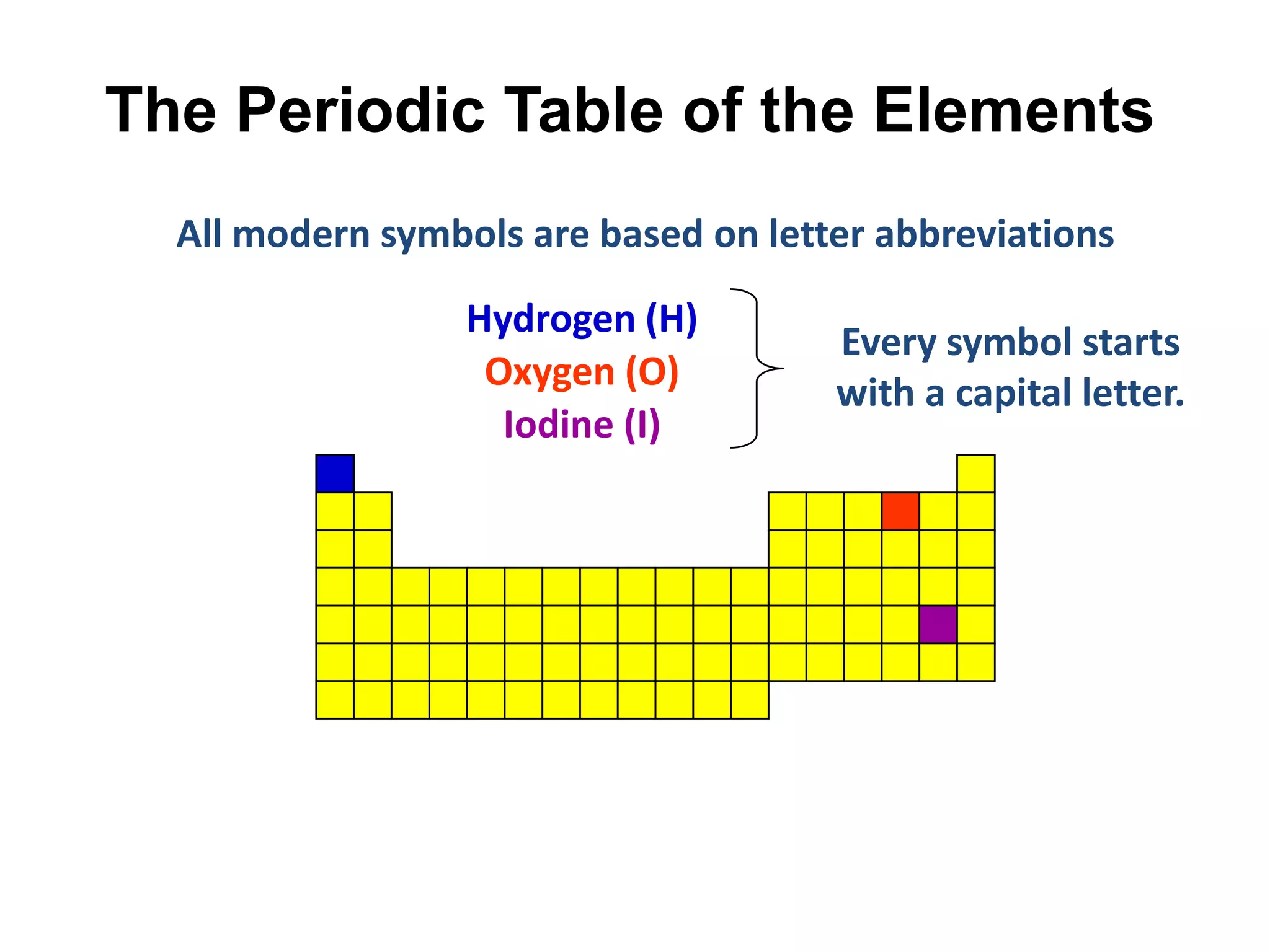
  All modern symbols are based on letter abbreviations

                  Hydrogen (H)
                                      Every symbol starts
                   Oxygen (O)
                                      with a capital letter.
                    Iodine (I)
The Periodic Table of the Elements
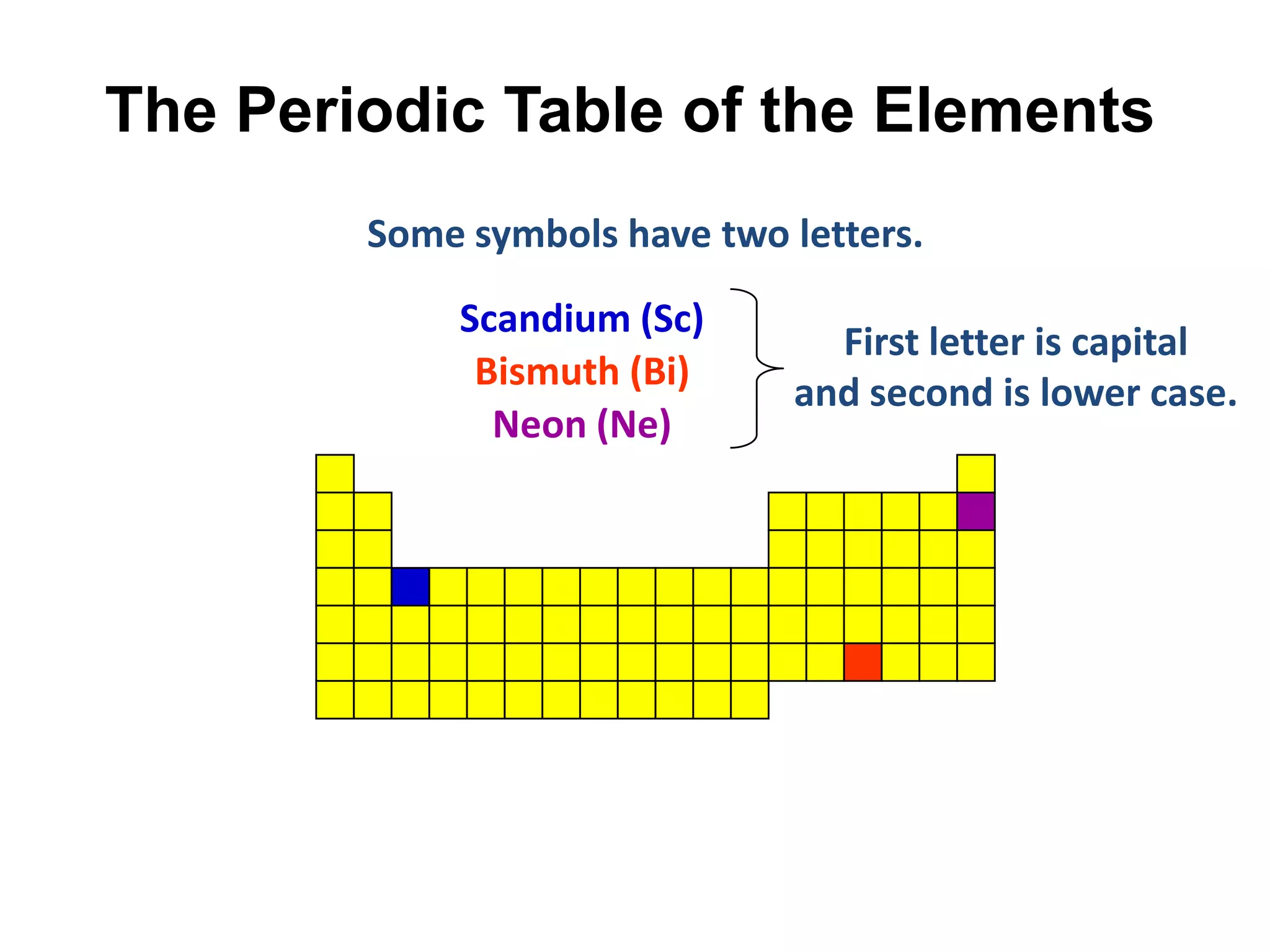
        Some symbols have two letters.

            Scandium (Sc)
                                 First letter is capital
             Bismuth (Bi)
                               and second is lower case.
              Neon (Ne)
The Periodic Table of the Elements
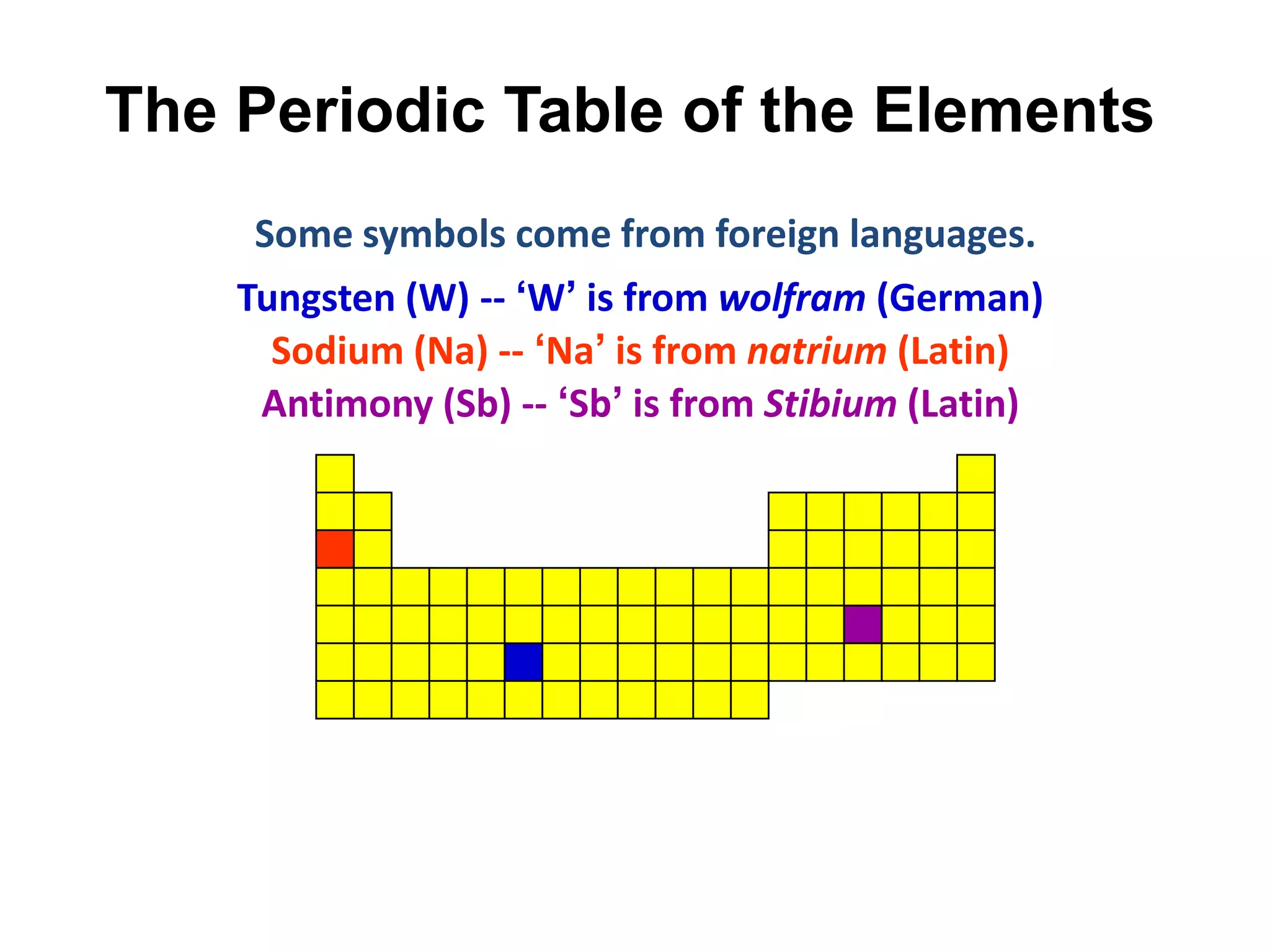
     Some symbols come from foreign languages.
    Tungsten (W) -- „W‟ is from wolfram (German)
      Sodium (Na) -- „Na‟ is from natrium (Latin)
     Antimony (Sb) -- „Sb‟ is from Stibium (Latin)
The Periodic Table of the Elements
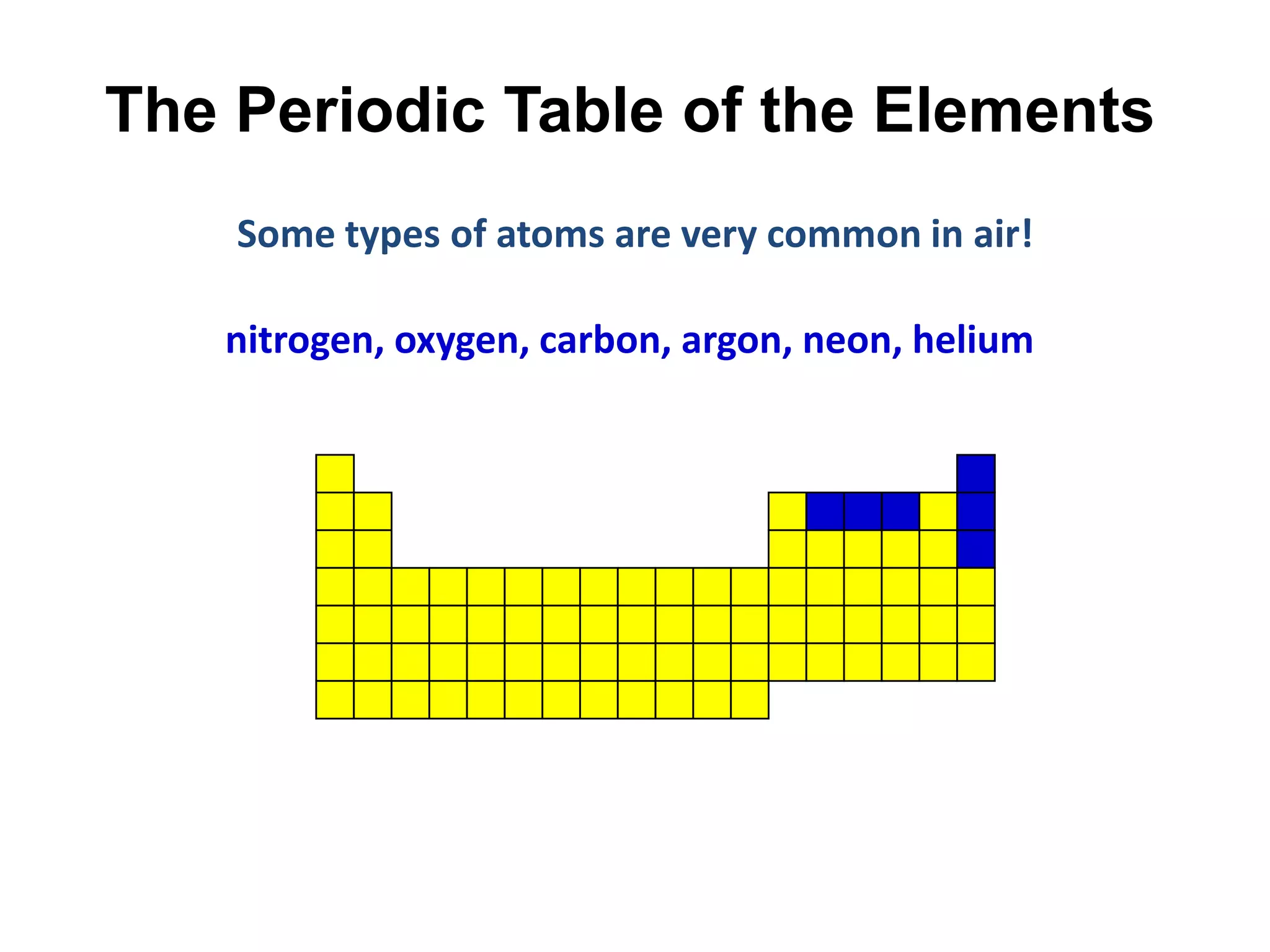
    Some types of atoms are very common in air!

   nitrogen, oxygen, carbon, argon, neon, helium
The Periodic Table of the Elements
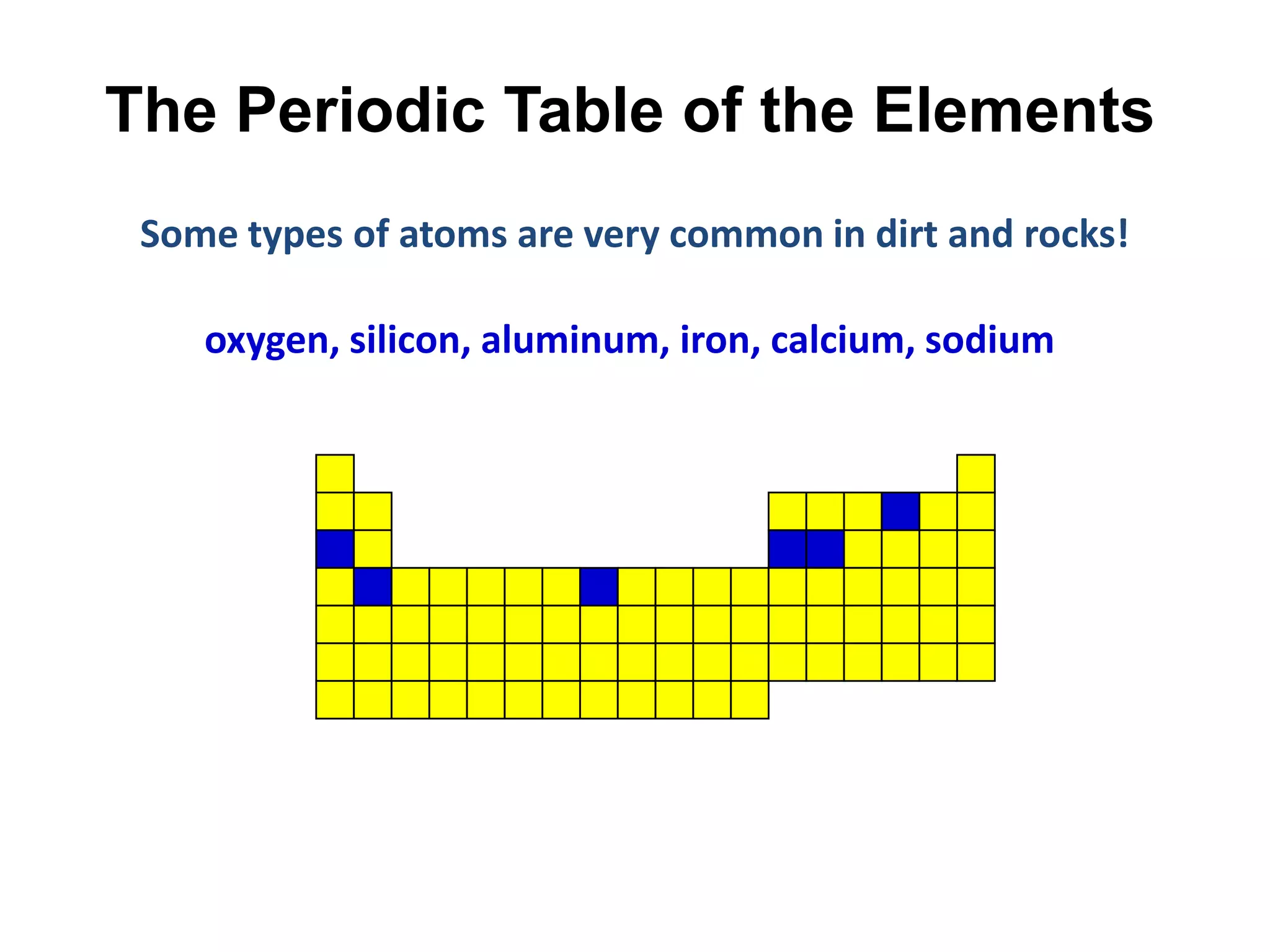
 Some types of atoms are very common in dirt and rocks!

    oxygen, silicon, aluminum, iron, calcium, sodium
The Periodic Table of the Elements
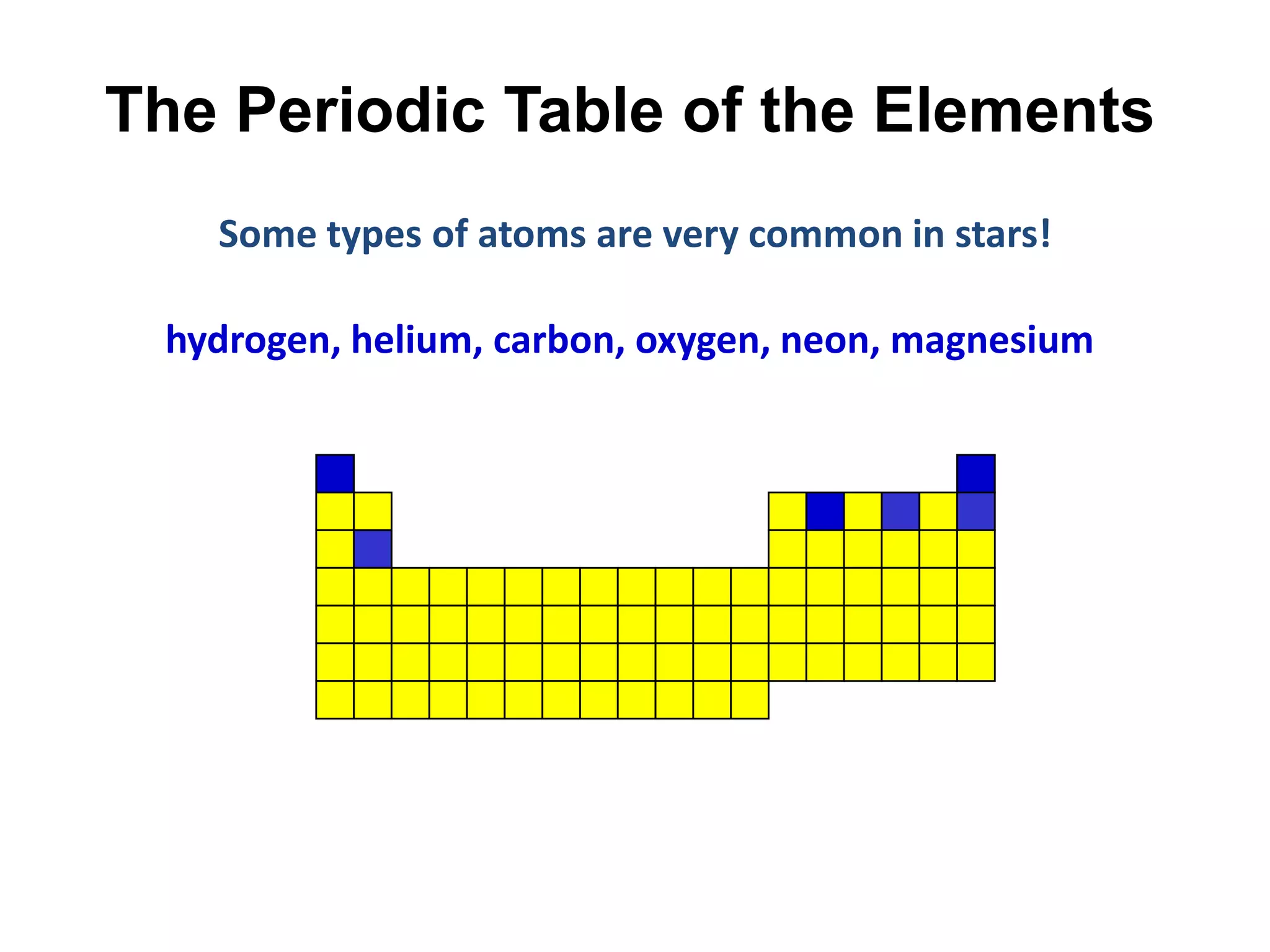
   Some types of atoms are very common in stars!

 hydrogen, helium, carbon, oxygen, neon, magnesium
The Periodic Table of the Elements
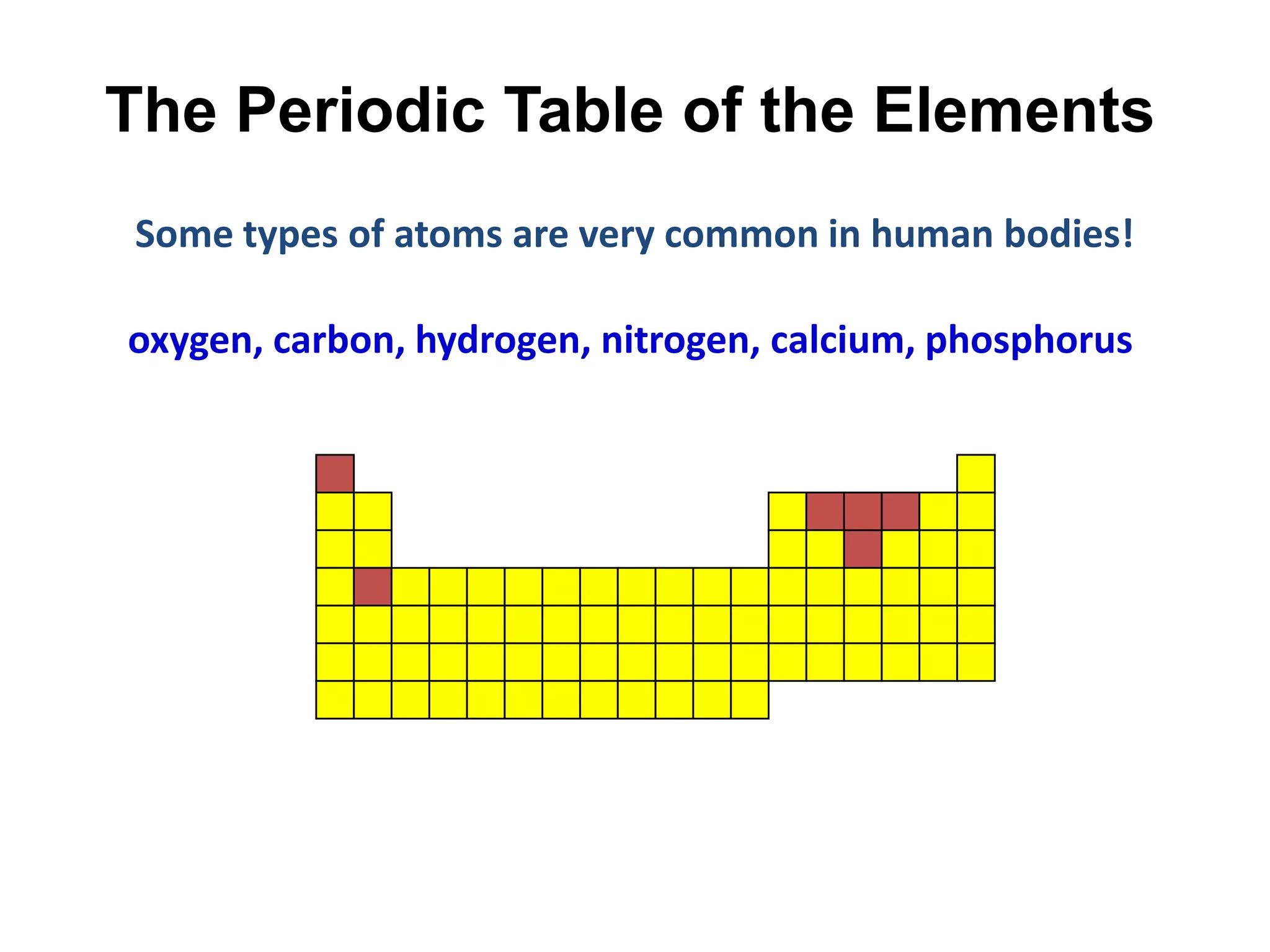
Some types of atoms are very common in human bodies!

oxygen, carbon, hydrogen, nitrogen, calcium, phosphorus
The Periodic Table of the Elements
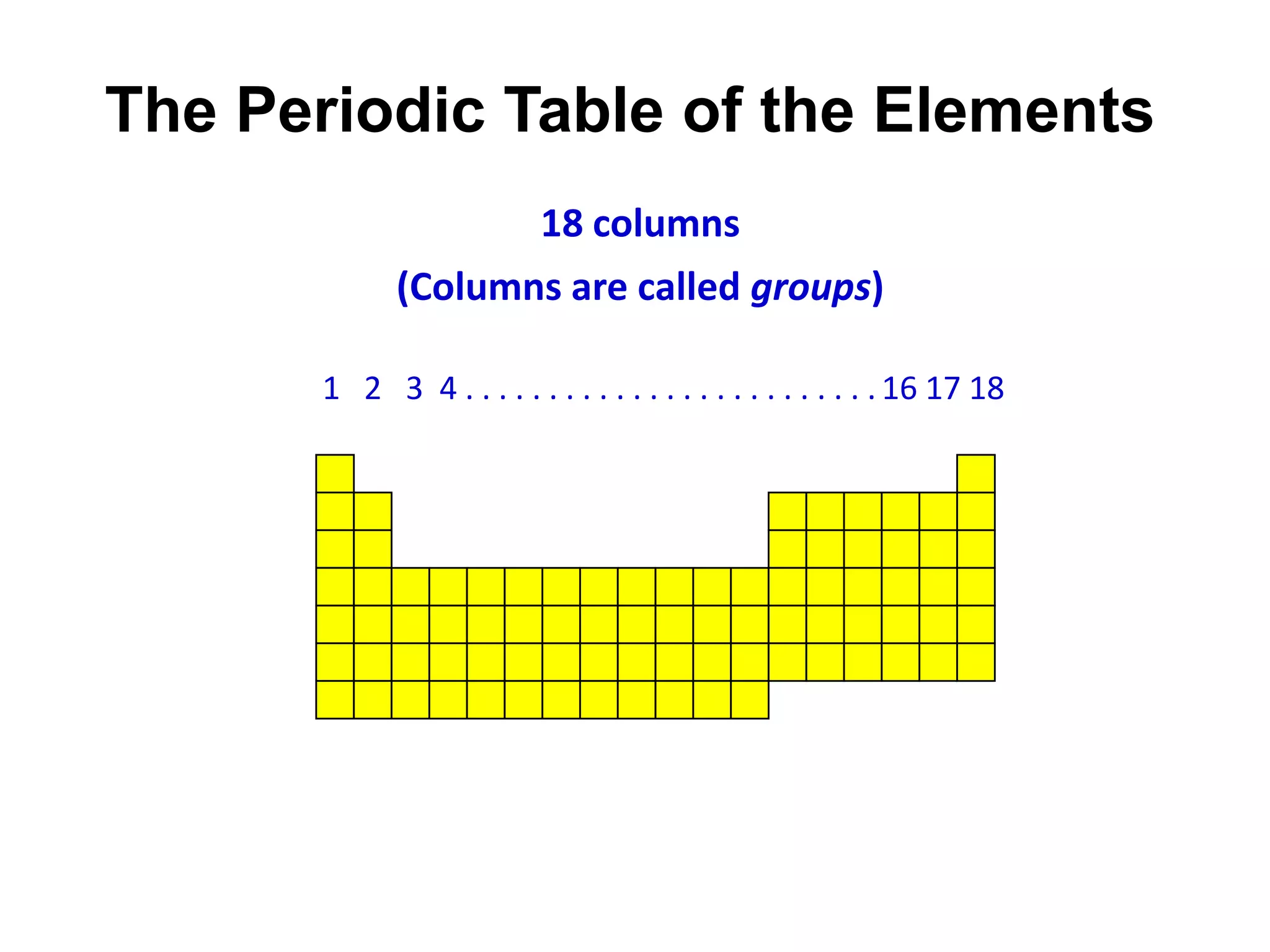
                     18 columns
              (Columns are called groups)

       1 2 3 4 . . . . . . . . . . . . . . . . . . . . . . . . . 16 17 18
The Periodic Table of the Elements

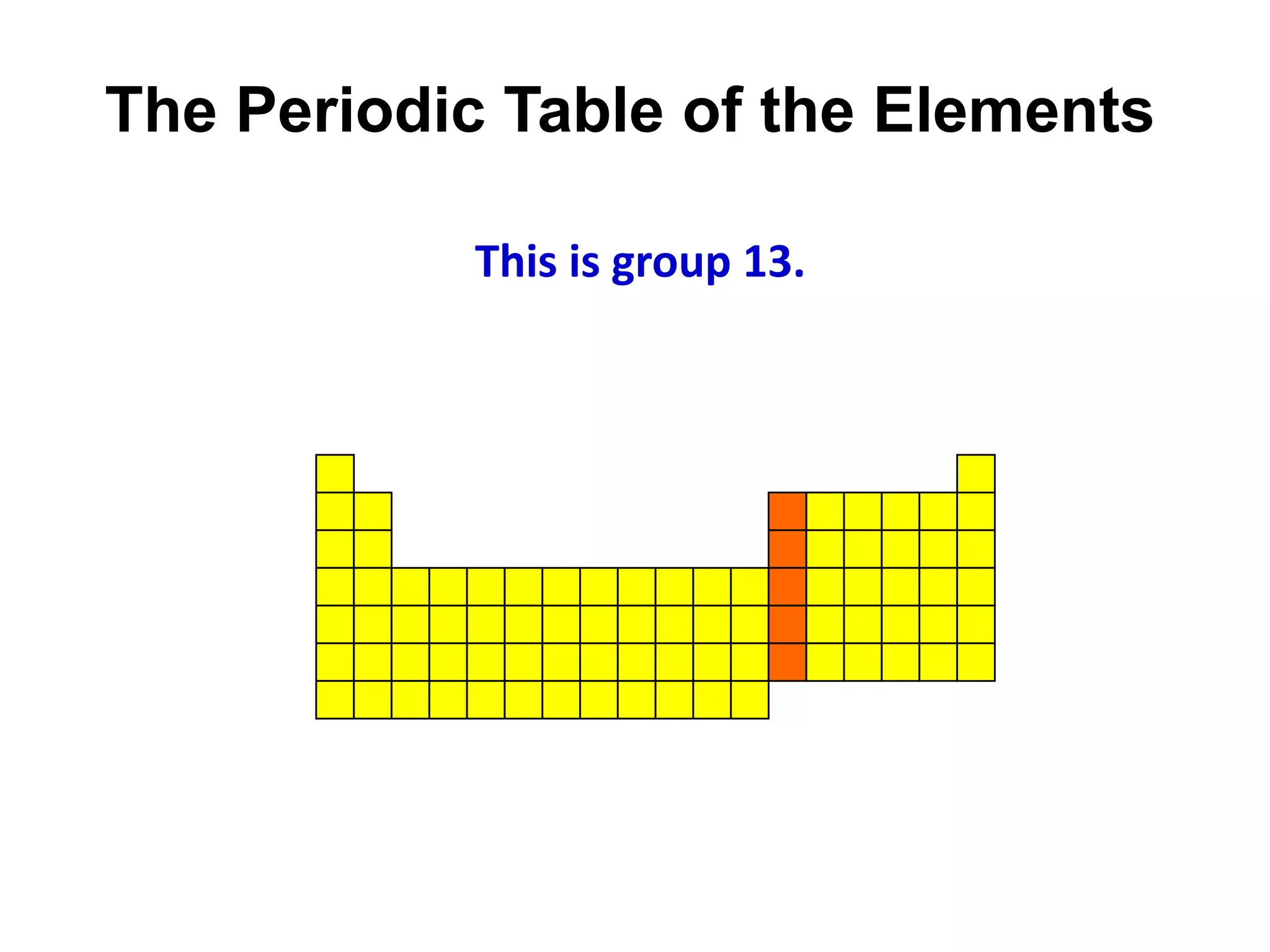
           This is group 13.
The Periodic Table of the Elements
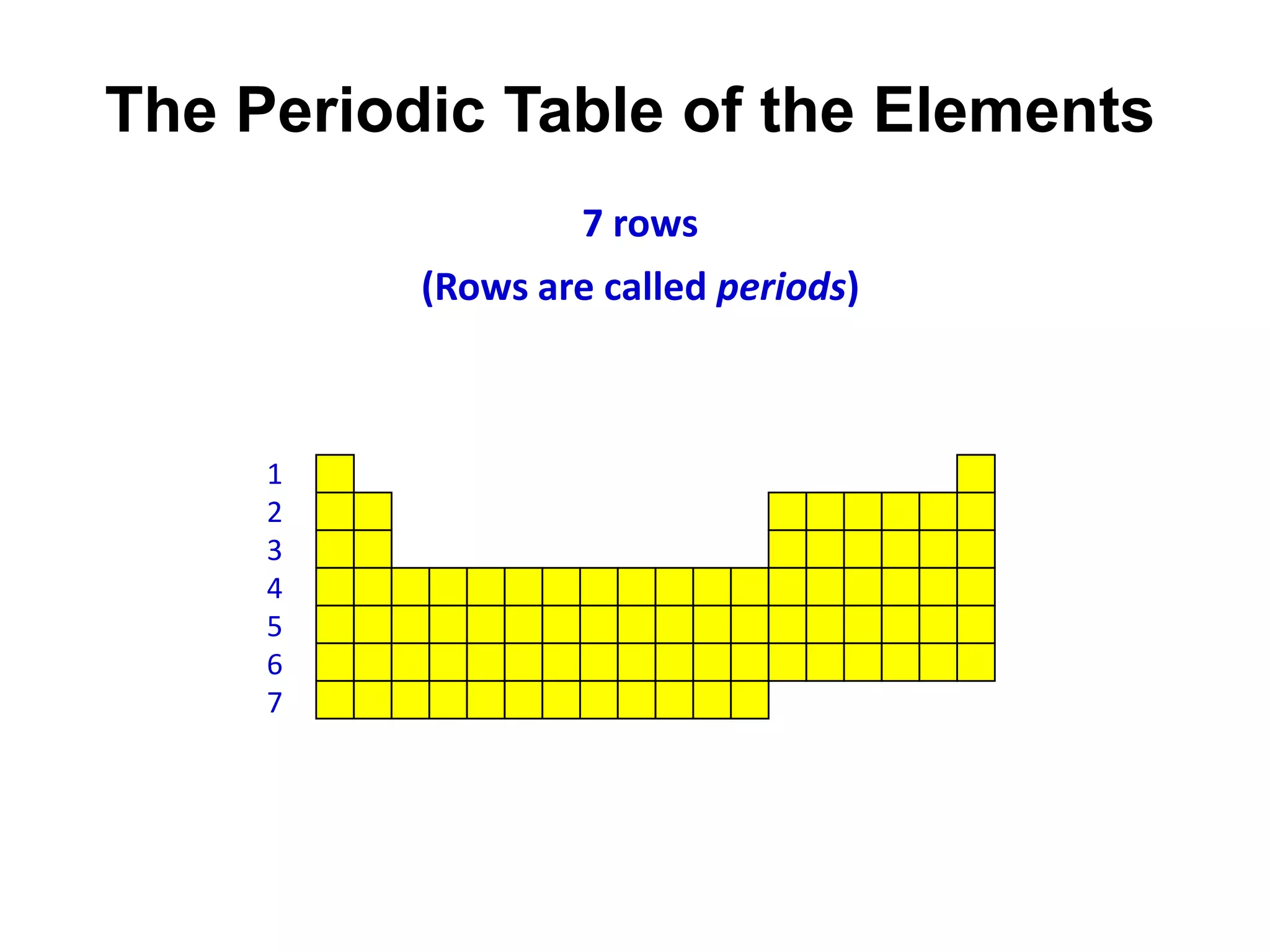
                  7 rows
          (Rows are called periods)


     1
     2
     3
     4
     5
     6
     7
The Periodic Table of the Elements

            This is period 4.
The Periodic Table of the Elements

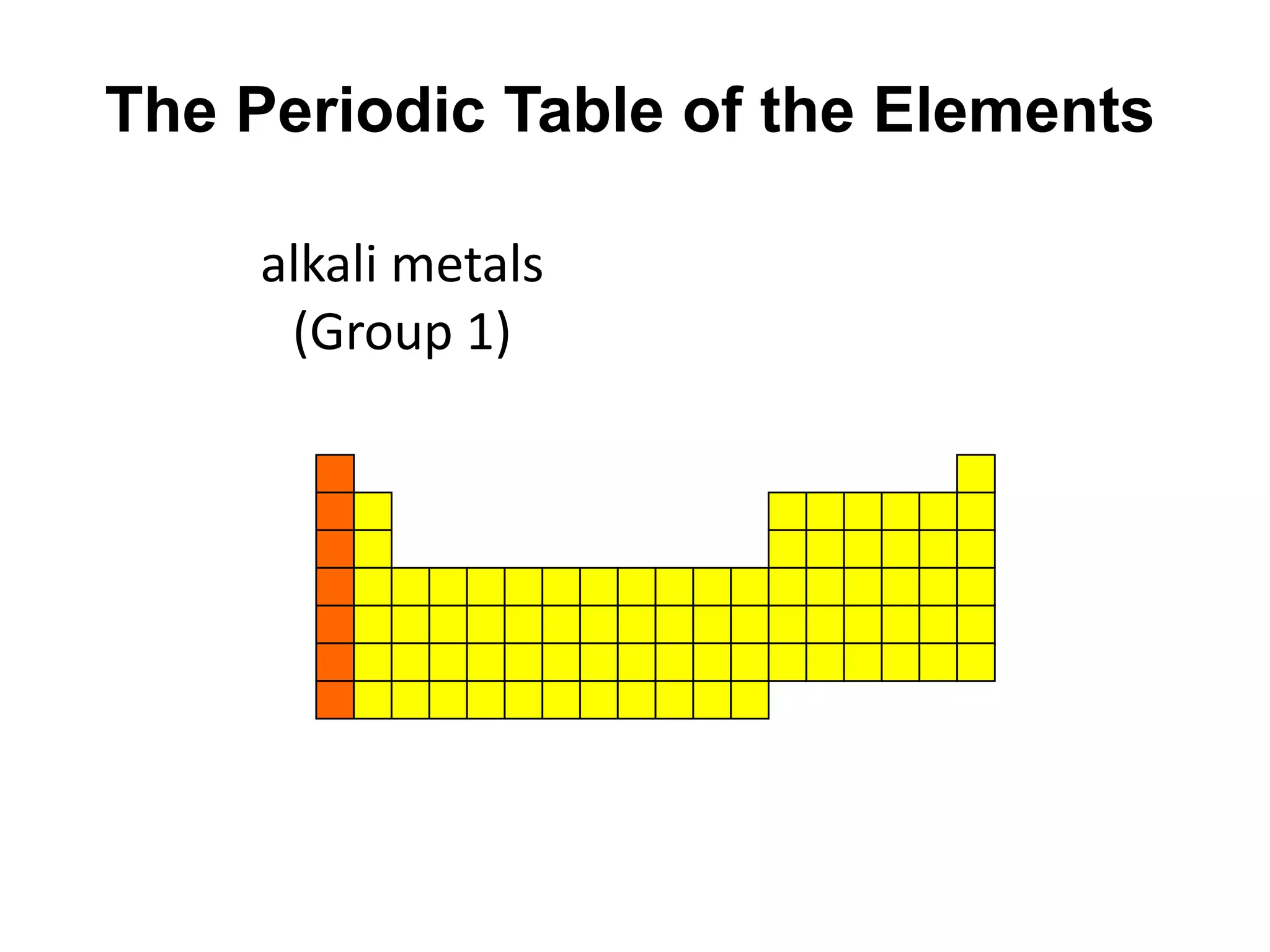
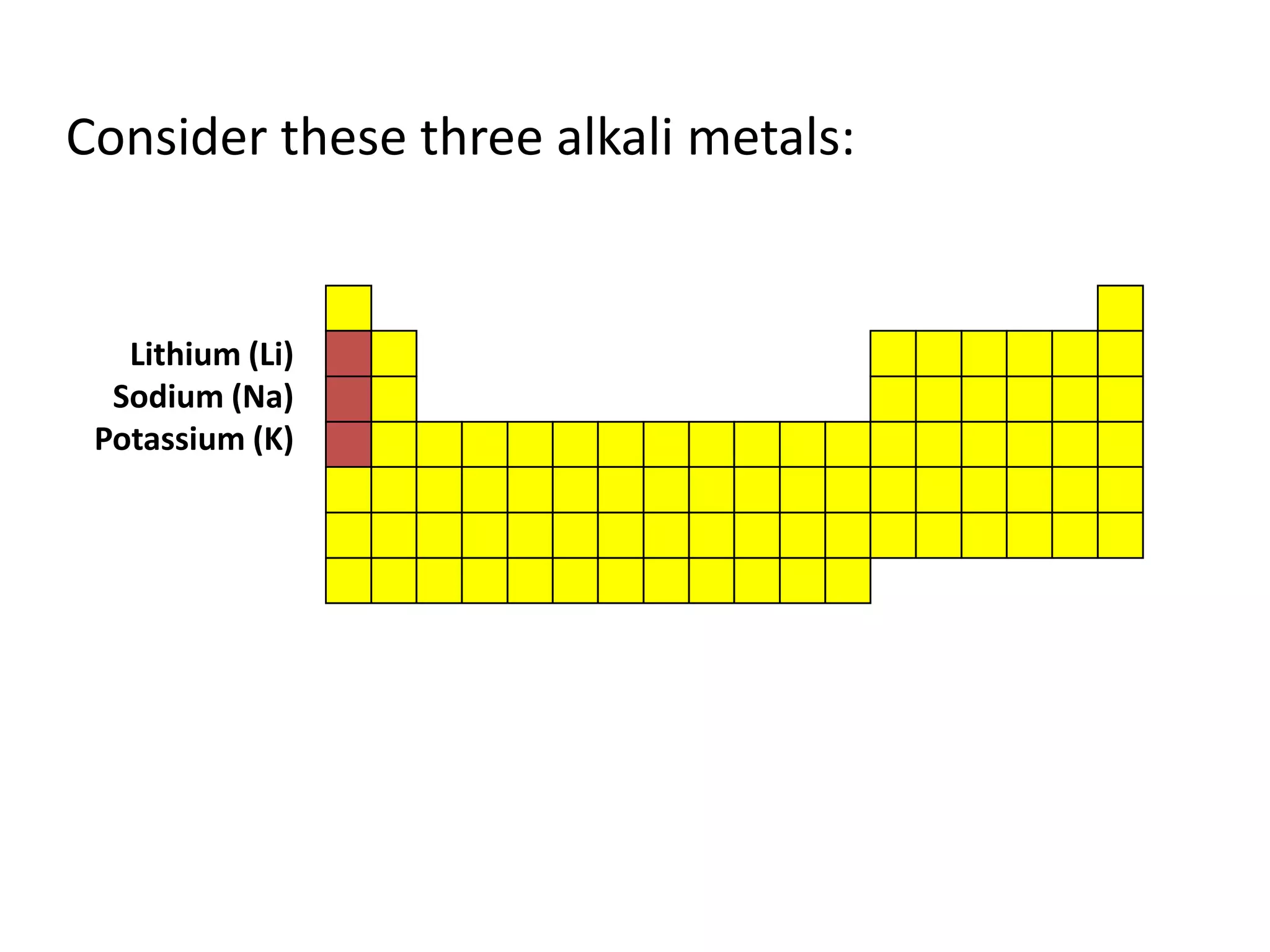
     alkali metals
      (Group 1)
The Periodic Table of the Elements

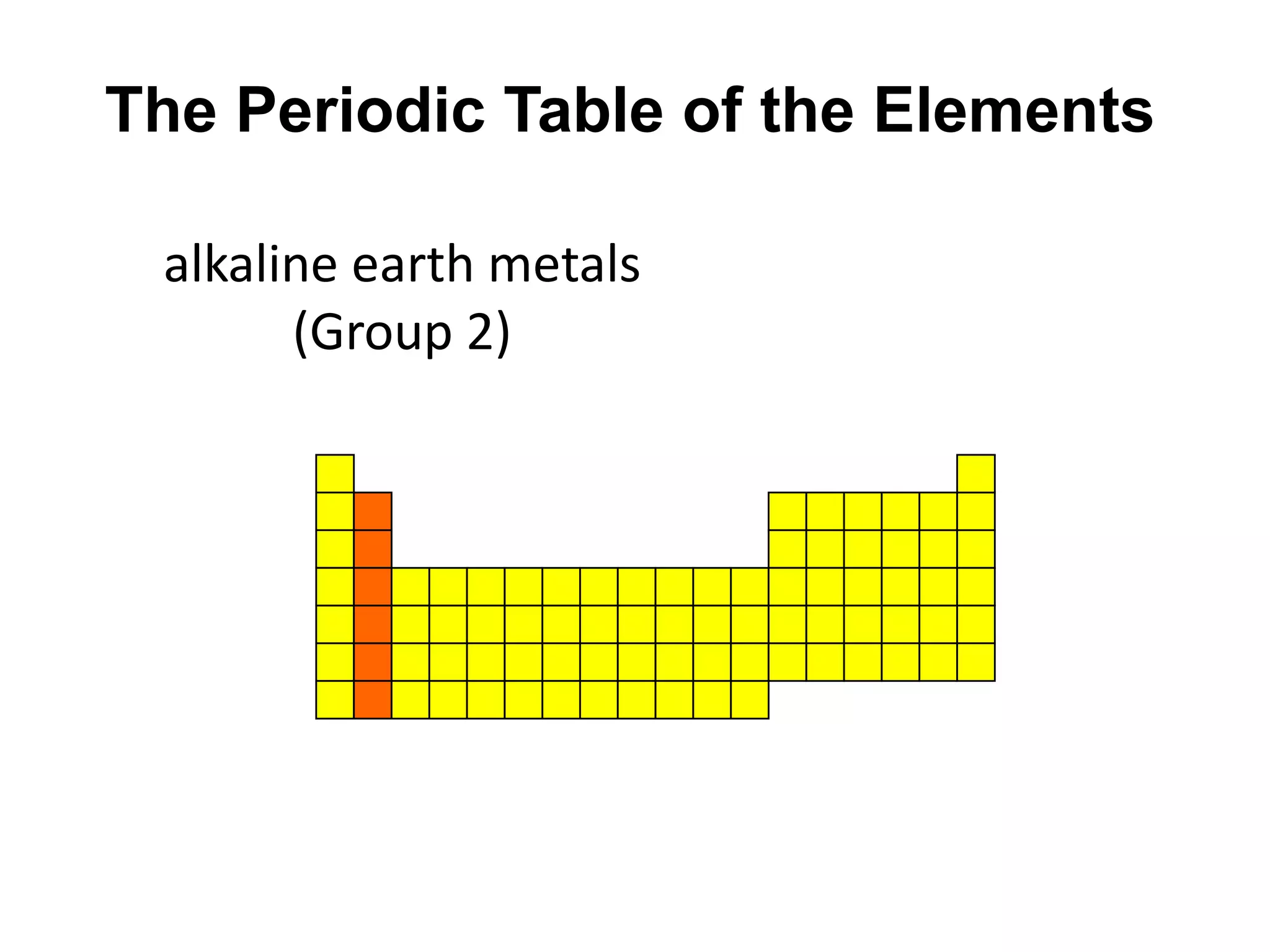
 alkaline earth metals
       (Group 2)
The Periodic Table of the Elements

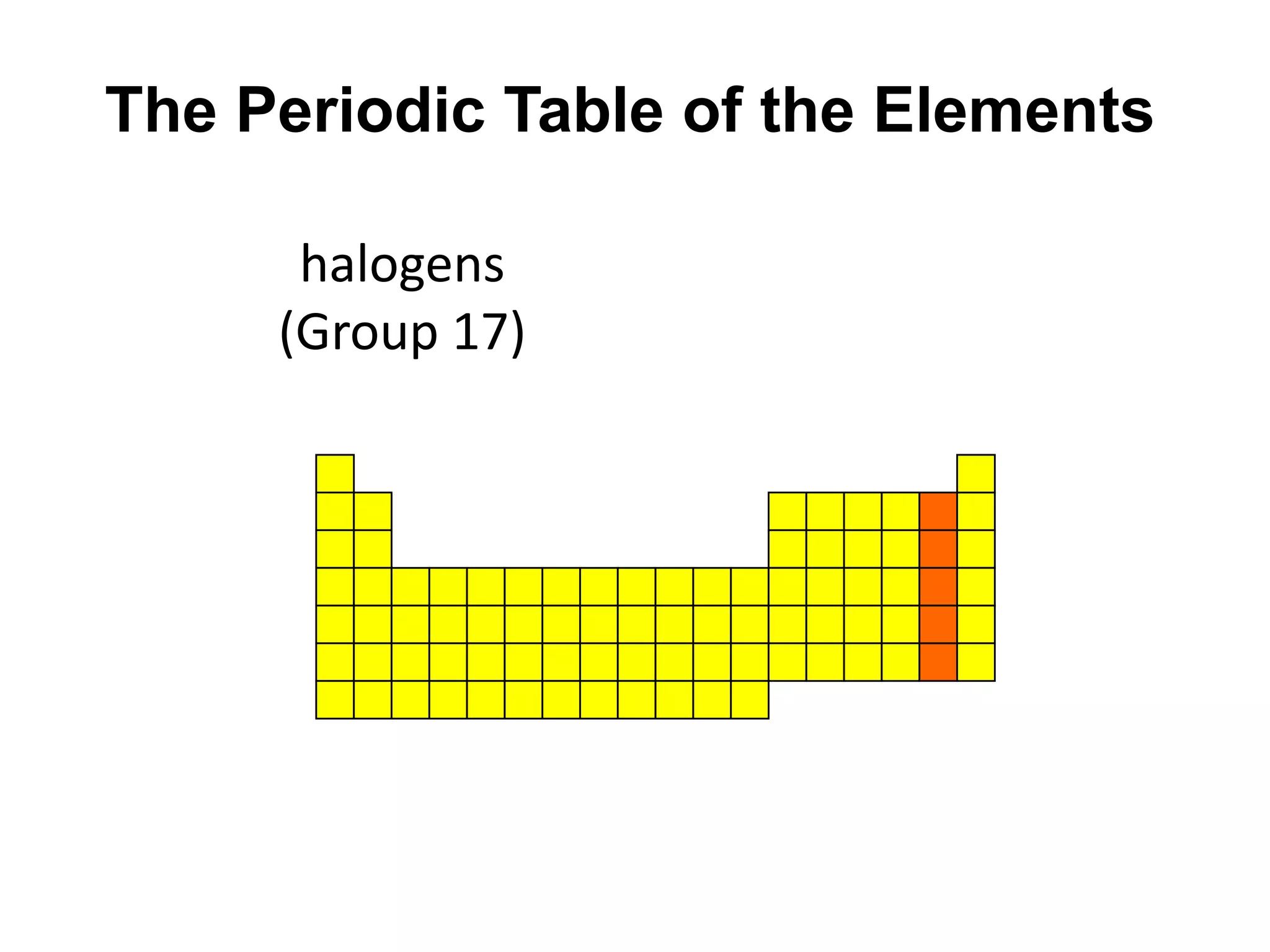
      halogens
     (Group 17)
The Periodic Table of the Elements

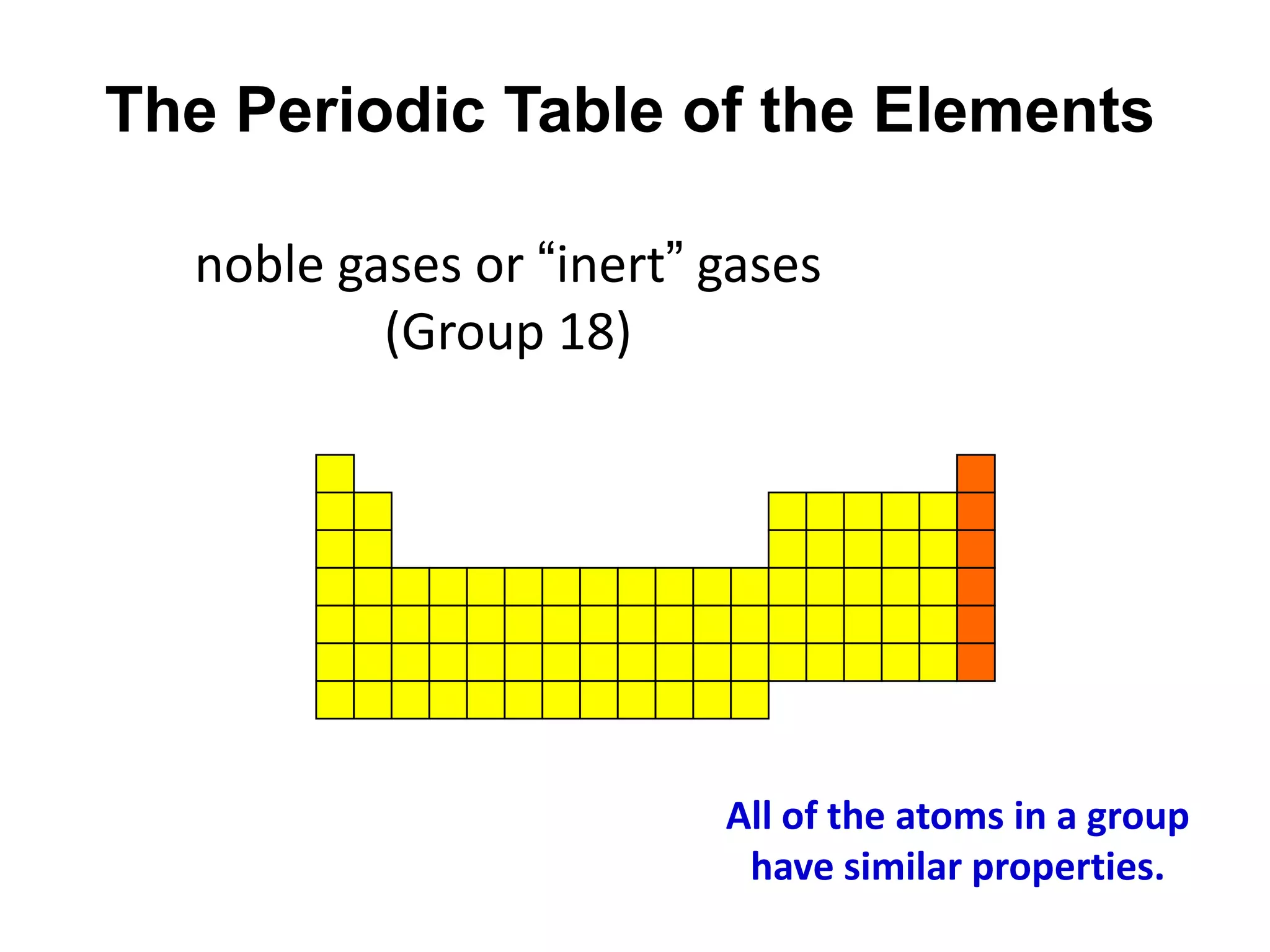
  noble gases or “inert” gases
          (Group 18)


                         All of the atoms in a group
                          have similar properties.
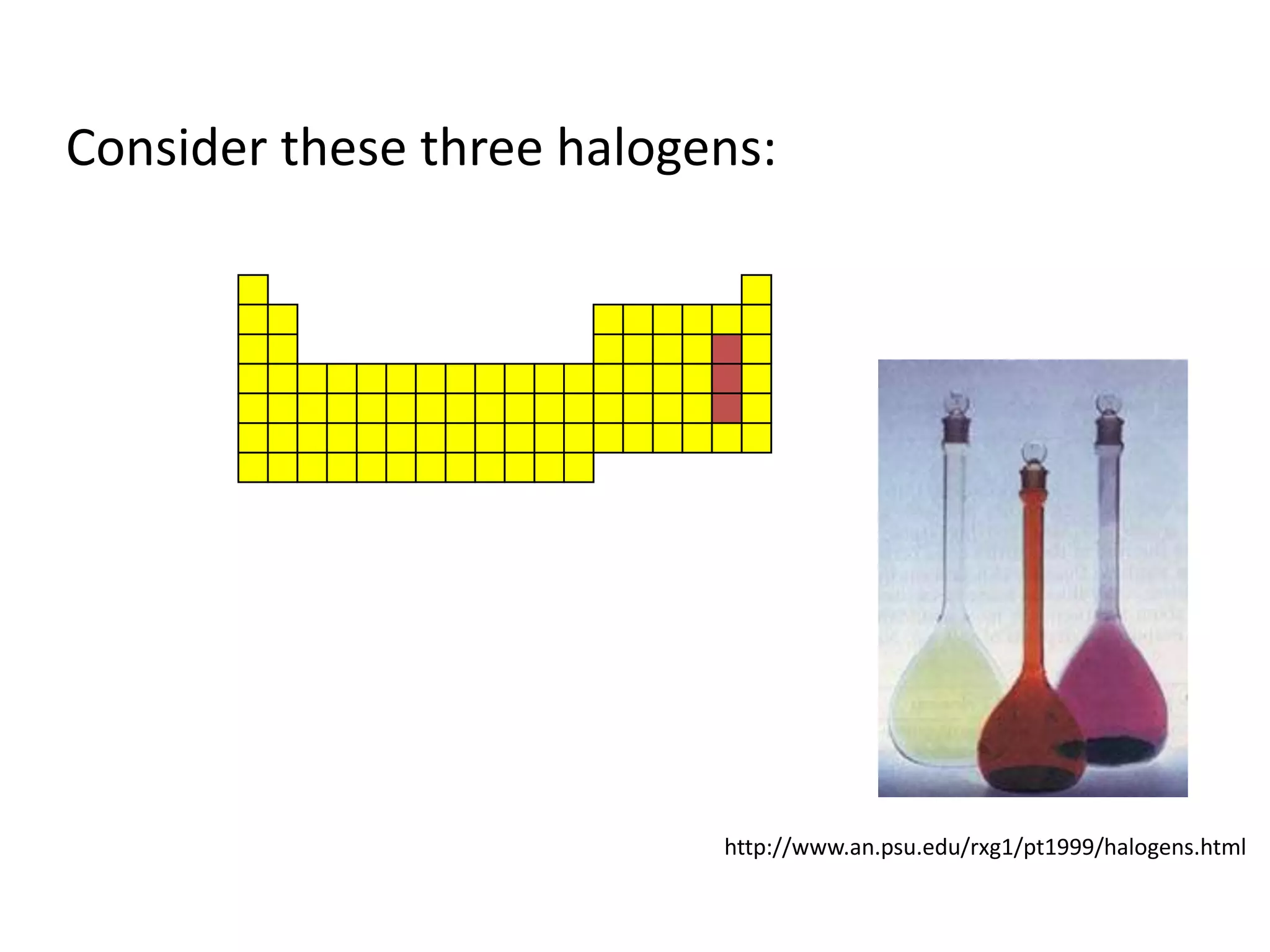
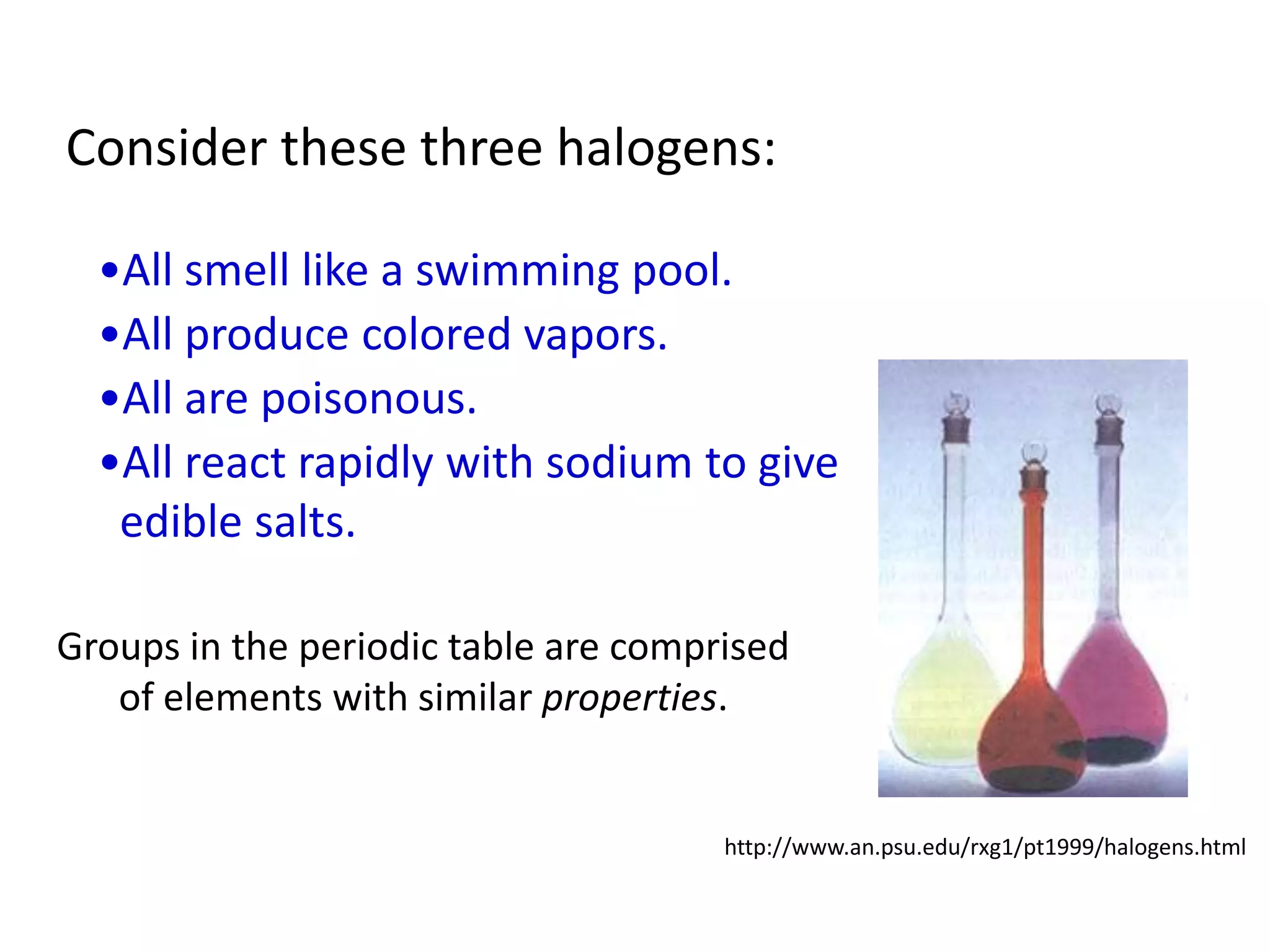
Consider these three halogens:


                           http://www.an.psu.edu/rxg1/pt1999/halogens.html
Consider these three halogens:

  •All smell like a swimming pool.
  •All produce colored vapors.
  •All are poisonous.
  •All react rapidly with sodium to give
   edible salts.

Groups in the periodic table are comprised
   of elements with similar properties.


                                      http://www.an.psu.edu/rxg1/pt1999/halogens.html
Consider these three alkali metals:


   Lithium (Li)
  Sodium (Na)
 Potassium (K)
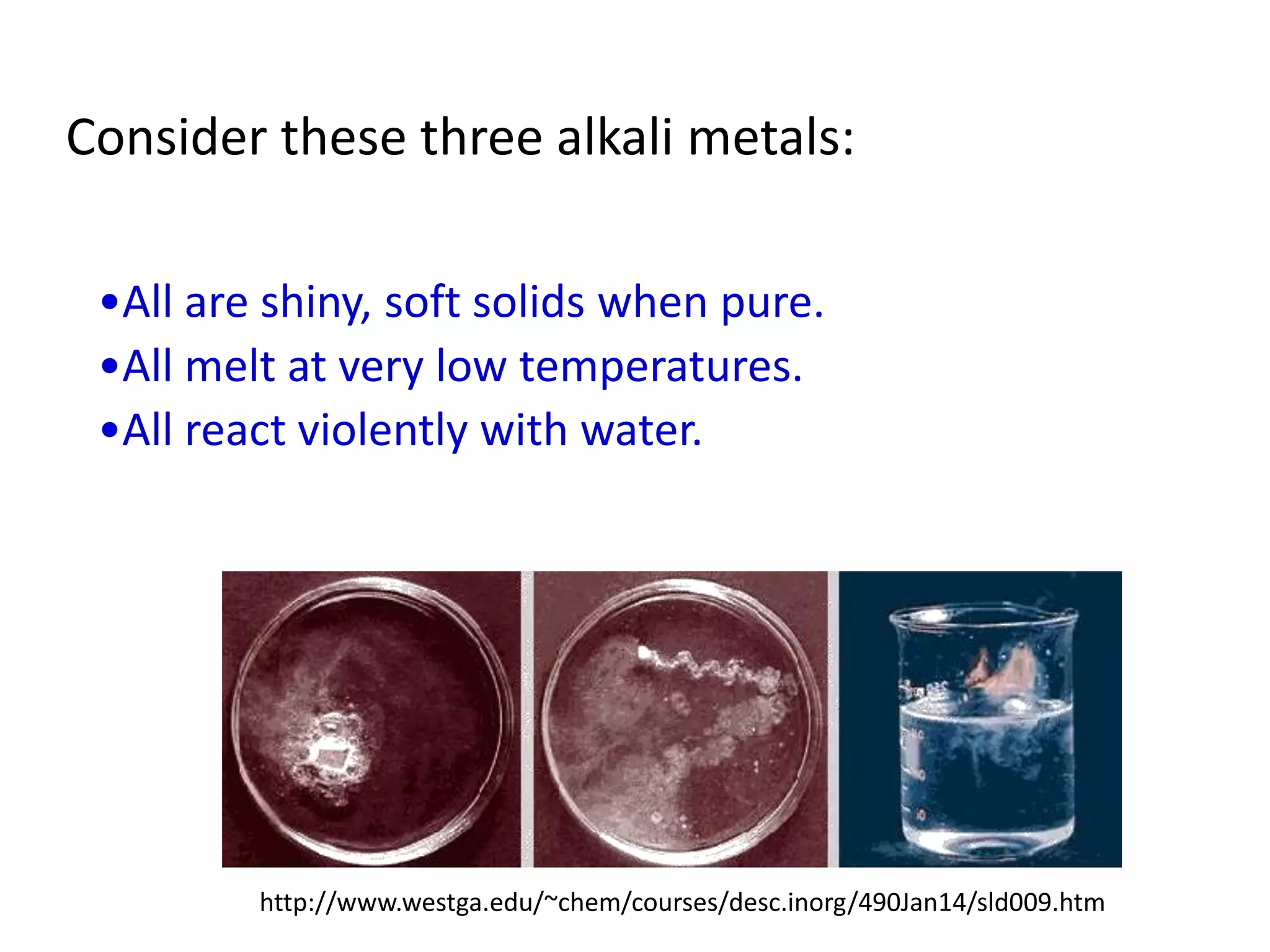
Consider these three alkali metals:

 •All are shiny, soft solids when pure.
 •All melt at very low temperatures.


Lithium mp = 181oC
Sodium mp = 98oC
Potassium mp = 63oC
Consider these three alkali metals:

 •All are shiny, soft solids when pure.
 •All melt at very low temperatures.
 •All react violently with water.


         http://www.westga.edu/~chem/courses/desc.inorg/490Jan14/sld009.htm
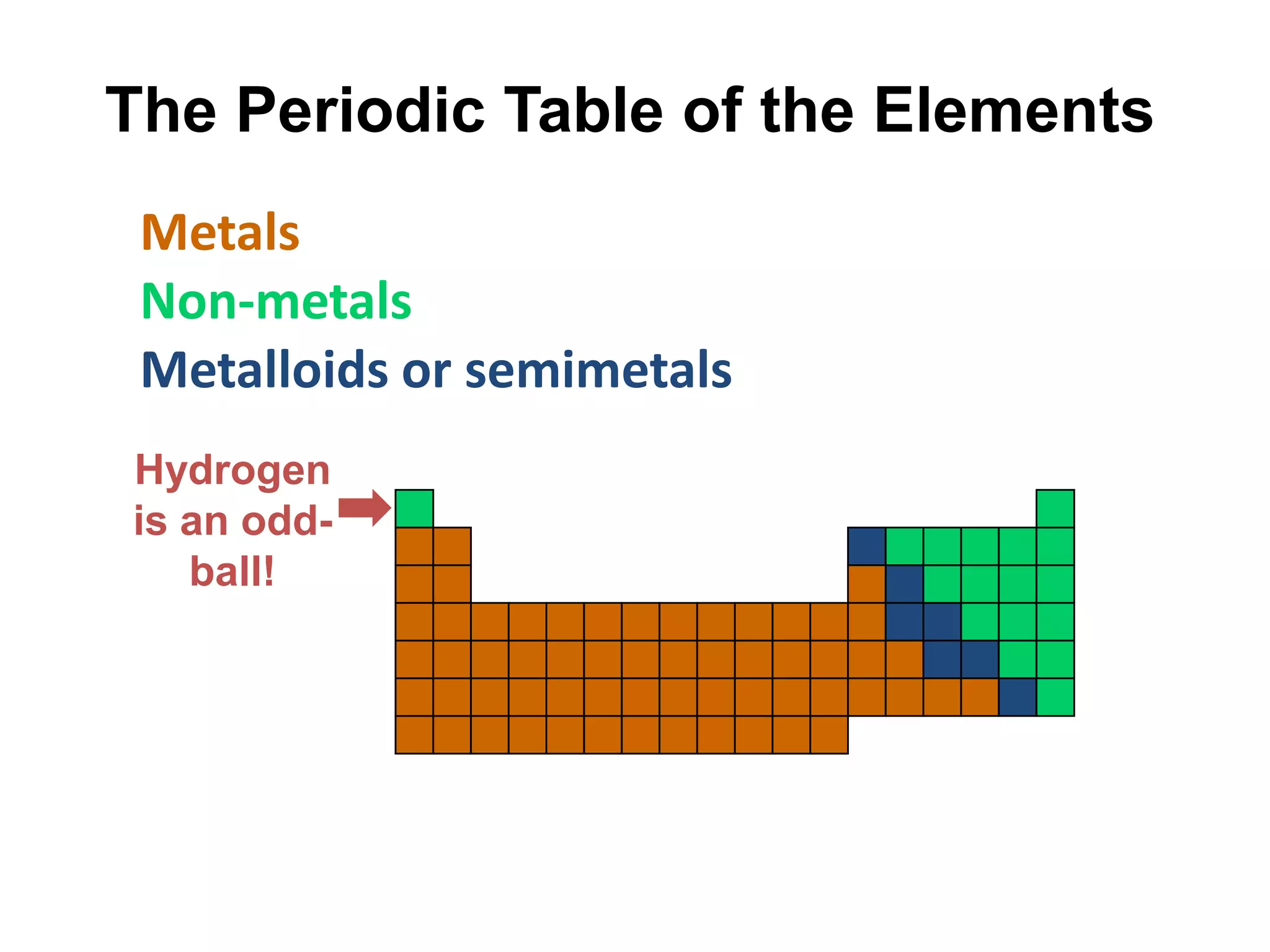
The Periodic Table of the Elements
 Metals
 Non-metals
 Metalloids or semimetals
Hydrogen
is an odd-
   ball!
The Periodic Table of the Elements
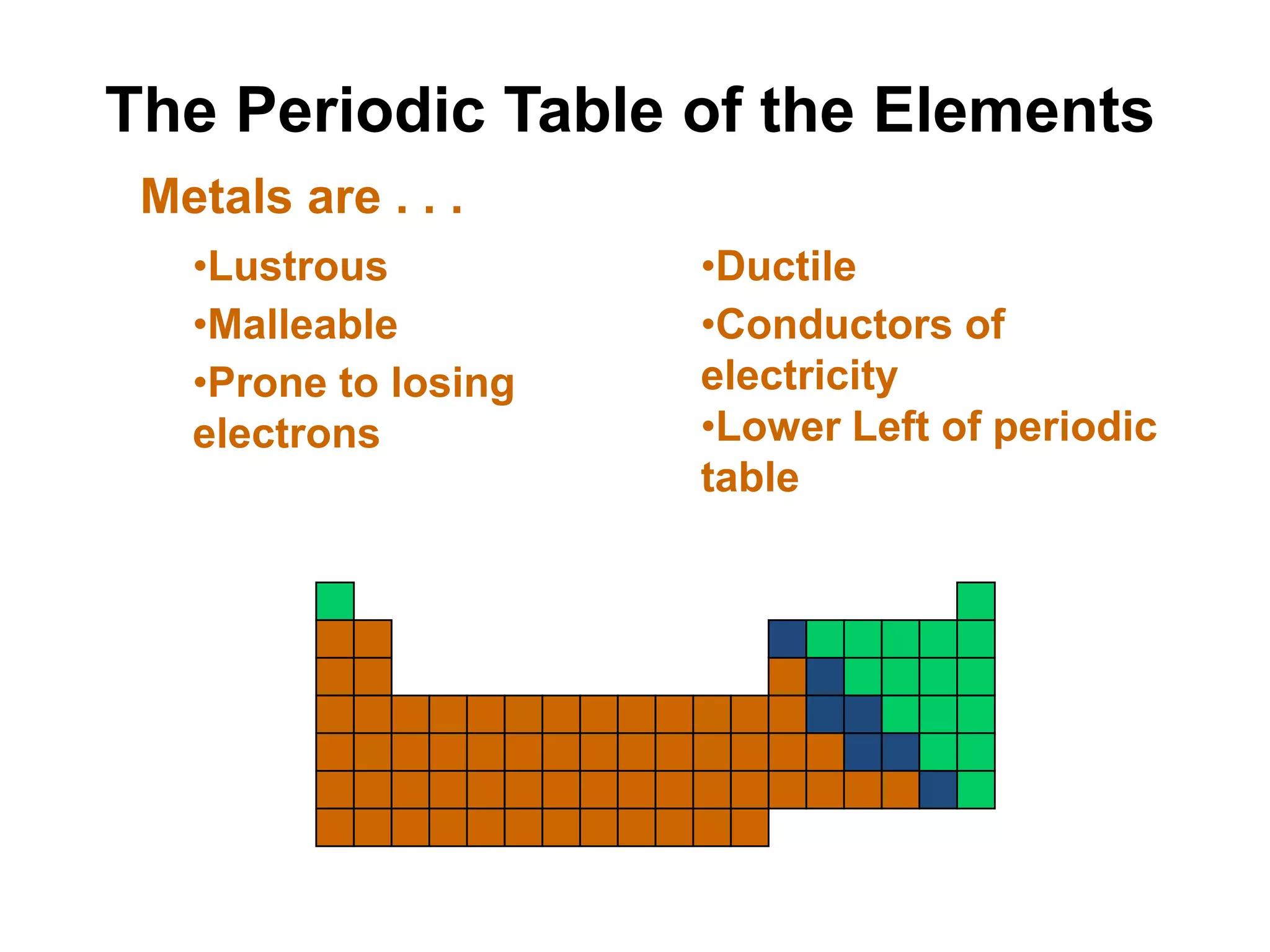
 Metals are . . .
   •Lustrous          •Ductile
   •Malleable         •Conductors of
   •Prone to losing   electricity
   electrons          •Lower Left of periodic
                      table
The Periodic Table of the Elements
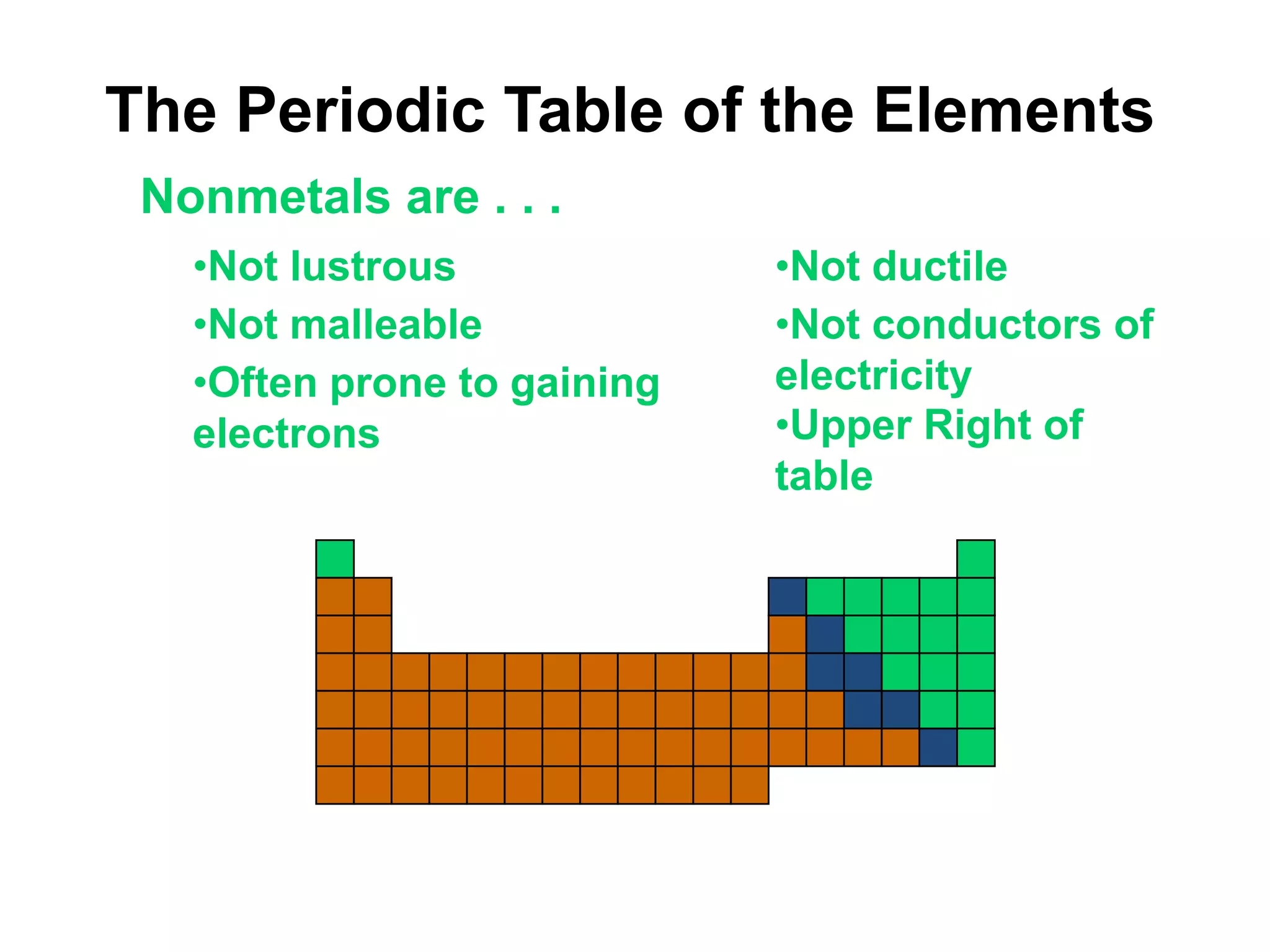
 Nonmetals are . . .
   •Not lustrous             •Not ductile
   •Not malleable            •Not conductors of
   •Often prone to gaining   electricity
   electrons                 •Upper Right of
                             table

Chem115 lecture1 120109

  • 1.
    Chem 115: BasicPhysiological Chemistry Dr. Kathryn Huisinga khuisinga@malone.edu X 8356 Text: General, Organic, and Biochemistry, 7th ed., by Denniston, Topping, and Caret http://www.mhhe.com/denniston A Laboratory Manual for General, Organic, and Biochemistry, 7th ed., by Henrickson www.saplinglearning.com
  • 2.
    Minute paper • Name,Major, year • Where you are from? • What science and math classes you have taken before (HS or college level)? • What do you hope to learn in Chem 115? • How do you think studying chemistry can teach you something about God? • Anything else you want me to know
  • 3.
    Syllabus • Online access-Malone e-companion and saplinglearning.com • Communication outside of class will be via e- mail and posting on companion site(s). • Instructional Methods: – Attendance & Participation – Homework Problem Sets: saplinglearning.com – Quizes – Exams – Lab (more details during lab this week)
  • 4.
    Syllabus • Attendance – Lecture – Lab – Exams • Grading Scale • Course Requirements & Classroom Procedures – Cell Phones- NOT ALLOWED – Calculators- NEEDED – Electronic note-taking devices- Your choice • i.e. – Laptop or ipad
  • 5.
    Syllabus • Disability Accommodations – Center for Student Success – Your responsibility to communicate this to me • Academic Integrity – Taken Very Seriously – If you aren’t sure if something is allowed, ask. – Plagiarism, Cheating on Exams, copying homework or labs • If you are copying something, from anywhere, it is not OK! • Subject-to-change
  • 6.
    • Study Tips – SQ3R+ – Repetition – Frequency – Teach each other – Environment of learning • Peer Tutoring: – Jennifer Peters – Monday, 6:00 p.m. • in the tutoring room (Library Seminar F) • Communicate problems to me – I can’t help you if I don’t know you are having problems • Or if I don’t know until after the exam!!
  • 7.
    Chem 115:Basic PhysiologicalChemistry • “General” Chemistry (Chapters 1-9) – Atoms, Chemical Structures & Equations, Acids, Bases, Solutions, Matter, Energy • Organic Chemistry (Chapter 10-15) – Chemistry of Carbon & atoms that bond to it • Biochemistry (Chapter 16-23) – Carbohydrates, Fats, Proteins, DNA, RNA, Metabolism and all Biomolecules • How do things work “chemically” inside a living organism?
  • 8.
    Course Outline Topics Reading • Chemistry: Stuff & measuring it Chapters 1,5 • What is an atom? Chapters 2, 9 • How do atoms interact & react? Chemical bonding & reactions Chapters3,4 • Organic compounds: How does carbon interact? Chapters 10-17 • Carbohydrates, an intermolecular chemical reaction Chapter 16 • Intermolecular Forces: Water, Lipids, Solubility & Phase change Chapters 6, 11-14,17 • Solutions: What’s your concentration? Chapter 6 • Acids & Bases and how the amino acids do it all Chapters 7 & 8 • Proteins: where the action is at- cellular workhorses Chapter 18 • Enzymes: speed me up please Chapters 7 & 19 • Nucleic Acids and how DNA is in command Chapter 20 • Metabolism: how you do what you do! Chapters 21-23
  • 9.
    Chemistry • the studyof matter • its chemical and physical properties • the chemical and physical changes it undergoes • the energy changes that accompany those processes • Most changes either require energy or produce energy • This class will focus on the changes that happen in living systems
  • 10.
    Why do youneed to know chemistry? public health pharmaceutical industry CHEMISTRY food science medical practitioners forensic sciences
  • 11.
    Chemistry overlaps withmany different disciplines. + Bunny reproduction is biology!
  • 12.
    Chemistry overlaps withmany different disciplines. But chemists study the hormonal changes that tell the bunnies when to mate! + Bunny reproduction is biology!
  • 13.
    Chemistry overlaps withmany different disciplines. Psychologists study how mice “learn”.
  • 14.
    Chemistry overlaps withmany different disciplines. But chemists study the neurotransmitters responsible for learning! Psychologists study how mice “learn”.
  • 15.
    Chemistry overlaps withmany different disciplines. What happens when a bunny baby crosses a road is physics.
  • 16.
    Chemistry overlaps withmany different disciplines. What happens when a bunny baby crosses a road is physics.
  • 17.
    Chemistry overlaps withmany different disciplines. What happens to the bunny baby‟s body in the hot summer sun is chemistry!
  • 18.
    MAJOR AREAS OFCHEMISTRY • Biochemistry - the study of life at the molecular level • Organic chemistry - the study of matter containing carbon and hydrogen • Inorganic chemistry - the study of matter containing elements, not organic • Analytic chemistry - analyze matter to determine identity and composition • Physical chemistry - attempts to explain the way matter behaves
  • 19.
    Chemistry uses thescientific method • How does something work? • What is the “truth” about how something works? • Does my data support my hypothesis? • Do I need to change my hypothesis?
  • 20.
    Experimental methods • Experimentsproduce DATA & RESULTS • DATA: – Recorded observations or measurements • Mass, Time, Temp, volume, energy • RESULTS: – Outcome of experiment – Conclusions drawn from observations – Usually several pieces of data form a result
  • 21.
    CHEMISTRY the study ofmatter and its changes . . . but what is matter?
  • 22.
    CHEMISTRY the studyof matter and its changes Matter is “stuff ” (anything with mass and volume)
  • 23.
    CHEMISTRY the study of matter and its changes Which of these are matter? hammer Q-tip fear paper bag beauty blood talent acorn air gravity
  • 24.
    Classification of Matter •Pure substance - a substance that has only one component • Mixture - a combination of two or more pure substances in which each substance retains its own identity, not undergoing a chemical reaction
  • 25.
    Classification of Matter •Element - a pure substance that cannot be changed into a simpler form of matter by any chemical reaction • Compound - a substance resulting from the combination of two or more elements in a definite, reproducible way, in a fixed ratio
  • 26.
    Classification of Matter •Mixture - a combination of two or more pure substances in which each substance retains its own identity • Homogeneous - uniform composition, particles well mixed, thoroughly intermingled • Heterogeneous – nonuniform composition, random placement
  • 27.
    Classification of Matter •Which classes of matter are shown below? Homogeneous Heterogeneous compound mixture mixture
  • 28.
    The Periodic Tableof the Elements
  • 29.
    The Periodic Tableof the Elements We know that all “matter” is made up of very, very, very tiny spheres called atoms. Each square in this table represents a different kind of atom. There are over 114 different kinds of atoms.
  • 30.
    The Periodic Tableof the Elements We know that all “matter” is made up of very, very, very tiny spheres called atoms. Each square in this table represents a different kind of atom. Table organization is based on each atom‟s makeup and the similarities of the properties of the various kinds of atoms.
  • 31.
    The Periodic Tableof the Elements
  • 32.
    The Periodic Tableof the Elements
  • 33.
    The Periodic Tableof the Elements
  • 34.
    The Periodic Tableof the Elements Table is usually displayed this way. (it takes up less space) We won‟t discuss any of these elements in Physiological Chemistry
  • 35.
    The Periodic Tableof the Elements Every kind of atom has a name and a “symbol.”
  • 36.
    The Periodic Tableof the Elements All modern symbols are based on letter abbreviations Hydrogen (H) Every symbol starts Oxygen (O) with a capital letter. Iodine (I)
  • 37.
    The Periodic Tableof the Elements Some symbols have two letters. Scandium (Sc) First letter is capital Bismuth (Bi) and second is lower case. Neon (Ne)
  • 38.
    The Periodic Tableof the Elements Some symbols come from foreign languages. Tungsten (W) -- „W‟ is from wolfram (German) Sodium (Na) -- „Na‟ is from natrium (Latin) Antimony (Sb) -- „Sb‟ is from Stibium (Latin)
  • 39.
    The Periodic Tableof the Elements Some types of atoms are very common in air! nitrogen, oxygen, carbon, argon, neon, helium
  • 40.
    The Periodic Tableof the Elements Some types of atoms are very common in dirt and rocks! oxygen, silicon, aluminum, iron, calcium, sodium
  • 41.
    The Periodic Tableof the Elements Some types of atoms are very common in stars! hydrogen, helium, carbon, oxygen, neon, magnesium
  • 42.
    The Periodic Tableof the Elements Some types of atoms are very common in human bodies! oxygen, carbon, hydrogen, nitrogen, calcium, phosphorus
  • 43.
    The Periodic Tableof the Elements 18 columns (Columns are called groups) 1 2 3 4 . . . . . . . . . . . . . . . . . . . . . . . . . 16 17 18
  • 44.
    The Periodic Tableof the Elements This is group 13.
  • 45.
    The Periodic Tableof the Elements 7 rows (Rows are called periods) 1 2 3 4 5 6 7
  • 46.
    The Periodic Tableof the Elements This is period 4.
  • 47.
    The Periodic Tableof the Elements alkali metals (Group 1)
  • 48.
    The Periodic Tableof the Elements alkaline earth metals (Group 2)
  • 49.
    The Periodic Tableof the Elements halogens (Group 17)
  • 50.
    The Periodic Tableof the Elements noble gases or “inert” gases (Group 18) All of the atoms in a group have similar properties.
  • 51.
    Consider these threehalogens: http://www.an.psu.edu/rxg1/pt1999/halogens.html
  • 52.
    Consider these threehalogens: •All smell like a swimming pool. •All produce colored vapors. •All are poisonous. •All react rapidly with sodium to give edible salts. Groups in the periodic table are comprised of elements with similar properties. http://www.an.psu.edu/rxg1/pt1999/halogens.html
  • 53.
    Consider these threealkali metals: Lithium (Li) Sodium (Na) Potassium (K)
  • 54.
    Consider these threealkali metals: •All are shiny, soft solids when pure. •All melt at very low temperatures. Lithium mp = 181oC Sodium mp = 98oC Potassium mp = 63oC
  • 55.
    Consider these threealkali metals: •All are shiny, soft solids when pure. •All melt at very low temperatures. •All react violently with water. http://www.westga.edu/~chem/courses/desc.inorg/490Jan14/sld009.htm
  • 56.
    The Periodic Tableof the Elements Metals Non-metals Metalloids or semimetals Hydrogen is an odd- ball!
  • 57.
    The Periodic Tableof the Elements Metals are . . . •Lustrous •Ductile •Malleable •Conductors of •Prone to losing electricity electrons •Lower Left of periodic table
  • 58.
    The Periodic Tableof the Elements Nonmetals are . . . •Not lustrous •Not ductile •Not malleable •Not conductors of •Often prone to gaining electricity electrons •Upper Right of table

Editor's Notes

  • #4 You are all “adults” and you are responsible for yourself and for knowing the information in the syllabus. Even if I don’t point it out, you are responsible, so I would recommend that you read it!
  • #8 All of the things we will study were created by God, and understanding how they work is so cool! I also think it is cool that he made us intelligent enough to figure out how these things work, but there is still so much that we don’t understand about how living things work. There will always be more mysteries to be revealed.
  • #20 Types of data?