Moscow State University, School of Educational Studies
Nersesyan L.G.
2015
What is a chart?
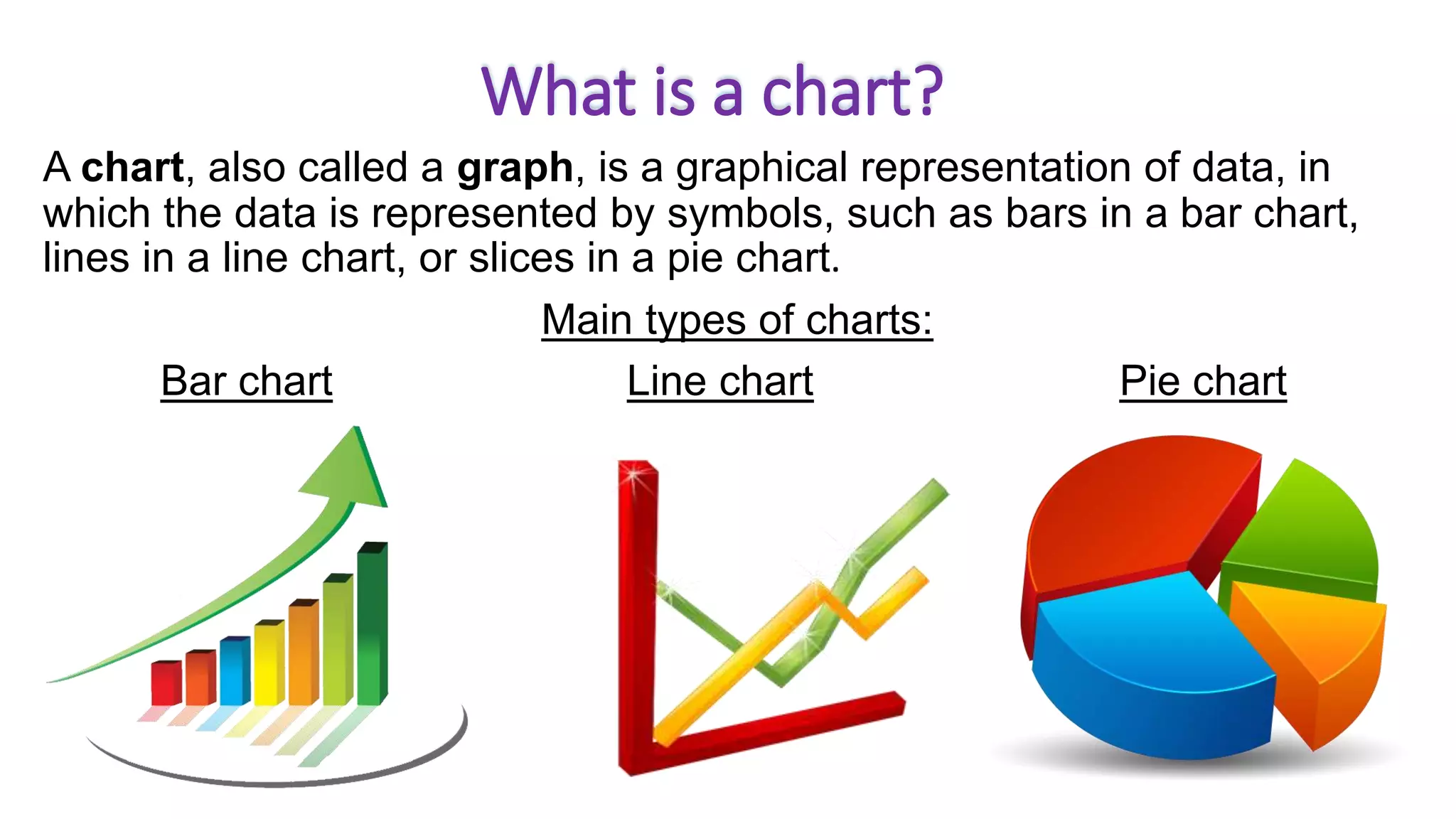
A chart, also called a graph, is a graphical representation of data, in
which the data is represented by symbols, such as bars in a bar chart,
lines in a line chart, or slices in a pie chart.
Main types of charts:
Bar chart Line chart Pie chart
Pie Chart
55%
25%
15%
5%
Pet Ownership
Dogs
Cats
Fish
Rodents
The pie chart shown below represents the percentage of people who own various pets. As
you can see, the 'dog ownership' slice is by far the largest, which means that most people
represented in this chart own dogs as opposed to cats, fish and rodents.
Line Graph
0
20
40
60
80
100
120
1985 1995 2005 2015
Numberoftimeseatenperyear
Consumption of Fast Food by Teenagers
Pizza
Fish&Chips
Hamburgers
The line graph below shows changes in the amount and type of fast food consumed by
teenagers from 1985 to 2015.
Bar Chart
The bar chart shows the monthly spending in dollars of a family in the USA on three
items in 2010.
0
100
200
300
400
500
Jan Feb Mar Apr
Monthly Expenditure
Food
Gas
Clothing
What is a table?
A table is a means of arranging data in rows and columns. The use of
tables is pervasive throughout all communication, research and data
analysis.
Table
Food and Drink Housing Clothing Entertainment
France 25% 31% 7% 13%
Germany 22% 33% 15% 19%
UK 27% 37% 11% 11%
Turkey 36% 20% 12% 10
The table illustrates the proportion of monthly household income four countries
spend on food and drink, housing, clothing and entertainment.
Formulas & Graphs
y=
𝟐∗ 𝟒
𝟐
+ 𝒙Following the link, you can
produce a graph of any formula
you want
http://www.wolframalpha.com
Graphs And Charts That Perfectly Illustrate our life
You can find this video here http://www.youtube.com/watch?v=q0BG5bppVUQ
Writing About Graphs, Charts and Tables
• Underline key words.
• Write related words - turn nouns into verbs, verbs
into nouns, adjectives into adverbs, etc.
• Write opposite words, similar words, synonyms, etc.
• Circle and highlight the graph. Use arrows.
• Identify trends. A trend is the overall idea of the
graph.
• Don’t write about everything on the graph. Pick the
biggest, the smallest, the main points, the main
trends. Group similar things together.
• Don’t use “I feel”, “as I have written,” “as you can
see,” etc. Keep it academic.
Writing About Graphs, Charts and Tables
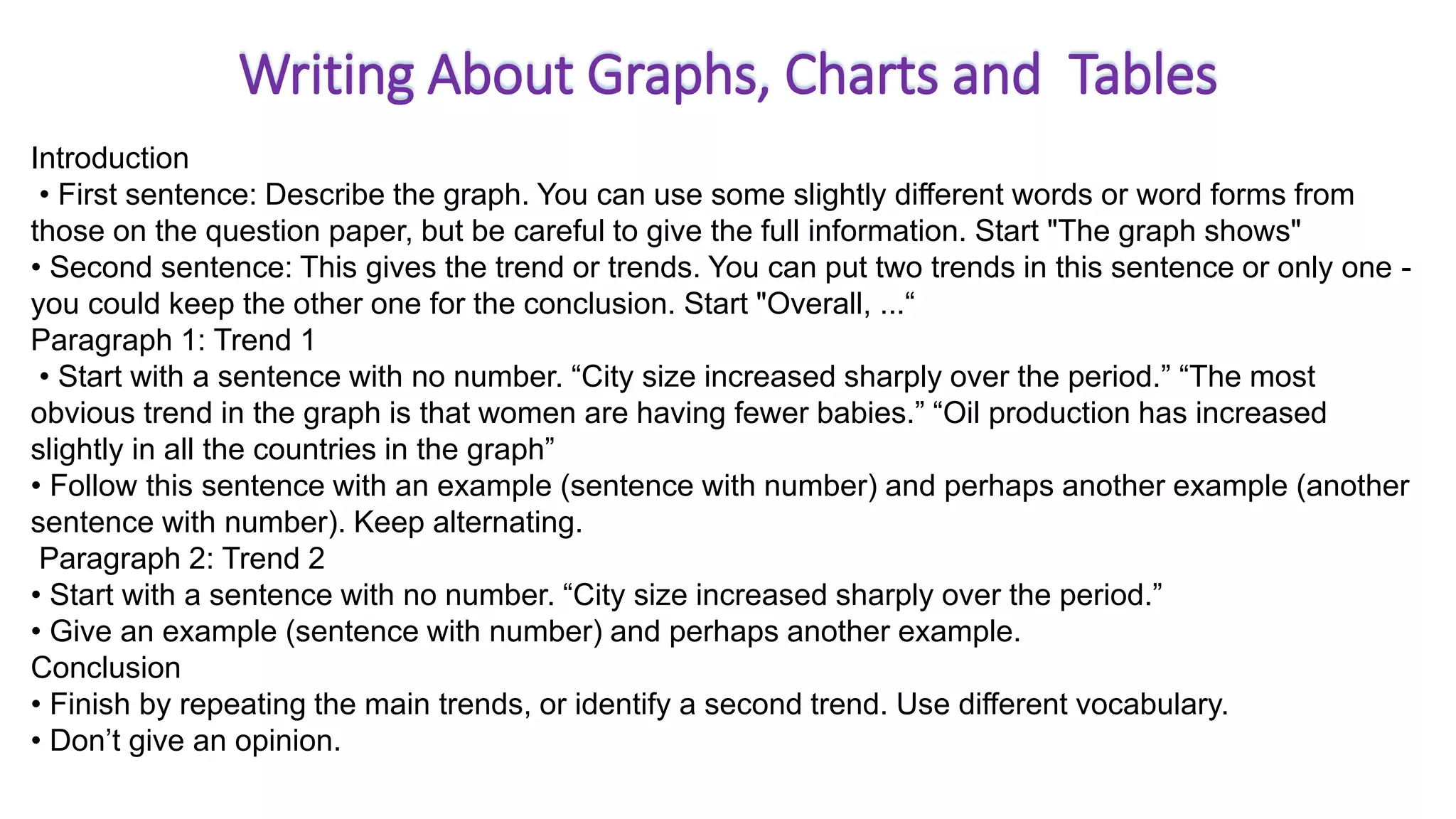
Introduction
• First sentence: Describe the graph. You can use some slightly different words or word forms from
those on the question paper, but be careful to give the full information. Start "The graph shows"
• Second sentence: This gives the trend or trends. You can put two trends in this sentence or only one -
you could keep the other one for the conclusion. Start "Overall, ...“
Paragraph 1: Trend 1
• Start with a sentence with no number. “City size increased sharply over the period.” “The most
obvious trend in the graph is that women are having fewer babies.” “Oil production has increased
slightly in all the countries in the graph”
• Follow this sentence with an example (sentence with number) and perhaps another example (another
sentence with number). Keep alternating.
Paragraph 2: Trend 2
• Start with a sentence with no number. “City size increased sharply over the period.”
• Give an example (sentence with number) and perhaps another example.
Conclusion
• Finish by repeating the main trends, or identify a second trend. Use different vocabulary.
• Don’t give an opinion.

Charts, Graphs and Tables

  • 1.
    Moscow State University,School of Educational Studies Nersesyan L.G. 2015
  • 2.
    What is achart? A chart, also called a graph, is a graphical representation of data, in which the data is represented by symbols, such as bars in a bar chart, lines in a line chart, or slices in a pie chart. Main types of charts: Bar chart Line chart Pie chart
  • 3.
    Pie Chart 55% 25% 15% 5% Pet Ownership Dogs Cats Fish Rodents Thepie chart shown below represents the percentage of people who own various pets. As you can see, the 'dog ownership' slice is by far the largest, which means that most people represented in this chart own dogs as opposed to cats, fish and rodents.
  • 4.
    Line Graph 0 20 40 60 80 100 120 1985 19952005 2015 Numberoftimeseatenperyear Consumption of Fast Food by Teenagers Pizza Fish&Chips Hamburgers The line graph below shows changes in the amount and type of fast food consumed by teenagers from 1985 to 2015.
  • 5.
    Bar Chart The barchart shows the monthly spending in dollars of a family in the USA on three items in 2010. 0 100 200 300 400 500 Jan Feb Mar Apr Monthly Expenditure Food Gas Clothing
  • 6.
    What is atable? A table is a means of arranging data in rows and columns. The use of tables is pervasive throughout all communication, research and data analysis.
  • 7.
    Table Food and DrinkHousing Clothing Entertainment France 25% 31% 7% 13% Germany 22% 33% 15% 19% UK 27% 37% 11% 11% Turkey 36% 20% 12% 10 The table illustrates the proportion of monthly household income four countries spend on food and drink, housing, clothing and entertainment.
  • 8.
    Formulas & Graphs y= 𝟐∗𝟒 𝟐 + 𝒙Following the link, you can produce a graph of any formula you want http://www.wolframalpha.com
  • 9.
    Graphs And ChartsThat Perfectly Illustrate our life You can find this video here http://www.youtube.com/watch?v=q0BG5bppVUQ
  • 10.
    Writing About Graphs,Charts and Tables • Underline key words. • Write related words - turn nouns into verbs, verbs into nouns, adjectives into adverbs, etc. • Write opposite words, similar words, synonyms, etc. • Circle and highlight the graph. Use arrows. • Identify trends. A trend is the overall idea of the graph. • Don’t write about everything on the graph. Pick the biggest, the smallest, the main points, the main trends. Group similar things together. • Don’t use “I feel”, “as I have written,” “as you can see,” etc. Keep it academic.
  • 11.
    Writing About Graphs,Charts and Tables Introduction • First sentence: Describe the graph. You can use some slightly different words or word forms from those on the question paper, but be careful to give the full information. Start "The graph shows" • Second sentence: This gives the trend or trends. You can put two trends in this sentence or only one - you could keep the other one for the conclusion. Start "Overall, ...“ Paragraph 1: Trend 1 • Start with a sentence with no number. “City size increased sharply over the period.” “The most obvious trend in the graph is that women are having fewer babies.” “Oil production has increased slightly in all the countries in the graph” • Follow this sentence with an example (sentence with number) and perhaps another example (another sentence with number). Keep alternating. Paragraph 2: Trend 2 • Start with a sentence with no number. “City size increased sharply over the period.” • Give an example (sentence with number) and perhaps another example. Conclusion • Finish by repeating the main trends, or identify a second trend. Use different vocabulary. • Don’t give an opinion.