SYSTEM ANALYSIS & DESIGN
Characteristics
of a System
PRESENTED BY-
SWAPNIL WALDE
B.Com(Computer Application), L.L.B.
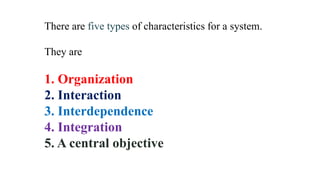
There are five types of characteristics for a system.
They are
1. Organization
2. Interaction
3. Interdependence
4. Integration
5. A central objective
Characteristics
of a
System
Organization
Interaction
Inter-
dependence
Integration
Central
objective
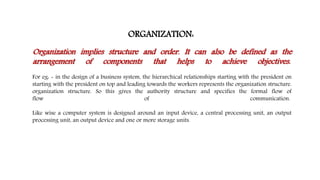
ORGANIZATION:
Organization implies structure and order. It can also be defined as the
arrangement of components that helps to achieve objectives.
For eg: - in the design of a business system, the hierarchical relationships starting with the president on
starting with the president on top and leading towards the workers represents the organization structure.
organization structure. So this gives the authority structure and specifies the formal flow of
flow of communication.
Like wise a computer system is designed around an input device, a central processing unit, an output
processing unit, an output device and one or more storage units.
INTERACTION:
Interaction refers to the manner in which each component functions with
other components of the system.ie, there should be an interrelationship
between each components of a system.
For eg: - in an organization there should be interaction between purchase department and production
department and production department, same way advertising with sales, payroll with personnel.
with personnel.
In computer system, the central processing unit must interact with the input device to solve a
device to solve a problem. In turn the main memory holds programs and data that the arithmetic unit
that the arithmetic unit uses for computation.
INTERDEPENDENCE:
This is one of the important characteristics of a system.
Interdependence means the parts or the components of an organization or computer system
computer system depend on one another.
Each component or parts should depend on other components of an organization. One
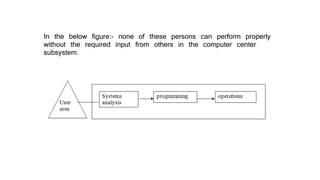
In the below figure:- none of these persons can perform properly
without the required input from others in the computer center
subsystem.
INTEGRATION
Integration refers to the holism of systems.
Synthesis follows analysis to achieve the central objective of the organization.
It is concerned with how a system is tied together.
It is more than sharing a physical part or location.
It work together within the system even though each part performs a means that parts of the
that parts of the system unique function.
CENTRAL OBJECTIVE
The last characteristic of a system is its central objective. Objectives may be real or stated.
In subsequent sections, we shall be particularly interested in open, physical man made system
such as organizations and management information systems.
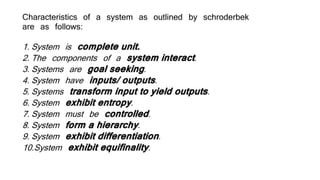
Characteristics of a system as outlined by schroderbek
are as follows:
1. System is complete unit.
2. The components of a system interact.
3. Systems are goal seeking.
4. System have inputs/ outputs.
5. Systems transform input to yield outputs.
6. System exhibit entropy.
7. System must be controlled.
8. System form a hierarchy.
9. System exhibit differentiation.
10.System exhibit equifinality.

Charcteristics of System

  • 1.
    SYSTEM ANALYSIS &DESIGN Characteristics of a System PRESENTED BY- SWAPNIL WALDE B.Com(Computer Application), L.L.B.
  • 2.
    There are fivetypes of characteristics for a system. They are 1. Organization 2. Interaction 3. Interdependence 4. Integration 5. A central objective
  • 3.
  • 4.
    ORGANIZATION: Organization implies structureand order. It can also be defined as the arrangement of components that helps to achieve objectives. For eg: - in the design of a business system, the hierarchical relationships starting with the president on starting with the president on top and leading towards the workers represents the organization structure. organization structure. So this gives the authority structure and specifies the formal flow of flow of communication. Like wise a computer system is designed around an input device, a central processing unit, an output processing unit, an output device and one or more storage units.
  • 5.
    INTERACTION: Interaction refers tothe manner in which each component functions with other components of the system.ie, there should be an interrelationship between each components of a system. For eg: - in an organization there should be interaction between purchase department and production department and production department, same way advertising with sales, payroll with personnel. with personnel. In computer system, the central processing unit must interact with the input device to solve a device to solve a problem. In turn the main memory holds programs and data that the arithmetic unit that the arithmetic unit uses for computation.
  • 6.
    INTERDEPENDENCE: This is oneof the important characteristics of a system. Interdependence means the parts or the components of an organization or computer system computer system depend on one another. Each component or parts should depend on other components of an organization. One
  • 7.
    In the belowfigure:- none of these persons can perform properly without the required input from others in the computer center subsystem.
  • 8.
    INTEGRATION Integration refers tothe holism of systems. Synthesis follows analysis to achieve the central objective of the organization. It is concerned with how a system is tied together. It is more than sharing a physical part or location. It work together within the system even though each part performs a means that parts of the that parts of the system unique function.
  • 9.
    CENTRAL OBJECTIVE The lastcharacteristic of a system is its central objective. Objectives may be real or stated. In subsequent sections, we shall be particularly interested in open, physical man made system such as organizations and management information systems.
  • 10.
    Characteristics of asystem as outlined by schroderbek are as follows: 1. System is complete unit. 2. The components of a system interact. 3. Systems are goal seeking. 4. System have inputs/ outputs. 5. Systems transform input to yield outputs. 6. System exhibit entropy. 7. System must be controlled. 8. System form a hierarchy. 9. System exhibit differentiation. 10.System exhibit equifinality.