Software Engineering
College of Arts, Media and Technology ,CMU.

Kittitouch S.
1.2-26-11-12









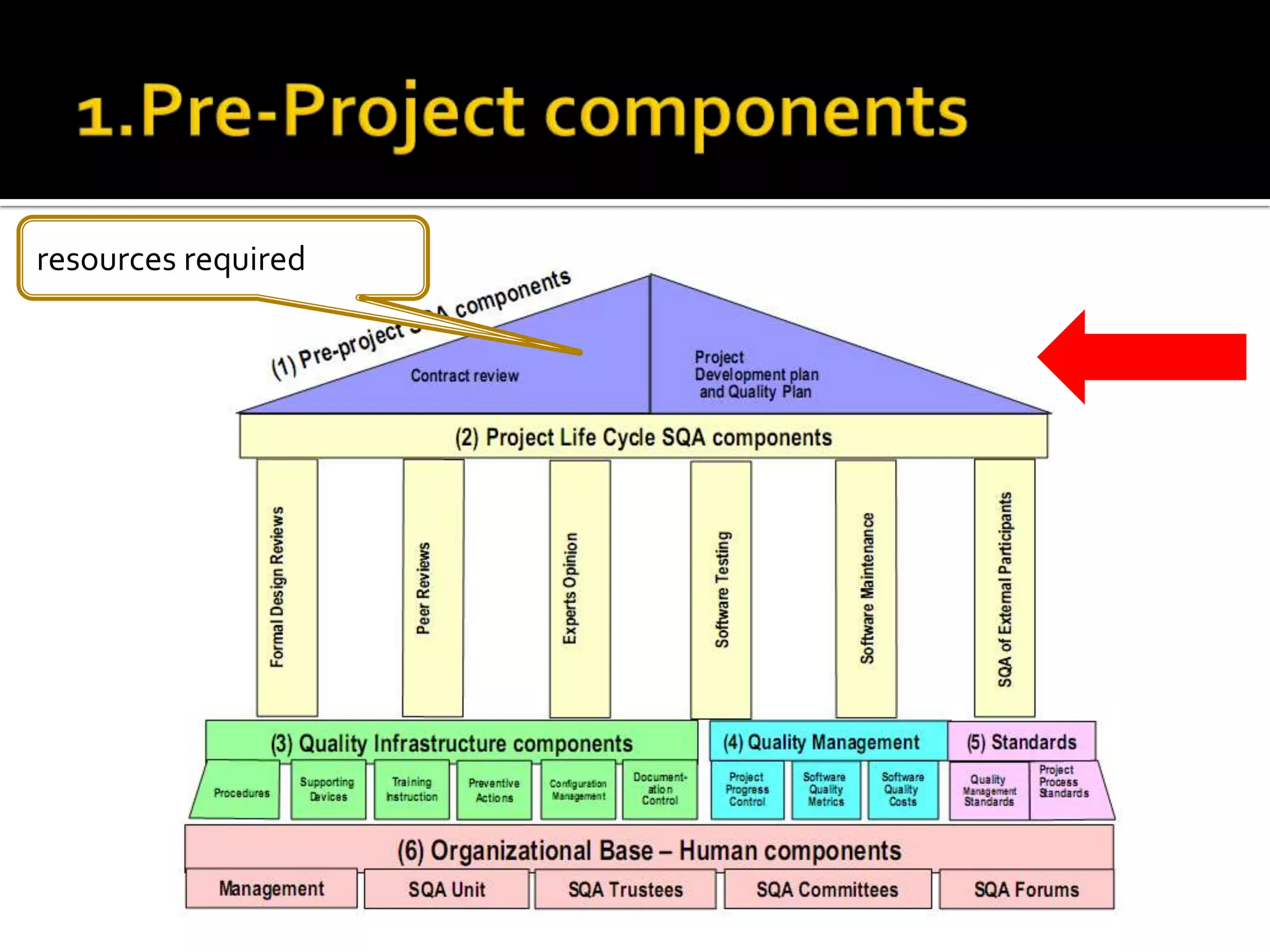
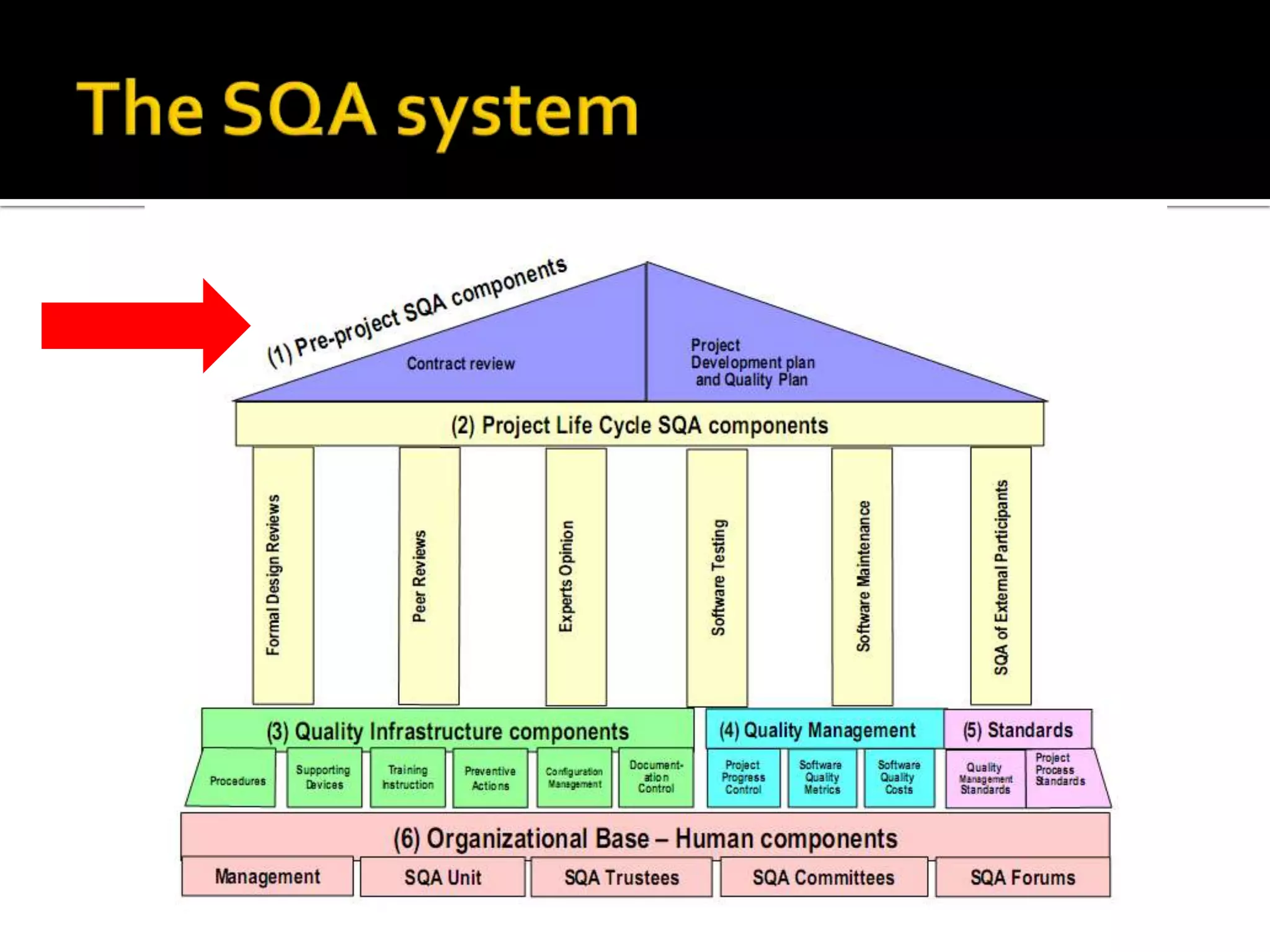
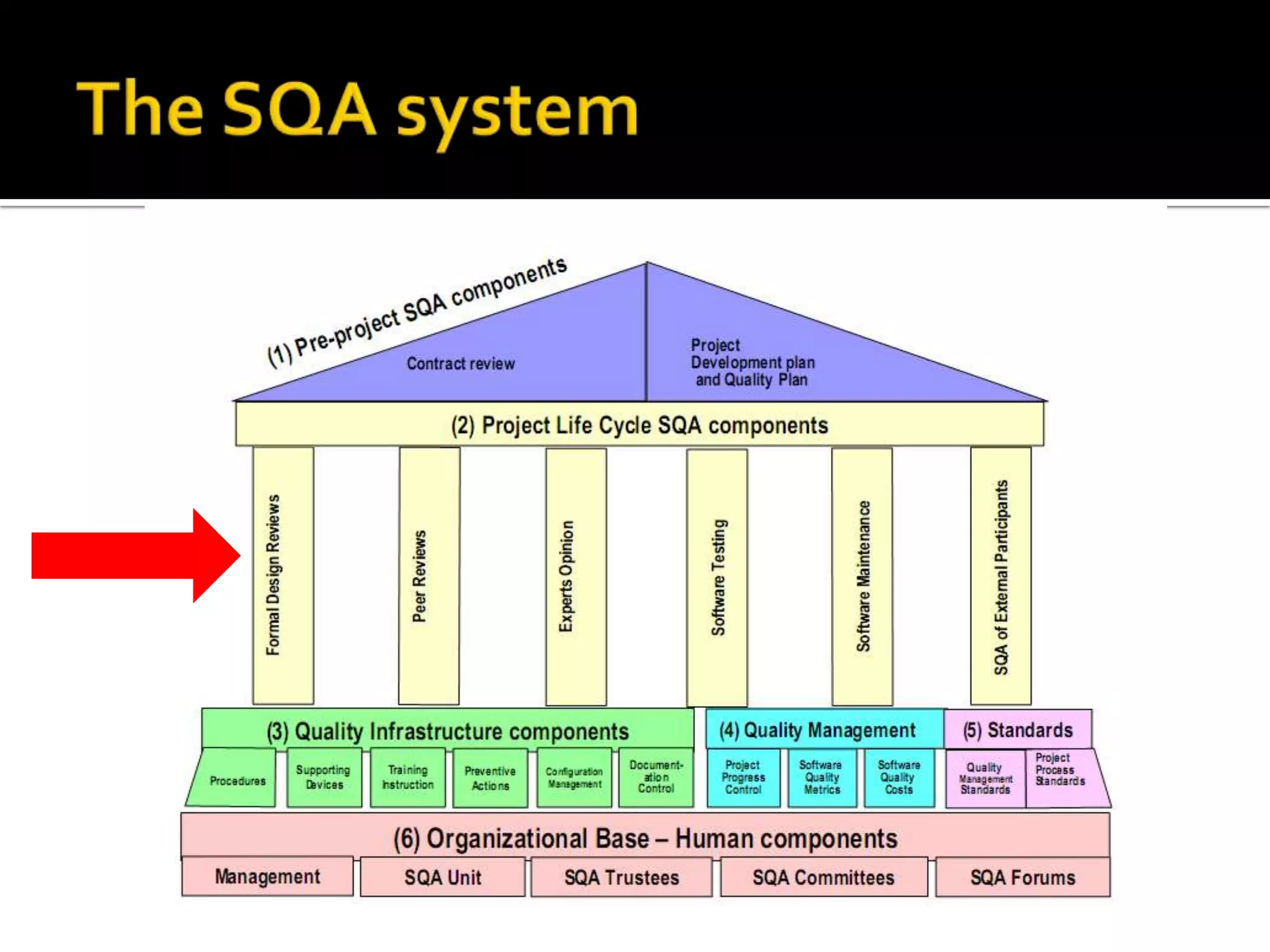
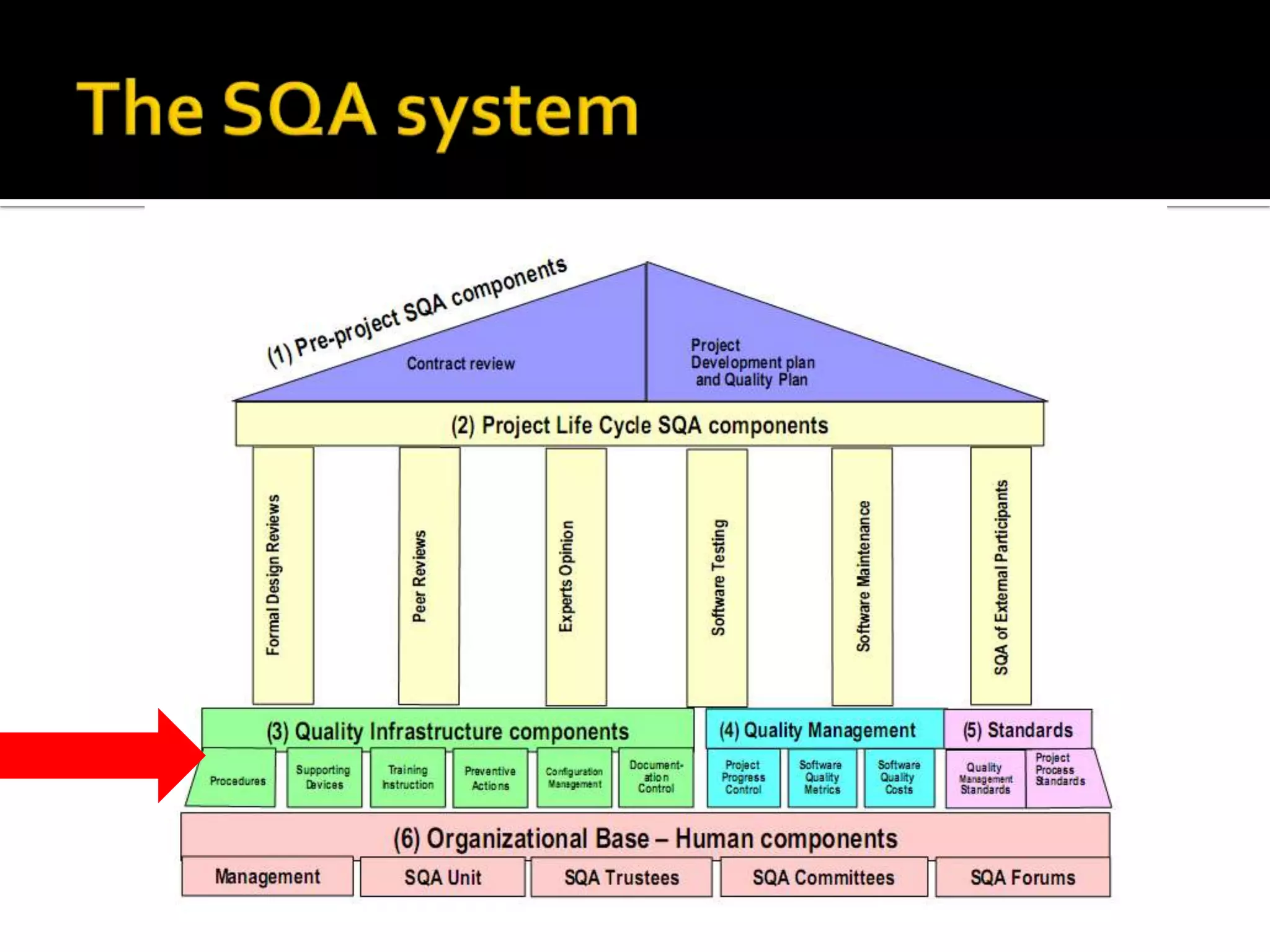
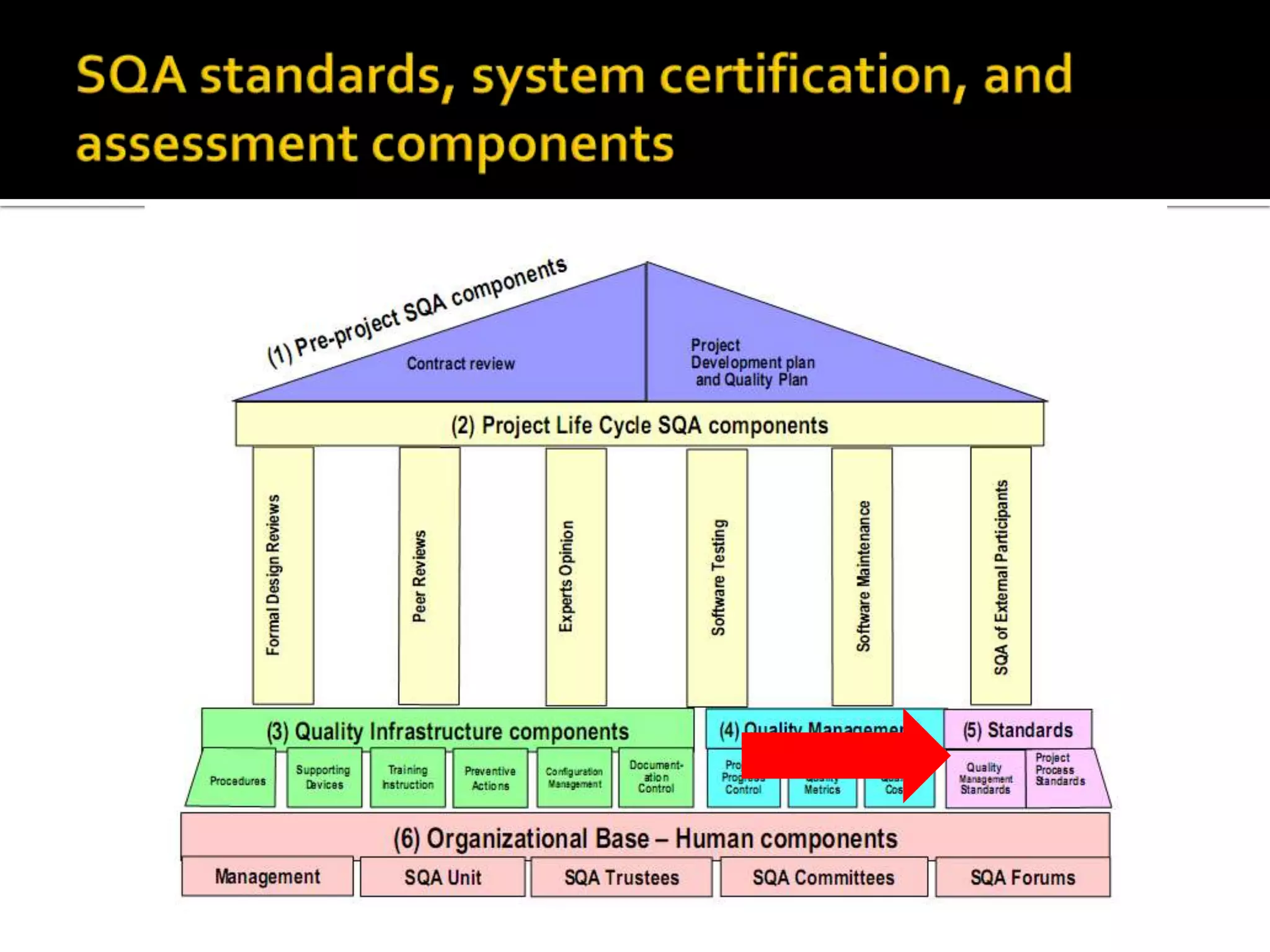
The SQA system
Pre-project component
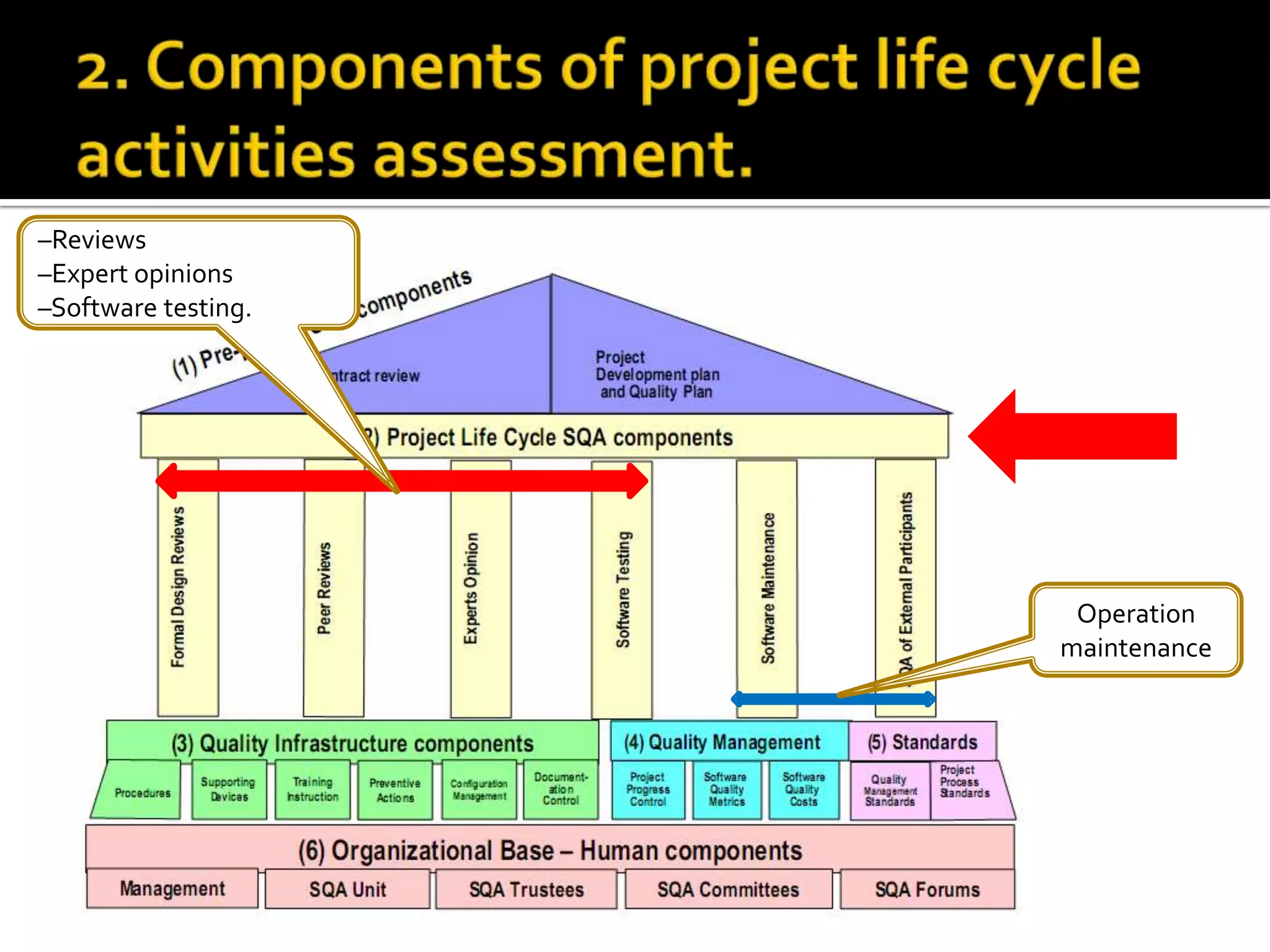
Software project life cycle components
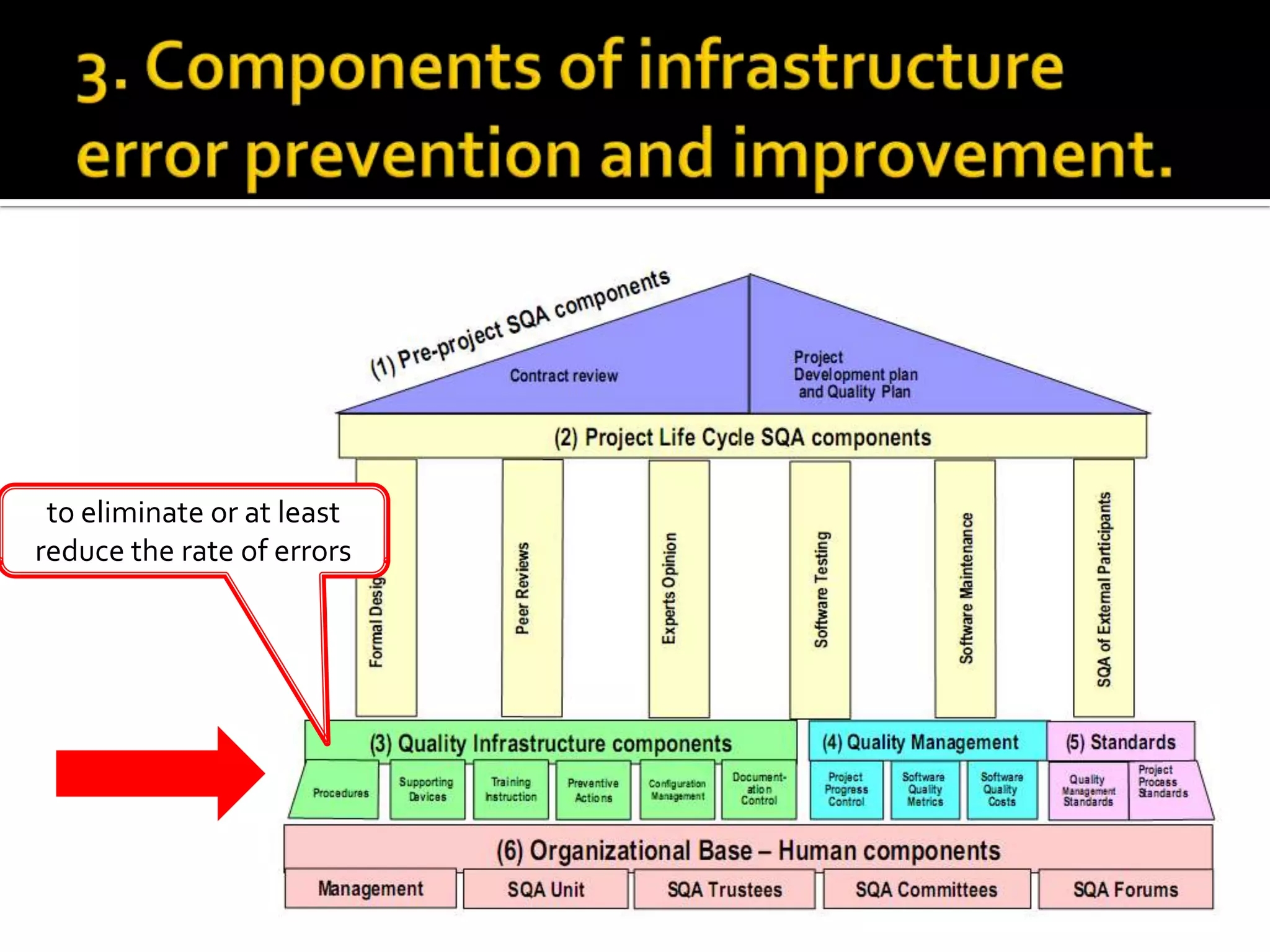
Infrastructure components for error prevention and
improvement
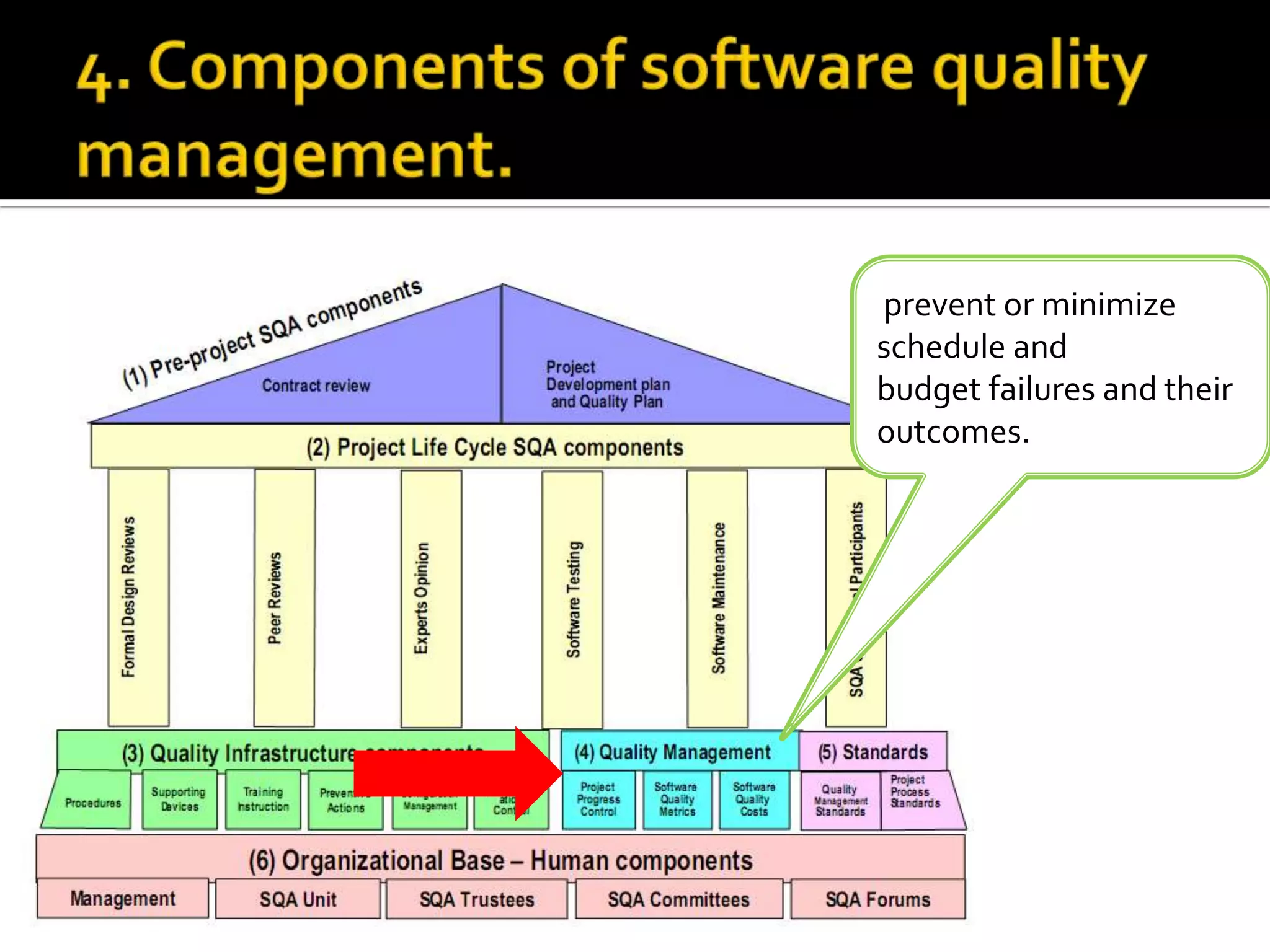
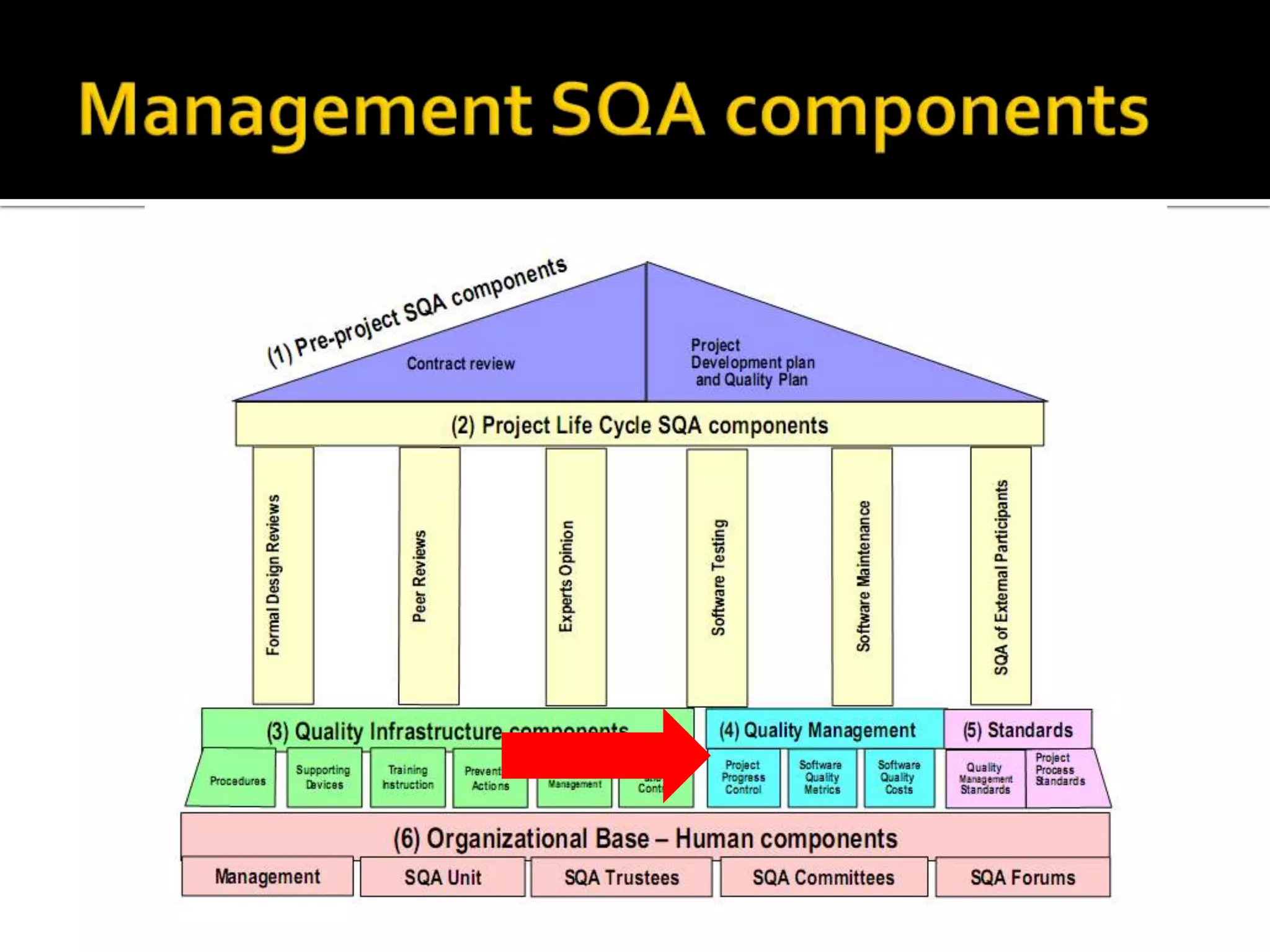
Management SQA components
SQA standards, system certification, and
assessment components
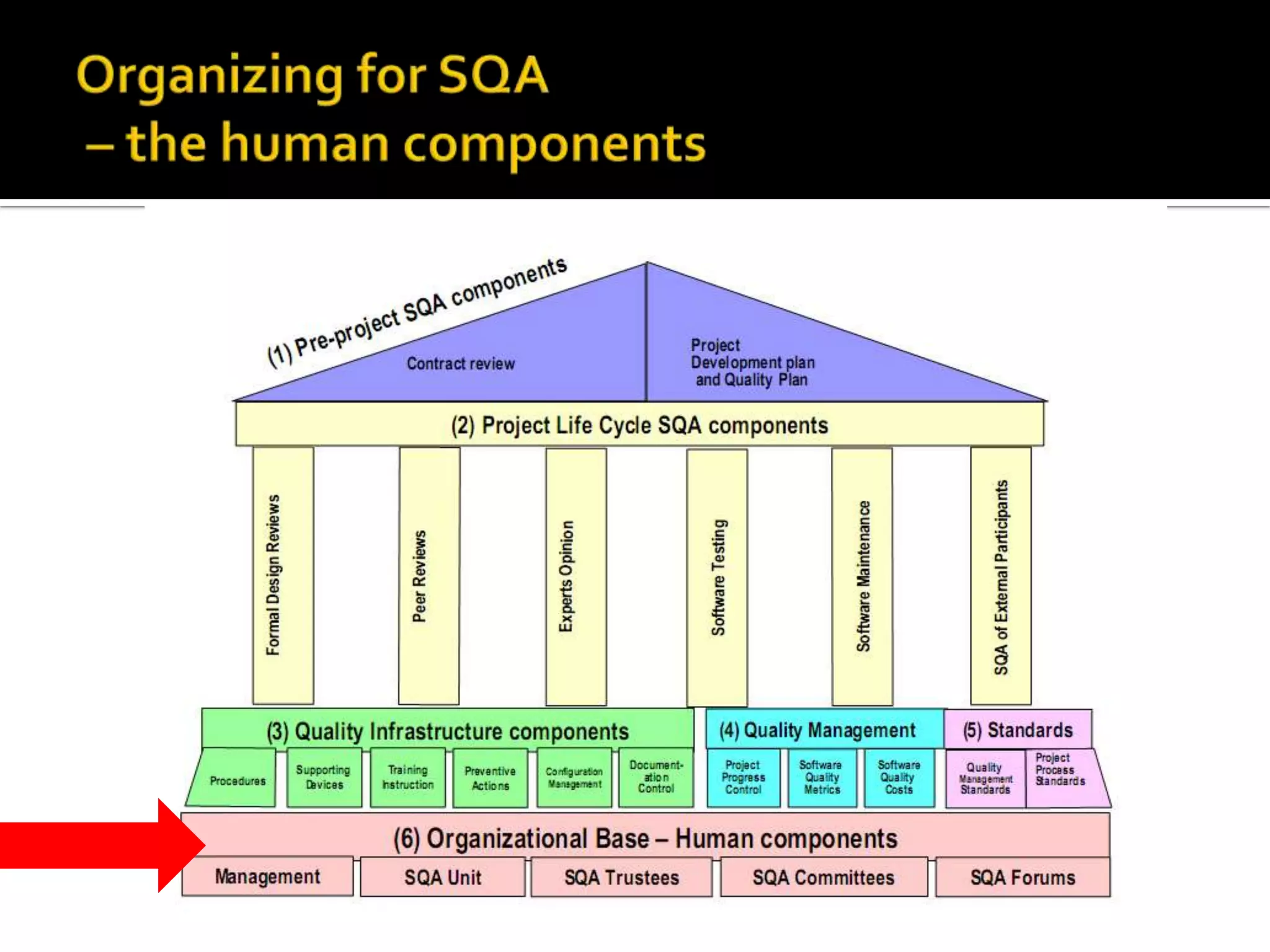
Organizing for SQA
Considerations guiding construction of an
organization’s SQA system


Software is…
▪ High complexity.
▪ Invisible product.
▪ Hard to search and fix defect(bug).



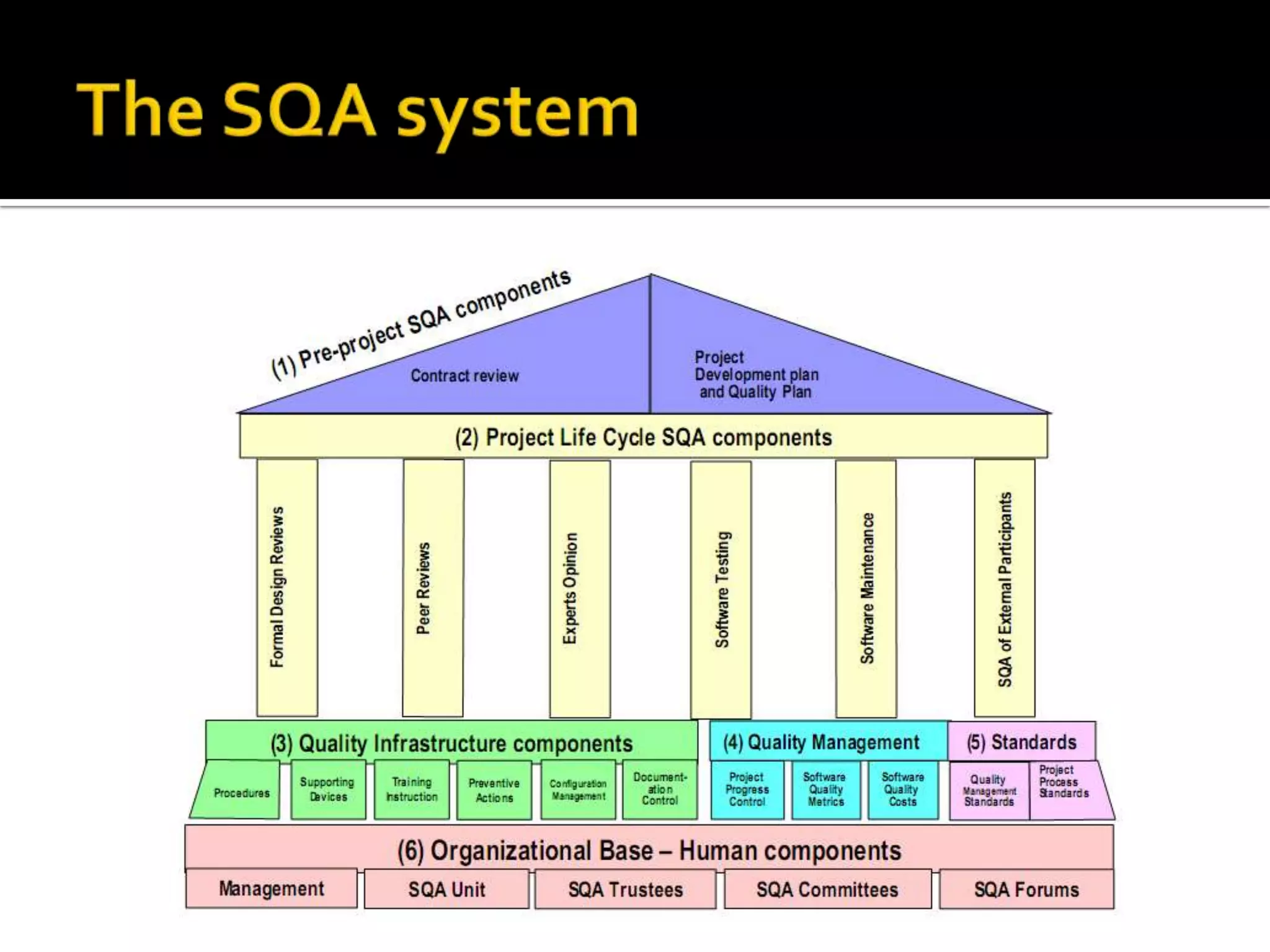
SQA system components can be classified
into six classes:
resources required
–Reviews
–Expert opinions
–Software testing.

Operation
maintenance
to eliminate or at least
reduce the rate of errors
prevent or minimize
schedule and
budget failures and their
outcomes.


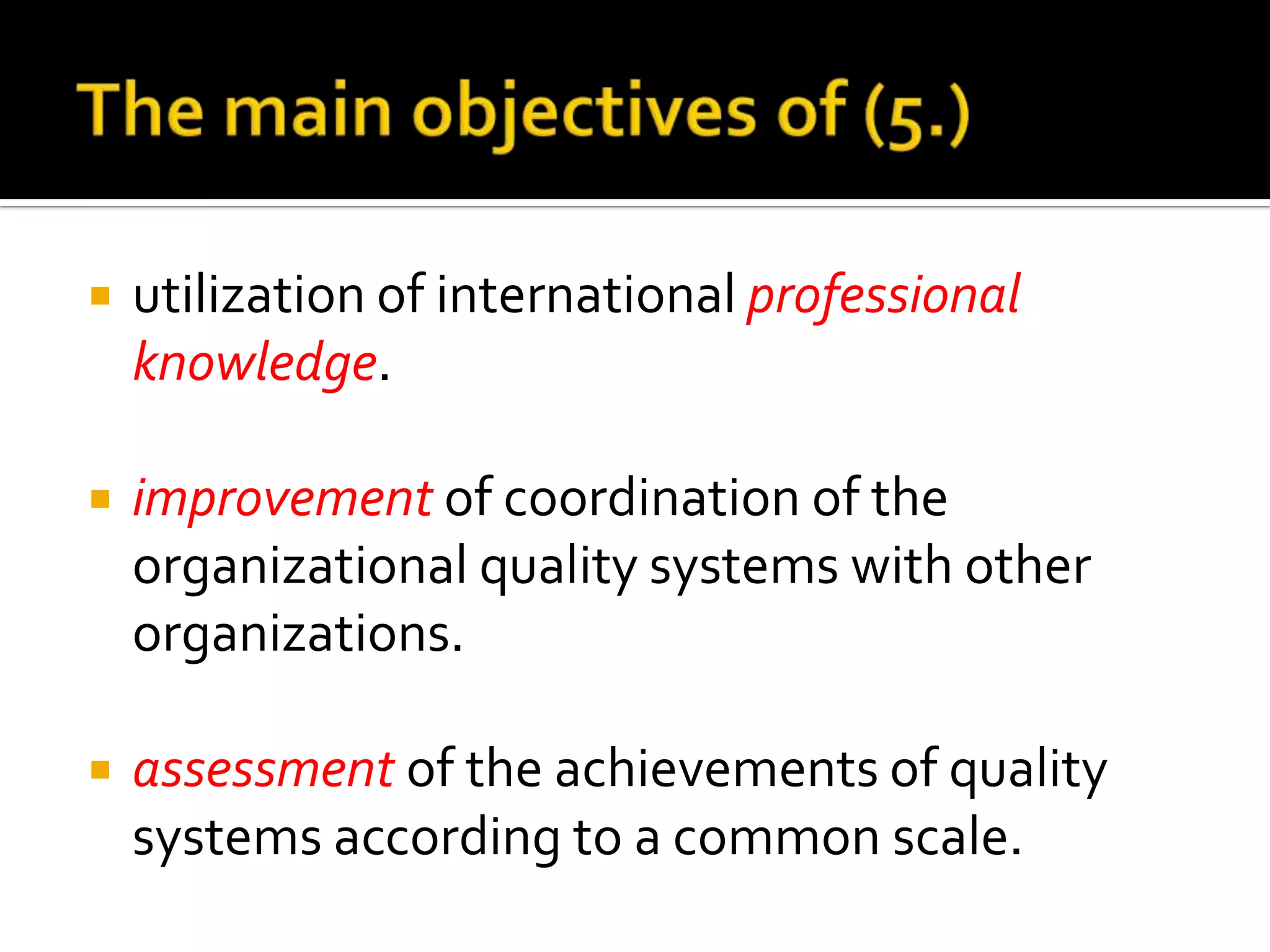
utilization of international professional
knowledge.



improvement of coordination of the
organizational quality systems with other
organizations.



assessment of the achievements of quality
systems according to a common scale.
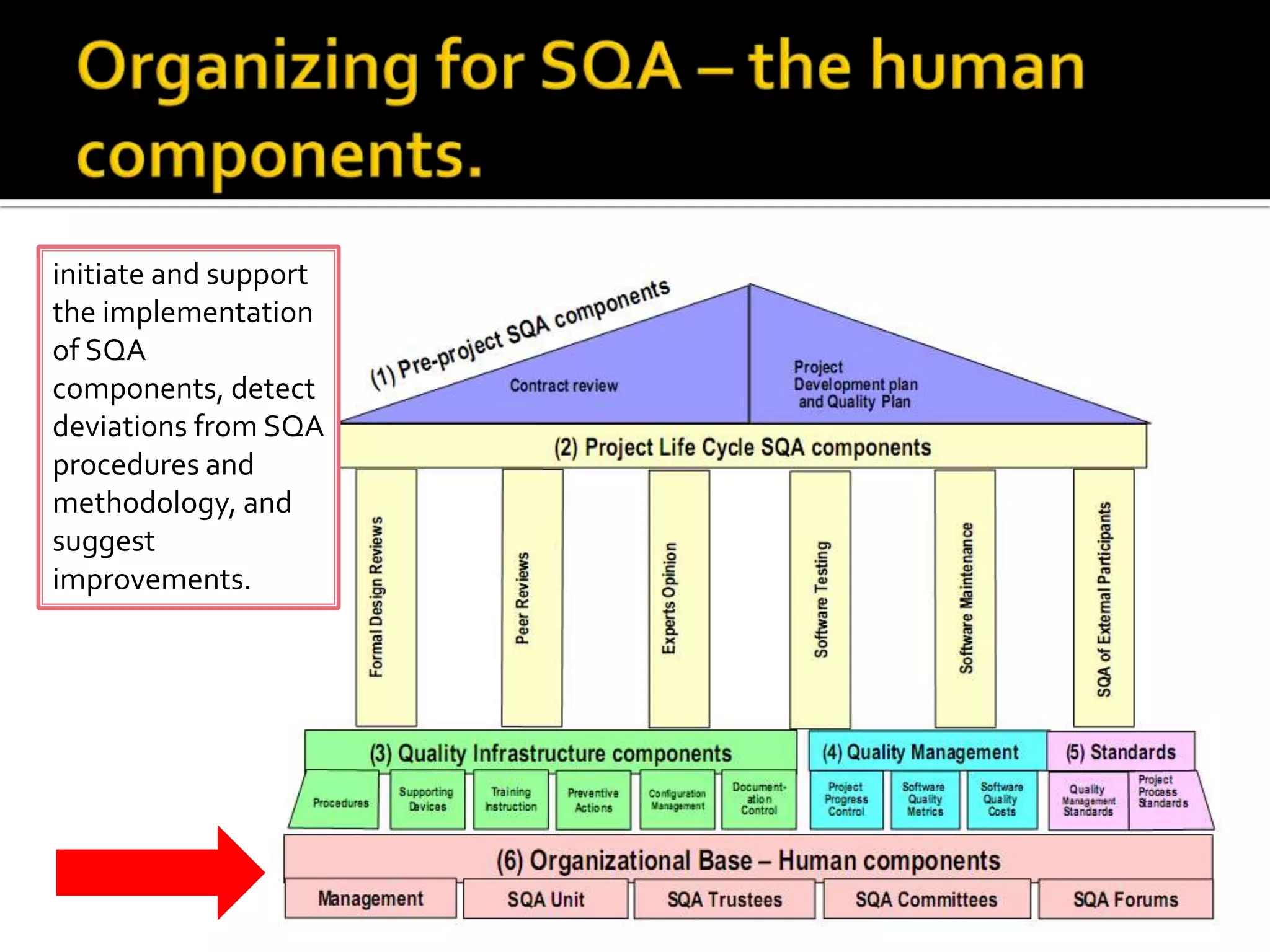
initiate and support
the implementation
of SQA
components, detect
deviations from SQA
procedures and
methodology, and
suggest
improvements.


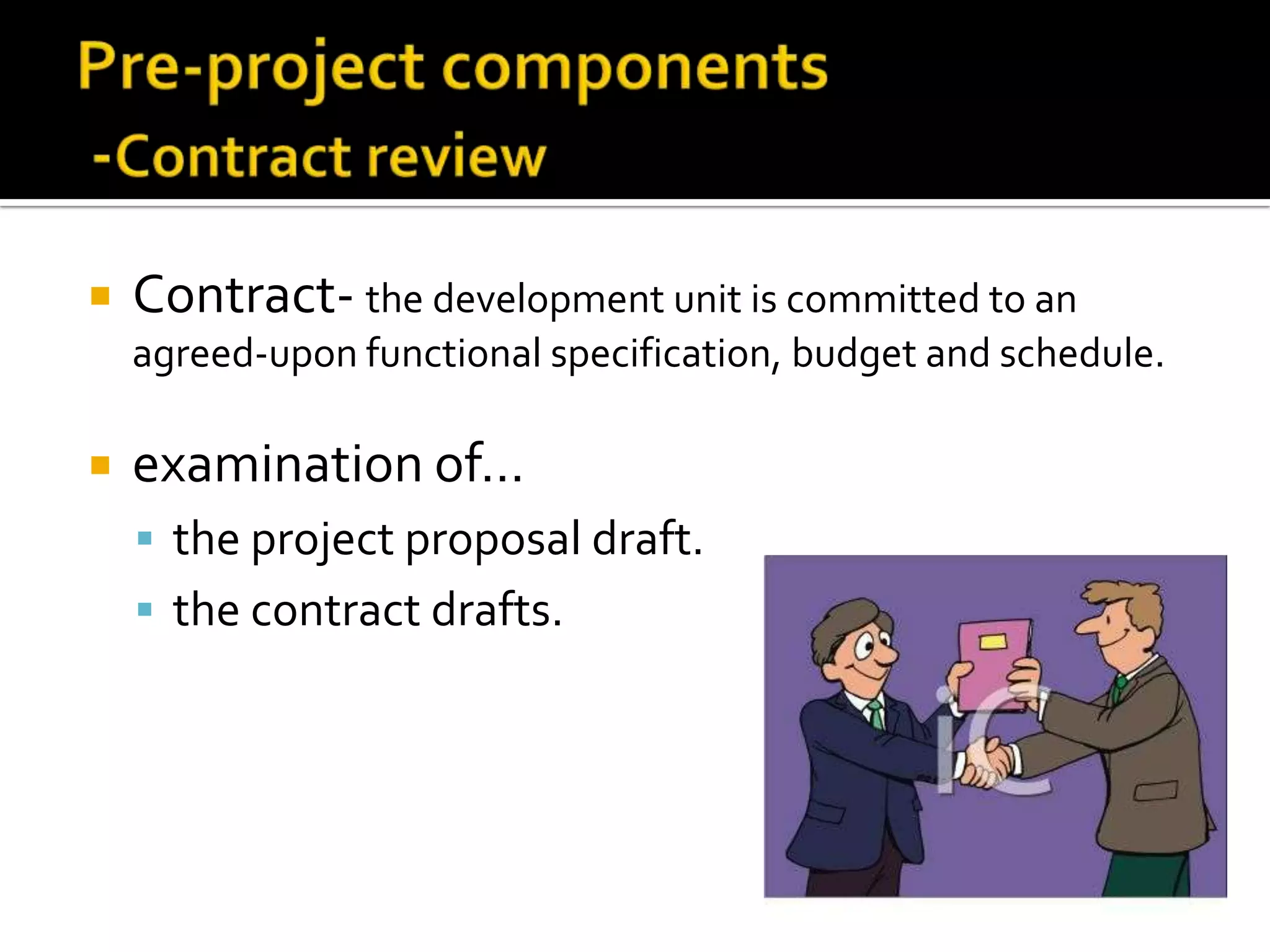
Contract- the development unit is committed to an
agreed-upon functional specification, budget and schedule.



examination of…
 the project proposal draft.
 the contract drafts.


Clarification of the customer’s requirements



Review of the project’s schedule and resource
requirement estimates



Evaluation of the professional staff’s capacity
to carry out the proposed project


Evaluation of the customer’s capacity to fulfill
his obligations



Evaluation of development risks.
a plan is prepared of the project (“development
plan”) and its integrated quality assurance
activities (“quality plan”). These plans include
additional details and needed revisions based
on prior plans that provided the basis for the
current proposal and contract.
It is quite common for several months to pass
between the tender submission and the
signing of the contract.







Schedules
Required manpower and hardware resources
Risk evaluations
Organizational issues: team
members, subcontractors and partnerships
Project methodology, development
tools, etc.
Software reuse plans.


Quality goals, expressed in the appropriate
measurable terms



Criteria for starting and ending each project
stage



Lists of reviews, tests, and other scheduled
verification and validation activities.


Read the examples of Project Plan and
Quality Plan in SQA. site.


Reviews



Expert opinions



Software testing



Software maintenance



Assurance of the quality of the subcontractors’
work and the customer supplied parts.


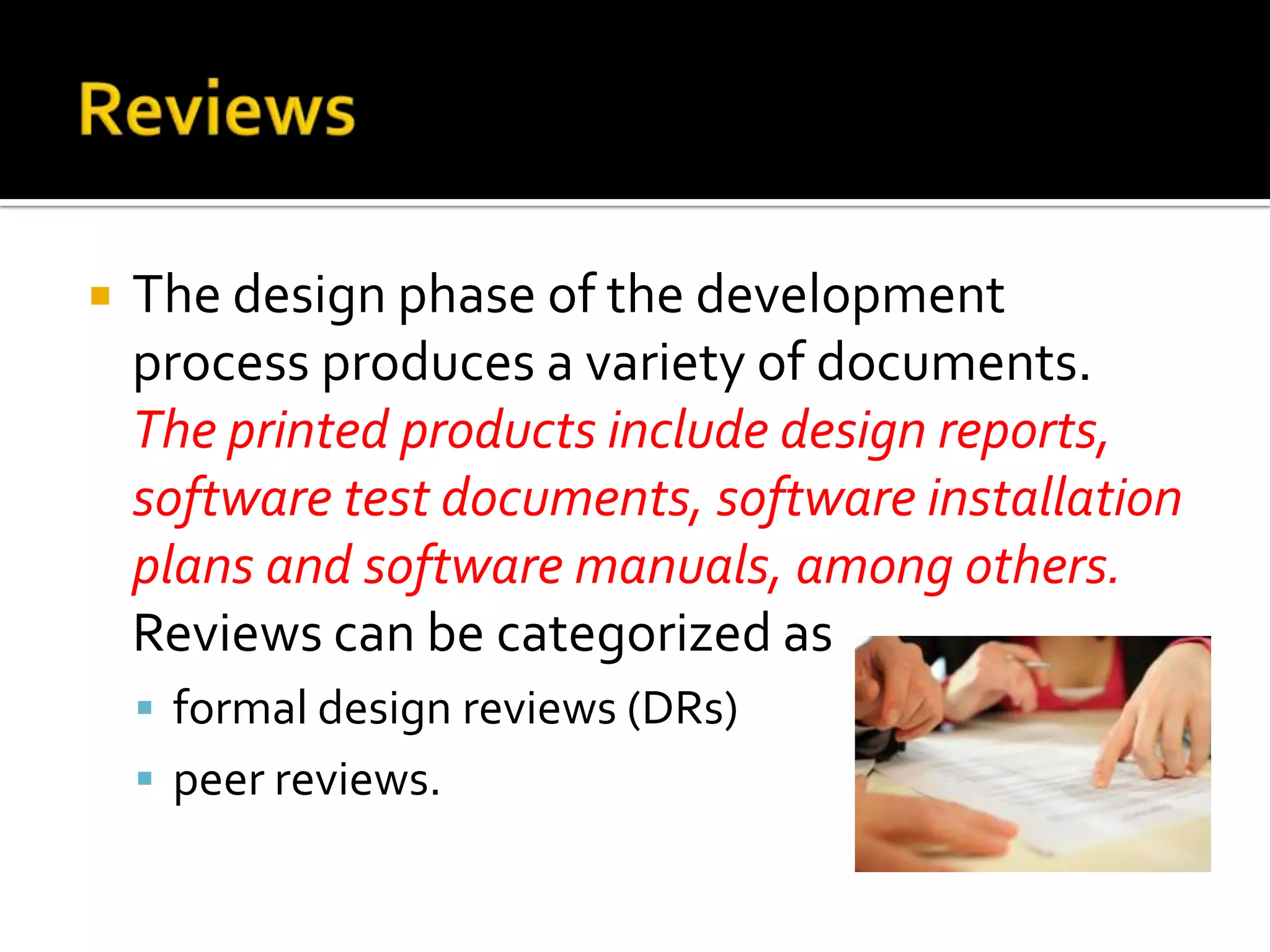
The design phase of the development
process produces a variety of documents.
The printed products include design reports,
software test documents, software installation
plans and software manuals, among others.
Reviews can be categorized as
 formal design reviews (DRs)
 peer reviews.


The committees are composed of senior
professionals, including the project leader
and, usually, the department manager, the
chief software engineer, and heads of other
related departments.



The DR report itself includes a list of required
corrections (termed “action items”).


When a design review committee sits in order to decide
upon the continuation of the work completed so far, one
of the following options is usually open for
consideration:
 Immediate approval of the DR document and continuation to

the next development phase.

 Approval to proceed to the next development phase after all

the action items have been completed and inspected by the
committee’s representative.

 An additional DR is required and scheduled to take place after

all the action items have been completed and inspected by the
committee’s representative.


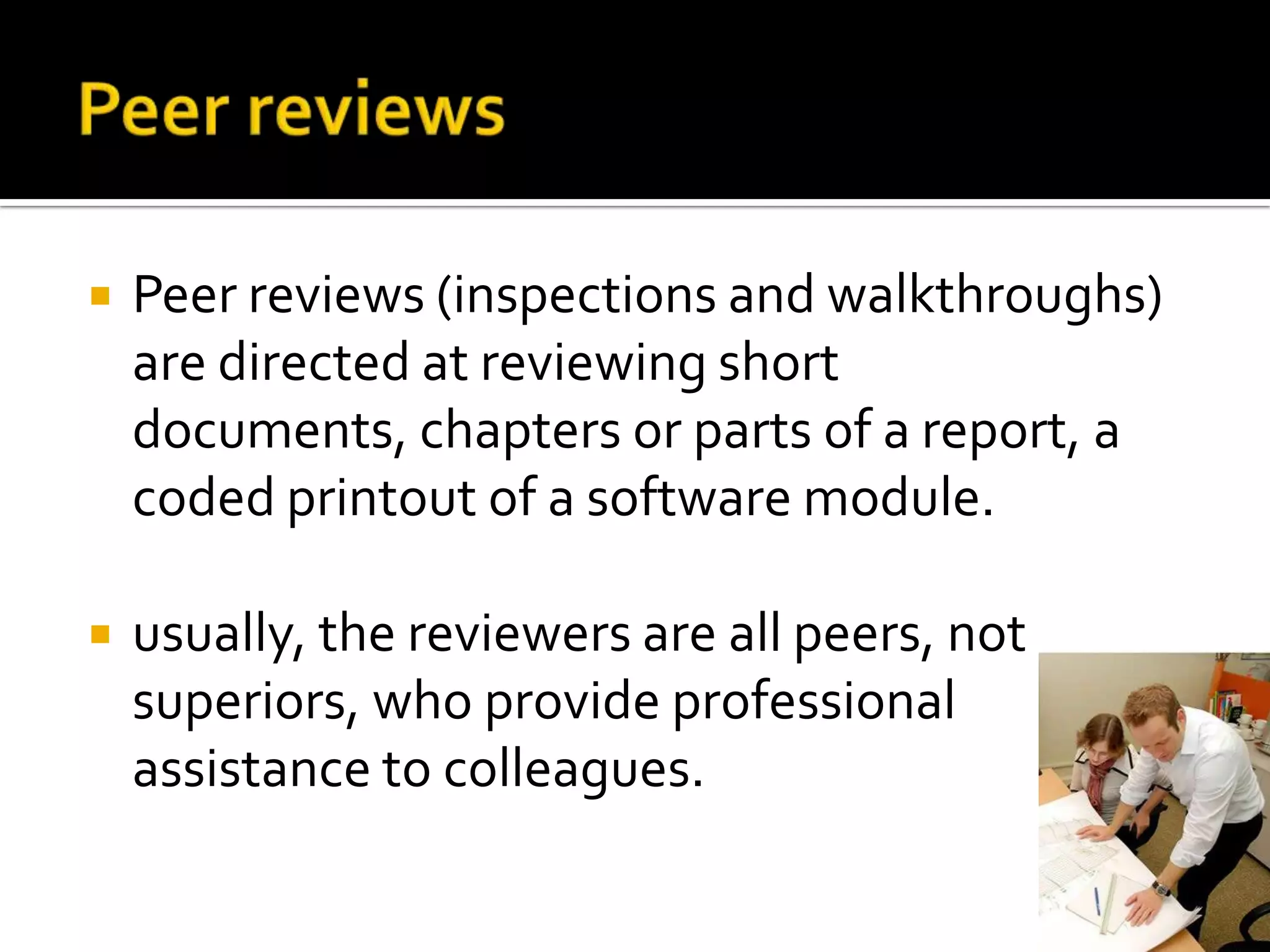
Peer reviews (inspections and walkthroughs)
are directed at reviewing short
documents, chapters or parts of a report, a
coded printout of a software module.



usually, the reviewers are all peers, not
superiors, who provide professional
assistance to colleagues.


The main objective of inspections and
walkthroughs is to detect as many design and
programming faults as possible.



The output is a list of detected faults and, for
inspections, also a defect summary and
statistics to be used as a database for
reviewing and improving development
methods.


Expert opinions support quality assessment
efforts by introducing additional external
capabilities into the organization’s in-house
development process. Turning to outside
experts may be particularly useful in the
following situations:


Insufficient in-house professional capabilities
in a given area.



In small organizations in many cases it is
difficult to find enough suitable candidates to
participate in the design review teams.



In cases of major disagreement among the
organization’s


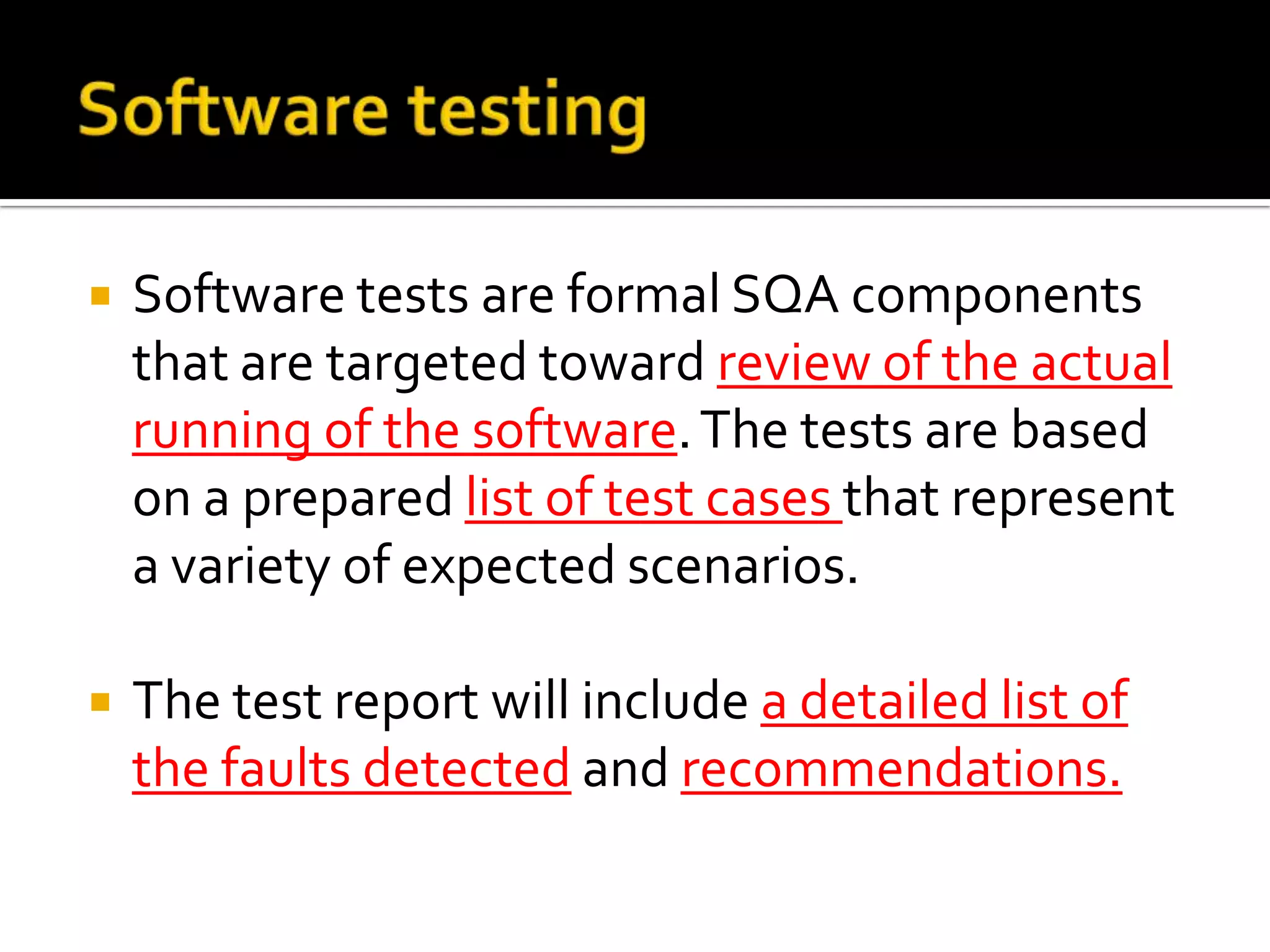
Software tests are formal SQA components
that are targeted toward review of the actual
running of the software. The tests are based
on a prepared list of test cases that represent
a variety of expected scenarios.



The test report will include a detailed list of
the faults detected and recommendations.


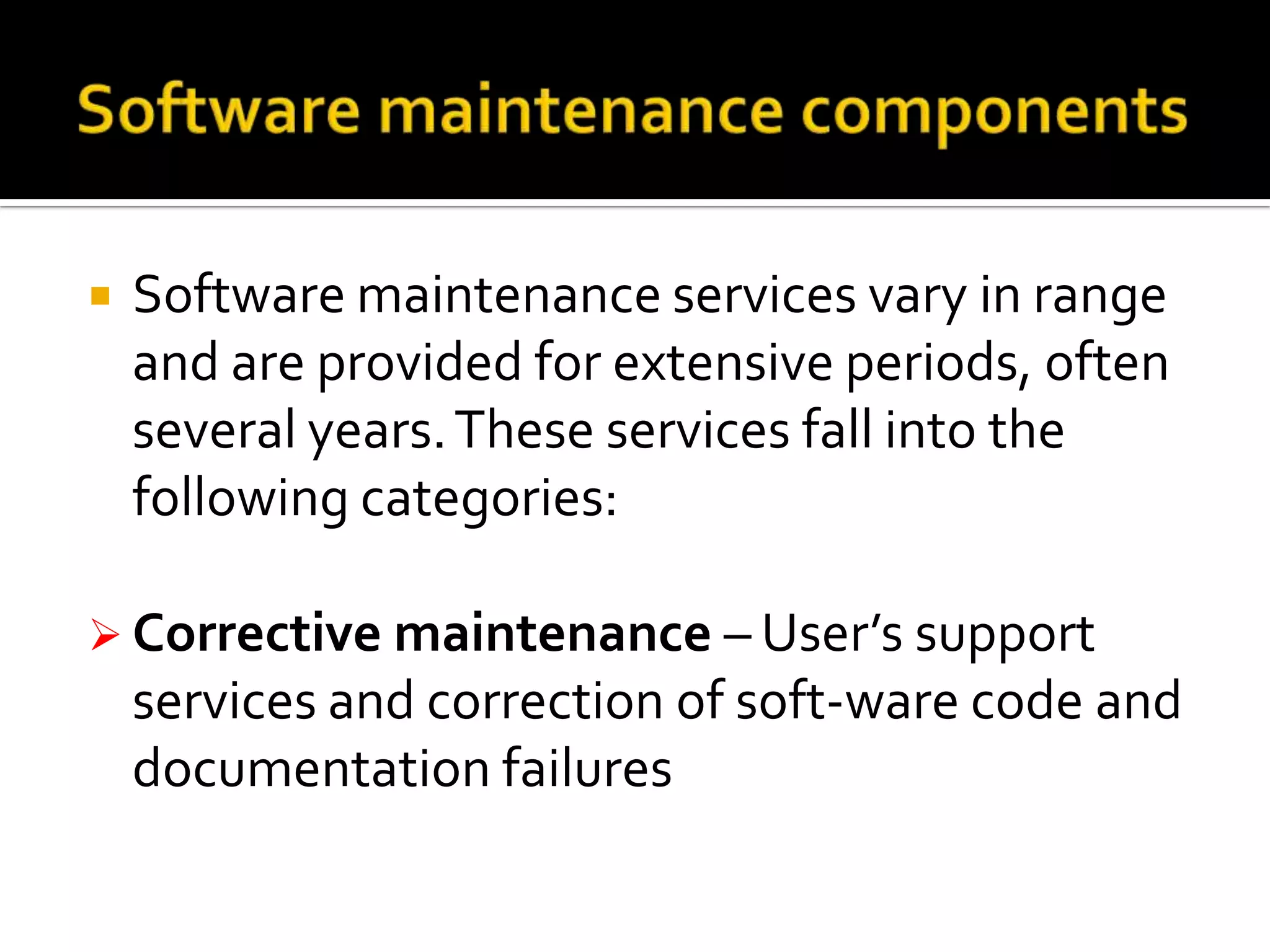
Software maintenance services vary in range
and are provided for extensive periods, often
several years. These services fall into the
following categories:

 Corrective maintenance – User’s support

services and correction of soft-ware code and
documentation failures
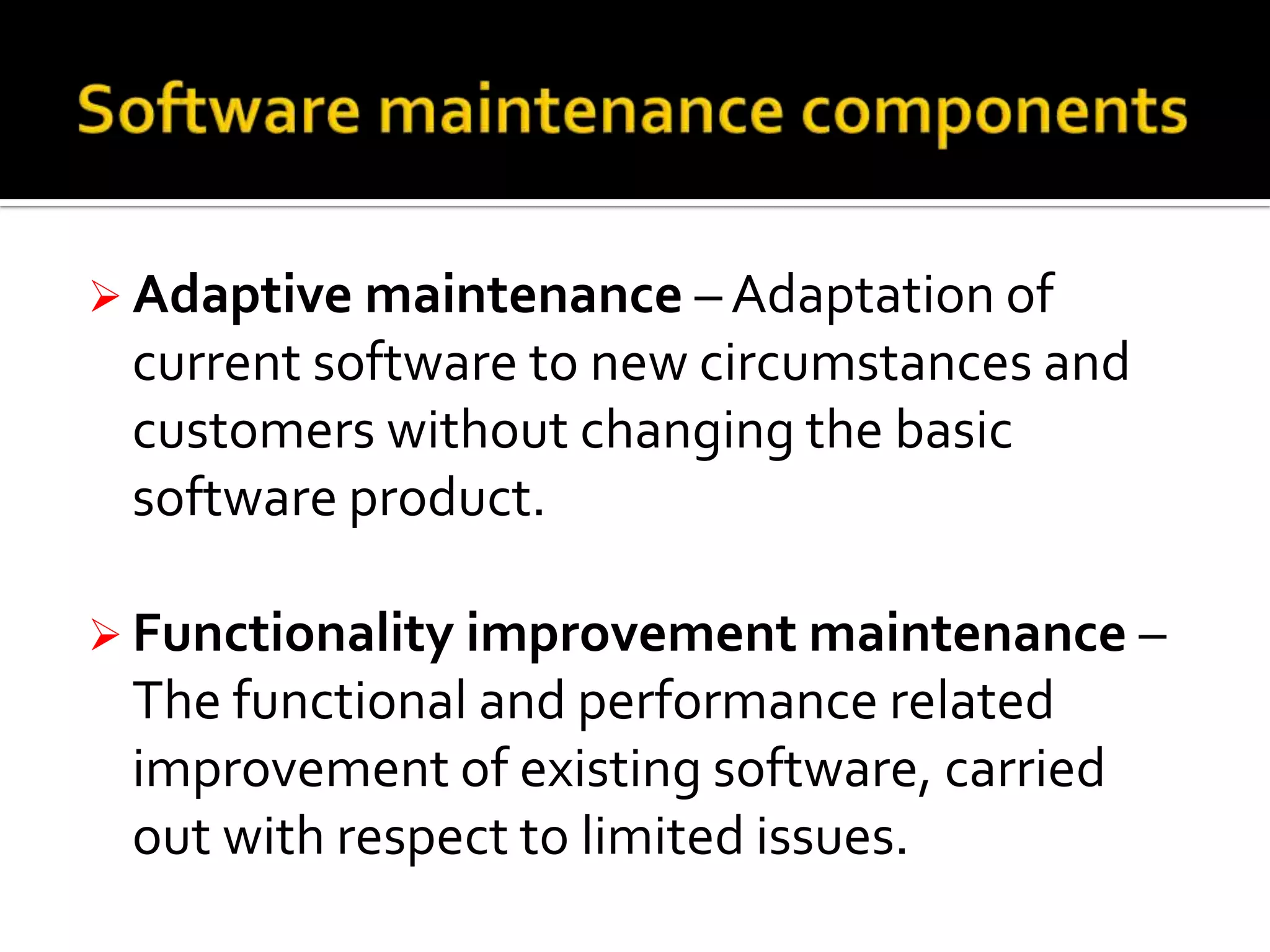
 Adaptive maintenance – Adaptation of

current software to new circumstances and
customers without changing the basic
software product.
 Functionality improvement maintenance –

The functional and performance related
improvement of existing software, carried
out with respect to limited issues.


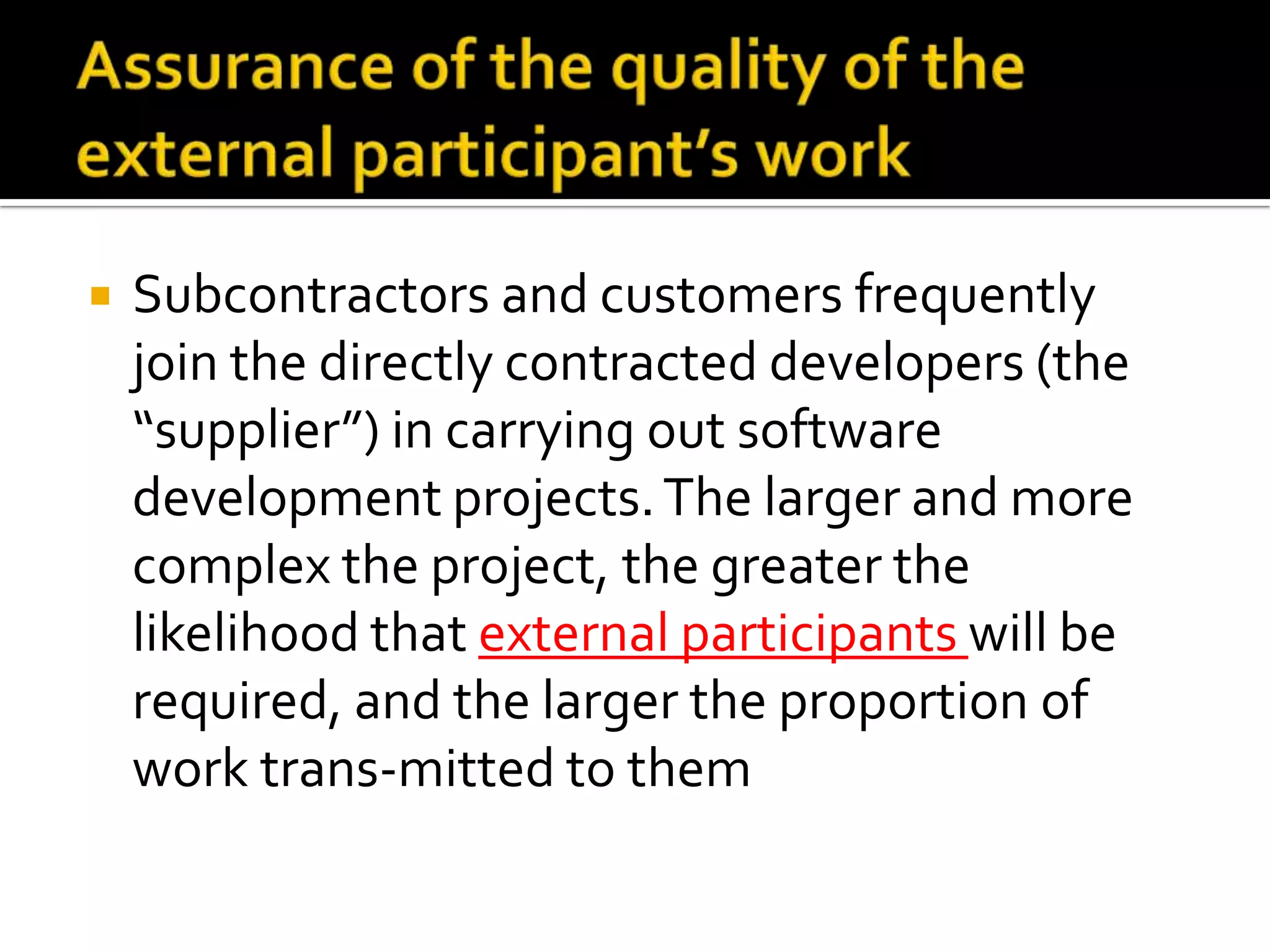
Subcontractors and customers frequently
join the directly contracted developers (the
“supplier”) in carrying out software
development projects. The larger and more
complex the project, the greater the
likelihood that external participants will be
required, and the larger the proportion of
work trans-mitted to them







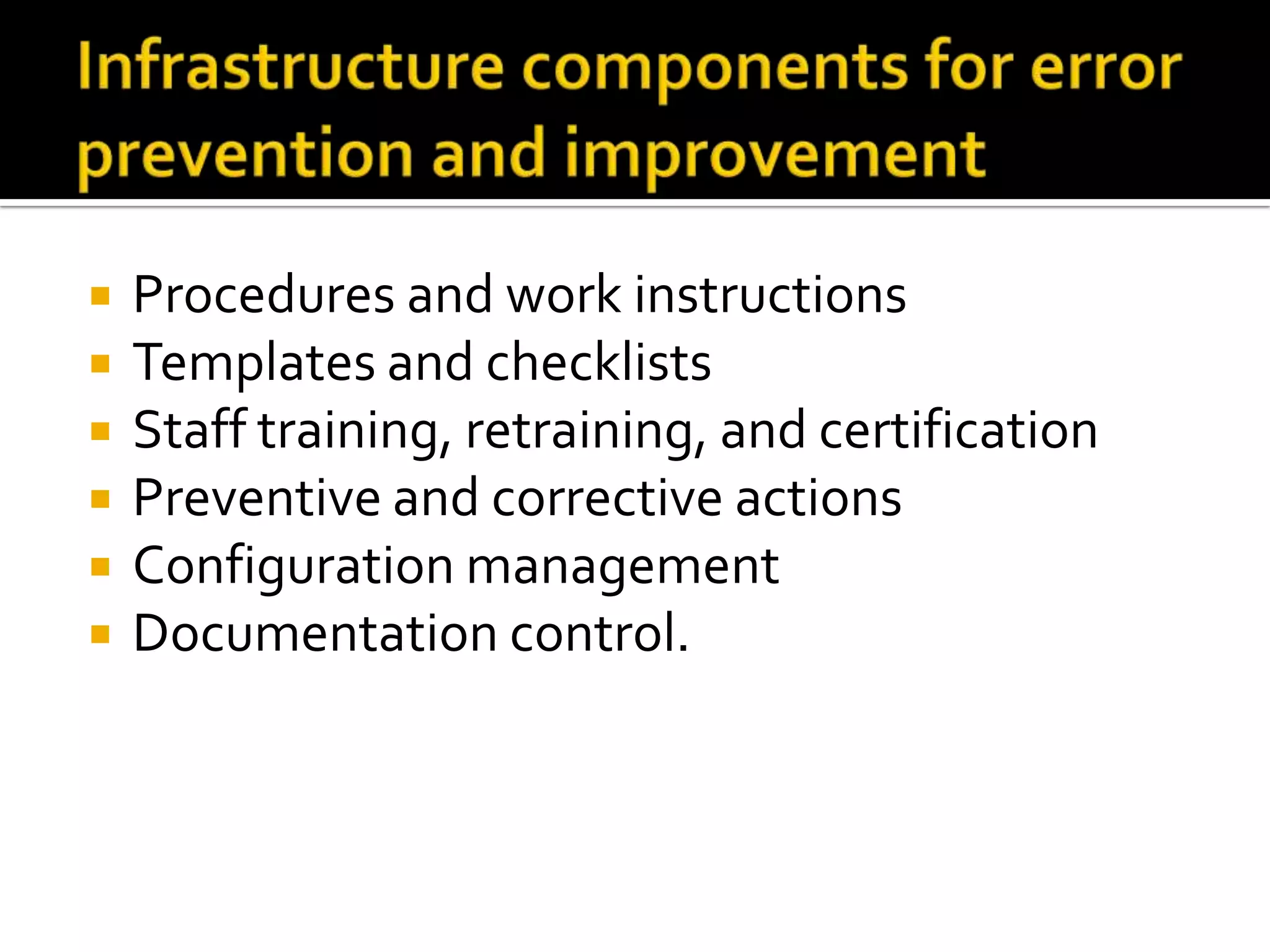
Procedures and work instructions
Templates and checklists
Staff training, retraining, and certification
Preventive and corrective actions
Configuration management
Documentation control.


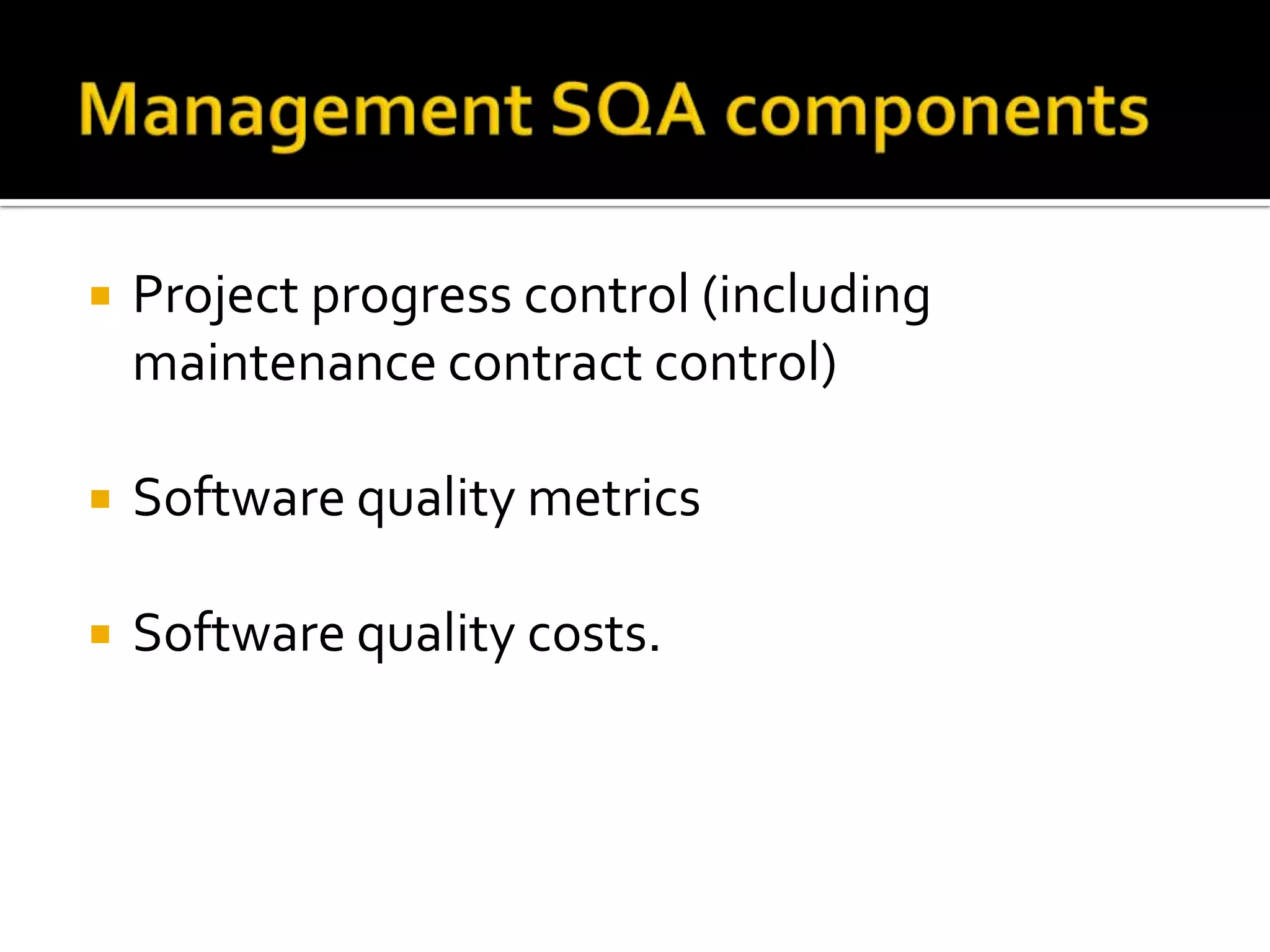
Project progress control (including
maintenance contract control)



Software quality metrics



Software quality costs.


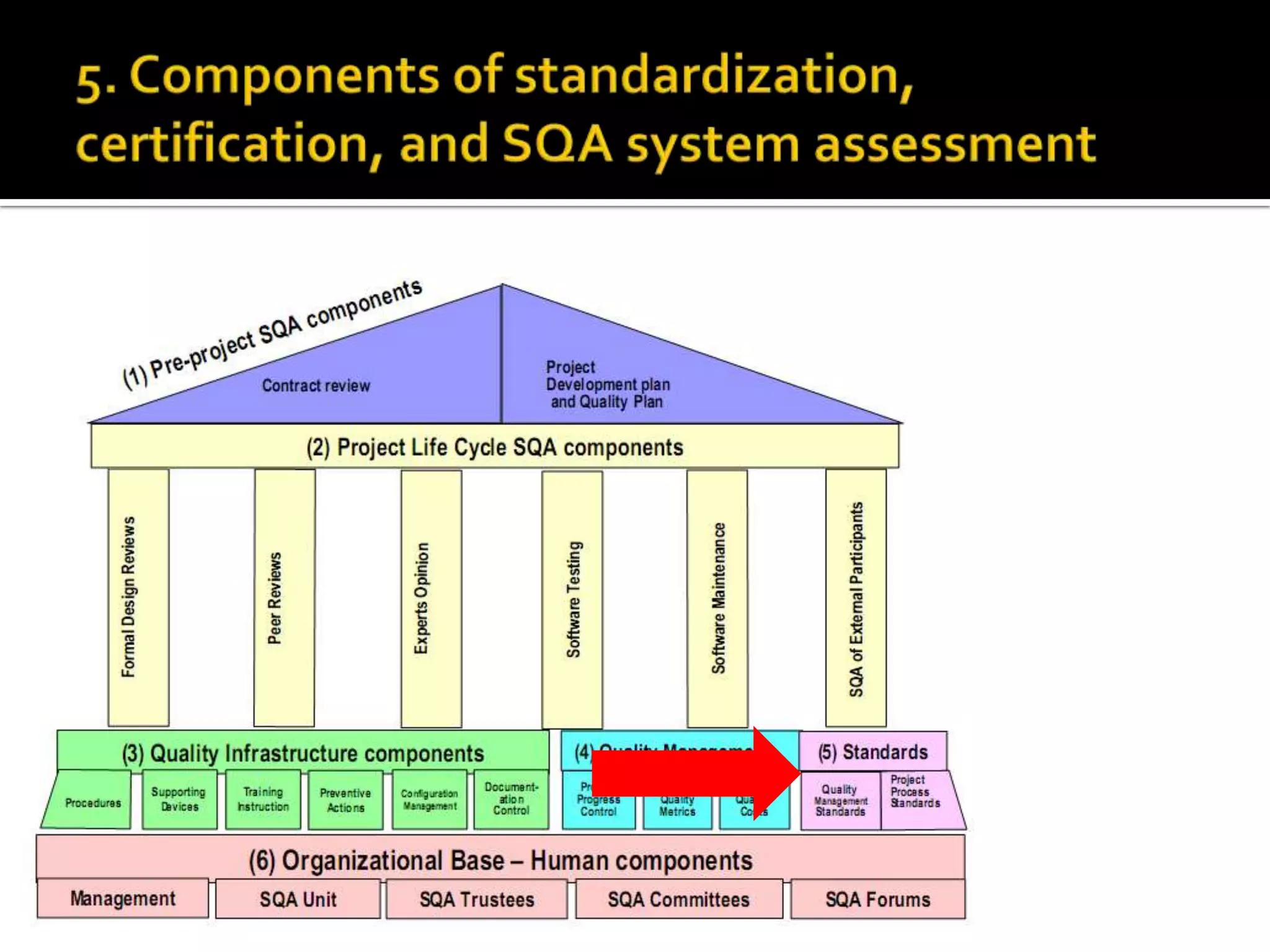
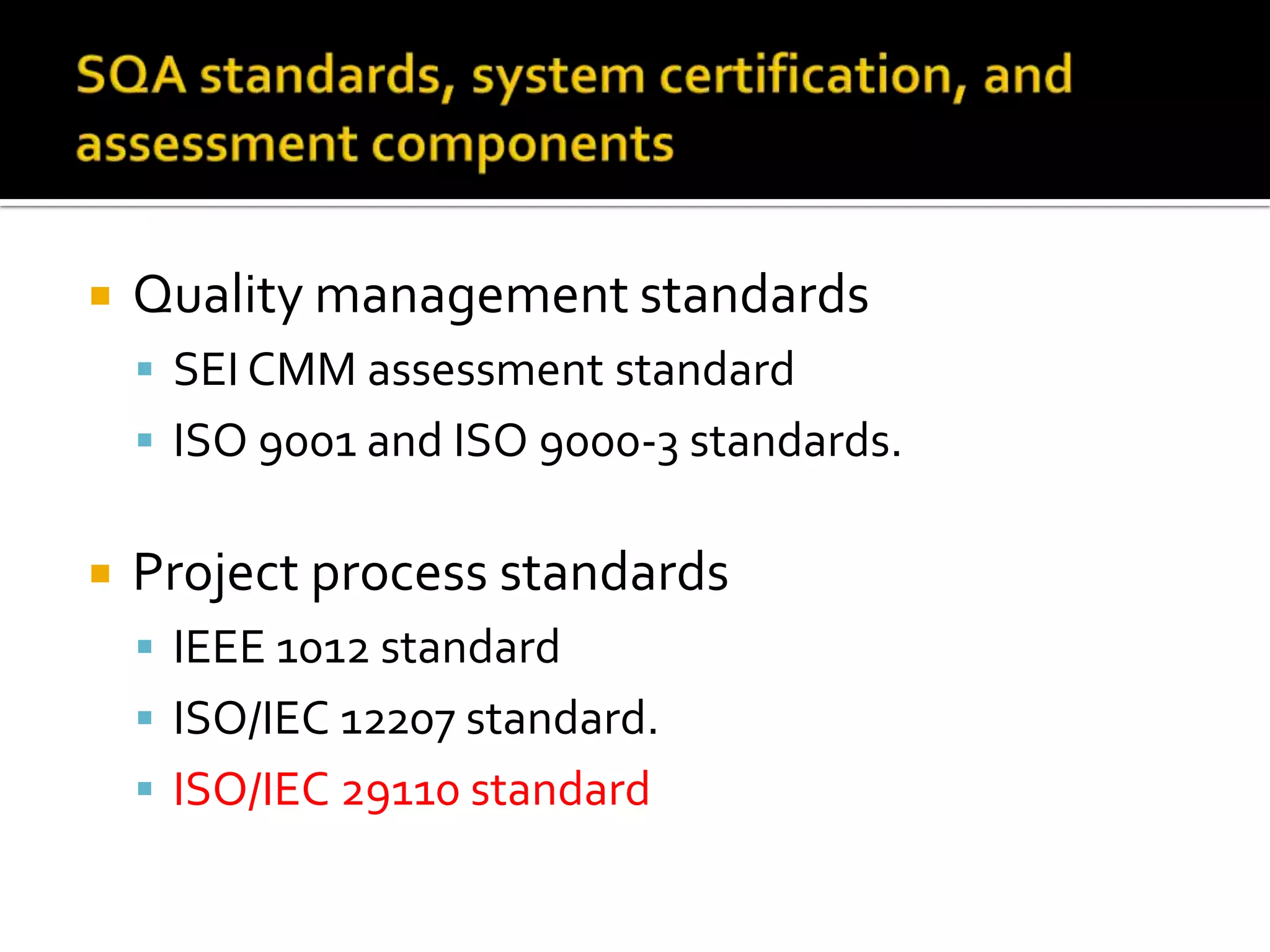
Quality management standards
 SEI CMM assessment standard
 ISO 9001 and ISO 9000-3 standards.



Project process standards
 IEEE 1012 standard
 ISO/IEC 12207 standard.
 ISO/IEC 29110 standard


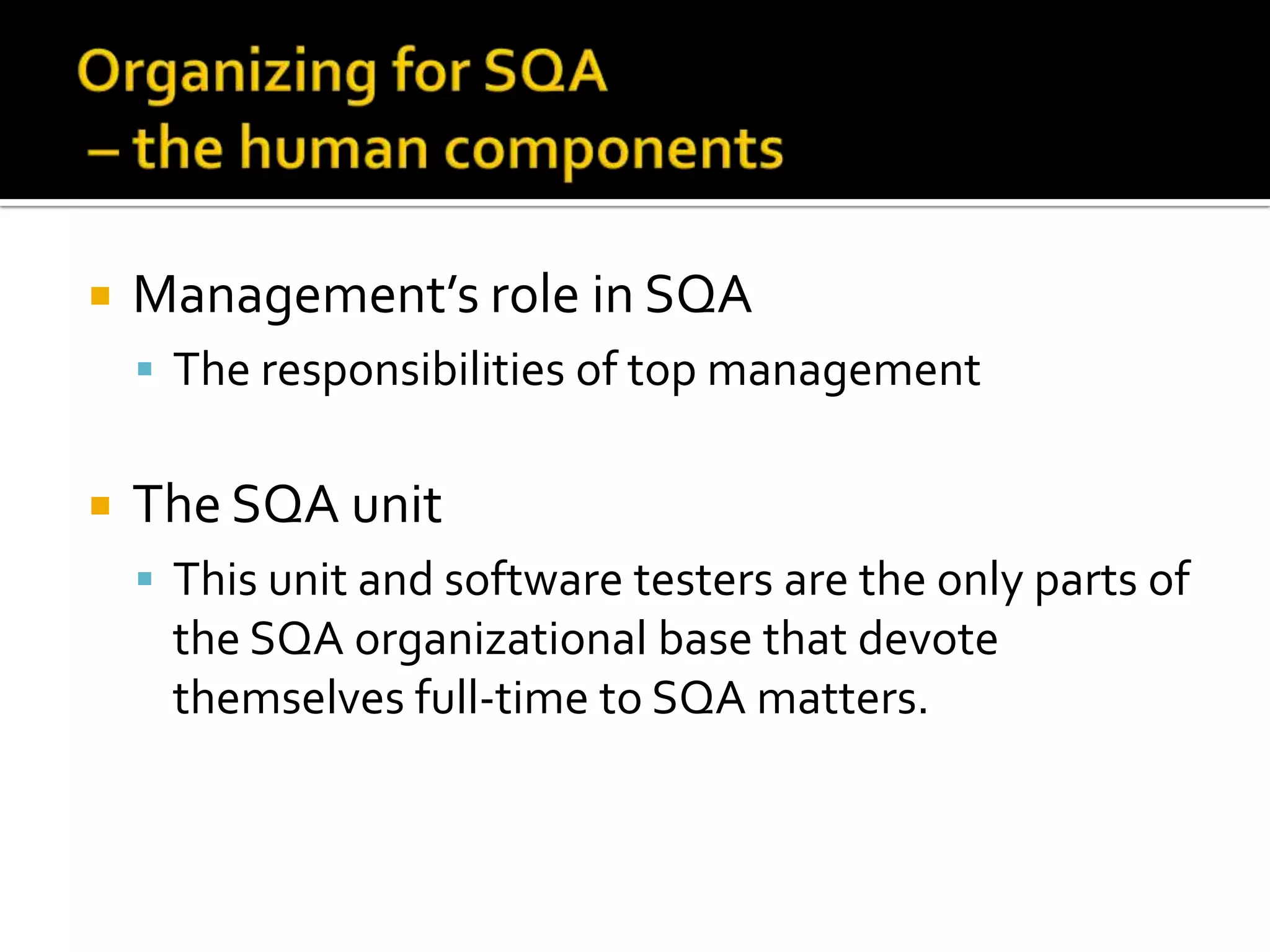
Management’s role in SQA
 The responsibilities of top management



The SQA unit
 This unit and software testers are the only parts of

the SQA organizational base that devote
themselves full-time to SQA matters.


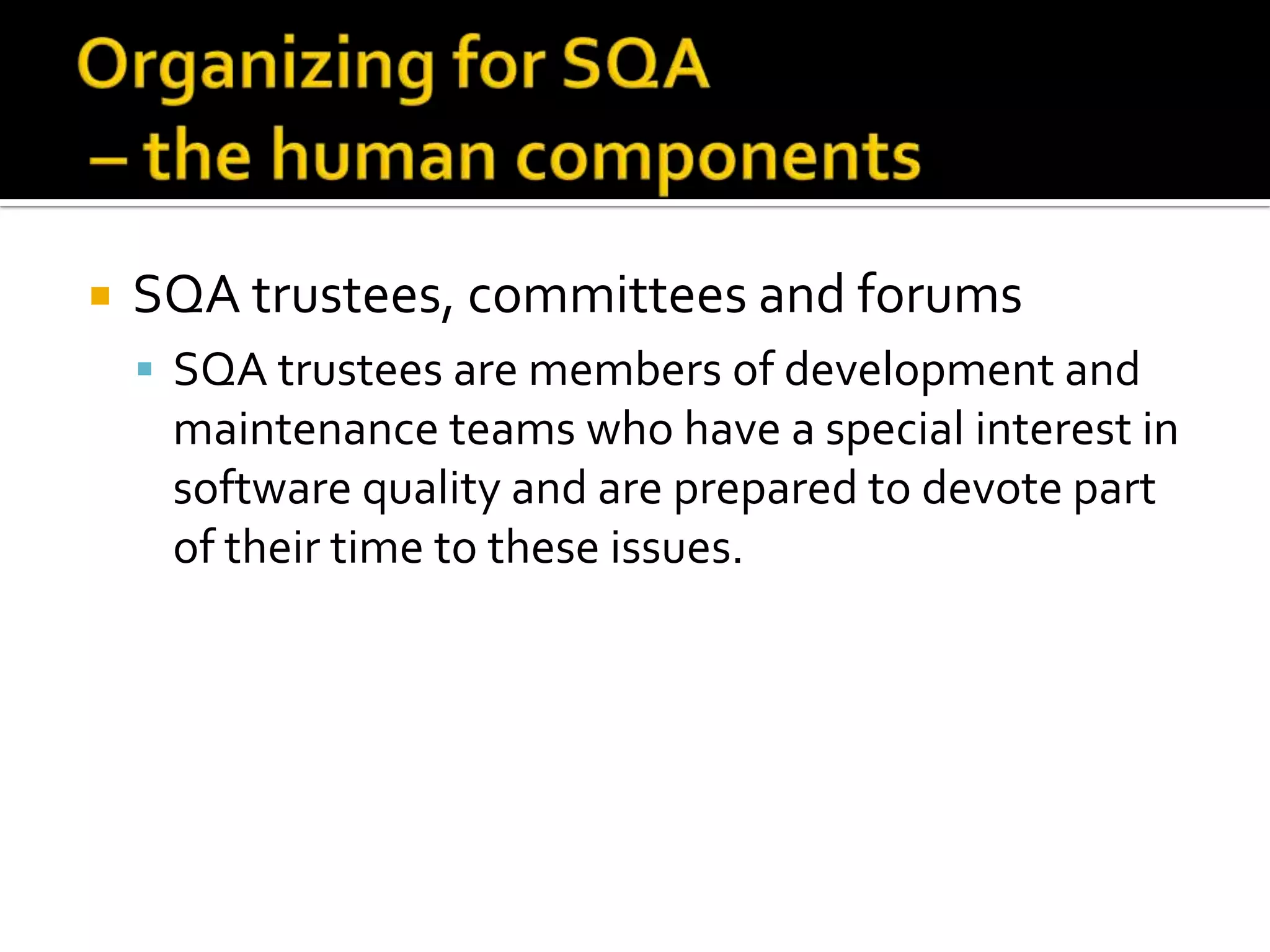
SQA trustees, committees and forums
 SQA trustees are members of development and

maintenance teams who have a special interest in
software quality and are prepared to devote part
of their time to these issues.


Decisions regarding the organization’s
software quality management sys-tem fall
into two main categories:

1.

The SQA organizational base
The SQA components to be implemented
within the organization and the extent of
their use.

2.


The type of software development clientele.



The type of software maintenance clientele.



The range of products.



The size of the organization.



The degree and nature of cooperation with other
organizations carrying out related projects.



Optimization objectives.


The level of software complexity and
difficulty.



The degree of staff experience with project
technology.



The extent of software reuse in new projects.


Professional qualifications.



Level of acquaintance with team members.


Chapter 4:Daniel Galin. SOFTWARE QUALITY ASSURANCE From
theory to implementation. Pearson Education Limited,2004.

Ch 4 components of the sqa system

  • 1.
    Software Engineering College ofArts, Media and Technology ,CMU. Kittitouch S. 1.2-26-11-12
  • 2.
            The SQA system Pre-projectcomponent Software project life cycle components Infrastructure components for error prevention and improvement Management SQA components SQA standards, system certification, and assessment components Organizing for SQA Considerations guiding construction of an organization’s SQA system
  • 3.
     Software is… ▪ Highcomplexity. ▪ Invisible product. ▪ Hard to search and fix defect(bug).  SQA system components can be classified into six classes:
  • 5.
  • 6.
  • 7.
    to eliminate orat least reduce the rate of errors
  • 8.
    prevent or minimize scheduleand budget failures and their outcomes.
  • 10.
     utilization of internationalprofessional knowledge.  improvement of coordination of the organizational quality systems with other organizations.  assessment of the achievements of quality systems according to a common scale.
  • 11.
    initiate and support theimplementation of SQA components, detect deviations from SQA procedures and methodology, and suggest improvements.
  • 13.
     Contract- the developmentunit is committed to an agreed-upon functional specification, budget and schedule.  examination of…  the project proposal draft.  the contract drafts.
  • 14.
     Clarification of thecustomer’s requirements  Review of the project’s schedule and resource requirement estimates  Evaluation of the professional staff’s capacity to carry out the proposed project
  • 15.
     Evaluation of thecustomer’s capacity to fulfill his obligations  Evaluation of development risks.
  • 16.
    a plan isprepared of the project (“development plan”) and its integrated quality assurance activities (“quality plan”). These plans include additional details and needed revisions based on prior plans that provided the basis for the current proposal and contract. It is quite common for several months to pass between the tender submission and the signing of the contract.
  • 17.
          Schedules Required manpower andhardware resources Risk evaluations Organizational issues: team members, subcontractors and partnerships Project methodology, development tools, etc. Software reuse plans.
  • 18.
     Quality goals, expressedin the appropriate measurable terms  Criteria for starting and ending each project stage  Lists of reviews, tests, and other scheduled verification and validation activities.
  • 19.
     Read the examplesof Project Plan and Quality Plan in SQA. site.
  • 21.
     Reviews  Expert opinions  Software testing  Softwaremaintenance  Assurance of the quality of the subcontractors’ work and the customer supplied parts.
  • 22.
     The design phaseof the development process produces a variety of documents. The printed products include design reports, software test documents, software installation plans and software manuals, among others. Reviews can be categorized as  formal design reviews (DRs)  peer reviews.
  • 23.
     The committees arecomposed of senior professionals, including the project leader and, usually, the department manager, the chief software engineer, and heads of other related departments.  The DR report itself includes a list of required corrections (termed “action items”).
  • 24.
     When a designreview committee sits in order to decide upon the continuation of the work completed so far, one of the following options is usually open for consideration:  Immediate approval of the DR document and continuation to the next development phase.  Approval to proceed to the next development phase after all the action items have been completed and inspected by the committee’s representative.  An additional DR is required and scheduled to take place after all the action items have been completed and inspected by the committee’s representative.
  • 25.
     Peer reviews (inspectionsand walkthroughs) are directed at reviewing short documents, chapters or parts of a report, a coded printout of a software module.  usually, the reviewers are all peers, not superiors, who provide professional assistance to colleagues.
  • 26.
     The main objectiveof inspections and walkthroughs is to detect as many design and programming faults as possible.  The output is a list of detected faults and, for inspections, also a defect summary and statistics to be used as a database for reviewing and improving development methods.
  • 27.
     Expert opinions supportquality assessment efforts by introducing additional external capabilities into the organization’s in-house development process. Turning to outside experts may be particularly useful in the following situations:
  • 28.
     Insufficient in-house professionalcapabilities in a given area.  In small organizations in many cases it is difficult to find enough suitable candidates to participate in the design review teams.  In cases of major disagreement among the organization’s
  • 29.
     Software tests areformal SQA components that are targeted toward review of the actual running of the software. The tests are based on a prepared list of test cases that represent a variety of expected scenarios.  The test report will include a detailed list of the faults detected and recommendations.
  • 30.
     Software maintenance servicesvary in range and are provided for extensive periods, often several years. These services fall into the following categories:  Corrective maintenance – User’s support services and correction of soft-ware code and documentation failures
  • 31.
     Adaptive maintenance– Adaptation of current software to new circumstances and customers without changing the basic software product.  Functionality improvement maintenance – The functional and performance related improvement of existing software, carried out with respect to limited issues.
  • 32.
     Subcontractors and customersfrequently join the directly contracted developers (the “supplier”) in carrying out software development projects. The larger and more complex the project, the greater the likelihood that external participants will be required, and the larger the proportion of work trans-mitted to them
  • 34.
          Procedures and workinstructions Templates and checklists Staff training, retraining, and certification Preventive and corrective actions Configuration management Documentation control.
  • 36.
     Project progress control(including maintenance contract control)  Software quality metrics  Software quality costs.
  • 38.
     Quality management standards SEI CMM assessment standard  ISO 9001 and ISO 9000-3 standards.  Project process standards  IEEE 1012 standard  ISO/IEC 12207 standard.  ISO/IEC 29110 standard
  • 40.
     Management’s role inSQA  The responsibilities of top management  The SQA unit  This unit and software testers are the only parts of the SQA organizational base that devote themselves full-time to SQA matters.
  • 41.
     SQA trustees, committeesand forums  SQA trustees are members of development and maintenance teams who have a special interest in software quality and are prepared to devote part of their time to these issues.
  • 43.
     Decisions regarding theorganization’s software quality management sys-tem fall into two main categories: 1. The SQA organizational base The SQA components to be implemented within the organization and the extent of their use. 2.
  • 44.
     The type ofsoftware development clientele.  The type of software maintenance clientele.  The range of products.  The size of the organization.  The degree and nature of cooperation with other organizations carrying out related projects.  Optimization objectives.
  • 45.
     The level ofsoftware complexity and difficulty.  The degree of staff experience with project technology.  The extent of software reuse in new projects.
  • 46.
     Professional qualifications.  Level ofacquaintance with team members.
  • 47.
     Chapter 4:Daniel Galin.SOFTWARE QUALITY ASSURANCE From theory to implementation. Pearson Education Limited,2004.