Machine Learning
Presentation
Prepared by :
AOURFAT Wafaa
2023-2024
Introduction to Machine
Learning
Machine learning is a powerful field of artificial intelligence that enables
computers to learn and improve from experience without being explicitly
programmed. It has become a crucial tool for solving complex problems
and driving innovation across various industries
What is Machine Learning?
Definition
Machine learning is a
method of data analysis
that automates the
building of analytical
models. It allows
systems to learn and
improve from data
without being
programmed explicitly.
Key Concepts
Machine learning involves
algorithms, data, and
models that enable
computers to perform
specific tasks efficiently by
learning from examples,
rather than following pre-
programmed instructions.
Applications
Machine learning is used
in a wide range of
applications, including
image recognition, natural
language processing,
predictive analytics, and
autonomous systems.
Types of Machine Learning
Algorithms
1 Supervised
Learning
The algorithm learns
from labeled data,
mapping inputs to
outputs to make
predictions on new,
unseen data.
2 Unsupervised
Learning
The algorithm
discovers patterns
and insights from
unlabeled data,
identifying hidden
structures and
groupings.
3 Reinforcement
Learning
The algorithm learns
by interacting with an
environment,
receiving rewards or
penalties to optimize
its behavior.
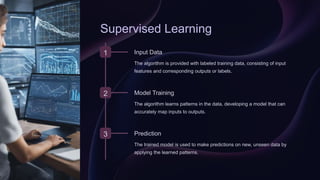
Supervised Learning
1 Input Data
The algorithm is provided with labeled training data, consisting of input
features and corresponding outputs or labels.
2 Model Training
The algorithm learns patterns in the data, developing a model that can
accurately map inputs to outputs.
3 Prediction
The trained model is used to make predictions on new, unseen data by
applying the learned patterns.
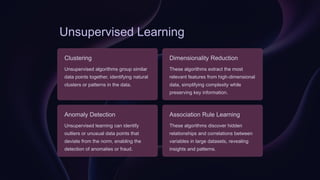
Unsupervised Learning
Clustering
Unsupervised algorithms group similar
data points together, identifying natural
clusters or patterns in the data.
Dimensionality Reduction
These algorithms extract the most
relevant features from high-dimensional
data, simplifying complexity while
preserving key information.
Anomaly Detection
Unsupervised learning can identify
outliers or unusual data points that
deviate from the norm, enabling the
detection of anomalies or fraud.
Association Rule Learning
These algorithms discover hidden
relationships and correlations between
variables in large datasets, revealing
insights and patterns.
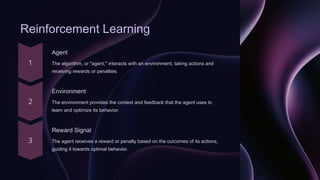
Reinforcement Learning
Agent
The algorithm, or "agent," interacts with an environment, taking actions and
receiving rewards or penalties.
Environment
The environment provides the context and feedback that the agent uses to
learn and optimize its behavior.
Reward Signal
The agent receives a reward or penalty based on the outcomes of its actions,
guiding it towards optimal behavior.
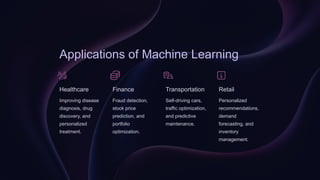
Applications of Machine Learning
Healthcare
Improving disease
diagnosis, drug
discovery, and
personalized
treatment.
Finance
Fraud detection,
stock price
prediction, and
portfolio
optimization.
Transportation
Self-driving cars,
traffic optimization,
and predictive
maintenance.
Retail
Personalized
recommendations,
demand
forecasting, and
inventory
management.
Thank you for your attention

Introduction-to-Machine-Learning (1).pptx

  • 1.
  • 2.
    Introduction to Machine Learning Machinelearning is a powerful field of artificial intelligence that enables computers to learn and improve from experience without being explicitly programmed. It has become a crucial tool for solving complex problems and driving innovation across various industries
  • 3.
    What is MachineLearning? Definition Machine learning is a method of data analysis that automates the building of analytical models. It allows systems to learn and improve from data without being programmed explicitly. Key Concepts Machine learning involves algorithms, data, and models that enable computers to perform specific tasks efficiently by learning from examples, rather than following pre- programmed instructions. Applications Machine learning is used in a wide range of applications, including image recognition, natural language processing, predictive analytics, and autonomous systems.
  • 4.
    Types of MachineLearning Algorithms 1 Supervised Learning The algorithm learns from labeled data, mapping inputs to outputs to make predictions on new, unseen data. 2 Unsupervised Learning The algorithm discovers patterns and insights from unlabeled data, identifying hidden structures and groupings. 3 Reinforcement Learning The algorithm learns by interacting with an environment, receiving rewards or penalties to optimize its behavior.
  • 5.
    Supervised Learning 1 InputData The algorithm is provided with labeled training data, consisting of input features and corresponding outputs or labels. 2 Model Training The algorithm learns patterns in the data, developing a model that can accurately map inputs to outputs. 3 Prediction The trained model is used to make predictions on new, unseen data by applying the learned patterns.
  • 6.
    Unsupervised Learning Clustering Unsupervised algorithmsgroup similar data points together, identifying natural clusters or patterns in the data. Dimensionality Reduction These algorithms extract the most relevant features from high-dimensional data, simplifying complexity while preserving key information. Anomaly Detection Unsupervised learning can identify outliers or unusual data points that deviate from the norm, enabling the detection of anomalies or fraud. Association Rule Learning These algorithms discover hidden relationships and correlations between variables in large datasets, revealing insights and patterns.
  • 7.
    Reinforcement Learning Agent The algorithm,or "agent," interacts with an environment, taking actions and receiving rewards or penalties. Environment The environment provides the context and feedback that the agent uses to learn and optimize its behavior. Reward Signal The agent receives a reward or penalty based on the outcomes of its actions, guiding it towards optimal behavior.
  • 8.
    Applications of MachineLearning Healthcare Improving disease diagnosis, drug discovery, and personalized treatment. Finance Fraud detection, stock price prediction, and portfolio optimization. Transportation Self-driving cars, traffic optimization, and predictive maintenance. Retail Personalized recommendations, demand forecasting, and inventory management.
  • 9.
    Thank you foryour attention