Ten Characteristics of Cortical
     Visual Impairment
                 By
          Kristy Josuweit
                TVI
Cortical Visual Impairment
• Definition: Cortical Visual Impairment (CVI) is
  a breakdown in communication between the
  eyes and the brain.
• Children & adults with CVI present with most
  or all of the following ten characteristics
  (Roman, 2007).

Roman-Lantzy, C. (2007). Cortical visual impairment: an approach to assessment and
intervention. New York, NY: AFB Press.
Color & Movement
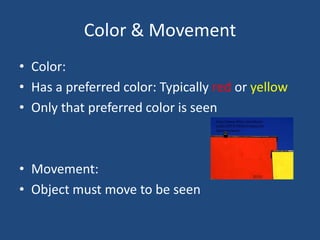
• Color:
• Has a preferred color: Typically red or yellow
• Only that preferred color is seen


• Movement:
• Object must move to be seen
Latency & Light Gazing
• Latency:
• When object is presented, visual attention is
  delayed
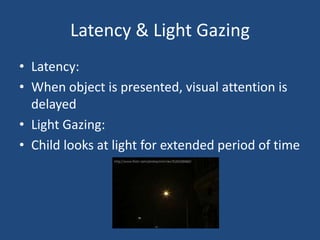
• Light Gazing:
• Child looks at light for extended period of time
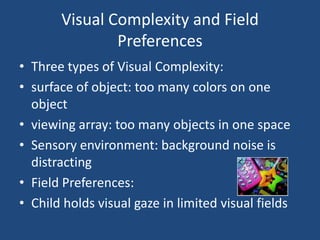
Visual Complexity and Field
               Preferences
• Three types of Visual Complexity:
• surface of object: too many colors on one
  object
• viewing array: too many objects in one space
• Sensory environment: background noise is
  distracting
• Field Preferences:
• Child holds visual gaze in limited visual fields
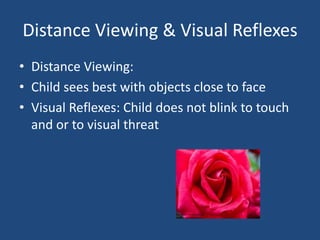
Distance Viewing & Visual Reflexes
• Distance Viewing:
• Child sees best with objects close to face
• Visual Reflexes: Child does not blink to touch
  and or to visual threat
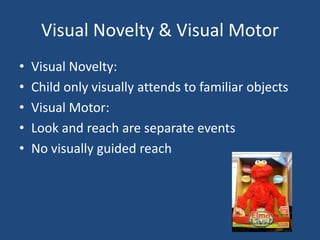
Visual Novelty & Visual Motor
•   Visual Novelty:
•   Child only visually attends to familiar objects
•   Visual Motor:
•   Look and reach are separate events
•   No visually guided reach

Characteristics of CVI

  • 1.
    Ten Characteristics ofCortical Visual Impairment By Kristy Josuweit TVI
  • 2.
    Cortical Visual Impairment •Definition: Cortical Visual Impairment (CVI) is a breakdown in communication between the eyes and the brain. • Children & adults with CVI present with most or all of the following ten characteristics (Roman, 2007). Roman-Lantzy, C. (2007). Cortical visual impairment: an approach to assessment and intervention. New York, NY: AFB Press.
  • 3.
    Color & Movement •Color: • Has a preferred color: Typically red or yellow • Only that preferred color is seen • Movement: • Object must move to be seen
  • 4.
    Latency & LightGazing • Latency: • When object is presented, visual attention is delayed • Light Gazing: • Child looks at light for extended period of time
  • 5.
    Visual Complexity andField Preferences • Three types of Visual Complexity: • surface of object: too many colors on one object • viewing array: too many objects in one space • Sensory environment: background noise is distracting • Field Preferences: • Child holds visual gaze in limited visual fields
  • 6.
    Distance Viewing &Visual Reflexes • Distance Viewing: • Child sees best with objects close to face • Visual Reflexes: Child does not blink to touch and or to visual threat
  • 7.
    Visual Novelty &Visual Motor • Visual Novelty: • Child only visually attends to familiar objects • Visual Motor: • Look and reach are separate events • No visually guided reach