4/8/2016
1
Pediatric
Cortical Visual 
Impairment
Dominick M. Maino, OD, MEd, FAAO, FCOVD‐A
Professor of Pediatrics/Binocular Vision
Illinois Eye Institute/Illinois College of Optometry
Lyons Family Eye Care
Chicago, Il
dmaino@ico.edu
ICO.edu
LyonsFamilyEyeCare.com
FB: Vision Therapy at 
Lyons Family Eye Care
Pediatric Cortical Visual Impairment Society
The American Conference on 
Pediatric Cortical Visual Impairment 
brings together professionals in 
optometry, ophthalmology, 
occupational therapy and visual 
educational psychology to increase 
the understanding of the definition, 
diagnosis and management of 
cortical vision loss in children. 
Drs. Dominick Maino, Joseph Maino, 
Kerri Pillen, Curt Baxsrom, Beth 
Ballinger, Nicole Hooper have all 
participated.
Cortical Visual Impairment
Kran B, Mayer L.  
Vision 
Impairment and 
Brain Damage
Ciuffreda K, 
Kapoor N. 
Acquired brain 
injury. 
Both in Taub M, 
Bartuccio M, Maino D. 
(Eds) Visual Diagnosis 
and Care of the Patient 
with Special Needs. 
Lippincott Williams & 
Wilkins , NY, New York; 
2012
Cortical Visual Impairment
4/8/2016
2
Pediatric Cerebral Visual Impairment
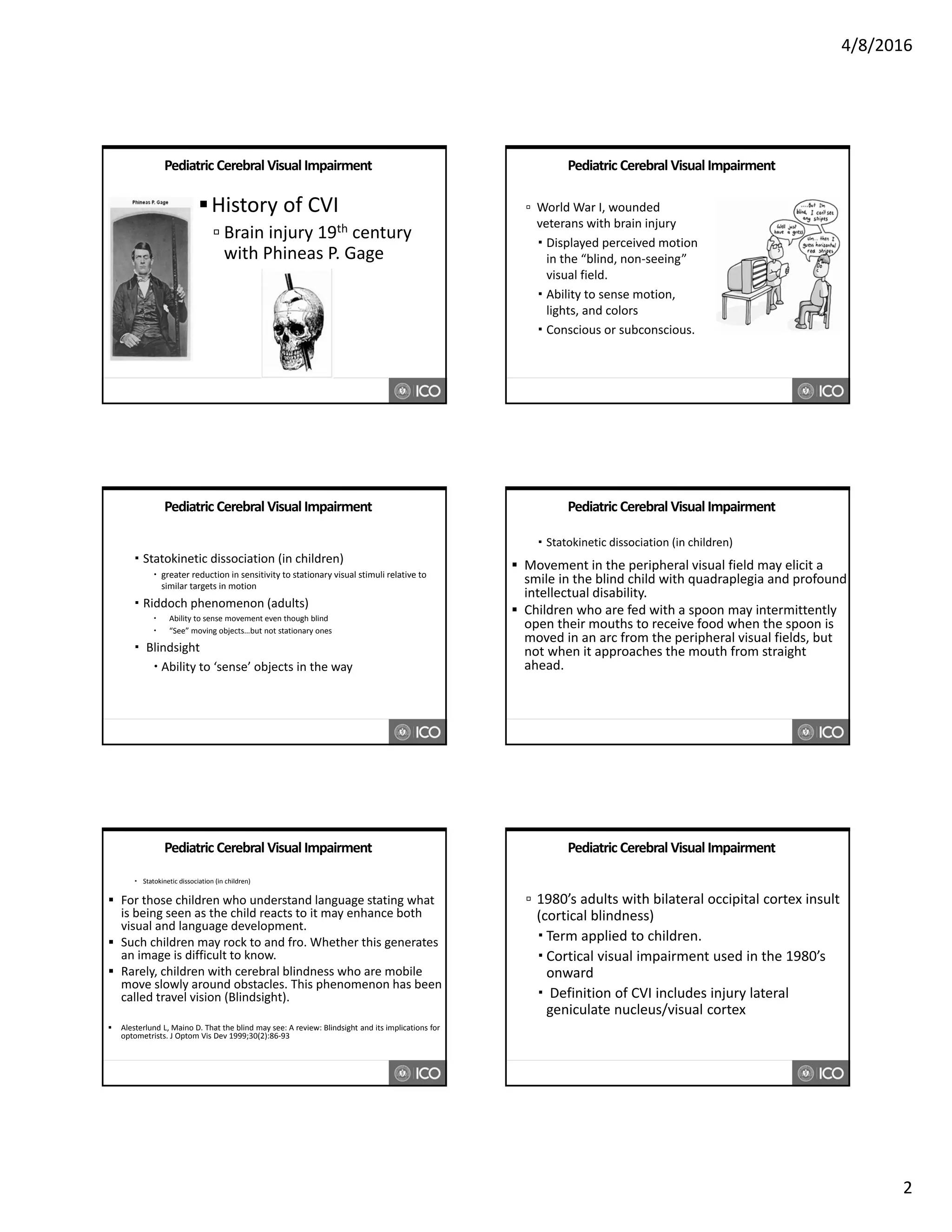
History of CVI
 Brain injury 19th century 
with Phineas P. Gage
Pediatric Cerebral Visual Impairment
 World War I, wounded 
veterans with brain injury 
 Displayed perceived motion 
in the “blind, non‐seeing” 
visual field. 
 Ability to sense motion, 
lights, and colors
 Conscious or subconscious. 
Pediatric Cerebral Visual Impairment
 Statokinetic dissociation (in children)
 greater reduction in sensitivity to stationary visual stimuli relative to 
similar targets in motion
 Riddoch phenomenon (adults)
 Ability to sense movement even though blind
 “See” moving objects…but not stationary ones
 Blindsight 
 Ability to ‘sense’ objects in the way
Pediatric Cerebral Visual Impairment
 Statokinetic dissociation (in children)
 Movement in the peripheral visual field may elicit a 
smile in the blind child with quadraplegia and profound 
intellectual disability.
 Children who are fed with a spoon may intermittently 
open their mouths to receive food when the spoon is 
moved in an arc from the peripheral visual fields, but 
not when it approaches the mouth from straight 
ahead.
Pediatric Cerebral Visual Impairment
 Statokinetic dissociation (in children)
 For those children who understand language stating what 
is being seen as the child reacts to it may enhance both 
visual and language development.
 Such children may rock to and fro. Whether this generates 
an image is difficult to know.
 Rarely, children with cerebral blindness who are mobile 
move slowly around obstacles. This phenomenon has been 
called travel vision (Blindsight). 
 Alesterlund L, Maino D. That the blind may see: A review: Blindsight and its implications for 
optometrists. J Optom Vis Dev 1999;30(2):86‐93
Pediatric Cerebral Visual Impairment
 1980’s adults with bilateral occipital cortex insult 
(cortical blindness)
 Term applied to children. 
 Cortical visual impairment used in the 1980’s 
onward
 Definition of CVI includes injury lateral 
geniculate nucleus/visual cortex 
4/8/2016
3
Pediatric Cerebral Visual Impairment
Reduced visual acuity identifying feature. 
Many children damage to white matter 
surrounding the ventricals (perventricular 
leukomalacia PVL)
Cerebral Visual Impairment now used 
(especially in Europe)
Pediatric Cerebral Visual Impairment
 Cerebral visual impairment: inclusive term
 Reduced visual acuity 
 Oculomotor anomalies
 Visual field loss
 Vision information processing problems 
 Cognitive Visual Dysfunction (CVD) 
 Used to identify visual perceptual anomalies
 Used to identify vision information processing 
problems
Cerebral vs Cortical Visual Impairment
Pediatric Cerebral Visual Impairment
 Classification of CVI
 Ocular visual impairment: Refractive state. Optics, 
Eye health
 Cerebral visual impairment: Neuro‐pathway 
problems, cortical problems, oculomotor 
dysfunction, vision information processing (dorsal 
and ventral streaming processing mechanisms)
Pediatric Cerebral Visual Impairment
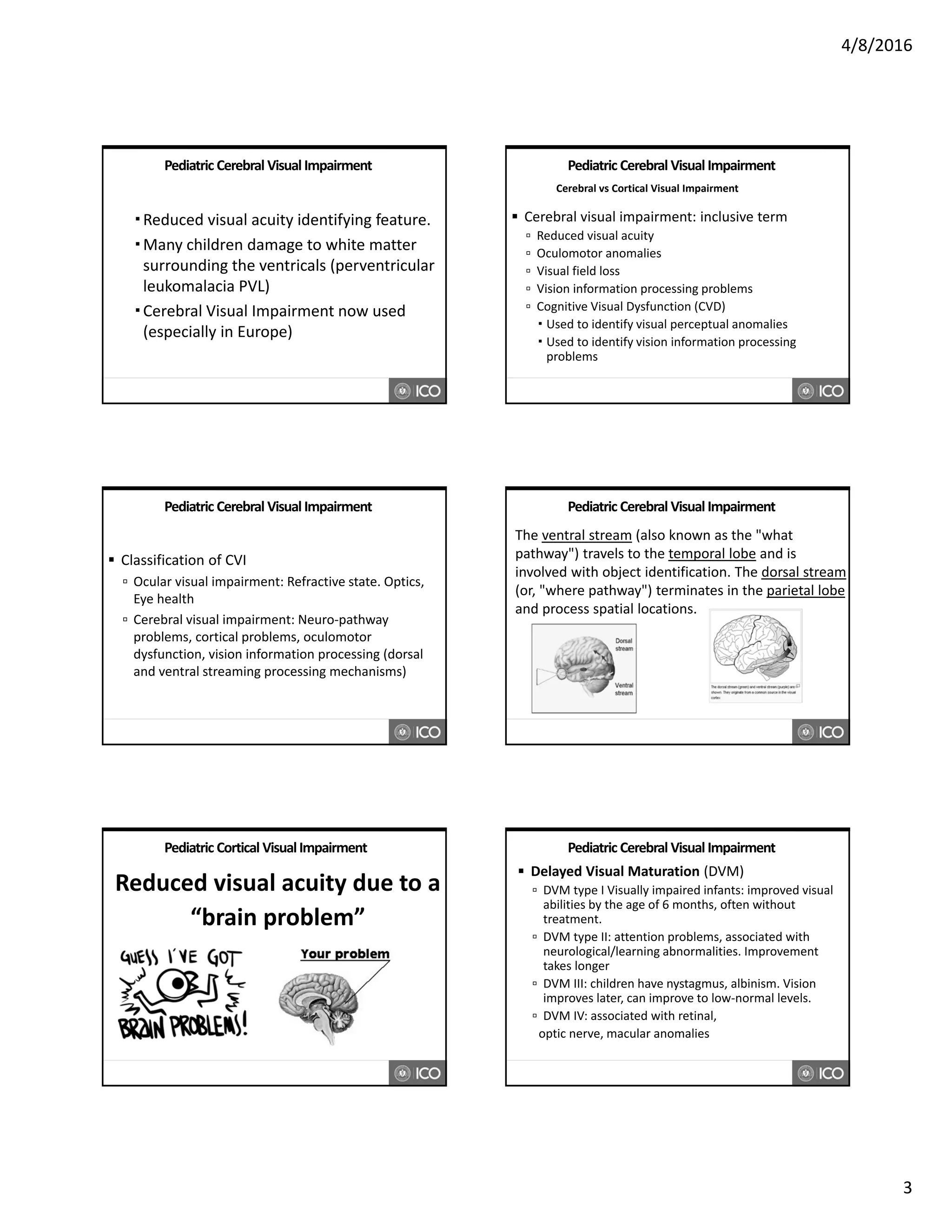
The ventral stream (also known as the "what 
pathway") travels to the temporal lobe and is 
involved with object identification. The dorsal stream
(or, "where pathway") terminates in the parietal lobe
and process spatial locations.
Pediatric Cortical Visual Impairment
Reduced visual acuity due to a 
“brain problem”
Pediatric Cerebral Visual Impairment
 Delayed Visual Maturation (DVM)
 DVM type I Visually impaired infants: improved visual 
abilities by the age of 6 months, often without 
treatment. 
 DVM type II: attention problems, associated with 
neurological/learning abnormalities. Improvement 
takes longer 
 DVM III: children have nystagmus, albinism. Vision 
improves later, can improve to low‐normal levels. 
 DVM IV: associated with retinal, 
optic nerve, macular anomalies 
4/8/2016
4
Pediatric Cerebral Visual Impairment
Determining Vision Function and
Functional Vision in Children with
Pediatric Cerebral Visual Impairment 
Vision Function and Functional Vision Anomalies in PCV
Diagnostic Approaches & Strategies 
1.Case History
2.Visual Acuity
3.Refractive Error
4.Vision Function Assessment
5.Ocular Health
6.Special Tools 
Vision Function and Functional Vision Anomalies in PCV
Vision Function
Clarity of vision (visual acuity, contrast 
sensitivity, refractive error)
Oculomotor ability (pursuits and 
saccades; convergence and divergence)
Accommodation (focusing)
Depth perception (3D vision) 
Vision Function and Functional Vision Anomalies in PCV
Vision Function
Eye health
Biomicroscopy
Tonometry
Dilated Fundus Evaluation
Special diagnostic tools
EOG (electrooculogram)
ERG (electroretinogram)
VER/VEP (visually evoked response 
visual evoked potential)
Vision Function and Functional Vision Anomalies in PCV
Functional Vision
Functionally induced disability that overlays 
pathologically induced disability
Uncorrected refractive error : Amblyopia
Constant Strabismus: Amblyopia 
Oculomotor dysfunction, Binocular vision 
dysfunction, Accommodative dysfunction: 
Attention
Vision Function and Functional Vision Anomalies in PCV
Functional vision 
Vision information processing (VIP)/       
Visual perceptual skills
laterality/directionality
visual motor integration
non‐motor perceptual skills
auditory perceptual/processing
4/8/2016
5
Vision Function and Functional Vision Anomalies in PCV
Vision Function
Clarity of vision
What is visual acuity? 
What is contrast sensitivity?
What is refractive error?
Vision Function and Functional Vision Anomalies in PCV
Vision Function
Clarity of vision
What is visual acuity? 
The ability to see a certain size 
object at a certain distance.
Vision Function and Functional Vision Anomalies in PCV
Vision Function
Clarity of vision
What is contrast sensitivity?
Vision Function and Functional Vision Anomalies in PCV
Contrast sensitivity measures the ability to 
see details at low contrast levels. Visual 
information at low contrast levels is 
particularly important: 
1. in communication, since the faint 
shadows on our faces carry the visual 
information related to facial 
expressions. 
Vision Function and Functional Vision Anomalies in PCV
2. in orientation and mobility, where 
we need to see such critical low‐contrast 
forms as the curb, faint shadows, and 
stairs when walking down. In traffic, the 
demanding situations are at low 
contrast levels, for example, seeing in 
dusk, rain, fog, snow fall, and at night. 
Vision Function and Functional Vision Anomalies in PCV
3. in every day tasks, where there 
are numerous visual tasks at low 
contrast, like cutting an onion on a 
light colored surface, pouring coffee 
into a dark mug, checking the 
quality of ironing, etc. 
4/8/2016
6
Vision Function and Functional Vision Anomalies in PCV
4. in near vision tasks like reading 
and writing, if the information is at 
low contrast as in poor quality copies 
or in a fancy, barely readable 
invitation, etc. 
from http://www.lea‐
test.fi/en/vistests/pediatric/cstests/cstests.html
Vision Function and Functional Vision Anomalies in PCV
Vision Function and Functional Vision Anomalies in PCV Vision Function and Functional Vision Anomalies in PCV
Vision Function and Functional Vision Anomalies in PCV
Tests of 
Visual 
Acuity and 
Contrast
Used with 
permission
4/8/2016
7
Vision Function and Functional Vision Anomalies in PCV
Pursuits, 
Saccades, 
Convergence
Vision Function and Functional Vision Anomalies in PCV
Retinoscopy
Bell (Apell) 
Target(Wolf Wand) directly in front of the retinoscope
Patient fixates the target 
Move the ball toward the patient slowly and smoothly
The distance of the target from the patient is recorded for a change in 
motion or other changes of interest 
Expect to see a change from “with” to “against” on the way in at 35 ‐
42 cm. (14 ‐ 17inches) and a change from “against” to with at 37.5 ‐ 45 
cm. (15 ‐18 inches). 
Retinoscopy
Color vision, copy forms, 
Matching, Visual Fields
Pediatric Cerebral Visual Impairment
Therapeutic Strategies for the 
Treatment of 
Pediatric Cerebral Visual 
Impairment
4/8/2016
8
Pediatric Cerebral Visual Impairment
 Treatment begins with the basics. 
Vision function 
Refractive correction 
Spectacles therapeutic
Eye health
Pediatric Cerebral Visual Impairment
 Treatment with spectacle/lenses 
 multi‐focal prescription/bifocal
 prism
 occlusion
Pediatric Cerebral Visual Impairment
 Treatment with spectacle/lenses/computer devices 
 task specific glasses
 high “+” adds (magnification)
 Telescopes
 Microscopes
Pediatric Cerebral Visual Impairment
 Vision Therapy
 Oculomotor/hand‐
eye/accommodation
& fusion
 Biocular
 Binocular
 Integration
Pediatric Cerebral Visual Impairment
 Vision Therapy
 Integration/Stabilization
 Visual stimulation
 Vision information 
processing
 Vestibular/Vision
Apps 4 Vision Development
http://www.sovoto.com/group/apps4VisionDevelopment
Pediatric Cerebral Visual Impairment
 http://www.wonderbaby.org/articles/cvi
‐educational‐tools
4/8/2016
9
Pediatric Cerebral Visual Impairment
Perceptual Learning vs Vision Therapy
Pediatric Cerebral Visual Impairment
Thinking Outside the LightBox
Pediatric Cerebral Visual Impairment
What follows is supplemental information
to the presentation, resources and
references that are not necessarily a part of
this presentation, but which I thought you
would like to have for your own
information.
Pediatric Cerebral Visual Impairment
How Do Environmental Factors, 
Medications and Non‐Visual Handicaps 
Affect the Evaluation and Treatment of 
Pediatric Cerebral Visual Impairment?
Pediatric Cerebral Visual Impairment
For individuals with disability…
 Medications: Prescribed many more medications
 Higher affinity for adverse effects due to 
environmental/systemic factors
 Seldom complain of symptoms related to their disability, 
systemic anomalies, or medication side effects 
Pediatric Cerebral Visual Impairment
 Alternative and complementary 
medical therapies
Maino D. Evidence based medicine and CAM: a review. Optom Vis Dev 2012;43(1):13‐17
Lemer P. Complementary and Alternative Approaches. In Taub M, Bartuccio M, Maino D. 
Visual Diagnosis and Care of Patients with Special Needs. Lippincott, Williams, Wilkins. 
2012
 Traditional allopathic approaches
4/8/2016
10
Pediatric Cerebral Visual Impairment
 Mental illnesses in children
 Pediatric Bipolar disorder
 Pediatric depression 
Pediatric Cerebral Visual Impairment
 Major environmental hazard: People
 do not know how to respond
 make assumptions 
 true for lay individuals, teacher, health care 
professionals
Medication Side Effects
Antidepressants
Abdominal pain/constipation Blurred vision
Abnormal dreams/thinking Increased risk of
Disturbances
Anxiety Photophobia
Medication Side Effects
Anticonvulsants
Memory problems/amnesia Blurred vision
Sedation Dimming of vision
Insomnia Diplopia
Bronchitis Involuntary eye movements
Fluid retention Dry eye
Medication Side Effects
Anti-Parkisons
Abnormal dreams/insomnia Vision
abnormalities
Increased muscle tone/weakness Blurred vision
Involuntary movements Mydriasis
Hallucinations Decreased
accommodation
Medication Side Effects
Tranquilizers
Breast development in men Risk of narrow angle GLC
Breathing problems Cycloplegia/Mydriasis
Insomnia Decreased vision
Tardive dyskinesia Capsular cataract
4/8/2016
11
Medication Side Effects
Anti-anxiety
Anemia Decreased accommodation
Seizures Nystagmus
Blood disorders Diplopia
Unusual excitement Mydriasis
PCVI: References
 Dutton GN, Bax M. (eds). Visual impairment in children due to damage to 
the brain.  Clinics in Developmental Medicine.  no 186. MacKieth Press. 
London;2010.
 Strategies for dealing with visual problems due to cerebral visual 
impairment: Gillian McDaid, Debbie Cockburn, Gordon N Dutton available 
from http://www.ssc.education.ed.ac.uk/courses/vi&multi/vjan08i.html
 Alesterlund L, Maino D. That the blind may see: A review: Blindsight and 
its implications for optometrists. J Optom Vis Dev 1999;30(2):86‐93
 Kran B. Mayer L. Vision impairment  and brain damage. In Taub M, 
Bartuccio M, Maino D. (Eds) Visual Diagnosis and Care of the Patient with 
Special Needs. Lippincott Williams & Wilkins , NY, New York; 2012:135‐
146.
PCVI: References
 Colenbrander A. What’s in a name? Appropriate terminology 
for CVI. J Vis Impair Blind. 2010:583‐585
 Roman Lantzy CA, Lantzy A. Outcomes and opportunities: A 
study of children with cortical visual impairment. J Vis Impair 
Blind. 2010:649‐653.
 http://www.aph.org/cvi/define.html
 Cerebral Visual Impairment in Periventricular Leukomalacia: 
MR Correlation: Available from 
http://www.ajnr.org/content/17/5/979.full.pdf
References
 Luek AH. Cortical or cerebral visual impairment in children: A brief 
overview. J Vis Impair Blind. 2010:585‐592.
 Woodhouse JM, Maino DM. Down syndrome: In Taub M, Bartuccio
M, Maino D. (Eds) Visual Diagnosis and Care of the Patient with 
Special Needs. Lippincott Williams & Wilkins , NY, New York; 2012:31‐
40.
 Wesson M, Maino D. Oculo‐visual findings in Down syndrome, 
cerebral palsy, and mental retardation with non‐specific etiology. In 
Maino D (ed). Diagnosis and Management of Special Populations. 
Mosby‐Yearbook, Inc. St. Louis, MO. 1995:17‐54.
 Taub M, Reddell A. Cerebral Palsy. In Taub M, Bartuccio M, Maino D. 
(Eds) Visual Diagnosis and Care of the Patient with Special Needs. 
Lippincott Williams & Wilkins , NY, New York; 2012:21‐30.
References
 Ciuffreda K, Kapoor N. Acquired brain injury.  In 
Taub M, Bartuccio M, Maino D. (Eds) Visual 
Diagnosis and Care of the Patient with Special 
Needs. Lippincott Williams & Wilkins , NY, New 
York; 2012:95‐100.
 Roman‐Lantzy, C. Cortical visual impairment: An 
approach to assessment and intervention. AFB 
Press, NY, New York; 2007.
 http://www.MainosMemos.blogspot.com
Pediatric Cerebral Visual Impairment
 Resources 
 Facebook (http://www.facebook.com/Thinkingoutsidethelightbox)
 Pinterest http://pinterest.com/achampine0302/cortical‐visual‐
impairment‐cvi‐goodies/
 Blogs http://www.MainosMemos.blogspot.com
 Apps http://www.sovoto.com/group/apps4VisionDevelopment
 Infant Visual Stimulations https://itunes.apple.com/us/app/infant‐
visual‐stimulation/id427443223
 Infant Visual Stimulation Video 
https://www.youtube.com/watch?v=Eyj5PqwUn0w
 COVD http://www.COVD.org
 OEPF http://www.OEPF.org
 Vision Help blog http://visionhelp.wordpress.com/
 MainosMemos http://www.MainosMemos.blogspot.com
4/8/2016
12
Dominick M. Maino, OD, MEd, FAAO, FCOVD‐A
Professor of Pediatrics/Binocular Vision  Illinois Eye Institute
Illinois College of Optometry
3241 S. Michigan Ave.   Chicago, Il 60616
Lyons Family Eye Care
3250 N. Lincoln Ave.   Chicago, Il 60657
dmaino@ico.edu
ICO.edu
LyonsFamilyEyeCare.com
FB: Vision Therapy at Lyons 
Family Eye Care

Pediatric Cortical Visual Impairment