
Copyright © Terry Felke-Morris http://terrymorris.net
Web Development & Design
Foundations with HTML5
8th
Edition
CHAPTER 6
KEY CONCEPTS
1
Copyright © Terry Felke-Morris http://terrymorris.net
Learning Outcomes
In this chapter, you will learn how to ...
◦Describe and apply the CSS Box Model
◦Configure margin with CSS
◦Configure float with CSS
◦Configure fixed, relative, and absolute positioning with CSS
◦Create two-column page layouts using CSS
◦Configure navigation in unordered lists and style with CSS
◦Add interactivity to hyperlinks with CSS pseudo-classes
◦Configure web pages with HTML5 structural elements, including
section, article, and aside
2
Copyright © Terry Felke-Morris http://terrymorris.net
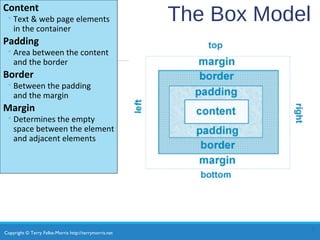
The Box ModelContent
◦Text & web page elements
in the container
Padding
◦Area between the content
and the border
Border
◦Between the padding
and the margin
Margin
◦Determines the empty
space between the element
and adjacent elements
3
Copyright © Terry Felke-Morris http://terrymorris.net
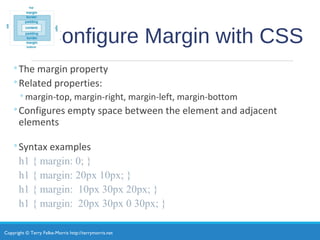
Configure Margin with CSS
◦The margin property
◦Related properties:
◦margin-top, margin-right, margin-left, margin-bottom
◦Configures empty space between the element and adjacent
elements
◦Syntax examples
h1 { margin: 0; }
h1 { margin: 20px 10px; }
h1 { margin: 10px 30px 20px; }
h1 { margin: 20px 30px 0 30px; }
Copyright © Terry Felke-Morris http://terrymorris.net
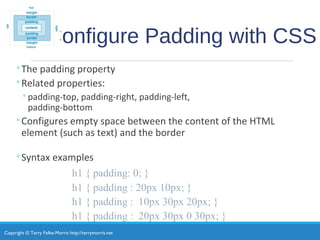
Configure Padding with CSS
◦The padding property
◦Related properties:
◦padding-top, padding-right, padding-left,
padding-bottom
◦Configures empty space between the content of the HTML
element (such as text) and the border
◦Syntax examples
h1 { padding: 0; }
h1 { padding : 20px 10px; }
h1 { padding : 10px 30px 20px; }
h1 { padding : 20px 30px 0 30px; }
Copyright © Terry Felke-Morris http://terrymorris.net
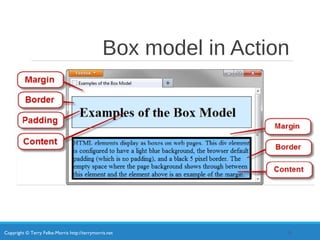
Box model in Action
6
Copyright © Terry Felke-Morris http://terrymorris.net
The CSS box-sizing
Property
Default value for width or height is the value for ONLY the content (not
including border and padding).
The box-sizing property is used to selector to direct the browser to
calculate the width and height of an element to include the value for
content, padding, and border.
Use the universal selector (*) to apply this to all the element on the
page
Example:
* { box-sizing: border-box; }
7
Copyright © Terry Felke-Morris http://terrymorris.net
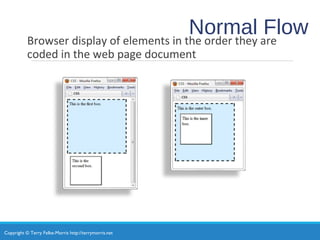
Normal FlowBrowser display of elements in the order they are
coded in the web page document
Copyright © Terry Felke-Morris http://terrymorris.net
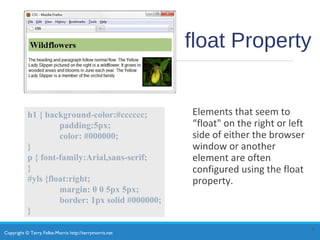
h1 { background-color:#cccccc;
padding:5px;
color: #000000;
}
p { font-family:Arial,sans-serif;
}
#yls {float:right;
margin: 0 0 5px 5px;
border: 1px solid #000000;
}
float Property
Elements that seem to
“float" on the right or left
side of either the browser
window or another
element are often
configured using the float
property.
9
Copyright © Terry Felke-Morris http://terrymorris.net
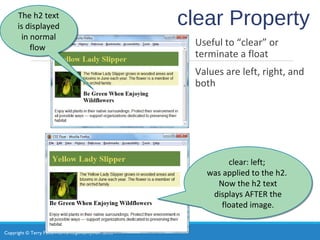
clear Property
Useful to “clear” or
terminate a float
Values are left, right, and
both
The h2 text
is displayed
in normal
flow.
The h2 text
is displayed
in normal
flow.
clear: left;
was applied to the h2.
Now the h2 text
displays AFTER the
floated image.
clear: left;
was applied to the h2.
Now the h2 text
displays AFTER the
floated image.
Copyright © Terry Felke-Morris http://terrymorris.net
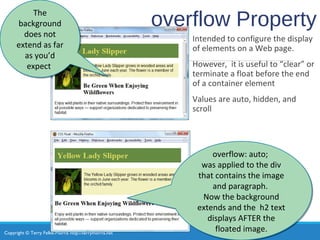
overflow Property
Intended to configure the display
of elements on a Web page.
However, it is useful to “clear” or
terminate a float before the end
of a container element
Values are auto, hidden, and
scroll
The
background
does not
extend as far
as you’d
expect.
The
background
does not
extend as far
as you’d
expect.
overflow: auto;
was applied to the div
that contains the image
and paragraph.
Now the background
extends and the h2 text
displays AFTER the
floated image.
overflow: auto;
was applied to the div
that contains the image
and paragraph.
Now the background
extends and the h2 text
displays AFTER the
floated image.
Copyright © Terry Felke-Morris http://terrymorris.net
Checkpoint
1. List the components of the box model
from innermost to outermost.
2. Describe the purpose of the CSS float
property.
3. Which two CSS properties can be used
to clear a float?
12
Copyright © Terry Felke-Morris http://terrymorris.net
CSS display
Property
Configures how and if an element is displayed
◦display: none;
◦The element will not be displayed.
◦display: block;
◦The element is rendered as a block element – even if it is actually an
inline element, such as a hyperlink.
◦display: inline;
◦The element will be rendered as an inline element – even if it is
actually a block element – such as a <li>.
o display: inline-block;
oThe element will display as an inline display element adjacent to other
inline display elements but also can be configured with properties of
block display elements including width and height.
13
Copyright © Terry Felke-Morris http://terrymorris.net
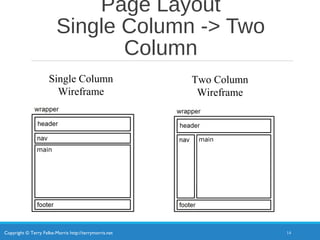
Page Layout
Single Column -> Two
Column
14
Single Column
Wireframe
Two Column
Wireframe
Copyright © Terry Felke-Morris http://terrymorris.net
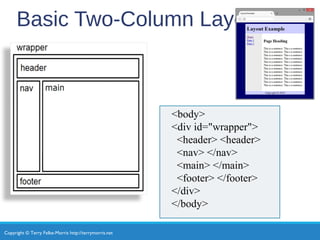
Basic Two-Column Layout
<body>
<div id="wrapper">
<header> <header>
<nav> </nav>
<main> </main>
<footer> </footer>
</div>
</body>
Copyright © Terry Felke-Morris http://terrymorris.net
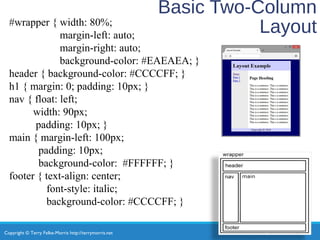
Basic Two-Column
Layout#wrapper { width: 80%;
margin-left: auto;
margin-right: auto;
background-color: #EAEAEA; }
header { background-color: #CCCCFF; }
h1 { margin: 0; padding: 10px; }
nav { float: left;
width: 90px;
padding: 10px; }
main { margin-left: 100px;
padding: 10px;
background-color: #FFFFFF; }
footer { text-align: center;
font-style: italic;
background-color: #CCCCFF; }
Copyright © Terry Felke-Morris http://terrymorris.net
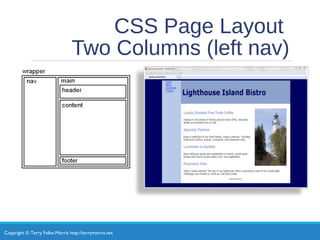
CSS Page Layout
Two Columns (left nav)
Copyright © Terry Felke-Morris http://terrymorris.net
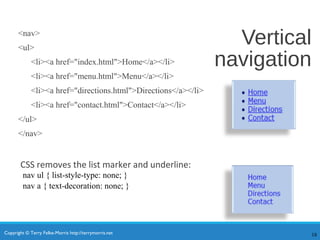
Vertical
navigation
<nav>
<ul>
<li><a href="index.html">Home</a></li>
<li><a href="menu.html">Menu</a></li>
<li><a href="directions.html">Directions</a></li>
<li><a href="contact.html">Contact</a></li>
</ul>
</nav>
CSS removes the list marker and underline:
nav ul { list-style-type: none; }
nav a { text-decoration: none; }
18
Copyright © Terry Felke-Morris http://terrymorris.net
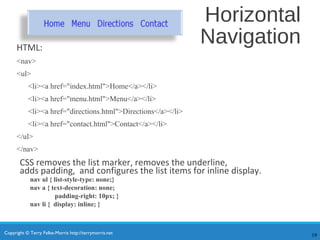
Horizontal
NavigationHTML:
<nav>
<ul>
<li><a href="index.html">Home</a></li>
<li><a href="menu.html">Menu</a></li>
<li><a href="directions.html">Directions</a></li>
<li><a href="contact.html">Contact</a></li>
</ul>
</nav>
CSS removes the list marker, removes the underline,
adds padding, and configures the list items for inline display.
nav ul { list-style-type: none;}
nav a { text-decoration: none;
padding-right: 10px; }
nav li { display: inline; }
19
Copyright © Terry Felke-Morris http://terrymorris.net
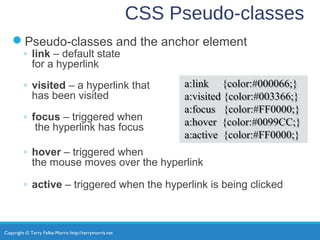
CSS Pseudo-classes
Pseudo-classes and the anchor element
◦ link – default state
for a hyperlink
◦ visited – a hyperlink that
has been visited
◦ focus – triggered when
the hyperlink has focus
◦ hover – triggered when
the mouse moves over the hyperlink
◦ active – triggered when the hyperlink is being clicked
a:link {color:#000066;}
a:visited {color:#003366;}
a:focus {color:#FF0000;}
a:hover {color:#0099CC;}
a:active {color:#FF0000;}
a:link {color:#000066;}
a:visited {color:#003366;}
a:focus {color:#FF0000;}
a:hover {color:#0099CC;}
a:active {color:#FF0000;}
Copyright © Terry Felke-Morris http://terrymorris.net
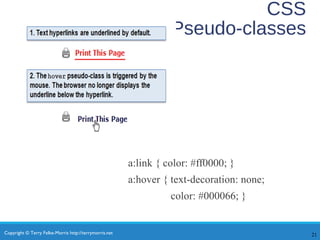
CSS
Pseudo-classes
a:link { color: #ff0000; }
a:hover { text-decoration: none;
color: #000066; }
21
Copyright © Terry Felke-Morris http://terrymorris.net
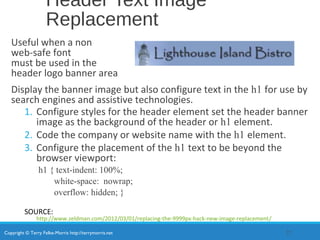
Header Text Image
Replacement
Useful when a non
web-safe font
must be used in the
header logo banner area
Display the banner image but also configure text in the h1 for use by
search engines and assistive technologies.
1. Configure styles for the header element set the header banner
image as the background of the header or h1 element.
2. Code the company or website name with the h1 element.
3. Configure the placement of the h1 text to be beyond the
browser viewport:
h1 { text-indent: 100%;
white-space: nowrap;
overflow: hidden; }
SOURCE:
http://www.zeldman.com/2012/03/01/replacing-the-9999px-hack-new-image-replacement/
22
Copyright © Terry Felke-Morris http://terrymorris.net
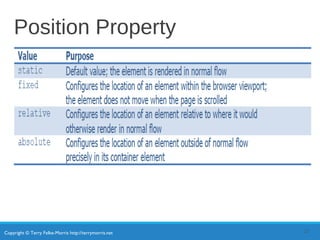
Position Property
23
Copyright © Terry Felke-Morris http://terrymorris.net
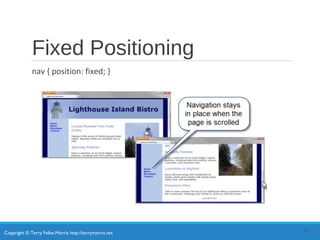
Fixed Positioning
nav { position: fixed; }
24
Copyright © Terry Felke-Morris http://terrymorris.net
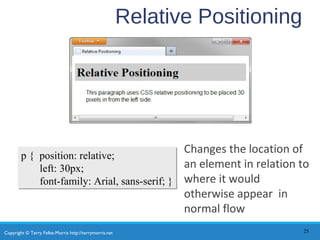
Relative Positioning
Changes the location of
an element in relation to
where it would
otherwise appear in
normal flow
25
p { position: relative;
left: 30px;
font-family: Arial, sans-serif; }
p { position: relative;
left: 30px;
font-family: Arial, sans-serif; }
Copyright © Terry Felke-Morris http://terrymorris.net
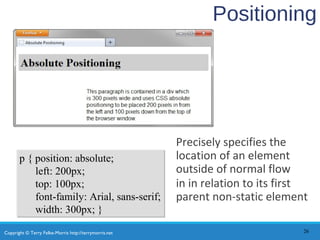
Positioning
Precisely specifies the
location of an element
outside of normal flow
in in relation to its first
parent non-static element
26
p { position: absolute;
left: 200px;
top: 100px;
font-family: Arial, sans-serif;
width: 300px; }
p { position: absolute;
left: 200px;
top: 100px;
font-family: Arial, sans-serif;
width: 300px; }
Copyright © Terry Felke-Morris http://terrymorris.net
CSS Debugging
Tips
Manually check syntax errors
Use W3C CSS Validator to check syntax errors
◦http://jigsaw.w3.org/css-validator/
Configure temporary background colors
Configure temporary borders
Use CSS comments to find the unexpected
/* the browser ignores this code */
Don’t expect your pages to look exactly the same in all
browsers!
Be patient!
27
Copyright © Terry Felke-Morris http://terrymorris.net
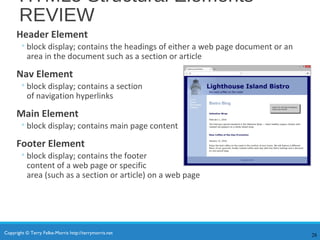
HTML5 Structural Elements
REVIEW
Header Element
◦block display; contains the headings of either a web page document or an
area in the document such as a section or article
Nav Element
◦block display; contains a section
of navigation hyperlinks
Main Element
◦block display; contains main page content
Footer Element
◦block display; contains the footer
content of a web page or specific
area (such as a section or article) on a web page
28
Copyright © Terry Felke-Morris http://terrymorris.net
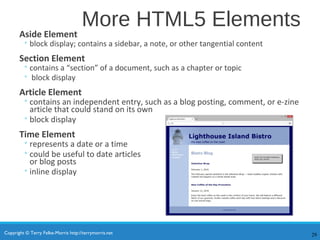
More HTML5 Elements
Aside Element
◦ block display; contains a sidebar, a note, or other tangential content
Section Element
◦ contains a “section” of a document, such as a chapter or topic
◦ block display
Article Element
◦contains an independent entry, such as a blog posting, comment, or e-zine
article that could stand on its own
◦block display
Time Element
◦represents a date or a time
◦could be useful to date articles
or blog posts
◦inline display
29
Copyright © Terry Felke-Morris http://terrymorris.net
HTML5 Compatibility with
Older BrowsersCSS
header, main, nav, footer, section, article,
figure, figcaption, aside { display: block; }
HTML5 Shim (aka HTML5 Shiv)
<!--[if lt IE 9]>
<script src=" http://html5shim.googlecode.com/svn/trunk/html5.js">
</script>
<![endif]-->
30
Copyright © Terry Felke-Morris http://terrymorris.net
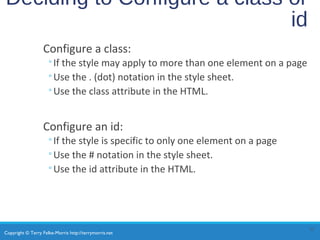
Deciding to Configure a class or
id
Configure a class:
◦If the style may apply to more than one element on a page
◦Use the . (dot) notation in the style sheet.
◦Use the class attribute in the HTML.
Configure an id:
◦If the style is specific to only one element on a page
◦Use the # notation in the style sheet.
◦Use the id attribute in the HTML.
31
Copyright © Terry Felke-Morris http://terrymorris.net
CHECKPOINT
1. Describe a reason to use HTML5 structural elements instead of div
elements for some page areas.
2. Describe one CSS debugging tip that you have found to be helpful.
3. Describe how to choose whether to configure an HTML element
selector, create a class, or create an id when working with CSS.
32
Copyright © Terry Felke-Morris http://terrymorris.net
Summary
This chapter introduced you to the box
model, CSS pseudo-classes, configuring
two-column page layouts with CSS, and
additional HTML5 structural elements.
33

Chapter6

  • 1.
    Copyright © TerryFelke-Morris http://terrymorris.net Web Development & Design Foundations with HTML5 8th Edition CHAPTER 6 KEY CONCEPTS 1
  • 2.
    Copyright © TerryFelke-Morris http://terrymorris.net Learning Outcomes In this chapter, you will learn how to ... ◦Describe and apply the CSS Box Model ◦Configure margin with CSS ◦Configure float with CSS ◦Configure fixed, relative, and absolute positioning with CSS ◦Create two-column page layouts using CSS ◦Configure navigation in unordered lists and style with CSS ◦Add interactivity to hyperlinks with CSS pseudo-classes ◦Configure web pages with HTML5 structural elements, including section, article, and aside 2
  • 3.
    Copyright © TerryFelke-Morris http://terrymorris.net The Box ModelContent ◦Text & web page elements in the container Padding ◦Area between the content and the border Border ◦Between the padding and the margin Margin ◦Determines the empty space between the element and adjacent elements 3
  • 4.
    Copyright © TerryFelke-Morris http://terrymorris.net Configure Margin with CSS ◦The margin property ◦Related properties: ◦margin-top, margin-right, margin-left, margin-bottom ◦Configures empty space between the element and adjacent elements ◦Syntax examples h1 { margin: 0; } h1 { margin: 20px 10px; } h1 { margin: 10px 30px 20px; } h1 { margin: 20px 30px 0 30px; }
  • 5.
    Copyright © TerryFelke-Morris http://terrymorris.net Configure Padding with CSS ◦The padding property ◦Related properties: ◦padding-top, padding-right, padding-left, padding-bottom ◦Configures empty space between the content of the HTML element (such as text) and the border ◦Syntax examples h1 { padding: 0; } h1 { padding : 20px 10px; } h1 { padding : 10px 30px 20px; } h1 { padding : 20px 30px 0 30px; }
  • 6.
    Copyright © TerryFelke-Morris http://terrymorris.net Box model in Action 6
  • 7.
    Copyright © TerryFelke-Morris http://terrymorris.net The CSS box-sizing Property Default value for width or height is the value for ONLY the content (not including border and padding). The box-sizing property is used to selector to direct the browser to calculate the width and height of an element to include the value for content, padding, and border. Use the universal selector (*) to apply this to all the element on the page Example: * { box-sizing: border-box; } 7
  • 8.
    Copyright © TerryFelke-Morris http://terrymorris.net Normal FlowBrowser display of elements in the order they are coded in the web page document
  • 9.
    Copyright © TerryFelke-Morris http://terrymorris.net h1 { background-color:#cccccc; padding:5px; color: #000000; } p { font-family:Arial,sans-serif; } #yls {float:right; margin: 0 0 5px 5px; border: 1px solid #000000; } float Property Elements that seem to “float" on the right or left side of either the browser window or another element are often configured using the float property. 9
  • 10.
    Copyright © TerryFelke-Morris http://terrymorris.net clear Property Useful to “clear” or terminate a float Values are left, right, and both The h2 text is displayed in normal flow. The h2 text is displayed in normal flow. clear: left; was applied to the h2. Now the h2 text displays AFTER the floated image. clear: left; was applied to the h2. Now the h2 text displays AFTER the floated image.
  • 11.
    Copyright © TerryFelke-Morris http://terrymorris.net overflow Property Intended to configure the display of elements on a Web page. However, it is useful to “clear” or terminate a float before the end of a container element Values are auto, hidden, and scroll The background does not extend as far as you’d expect. The background does not extend as far as you’d expect. overflow: auto; was applied to the div that contains the image and paragraph. Now the background extends and the h2 text displays AFTER the floated image. overflow: auto; was applied to the div that contains the image and paragraph. Now the background extends and the h2 text displays AFTER the floated image.
  • 12.
    Copyright © TerryFelke-Morris http://terrymorris.net Checkpoint 1. List the components of the box model from innermost to outermost. 2. Describe the purpose of the CSS float property. 3. Which two CSS properties can be used to clear a float? 12
  • 13.
    Copyright © TerryFelke-Morris http://terrymorris.net CSS display Property Configures how and if an element is displayed ◦display: none; ◦The element will not be displayed. ◦display: block; ◦The element is rendered as a block element – even if it is actually an inline element, such as a hyperlink. ◦display: inline; ◦The element will be rendered as an inline element – even if it is actually a block element – such as a <li>. o display: inline-block; oThe element will display as an inline display element adjacent to other inline display elements but also can be configured with properties of block display elements including width and height. 13
  • 14.
    Copyright © TerryFelke-Morris http://terrymorris.net Page Layout Single Column -> Two Column 14 Single Column Wireframe Two Column Wireframe
  • 15.
    Copyright © TerryFelke-Morris http://terrymorris.net Basic Two-Column Layout <body> <div id="wrapper"> <header> <header> <nav> </nav> <main> </main> <footer> </footer> </div> </body>
  • 16.
    Copyright © TerryFelke-Morris http://terrymorris.net Basic Two-Column Layout#wrapper { width: 80%; margin-left: auto; margin-right: auto; background-color: #EAEAEA; } header { background-color: #CCCCFF; } h1 { margin: 0; padding: 10px; } nav { float: left; width: 90px; padding: 10px; } main { margin-left: 100px; padding: 10px; background-color: #FFFFFF; } footer { text-align: center; font-style: italic; background-color: #CCCCFF; }
  • 17.
    Copyright © TerryFelke-Morris http://terrymorris.net CSS Page Layout Two Columns (left nav)
  • 18.
    Copyright © TerryFelke-Morris http://terrymorris.net Vertical navigation <nav> <ul> <li><a href="index.html">Home</a></li> <li><a href="menu.html">Menu</a></li> <li><a href="directions.html">Directions</a></li> <li><a href="contact.html">Contact</a></li> </ul> </nav> CSS removes the list marker and underline: nav ul { list-style-type: none; } nav a { text-decoration: none; } 18
  • 19.
    Copyright © TerryFelke-Morris http://terrymorris.net Horizontal NavigationHTML: <nav> <ul> <li><a href="index.html">Home</a></li> <li><a href="menu.html">Menu</a></li> <li><a href="directions.html">Directions</a></li> <li><a href="contact.html">Contact</a></li> </ul> </nav> CSS removes the list marker, removes the underline, adds padding, and configures the list items for inline display. nav ul { list-style-type: none;} nav a { text-decoration: none; padding-right: 10px; } nav li { display: inline; } 19
  • 20.
    Copyright © TerryFelke-Morris http://terrymorris.net CSS Pseudo-classes Pseudo-classes and the anchor element ◦ link – default state for a hyperlink ◦ visited – a hyperlink that has been visited ◦ focus – triggered when the hyperlink has focus ◦ hover – triggered when the mouse moves over the hyperlink ◦ active – triggered when the hyperlink is being clicked a:link {color:#000066;} a:visited {color:#003366;} a:focus {color:#FF0000;} a:hover {color:#0099CC;} a:active {color:#FF0000;} a:link {color:#000066;} a:visited {color:#003366;} a:focus {color:#FF0000;} a:hover {color:#0099CC;} a:active {color:#FF0000;}
  • 21.
    Copyright © TerryFelke-Morris http://terrymorris.net CSS Pseudo-classes a:link { color: #ff0000; } a:hover { text-decoration: none; color: #000066; } 21
  • 22.
    Copyright © TerryFelke-Morris http://terrymorris.net Header Text Image Replacement Useful when a non web-safe font must be used in the header logo banner area Display the banner image but also configure text in the h1 for use by search engines and assistive technologies. 1. Configure styles for the header element set the header banner image as the background of the header or h1 element. 2. Code the company or website name with the h1 element. 3. Configure the placement of the h1 text to be beyond the browser viewport: h1 { text-indent: 100%; white-space: nowrap; overflow: hidden; } SOURCE: http://www.zeldman.com/2012/03/01/replacing-the-9999px-hack-new-image-replacement/ 22
  • 23.
    Copyright © TerryFelke-Morris http://terrymorris.net Position Property 23
  • 24.
    Copyright © TerryFelke-Morris http://terrymorris.net Fixed Positioning nav { position: fixed; } 24
  • 25.
    Copyright © TerryFelke-Morris http://terrymorris.net Relative Positioning Changes the location of an element in relation to where it would otherwise appear in normal flow 25 p { position: relative; left: 30px; font-family: Arial, sans-serif; } p { position: relative; left: 30px; font-family: Arial, sans-serif; }
  • 26.
    Copyright © TerryFelke-Morris http://terrymorris.net Positioning Precisely specifies the location of an element outside of normal flow in in relation to its first parent non-static element 26 p { position: absolute; left: 200px; top: 100px; font-family: Arial, sans-serif; width: 300px; } p { position: absolute; left: 200px; top: 100px; font-family: Arial, sans-serif; width: 300px; }
  • 27.
    Copyright © TerryFelke-Morris http://terrymorris.net CSS Debugging Tips Manually check syntax errors Use W3C CSS Validator to check syntax errors ◦http://jigsaw.w3.org/css-validator/ Configure temporary background colors Configure temporary borders Use CSS comments to find the unexpected /* the browser ignores this code */ Don’t expect your pages to look exactly the same in all browsers! Be patient! 27
  • 28.
    Copyright © TerryFelke-Morris http://terrymorris.net HTML5 Structural Elements REVIEW Header Element ◦block display; contains the headings of either a web page document or an area in the document such as a section or article Nav Element ◦block display; contains a section of navigation hyperlinks Main Element ◦block display; contains main page content Footer Element ◦block display; contains the footer content of a web page or specific area (such as a section or article) on a web page 28
  • 29.
    Copyright © TerryFelke-Morris http://terrymorris.net More HTML5 Elements Aside Element ◦ block display; contains a sidebar, a note, or other tangential content Section Element ◦ contains a “section” of a document, such as a chapter or topic ◦ block display Article Element ◦contains an independent entry, such as a blog posting, comment, or e-zine article that could stand on its own ◦block display Time Element ◦represents a date or a time ◦could be useful to date articles or blog posts ◦inline display 29
  • 30.
    Copyright © TerryFelke-Morris http://terrymorris.net HTML5 Compatibility with Older BrowsersCSS header, main, nav, footer, section, article, figure, figcaption, aside { display: block; } HTML5 Shim (aka HTML5 Shiv) <!--[if lt IE 9]> <script src=" http://html5shim.googlecode.com/svn/trunk/html5.js"> </script> <![endif]--> 30
  • 31.
    Copyright © TerryFelke-Morris http://terrymorris.net Deciding to Configure a class or id Configure a class: ◦If the style may apply to more than one element on a page ◦Use the . (dot) notation in the style sheet. ◦Use the class attribute in the HTML. Configure an id: ◦If the style is specific to only one element on a page ◦Use the # notation in the style sheet. ◦Use the id attribute in the HTML. 31
  • 32.
    Copyright © TerryFelke-Morris http://terrymorris.net CHECKPOINT 1. Describe a reason to use HTML5 structural elements instead of div elements for some page areas. 2. Describe one CSS debugging tip that you have found to be helpful. 3. Describe how to choose whether to configure an HTML element selector, create a class, or create an id when working with CSS. 32
  • 33.
    Copyright © TerryFelke-Morris http://terrymorris.net Summary This chapter introduced you to the box model, CSS pseudo-classes, configuring two-column page layouts with CSS, and additional HTML5 structural elements. 33