TSP.1
9.4
Travelling Salesperson Problem
(TSP)
• Very famous problem
• Many practical applications
• Very easy to describe
• Very difficult to solve (Curse of Dimensionality)
• We shall consider the dynamic
programming (DP) approach
• Other approaches: see 620-362
TSP.2
Problem Formulation
• There are many ways to describe this
problem.
• We shall consider the following:
– English version
– Linear Programming oriented version
– Linear Programming Free version
– Dynamic programming version
TSP.3
English Version
• You are given a set of n cities
• You are given the distances between
the cities
• You start and terminate your tour at
your home city
• You must visit each other city exactly
once.
• Your mission is to determine the
shortest tour.
TSP.4
Maths versions
• We shall consider two Maths Version
• The first is LP-based
• The second is LP-free
• The first version dominates the OR
literature
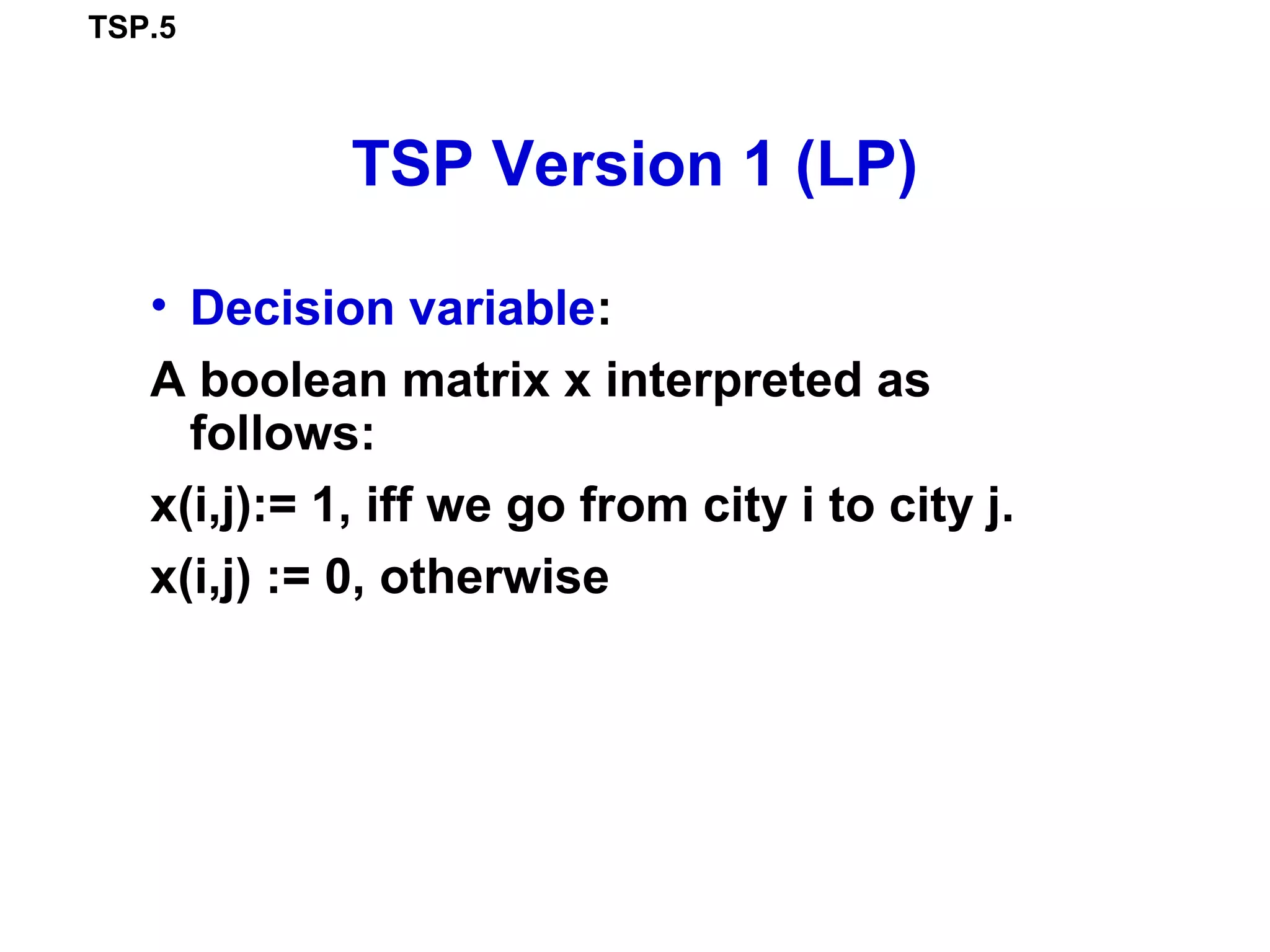
TSP.5
TSP Version 1 (LP)
• Decision variable:
A boolean matrix x interpreted as
follows:
x(i,j):= 1, iff we go from city i to city j.
x(i,j) := 0, otherwise
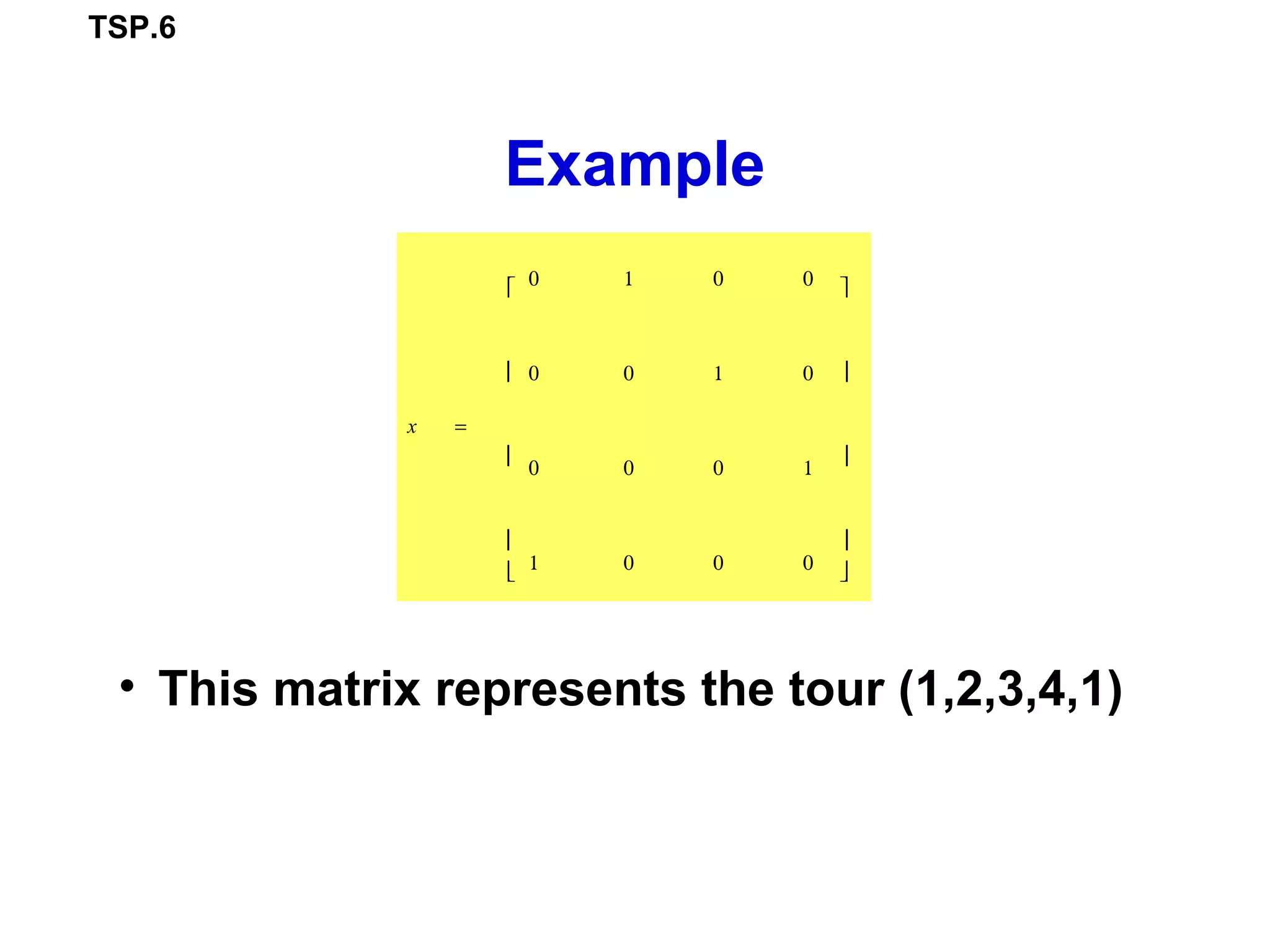
TSP.6
Example
• This matrix represents the tour (1,2,3,4,1)
x =
0 1 0 0
0 0 1 0
0 0 0 1
1 0 0 0










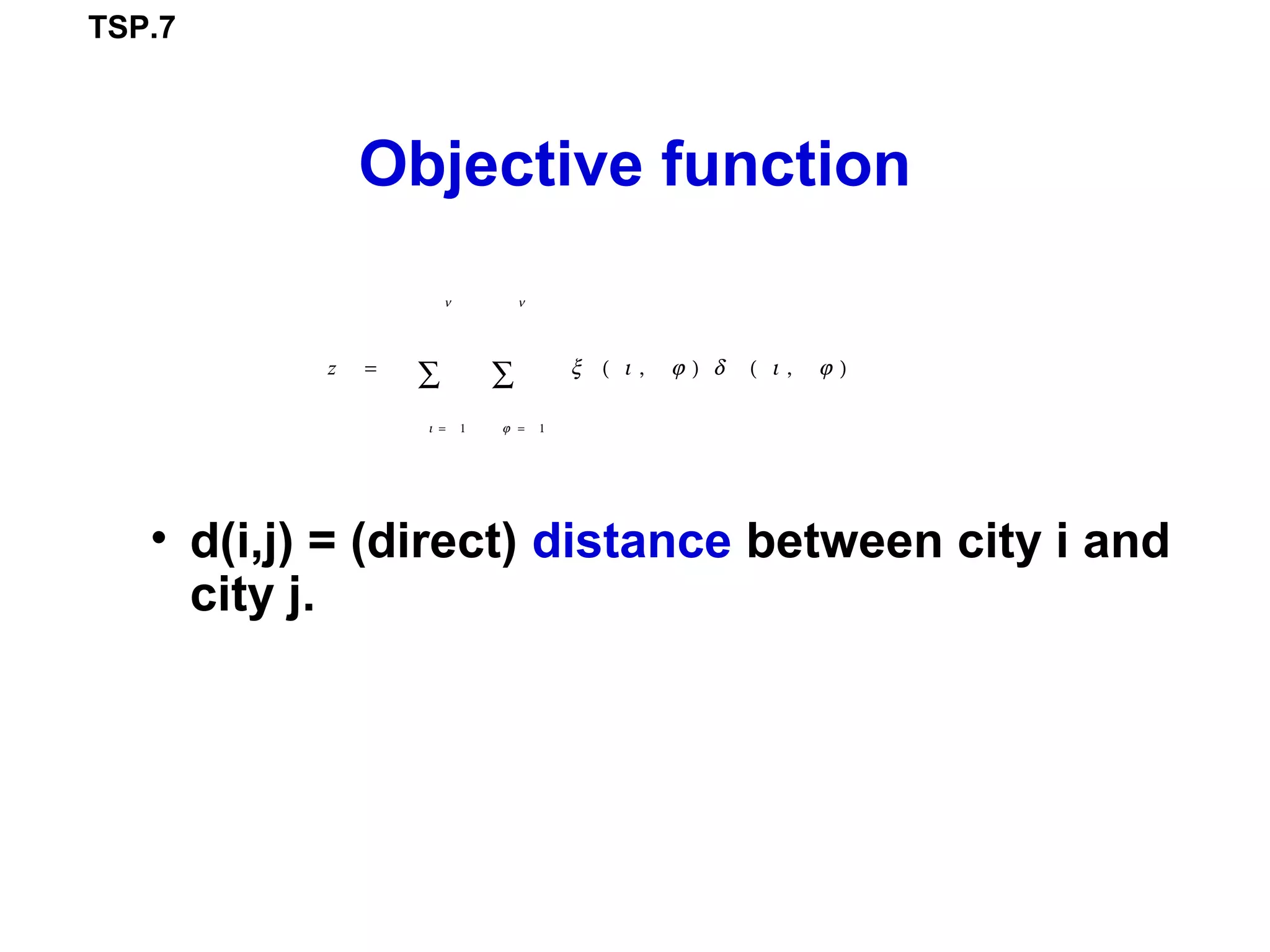
TSP.7
Objective function
• d(i,j) = (direct) distance between city i and
city j.
z = ξ ( ι , ϕ ) δ ( ι , ϕ )
ϕ = 1
ν
∑
ι = 1
ν
∑
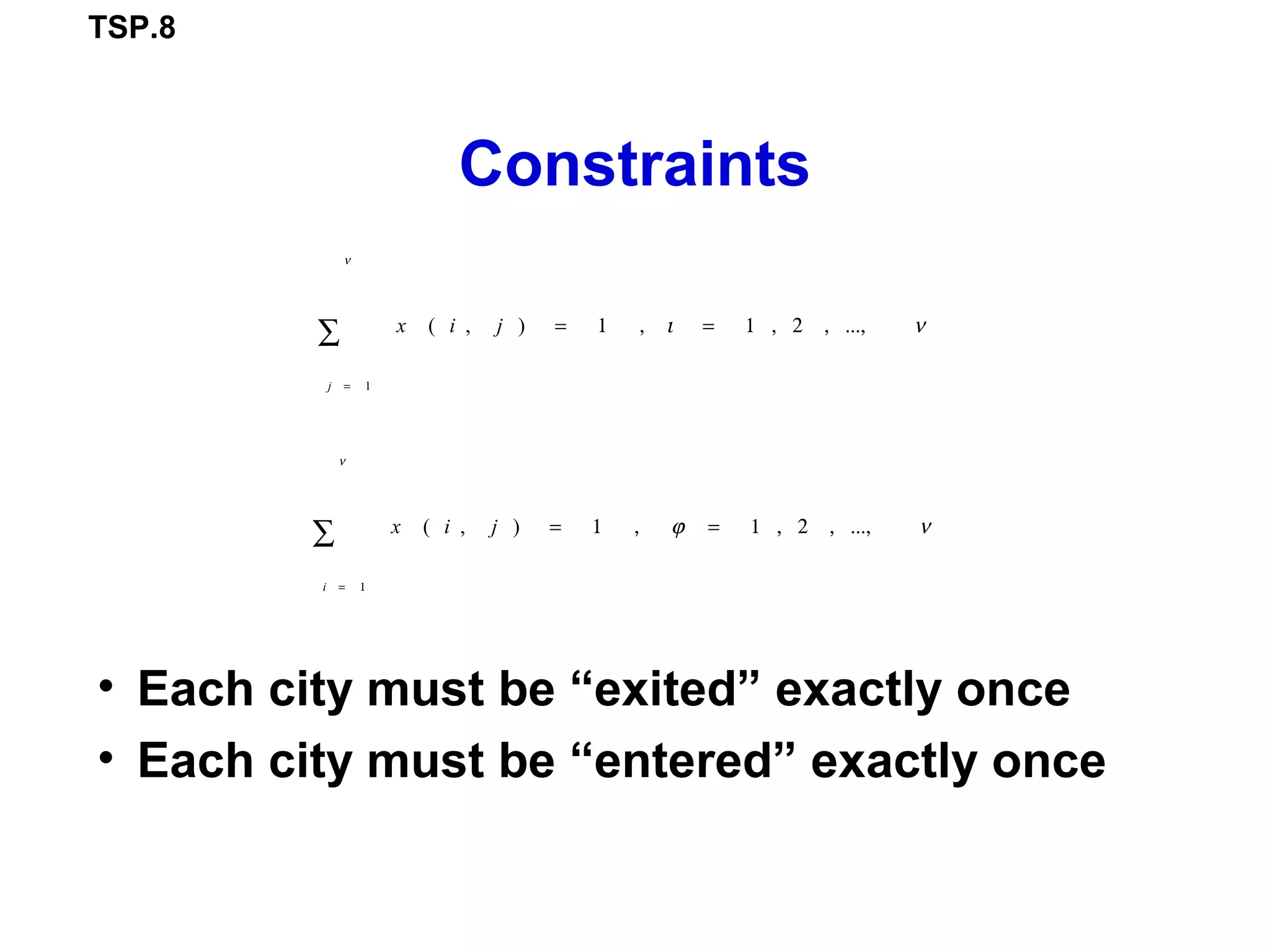
TSP.8
Constraints
• Each city must be “exited” exactly once
• Each city must be “entered” exactly once
x ( i , j )
j = 1
ν
∑ = 1 , ι = 1 , 2 , ..., ν
x ( i , j )
i = 1
ν
∑ = 1 , ϕ = 1 , 2 , ..., ν
TSP.9
Is this enough ?
TSP.10
No!
• The first two constraints allow sub-
tours
• Thus, we have to add a constraint that
will prevent sub-tours
TSP.11
Explanation: sub-tours
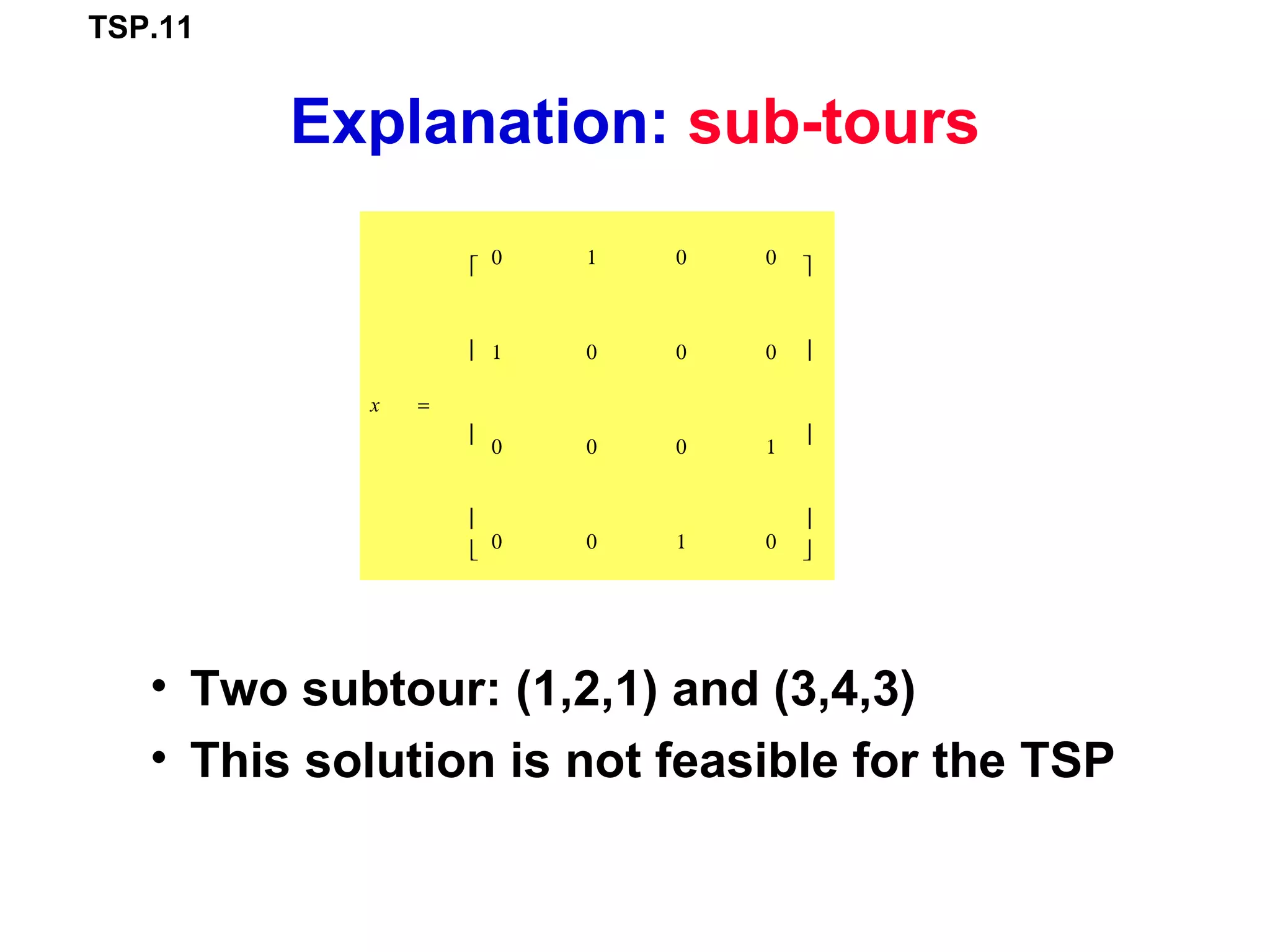
• Two subtour: (1,2,1) and (3,4,3)
• This solution is not feasible for the TSP
x =
0 1 0 0
1 0 0 0
0 0 0 1
0 0 1 0










TSP.12
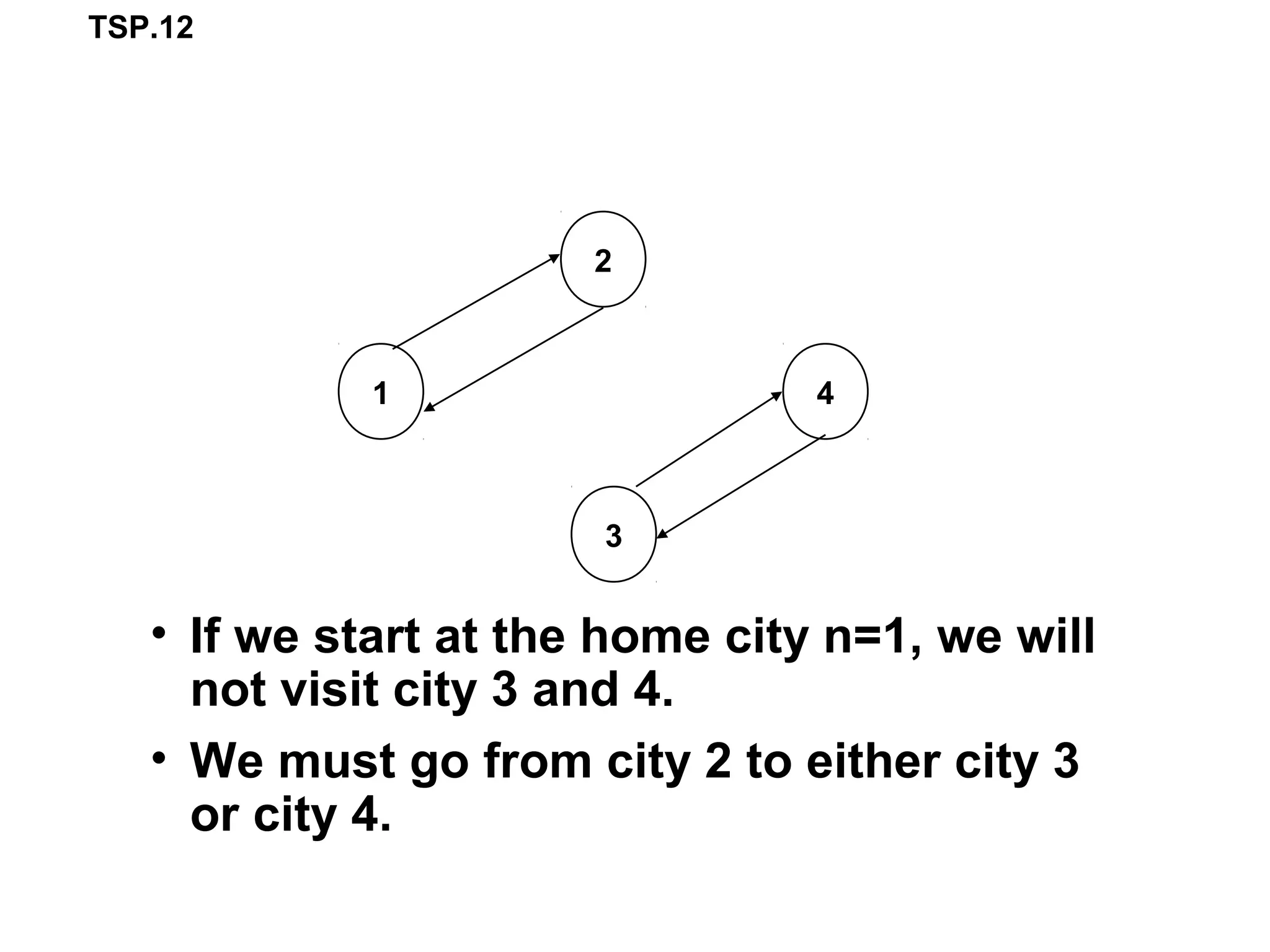
• If we start at the home city n=1, we will
not visit city 3 and 4.
• We must go from city 2 to either city 3
or city 4.
1
2
3
4
TSP.13
Subtour elimination constraint
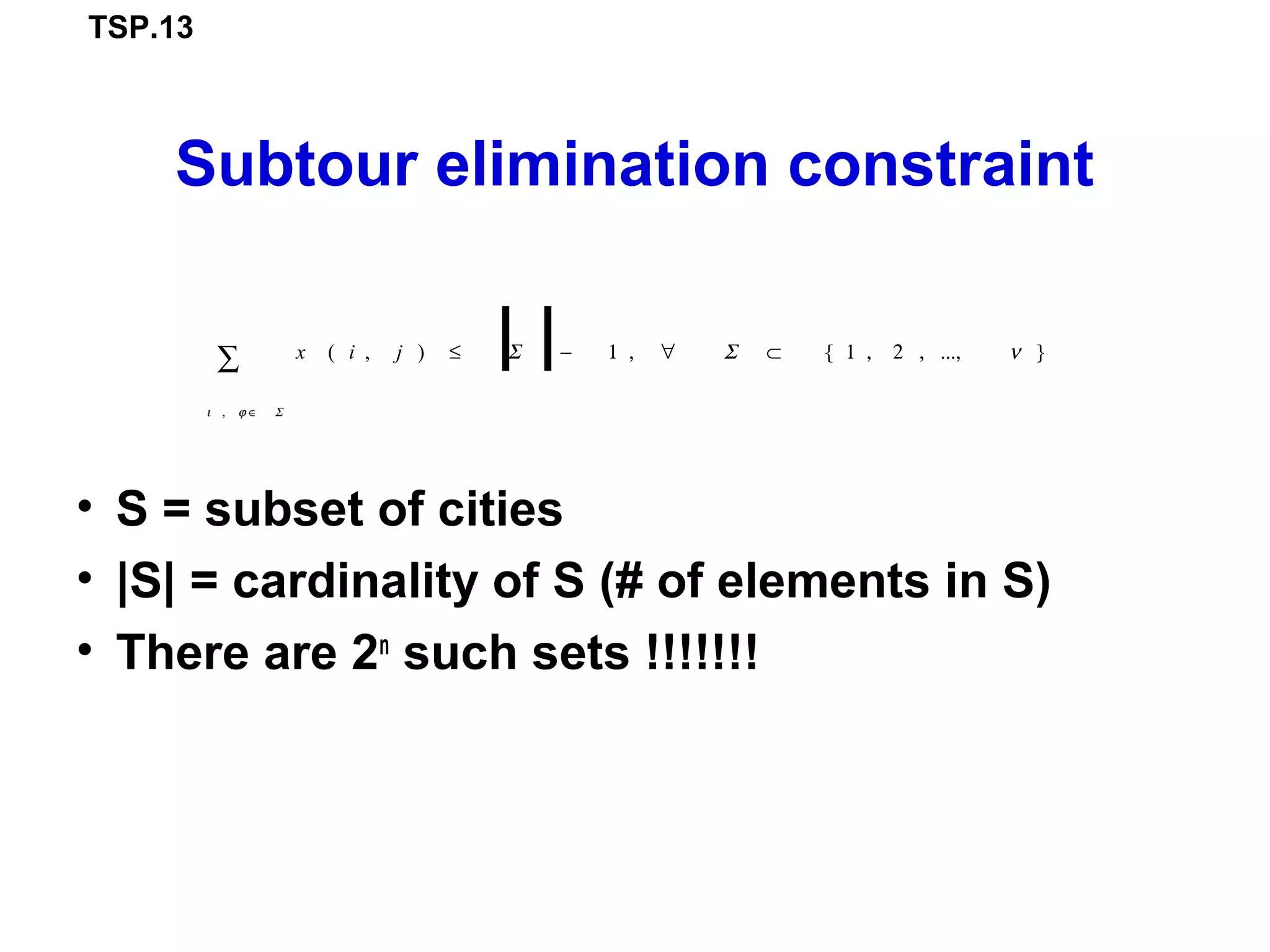
• S = subset of cities
• |S| = cardinality of S (# of elements in S)
• There are 2n
such sets !!!!!!!
x ( i , j ) ≤ Σ
ι , ϕ ∈ Σ
∑ − 1 , ∀ Σ ⊂ { 1 , 2 , ..., ν }
TSP.14
Example
• Consider S={1,2}, |S|=2
x =
0 1 0 0
1 0 0 0
0 0 0 1
0 0 1 0










x ( i , j ) = 2
ι , ϕ ∈ Σ
∑
• Hence the sub-tour
elimination constraint is
not satisfied.
• Indeed, thee are two
subtours in this solution
TSP.15
Thus, LP Version
min
x
x ( i , j ) d ( i , j )
j = 1
ν
∑
ι = 1
ν
∑
σ . τ.
ξ ( ι , ϕ) = 1 , ι = 1 , 2 , ..., ν
ϕ = 1
ν
∑
ξ ( ι , ϕ) = 1 , ϕ = 1 , 2 , ..., ν
ι = 1
ν
∑
ξ ( ι , ϕ) ≤ Σ − 1 , ∀ Σ ⊂ { 1 , 2 , ..., ν }
ι , ϕ∈ Σ
ν
∑
ξ ( ι , ϕ) ∈ { 0 , 1 }
TSP.16
LP-Free Version
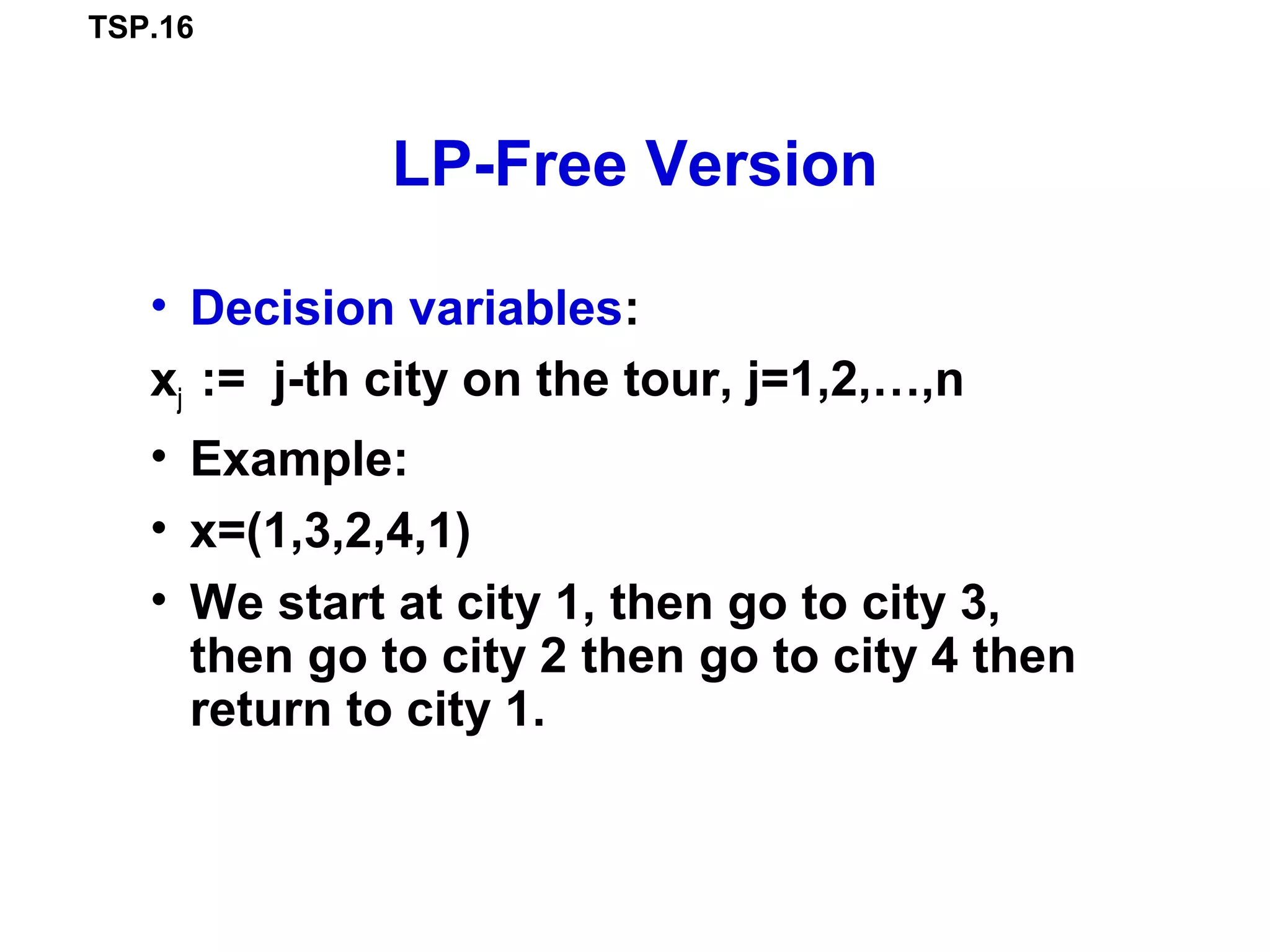
• Decision variables:
xj := j-th city on the tour, j=1,2,…,n
• Example:
• x=(1,3,2,4,1)
• We start at city 1, then go to city 3,
then go to city 2 then go to city 4 then
return to city 1.
TSP.17
ASSUMPTION
• Assume that 0 is the home city, and
that there are n other cities
TSP.18
Objective function
z = δ ( 0 , ξ
1
) + δ ( ξ
ϕ
ϕ = 1
ν − 1
∑ , ξ
ϕ + 1
) + δ ( ξ
ν
, 0 )
TSP.19
Constraints
• The constraint basically says that x
is a permutation of the cities (1,2,3,
…,n)
• Make sure that you appreciate the
role of { } in this formulation.
x
1
, ..., x
n
{ } = { 1 , 2 , 3 , ..., ν }
TSP.20
LP-Free Formulation
• There are n! feasible solutions
x
1
, ..., x
n
{ } = { 1 , 2 , 3 , ..., ν }
min
x
d ( 0 , x
1
) + δ ( ξ
ϕ
ϕ = 1
ν − 1
∑ , ξ
ϕ + 1
) + δ ( ξ
ν
, 0 )






TSP.21
Which one do you prefer?
TSP.22
LP Version
min
x
x ( i , j ) d ( i , j )
j = 1
ν
∑
ι = 1
ν
∑
σ . τ.
ξ ( ι , ϕ) = 1 , ι = 1 , 2 , ..., ν
ϕ = 1
ν
∑
ξ ( ι , ϕ) = 1 , ϕ = 1 , 2 , ..., ν
ι = 1
ν
∑
ξ ( ι , ϕ) ≤ Σ − 1 , ∀ Σ ⊂ { 1 , 2 , ..., ν }
ι , ϕ∈ Σ
ν
∑
ξ ( ι , ϕ) ∈ { 0 , 1 }
TSP.23
LP Free Version
x
1
, ..., x
n
{ } = { 1 , 2 , 3 , ..., ν }
min
x
d ( 0 , x
1
) + δ ( ξ
ϕ
ϕ = 1
ν − 1
∑ , ξ
ϕ + 1
) + δ ( ξ
ν
, 0 )






TSP.24
DP Solution
• Let,
f(i,s) := shortest sub-tour given that we
are at city i and still have to visit the
cities in s (and return to home city)
Then clearly,
f (i,φ) = d(i,0), φ = empty set
f (i,s) = min
j ∈S
d(i, j) + f (j,s  {j}){ }, s ≠ φ
s  A:= {k ∈ s,k ∉ A}.
TSP.25
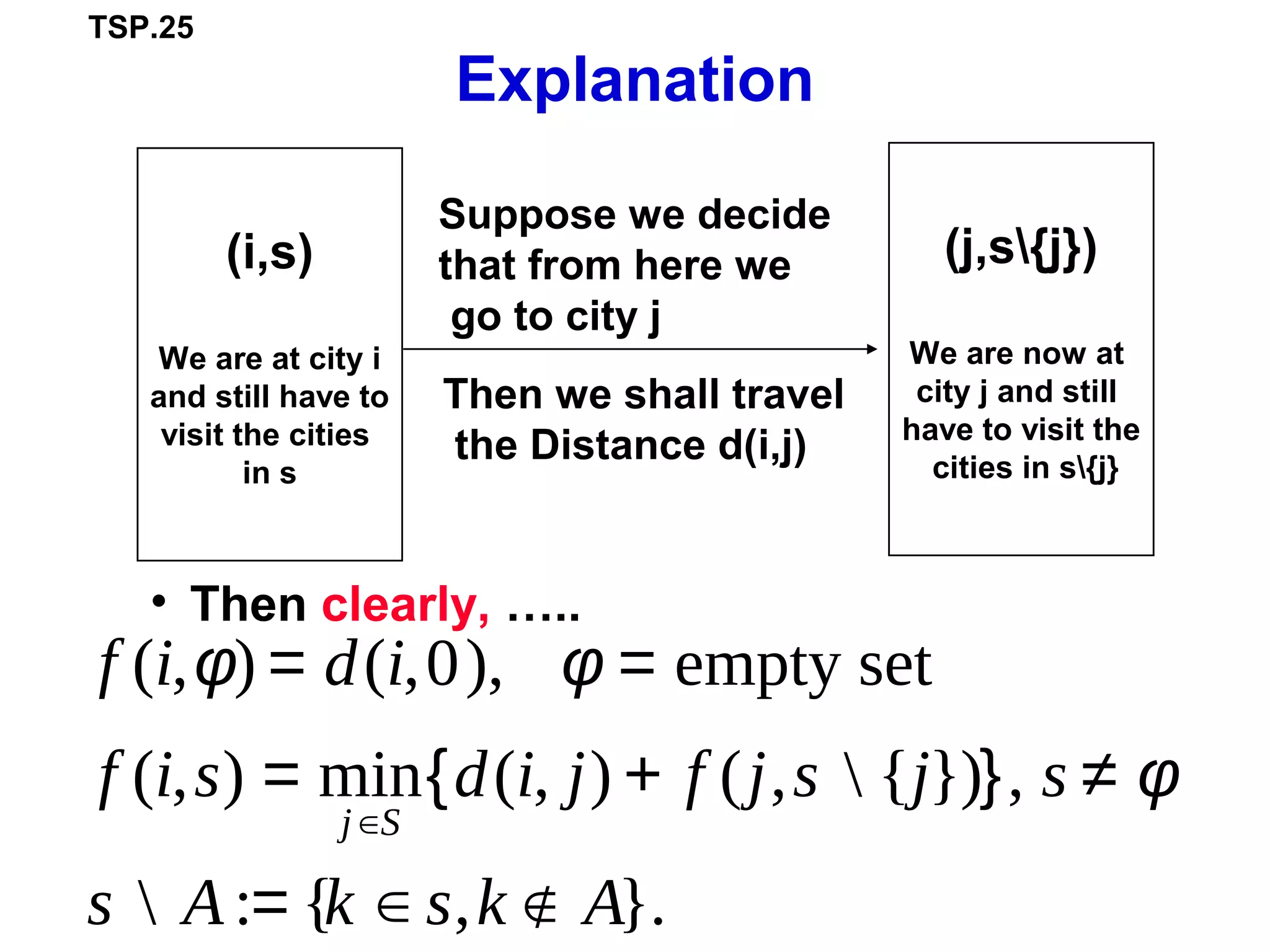
Explanation
• Then clearly, …..
(i,s)
We are at city i
and still have to
visit the cities
in s
Suppose we decide
that from here we
go to city j
Then we shall travel
the Distance d(i,j)
(j,s{j})
We are now at
city j and still
have to visit the
cities in s{j}
f (i,φ) = d(i,0), φ = empty set
f (i,s) = min
j ∈S
d(i, j) + f (j,s  {j}){ }, s ≠ φ
s  A := {k ∈ s,k ∉ A}.
TSP.26
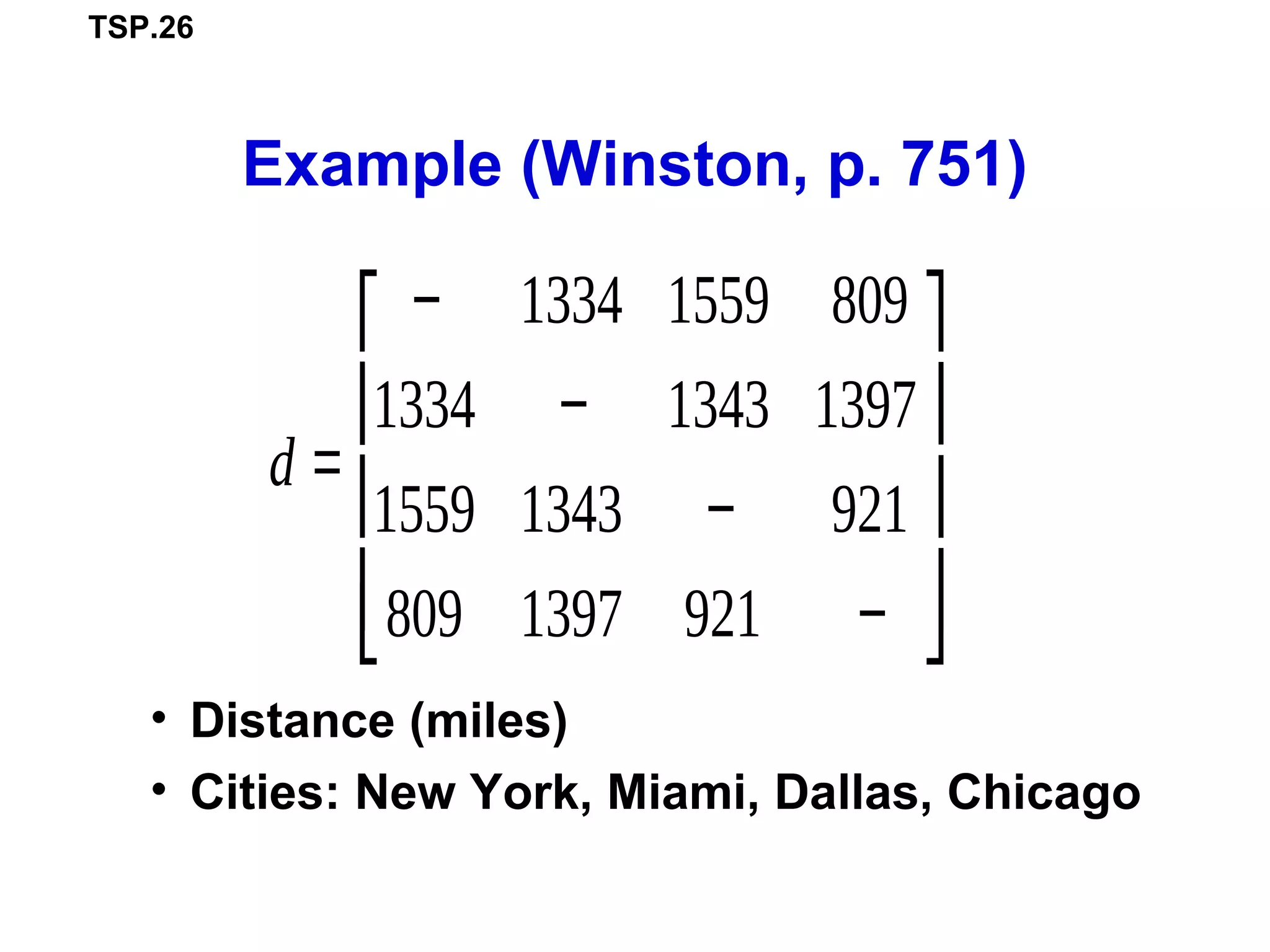
Example (Winston, p. 751)
• Distance (miles)
• Cities: New York, Miami, Dallas, Chicago
d =
− 1334 1559 809
1334 − 1343 1397
1559 1343 − 921
809 1397 921 −
⎡
⎣
⎢
⎢
⎢
⎤
⎦
⎥
⎥
⎥
TSP.27
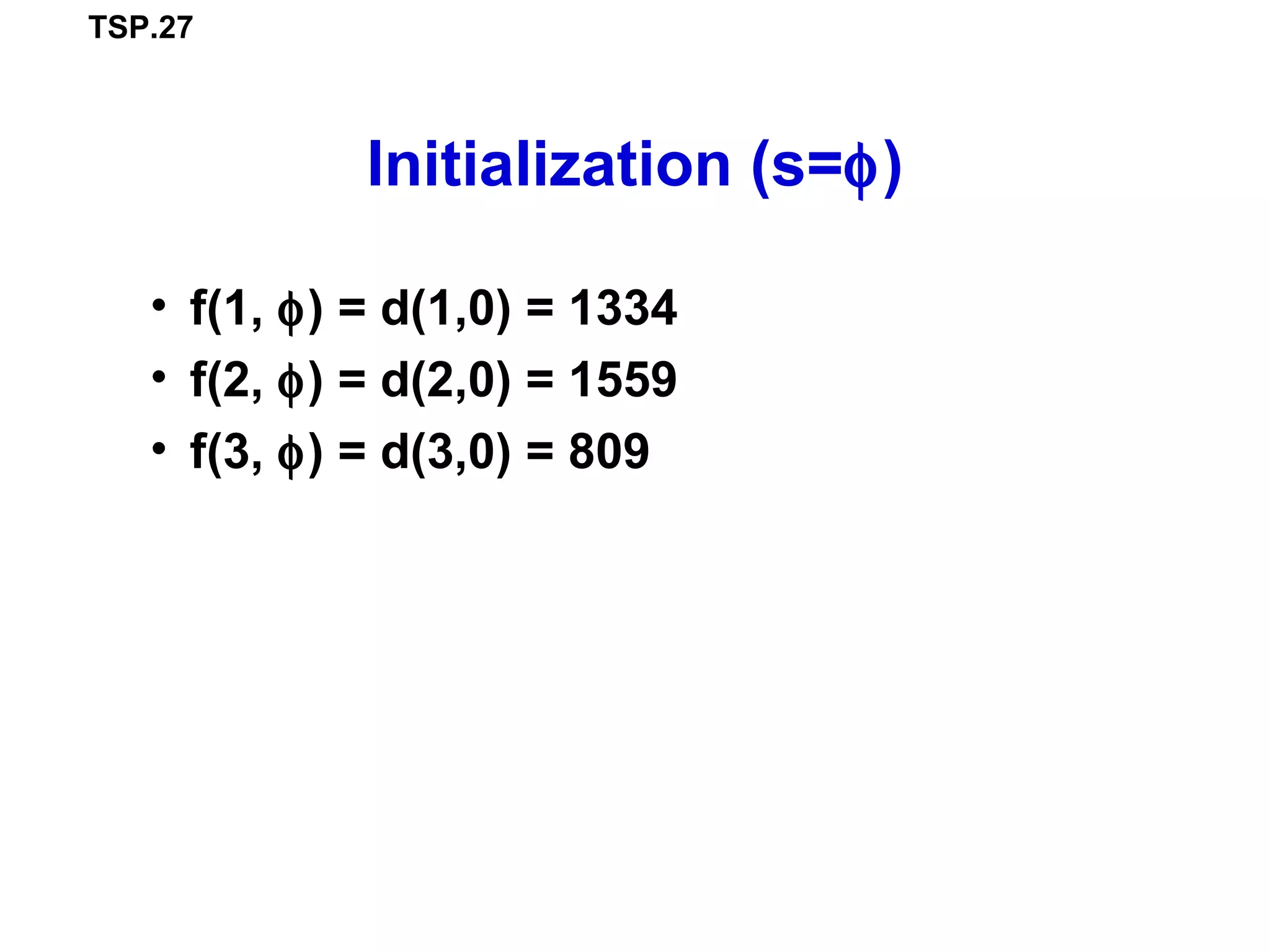
Initialization (s=φ)
• f(1, φ) = d(1,0) = 1334
• f(2, φ) = d(2,0) = 1559
• f(3, φ) = d(3,0) = 809
TSP.28
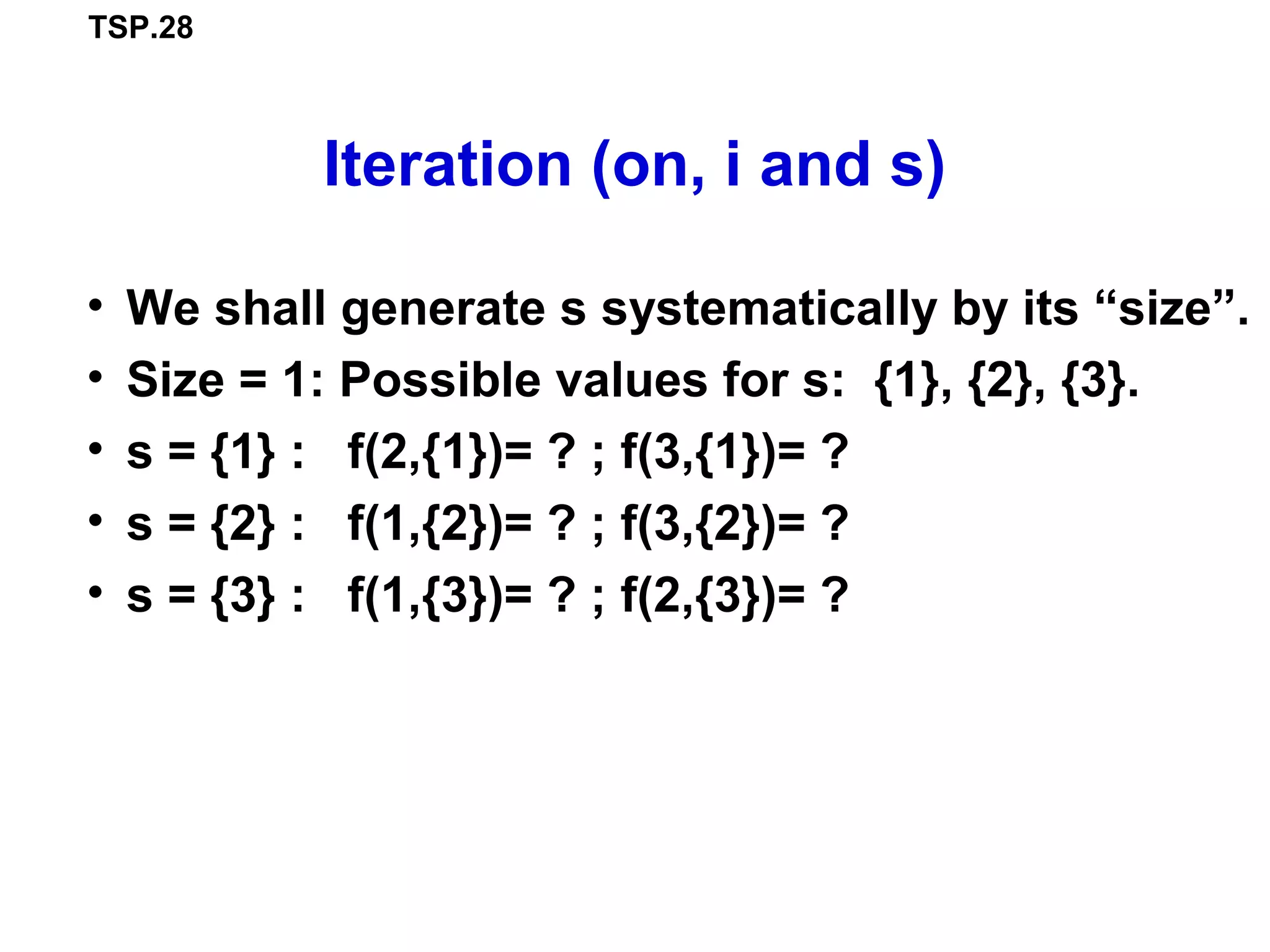
Iteration (on, i and s)
• We shall generate s systematically by its “size”.
• Size = 1: Possible values for s: {1}, {2}, {3}.
• s = {1} : f(2,{1})= ? ; f(3,{1})= ?
• s = {2} : f(1,{2})= ? ; f(3,{2})= ?
• s = {3} : f(1,{3})= ? ; f(2,{3})= ?
TSP.29
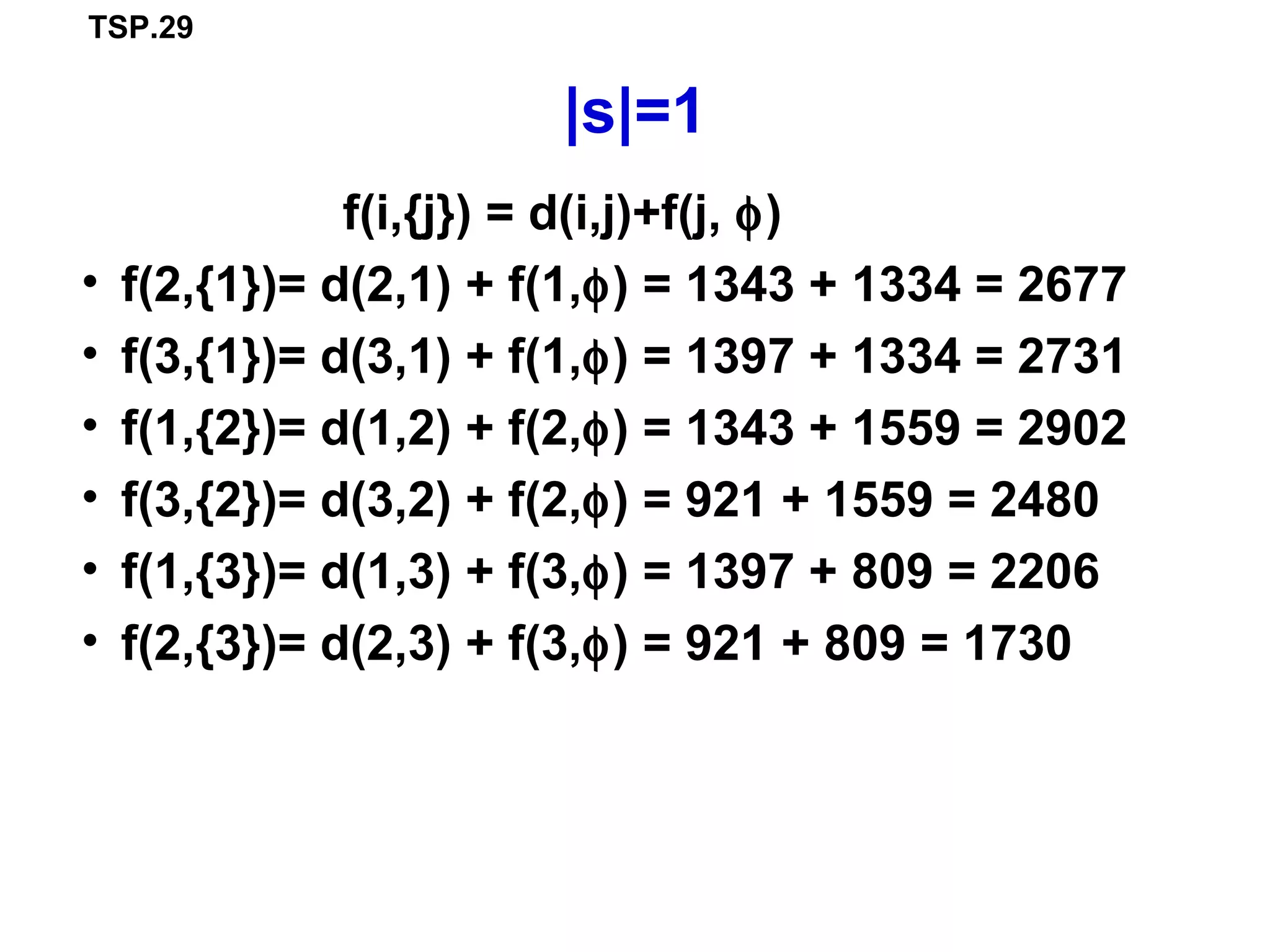
|s|=1
f(i,{j}) = d(i,j)+f(j, φ)
• f(2,{1})= d(2,1) + f(1,φ) = 1343 + 1334 = 2677
• f(3,{1})= d(3,1) + f(1,φ) = 1397 + 1334 = 2731
• f(1,{2})= d(1,2) + f(2,φ) = 1343 + 1559 = 2902
• f(3,{2})= d(3,2) + f(2,φ) = 921 + 1559 = 2480
• f(1,{3})= d(1,3) + f(3,φ) = 1397 + 809 = 2206
• f(2,{3})= d(2,3) + f(3,φ) = 921 + 809 = 1730
TSP.30
|s| = 2
f(i,s)= min{d(i,j)+f(j,s{j}): j in s}
• Size = 2: Possible values for s: {1,2}, {1,3}, {2,3}
Thus, we have to determine the values of
• f(3,{1,2}) = ? ; f(2,{1,3}) = ? ; f(1,{2,3}) = ?
• Eg:
f(3,{1,2}) = min {d(3,j) + f(j,s{j}): j in {1,2} }
= min {d(3,1) + f(1,{2}) , d(3,2) + f(2,{1})}
= min {1397+2902,921+2677}
= min {4299,3598}
= 3598 , N(3,{1,2})={2}
TSP.31
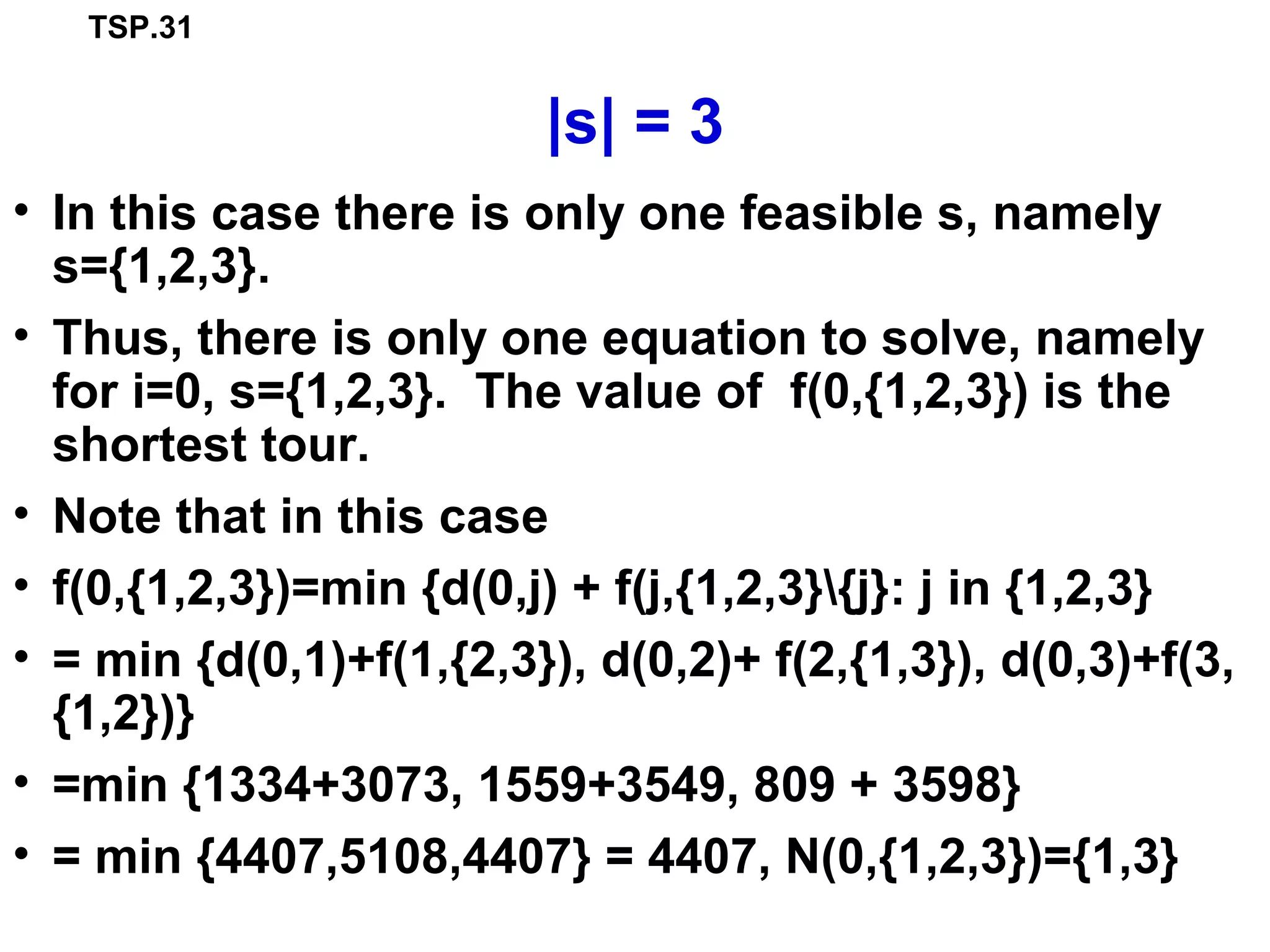
|s| = 3
• In this case there is only one feasible s, namely
s={1,2,3}.
• Thus, there is only one equation to solve, namely
for i=0, s={1,2,3}. The value of f(0,{1,2,3}) is the
shortest tour.
• Note that in this case
• f(0,{1,2,3})=min {d(0,j) + f(j,{1,2,3}{j}: j in {1,2,3}
• = min {d(0,1)+f(1,{2,3}), d(0,2)+ f(2,{1,3}), d(0,3)+f(3,
{1,2})}
• =min {1334+3073, 1559+3549, 809 + 3598}
• = min {4407,5108,4407} = 4407, N(0,{1,2,3})={1,3}
TSP.32
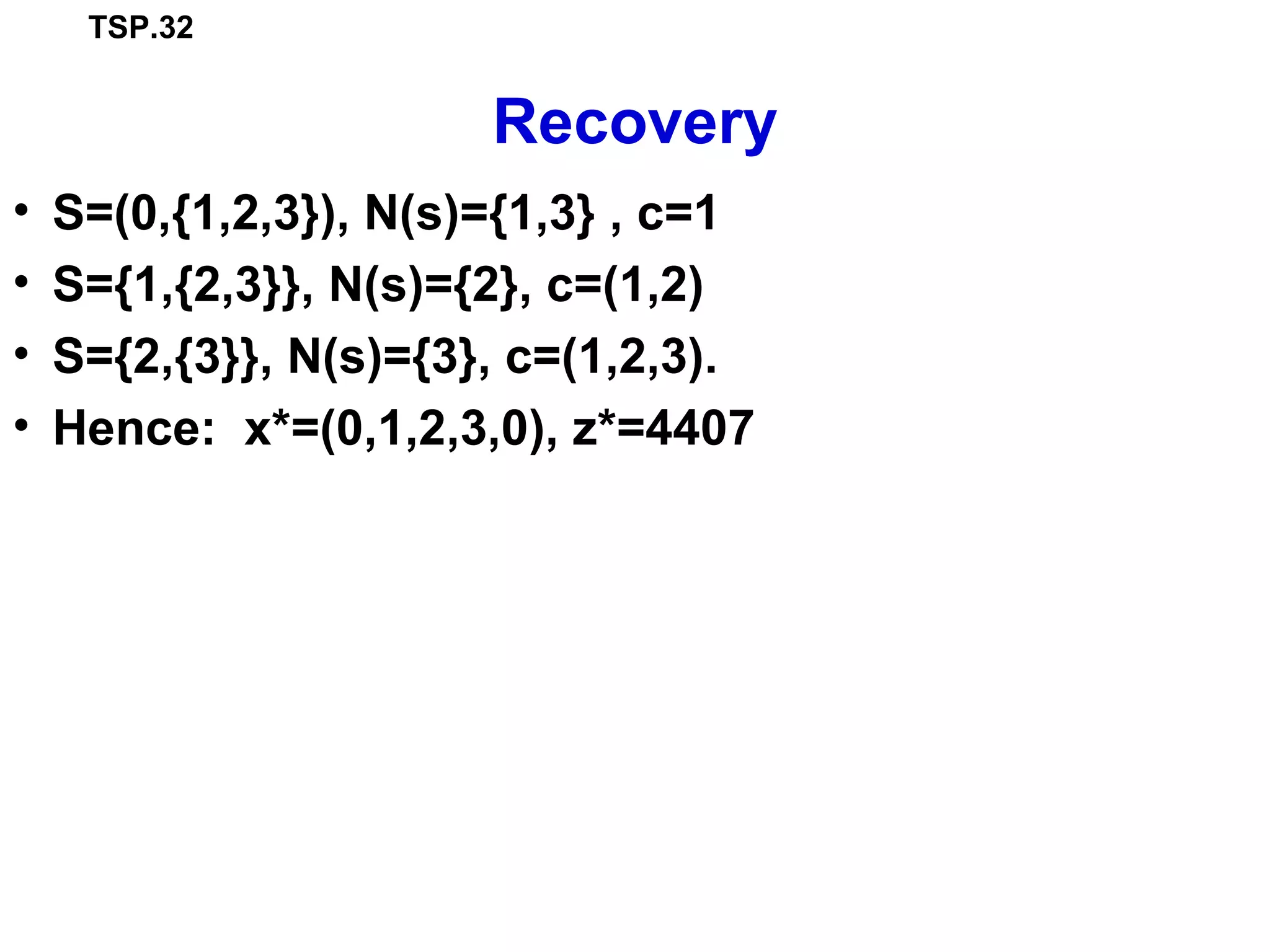
Recovery
• S=(0,{1,2,3}), N(s)={1,3} , c=1
• S={1,{2,3}}, N(s)={2}, c=(1,2)
• S={2,{3}}, N(s)={3}, c=(1,2,3).
• Hence: x*=(0,1,2,3,0), z*=4407

Chapter9 4

  • 1.
    TSP.1 9.4 Travelling Salesperson Problem (TSP) •Very famous problem • Many practical applications • Very easy to describe • Very difficult to solve (Curse of Dimensionality) • We shall consider the dynamic programming (DP) approach • Other approaches: see 620-362
  • 2.
    TSP.2 Problem Formulation • Thereare many ways to describe this problem. • We shall consider the following: – English version – Linear Programming oriented version – Linear Programming Free version – Dynamic programming version
  • 3.
    TSP.3 English Version • Youare given a set of n cities • You are given the distances between the cities • You start and terminate your tour at your home city • You must visit each other city exactly once. • Your mission is to determine the shortest tour.
  • 4.
    TSP.4 Maths versions • Weshall consider two Maths Version • The first is LP-based • The second is LP-free • The first version dominates the OR literature
  • 5.
    TSP.5 TSP Version 1(LP) • Decision variable: A boolean matrix x interpreted as follows: x(i,j):= 1, iff we go from city i to city j. x(i,j) := 0, otherwise
  • 6.
    TSP.6 Example • This matrixrepresents the tour (1,2,3,4,1) x = 0 1 0 0 0 0 1 0 0 0 0 1 1 0 0 0          
  • 7.
    TSP.7 Objective function • d(i,j)= (direct) distance between city i and city j. z = ξ ( ι , ϕ ) δ ( ι , ϕ ) ϕ = 1 ν ∑ ι = 1 ν ∑
  • 8.
    TSP.8 Constraints • Each citymust be “exited” exactly once • Each city must be “entered” exactly once x ( i , j ) j = 1 ν ∑ = 1 , ι = 1 , 2 , ..., ν x ( i , j ) i = 1 ν ∑ = 1 , ϕ = 1 , 2 , ..., ν
  • 9.
  • 10.
    TSP.10 No! • The firsttwo constraints allow sub- tours • Thus, we have to add a constraint that will prevent sub-tours
  • 11.
    TSP.11 Explanation: sub-tours • Twosubtour: (1,2,1) and (3,4,3) • This solution is not feasible for the TSP x = 0 1 0 0 1 0 0 0 0 0 0 1 0 0 1 0          
  • 12.
    TSP.12 • If westart at the home city n=1, we will not visit city 3 and 4. • We must go from city 2 to either city 3 or city 4. 1 2 3 4
  • 13.
    TSP.13 Subtour elimination constraint •S = subset of cities • |S| = cardinality of S (# of elements in S) • There are 2n such sets !!!!!!! x ( i , j ) ≤ Σ ι , ϕ ∈ Σ ∑ − 1 , ∀ Σ ⊂ { 1 , 2 , ..., ν }
  • 14.
    TSP.14 Example • Consider S={1,2},|S|=2 x = 0 1 0 0 1 0 0 0 0 0 0 1 0 0 1 0           x ( i , j ) = 2 ι , ϕ ∈ Σ ∑ • Hence the sub-tour elimination constraint is not satisfied. • Indeed, thee are two subtours in this solution
  • 15.
    TSP.15 Thus, LP Version min x x( i , j ) d ( i , j ) j = 1 ν ∑ ι = 1 ν ∑ σ . τ. ξ ( ι , ϕ) = 1 , ι = 1 , 2 , ..., ν ϕ = 1 ν ∑ ξ ( ι , ϕ) = 1 , ϕ = 1 , 2 , ..., ν ι = 1 ν ∑ ξ ( ι , ϕ) ≤ Σ − 1 , ∀ Σ ⊂ { 1 , 2 , ..., ν } ι , ϕ∈ Σ ν ∑ ξ ( ι , ϕ) ∈ { 0 , 1 }
  • 16.
    TSP.16 LP-Free Version • Decisionvariables: xj := j-th city on the tour, j=1,2,…,n • Example: • x=(1,3,2,4,1) • We start at city 1, then go to city 3, then go to city 2 then go to city 4 then return to city 1.
  • 17.
    TSP.17 ASSUMPTION • Assume that0 is the home city, and that there are n other cities
  • 18.
    TSP.18 Objective function z =δ ( 0 , ξ 1 ) + δ ( ξ ϕ ϕ = 1 ν − 1 ∑ , ξ ϕ + 1 ) + δ ( ξ ν , 0 )
  • 19.
    TSP.19 Constraints • The constraintbasically says that x is a permutation of the cities (1,2,3, …,n) • Make sure that you appreciate the role of { } in this formulation. x 1 , ..., x n { } = { 1 , 2 , 3 , ..., ν }
  • 20.
    TSP.20 LP-Free Formulation • Thereare n! feasible solutions x 1 , ..., x n { } = { 1 , 2 , 3 , ..., ν } min x d ( 0 , x 1 ) + δ ( ξ ϕ ϕ = 1 ν − 1 ∑ , ξ ϕ + 1 ) + δ ( ξ ν , 0 )      
  • 21.
  • 22.
    TSP.22 LP Version min x x (i , j ) d ( i , j ) j = 1 ν ∑ ι = 1 ν ∑ σ . τ. ξ ( ι , ϕ) = 1 , ι = 1 , 2 , ..., ν ϕ = 1 ν ∑ ξ ( ι , ϕ) = 1 , ϕ = 1 , 2 , ..., ν ι = 1 ν ∑ ξ ( ι , ϕ) ≤ Σ − 1 , ∀ Σ ⊂ { 1 , 2 , ..., ν } ι , ϕ∈ Σ ν ∑ ξ ( ι , ϕ) ∈ { 0 , 1 }
  • 23.
    TSP.23 LP Free Version x 1 ,..., x n { } = { 1 , 2 , 3 , ..., ν } min x d ( 0 , x 1 ) + δ ( ξ ϕ ϕ = 1 ν − 1 ∑ , ξ ϕ + 1 ) + δ ( ξ ν , 0 )      
  • 24.
    TSP.24 DP Solution • Let, f(i,s):= shortest sub-tour given that we are at city i and still have to visit the cities in s (and return to home city) Then clearly, f (i,φ) = d(i,0), φ = empty set f (i,s) = min j ∈S d(i, j) + f (j,s {j}){ }, s ≠ φ s A:= {k ∈ s,k ∉ A}.
  • 25.
    TSP.25 Explanation • Then clearly,….. (i,s) We are at city i and still have to visit the cities in s Suppose we decide that from here we go to city j Then we shall travel the Distance d(i,j) (j,s{j}) We are now at city j and still have to visit the cities in s{j} f (i,φ) = d(i,0), φ = empty set f (i,s) = min j ∈S d(i, j) + f (j,s {j}){ }, s ≠ φ s A := {k ∈ s,k ∉ A}.
  • 26.
    TSP.26 Example (Winston, p.751) • Distance (miles) • Cities: New York, Miami, Dallas, Chicago d = − 1334 1559 809 1334 − 1343 1397 1559 1343 − 921 809 1397 921 − ⎡ ⎣ ⎢ ⎢ ⎢ ⎤ ⎦ ⎥ ⎥ ⎥
  • 27.
    TSP.27 Initialization (s=φ) • f(1,φ) = d(1,0) = 1334 • f(2, φ) = d(2,0) = 1559 • f(3, φ) = d(3,0) = 809
  • 28.
    TSP.28 Iteration (on, iand s) • We shall generate s systematically by its “size”. • Size = 1: Possible values for s: {1}, {2}, {3}. • s = {1} : f(2,{1})= ? ; f(3,{1})= ? • s = {2} : f(1,{2})= ? ; f(3,{2})= ? • s = {3} : f(1,{3})= ? ; f(2,{3})= ?
  • 29.
    TSP.29 |s|=1 f(i,{j}) = d(i,j)+f(j,φ) • f(2,{1})= d(2,1) + f(1,φ) = 1343 + 1334 = 2677 • f(3,{1})= d(3,1) + f(1,φ) = 1397 + 1334 = 2731 • f(1,{2})= d(1,2) + f(2,φ) = 1343 + 1559 = 2902 • f(3,{2})= d(3,2) + f(2,φ) = 921 + 1559 = 2480 • f(1,{3})= d(1,3) + f(3,φ) = 1397 + 809 = 2206 • f(2,{3})= d(2,3) + f(3,φ) = 921 + 809 = 1730
  • 30.
    TSP.30 |s| = 2 f(i,s)=min{d(i,j)+f(j,s{j}): j in s} • Size = 2: Possible values for s: {1,2}, {1,3}, {2,3} Thus, we have to determine the values of • f(3,{1,2}) = ? ; f(2,{1,3}) = ? ; f(1,{2,3}) = ? • Eg: f(3,{1,2}) = min {d(3,j) + f(j,s{j}): j in {1,2} } = min {d(3,1) + f(1,{2}) , d(3,2) + f(2,{1})} = min {1397+2902,921+2677} = min {4299,3598} = 3598 , N(3,{1,2})={2}
  • 31.
    TSP.31 |s| = 3 •In this case there is only one feasible s, namely s={1,2,3}. • Thus, there is only one equation to solve, namely for i=0, s={1,2,3}. The value of f(0,{1,2,3}) is the shortest tour. • Note that in this case • f(0,{1,2,3})=min {d(0,j) + f(j,{1,2,3}{j}: j in {1,2,3} • = min {d(0,1)+f(1,{2,3}), d(0,2)+ f(2,{1,3}), d(0,3)+f(3, {1,2})} • =min {1334+3073, 1559+3549, 809 + 3598} • = min {4407,5108,4407} = 4407, N(0,{1,2,3})={1,3}
  • 32.
    TSP.32 Recovery • S=(0,{1,2,3}), N(s)={1,3}, c=1 • S={1,{2,3}}, N(s)={2}, c=(1,2) • S={2,{3}}, N(s)={3}, c=(1,2,3). • Hence: x*=(0,1,2,3,0), z*=4407