Time complexity of loops
Alexandra Stefan
2/8/2023
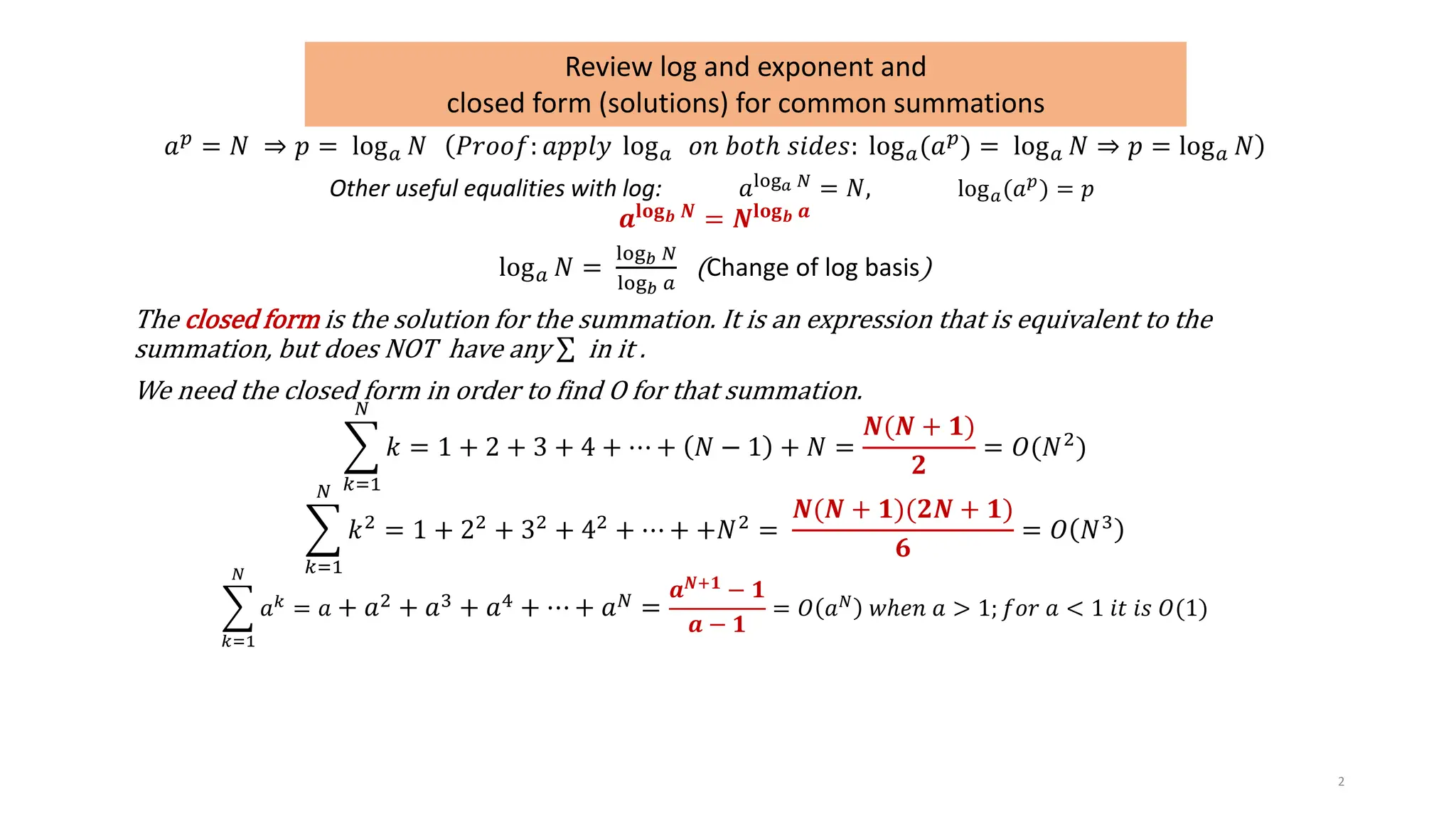
𝑎𝑝 = 𝑁 ⇒ 𝑝 = log𝑎 𝑁 𝑃𝑟𝑜𝑜𝑓: 𝑎𝑝𝑝𝑙𝑦 log𝑎 𝑜𝑛 𝑏𝑜𝑡ℎ 𝑠𝑖𝑑𝑒𝑠: log𝑎(𝑎𝑝) = log𝑎 𝑁 ⇒ 𝑝 = log𝑎 𝑁
Other useful equalities with log: 𝑎log𝑎 𝑁 = 𝑁, log𝑎(𝑎𝑝
) = 𝑝
𝒂𝐥𝐨𝐠𝒃 𝑵 = 𝑵𝐥𝐨𝐠𝒃 𝒂
log𝑎 𝑁 =
log𝑏 𝑁
log𝑏 𝑎
(Change of log basis)
The closed form is the solution for the summation. It is an expression that is equivalent to the
summation, but does NOT have any σ in it .
We need the closed form in order to find O for that summation.
෍
𝑘=1
𝑁
𝑘 = 1 + 2 + 3 + 4 + ⋯ + 𝑁 − 1 + 𝑁 =
𝑵(𝑵 + 𝟏)
𝟐
= 𝑂(𝑁2
)
෍
𝑘=1
𝑁
𝑘2
= 1 + 22
+ 32
+ 42
+ ⋯ + +𝑁2
=
𝑵(𝑵 + 𝟏)(𝟐𝑵 + 𝟏)
𝟔
= 𝑂 𝑁3
෍
𝑘=1
𝑁
𝑎𝑘
= 𝑎 + 𝑎2 + 𝑎3 + 𝑎4 + ⋯ + 𝑎𝑁 =
𝒂𝑵+𝟏
− 𝟏
𝒂 − 𝟏
= 𝑂 𝑎𝑁
𝑤ℎ𝑒𝑛 𝑎 > 1; 𝑓𝑜𝑟 𝑎 < 1 𝑖𝑡 𝑖𝑠 𝑂(1)
2
Review log and exponent and
closed form (solutions) for common summations
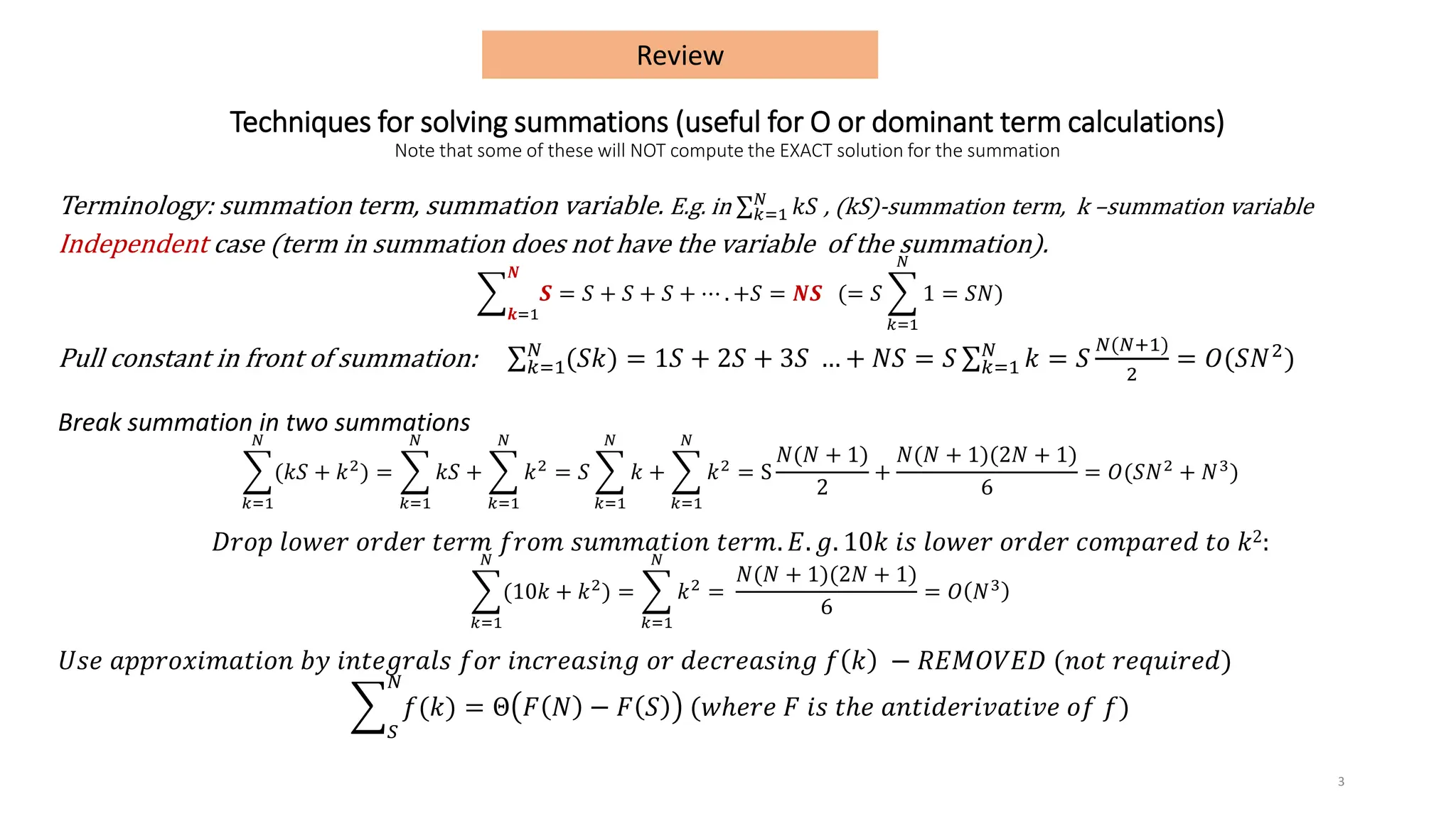
Techniques for solving summations (useful for O or dominant term calculations)
Note that some of these will NOT compute the EXACT solution for the summation
Terminology: summation term, summation variable. E.g. in σ𝑘=1
𝑁
𝑘𝑆 , (kS)-summation term, k –summation variable
Independent case (term in summation does not have the variable of the summation).
෍
𝒌=1
𝑵
𝑺 = 𝑆 + 𝑆 + 𝑆 + ⋯ . +𝑆 = 𝑵𝑺 (= 𝑆 ෍
𝑘=1
𝑁
1 = 𝑆𝑁)
Pull constant in front of summation: σ𝑘=1
𝑁
(𝑆𝑘) = 1𝑆 + 2𝑆 + 3𝑆 … + 𝑁𝑆 = 𝑆 σ𝑘=1
𝑁
𝑘 = 𝑆
𝑁(𝑁+1)
2
= 𝑂(𝑆𝑁2)
Break summation in two summations
෍
𝑘=1
𝑁
(𝑘𝑆 + 𝑘2
) = ෍
𝑘=1
𝑁
𝑘𝑆 + ෍
𝑘=1
𝑁
𝑘2
= 𝑆 ෍
𝑘=1
𝑁
𝑘 + ෍
𝑘=1
𝑁
𝑘2
= S
𝑁(𝑁 + 1)
2
+
𝑁(𝑁 + 1)(2𝑁 + 1)
6
= 𝑂(𝑆𝑁2
+ 𝑁3
)
𝐷𝑟𝑜𝑝 𝑙𝑜𝑤𝑒𝑟 𝑜𝑟𝑑𝑒𝑟 𝑡𝑒𝑟𝑚 𝑓𝑟𝑜𝑚 𝑠𝑢𝑚𝑚𝑎𝑡𝑖𝑜𝑛 𝑡𝑒𝑟𝑚. 𝐸. 𝑔. 10𝑘 𝑖𝑠 𝑙𝑜𝑤𝑒𝑟 𝑜𝑟𝑑𝑒𝑟 𝑐𝑜𝑚𝑝𝑎𝑟𝑒𝑑 𝑡𝑜 𝑘2:
෍
𝑘=1
𝑁
(10𝑘 + 𝑘2
) = ෍
𝑘=1
𝑁
𝑘2
=
𝑁(𝑁 + 1)(2𝑁 + 1)
6
= 𝑂 𝑁3
𝑈𝑠𝑒 𝑎𝑝𝑝𝑟𝑜𝑥𝑖𝑚𝑎𝑡𝑖𝑜𝑛 𝑏𝑦 𝑖𝑛𝑡𝑒𝑔𝑟𝑎𝑙𝑠 𝑓𝑜𝑟 𝑖𝑛𝑐𝑟𝑒𝑎𝑠𝑖𝑛𝑔 𝑜𝑟 𝑑𝑒𝑐𝑟𝑒𝑎𝑠𝑖𝑛𝑔 𝑓 𝑘 − 𝑅𝐸𝑀𝑂𝑉𝐸𝐷 (𝑛𝑜𝑡 𝑟𝑒𝑞𝑢𝑖𝑟𝑒𝑑)
෍
𝑆
𝑁
𝑓(𝑘) = Θ 𝐹 𝑁 − 𝐹 𝑆 (𝑤ℎ𝑒𝑟𝑒 𝐹 𝑖𝑠 𝑡ℎ𝑒 𝑎𝑛𝑡𝑖𝑑𝑒𝑟𝑖𝑣𝑎𝑡𝑖𝑣𝑒 𝑜𝑓 𝑓)
3
Review
#include <stdio.h>
int linear_search(int ar[], int S, int val);
int main(){
char fname[100];
int mx_size, N, i, M, val;
FILE *fp;
printf("Enter the filename: ");
scanf("%s", fname);
fp =fopen(fname, "r");
if (fp == NULL){
printf("File could not be opened.n"); return 1;
}
fscanf(fp, "%d %d", &mx_size, &N);
int nums1[mx_size];
//int* nums1 = malloc(mx_size * sizeof(int));
// read from file and populate array
for (i = 0; i < N; i++) {
fscanf(fp, "%d ", &nums1[i]);
}
int found = linear_search(nums1, N, 67);
printf("nreturned index:%dn", found);
// read the second line of numbers from file and search for them in nums1
fscanf(fp, "%d", &M);
for(i=0; i<M; i++){
fscanf(fp, "%d", &val);
found = linear_search(nums1, N, val);
printf("nreturned index:%dn", found);
}
fclose(fp);
return (EXIT_SUCCESS);
}
// Assumes array ar has S elements.
int linear_search(int ar[], int S, int val){
printf("n Searching for %d ...n",val);
for(int i=0; i<S; i++) {
printf("%4d|", ar[i]);
if ( ar[i] == val )
return i;
}
printf("n");
return -1;
}
4
30 5
3 7 10 19 20
10
67 20 -3 9 7 1 22 13 8 6
Sample data file 1:
10 7
5 10 13 20 26 30 37
4
67 22 -3 10
Sample data file 2:
// Assumes array nums has at least T elements.
int count(int nums[], int T, int V){
int count = 0;
for(int k=0; k<T; k++) {
if ( nums[k] == V )
count++;
}
return count;
}
Time Complexity for Function Definitions and Function Calls
TC for a function DEFINITION can ONLY depend on the data
passed as argument E.g. for
int count(int nums[], int T, int V){
…
}
In the TC expression, O, we can only have:
• variable names that are parameters
• E.g. O(T+V) is ok because both S and V are parameters.
• E.g. O(N) is wrong because there is no N in the list of parameters
• variables that represent a number (typically integer)
• E.g. size of the array, size of a data record, max value in an array
• It is wrong to say O(nums2) because nums is an entire array. What
is nums2?
• Remember that TC in the end should give a quantity.
• DEFINED “new” variables
• I can use names that are not among the function parameters, but I
have clearly define them with respect to the input data. E.g. I can
say “O(N) where N is the number of elements in ar”. Here N is not
a parameter of count, but I have defined what N represents
with respect to nums, and N is an integer.
Solve the examples with strings from the next page
The TC for a function CALL is based on the time complexity of
the function definition and the arguments passed when called.
E.g. given the TC for a function definition in terms of its signature:
int foo(int nums[], int S, int V) // has TC O(S2)
when called, we replace the S with whatever data is passed in the
function call (pay special attention to constants-see example below) . E.g.
We can find the TC of function calls:
r=search(nums, M, 7); // O(M2)
r=search(nums, d, S); // O(d2), not S2
r=search(nums, T+X, 7); // O( (T+X)2 )
r=search(nums, 39,7); // O(1) 1, not 39
To understand why we simply substitute the corresponding argument
variables in the TC, here is a discussion at the Assume that the Θ(S2)
time complexity of the above function comes from the detailed
instruction count: 7S2 + 12S + 9 . When the function is called with M for S
(e.g. in search(arr1, M, 7) ) the detailed count becomes 7M2
+ 12M + 9 which is Θ(M2)
5
What is the time complexity (TC) of the function definitions below?
/* Assumes text is a good string (NULL terminated).
text could have been allocated either dynamic
(with malloc/calloc) or static (with []) */
int count_char(char * text){
int count = 0;
for(int k=0; k<strlen(text); k++) {
if ( text[k] == 'A' ){
count++;
}
}
return count;
}
/* Assumes animal is a good string (NULL terminated).
animal could have been allocated either dynamic
(with malloc/calloc) or static (with []) */
void print_ct_sheep(int X, char * animal){
printf("X=%d, N=%dn", X, N);
for (int k=0; k<X; k++){
printf("%3d %sn", k, animal);
}
printf("n");
}
6
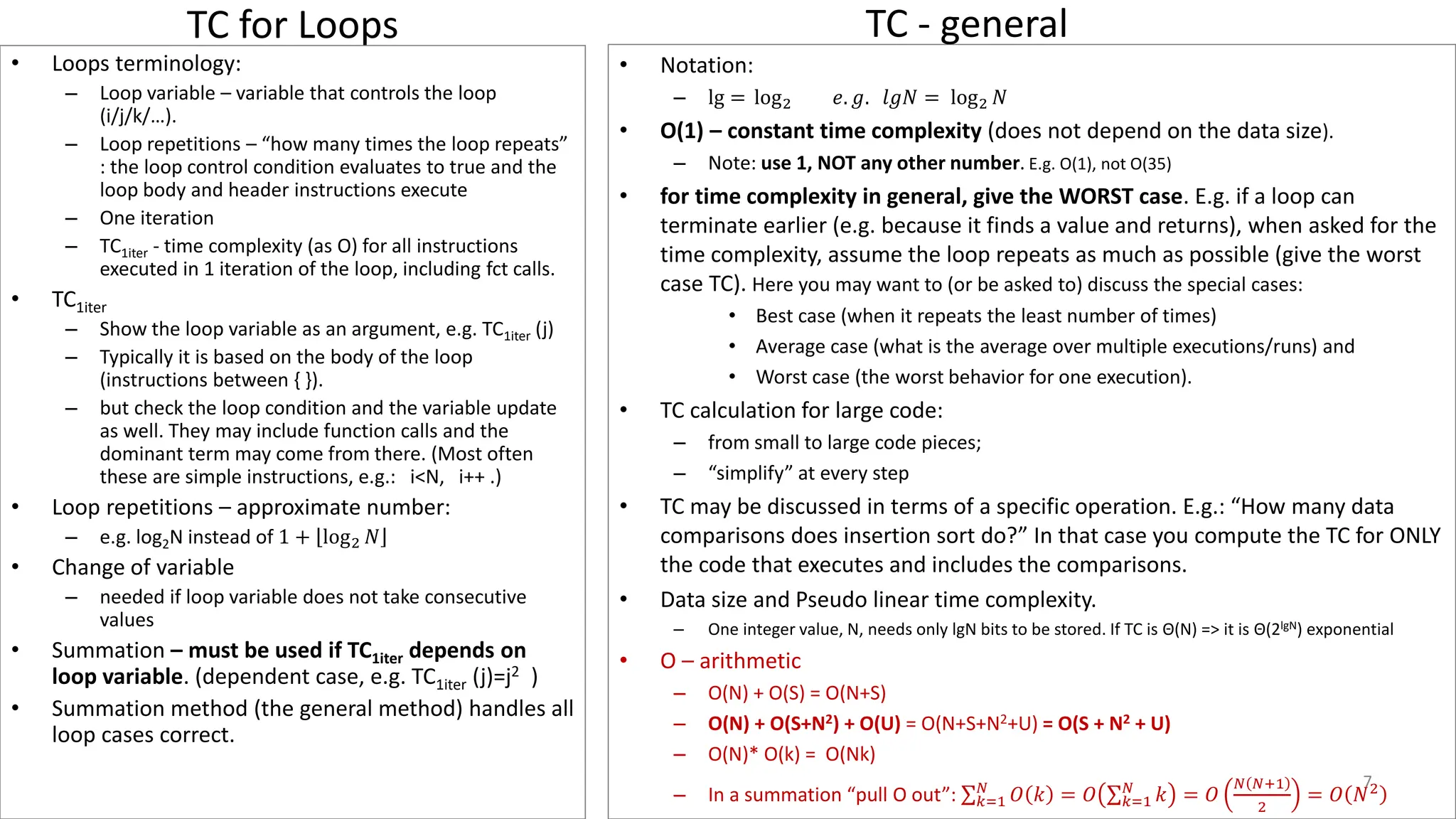
TC for Loops
• Notation:
– lg = log2 𝑒. 𝑔. 𝑙𝑔𝑁 = log2 𝑁
• O(1) – constant time complexity (does not depend on the data size).
– Note: use 1, NOT any other number. E.g. O(1), not O(35)
• for time complexity in general, give the WORST case. E.g. if a loop can
terminate earlier (e.g. because it finds a value and returns), when asked for the
time complexity, assume the loop repeats as much as possible (give the worst
case TC). Here you may want to (or be asked to) discuss the special cases:
• Best case (when it repeats the least number of times)
• Average case (what is the average over multiple executions/runs) and
• Worst case (the worst behavior for one execution).
• TC calculation for large code:
– from small to large code pieces;
– “simplify” at every step
• TC may be discussed in terms of a specific operation. E.g.: “How many data
comparisons does insertion sort do?” In that case you compute the TC for ONLY
the code that executes and includes the comparisons.
• Data size and Pseudo linear time complexity.
– One integer value, N, needs only lgN bits to be stored. If TC is Θ(N) => it is Θ(2lgN) exponential
• O – arithmetic
– O(N) + O(S) = O(N+S)
– O(N) + O(S+N2) + O(U) = O(N+S+N2+U) = O(S + N2 + U)
– O(N)* O(k) = O(Nk)
– In a summation “pull O out”: σ𝑘=1
𝑁
𝑂 𝑘 = 𝑂 σ𝑘=1
𝑁
𝑘 = 𝑂
𝑁 𝑁+1
2
= 𝑂 𝑁2
• Loops terminology:
– Loop variable – variable that controls the loop
(i/j/k/…).
– Loop repetitions – “how many times the loop repeats”
: the loop control condition evaluates to true and the
loop body and header instructions execute
– One iteration
– TC1iter - time complexity (as O) for all instructions
executed in 1 iteration of the loop, including fct calls.
• TC1iter
– Show the loop variable as an argument, e.g. TC1iter (j)
– Typically it is based on the body of the loop
(instructions between { }).
– but check the loop condition and the variable update
as well. They may include function calls and the
dominant term may come from there. (Most often
these are simple instructions, e.g.: i<N, i++ .)
• Loop repetitions – approximate number:
– e.g. log2N instead of 1 + log2 𝑁
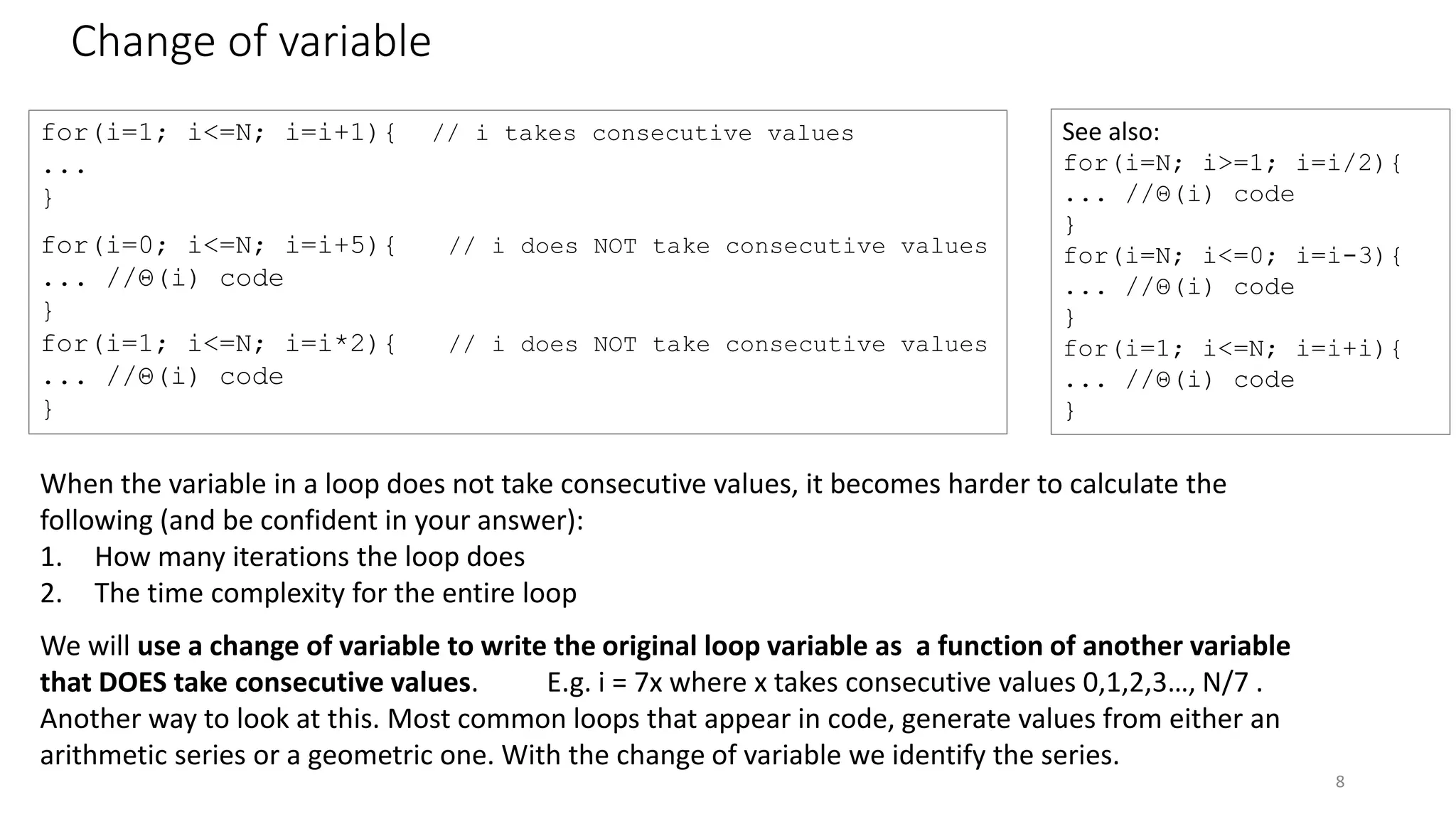
• Change of variable
– needed if loop variable does not take consecutive
values
• Summation – must be used if TC1iter depends on
loop variable. (dependent case, e.g. TC1iter (j)=j2 )
• Summation method (the general method) handles all
loop cases correct.
7
TC - general
Change of variable
8
for(i=1; i<=N; i=i+1){ // i takes consecutive values
...
}
for(i=0; i<=N; i=i+5){ // i does NOT take consecutive values
... //Θ(i) code
}
for(i=1; i<=N; i=i*2){ // i does NOT take consecutive values
... //Θ(i) code
}
See also:
for(i=N; i>=1; i=i/2){
... //Θ(i) code
}
for(i=N; i<=0; i=i-3){
... //Θ(i) code
}
for(i=1; i<=N; i=i+i){
... //Θ(i) code
}
When the variable in a loop does not take consecutive values, it becomes harder to calculate the
following (and be confident in your answer):
1. How many iterations the loop does
2. The time complexity for the entire loop
We will use a change of variable to write the original loop variable as a function of another variable
that DOES take consecutive values. E.g. i = 7x where x takes consecutive values 0,1,2,3…, N/7 .
Another way to look at this. Most common loops that appear in code, generate values from either an
arithmetic series or a geometric one. With the change of variable we identify the series.
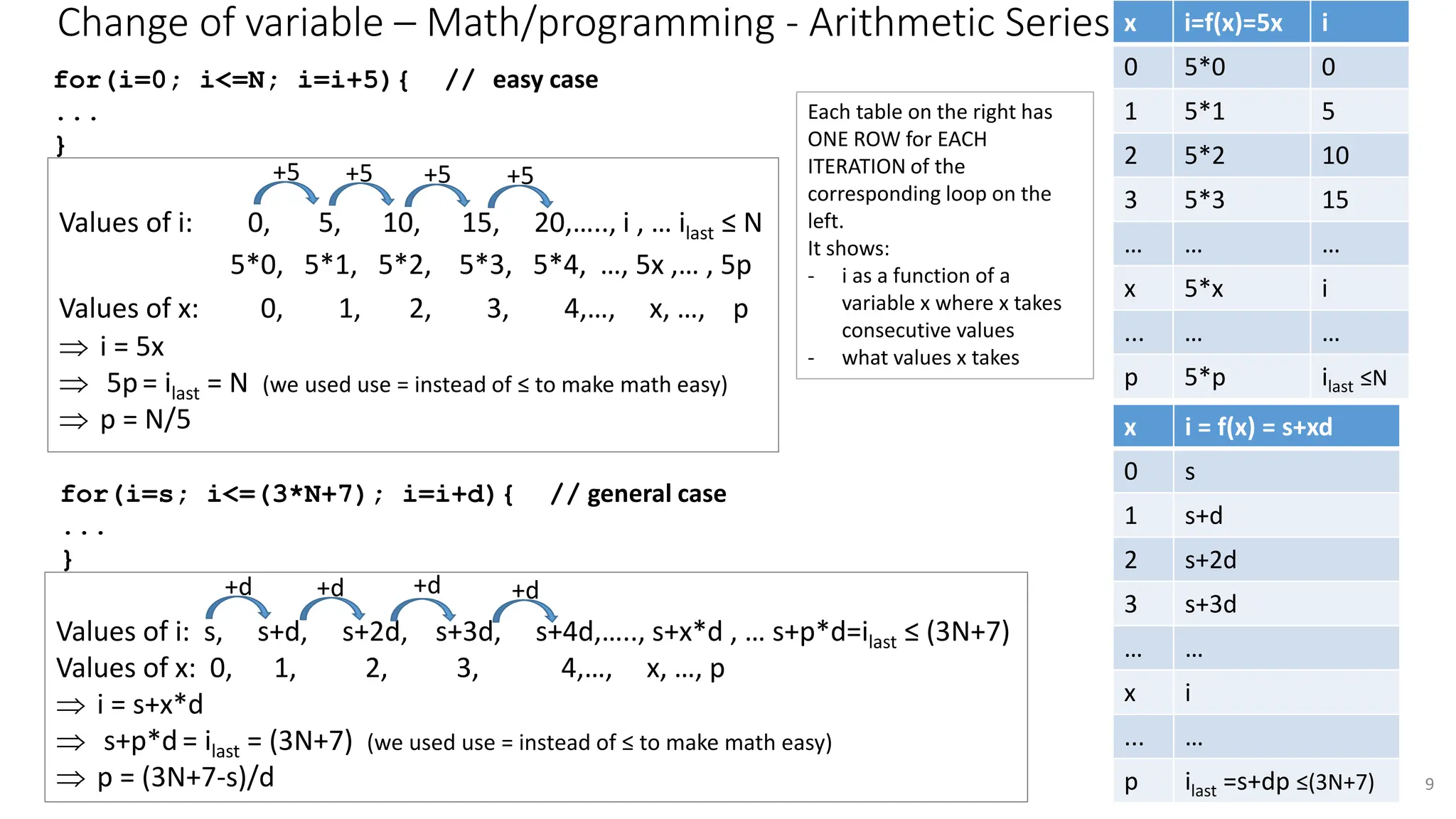
Change of variable – Math/programming - Arithmetic Series
9
for(i=s; i<=(3*N+7); i=i+d){ // general case
...
}
Values of i: s, s+d, s+2d, s+3d, s+4d,….., s+x*d , … s+p*d=ilast ≤ (3N+7)
Values of x: 0, 1, 2, 3, 4,…, x, …, p
 i = s+x*d
 s+p*d = ilast = (3N+7) (we used use = instead of ≤ to make math easy)
 p = (3N+7-s)/d
+d +d +d +d
x i = f(x) = s+xd
0 s
1 s+d
2 s+2d
3 s+3d
… …
x i
... …
p ilast =s+dp ≤(3N+7)
Values of i: 0, 5, 10, 15, 20,….., i , … ilast ≤ N
5*0, 5*1, 5*2, 5*3, 5*4, …, 5x ,… , 5p
Values of x: 0, 1, 2, 3, 4,…, x, …, p
 i = 5x
 5p= ilast = N (we used use = instead of ≤ to make math easy)
 p = N/5
+5 +5 +5 +5
for(i=0; i<=N; i=i+5){ // easy case
...
}
x i=f(x)=5x i
0 5*0 0
1 5*1 5
2 5*2 10
3 5*3 15
… … …
x 5*x i
... … …
p 5*p ilast ≤N
Each table on the right has
ONE ROW for EACH
ITERATION of the
corresponding loop on the
left.
It shows:
- i as a function of a
variable x where x takes
consecutive values
- what values x takes
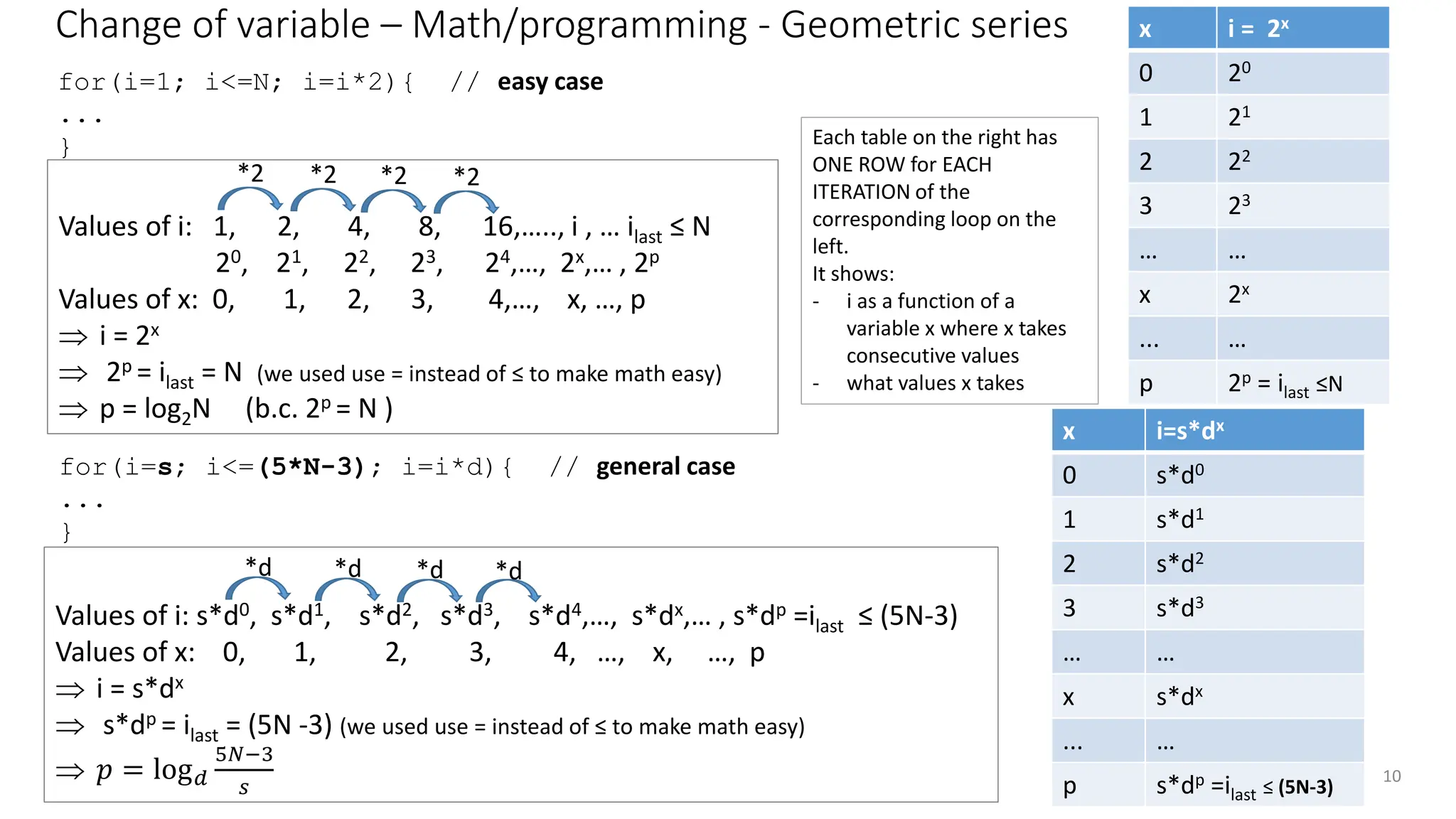
Change of variable – Math/programming - Geometric series
10
Values of i: s*d0, s*d1, s*d2, s*d3, s*d4,…, s*dx,… , s*dp =ilast ≤ (5N-3)
Values of x: 0, 1, 2, 3, 4, …, x, …, p
 i = s*dx
 s*dp = ilast = (5N -3) (we used use = instead of ≤ to make math easy)
 𝑝 = log𝑑
5𝑁−3
𝑠
for(i=s; i<=(5*N-3); i=i*d){ // general case
...
}
*d *d *d *d
x i=s*dx
0 s*d0
1 s*d1
2 s*d2
3 s*d3
… …
x s*dx
... …
p s*dp =ilast ≤ (5N-3)
Values of i: 1, 2, 4, 8, 16,….., i , … ilast ≤ N
20, 21, 22, 23, 24,…, 2x,… , 2p
Values of x: 0, 1, 2, 3, 4,…, x, …, p
 i = 2x
 2p = ilast = N (we used use = instead of ≤ to make math easy)
 p = log2N (b.c. 2p = N )
*2 *2 *2 *2
for(i=1; i<=N; i=i*2){ // easy case
...
}
x i = 2x
0 20
1 21
2 22
3 23
… …
x 2x
... …
p 2p = ilast ≤N
Each table on the right has
ONE ROW for EACH
ITERATION of the
corresponding loop on the
left.
It shows:
- i as a function of a
variable x where x takes
consecutive values
- what values x takes
The Four Cases of
Time Complexity Calculations for Loops
(or use summation always and no special cases)
11
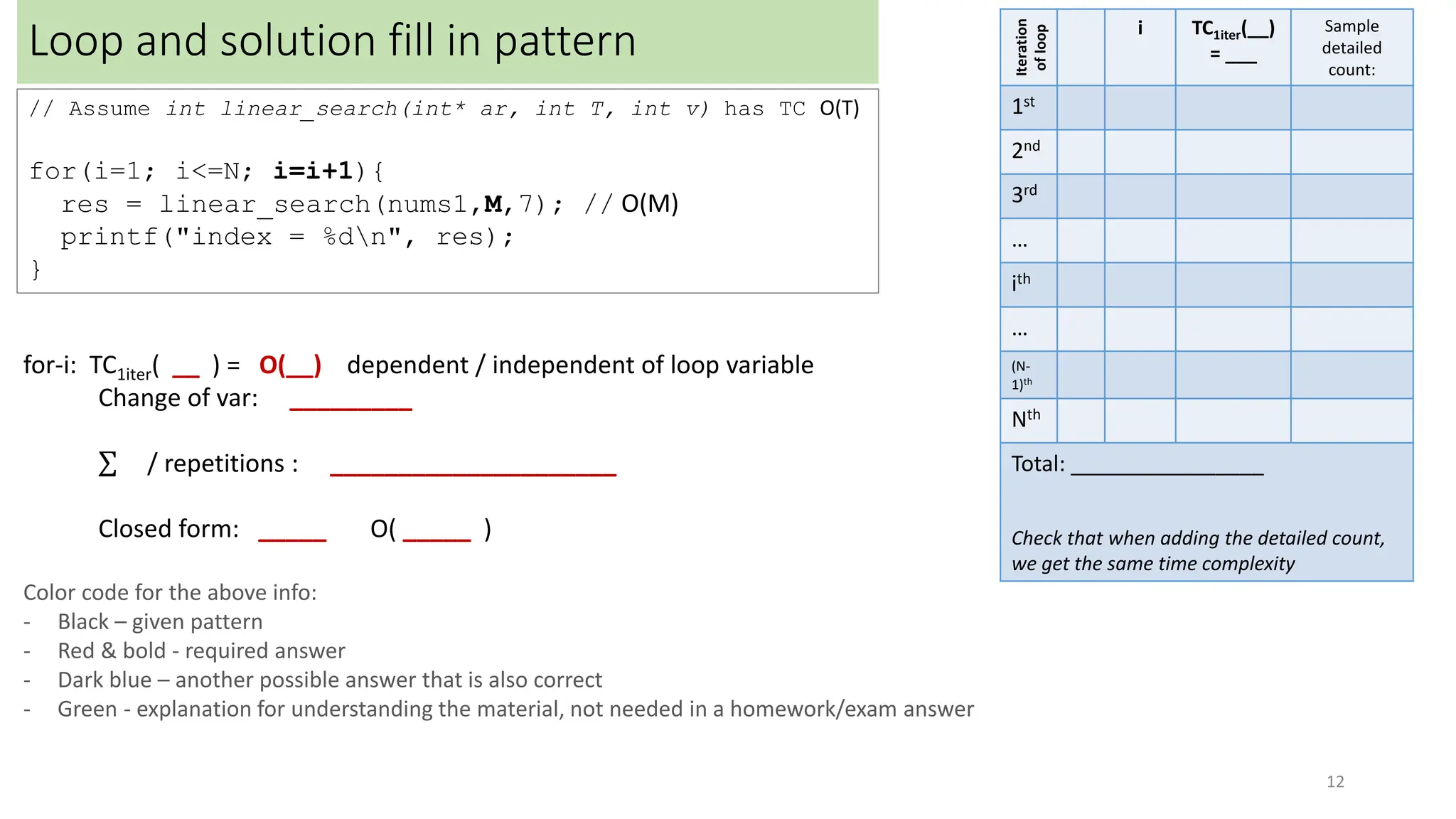
Loop and solution fill in pattern
12
// Assume int linear_search(int* ar, int T, int v) has TC O(T)
for(i=1; i<=N; i=i+1){
res = linear_search(nums1,M,7); // O(M)
printf("index = %dn", res);
}
Iteration
of
loop
i TC1iter(__)
= ___
Sample
detailed
count:
1st
2nd
3rd
…
ith
…
(N-
1)th
Nth
Total: ________________
Check that when adding the detailed count,
we get the same time complexity
for-i: TC1iter( __ ) = O(__) dependent / independent of loop variable
Change of var: _________
σ / repetitions : _____________________
Closed form: _____ O( _____ )
Color code for the above info:
- Black – given pattern
- Red & bold - required answer
- Dark blue – another possible answer that is also correct
- Green - explanation for understanding the material, not needed in a homework/exam answer
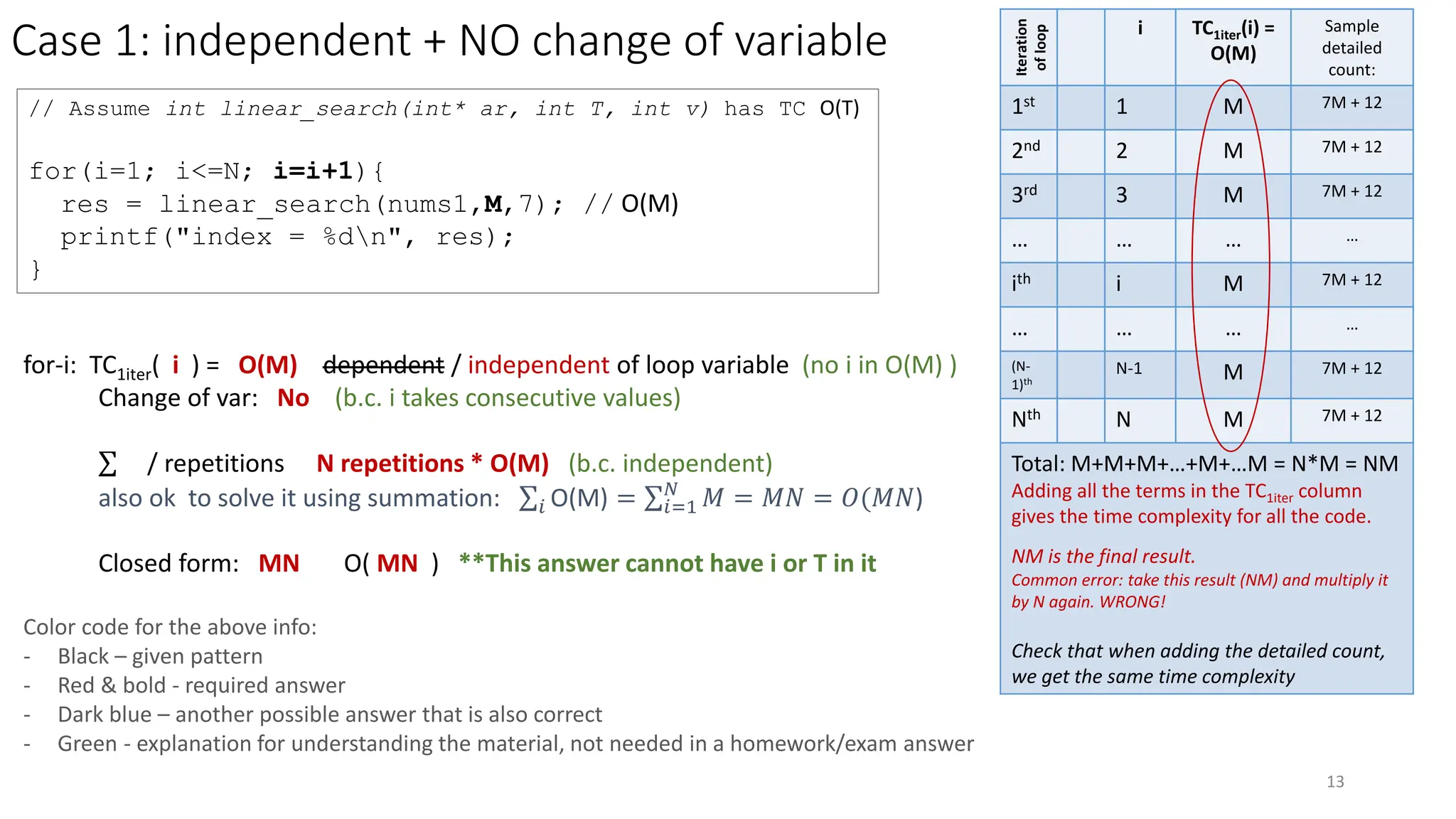
Case 1: independent + NO change of variable
13
// Assume int linear_search(int* ar, int T, int v) has TC O(T)
for(i=1; i<=N; i=i+1){
res = linear_search(nums1,M,7); // O(M)
printf("index = %dn", res);
}
Iteration
of
loop
i TC1iter(i) =
O(M)
Sample
detailed
count:
1st 1 M 7M + 12
2nd 2 M 7M + 12
3rd 3 M 7M + 12
… … … …
ith i M 7M + 12
… … … …
(N-
1)th
N-1 M 7M + 12
Nth N M 7M + 12
Total: M+M+M+…+M+…M = N*M = NM
Adding all the terms in the TC1iter column
gives the time complexity for all the code.
NM is the final result.
Common error: take this result (NM) and multiply it
by N again. WRONG!
Check that when adding the detailed count,
we get the same time complexity
for-i: TC1iter( i ) = O(M) dependent / independent of loop variable (no i in O(M) )
Change of var: No (b.c. i takes consecutive values)
σ / repetitions N repetitions * O(M) (b.c. independent)
also ok to solve it using summation: σ𝑖 O(M) = σ𝑖=1
𝑁
𝑀 = 𝑀𝑁 = 𝑂(𝑀𝑁)
Closed form: MN O( MN ) **This answer cannot have i or T in it
Color code for the above info:
- Black – given pattern
- Red & bold - required answer
- Dark blue – another possible answer that is also correct
- Green - explanation for understanding the material, not needed in a homework/exam answer
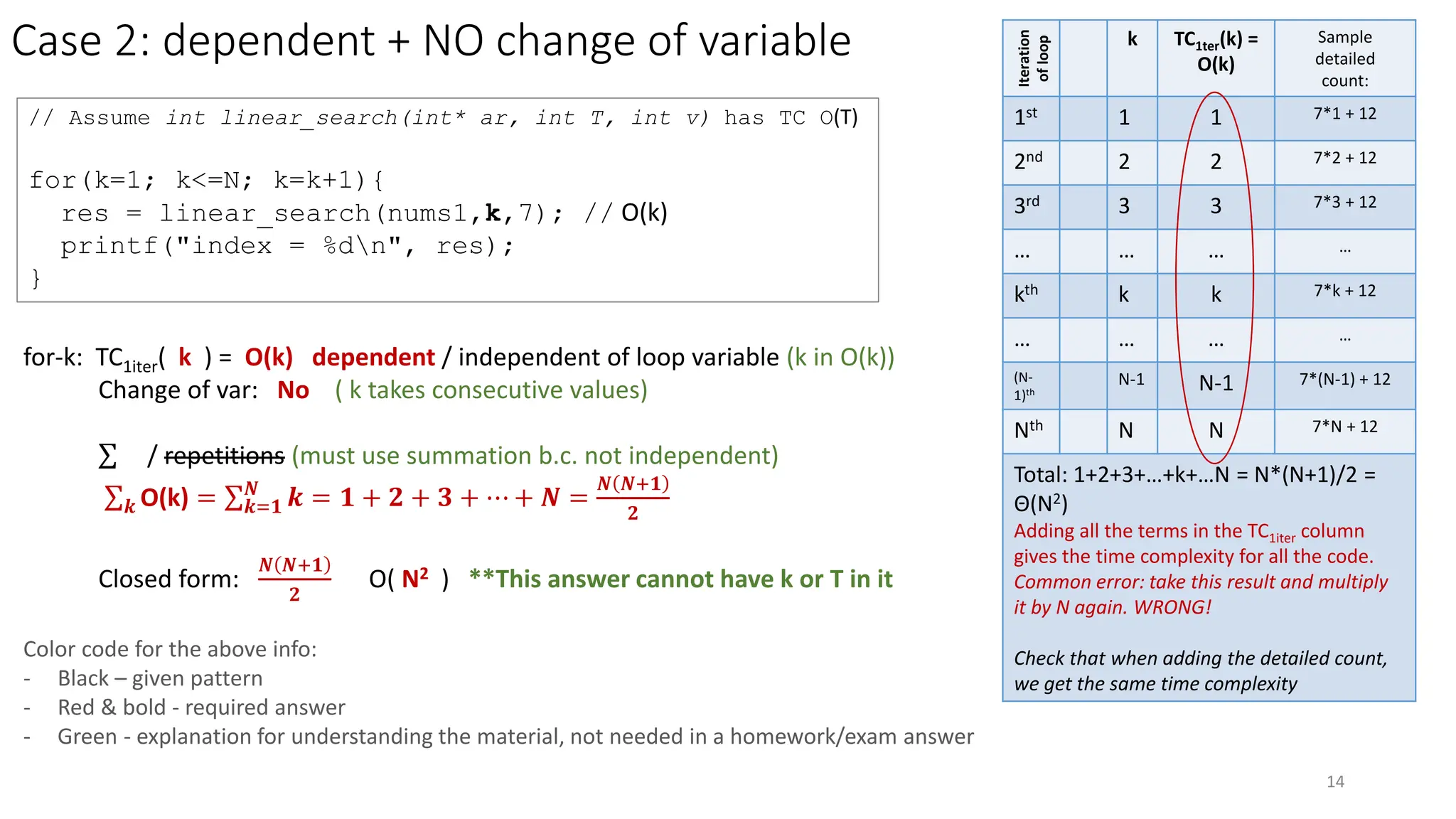
Case 2: dependent + NO change of variable
14
// Assume int linear_search(int* ar, int T, int v) has TC O(T)
for(k=1; k<=N; k=k+1){
res = linear_search(nums1,k,7); // O(k)
printf("index = %dn", res);
}
Iteration
of
loop
k TC1ter(k) =
O(k)
Sample
detailed
count:
1st 1 1 7*1 + 12
2nd 2 2 7*2 + 12
3rd 3 3 7*3 + 12
… … … …
kth k k 7*k + 12
… … … …
(N-
1)th
N-1 N-1 7*(N-1) + 12
Nth N N 7*N + 12
Total: 1+2+3+…+k+…N = N*(N+1)/2 =
Θ(N2)
Adding all the terms in the TC1iter column
gives the time complexity for all the code.
Common error: take this result and multiply
it by N again. WRONG!
Check that when adding the detailed count,
we get the same time complexity
for-k: TC1iter( k ) = O(k) dependent / independent of loop variable (k in O(k))
Change of var: No ( k takes consecutive values)
σ / repetitions (must use summation b.c. not independent)
σ𝒌 O(k) = σ𝒌=𝟏
𝑵
𝒌 = 𝟏 + 𝟐 + 𝟑 + ⋯ + 𝑵 =
𝑵 𝑵+𝟏
𝟐
Closed form:
𝑵 𝑵+𝟏
𝟐
O( N2 ) **This answer cannot have k or T in it
Color code for the above info:
- Black – given pattern
- Red & bold - required answer
- Green - explanation for understanding the material, not needed in a homework/exam answer
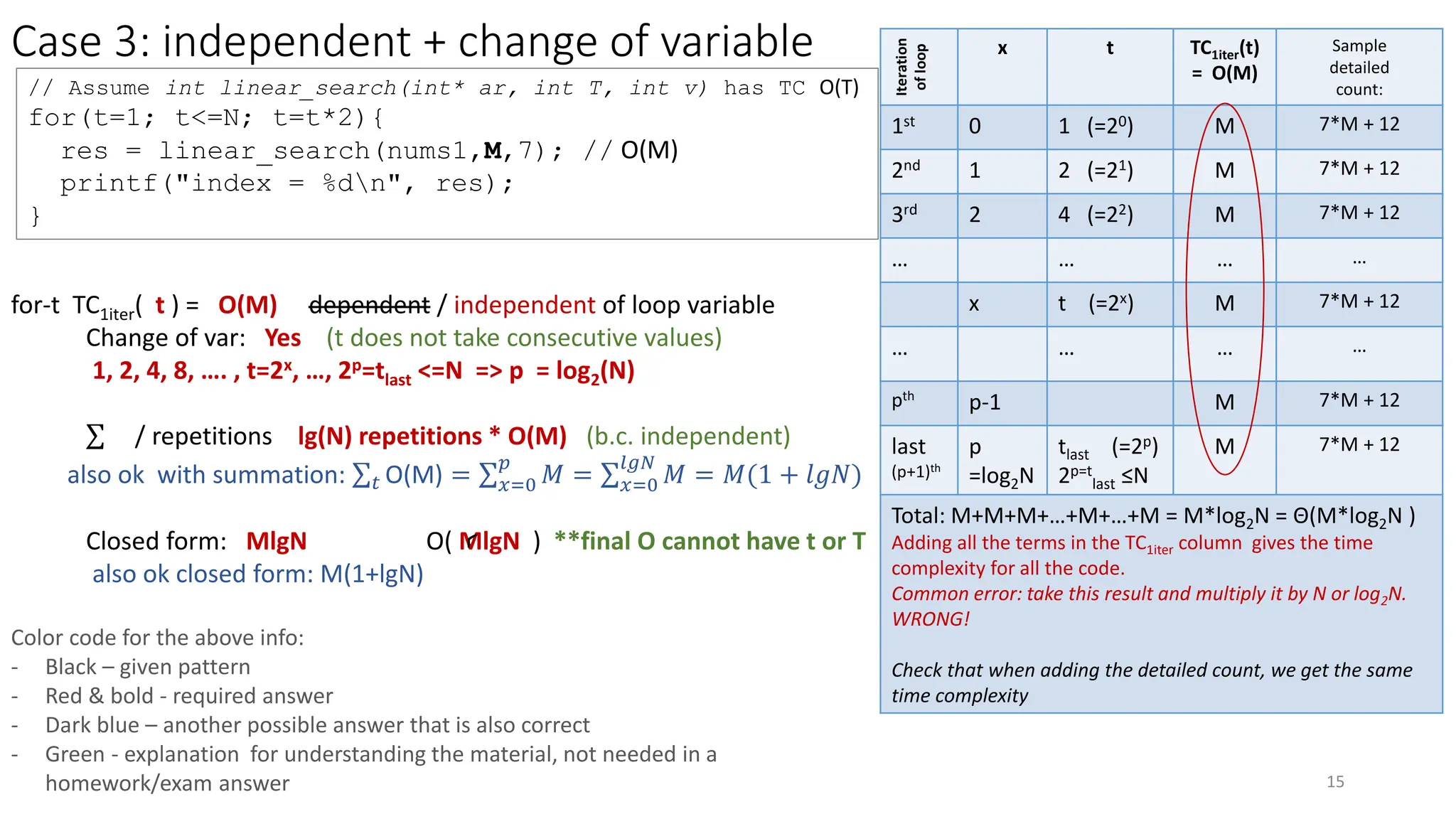
Case 3: independent + change of variable
15
// Assume int linear_search(int* ar, int T, int v) has TC O(T)
for(t=1; t<=N; t=t*2){
res = linear_search(nums1,M,7); // O(M)
printf("index = %dn", res);
}
Iteration
of
loop
x t TC1iter(t)
= O(M)
Sample
detailed
count:
1st 0 1 (=20) M 7*M + 12
2nd 1 2 (=21) M 7*M + 12
3rd 2 4 (=22) M 7*M + 12
… … … …
x t (=2x) M 7*M + 12
… … … …
pth
p-1 M 7*M + 12
last
(p+1)th
p
=log2N
tlast (=2p)
2p=t
last ≤N
M 7*M + 12
Total: M+M+M+…+M+…+M = M*log2N = Θ(M*log2N )
Adding all the terms in the TC1iter column gives the time
complexity for all the code.
Common error: take this result and multiply it by N or log2N.
WRONG!
Check that when adding the detailed count, we get the same
time complexity
for-t TC1iter( t ) = O(M) dependent / independent of loop variable
Change of var: Yes (t does not take consecutive values)
1, 2, 4, 8, …. , t=2x, …, 2p=tlast <=N => p = log2(N)
σ / repetitions lg(N) repetitions * O(M) (b.c. independent)
also ok with summation: σ𝑡 O(M) = σ𝑥=0
𝑝
𝑀 = σ𝑥=0
𝑙𝑔𝑁
𝑀 = 𝑀(1 + 𝑙𝑔𝑁)
Closed form: MlgN O( MlgN ) **final O cannot have t or T
also ok closed form: M(1+lgN)
Color code for the above info:
- Black – given pattern
- Red & bold - required answer
- Dark blue – another possible answer that is also correct
- Green - explanation for understanding the material, not needed in a
homework/exam answer
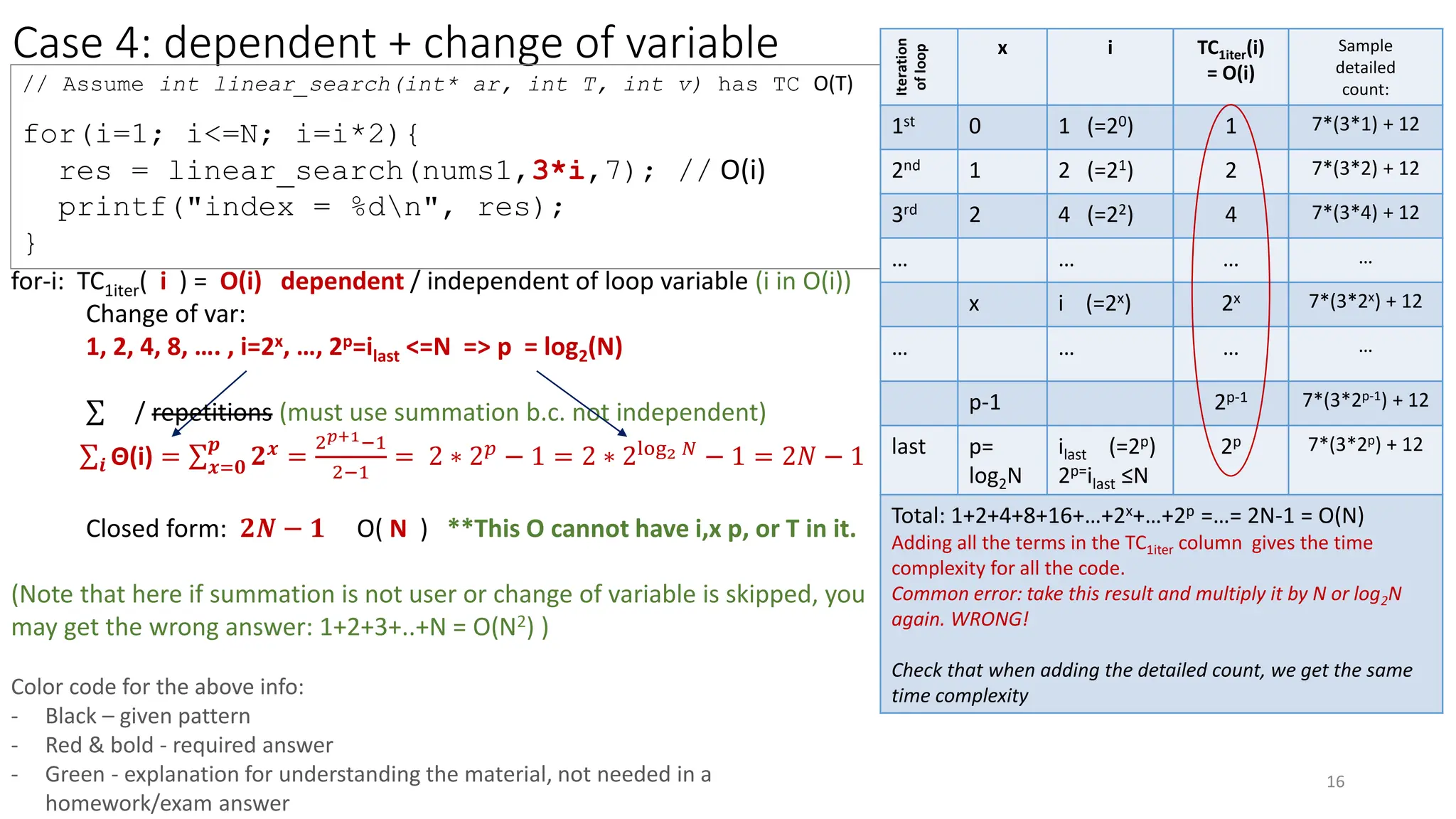
Case 4: dependent + change of variable
16
// Assume int linear_search(int* ar, int T, int v) has TC O(T)
for(i=1; i<=N; i=i*2){
res = linear_search(nums1,3*i,7); // O(i)
printf("index = %dn", res);
}
Iteration
of
loop
x i TC1iter(i)
= O(i)
Sample
detailed
count:
1st 0 1 (=20) 1 7*(3*1) + 12
2nd 1 2 (=21) 2 7*(3*2) + 12
3rd 2 4 (=22) 4 7*(3*4) + 12
… … … …
x i (=2x) 2x 7*(3*2x) + 12
… … … …
p-1 2p-1 7*(3*2p-1) + 12
last p=
log2N
ilast (=2p)
2p=ilast ≤N
2p 7*(3*2p) + 12
Total: 1+2+4+8+16+…+2x+…+2p =…= 2N-1 = O(N)
Adding all the terms in the TC1iter column gives the time
complexity for all the code.
Common error: take this result and multiply it by N or log2N
again. WRONG!
Check that when adding the detailed count, we get the same
time complexity
for-i: TC1iter( i ) = O(i) dependent / independent of loop variable (i in O(i))
Change of var:
1, 2, 4, 8, …. , i=2x, …, 2p=ilast <=N => p = log2(N)
σ / repetitions (must use summation b.c. not independent)
σ𝒊 Θ(i) = σ𝒙=𝟎
𝒑
𝟐𝒙
=
2𝑝+1−1
2−1
= 2 ∗ 2𝑝
− 1 = 2 ∗ 2log2 𝑁
− 1 = 2𝑁 − 1
Closed form: 𝟐𝑵 − 𝟏 O( N ) **This O cannot have i,x p, or T in it.
(Note that here if summation is not user or change of variable is skipped, you
may get the wrong answer: 1+2+3+..+N = O(N2) )
Color code for the above info:
- Black – given pattern
- Red & bold - required answer
- Green - explanation for understanding the material, not needed in a
homework/exam answer
Summary
17
for(i=1; i<=N; i=i+1){
res = linear_search(nums1,M,7); // O(M)
printf("index = %dn", res);
}
TC1iter(i) = O(M), independent of i (=> can use repetitions)
change of var : NO (i takes consecutive values)
Repetitions: 𝑁 ∗ 𝑂 𝑀 = 𝑂(𝑀𝑁)
(Solution with summation: σ𝑖 𝑂(M) = σ𝑖=1
𝑁
𝑂(𝑀) = 𝑁 ∗ 𝑂 𝑀 = 𝑂(𝑀𝑁)
for(k=1; k<=N; k=k+1){
res = linear_search(nums1,k,7); ); // O(k)
printf("index = %dn", res);
}
TC1iter(k)= O(k), dependent of k (=> must use summation)
change of var : NO (k takes consecutive values)
Summation: σ𝑘 𝑂(k) = σ𝑘=1
𝑁
𝑂(𝑘) = σ𝑘=1
𝑁
𝑘 =
𝑁(𝑁+1)
2
=
𝑂(𝑁2)
for(t=1; t<=N; t=t*5){
res = linear_search(nums1,M,7); // O(M)
printf("index = %dn", res);
}
TC1iter(t)= O(M), independent of t (=> can use repetitions)
change of var : YES (bc t does NOT take consecutive values)
Values of t: 1,5,25, 125, … , i=5x, … , 5p= ilast<=N => p = log5N
Repetitions : p = log5N => O(𝑀𝑝) = 𝑂(𝑀 (log5 𝑁))
(Solution with summation:
σ𝑡 O(M) = σ𝑥=0
𝑝
𝑂(𝑀) = 𝑂(𝑀𝑝) = 𝑂(𝑀 (log5 𝑁)) )
for(i=1; i<=N; i=i*5){
res = linear_search(nums1,i,7); // O(i)
printf("index = %dn", res);
}
TC1iter(i)= O(i), dependent of i (=> must use summation)
Change of var: YES (i does NOT take consecutive values) :
Values of i: 1,5, 25, 125, … , i=5e, … , 5p= ilast<=N => p = log5N
Summation : σ𝑖 𝑂(i) = σ𝑖 i = σ𝑒=0
𝑝
5𝑒 =
5𝑝+1−1
5−1
=
5∗5𝑝−1
4
=
𝑂 5𝑝
= 𝑂 5log5 𝑁
= 𝑂 𝑁
// Assume that the function linear_search(int num1[], int S, int val) has time complexity O(S)
Good example: change of variable with i2 in TC1iter
// assume that the time complexity of foo(int t, int M) is O(t2M)
for(i=0; i<N; i=i+4)
foo(i,M);
replace i2 with (4x)2
18
for-i: TC1iter(i) = O(i2M) Dependent ()
change of var. i: 0,4, 8, 12, … i=4x, ilast = 4p = N => p = N/4
σ𝑖 𝑂(𝑖2𝑀) = σ𝑥=0
𝑁/4
[(4𝑥)2𝑀] = 16𝑀 σ𝑥=0
𝑁/4
𝑥2 = 16𝑀
𝑵
𝟒
(
𝑵
𝟒
+𝟏)(𝟐
𝑵
𝟒
+𝟏)
𝟔
= 𝑂(𝑁3𝑀)
𝑂(𝑁3𝑀)
In the call to foo, i was passed for t =>
use O(i2M), NOT O(t2M)
෍
𝑘=1
𝑁
𝑘2
=
𝑁(𝑁 + 1)(2𝑁 + 1)
6
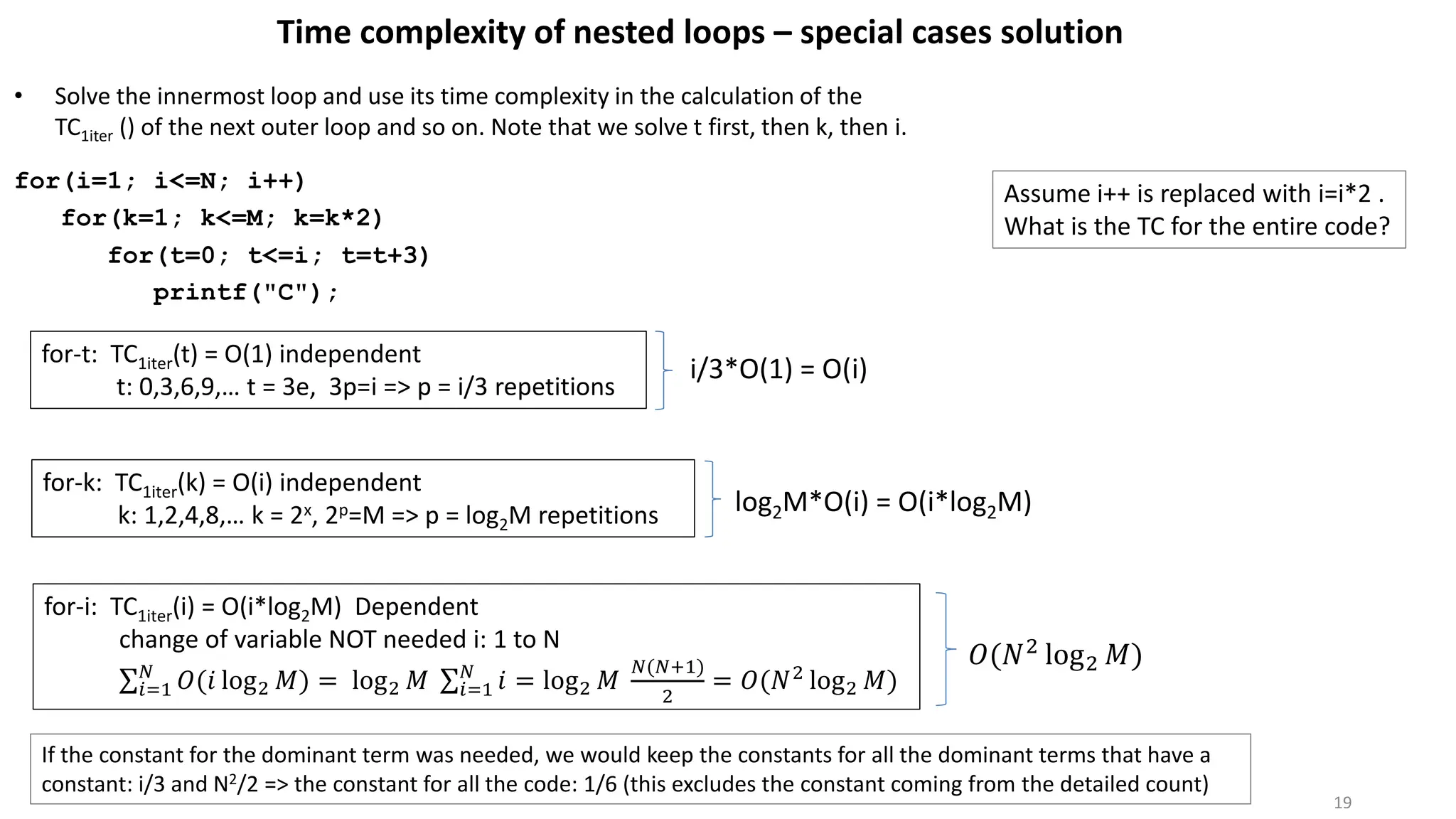
Time complexity of nested loops – special cases solution
• Solve the innermost loop and use its time complexity in the calculation of the
TC1iter () of the next outer loop and so on. Note that we solve t first, then k, then i.
for(i=1; i<=N; i++)
for(k=1; k<=M; k=k*2)
for(t=0; t<=i; t=t+3)
printf("C");
for-t: TC1iter(t) = O(1) independent
t: 0,3,6,9,… t = 3e, 3p=i => p = i/3 repetitions
19
i/3*O(1) = O(i)
for-k: TC1iter(k) = O(i) independent
k: 1,2,4,8,… k = 2x, 2p=M => p = log2M repetitions log2M*O(i) = O(i*log2M)
for-i: TC1iter(i) = O(i*log2M) Dependent
change of variable NOT needed i: 1 to N
σ𝑖=1
𝑁
𝑂(𝑖 log2 𝑀) = log2 𝑀 σ𝑖=1
𝑁
𝑖 = log2 𝑀
𝑁(𝑁+1)
2
= 𝑂(𝑁2 log2 𝑀)
𝑂(𝑁2 log2 𝑀)
If the constant for the dominant term was needed, we would keep the constants for all the dominant terms that have a
constant: i/3 and N2/2 => the constant for all the code: 1/6 (this excludes the constant coming from the detailed count)
Assume i++ is replaced with i=i*2 .
What is the TC for the entire code?
Time Complexity of Sequential Loops
// Write the Θ (Theta) time complexity
for (i=left; i<=right; i++)
printf("%d, ", A[i]);
for (i=0; i<p; i++) {
for (k=0; k<r; k++)
printf("B");
}
20
The actual size of the data being processed by the first loop is right-left+1.
In applications (e.g. binary search or merge sort) this quantity often
results in a fraction (e.g. half) of the amount of data in the previous
iteration.
Θ(M)
where M = right-left+1
Θ(pr)
Θ(M+pr)
where M = right-left+1
If multiple variable appear in the time complexity, there may be more
than one dominant term.
Example 1 the time complexity of the above code
Example 2: 27n4m + 6n3 + 7nm2 + 100 = Θ ( n4m + nm2 )
Insertion Sort Time Complexity
21
‘Total’ instructions in worst case:
T(N) = (N-1) + (N-2) + … 2 + 1 =
= [N * (N-1)]/2 -> O(N2)
Note that the N2 came from the summation, NOT because
‘there is an N in the inner loop’ (NOT because N * N).
i
Inner loop time complexity:
Best : Worst: Average:
1 i i/2
1 1 1 1
2 1 2 2/2
… …
N-2 1 N-2 (N-2)/2
N-1 1 N-1 (N-1)/2
Total (N-1) [N * (N-1)]/2 [N * (N-1)]/4
Order of
magnitude
O(N) O(N2) O(N2)
Data that
produces it.
Sorted Sorted in
reverse order
Random data => O(N2)
O will be explained in detail later. It says that
the algorithm take at most order of N2.
See the Khan Academy for a discussion on
the use of O(N2):
https://www.khanacademy.org/computing/c
omputer-science/algorithms/insertion-
sort/a/insertion-sort
Insertion sort is adaptive
void insertion_sort(int A[],int N){
int i,k,key;
for (i=1; i<N; i++)
key = A[i];
// insert A[i] in the
// sorted sequence A[0…i-1]
k = i-1;
while (k>=0) and (A[k]>key)
A[k+1] = A[k];
k = k–1;
}
A[k+1] = key;
}
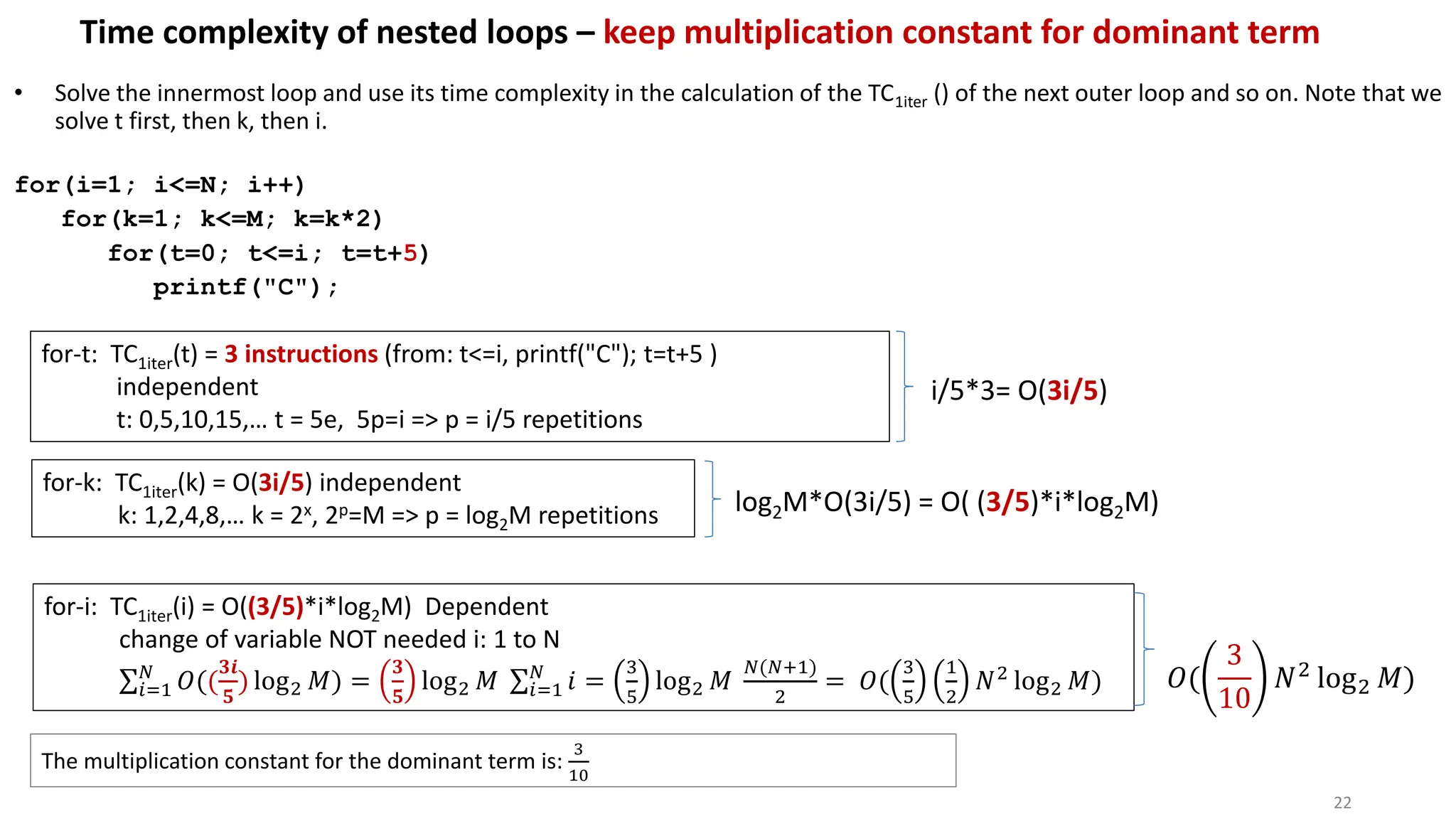
Time complexity of nested loops – keep multiplication constant for dominant term
• Solve the innermost loop and use its time complexity in the calculation of the TC1iter () of the next outer loop and so on. Note that we
solve t first, then k, then i.
for(i=1; i<=N; i++)
for(k=1; k<=M; k=k*2)
for(t=0; t<=i; t=t+5)
printf("C");
for-t: TC1iter(t) = 3 instructions (from: t<=i, printf("C"); t=t+5 )
independent
t: 0,5,10,15,… t = 5e, 5p=i => p = i/5 repetitions
22
i/5*3= O(3i/5)
for-k: TC1iter(k) = O(3i/5) independent
k: 1,2,4,8,… k = 2x, 2p=M => p = log2M repetitions log2M*O(3i/5) = O( (3/5)*i*log2M)
for-i: TC1iter(i) = O((3/5)*i*log2M) Dependent
change of variable NOT needed i: 1 to N
σ𝑖=1
𝑁
𝑂((
𝟑𝒊
𝟓
) log2 𝑀) =
𝟑
𝟓
log2 𝑀 σ𝑖=1
𝑁
𝑖 =
3
5
log2 𝑀
𝑁(𝑁+1)
2
= 𝑂(
3
5
1
2
𝑁2 log2 𝑀) 𝑂(
3
10
𝑁2 log2 𝑀)
The multiplication constant for the dominant term is:
3
10

time_complexity_list_02_04_2024_22_pages.pdf

  • 1.
    Time complexity ofloops Alexandra Stefan 2/8/2023
  • 2.
    𝑎𝑝 = 𝑁⇒ 𝑝 = log𝑎 𝑁 𝑃𝑟𝑜𝑜𝑓: 𝑎𝑝𝑝𝑙𝑦 log𝑎 𝑜𝑛 𝑏𝑜𝑡ℎ 𝑠𝑖𝑑𝑒𝑠: log𝑎(𝑎𝑝) = log𝑎 𝑁 ⇒ 𝑝 = log𝑎 𝑁 Other useful equalities with log: 𝑎log𝑎 𝑁 = 𝑁, log𝑎(𝑎𝑝 ) = 𝑝 𝒂𝐥𝐨𝐠𝒃 𝑵 = 𝑵𝐥𝐨𝐠𝒃 𝒂 log𝑎 𝑁 = log𝑏 𝑁 log𝑏 𝑎 (Change of log basis) The closed form is the solution for the summation. It is an expression that is equivalent to the summation, but does NOT have any σ in it . We need the closed form in order to find O for that summation. ෍ 𝑘=1 𝑁 𝑘 = 1 + 2 + 3 + 4 + ⋯ + 𝑁 − 1 + 𝑁 = 𝑵(𝑵 + 𝟏) 𝟐 = 𝑂(𝑁2 ) ෍ 𝑘=1 𝑁 𝑘2 = 1 + 22 + 32 + 42 + ⋯ + +𝑁2 = 𝑵(𝑵 + 𝟏)(𝟐𝑵 + 𝟏) 𝟔 = 𝑂 𝑁3 ෍ 𝑘=1 𝑁 𝑎𝑘 = 𝑎 + 𝑎2 + 𝑎3 + 𝑎4 + ⋯ + 𝑎𝑁 = 𝒂𝑵+𝟏 − 𝟏 𝒂 − 𝟏 = 𝑂 𝑎𝑁 𝑤ℎ𝑒𝑛 𝑎 > 1; 𝑓𝑜𝑟 𝑎 < 1 𝑖𝑡 𝑖𝑠 𝑂(1) 2 Review log and exponent and closed form (solutions) for common summations
  • 3.
    Techniques for solvingsummations (useful for O or dominant term calculations) Note that some of these will NOT compute the EXACT solution for the summation Terminology: summation term, summation variable. E.g. in σ𝑘=1 𝑁 𝑘𝑆 , (kS)-summation term, k –summation variable Independent case (term in summation does not have the variable of the summation). ෍ 𝒌=1 𝑵 𝑺 = 𝑆 + 𝑆 + 𝑆 + ⋯ . +𝑆 = 𝑵𝑺 (= 𝑆 ෍ 𝑘=1 𝑁 1 = 𝑆𝑁) Pull constant in front of summation: σ𝑘=1 𝑁 (𝑆𝑘) = 1𝑆 + 2𝑆 + 3𝑆 … + 𝑁𝑆 = 𝑆 σ𝑘=1 𝑁 𝑘 = 𝑆 𝑁(𝑁+1) 2 = 𝑂(𝑆𝑁2) Break summation in two summations ෍ 𝑘=1 𝑁 (𝑘𝑆 + 𝑘2 ) = ෍ 𝑘=1 𝑁 𝑘𝑆 + ෍ 𝑘=1 𝑁 𝑘2 = 𝑆 ෍ 𝑘=1 𝑁 𝑘 + ෍ 𝑘=1 𝑁 𝑘2 = S 𝑁(𝑁 + 1) 2 + 𝑁(𝑁 + 1)(2𝑁 + 1) 6 = 𝑂(𝑆𝑁2 + 𝑁3 ) 𝐷𝑟𝑜𝑝 𝑙𝑜𝑤𝑒𝑟 𝑜𝑟𝑑𝑒𝑟 𝑡𝑒𝑟𝑚 𝑓𝑟𝑜𝑚 𝑠𝑢𝑚𝑚𝑎𝑡𝑖𝑜𝑛 𝑡𝑒𝑟𝑚. 𝐸. 𝑔. 10𝑘 𝑖𝑠 𝑙𝑜𝑤𝑒𝑟 𝑜𝑟𝑑𝑒𝑟 𝑐𝑜𝑚𝑝𝑎𝑟𝑒𝑑 𝑡𝑜 𝑘2: ෍ 𝑘=1 𝑁 (10𝑘 + 𝑘2 ) = ෍ 𝑘=1 𝑁 𝑘2 = 𝑁(𝑁 + 1)(2𝑁 + 1) 6 = 𝑂 𝑁3 𝑈𝑠𝑒 𝑎𝑝𝑝𝑟𝑜𝑥𝑖𝑚𝑎𝑡𝑖𝑜𝑛 𝑏𝑦 𝑖𝑛𝑡𝑒𝑔𝑟𝑎𝑙𝑠 𝑓𝑜𝑟 𝑖𝑛𝑐𝑟𝑒𝑎𝑠𝑖𝑛𝑔 𝑜𝑟 𝑑𝑒𝑐𝑟𝑒𝑎𝑠𝑖𝑛𝑔 𝑓 𝑘 − 𝑅𝐸𝑀𝑂𝑉𝐸𝐷 (𝑛𝑜𝑡 𝑟𝑒𝑞𝑢𝑖𝑟𝑒𝑑) ෍ 𝑆 𝑁 𝑓(𝑘) = Θ 𝐹 𝑁 − 𝐹 𝑆 (𝑤ℎ𝑒𝑟𝑒 𝐹 𝑖𝑠 𝑡ℎ𝑒 𝑎𝑛𝑡𝑖𝑑𝑒𝑟𝑖𝑣𝑎𝑡𝑖𝑣𝑒 𝑜𝑓 𝑓) 3 Review
  • 4.
    #include <stdio.h> int linear_search(intar[], int S, int val); int main(){ char fname[100]; int mx_size, N, i, M, val; FILE *fp; printf("Enter the filename: "); scanf("%s", fname); fp =fopen(fname, "r"); if (fp == NULL){ printf("File could not be opened.n"); return 1; } fscanf(fp, "%d %d", &mx_size, &N); int nums1[mx_size]; //int* nums1 = malloc(mx_size * sizeof(int)); // read from file and populate array for (i = 0; i < N; i++) { fscanf(fp, "%d ", &nums1[i]); } int found = linear_search(nums1, N, 67); printf("nreturned index:%dn", found); // read the second line of numbers from file and search for them in nums1 fscanf(fp, "%d", &M); for(i=0; i<M; i++){ fscanf(fp, "%d", &val); found = linear_search(nums1, N, val); printf("nreturned index:%dn", found); } fclose(fp); return (EXIT_SUCCESS); } // Assumes array ar has S elements. int linear_search(int ar[], int S, int val){ printf("n Searching for %d ...n",val); for(int i=0; i<S; i++) { printf("%4d|", ar[i]); if ( ar[i] == val ) return i; } printf("n"); return -1; } 4 30 5 3 7 10 19 20 10 67 20 -3 9 7 1 22 13 8 6 Sample data file 1: 10 7 5 10 13 20 26 30 37 4 67 22 -3 10 Sample data file 2: // Assumes array nums has at least T elements. int count(int nums[], int T, int V){ int count = 0; for(int k=0; k<T; k++) { if ( nums[k] == V ) count++; } return count; }
  • 5.
    Time Complexity forFunction Definitions and Function Calls TC for a function DEFINITION can ONLY depend on the data passed as argument E.g. for int count(int nums[], int T, int V){ … } In the TC expression, O, we can only have: • variable names that are parameters • E.g. O(T+V) is ok because both S and V are parameters. • E.g. O(N) is wrong because there is no N in the list of parameters • variables that represent a number (typically integer) • E.g. size of the array, size of a data record, max value in an array • It is wrong to say O(nums2) because nums is an entire array. What is nums2? • Remember that TC in the end should give a quantity. • DEFINED “new” variables • I can use names that are not among the function parameters, but I have clearly define them with respect to the input data. E.g. I can say “O(N) where N is the number of elements in ar”. Here N is not a parameter of count, but I have defined what N represents with respect to nums, and N is an integer. Solve the examples with strings from the next page The TC for a function CALL is based on the time complexity of the function definition and the arguments passed when called. E.g. given the TC for a function definition in terms of its signature: int foo(int nums[], int S, int V) // has TC O(S2) when called, we replace the S with whatever data is passed in the function call (pay special attention to constants-see example below) . E.g. We can find the TC of function calls: r=search(nums, M, 7); // O(M2) r=search(nums, d, S); // O(d2), not S2 r=search(nums, T+X, 7); // O( (T+X)2 ) r=search(nums, 39,7); // O(1) 1, not 39 To understand why we simply substitute the corresponding argument variables in the TC, here is a discussion at the Assume that the Θ(S2) time complexity of the above function comes from the detailed instruction count: 7S2 + 12S + 9 . When the function is called with M for S (e.g. in search(arr1, M, 7) ) the detailed count becomes 7M2 + 12M + 9 which is Θ(M2) 5
  • 6.
    What is thetime complexity (TC) of the function definitions below? /* Assumes text is a good string (NULL terminated). text could have been allocated either dynamic (with malloc/calloc) or static (with []) */ int count_char(char * text){ int count = 0; for(int k=0; k<strlen(text); k++) { if ( text[k] == 'A' ){ count++; } } return count; } /* Assumes animal is a good string (NULL terminated). animal could have been allocated either dynamic (with malloc/calloc) or static (with []) */ void print_ct_sheep(int X, char * animal){ printf("X=%d, N=%dn", X, N); for (int k=0; k<X; k++){ printf("%3d %sn", k, animal); } printf("n"); } 6
  • 7.
    TC for Loops •Notation: – lg = log2 𝑒. 𝑔. 𝑙𝑔𝑁 = log2 𝑁 • O(1) – constant time complexity (does not depend on the data size). – Note: use 1, NOT any other number. E.g. O(1), not O(35) • for time complexity in general, give the WORST case. E.g. if a loop can terminate earlier (e.g. because it finds a value and returns), when asked for the time complexity, assume the loop repeats as much as possible (give the worst case TC). Here you may want to (or be asked to) discuss the special cases: • Best case (when it repeats the least number of times) • Average case (what is the average over multiple executions/runs) and • Worst case (the worst behavior for one execution). • TC calculation for large code: – from small to large code pieces; – “simplify” at every step • TC may be discussed in terms of a specific operation. E.g.: “How many data comparisons does insertion sort do?” In that case you compute the TC for ONLY the code that executes and includes the comparisons. • Data size and Pseudo linear time complexity. – One integer value, N, needs only lgN bits to be stored. If TC is Θ(N) => it is Θ(2lgN) exponential • O – arithmetic – O(N) + O(S) = O(N+S) – O(N) + O(S+N2) + O(U) = O(N+S+N2+U) = O(S + N2 + U) – O(N)* O(k) = O(Nk) – In a summation “pull O out”: σ𝑘=1 𝑁 𝑂 𝑘 = 𝑂 σ𝑘=1 𝑁 𝑘 = 𝑂 𝑁 𝑁+1 2 = 𝑂 𝑁2 • Loops terminology: – Loop variable – variable that controls the loop (i/j/k/…). – Loop repetitions – “how many times the loop repeats” : the loop control condition evaluates to true and the loop body and header instructions execute – One iteration – TC1iter - time complexity (as O) for all instructions executed in 1 iteration of the loop, including fct calls. • TC1iter – Show the loop variable as an argument, e.g. TC1iter (j) – Typically it is based on the body of the loop (instructions between { }). – but check the loop condition and the variable update as well. They may include function calls and the dominant term may come from there. (Most often these are simple instructions, e.g.: i<N, i++ .) • Loop repetitions – approximate number: – e.g. log2N instead of 1 + log2 𝑁 • Change of variable – needed if loop variable does not take consecutive values • Summation – must be used if TC1iter depends on loop variable. (dependent case, e.g. TC1iter (j)=j2 ) • Summation method (the general method) handles all loop cases correct. 7 TC - general
  • 8.
    Change of variable 8 for(i=1;i<=N; i=i+1){ // i takes consecutive values ... } for(i=0; i<=N; i=i+5){ // i does NOT take consecutive values ... //Θ(i) code } for(i=1; i<=N; i=i*2){ // i does NOT take consecutive values ... //Θ(i) code } See also: for(i=N; i>=1; i=i/2){ ... //Θ(i) code } for(i=N; i<=0; i=i-3){ ... //Θ(i) code } for(i=1; i<=N; i=i+i){ ... //Θ(i) code } When the variable in a loop does not take consecutive values, it becomes harder to calculate the following (and be confident in your answer): 1. How many iterations the loop does 2. The time complexity for the entire loop We will use a change of variable to write the original loop variable as a function of another variable that DOES take consecutive values. E.g. i = 7x where x takes consecutive values 0,1,2,3…, N/7 . Another way to look at this. Most common loops that appear in code, generate values from either an arithmetic series or a geometric one. With the change of variable we identify the series.
  • 9.
    Change of variable– Math/programming - Arithmetic Series 9 for(i=s; i<=(3*N+7); i=i+d){ // general case ... } Values of i: s, s+d, s+2d, s+3d, s+4d,….., s+x*d , … s+p*d=ilast ≤ (3N+7) Values of x: 0, 1, 2, 3, 4,…, x, …, p  i = s+x*d  s+p*d = ilast = (3N+7) (we used use = instead of ≤ to make math easy)  p = (3N+7-s)/d +d +d +d +d x i = f(x) = s+xd 0 s 1 s+d 2 s+2d 3 s+3d … … x i ... … p ilast =s+dp ≤(3N+7) Values of i: 0, 5, 10, 15, 20,….., i , … ilast ≤ N 5*0, 5*1, 5*2, 5*3, 5*4, …, 5x ,… , 5p Values of x: 0, 1, 2, 3, 4,…, x, …, p  i = 5x  5p= ilast = N (we used use = instead of ≤ to make math easy)  p = N/5 +5 +5 +5 +5 for(i=0; i<=N; i=i+5){ // easy case ... } x i=f(x)=5x i 0 5*0 0 1 5*1 5 2 5*2 10 3 5*3 15 … … … x 5*x i ... … … p 5*p ilast ≤N Each table on the right has ONE ROW for EACH ITERATION of the corresponding loop on the left. It shows: - i as a function of a variable x where x takes consecutive values - what values x takes
  • 10.
    Change of variable– Math/programming - Geometric series 10 Values of i: s*d0, s*d1, s*d2, s*d3, s*d4,…, s*dx,… , s*dp =ilast ≤ (5N-3) Values of x: 0, 1, 2, 3, 4, …, x, …, p  i = s*dx  s*dp = ilast = (5N -3) (we used use = instead of ≤ to make math easy)  𝑝 = log𝑑 5𝑁−3 𝑠 for(i=s; i<=(5*N-3); i=i*d){ // general case ... } *d *d *d *d x i=s*dx 0 s*d0 1 s*d1 2 s*d2 3 s*d3 … … x s*dx ... … p s*dp =ilast ≤ (5N-3) Values of i: 1, 2, 4, 8, 16,….., i , … ilast ≤ N 20, 21, 22, 23, 24,…, 2x,… , 2p Values of x: 0, 1, 2, 3, 4,…, x, …, p  i = 2x  2p = ilast = N (we used use = instead of ≤ to make math easy)  p = log2N (b.c. 2p = N ) *2 *2 *2 *2 for(i=1; i<=N; i=i*2){ // easy case ... } x i = 2x 0 20 1 21 2 22 3 23 … … x 2x ... … p 2p = ilast ≤N Each table on the right has ONE ROW for EACH ITERATION of the corresponding loop on the left. It shows: - i as a function of a variable x where x takes consecutive values - what values x takes
  • 11.
    The Four Casesof Time Complexity Calculations for Loops (or use summation always and no special cases) 11
  • 12.
    Loop and solutionfill in pattern 12 // Assume int linear_search(int* ar, int T, int v) has TC O(T) for(i=1; i<=N; i=i+1){ res = linear_search(nums1,M,7); // O(M) printf("index = %dn", res); } Iteration of loop i TC1iter(__) = ___ Sample detailed count: 1st 2nd 3rd … ith … (N- 1)th Nth Total: ________________ Check that when adding the detailed count, we get the same time complexity for-i: TC1iter( __ ) = O(__) dependent / independent of loop variable Change of var: _________ σ / repetitions : _____________________ Closed form: _____ O( _____ ) Color code for the above info: - Black – given pattern - Red & bold - required answer - Dark blue – another possible answer that is also correct - Green - explanation for understanding the material, not needed in a homework/exam answer
  • 13.
    Case 1: independent+ NO change of variable 13 // Assume int linear_search(int* ar, int T, int v) has TC O(T) for(i=1; i<=N; i=i+1){ res = linear_search(nums1,M,7); // O(M) printf("index = %dn", res); } Iteration of loop i TC1iter(i) = O(M) Sample detailed count: 1st 1 M 7M + 12 2nd 2 M 7M + 12 3rd 3 M 7M + 12 … … … … ith i M 7M + 12 … … … … (N- 1)th N-1 M 7M + 12 Nth N M 7M + 12 Total: M+M+M+…+M+…M = N*M = NM Adding all the terms in the TC1iter column gives the time complexity for all the code. NM is the final result. Common error: take this result (NM) and multiply it by N again. WRONG! Check that when adding the detailed count, we get the same time complexity for-i: TC1iter( i ) = O(M) dependent / independent of loop variable (no i in O(M) ) Change of var: No (b.c. i takes consecutive values) σ / repetitions N repetitions * O(M) (b.c. independent) also ok to solve it using summation: σ𝑖 O(M) = σ𝑖=1 𝑁 𝑀 = 𝑀𝑁 = 𝑂(𝑀𝑁) Closed form: MN O( MN ) **This answer cannot have i or T in it Color code for the above info: - Black – given pattern - Red & bold - required answer - Dark blue – another possible answer that is also correct - Green - explanation for understanding the material, not needed in a homework/exam answer
  • 14.
    Case 2: dependent+ NO change of variable 14 // Assume int linear_search(int* ar, int T, int v) has TC O(T) for(k=1; k<=N; k=k+1){ res = linear_search(nums1,k,7); // O(k) printf("index = %dn", res); } Iteration of loop k TC1ter(k) = O(k) Sample detailed count: 1st 1 1 7*1 + 12 2nd 2 2 7*2 + 12 3rd 3 3 7*3 + 12 … … … … kth k k 7*k + 12 … … … … (N- 1)th N-1 N-1 7*(N-1) + 12 Nth N N 7*N + 12 Total: 1+2+3+…+k+…N = N*(N+1)/2 = Θ(N2) Adding all the terms in the TC1iter column gives the time complexity for all the code. Common error: take this result and multiply it by N again. WRONG! Check that when adding the detailed count, we get the same time complexity for-k: TC1iter( k ) = O(k) dependent / independent of loop variable (k in O(k)) Change of var: No ( k takes consecutive values) σ / repetitions (must use summation b.c. not independent) σ𝒌 O(k) = σ𝒌=𝟏 𝑵 𝒌 = 𝟏 + 𝟐 + 𝟑 + ⋯ + 𝑵 = 𝑵 𝑵+𝟏 𝟐 Closed form: 𝑵 𝑵+𝟏 𝟐 O( N2 ) **This answer cannot have k or T in it Color code for the above info: - Black – given pattern - Red & bold - required answer - Green - explanation for understanding the material, not needed in a homework/exam answer
  • 15.
    Case 3: independent+ change of variable 15 // Assume int linear_search(int* ar, int T, int v) has TC O(T) for(t=1; t<=N; t=t*2){ res = linear_search(nums1,M,7); // O(M) printf("index = %dn", res); } Iteration of loop x t TC1iter(t) = O(M) Sample detailed count: 1st 0 1 (=20) M 7*M + 12 2nd 1 2 (=21) M 7*M + 12 3rd 2 4 (=22) M 7*M + 12 … … … … x t (=2x) M 7*M + 12 … … … … pth p-1 M 7*M + 12 last (p+1)th p =log2N tlast (=2p) 2p=t last ≤N M 7*M + 12 Total: M+M+M+…+M+…+M = M*log2N = Θ(M*log2N ) Adding all the terms in the TC1iter column gives the time complexity for all the code. Common error: take this result and multiply it by N or log2N. WRONG! Check that when adding the detailed count, we get the same time complexity for-t TC1iter( t ) = O(M) dependent / independent of loop variable Change of var: Yes (t does not take consecutive values) 1, 2, 4, 8, …. , t=2x, …, 2p=tlast <=N => p = log2(N) σ / repetitions lg(N) repetitions * O(M) (b.c. independent) also ok with summation: σ𝑡 O(M) = σ𝑥=0 𝑝 𝑀 = σ𝑥=0 𝑙𝑔𝑁 𝑀 = 𝑀(1 + 𝑙𝑔𝑁) Closed form: MlgN O( MlgN ) **final O cannot have t or T also ok closed form: M(1+lgN) Color code for the above info: - Black – given pattern - Red & bold - required answer - Dark blue – another possible answer that is also correct - Green - explanation for understanding the material, not needed in a homework/exam answer
  • 16.
    Case 4: dependent+ change of variable 16 // Assume int linear_search(int* ar, int T, int v) has TC O(T) for(i=1; i<=N; i=i*2){ res = linear_search(nums1,3*i,7); // O(i) printf("index = %dn", res); } Iteration of loop x i TC1iter(i) = O(i) Sample detailed count: 1st 0 1 (=20) 1 7*(3*1) + 12 2nd 1 2 (=21) 2 7*(3*2) + 12 3rd 2 4 (=22) 4 7*(3*4) + 12 … … … … x i (=2x) 2x 7*(3*2x) + 12 … … … … p-1 2p-1 7*(3*2p-1) + 12 last p= log2N ilast (=2p) 2p=ilast ≤N 2p 7*(3*2p) + 12 Total: 1+2+4+8+16+…+2x+…+2p =…= 2N-1 = O(N) Adding all the terms in the TC1iter column gives the time complexity for all the code. Common error: take this result and multiply it by N or log2N again. WRONG! Check that when adding the detailed count, we get the same time complexity for-i: TC1iter( i ) = O(i) dependent / independent of loop variable (i in O(i)) Change of var: 1, 2, 4, 8, …. , i=2x, …, 2p=ilast <=N => p = log2(N) σ / repetitions (must use summation b.c. not independent) σ𝒊 Θ(i) = σ𝒙=𝟎 𝒑 𝟐𝒙 = 2𝑝+1−1 2−1 = 2 ∗ 2𝑝 − 1 = 2 ∗ 2log2 𝑁 − 1 = 2𝑁 − 1 Closed form: 𝟐𝑵 − 𝟏 O( N ) **This O cannot have i,x p, or T in it. (Note that here if summation is not user or change of variable is skipped, you may get the wrong answer: 1+2+3+..+N = O(N2) ) Color code for the above info: - Black – given pattern - Red & bold - required answer - Green - explanation for understanding the material, not needed in a homework/exam answer
  • 17.
    Summary 17 for(i=1; i<=N; i=i+1){ res= linear_search(nums1,M,7); // O(M) printf("index = %dn", res); } TC1iter(i) = O(M), independent of i (=> can use repetitions) change of var : NO (i takes consecutive values) Repetitions: 𝑁 ∗ 𝑂 𝑀 = 𝑂(𝑀𝑁) (Solution with summation: σ𝑖 𝑂(M) = σ𝑖=1 𝑁 𝑂(𝑀) = 𝑁 ∗ 𝑂 𝑀 = 𝑂(𝑀𝑁) for(k=1; k<=N; k=k+1){ res = linear_search(nums1,k,7); ); // O(k) printf("index = %dn", res); } TC1iter(k)= O(k), dependent of k (=> must use summation) change of var : NO (k takes consecutive values) Summation: σ𝑘 𝑂(k) = σ𝑘=1 𝑁 𝑂(𝑘) = σ𝑘=1 𝑁 𝑘 = 𝑁(𝑁+1) 2 = 𝑂(𝑁2) for(t=1; t<=N; t=t*5){ res = linear_search(nums1,M,7); // O(M) printf("index = %dn", res); } TC1iter(t)= O(M), independent of t (=> can use repetitions) change of var : YES (bc t does NOT take consecutive values) Values of t: 1,5,25, 125, … , i=5x, … , 5p= ilast<=N => p = log5N Repetitions : p = log5N => O(𝑀𝑝) = 𝑂(𝑀 (log5 𝑁)) (Solution with summation: σ𝑡 O(M) = σ𝑥=0 𝑝 𝑂(𝑀) = 𝑂(𝑀𝑝) = 𝑂(𝑀 (log5 𝑁)) ) for(i=1; i<=N; i=i*5){ res = linear_search(nums1,i,7); // O(i) printf("index = %dn", res); } TC1iter(i)= O(i), dependent of i (=> must use summation) Change of var: YES (i does NOT take consecutive values) : Values of i: 1,5, 25, 125, … , i=5e, … , 5p= ilast<=N => p = log5N Summation : σ𝑖 𝑂(i) = σ𝑖 i = σ𝑒=0 𝑝 5𝑒 = 5𝑝+1−1 5−1 = 5∗5𝑝−1 4 = 𝑂 5𝑝 = 𝑂 5log5 𝑁 = 𝑂 𝑁 // Assume that the function linear_search(int num1[], int S, int val) has time complexity O(S)
  • 18.
    Good example: changeof variable with i2 in TC1iter // assume that the time complexity of foo(int t, int M) is O(t2M) for(i=0; i<N; i=i+4) foo(i,M); replace i2 with (4x)2 18 for-i: TC1iter(i) = O(i2M) Dependent () change of var. i: 0,4, 8, 12, … i=4x, ilast = 4p = N => p = N/4 σ𝑖 𝑂(𝑖2𝑀) = σ𝑥=0 𝑁/4 [(4𝑥)2𝑀] = 16𝑀 σ𝑥=0 𝑁/4 𝑥2 = 16𝑀 𝑵 𝟒 ( 𝑵 𝟒 +𝟏)(𝟐 𝑵 𝟒 +𝟏) 𝟔 = 𝑂(𝑁3𝑀) 𝑂(𝑁3𝑀) In the call to foo, i was passed for t => use O(i2M), NOT O(t2M) ෍ 𝑘=1 𝑁 𝑘2 = 𝑁(𝑁 + 1)(2𝑁 + 1) 6
  • 19.
    Time complexity ofnested loops – special cases solution • Solve the innermost loop and use its time complexity in the calculation of the TC1iter () of the next outer loop and so on. Note that we solve t first, then k, then i. for(i=1; i<=N; i++) for(k=1; k<=M; k=k*2) for(t=0; t<=i; t=t+3) printf("C"); for-t: TC1iter(t) = O(1) independent t: 0,3,6,9,… t = 3e, 3p=i => p = i/3 repetitions 19 i/3*O(1) = O(i) for-k: TC1iter(k) = O(i) independent k: 1,2,4,8,… k = 2x, 2p=M => p = log2M repetitions log2M*O(i) = O(i*log2M) for-i: TC1iter(i) = O(i*log2M) Dependent change of variable NOT needed i: 1 to N σ𝑖=1 𝑁 𝑂(𝑖 log2 𝑀) = log2 𝑀 σ𝑖=1 𝑁 𝑖 = log2 𝑀 𝑁(𝑁+1) 2 = 𝑂(𝑁2 log2 𝑀) 𝑂(𝑁2 log2 𝑀) If the constant for the dominant term was needed, we would keep the constants for all the dominant terms that have a constant: i/3 and N2/2 => the constant for all the code: 1/6 (this excludes the constant coming from the detailed count) Assume i++ is replaced with i=i*2 . What is the TC for the entire code?
  • 20.
    Time Complexity ofSequential Loops // Write the Θ (Theta) time complexity for (i=left; i<=right; i++) printf("%d, ", A[i]); for (i=0; i<p; i++) { for (k=0; k<r; k++) printf("B"); } 20 The actual size of the data being processed by the first loop is right-left+1. In applications (e.g. binary search or merge sort) this quantity often results in a fraction (e.g. half) of the amount of data in the previous iteration. Θ(M) where M = right-left+1 Θ(pr) Θ(M+pr) where M = right-left+1 If multiple variable appear in the time complexity, there may be more than one dominant term. Example 1 the time complexity of the above code Example 2: 27n4m + 6n3 + 7nm2 + 100 = Θ ( n4m + nm2 )
  • 21.
    Insertion Sort TimeComplexity 21 ‘Total’ instructions in worst case: T(N) = (N-1) + (N-2) + … 2 + 1 = = [N * (N-1)]/2 -> O(N2) Note that the N2 came from the summation, NOT because ‘there is an N in the inner loop’ (NOT because N * N). i Inner loop time complexity: Best : Worst: Average: 1 i i/2 1 1 1 1 2 1 2 2/2 … … N-2 1 N-2 (N-2)/2 N-1 1 N-1 (N-1)/2 Total (N-1) [N * (N-1)]/2 [N * (N-1)]/4 Order of magnitude O(N) O(N2) O(N2) Data that produces it. Sorted Sorted in reverse order Random data => O(N2) O will be explained in detail later. It says that the algorithm take at most order of N2. See the Khan Academy for a discussion on the use of O(N2): https://www.khanacademy.org/computing/c omputer-science/algorithms/insertion- sort/a/insertion-sort Insertion sort is adaptive void insertion_sort(int A[],int N){ int i,k,key; for (i=1; i<N; i++) key = A[i]; // insert A[i] in the // sorted sequence A[0…i-1] k = i-1; while (k>=0) and (A[k]>key) A[k+1] = A[k]; k = k–1; } A[k+1] = key; }
  • 22.
    Time complexity ofnested loops – keep multiplication constant for dominant term • Solve the innermost loop and use its time complexity in the calculation of the TC1iter () of the next outer loop and so on. Note that we solve t first, then k, then i. for(i=1; i<=N; i++) for(k=1; k<=M; k=k*2) for(t=0; t<=i; t=t+5) printf("C"); for-t: TC1iter(t) = 3 instructions (from: t<=i, printf("C"); t=t+5 ) independent t: 0,5,10,15,… t = 5e, 5p=i => p = i/5 repetitions 22 i/5*3= O(3i/5) for-k: TC1iter(k) = O(3i/5) independent k: 1,2,4,8,… k = 2x, 2p=M => p = log2M repetitions log2M*O(3i/5) = O( (3/5)*i*log2M) for-i: TC1iter(i) = O((3/5)*i*log2M) Dependent change of variable NOT needed i: 1 to N σ𝑖=1 𝑁 𝑂(( 𝟑𝒊 𝟓 ) log2 𝑀) = 𝟑 𝟓 log2 𝑀 σ𝑖=1 𝑁 𝑖 = 3 5 log2 𝑀 𝑁(𝑁+1) 2 = 𝑂( 3 5 1 2 𝑁2 log2 𝑀) 𝑂( 3 10 𝑁2 log2 𝑀) The multiplication constant for the dominant term is: 3 10