Lesson 6
Diesel Engine Components
Main parts
structural parts (stationary p.)
running parts

Systems
Structural parts
PURPOSE:
- to support running parts
- to keep them in position and line
- to provide jackets and passages for cooling water,
sumps, for lube oil
- to form protective casing for running parts
- to support auxiliaries (valves, camshaft, turbo
blowers)
Running parts
PURPOSE
- to convert the power of combustion in the cylinders to
mechanical work
Systems
PURPOSE
- Supply of air
- Removal of exhaust
- Turbocharging
- Supply and injection of fuel
- Lubrication
- Cooling
Structural parts
bedplate
frame or column
engine or cylinder block
cylinder liners
cylinder head or cover
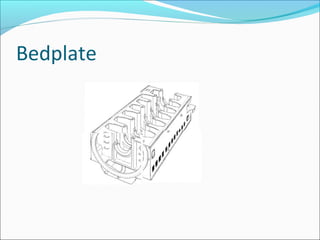
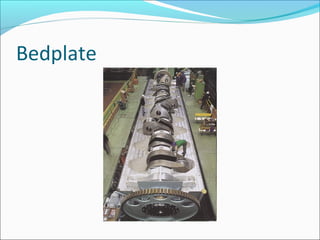
Bedplate
foundation on which the engine is built
must be rigid enough to support the rest of the

engine and hold the crankshaft which sits on the
bearing housing in alignment with transverse girders
at the same time, the bedplate has to be flexible
enough to hog and sag with the foundation plate to
which it is attached and which forms part of the ship
structure
Bedplate
Bedplate
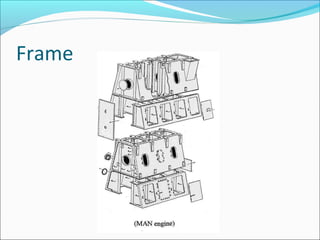
Frame
load-carrying part of an engine
it may include parts as the cylinder block,base, sump

and end plates
in two-stroke engines, frames are sometimes known
as A-frames
Frame
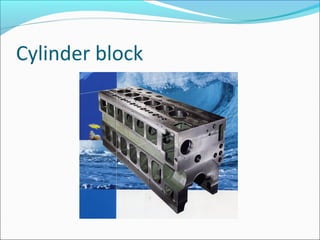
Cylinder Block
=engine block
part of the engine frame that supports the engine
cylinder liners, heads and crankshafts
cylinder blocks for most large engines are made of
castings and plates that are welded horizontally and
vertically for strength and rigidity (stiffener)
entablature = cylinder block which incorporates the
scavenge air spaces in two-stroke engines
Cylinder block
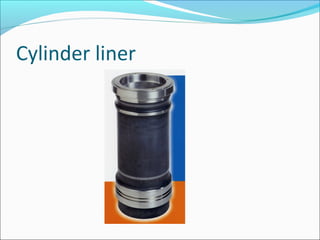
Cylinder liner
a bore in which an engine piston moves back and

forth
replaceable
the material of the liner must withstand extreme heat
and pressure developed within the combustion space
at the top of the cylinder, and at the same time must
permit the piston and its sealing rings to move with a
minimum of friction
Cylinder liner
Dry liner
Wet liner
Cylinder liner
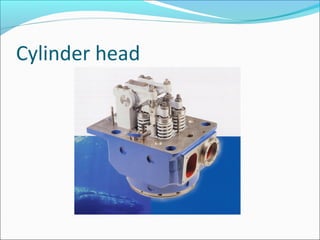
Cylinder head
= cylinder cover
• the space at the combustion chamber top is formed
and sealed by a cylinder head
• the cylinder head of a four-stroke engine houses
intake and exhaust valves, the fuel injection valve, air
starting vale, safety valve
(the two-stroke engine lacks the intake valve)
Cylinder head
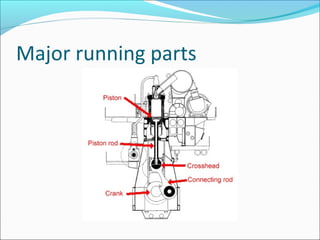
Major running parts
piston
piston rod
crosshead
connecting rod
crankshaft & its bearings
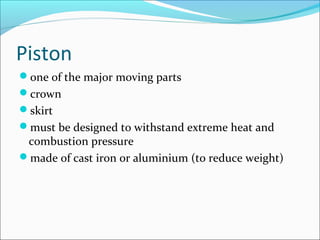
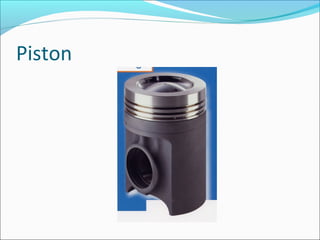
Piston
one of the major moving parts
crown
skirt
must be designed to withstand extreme heat and

combustion pressure
made of cast iron or aluminium (to reduce weight)
Piston
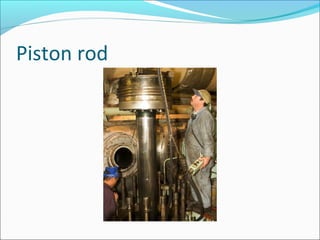
Piston rod
connects the piston with the crosshead
Piston rod
Crosshead
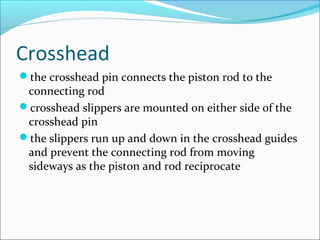
the crosshead pin connects the piston rod to the

connecting rod
crosshead slippers are mounted on either side of the
crosshead pin
the slippers run up and down in the crosshead guides
and prevent the connecting rod from moving
sideways as the piston and rod reciprocate
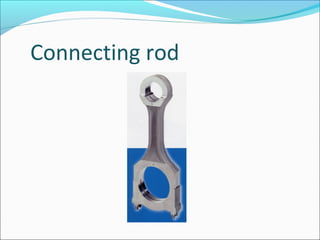
Connecting rod
it is fitted between the crosshead and the crankshaft
it transmits the firing force, and together with the

crankshaft converts the reciprocating motion to a
rotary motion
Connecting rod
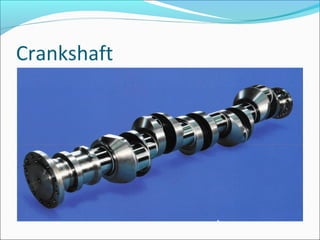
Crankshaft & its bearings
one of the largest moving parts
it consists of a series of cranks formed in a shaft
converts reciprocating motion of the piston into

rotary motion
counterweights for balancing purposes
Crankshaft
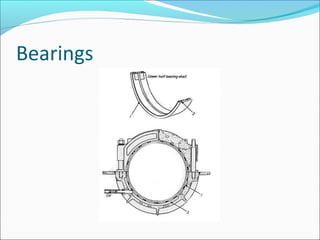
Bearings
Major running parts
Arrangements for the air supply
and gas exhaust:
valves (inlet & exhaust), valve gear (camshaft &
camshaft drive, push rod, rocker arm, spring),
manifolds, scavenging and supercharging
(turboblower systems)
Fuel injection system
fuel pump, high pressure piping, injector, nozzle
Engine Parameters
Cylinder bore – inner diameter of the cylinder (in

mm or cm)
Stroke – the distance the piston travels between top
and bottom dead centers (in mm or cm)
Engine speed – speed at which the crankshaft
rotates (measured in revolutions per minute)
Maximum Continuous Rating (MCR) – the
designed maximum power which a diesel engine is
capable of delivering continuously, at nominal
maximum speed, in the period between two
consecutive overhaulings

Diesel enginecomponents

  • 1.
  • 2.
    Diesel Engine Components Mainparts structural parts (stationary p.) running parts Systems
  • 3.
    Structural parts PURPOSE: - tosupport running parts - to keep them in position and line - to provide jackets and passages for cooling water, sumps, for lube oil - to form protective casing for running parts - to support auxiliaries (valves, camshaft, turbo blowers)
  • 4.
    Running parts PURPOSE - toconvert the power of combustion in the cylinders to mechanical work
  • 5.
    Systems PURPOSE - Supply ofair - Removal of exhaust - Turbocharging - Supply and injection of fuel - Lubrication - Cooling
  • 6.
    Structural parts bedplate frame orcolumn engine or cylinder block cylinder liners cylinder head or cover
  • 7.
    Bedplate foundation on whichthe engine is built must be rigid enough to support the rest of the engine and hold the crankshaft which sits on the bearing housing in alignment with transverse girders at the same time, the bedplate has to be flexible enough to hog and sag with the foundation plate to which it is attached and which forms part of the ship structure
  • 8.
  • 9.
  • 10.
    Frame load-carrying part ofan engine it may include parts as the cylinder block,base, sump and end plates in two-stroke engines, frames are sometimes known as A-frames
  • 11.
  • 12.
    Cylinder Block =engine block partof the engine frame that supports the engine cylinder liners, heads and crankshafts cylinder blocks for most large engines are made of castings and plates that are welded horizontally and vertically for strength and rigidity (stiffener) entablature = cylinder block which incorporates the scavenge air spaces in two-stroke engines
  • 13.
  • 14.
    Cylinder liner a borein which an engine piston moves back and forth replaceable the material of the liner must withstand extreme heat and pressure developed within the combustion space at the top of the cylinder, and at the same time must permit the piston and its sealing rings to move with a minimum of friction
  • 15.
  • 16.
  • 17.
    Cylinder head = cylindercover • the space at the combustion chamber top is formed and sealed by a cylinder head • the cylinder head of a four-stroke engine houses intake and exhaust valves, the fuel injection valve, air starting vale, safety valve (the two-stroke engine lacks the intake valve)
  • 18.
  • 19.
    Major running parts piston pistonrod crosshead connecting rod crankshaft & its bearings
  • 20.
    Piston one of themajor moving parts crown skirt must be designed to withstand extreme heat and combustion pressure made of cast iron or aluminium (to reduce weight)
  • 21.
  • 22.
    Piston rod connects thepiston with the crosshead
  • 23.
  • 24.
    Crosshead the crosshead pinconnects the piston rod to the connecting rod crosshead slippers are mounted on either side of the crosshead pin the slippers run up and down in the crosshead guides and prevent the connecting rod from moving sideways as the piston and rod reciprocate
  • 25.
    Connecting rod it isfitted between the crosshead and the crankshaft it transmits the firing force, and together with the crankshaft converts the reciprocating motion to a rotary motion
  • 26.
  • 27.
    Crankshaft & itsbearings one of the largest moving parts it consists of a series of cranks formed in a shaft converts reciprocating motion of the piston into rotary motion counterweights for balancing purposes
  • 28.
  • 29.
  • 30.
  • 31.
    Arrangements for theair supply and gas exhaust: valves (inlet & exhaust), valve gear (camshaft & camshaft drive, push rod, rocker arm, spring), manifolds, scavenging and supercharging (turboblower systems)
  • 32.
    Fuel injection system fuelpump, high pressure piping, injector, nozzle
  • 33.
    Engine Parameters Cylinder bore– inner diameter of the cylinder (in mm or cm) Stroke – the distance the piston travels between top and bottom dead centers (in mm or cm) Engine speed – speed at which the crankshaft rotates (measured in revolutions per minute) Maximum Continuous Rating (MCR) – the designed maximum power which a diesel engine is capable of delivering continuously, at nominal maximum speed, in the period between two consecutive overhaulings