CSI Global Education Inc. The Economy CHAPTER 5: Economic Policy
Economic Policy in General Policy makers use information about inflation, unemployment, GDP, interest rates….to formulate policy to keep the economy on a long-term stable growth path. However, we do know that recessions occur, that growth is sometimes stronger, or weaker, than expected. What role does the Department of Finance and the Bank of Canada play here? Can you anticipate the direction of BoC policy after looking at the fundamentals of the economy?
Fiscal Policy Looking at the role of government in the area of: Taxation Government spending Government borrowing
Fiscal Policy Main tool of fiscal policy is the annual Federal Budget.  The budget contains projections for the coming year in the areas of spending, revenue, the deficit and debt. Deficit = the annual mismatch in spending and revenue. How have Canada’s finances changed over the last decade?
Fiscal Policy Fiscal policy can impact the economy in many key ways: Spending : via government spending in the economy and through transfer payments to citizens. Taxes : changes in taxes have a direct impact on spending decisions by both consumers and businesses. Automatic stabilizers : policy actions that move counter to the business cycle. How do these work?
The Bank of Canada - Duties Regulate credit & currency Control and protect the external value of the dollar Use monetary policy to reduce fluctuations in prices, employment, trade and production Promote the country’s economic welfare
The Bank of Canada – Functions Issues bank notes Acts as the government’s fiscal agent Controller of the clearing system Lender of last resort Maintains orderly conditions in financial markets Main and most visible function: Conduct monetary policy
The Bank’s Influence Over Interest Rates Cash management (via the growth in the money supply) Open market operations (direct influence) Changes in the bank rate (direct influence) Moral Suasion
Monetary Policy The most important role of the BoC  Objective Of Monetary Policy: Growth with price stability = Growth without inflation Goals for max. increases in CPI: inflation-control target target range is 1% to 3% BoC goal is to keep inflation at the 2% target midpoint
Monetary Policy Objective: Moderate growth in the money supply leads to moderate growth in the economy and modest inflation, thus: Monetary Policy = Management of the growth of the money supply
The Overnight Money Market The BoC implements monetary policy by influencing “overnight money” The overnight market is a marketplace where financial institutions lend each other money on an overnight basis.  When the BoC changes the target for the overnight rate, other short-term interest rates also usually change. The BoC establishes a 50 basis point “operating band” for overnight financing. – The Bank Rate is set at the upper limit of the operating band
The Overnight Money Market Changes in the operating band indicate an easing or tightening of monetary conditions. Each day, the BoC targets the mid-point of the band. Changes are announced by press release.
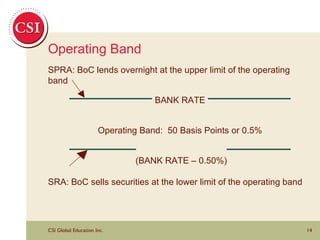
Operating Band SPRA: BoC lends overnight at the upper limit of the operating band BANK RATE Operating Band:  50 Basis Points or 0.5% (BANK RATE – 0.50%) SRA: BoC sells securities at the lower limit of the operating band
Open Market Operations Policy aimed at having a direct impact on the demand for credit in the economy.  When would the BoC use a Special Purchase and Resale Agreement (SPRA) and a Sale and Purchase Agreement (SRA)?
Open Market Operations Special Purchase and Resale Agreements (SPRAs) When:   Overnight money is trading  above  the target rate Objective: Relieve upward pressure on overnight rates and  reinforce the upper limit of the target Why: May dampen economic activity by leading to higher  short-term rates across the entire spectrum of market  rates  How: ?
Open Market Operations Special Purchase and Resale Agreements (SPRAs) How: BoC buys short-term government securities from primary dealers  The securities are then sold back at a predetermined price the next business day  - the BoC lends to a FI overnight at the top end of the target - if a FI has a need to borrow overnight, the preference is to borrow  at a lower rate than what is prevailing in the market  -  the BoC becomes an alternative to borrowing from other lenders -  this drives down short-term interest rates back to the target
Open Market Operations  (continued) Sale and Purchase Agreements (SRAs) When:   Overnight money is trading  below  the target rate Objective: Relieve downward pressure on overnight rates and  reinforce the target Why: May lead to lower interest rates throughout the  economy and to an increase in inflation pressures  in the economy How: ?
Open Market Operations  (continued) Sale and Purchase Agreements (SRAs) How: BoC offers to sell government securities to primary dealers  The securities are bought back at a predetermined price the next day - the BoC borrows from a FI overnight at the bottom of the target - if a FI has a need to lend overnight, the preference is to lend  money at a higher rate than what is prevailing in the market  -  the BoC becomes an alternative by offering higher overnight  lending rates  -  this drives up short-term rates back to the target
Changes in the Bank Rate Direct influence, as it sends a message to all market participants Bank rate = Minimum rate of interest that the BoC  charges on short-term loans to financial institutions. Set at the upper limit of the Bank’s operating band for the overnight lending rate.

Csc2 The Economy Ch 5

  • 1.
    CSI Global EducationInc. The Economy CHAPTER 5: Economic Policy
  • 2.
    Economic Policy inGeneral Policy makers use information about inflation, unemployment, GDP, interest rates….to formulate policy to keep the economy on a long-term stable growth path. However, we do know that recessions occur, that growth is sometimes stronger, or weaker, than expected. What role does the Department of Finance and the Bank of Canada play here? Can you anticipate the direction of BoC policy after looking at the fundamentals of the economy?
  • 3.
    Fiscal Policy Lookingat the role of government in the area of: Taxation Government spending Government borrowing
  • 4.
    Fiscal Policy Lookingat the role of government in the area of: Taxation Government spending Government borrowing
  • 5.
    Fiscal Policy Maintool of fiscal policy is the annual Federal Budget. The budget contains projections for the coming year in the areas of spending, revenue, the deficit and debt. Deficit = the annual mismatch in spending and revenue. How have Canada’s finances changed over the last decade?
  • 6.
    Fiscal Policy Fiscalpolicy can impact the economy in many key ways: Spending : via government spending in the economy and through transfer payments to citizens. Taxes : changes in taxes have a direct impact on spending decisions by both consumers and businesses. Automatic stabilizers : policy actions that move counter to the business cycle. How do these work?
  • 7.
    The Bank ofCanada - Duties Regulate credit & currency Control and protect the external value of the dollar Use monetary policy to reduce fluctuations in prices, employment, trade and production Promote the country’s economic welfare
  • 8.
    The Bank ofCanada – Functions Issues bank notes Acts as the government’s fiscal agent Controller of the clearing system Lender of last resort Maintains orderly conditions in financial markets Main and most visible function: Conduct monetary policy
  • 9.
    The Bank’s InfluenceOver Interest Rates Cash management (via the growth in the money supply) Open market operations (direct influence) Changes in the bank rate (direct influence) Moral Suasion
  • 10.
    Monetary Policy Themost important role of the BoC Objective Of Monetary Policy: Growth with price stability = Growth without inflation Goals for max. increases in CPI: inflation-control target target range is 1% to 3% BoC goal is to keep inflation at the 2% target midpoint
  • 11.
    Monetary Policy Objective:Moderate growth in the money supply leads to moderate growth in the economy and modest inflation, thus: Monetary Policy = Management of the growth of the money supply
  • 12.
    The Overnight MoneyMarket The BoC implements monetary policy by influencing “overnight money” The overnight market is a marketplace where financial institutions lend each other money on an overnight basis. When the BoC changes the target for the overnight rate, other short-term interest rates also usually change. The BoC establishes a 50 basis point “operating band” for overnight financing. – The Bank Rate is set at the upper limit of the operating band
  • 13.
    The Overnight MoneyMarket Changes in the operating band indicate an easing or tightening of monetary conditions. Each day, the BoC targets the mid-point of the band. Changes are announced by press release.
  • 14.
    Operating Band SPRA:BoC lends overnight at the upper limit of the operating band BANK RATE Operating Band: 50 Basis Points or 0.5% (BANK RATE – 0.50%) SRA: BoC sells securities at the lower limit of the operating band
  • 15.
    Open Market OperationsPolicy aimed at having a direct impact on the demand for credit in the economy. When would the BoC use a Special Purchase and Resale Agreement (SPRA) and a Sale and Purchase Agreement (SRA)?
  • 16.
    Open Market OperationsSpecial Purchase and Resale Agreements (SPRAs) When: Overnight money is trading above the target rate Objective: Relieve upward pressure on overnight rates and reinforce the upper limit of the target Why: May dampen economic activity by leading to higher short-term rates across the entire spectrum of market rates How: ?
  • 17.
    Open Market OperationsSpecial Purchase and Resale Agreements (SPRAs) How: BoC buys short-term government securities from primary dealers The securities are then sold back at a predetermined price the next business day - the BoC lends to a FI overnight at the top end of the target - if a FI has a need to borrow overnight, the preference is to borrow at a lower rate than what is prevailing in the market - the BoC becomes an alternative to borrowing from other lenders - this drives down short-term interest rates back to the target
  • 18.
    Open Market Operations (continued) Sale and Purchase Agreements (SRAs) When: Overnight money is trading below the target rate Objective: Relieve downward pressure on overnight rates and reinforce the target Why: May lead to lower interest rates throughout the economy and to an increase in inflation pressures in the economy How: ?
  • 19.
    Open Market Operations (continued) Sale and Purchase Agreements (SRAs) How: BoC offers to sell government securities to primary dealers The securities are bought back at a predetermined price the next day - the BoC borrows from a FI overnight at the bottom of the target - if a FI has a need to lend overnight, the preference is to lend money at a higher rate than what is prevailing in the market - the BoC becomes an alternative by offering higher overnight lending rates - this drives up short-term rates back to the target
  • 20.
    Changes in theBank Rate Direct influence, as it sends a message to all market participants Bank rate = Minimum rate of interest that the BoC charges on short-term loans to financial institutions. Set at the upper limit of the Bank’s operating band for the overnight lending rate.