PRESENTATION
ON
FINANCIAL INTERMEDIARY
Financial Intermediary?
• A financial intermediary is an entity that acts as the middleman
between two parties in a financial transaction.
• It facilitates the channeling of funds between lenders
and borrowers indirectly.
Example :-
Savers give funds to an intermediary institution (such as a bank), and that institution
gives those funds to spenders (borrowers). This may be in the form of loans or
mortgages.
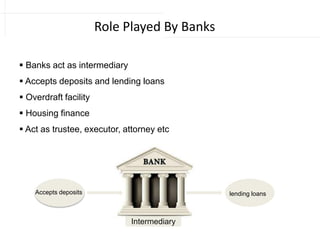
Accepts deposits lending loans
Intermediary
Role Played By Banks
 Banks act as intermediary
 Accepts deposits and lending loans
 Overdraft facility
 Housing finance
 Act as trustee, executor, attorney etc
Contd…
 Dealing in foreign exchange
 Purchase and sale of securities
 Credit creation
 Loans against saving certificate
 Educational loan scheme
 Collection of cheques, dividend and interest.
Depositor Confidence
• Risks specific to financial intermediaries, such as banks, include the risk of losing
depositor confidence and misjudging the credit worthiness of borrowers.
• It is of the utmost importance that each and every bank be seen by the public as a
safe place to deposit money.
• Failure to do so can, at the extreme, result in public panic and a bank run. Banks
must not only manage their business prudently, they have to convince the public
that they are doing so.
Risk Managed By Banks As Financial Intermediaries
Contd…
Credit Risk
•Banks are in the business of taking on risk. When they borrow from a
depositor, the depositor needs to be 100 percent confident that they will get
their money returned
•When a bank loans money, it knows that some of the loans will not be re-
paid. Of course, they don't know which ones will go bad in advance. What
they do for each loan is a thorough analysis to determine how much risk the
bank is taking on that the borrower won't repay the money.
More Complex Risks
• The major banking crisis in the United States that saw the collapse of Lehman Brothers in
2008 brought to focus other kinds of risks
• These include capital adequacy and liquidity management. Capital adequacy is a
comparison of a bank's assets to its capital. Liquidity management, when properly done,
ensures an organization has realistic cash flow projections for both in and outflows, and
the ability to meet all of its obligations on time.
Continued…
Contd…
Systemic Risk
It is the risk of collapse of an entire financial system or entire market, as opposed
to risk associated with any one individual entity, group or component of a system,
that can be contained therein without harming the entire system.
It refers to the risks imposed by interlink ages and interdependencies in a system
or market, where the failure of a single entity or cluster of entities can cause a
cascading failure, which could potentially bankrupt or bring down the entire system
or market
Types Financial Intermediaries?
Unorganized Sector Organized Sector
Unorganized Sectors
Money Lenders
Self Help Group
Indigenous Banker
Chit Funds
Nidhis
Organized Sectors
Development Financial Institutions(DFIs)
NBFCs
State Financial Corporation(SFC)
Insurance Companies
Mutual Funds
Development Financial Institutions(DFIs)
A financial agencies that provide medium and long-term financial
assistance .
Engaged in promotion and development of industry, agriculture
and other key sectors.
Various Institutions Covered Under All India DFIs
 IFCI (Industrial finance corporation of India )
 IDBI (Industrial development bank of India)
 ICICI (Industrial credit and investment corporation of India)
 IIBI (Industrial investment bank of India)
 SIDBI (Small industries development bank of India )
 NABARD(National bank for agriculture and rural development )
State Financial Corporation(SFCs)
Mainly concentrate on industrial development in a state and Created under
the state finance corporations Act,1951
Some of the Objectives are :-
 Financing and promoting SMEs .
 Providing loans.
 Discounting the bills.
 To establish uniformity in regional industries.
Insurance Companies
Concentrate on fulfilling the insurance needs of the community, both for
life and non life insurance.
Mutual Fund
 The term mutual fund suggest the group of people to invest their money
together to buy stock and bonds and in some cases combination of both.
 Trade in diversified holdings and is professionally managed .
Stock
Bonds
Mutual
Fund
FMCG
Steel
Pharmacy
IT
Banking
How Mutual Fund Works
AMC or
Fund manager
Returns
Securities
Investors
Trustees
Trustees monitor the AMC
Non Banking Finance Companies(NBFCs)
 They are registered under the companies Act, 1956.
 NBFCs are financial institution that provide banking services .
 They don’t hold a banking license.
 They can’t accept demand deposit
 They engaged in the business of loans and advances, acquisition of shares/
stocks/bonds/debentures/securities .
Summary
• Financial Intermediary?
Bibliography
• https://en.wikipedia.org/
• www.yourarticlelibrary.com
• Book=PGDBO volume -1
Conclusion
• Financial intermediary are essential for each
country’s economy, since no growth can be
achieved unless savings are efficiently
channeled into investment.
Thank you

Financial intermederies

  • 1.
  • 2.
    Financial Intermediary? • Afinancial intermediary is an entity that acts as the middleman between two parties in a financial transaction. • It facilitates the channeling of funds between lenders and borrowers indirectly. Example :- Savers give funds to an intermediary institution (such as a bank), and that institution gives those funds to spenders (borrowers). This may be in the form of loans or mortgages.
  • 3.
    Accepts deposits lendingloans Intermediary Role Played By Banks  Banks act as intermediary  Accepts deposits and lending loans  Overdraft facility  Housing finance  Act as trustee, executor, attorney etc
  • 4.
    Contd…  Dealing inforeign exchange  Purchase and sale of securities  Credit creation  Loans against saving certificate  Educational loan scheme  Collection of cheques, dividend and interest.
  • 5.
    Depositor Confidence • Risksspecific to financial intermediaries, such as banks, include the risk of losing depositor confidence and misjudging the credit worthiness of borrowers. • It is of the utmost importance that each and every bank be seen by the public as a safe place to deposit money. • Failure to do so can, at the extreme, result in public panic and a bank run. Banks must not only manage their business prudently, they have to convince the public that they are doing so. Risk Managed By Banks As Financial Intermediaries
  • 6.
    Contd… Credit Risk •Banks arein the business of taking on risk. When they borrow from a depositor, the depositor needs to be 100 percent confident that they will get their money returned •When a bank loans money, it knows that some of the loans will not be re- paid. Of course, they don't know which ones will go bad in advance. What they do for each loan is a thorough analysis to determine how much risk the bank is taking on that the borrower won't repay the money.
  • 7.
    More Complex Risks •The major banking crisis in the United States that saw the collapse of Lehman Brothers in 2008 brought to focus other kinds of risks • These include capital adequacy and liquidity management. Capital adequacy is a comparison of a bank's assets to its capital. Liquidity management, when properly done, ensures an organization has realistic cash flow projections for both in and outflows, and the ability to meet all of its obligations on time. Continued…
  • 8.
    Contd… Systemic Risk It isthe risk of collapse of an entire financial system or entire market, as opposed to risk associated with any one individual entity, group or component of a system, that can be contained therein without harming the entire system. It refers to the risks imposed by interlink ages and interdependencies in a system or market, where the failure of a single entity or cluster of entities can cause a cascading failure, which could potentially bankrupt or bring down the entire system or market
  • 9.
  • 10.
    Unorganized Sectors Money Lenders SelfHelp Group Indigenous Banker Chit Funds Nidhis
  • 11.
    Organized Sectors Development FinancialInstitutions(DFIs) NBFCs State Financial Corporation(SFC) Insurance Companies Mutual Funds
  • 12.
    Development Financial Institutions(DFIs) Afinancial agencies that provide medium and long-term financial assistance . Engaged in promotion and development of industry, agriculture and other key sectors.
  • 13.
    Various Institutions CoveredUnder All India DFIs  IFCI (Industrial finance corporation of India )  IDBI (Industrial development bank of India)  ICICI (Industrial credit and investment corporation of India)  IIBI (Industrial investment bank of India)  SIDBI (Small industries development bank of India )  NABARD(National bank for agriculture and rural development )
  • 14.
    State Financial Corporation(SFCs) Mainlyconcentrate on industrial development in a state and Created under the state finance corporations Act,1951 Some of the Objectives are :-  Financing and promoting SMEs .  Providing loans.  Discounting the bills.  To establish uniformity in regional industries.
  • 15.
    Insurance Companies Concentrate onfulfilling the insurance needs of the community, both for life and non life insurance.
  • 16.
    Mutual Fund  Theterm mutual fund suggest the group of people to invest their money together to buy stock and bonds and in some cases combination of both.  Trade in diversified holdings and is professionally managed . Stock Bonds Mutual Fund FMCG Steel Pharmacy IT Banking
  • 17.
    How Mutual FundWorks AMC or Fund manager Returns Securities Investors Trustees Trustees monitor the AMC
  • 18.
    Non Banking FinanceCompanies(NBFCs)  They are registered under the companies Act, 1956.  NBFCs are financial institution that provide banking services .  They don’t hold a banking license.  They can’t accept demand deposit  They engaged in the business of loans and advances, acquisition of shares/ stocks/bonds/debentures/securities .
  • 19.
  • 20.
  • 21.
    Conclusion • Financial intermediaryare essential for each country’s economy, since no growth can be achieved unless savings are efficiently channeled into investment.
  • 22.