CAPITAL MARKETS
OVERVIEW OF MARKET
PARTICIPANTS AND
FINANCIAL
INNOVATION
1
Learning Objectives:
1. Enumerate participants in financial markets.
2. Explain the business of financial institutions
3. Describe what financial intermediary is.
4. Discuss how financial intermediary provide economic
functions.
5. Describe the nature of the management of assets and
liabilities by financial intermediaries.
2
ISSUER AND INVESTORS
•Financial intermediaries, An entity that acts as
the middleman between two parties in a
financial transaction.
•Regulators – regulates
certain aspects of
financial markets.
3
•Various entities issue financial assets,both debt
instruments and equity instruments and
various investors purchase these financial
assets
•It is common for an entity to both issue a
financial asset and at the same time invest in a
different financial asset.
4
CLASSIFICATION OF ENTITIES
Central Governments
Agencies of Central Governments
Municipal Governments
Supranationals
Nonfinancial Businesses
Financial Enterprises
Households
5
• Supranational Institution:is an organization
formed by two or more central government
through international treaties.
An international organization, or union,
whereby member states transcend national
boundaries
or interests to share in the decision-making
and vote on issues pertaining to the wider
grouping
• Two example of supranational institution are
International Bank for Reconstruction and
Development popularly referred to as World
Bank and American Development Bank
6
•Financial intermediaries include depository
institutions(commercial banks,savings and loan
associations) who acquire bulk of their funds
by offering their liabilities to the public mostly
in form of deposit.Others are discussed another
chapters.
•Some subsidiaries of nonfinancial business
provide financial services.These financial
institutions called captive finance companies.
7
A subsidiary whose purpose is to provide financing to
customers buying the parent company's product.
Captive finance companies can range in size from
mid-sized entities to giant firms, depending on the
size of the parent company. Their range of services
can also vary widely, from basic card services to full-
scale banking. A captive finance company can be a
source of significant profits for the parent
organization.
• Examples of captive finance companies;
oGeneral Motor Acceptance Corporations (a subsidiary of
General Motors)
oGeneral Electric Credit(a subsidiary of General Electric)
8
DEFINITION OF 'CAPTIVE FINANCE
COMPANY'
 Transform financial assets acquired through the market constitute them into
a different and more widely preferable ,type of asset,which becomes their
liability.This function is performed by financial intermediaries.(most
important type of financial institution)
 Exchange financial assets on behalf of consumers.
 Exchange financial assets on their own account.
 Assist in the creation of financial assets for their customers and then sell
those financial assets to other market participants.
 Provide investment advice to other market participants.
 Manage the portfolios of other market participants.
9
Financial businesses more popularly referred
to as financial institutions provide one or more
of the following services:
ROLE OF FİNANCİAL INTERMEDİARİES
•Financial intermediaries play the basic role of the
basic role of transforming financial assets that are
less desirable for a large part of the public into
other financial assets-their own liabilities-which
are more widely preferred by the public.This
transformation involves at least one of the four
economic functions;
10
ROLE OF FİNANCİAL INTERMEDİARİES
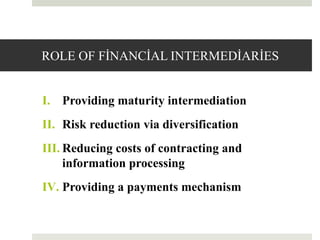
I. Providing maturity intermediation
II. Risk reduction via diversification
III. Reducing costs of contracting and
information processing
IV. Providing a payments mechanism
11
I. Maturity intermediation:by issuing
its own financial claims the
commercial commercial bank in
essence transforms a longer-term
asset into a shorter –term one by
giving the borrower a loan for length
of time sought and the
investors/depositor a financial asset
for the desired investment
horizon.This is called maturity
intermediation.
12
II. This economic function of financial intermediaries-
transforming more risky assets into less risky ones-is called
diversification.Even though individual investors can do it on
their own,they may not be able to to it as cost effectively as a
financial intermediary,depending on the amount of funds they
want to invest.Attaining cost effective diversification in order
to reduce risk by purchasing the financial assets of a financial
intermediary is an important economic benefit for financial
markets.
13
III. REDUCING THE COSTS OF CONTRACTING AND
INFORMATION PROCCESING
Investors purchasing financial assets must
develop skills necessary to evaluate an investment.
Those skills are developed, investors can apply them
when analyzing specific financial assets for
purchase.
Investors who want to make a loan to a
consumer or business need to write loan contract.
Although some people may enjoy devoting leisure
time to this task, most of us find leisure time to be in
short supply and compensation for sacrificing it.
The form of compensation could be a higher return
obtained from an investment.
In addition to the opportunity cost of time to
process the information about the financial asset,
the cost of this information must also be
considered. All these costs are information
processing costs.
The costs of writing loan contracts are
referred to as contracting costs. Another
dimension to contracting costs is the cost of
enforcing terms of loan agreement.
IV. PROVIDING A PAYMENTS MECHANISM
The previous three economic functions may
not be immediately obvious. This last one should be.
Most transactions made today are not with cash.
Payments are made using checks, credit cards, debit
cards and electronic transfers of funds. Financial
intermediaries provide these methods for making
payments.
At one time, noncash payments were
restricted to checks. Payment by credit card was
also at one time the exclusive domain of commercial
banks, but now other depository institutions offer
this service. Debit cards are offered by various
financial intermediaries.
A debit card differs from a credit card in
that a bill sent to credit cardholder periodically
(usually once a month) requests payment for
transactions made in the past. With a debit
card, funds are immediately withdrawn from
the purchaser’s account at time transaction
takes place.
The ability to make payments without
cash is critical for financial market. In short,
depository institutions transform assets that
cannot be used to make payments into other
assets.
OVERVIEW OF ASSET/LIABILITY
MANAGEMENT FOR FINANCIAL
INSTITUTIONS
To understand why managers of financial
institutions invest in particular types of financial
assets and types of investment strategies
employed. It is necessary to have a general
information of asset/liability problem.
For example, depository institutions seek
to generate income by difference between return
that they earn on assets and cost of their funds.
This difference is referred to as spread.
LIQUIDITY NEEDS
 Because of uncertainty about the timing and the amount of the cash outlays,
a financial institution must be prepared with sufficent cash to satisfy its
obligations.
 Also keep in mind that our discussion of liabilities assumes that the entity
that holds the obligation against the financial institution may exercise its
right to change the nature of deposit, perhaps incurring some penalty.
For example;
 In the case of a certificate of deposit,
the depositor may request the withdrawal
of funds prior to the maturity date.
•The deposit-accepting institution will grant this
request, but assess an early withdrawal penalty.
•Certain types of investment companies give
shareholders the right to redeem their shares at
any time.
•Some life insurance products provide a cash-
surrender value that allows the policyholder to
exchange the policy for a lump sum payment at
specified dates.
•Some life insurance products also offer a loan
value.
•In addition to uncertainty
about the timing and
amount of the cash
outlays, and the potential
for the depositor or
policyholder to withdraw
cash early or borrow
against a policy, a
financial institution is
alsoconcerned with
possible reduction in
cash inflows.
•In the case of a depository institution, it means the
inability to obtain deposits.
•For insurance companies, it means reduced
premiums because of the cancellation of policies.
•For certain types of investment companies, it
means not being able to find new buyers for shares.
İn the Philippine
Setting.....
23
Elements of the Financial System
1. Financial Claims- these are the money and the
rights to receive money under specific circumstances.
(ex: debt and equity)
2. Financial Institutions – they are private or
government organizations whose assets consists
primarily of claims or incomes primarily derived
from dealing in and/or performing services in
connection with claims. (commonly known as
Financial Intermediaries)
Elements of the Financial System
3. Financial Markets – serves as a means of
bringing the forces of demand and supply of
financial claims.
-is a market in which people and entities can
trade financial securities, commodities and
other fungible items of value at low transaction
costs and at prices that reflect supply and
demand
Elements of the Financial System
4. Government Agencies – Monetary
policies are formulated by the
Monetary Board of the Central Bank.
CENTRAL BANKS- supervises and
regulates the banking institutions and
other financial insitutions. It controls
money, credit and banking operations in
the country.
Elements of the Financial System
The Bangko Sentral ng Pilipinas (BSP) is the central
bank of the Republic of the Philippines. It was
established on 3 July 1993 pursuant to the provisions
of the 1987 Philippine Constitution and the New Central
Bank Act of 1993. The BSP took over from the Central
Bank of Philippines, which was established on 3
January 1949, as the country’s central monetary
authority. The BSP enjoys fiscal and administrative
autonomy from the National Government in the pursuit
of its mandated responsibilities.
Elements of the Financial System
Objectives
The BSP’s primary objective is to maintain price
stability conducive to a balanced and sustainable
economic growth. The BSP also aims to promote
and preserve monetary stability and the
convertibility of the national currency.
Elements of the Financial System
Objectives
The BSP’s primary objective is to maintain price
stability conducive to a balanced and sustainable
economic growth. The BSP also aims to promote
and preserve monetary stability and the
convertibility of the national currency.
Elements of the Financial System
Responsibilities
The BSP provides policy directions in the areas of money, banking and credit. It
supervises operations of banks and exercises regulatory powers over non-bank
financial institutions with quasi-banking functions.
Under the New Central Bank Act, the BSP performs the following functions, all
of which relate to its status as the Republic’s central monetary authority.
 Liquidity Management. The BSP formulates and implements monetary
policy aimed at influencing money supply consistent with its primary
objective to maintain price stability.
 Currency issue. The BSP has the exclusive power to issue the national
currency. All notes and coins issued by the BSP are fully guaranteed by the
Government and are considered legal tender for all private and public
debts.
Elements of the Financial System
Responsibilities (Continuation)
 Financial Supervision. The BSP supervises banks and exercises
regulatory powers over non-bank institutions performing quasi-banking
functions.
 Management of foreign currency reserves. The BSP seeks to maintain
sufficient international reserves to meet any foreseeable net demands for
foreign currencies in order to preserve the international stability and
convertibility of the Philippine peso.
 Determination of exchange rate policy. The BSP determines the
exchange rate policy of the Philippines. Currently, the BSP adheres to a
market-oriented foreign exchange rate policy such that the role of Bangko
Sentral is principally to ensure orderly conditions in the market.
 Other activities. The BSP functions as the banker, financial advisor and
official depository of the Government, its political subdivisions and
instrumentalities and government-owned and -controlled corporations.
Elements of the Financial System
5. Laws and Policies – laws and
regulations are made on money ,
credit and banking to ensure
monetary stability and economic
growth.
The Philippine Financial Institutions
Financial Institutions
- A body corporate that , as part of its normal activities
 takes money on deposit and makes advances of money and
 Does do under regulatory regime, governed by the central bank (or
its equivalent) of the country in which it operates.
FUNCTIONS OF THE FINANCIAL
INSTITUTIONS
1. Investigation and credit analysis –
Loan Applications are properly
evaluated to ensure the efficient use of
credit and to protect the savings of
individuals as well as to minimize the
risk of nonpayment of loans.
2. Matching the supply and demand for
funds – Financial institutions are
money brokers.
FUNCTIONS OF THE FINANCIAL
INSTITUTIONS
3. Provisions for Liquidity – through their
brokerage function, they provide an
organized market, the investor can find
a buyer for his debt or ownership
claims.
4. Provides payment system – the
transfer of goods and services has
become convenient, faster and
economical.
Structure of the Philippine Financial
System
•Banking Institutions:
1. Private Banking Institutions
a. Commercial Banking Institutions
– expanded commercial banking/universal
banking
– ordinary commercial banks
b. Thrift Banks
– savings and mortgage banks
– private development banks
– stock savings and loan associations
c. Rural Banks
Structure of the Philippine Financial
System
•Banking Institutions:
2. Government Banking Institutions
a. Development Bank of the
Philippines (DBP)
b. Land Bank of the Philippines (LBP)
•Non-Bank Financial Institutions
1. Private Non-Banking Institutions
a. Investment Houses-An investment
house, or investment bank, works primarily for
corporations and governments. These banks help
raise money for their clients through debt and stock offerings.
b. Investment Companies
Structure of the Philippine Financial
System
•Non-Bank Financial Institutions
1. Private Non-Banking Institutions
a. Investment Houses
b. Investment Companies
c. Financing Companies
d. Securities Dealer/Brokers
e. Non-Stock savings and loan associations
f. Buildings and loan associations
g. Pawnshops
h. Lending Investors
i. Pension Fund Managers
j. Trust companies/ departments
k. Insurance Companies
l. Credit cooperatives
Structure of the Philippine Financial
System
•Non-Bank Financial Institutions
2. Government Non-Banking Institutions
a.Government Service Insurance
System (GSIS)
b. Social Security System
Structure of the Philippine Financial
System
Depository Institutions to Non-
Depository Institutions
• Depository Institutions – banks that accepts deposits –
contribute to the economy by lending much of the money
saved by depositors.
• Non-Depository institutions - which are financial
intermediaries that cannot accept deposits but do pool
the payments in the form of premiums or contributions of
many people and either invest it or provide credit to
others.
Multinational Banks in the Philippines
 Citibank
 Deutsche Bank
 HSBC
 JP Morgan Chase
 Prebon
 Price-WaterHouse-Coopers
THANK YOU…
43

chapter2playersinthecapitalmarketPhilippines.pptx

  • 1.
    CAPITAL MARKETS OVERVIEW OFMARKET PARTICIPANTS AND FINANCIAL INNOVATION 1
  • 2.
    Learning Objectives: 1. Enumerateparticipants in financial markets. 2. Explain the business of financial institutions 3. Describe what financial intermediary is. 4. Discuss how financial intermediary provide economic functions. 5. Describe the nature of the management of assets and liabilities by financial intermediaries. 2
  • 3.
    ISSUER AND INVESTORS •Financialintermediaries, An entity that acts as the middleman between two parties in a financial transaction. •Regulators – regulates certain aspects of financial markets. 3
  • 4.
    •Various entities issuefinancial assets,both debt instruments and equity instruments and various investors purchase these financial assets •It is common for an entity to both issue a financial asset and at the same time invest in a different financial asset. 4
  • 5.
    CLASSIFICATION OF ENTITIES CentralGovernments Agencies of Central Governments Municipal Governments Supranationals Nonfinancial Businesses Financial Enterprises Households 5
  • 6.
    • Supranational Institution:isan organization formed by two or more central government through international treaties. An international organization, or union, whereby member states transcend national boundaries or interests to share in the decision-making and vote on issues pertaining to the wider grouping • Two example of supranational institution are International Bank for Reconstruction and Development popularly referred to as World Bank and American Development Bank 6
  • 7.
    •Financial intermediaries includedepository institutions(commercial banks,savings and loan associations) who acquire bulk of their funds by offering their liabilities to the public mostly in form of deposit.Others are discussed another chapters. •Some subsidiaries of nonfinancial business provide financial services.These financial institutions called captive finance companies. 7
  • 8.
    A subsidiary whosepurpose is to provide financing to customers buying the parent company's product. Captive finance companies can range in size from mid-sized entities to giant firms, depending on the size of the parent company. Their range of services can also vary widely, from basic card services to full- scale banking. A captive finance company can be a source of significant profits for the parent organization. • Examples of captive finance companies; oGeneral Motor Acceptance Corporations (a subsidiary of General Motors) oGeneral Electric Credit(a subsidiary of General Electric) 8 DEFINITION OF 'CAPTIVE FINANCE COMPANY'
  • 9.
     Transform financialassets acquired through the market constitute them into a different and more widely preferable ,type of asset,which becomes their liability.This function is performed by financial intermediaries.(most important type of financial institution)  Exchange financial assets on behalf of consumers.  Exchange financial assets on their own account.  Assist in the creation of financial assets for their customers and then sell those financial assets to other market participants.  Provide investment advice to other market participants.  Manage the portfolios of other market participants. 9 Financial businesses more popularly referred to as financial institutions provide one or more of the following services:
  • 10.
    ROLE OF FİNANCİALINTERMEDİARİES •Financial intermediaries play the basic role of the basic role of transforming financial assets that are less desirable for a large part of the public into other financial assets-their own liabilities-which are more widely preferred by the public.This transformation involves at least one of the four economic functions; 10
  • 11.
    ROLE OF FİNANCİALINTERMEDİARİES I. Providing maturity intermediation II. Risk reduction via diversification III. Reducing costs of contracting and information processing IV. Providing a payments mechanism 11
  • 12.
    I. Maturity intermediation:byissuing its own financial claims the commercial commercial bank in essence transforms a longer-term asset into a shorter –term one by giving the borrower a loan for length of time sought and the investors/depositor a financial asset for the desired investment horizon.This is called maturity intermediation. 12
  • 13.
    II. This economicfunction of financial intermediaries- transforming more risky assets into less risky ones-is called diversification.Even though individual investors can do it on their own,they may not be able to to it as cost effectively as a financial intermediary,depending on the amount of funds they want to invest.Attaining cost effective diversification in order to reduce risk by purchasing the financial assets of a financial intermediary is an important economic benefit for financial markets. 13
  • 14.
    III. REDUCING THECOSTS OF CONTRACTING AND INFORMATION PROCCESING Investors purchasing financial assets must develop skills necessary to evaluate an investment. Those skills are developed, investors can apply them when analyzing specific financial assets for purchase. Investors who want to make a loan to a consumer or business need to write loan contract. Although some people may enjoy devoting leisure time to this task, most of us find leisure time to be in short supply and compensation for sacrificing it. The form of compensation could be a higher return obtained from an investment.
  • 15.
    In addition tothe opportunity cost of time to process the information about the financial asset, the cost of this information must also be considered. All these costs are information processing costs. The costs of writing loan contracts are referred to as contracting costs. Another dimension to contracting costs is the cost of enforcing terms of loan agreement.
  • 16.
    IV. PROVIDING APAYMENTS MECHANISM The previous three economic functions may not be immediately obvious. This last one should be. Most transactions made today are not with cash. Payments are made using checks, credit cards, debit cards and electronic transfers of funds. Financial intermediaries provide these methods for making payments. At one time, noncash payments were restricted to checks. Payment by credit card was also at one time the exclusive domain of commercial banks, but now other depository institutions offer this service. Debit cards are offered by various financial intermediaries.
  • 17.
    A debit carddiffers from a credit card in that a bill sent to credit cardholder periodically (usually once a month) requests payment for transactions made in the past. With a debit card, funds are immediately withdrawn from the purchaser’s account at time transaction takes place. The ability to make payments without cash is critical for financial market. In short, depository institutions transform assets that cannot be used to make payments into other assets.
  • 18.
    OVERVIEW OF ASSET/LIABILITY MANAGEMENTFOR FINANCIAL INSTITUTIONS To understand why managers of financial institutions invest in particular types of financial assets and types of investment strategies employed. It is necessary to have a general information of asset/liability problem. For example, depository institutions seek to generate income by difference between return that they earn on assets and cost of their funds. This difference is referred to as spread.
  • 19.
    LIQUIDITY NEEDS  Becauseof uncertainty about the timing and the amount of the cash outlays, a financial institution must be prepared with sufficent cash to satisfy its obligations.  Also keep in mind that our discussion of liabilities assumes that the entity that holds the obligation against the financial institution may exercise its right to change the nature of deposit, perhaps incurring some penalty. For example;  In the case of a certificate of deposit, the depositor may request the withdrawal of funds prior to the maturity date.
  • 20.
    •The deposit-accepting institutionwill grant this request, but assess an early withdrawal penalty. •Certain types of investment companies give shareholders the right to redeem their shares at any time. •Some life insurance products provide a cash- surrender value that allows the policyholder to exchange the policy for a lump sum payment at specified dates. •Some life insurance products also offer a loan value.
  • 21.
    •In addition touncertainty about the timing and amount of the cash outlays, and the potential for the depositor or policyholder to withdraw cash early or borrow against a policy, a financial institution is alsoconcerned with possible reduction in cash inflows.
  • 22.
    •In the caseof a depository institution, it means the inability to obtain deposits. •For insurance companies, it means reduced premiums because of the cancellation of policies. •For certain types of investment companies, it means not being able to find new buyers for shares.
  • 23.
  • 24.
    Elements of theFinancial System 1. Financial Claims- these are the money and the rights to receive money under specific circumstances. (ex: debt and equity) 2. Financial Institutions – they are private or government organizations whose assets consists primarily of claims or incomes primarily derived from dealing in and/or performing services in connection with claims. (commonly known as Financial Intermediaries)
  • 25.
    Elements of theFinancial System 3. Financial Markets – serves as a means of bringing the forces of demand and supply of financial claims. -is a market in which people and entities can trade financial securities, commodities and other fungible items of value at low transaction costs and at prices that reflect supply and demand
  • 26.
    Elements of theFinancial System 4. Government Agencies – Monetary policies are formulated by the Monetary Board of the Central Bank. CENTRAL BANKS- supervises and regulates the banking institutions and other financial insitutions. It controls money, credit and banking operations in the country.
  • 27.
    Elements of theFinancial System The Bangko Sentral ng Pilipinas (BSP) is the central bank of the Republic of the Philippines. It was established on 3 July 1993 pursuant to the provisions of the 1987 Philippine Constitution and the New Central Bank Act of 1993. The BSP took over from the Central Bank of Philippines, which was established on 3 January 1949, as the country’s central monetary authority. The BSP enjoys fiscal and administrative autonomy from the National Government in the pursuit of its mandated responsibilities.
  • 28.
    Elements of theFinancial System Objectives The BSP’s primary objective is to maintain price stability conducive to a balanced and sustainable economic growth. The BSP also aims to promote and preserve monetary stability and the convertibility of the national currency.
  • 29.
    Elements of theFinancial System Objectives The BSP’s primary objective is to maintain price stability conducive to a balanced and sustainable economic growth. The BSP also aims to promote and preserve monetary stability and the convertibility of the national currency.
  • 30.
    Elements of theFinancial System Responsibilities The BSP provides policy directions in the areas of money, banking and credit. It supervises operations of banks and exercises regulatory powers over non-bank financial institutions with quasi-banking functions. Under the New Central Bank Act, the BSP performs the following functions, all of which relate to its status as the Republic’s central monetary authority.  Liquidity Management. The BSP formulates and implements monetary policy aimed at influencing money supply consistent with its primary objective to maintain price stability.  Currency issue. The BSP has the exclusive power to issue the national currency. All notes and coins issued by the BSP are fully guaranteed by the Government and are considered legal tender for all private and public debts.
  • 31.
    Elements of theFinancial System Responsibilities (Continuation)  Financial Supervision. The BSP supervises banks and exercises regulatory powers over non-bank institutions performing quasi-banking functions.  Management of foreign currency reserves. The BSP seeks to maintain sufficient international reserves to meet any foreseeable net demands for foreign currencies in order to preserve the international stability and convertibility of the Philippine peso.  Determination of exchange rate policy. The BSP determines the exchange rate policy of the Philippines. Currently, the BSP adheres to a market-oriented foreign exchange rate policy such that the role of Bangko Sentral is principally to ensure orderly conditions in the market.  Other activities. The BSP functions as the banker, financial advisor and official depository of the Government, its political subdivisions and instrumentalities and government-owned and -controlled corporations.
  • 32.
    Elements of theFinancial System 5. Laws and Policies – laws and regulations are made on money , credit and banking to ensure monetary stability and economic growth.
  • 33.
    The Philippine FinancialInstitutions Financial Institutions - A body corporate that , as part of its normal activities  takes money on deposit and makes advances of money and  Does do under regulatory regime, governed by the central bank (or its equivalent) of the country in which it operates.
  • 34.
    FUNCTIONS OF THEFINANCIAL INSTITUTIONS 1. Investigation and credit analysis – Loan Applications are properly evaluated to ensure the efficient use of credit and to protect the savings of individuals as well as to minimize the risk of nonpayment of loans. 2. Matching the supply and demand for funds – Financial institutions are money brokers.
  • 35.
    FUNCTIONS OF THEFINANCIAL INSTITUTIONS 3. Provisions for Liquidity – through their brokerage function, they provide an organized market, the investor can find a buyer for his debt or ownership claims. 4. Provides payment system – the transfer of goods and services has become convenient, faster and economical.
  • 36.
    Structure of thePhilippine Financial System •Banking Institutions: 1. Private Banking Institutions a. Commercial Banking Institutions – expanded commercial banking/universal banking – ordinary commercial banks b. Thrift Banks – savings and mortgage banks – private development banks – stock savings and loan associations c. Rural Banks
  • 37.
    Structure of thePhilippine Financial System •Banking Institutions: 2. Government Banking Institutions a. Development Bank of the Philippines (DBP) b. Land Bank of the Philippines (LBP)
  • 38.
    •Non-Bank Financial Institutions 1.Private Non-Banking Institutions a. Investment Houses-An investment house, or investment bank, works primarily for corporations and governments. These banks help raise money for their clients through debt and stock offerings. b. Investment Companies Structure of the Philippine Financial System
  • 39.
    •Non-Bank Financial Institutions 1.Private Non-Banking Institutions a. Investment Houses b. Investment Companies c. Financing Companies d. Securities Dealer/Brokers e. Non-Stock savings and loan associations f. Buildings and loan associations g. Pawnshops h. Lending Investors i. Pension Fund Managers j. Trust companies/ departments k. Insurance Companies l. Credit cooperatives Structure of the Philippine Financial System
  • 40.
    •Non-Bank Financial Institutions 2.Government Non-Banking Institutions a.Government Service Insurance System (GSIS) b. Social Security System Structure of the Philippine Financial System
  • 41.
    Depository Institutions toNon- Depository Institutions • Depository Institutions – banks that accepts deposits – contribute to the economy by lending much of the money saved by depositors. • Non-Depository institutions - which are financial intermediaries that cannot accept deposits but do pool the payments in the form of premiums or contributions of many people and either invest it or provide credit to others.
  • 42.
    Multinational Banks inthe Philippines  Citibank  Deutsche Bank  HSBC  JP Morgan Chase  Prebon  Price-WaterHouse-Coopers
  • 43.

Editor's Notes

  • #31 DEFINITION OF 'LEGAL TENDER' Any official medium of payment recognized by law that can be used to extinguish a public or private debt, or meet a financial obligation. The national currency is legal tender in practically every country.