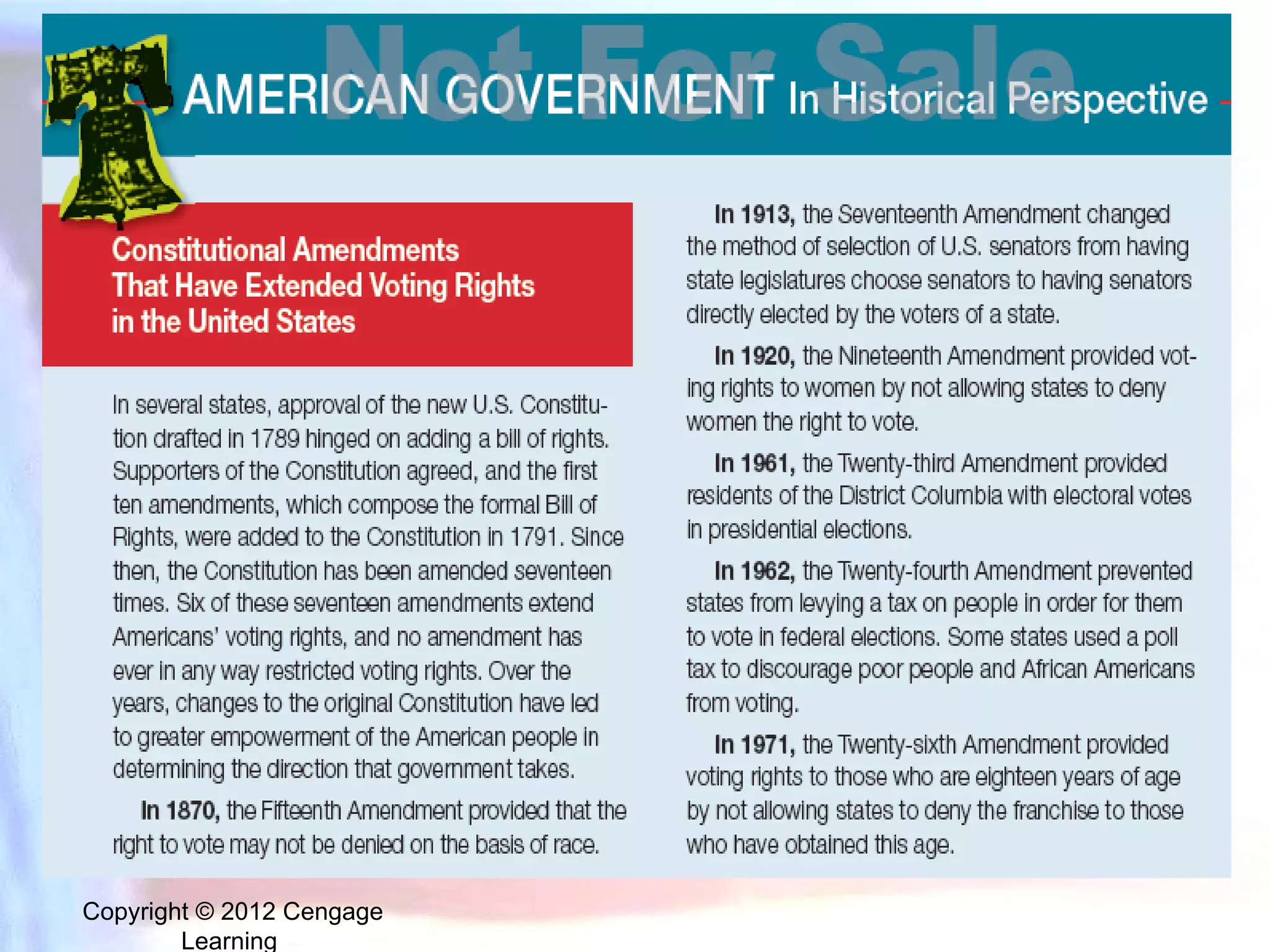
CHAPTER 1: LEARNING OBJECTIVES Introduction to Perspectives on American Government Understand how issues and topics in American politics may be viewed from a variety of perspectives, including  Historical context,  Popular culture,  Views from others around the world, and  Views from college students Copyright © 2012 Cengage Learning
CHAPTER 1: LEARNING OBJECTIVES Forms and Functions of Government  Identify the philosophical underpinnings of the American political system through the exploration of important theories such as  The “social contract” theory and  The concept of the “natural law” Compare and contrast democracy with other forms of government Copyright © 2012 Cengage Learning
CHAPTER 1: LEARNING OBJECTIVES American Government and Politics  Explain the importance of the value of popular sovereignty, and how that value is realized through “representative democracy” in the United States Copyright © 2012 Cengage Learning
CHAPTER 1: LEARNING OBJECTIVES American Political Culture Define “political culture” and describe the unique combination of political beliefs and values that form the American political culture, including majority rule, liberty, limited government, diversity, individualism, and equality of economic opportunity Copyright © 2012 Cengage Learning
CHAPTER 1: LEARNING OBJECTIVES Is American Democracy on the Decline?  Assess the health of American democracy and evaluate whether the American system is in decline by reviewing trends in voter turnout, negativity in politics, the influence of money in policy outcomes, and the integrity of election outcomes Copyright © 2012 Cengage Learning
CHAPTER 1: LEARNING OBJECTIVES Historical, Popular, and Global Perspectives  Appreciate that the American political system is best studied from a variety of perspectives, including historical, popular, and global Copyright © 2012 Cengage Learning
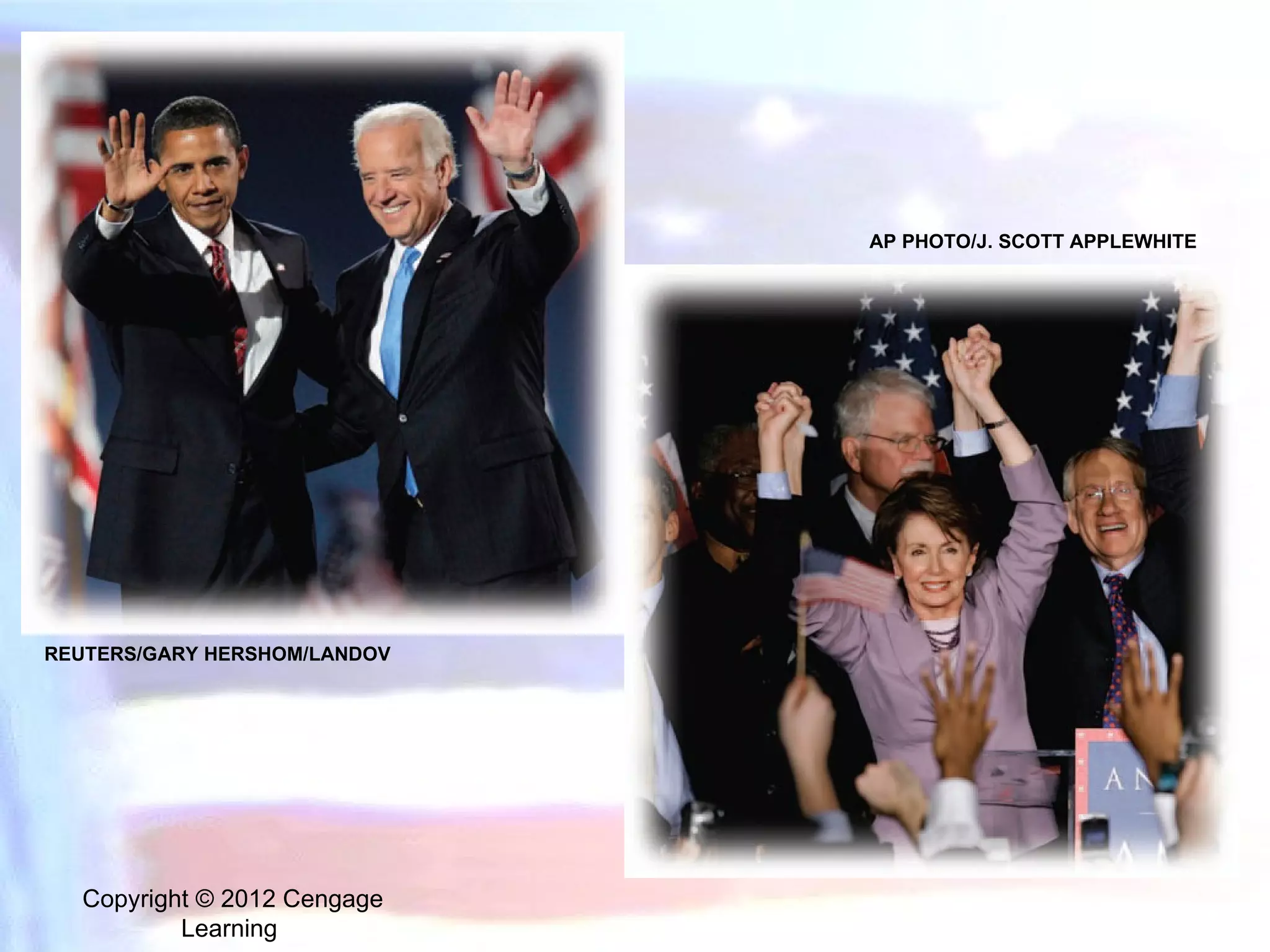
Copyright © 2012 Cengage Learning  REUTERS/GARY HERSHOM/LANDOV AP PHOTO/J. SCOTT APPLEWHITE
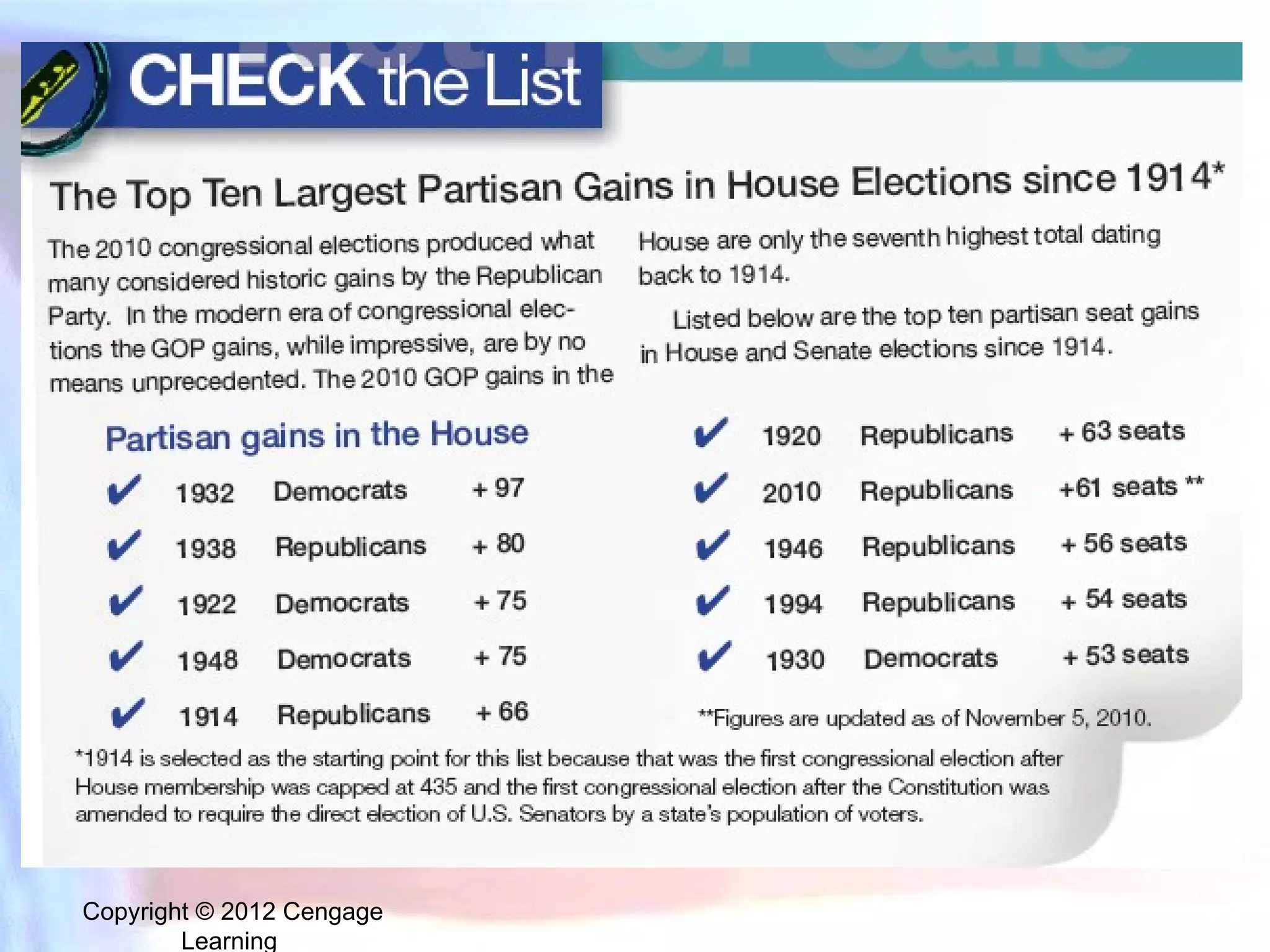
PLACING THE 2010 MIDTERM ELECTIONS INTO PERSPECTIVE The Republican Party achieved a major victory in the 2010 congressional elections—picked up over 60 House seats and a majority once again Also picked up 6 Senate seats Slicing the Democratic margin of control from 18 to 6 Copyright © 2012 Cengage Learning
PLACING THE 2010 MIDTERM ELECTIONS INTO PERSPECTIVE What undercurrents of popular opinion could possibly produce such an abrupt change of course?  Did 2010 mark a historically unprecedented midterm election outcome? How schizophrenic does the American electorate appear to the rest of the world? Can anybody predict what lies ahead for the 2012 presidential election? Copyright © 2012 Cengage Learning
Copyright © 2012 Cengage Learning
FORMS AND FUNCTIONS OF GOVERNMENT Government:   collection of public institutions that establish and enforce the rules by which the members must live Anarchy:  lawlessness and discord in the political system S ocial contract:  agreement to form a government and abide by its rules Copyright © 2012 Cengage Learning
FORMS AND FUNCTIONS OF GOVERNMENT Different forms of government - Democracy:  the people, either directly [ direct democracy ], or  Through elected representatives [ indirect democracy ], hold power and authority Copyright © 2012 Cengage Learning
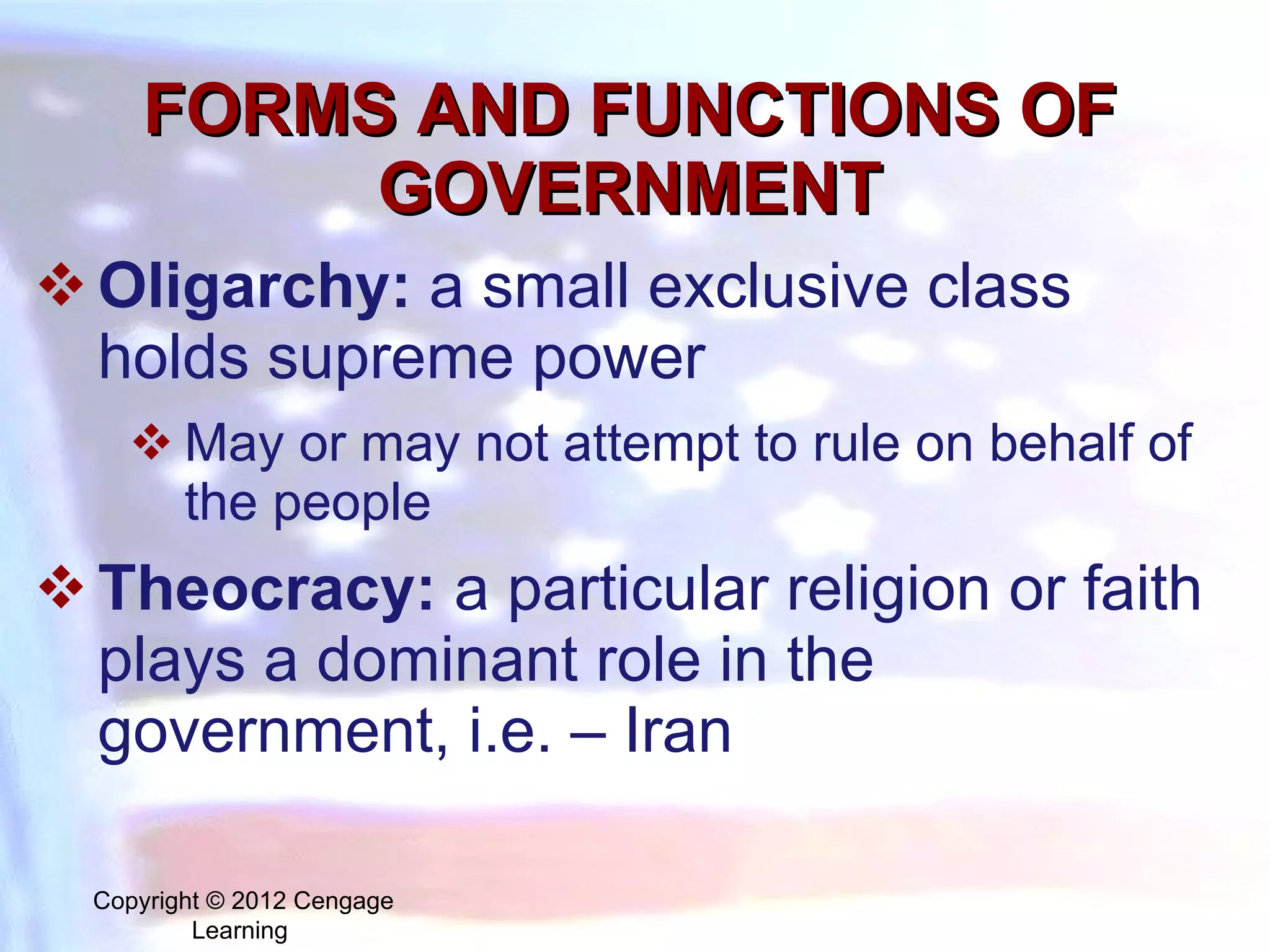
FORMS AND FUNCTIONS OF GOVERNMENT O ligarchy:   a small exclusive class holds supreme power  May or may not attempt to rule on behalf of the people Theocracy:  a particular religion or faith plays a dominant role in the government, i.e. – Iran Copyright © 2012 Cengage Learning
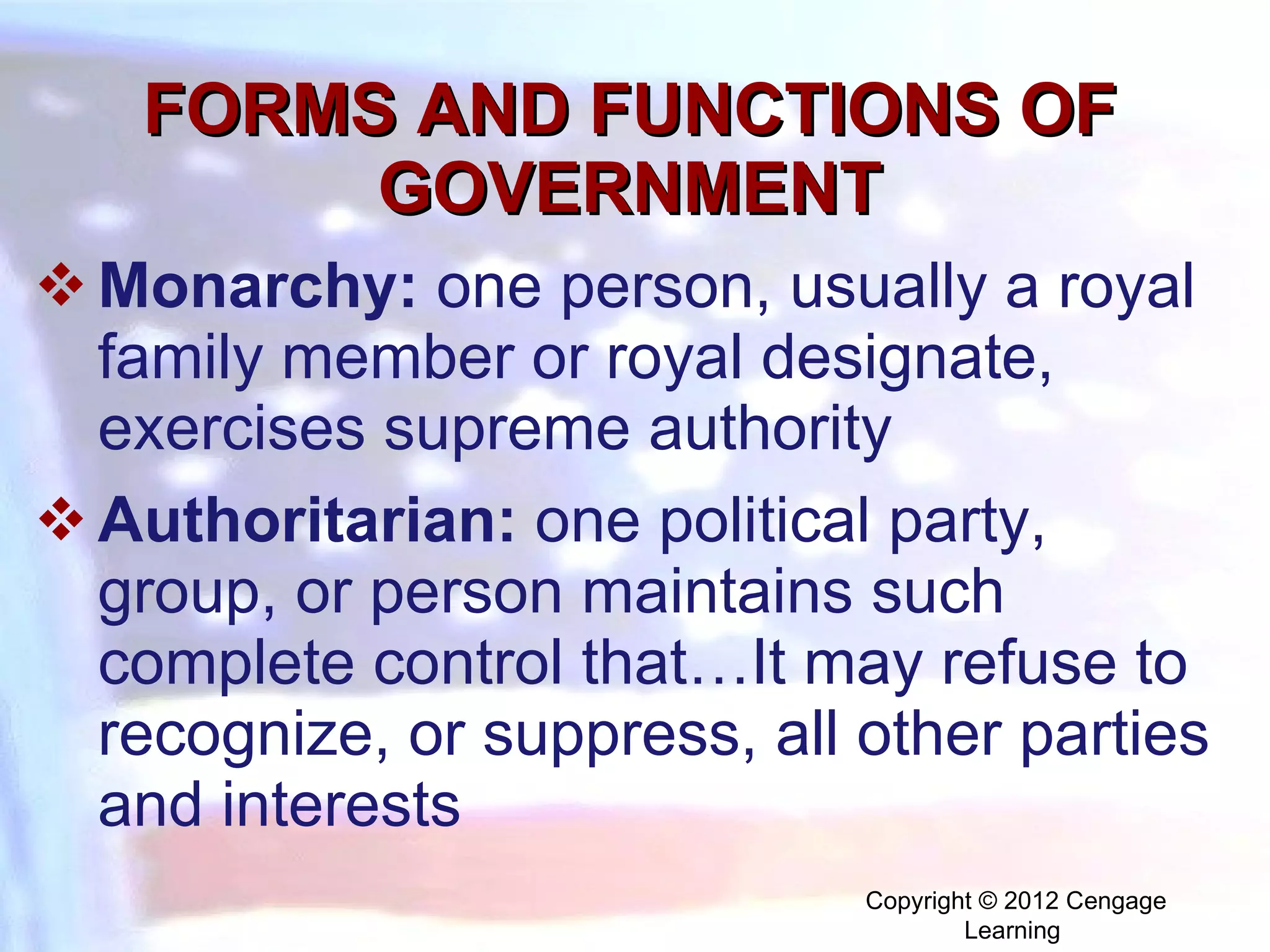
FORMS AND FUNCTIONS OF GOVERNMENT M onarchy:   one person, usually a royal family member or royal designate, exercises supreme authority Authoritarian:   one political party, group, or person maintains such complete control that…It may refuse to recognize, or suppress, all other parties and interests Copyright © 2012 Cengage Learning
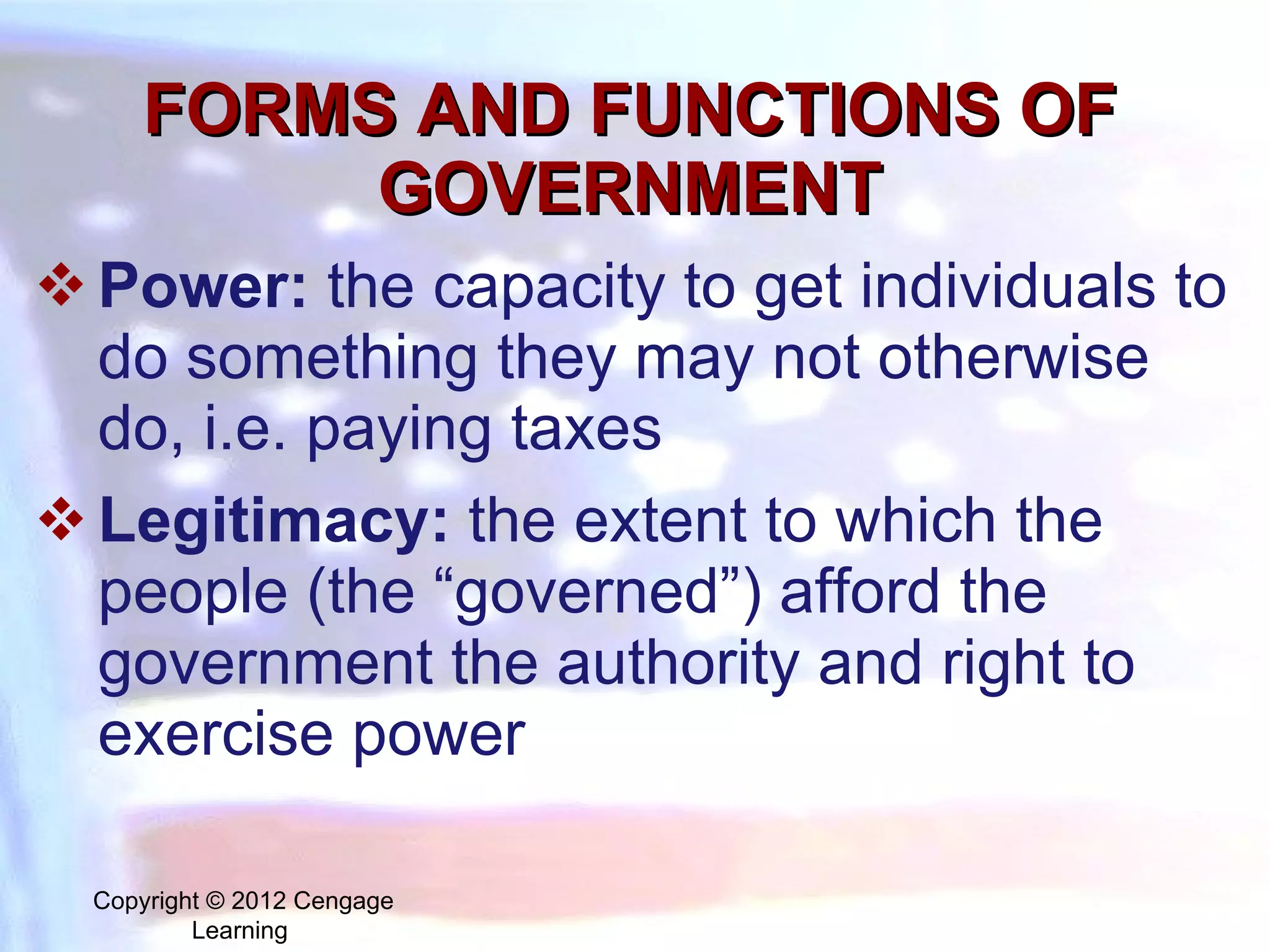
FORMS AND FUNCTIONS OF GOVERNMENT Power:   the capacity to get individuals to do something they may not otherwise do, i.e. paying taxes Legitimacy:   the extent to which the people (the “governed”) afford the government the authority and right to exercise power Copyright © 2012 Cengage Learning
Copyright © 2012 Cengage Learning
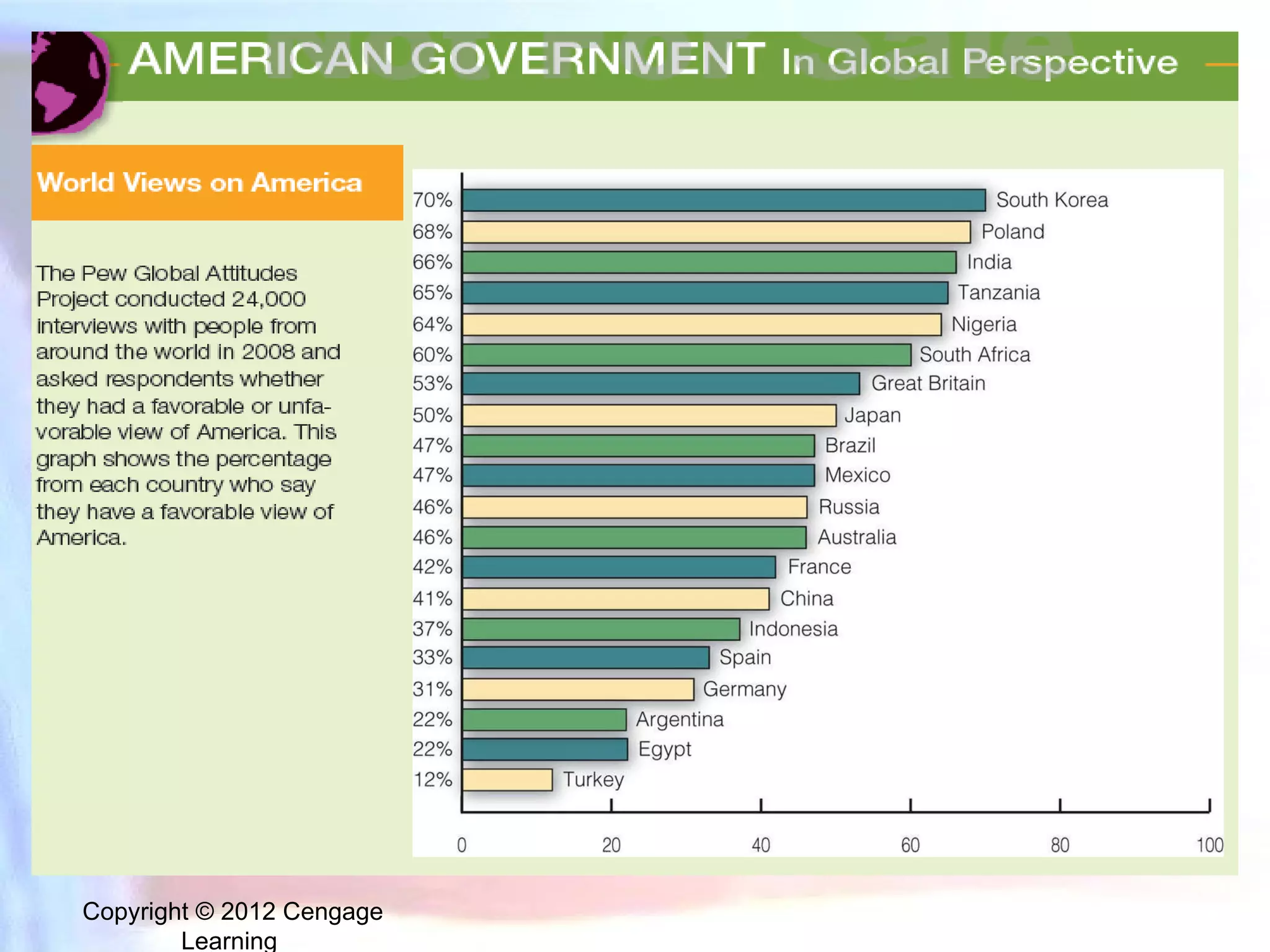
AMERICAN GOVERNMENT… IN GLOBAL PERSPECTIVE What trends do you notice in world opinion about the United States? Can you identify why certain regions of the world, or certain countries in particular, have higher or lower regard for the United States? Copyright © 2012 Cengage Learning
AMERICAN GOVERNMENT AND POLITICS Politics:   way in which institutions of government are organized to make laws, rules, and policies, and  How those institutions are influenced  Political scientist Harold Lasswell’s definition  “ Who gets what, when and how” Copyright © 2012 Cengage Learning
AMERICAN GOVERNMENT AND POLITICS Political philosopher John Locke proposed that people are born with  natural rights —derived from  natural law  R ules of conduct inherent in the relationship among human beings, and  More fundamental than any law that a governing authority might make Copyright © 2012 Cengage Learning
AMERICAN GOVERNMENT AND POLITICS Government cannot violate these natural rights—life, liberty, and property Government must be based on the “ consent of the governed ”—Citizens choose their government and its leaders It maintains legitimacy as long as the government respects the natural rights of individuals Copyright © 2012 Cengage Learning
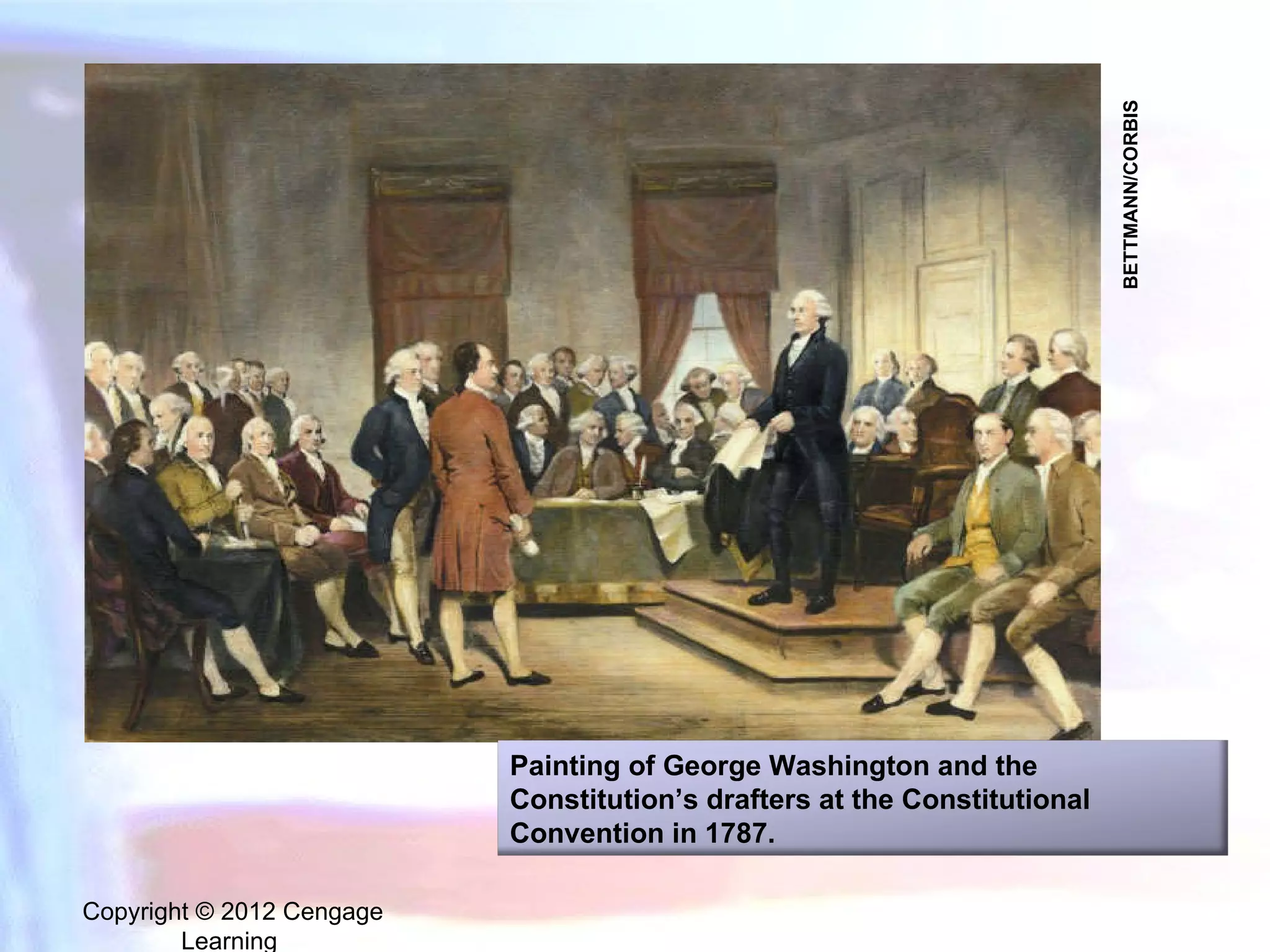
Copyright © 2012 Cengage Learning  BETTMANN/CORBIS Painting of George Washington and the Constitution’s drafters at the Constitutional Convention in 1787.
AMERICAN GOVERNMENT AND POLITICS With the first three words of the Constitution, “We the People” The Framers acknowledged that the ultimate source of power rests with the people— p opular sovereignty This “popular perspective” frames our understanding of how the U.S. government works Copyright © 2012 Cengage Learning
Copyright © 2012 Cengage Learning
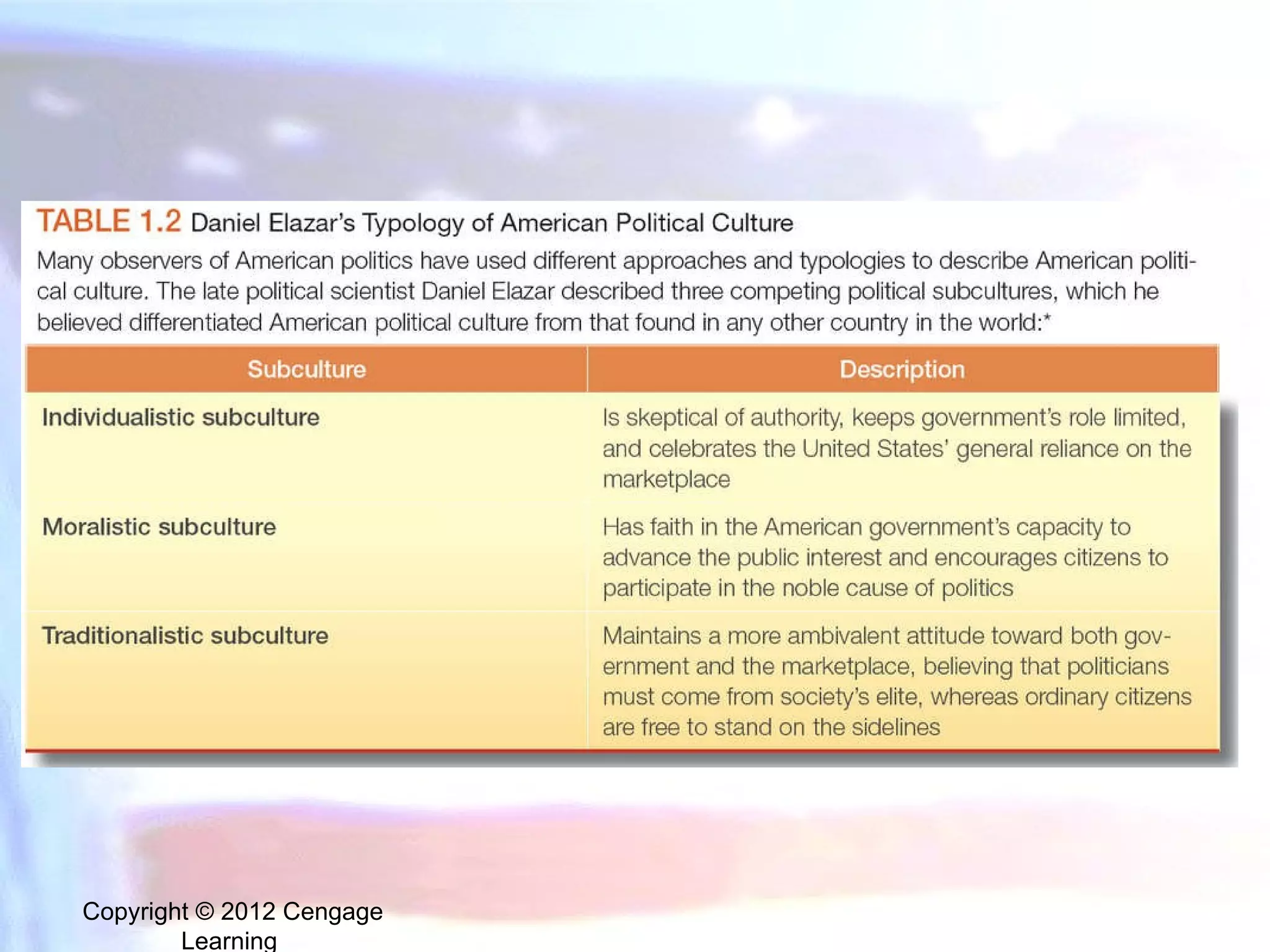
AMERICAN POLITICAL CULTURE Political culture:   widely held core values about the role of government and its operations and institutions  The essence of how a society thinks politically Transmitted from one generation to the next, and has an enduring influence on the politics of a nation Copyright © 2012 Cengage Learning
AMERICAN POLITICAL CULTURE Circumstances surrounding America’s first and current immigrants, and great ideas by enlightenment philosophers  Form the core set of values that define the American political culture One of the core values is  majority rule  Belief that the “will of the people” ought to guide public policy Copyright © 2012 Cengage Learning
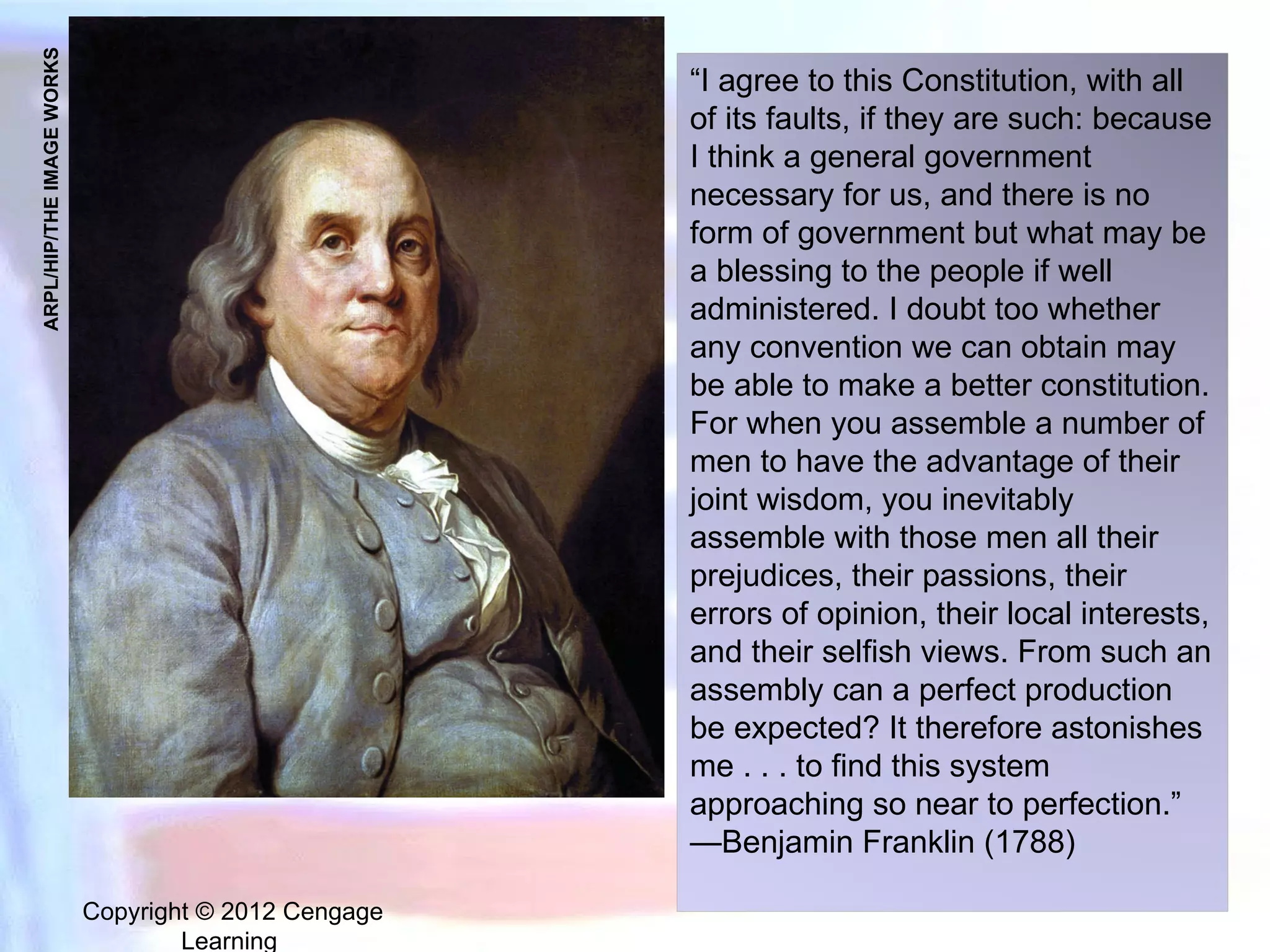
Copyright © 2012 Cengage Learning  ARPL/HIP/THE IMAGE WORKS “I agree to this Constitution, with all of its faults, if they are such: because I think a general government necessary for us, and there is no form of government but what may be a blessing to the people if well administered. I doubt too whether any convention we can obtain may be able to make a better constitution. For when you assemble a number of men to have the advantage of their joint wisdom, you inevitably assemble with those men all their prejudices, their passions, their errors of opinion, their local interests, and their selfish views. From such an assembly can a perfect production be expected? It therefore astonishes me . . . to find this system approaching so near to perfection.” —Benjamin Franklin (1788)
AMERICAN POLITICAL CULTURE Another core value in the American political culture is  minority rights   Rights and liberties that can’t be taken away by government Rights to speak freely, to choose a religion, or not to practice religion, are among the many liberties protected by the Bill of Rights Copyright © 2012 Cengage Learning
AMERICAN POLITICAL CULTURE Another core value in the American political culture is  limited government  Americans have generally supported Thomas Jefferson’s belief that—“the government that governs least governs best” Problems that may be solved without government should be solved that way Copyright © 2012 Cengage Learning
AMERICAN POLITICAL CULTURE Americans also generally believe that individuals are primarily responsible for their lot in life— individualism Individualism promotes another core value— equality of opportunity   Everyone should be given the same opportunity to achieve success Copyright © 2012 Cengage Learning
Copyright © 2012 Cengage Learning
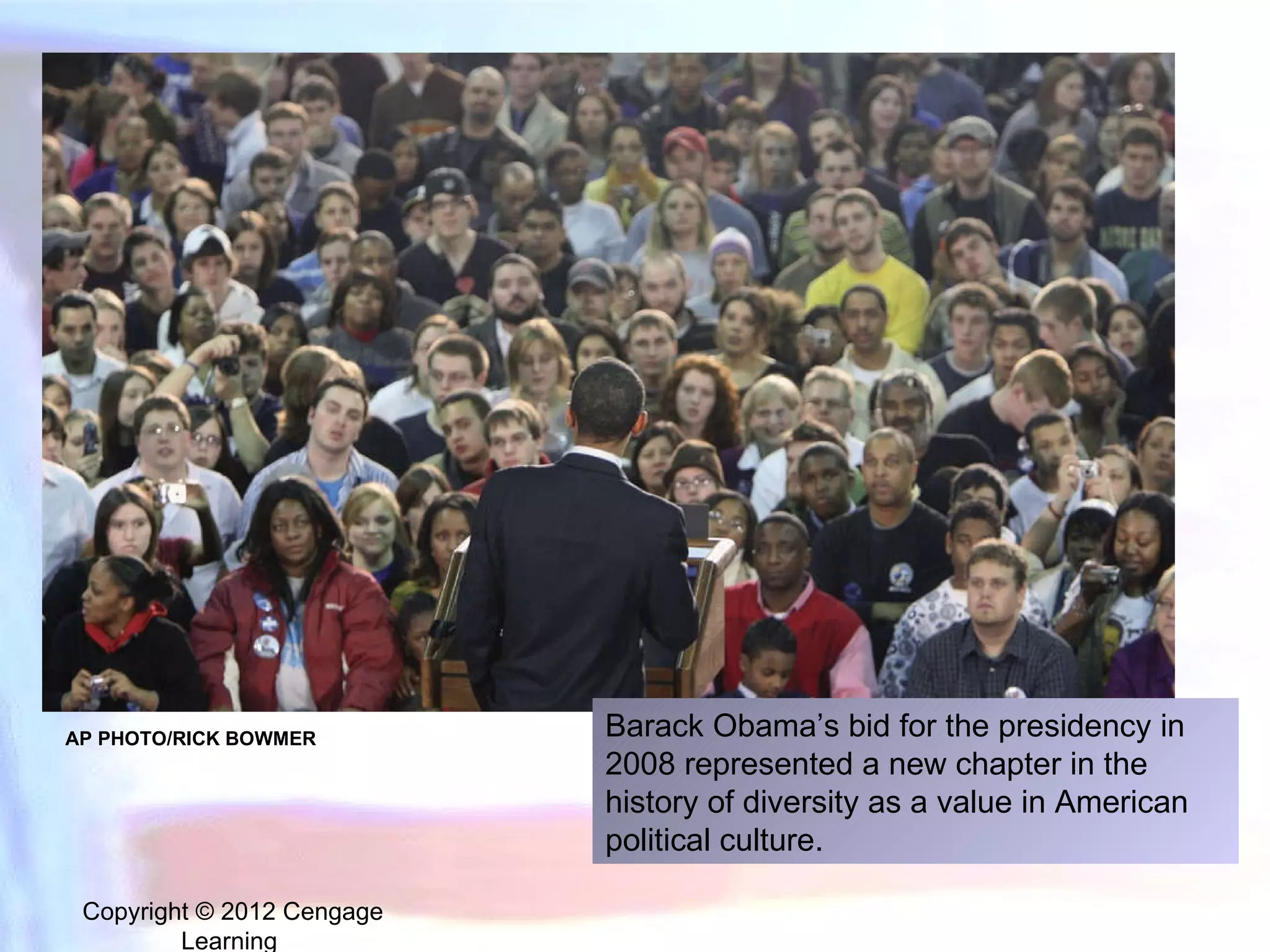
Copyright © 2012 Cengage Learning  Barack Obama’s bid for the presidency in 2008 represented a new chapter in the history of diversity as a value in American political culture. AP PHOTO/RICK BOWMER
IS AMERICAN DEMOCRACY ON THE DECLINE? The Case For and Against Decline The decline in voter turnout The 2000 presidential election crisis The suspension of civil liberties to protect national security The disproportionate influence of money and wealth on politics Copyright © 2012 Cengage Learning
Copyright © 2012 Cengage Learning  © 2012 CENGAGE LEARNING
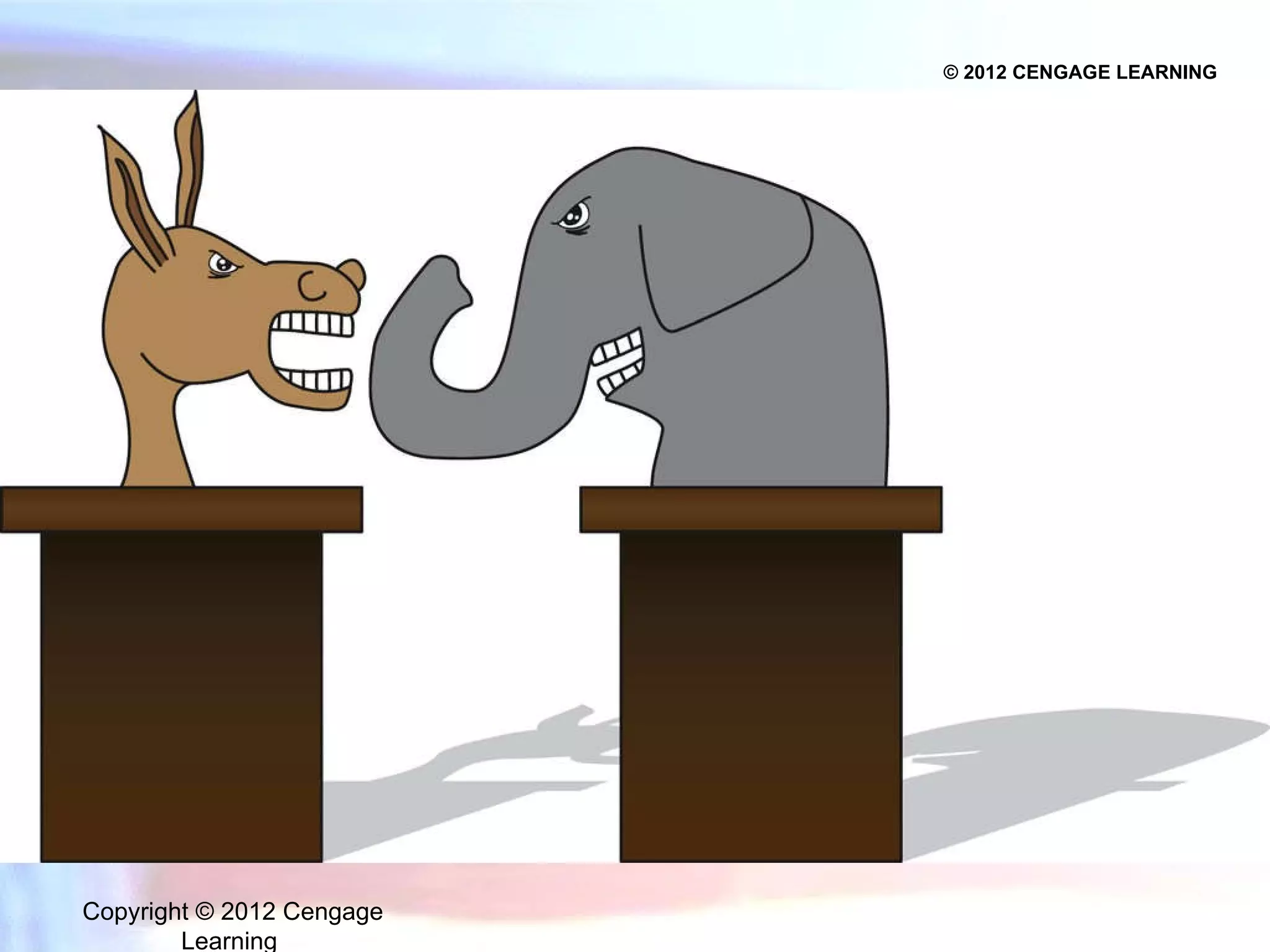
IS AMERICAN DEMOCRACY ON THE DECLINE? Politics that are more negative and conflictual The “red” state/“blue” state divide If we examine these characteristics with some historical perspective It is possible to draw quite different conclusions Copyright © 2012 Cengage Learning
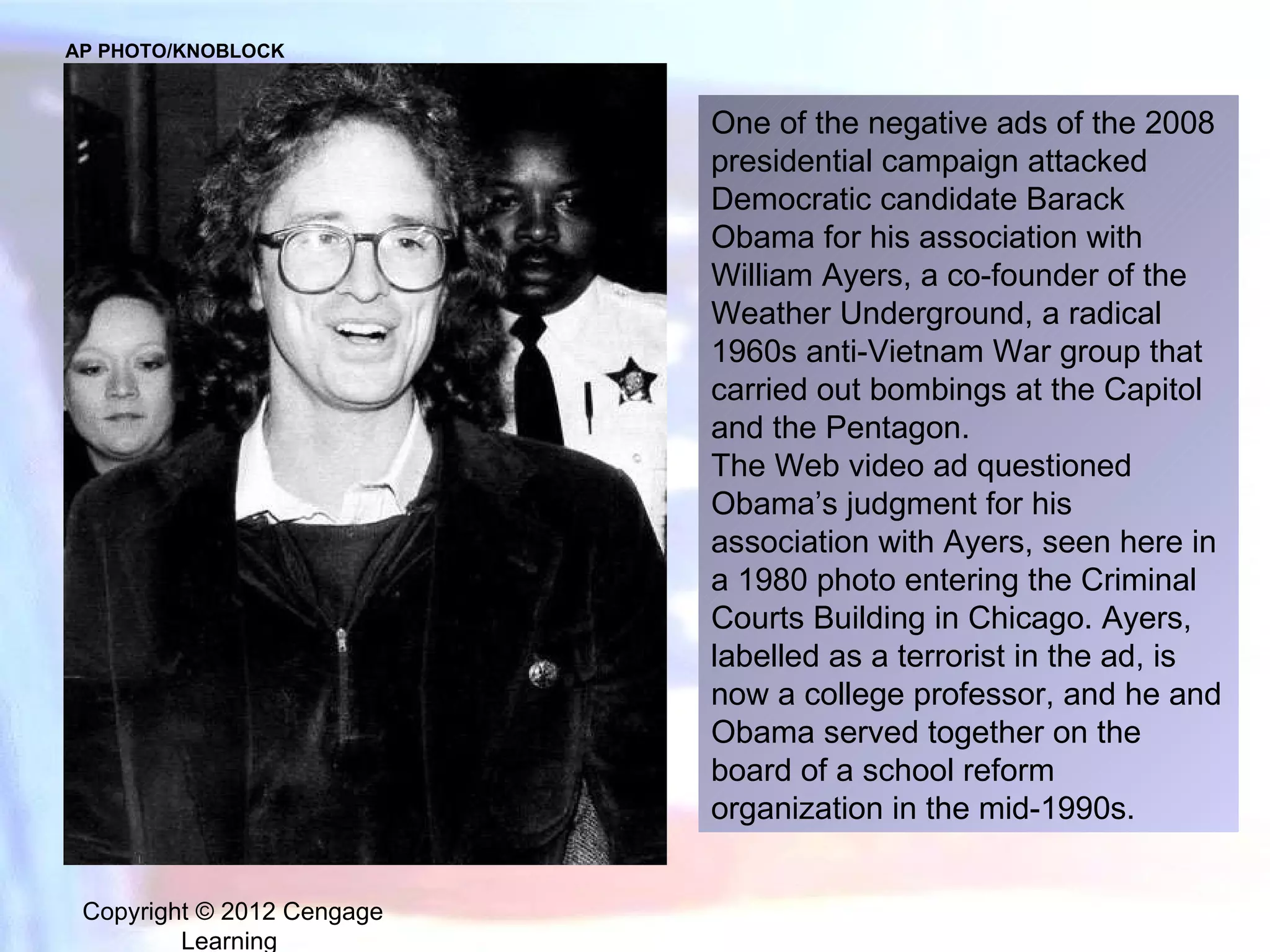
Copyright © 2012 Cengage Learning  One of the negative ads of the 2008 presidential campaign attacked Democratic candidate Barack Obama for his association with William Ayers, a co-founder of the Weather Underground, a radical 1960s anti-Vietnam War group that carried out bombings at the Capitol and the Pentagon.  The Web video ad questioned Obama’s judgment for his association with Ayers, seen here in a 1980 photo entering the Criminal Courts Building in Chicago. Ayers, labelled as a terrorist in the ad, is now a college professor, and he and Obama served together on the board of a school reform organization in the mid-1990s. AP PHOTO/KNOBLOCK
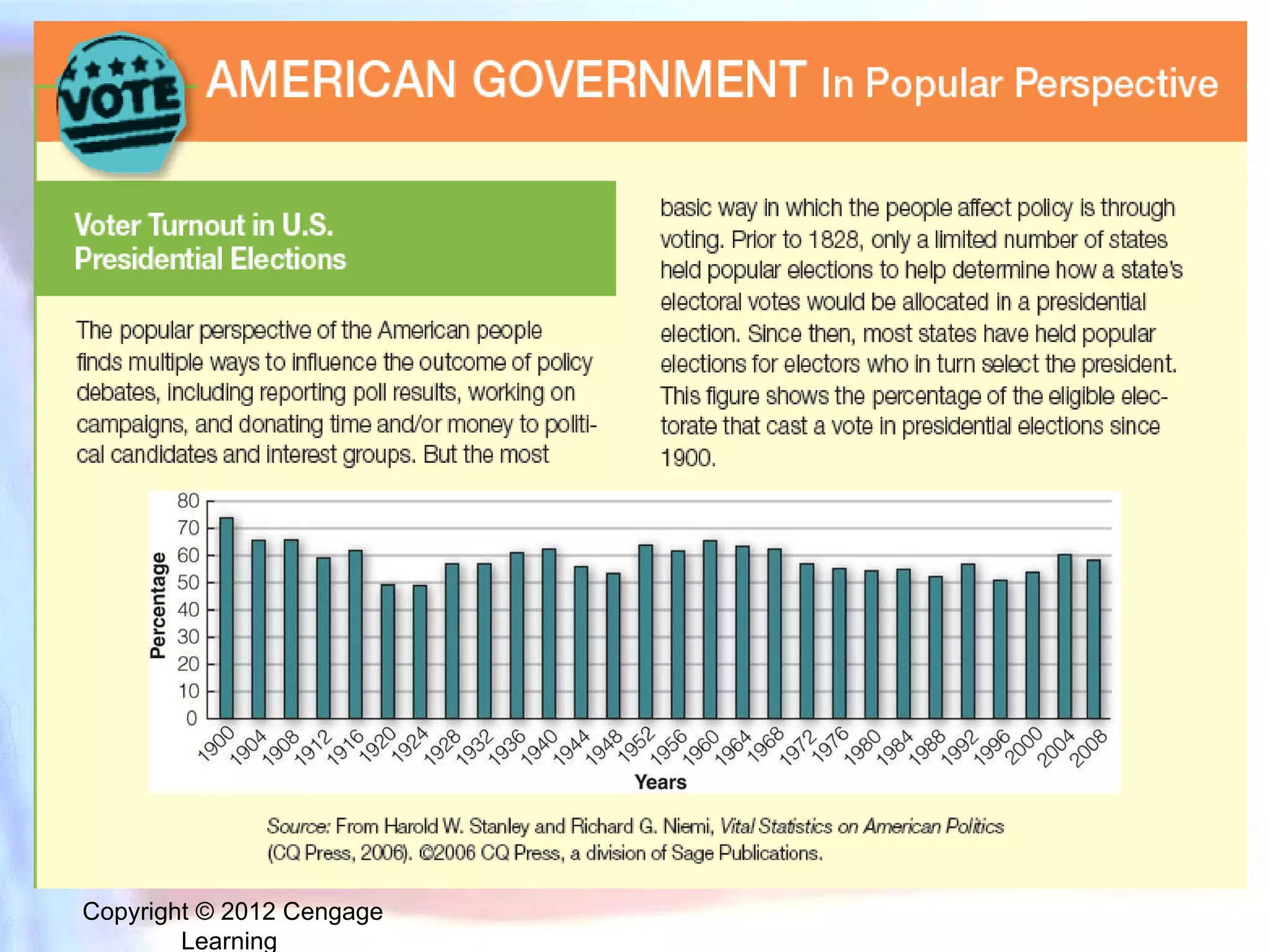
AMERICAN GOVERNMENT… IN POPULAR PERSPECTIVE VOTER TURNOUT IN U.S. PRESIDENTIAL ELECTIONS Before 1828, only a few states held popular elections to determine how a state’s electoral votes would be allocated  Since then, most states have popular elections for electors who in turn select the president Copyright © 2012 Cengage Learning
Copyright © 2012 Cengage Learning
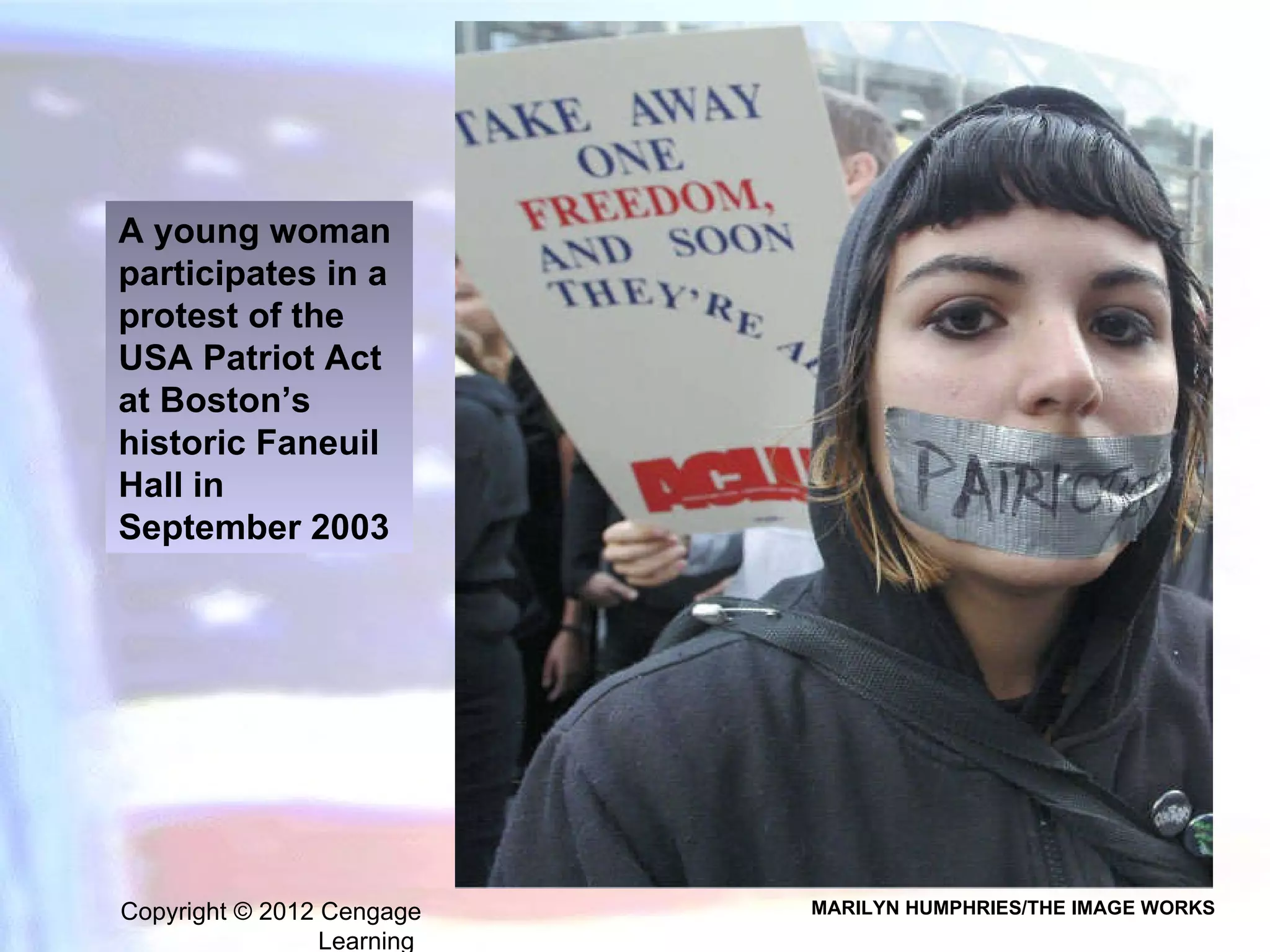
Copyright © 2012 Cengage Learning  A young woman participates in a protest of the USA Patriot Act at Boston’s historic Faneuil Hall in September 2003 MARILYN HUMPHRIES/THE IMAGE WORKS
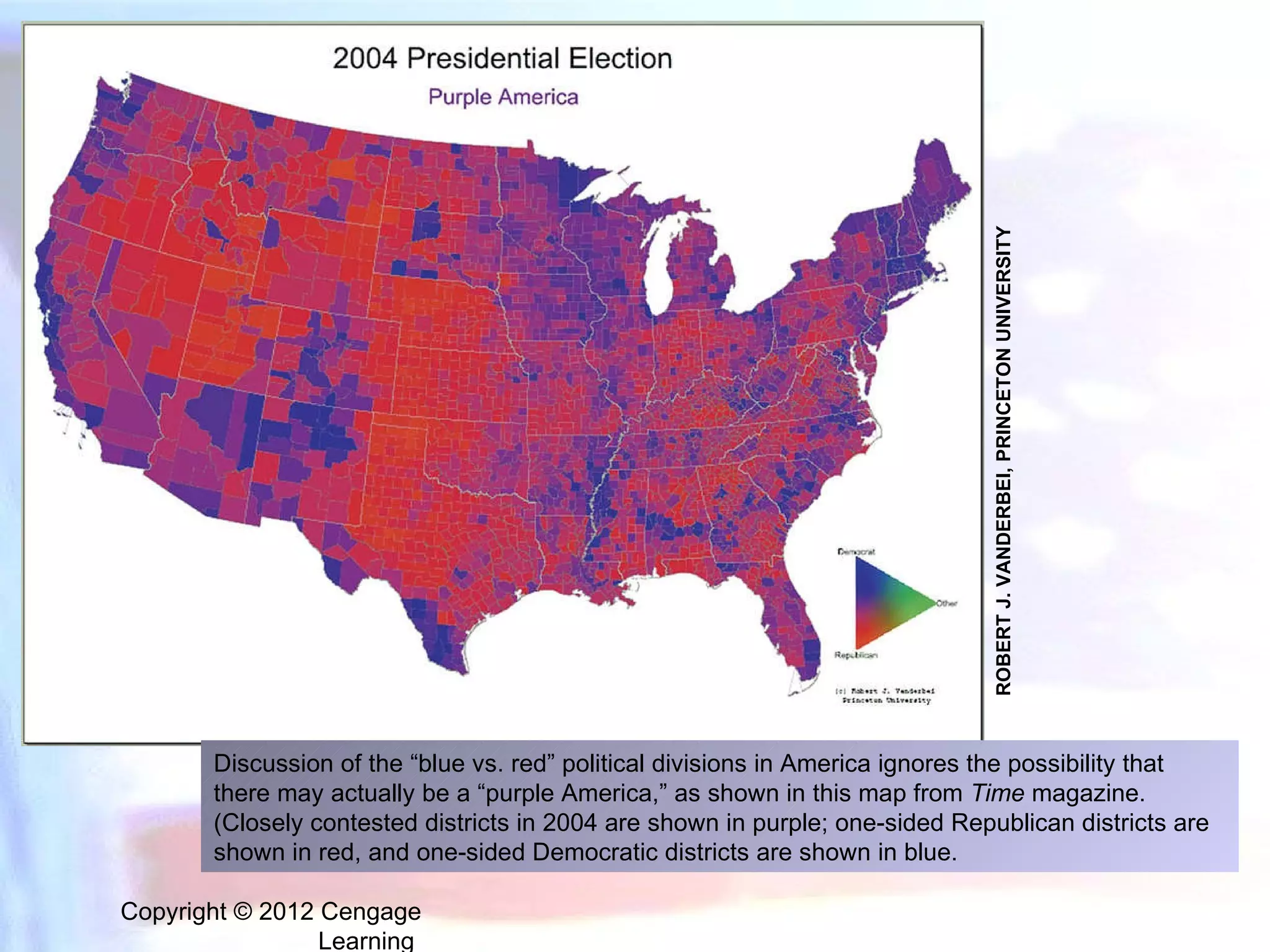
Copyright © 2012 Cengage Learning  Discussion of the “blue vs. red” political divisions in America ignores the possibility that there may actually be a “purple America,” as shown in this map from  Time  magazine. (Closely contested districts in 2004 are shown in purple; one-sided Republican districts are shown in red, and one-sided Democratic districts are shown in blue. ROBERT J. VANDERBEI, PRINCETON UNIVERSITY
HISTORICAL, POPULAR, AND GLOBAL PERSPECTIVES History can identify patterns, recurring problems, and trends in U.S. politics The popular perspective shows how the will of the people impacts U.S. politics A global perspective offers insights into how people around the world perceive American government Copyright © 2012 Cengage Learning
POLITICS INTERACTIVE! THE POLITICS OF NEGATIVITY? I n 2008, candidates were accused of being celebrities, liars, plagiarists, adulterers, and terrorist supporters www.factcheck.org, Annenberg School at the University of Pennsylvania, is an antidote to some of the negativity and misrepresentation Copyright © 2012 Cengage Learning
Copyright © 2012 Cengage Learning  © 2012 CENGAGE LEARNING
POLITICS INTERACTIVE! www.cengage.com/dautrich/americangovernment/2e Find the politics interactive link for details and examples of negative campaigning in American politics Consult as well the various links that relate to negativity in American politics in historical, popular, and global perspectives Copyright © 2012 Cengage Learning
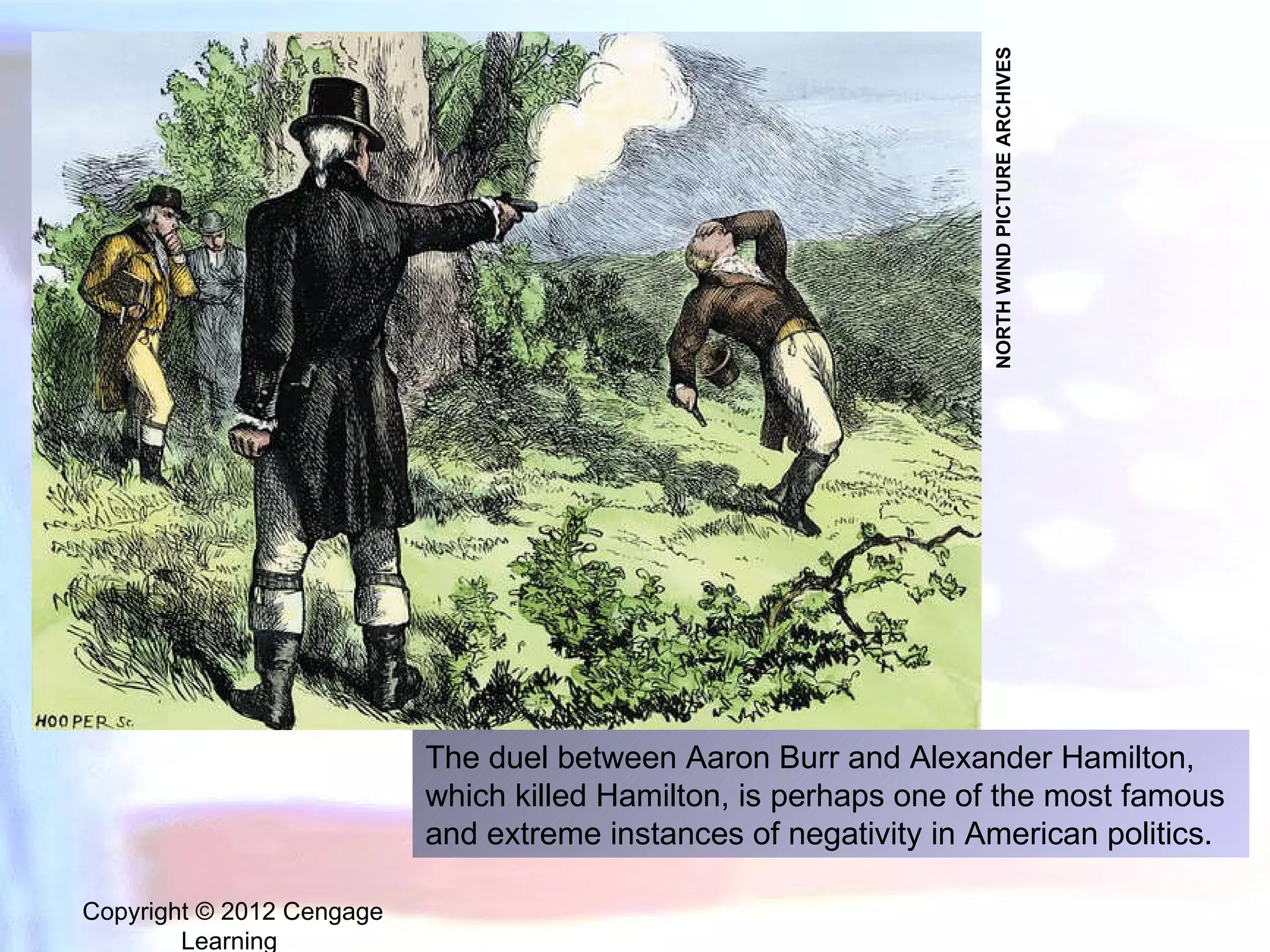
Copyright © 2012 Cengage Learning  The duel between Aaron Burr and Alexander Hamilton, which killed Hamilton, is perhaps one of the most famous and extreme instances of negativity in American politics. NORTH WIND PICTURE ARCHIVES

Chapter1

  • 1.
  • 2.
    CHAPTER 1: LEARNINGOBJECTIVES Introduction to Perspectives on American Government Understand how issues and topics in American politics may be viewed from a variety of perspectives, including Historical context, Popular culture, Views from others around the world, and Views from college students Copyright © 2012 Cengage Learning
  • 3.
    CHAPTER 1: LEARNINGOBJECTIVES Forms and Functions of Government Identify the philosophical underpinnings of the American political system through the exploration of important theories such as The “social contract” theory and The concept of the “natural law” Compare and contrast democracy with other forms of government Copyright © 2012 Cengage Learning
  • 4.
    CHAPTER 1: LEARNINGOBJECTIVES American Government and Politics Explain the importance of the value of popular sovereignty, and how that value is realized through “representative democracy” in the United States Copyright © 2012 Cengage Learning
  • 5.
    CHAPTER 1: LEARNINGOBJECTIVES American Political Culture Define “political culture” and describe the unique combination of political beliefs and values that form the American political culture, including majority rule, liberty, limited government, diversity, individualism, and equality of economic opportunity Copyright © 2012 Cengage Learning
  • 6.
    CHAPTER 1: LEARNINGOBJECTIVES Is American Democracy on the Decline? Assess the health of American democracy and evaluate whether the American system is in decline by reviewing trends in voter turnout, negativity in politics, the influence of money in policy outcomes, and the integrity of election outcomes Copyright © 2012 Cengage Learning
  • 7.
    CHAPTER 1: LEARNINGOBJECTIVES Historical, Popular, and Global Perspectives Appreciate that the American political system is best studied from a variety of perspectives, including historical, popular, and global Copyright © 2012 Cengage Learning
  • 8.
    Copyright © 2012 CengageLearning REUTERS/GARY HERSHOM/LANDOV AP PHOTO/J. SCOTT APPLEWHITE
  • 9.
    PLACING THE 2010MIDTERM ELECTIONS INTO PERSPECTIVE The Republican Party achieved a major victory in the 2010 congressional elections—picked up over 60 House seats and a majority once again Also picked up 6 Senate seats Slicing the Democratic margin of control from 18 to 6 Copyright © 2012 Cengage Learning
  • 10.
    PLACING THE 2010MIDTERM ELECTIONS INTO PERSPECTIVE What undercurrents of popular opinion could possibly produce such an abrupt change of course? Did 2010 mark a historically unprecedented midterm election outcome? How schizophrenic does the American electorate appear to the rest of the world? Can anybody predict what lies ahead for the 2012 presidential election? Copyright © 2012 Cengage Learning
  • 11.
  • 12.
    FORMS AND FUNCTIONSOF GOVERNMENT Government: collection of public institutions that establish and enforce the rules by which the members must live Anarchy: lawlessness and discord in the political system S ocial contract: agreement to form a government and abide by its rules Copyright © 2012 Cengage Learning
  • 13.
    FORMS AND FUNCTIONSOF GOVERNMENT Different forms of government - Democracy: the people, either directly [ direct democracy ], or Through elected representatives [ indirect democracy ], hold power and authority Copyright © 2012 Cengage Learning
  • 14.
    FORMS AND FUNCTIONSOF GOVERNMENT O ligarchy: a small exclusive class holds supreme power May or may not attempt to rule on behalf of the people Theocracy: a particular religion or faith plays a dominant role in the government, i.e. – Iran Copyright © 2012 Cengage Learning
  • 15.
    FORMS AND FUNCTIONSOF GOVERNMENT M onarchy: one person, usually a royal family member or royal designate, exercises supreme authority Authoritarian: one political party, group, or person maintains such complete control that…It may refuse to recognize, or suppress, all other parties and interests Copyright © 2012 Cengage Learning
  • 16.
    FORMS AND FUNCTIONSOF GOVERNMENT Power: the capacity to get individuals to do something they may not otherwise do, i.e. paying taxes Legitimacy: the extent to which the people (the “governed”) afford the government the authority and right to exercise power Copyright © 2012 Cengage Learning
  • 17.
  • 18.
  • 19.
    AMERICAN GOVERNMENT… INGLOBAL PERSPECTIVE What trends do you notice in world opinion about the United States? Can you identify why certain regions of the world, or certain countries in particular, have higher or lower regard for the United States? Copyright © 2012 Cengage Learning
  • 20.
    AMERICAN GOVERNMENT ANDPOLITICS Politics: way in which institutions of government are organized to make laws, rules, and policies, and How those institutions are influenced Political scientist Harold Lasswell’s definition “ Who gets what, when and how” Copyright © 2012 Cengage Learning
  • 21.
    AMERICAN GOVERNMENT ANDPOLITICS Political philosopher John Locke proposed that people are born with natural rights —derived from natural law R ules of conduct inherent in the relationship among human beings, and More fundamental than any law that a governing authority might make Copyright © 2012 Cengage Learning
  • 22.
    AMERICAN GOVERNMENT ANDPOLITICS Government cannot violate these natural rights—life, liberty, and property Government must be based on the “ consent of the governed ”—Citizens choose their government and its leaders It maintains legitimacy as long as the government respects the natural rights of individuals Copyright © 2012 Cengage Learning
  • 23.
    Copyright © 2012 CengageLearning BETTMANN/CORBIS Painting of George Washington and the Constitution’s drafters at the Constitutional Convention in 1787.
  • 24.
    AMERICAN GOVERNMENT ANDPOLITICS With the first three words of the Constitution, “We the People” The Framers acknowledged that the ultimate source of power rests with the people— p opular sovereignty This “popular perspective” frames our understanding of how the U.S. government works Copyright © 2012 Cengage Learning
  • 25.
  • 26.
    AMERICAN POLITICAL CULTUREPolitical culture: widely held core values about the role of government and its operations and institutions The essence of how a society thinks politically Transmitted from one generation to the next, and has an enduring influence on the politics of a nation Copyright © 2012 Cengage Learning
  • 27.
    AMERICAN POLITICAL CULTURECircumstances surrounding America’s first and current immigrants, and great ideas by enlightenment philosophers Form the core set of values that define the American political culture One of the core values is majority rule Belief that the “will of the people” ought to guide public policy Copyright © 2012 Cengage Learning
  • 28.
    Copyright © 2012 CengageLearning ARPL/HIP/THE IMAGE WORKS “I agree to this Constitution, with all of its faults, if they are such: because I think a general government necessary for us, and there is no form of government but what may be a blessing to the people if well administered. I doubt too whether any convention we can obtain may be able to make a better constitution. For when you assemble a number of men to have the advantage of their joint wisdom, you inevitably assemble with those men all their prejudices, their passions, their errors of opinion, their local interests, and their selfish views. From such an assembly can a perfect production be expected? It therefore astonishes me . . . to find this system approaching so near to perfection.” —Benjamin Franklin (1788)
  • 29.
    AMERICAN POLITICAL CULTUREAnother core value in the American political culture is minority rights Rights and liberties that can’t be taken away by government Rights to speak freely, to choose a religion, or not to practice religion, are among the many liberties protected by the Bill of Rights Copyright © 2012 Cengage Learning
  • 30.
    AMERICAN POLITICAL CULTUREAnother core value in the American political culture is limited government Americans have generally supported Thomas Jefferson’s belief that—“the government that governs least governs best” Problems that may be solved without government should be solved that way Copyright © 2012 Cengage Learning
  • 31.
    AMERICAN POLITICAL CULTUREAmericans also generally believe that individuals are primarily responsible for their lot in life— individualism Individualism promotes another core value— equality of opportunity Everyone should be given the same opportunity to achieve success Copyright © 2012 Cengage Learning
  • 32.
  • 33.
    Copyright © 2012 CengageLearning Barack Obama’s bid for the presidency in 2008 represented a new chapter in the history of diversity as a value in American political culture. AP PHOTO/RICK BOWMER
  • 34.
    IS AMERICAN DEMOCRACYON THE DECLINE? The Case For and Against Decline The decline in voter turnout The 2000 presidential election crisis The suspension of civil liberties to protect national security The disproportionate influence of money and wealth on politics Copyright © 2012 Cengage Learning
  • 35.
    Copyright © 2012 CengageLearning © 2012 CENGAGE LEARNING
  • 36.
    IS AMERICAN DEMOCRACYON THE DECLINE? Politics that are more negative and conflictual The “red” state/“blue” state divide If we examine these characteristics with some historical perspective It is possible to draw quite different conclusions Copyright © 2012 Cengage Learning
  • 37.
    Copyright © 2012 CengageLearning One of the negative ads of the 2008 presidential campaign attacked Democratic candidate Barack Obama for his association with William Ayers, a co-founder of the Weather Underground, a radical 1960s anti-Vietnam War group that carried out bombings at the Capitol and the Pentagon. The Web video ad questioned Obama’s judgment for his association with Ayers, seen here in a 1980 photo entering the Criminal Courts Building in Chicago. Ayers, labelled as a terrorist in the ad, is now a college professor, and he and Obama served together on the board of a school reform organization in the mid-1990s. AP PHOTO/KNOBLOCK
  • 38.
    AMERICAN GOVERNMENT… INPOPULAR PERSPECTIVE VOTER TURNOUT IN U.S. PRESIDENTIAL ELECTIONS Before 1828, only a few states held popular elections to determine how a state’s electoral votes would be allocated Since then, most states have popular elections for electors who in turn select the president Copyright © 2012 Cengage Learning
  • 39.
  • 40.
    Copyright © 2012 CengageLearning A young woman participates in a protest of the USA Patriot Act at Boston’s historic Faneuil Hall in September 2003 MARILYN HUMPHRIES/THE IMAGE WORKS
  • 41.
    Copyright © 2012 CengageLearning Discussion of the “blue vs. red” political divisions in America ignores the possibility that there may actually be a “purple America,” as shown in this map from Time magazine. (Closely contested districts in 2004 are shown in purple; one-sided Republican districts are shown in red, and one-sided Democratic districts are shown in blue. ROBERT J. VANDERBEI, PRINCETON UNIVERSITY
  • 42.
    HISTORICAL, POPULAR, ANDGLOBAL PERSPECTIVES History can identify patterns, recurring problems, and trends in U.S. politics The popular perspective shows how the will of the people impacts U.S. politics A global perspective offers insights into how people around the world perceive American government Copyright © 2012 Cengage Learning
  • 43.
    POLITICS INTERACTIVE! THEPOLITICS OF NEGATIVITY? I n 2008, candidates were accused of being celebrities, liars, plagiarists, adulterers, and terrorist supporters www.factcheck.org, Annenberg School at the University of Pennsylvania, is an antidote to some of the negativity and misrepresentation Copyright © 2012 Cengage Learning
  • 44.
    Copyright © 2012 CengageLearning © 2012 CENGAGE LEARNING
  • 45.
    POLITICS INTERACTIVE! www.cengage.com/dautrich/americangovernment/2eFind the politics interactive link for details and examples of negative campaigning in American politics Consult as well the various links that relate to negativity in American politics in historical, popular, and global perspectives Copyright © 2012 Cengage Learning
  • 46.
    Copyright © 2012 CengageLearning The duel between Aaron Burr and Alexander Hamilton, which killed Hamilton, is perhaps one of the most famous and extreme instances of negativity in American politics. NORTH WIND PICTURE ARCHIVES