American Government and Politics:  Deliberation, Democracy, and Citizenship Chapter Four E Pluribus Unum:  American Citizenship
Chapter Four:  Learning Objectives Describe the role of ideas and beliefs in what it means to be an American citizen Explain how immigration policy has changed over time and the controversies over assimilation that larger-scale immigration has spawned
Chapter Four:  Learning Objectives Explain how controversies over citizenship affected free blacks before the Civil War and Native Americans Identify the requirements that Congress has imposed for the naturalization of foreigners
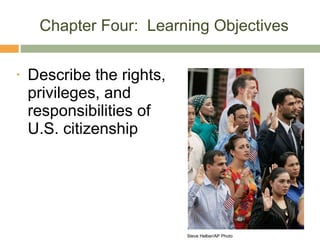
Chapter Four:  Learning Objectives Describe the rights, privileges, and responsibilities of U.S. citizenship Steve Helber/AP Photo
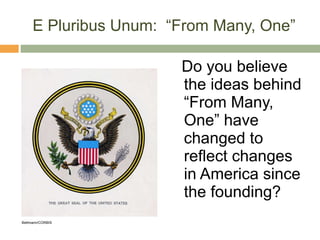
E Pluribus Unum:  “From Many, One” Do you believe the ideas behind “From Many, One” have changed to reflect changes in America since the founding? Bettmann/CORBIS
E Pluribus Unum:  Early Americans Characteristics of early America Vast, fertile land Common ancestry and religious background Shared language, customs, and manners Commitment to shared political beliefs
E Pluribus Unum:  Modern Americans Characteristics of modern America Diverse ethnic background and origin Multiple languages spoken, English dominates Diversity in religion, Christianity most prevalent Continued commitment to shared political beliefs
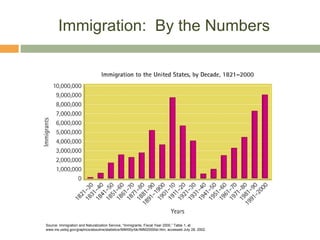
Immigration:  By the Numbers Source: Immigration and Naturalization Service, “Immigrants, Fiscal Year 2000,” Table 1, at www.ins.usdoj.gov/graphics/aboutins/statistics/IMM00yrbk/IMM2000list.htm, accessed July 28, 2002.
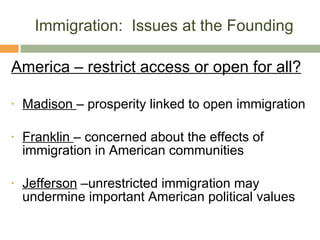
Immigration:  Issues at the Founding America – restrict access or open for all? Madison  – prosperity linked to open immigration Franklin  – concerned about the effects of immigration in American communities Jefferson  –unrestricted immigration may undermine important American political values
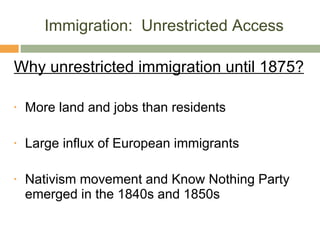
Immigration:  Unrestricted Access Why unrestricted immigration until 1875? More land and jobs than residents Large influx of European immigrants Nativism movement and Know Nothing Party emerged in the 1840s and 1850s
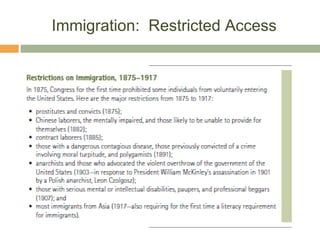
Immigration:  Restricted Access
Immigration:  Restricted Access What do you believe were reasons why our political leaders wanted to restrict immigration beginning in the late 18 th  century? Do you believe restricting immigration reflects the principles upon which our country was founded?
Immigration:  Modern Issues Features of modern immigration More immigration from Asia than ever before National origin quotas abolished in 1960s Recent decrease in number of refugees
Immigration:  Modern Issues Do you believe there are problems with legal immigration?  If so, what? Do you believe there are problems with illegal immigration? If so, what
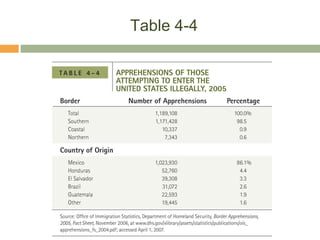
Immigration:  Modern Issues Issues related to illegal immigration As Table 4-4 demonstrates, illegal immigration occurs along all borders, although primarily along the Southern border How should the U.S. work to strengthen our borders and relationship with our neighboring countries to solve the problems of illegal immigration?
Table 4-4
Immigration:  Modern Issues Legal solutions to illegal immigration Immigration Reform and Control Act of 1986 Illegal Immigration Reform and Immigrant Responsibility Act of 1996 REAL ID Act of 2005 Secure Fence Act of 2006
Early Citizenship Controversies As the Constitution did not clearly define citizenship in the early years of our country, controversies emerged over the citizenship status of two groups:   1.  Free blacks before the Civil War  2.  Native Americans
Early Citizenship Controversies Free blacks before the Civil War How was citizenship for free blacks defined through the following actions of government? Missouri Compromise (1820) Seamen’s protection certificates Scott v. Sanford  (1857)
Early Citizenship Controversies Native Americans Treatment by British was based on situation The national government has always had the power to manage “all affairs with the Indians”
Early Citizenship Controversies What was the legal status of Native American tribes? Cherokee Nation v. Georgia  (1831) Worcester v. Georgia  (1832) Dawes Severalty Act (1887) Lone Wolf v. Hitchcock  (1903) Indian Citizenship Act (1924)
Acquiring American Citizenship There are two ways to become an American citizen: Through laws or treaties Through naturalization
Acquiring American Citizenship Citizenship through laws or treaties Louisiana Purchase Treaty (1803) Treaty of Guadalupe Hidalgo (1848) Practice has been upheld by the Supreme Court
Acquiring American Citizenship Citizenship through naturalization Naturalization Act of 1790 first law Some changes to requirements since 1795 -Eliminated race as a restriction -Language restrictions changed -Citizenship oath created
Pledges and Promises The citizenship oath Official oath adopted in 1929 Applicants for citizenship sign oath in a public ceremony Plan to update the oath in 2003 to simplify language was not approved
Acquiring American Citizenship What do you believe are some of the rights and responsibilities of American citizenship? The U.S.C.I.S. has defined some responsibilities of citizenship (page 120)
Myths and Misinformation Are Puerto Ricans American citizens? In a 2004 survey 41% of Americans correctly stated that Puerto Ricans are American citizens Puerto Ricans have been citizens since 1917 Puerto Rico functions much like a state – should it be granted statehood?
Expatriation How to become a non-citizen Voluntarily through expatriation Involuntarily through a variety of actions (page 123)
Assimilation:  Competing Ideas Two competing ideas in assimilation: 1.  The melting pot 2.  Multiculturalism
Assimilation:  The Melting Pot The melting pot Leave behind old identity Adopt new, common American identity What are some positive or negative aspects of the melting pot approach to assimilation?
Assimilation:  Multiculturalism Multiculturalism Emphasizes traditions from different cultures American culture benefits from diversity What are some positive or negative aspects of the multiculturalism approach to assimilation?
Citizenship and Deliberative Democracy What are some expectations of citizens? Loyalty to country and government Respect of laws and fellow citizens Obligation to participate in political process
Deliberation, Citizenship, and You Dual citizenship Dual citizenship prohibited until mid-twentieth century Four ways to claim dual citizenship (page 128) Do you believe dual citizenship should be allowed?  Why or why not?
Summary Citizenship has rights and responsibilities Defining citizenship in the U.S. has not always been clear-cut There have been and will continue to be debates over the assimilation of immigrants

Chapter4

  • 1.
    American Government andPolitics: Deliberation, Democracy, and Citizenship Chapter Four E Pluribus Unum: American Citizenship
  • 2.
    Chapter Four: Learning Objectives Describe the role of ideas and beliefs in what it means to be an American citizen Explain how immigration policy has changed over time and the controversies over assimilation that larger-scale immigration has spawned
  • 3.
    Chapter Four: Learning Objectives Explain how controversies over citizenship affected free blacks before the Civil War and Native Americans Identify the requirements that Congress has imposed for the naturalization of foreigners
  • 4.
    Chapter Four: Learning Objectives Describe the rights, privileges, and responsibilities of U.S. citizenship Steve Helber/AP Photo
  • 5.
    E Pluribus Unum: “From Many, One” Do you believe the ideas behind “From Many, One” have changed to reflect changes in America since the founding? Bettmann/CORBIS
  • 6.
    E Pluribus Unum: Early Americans Characteristics of early America Vast, fertile land Common ancestry and religious background Shared language, customs, and manners Commitment to shared political beliefs
  • 7.
    E Pluribus Unum: Modern Americans Characteristics of modern America Diverse ethnic background and origin Multiple languages spoken, English dominates Diversity in religion, Christianity most prevalent Continued commitment to shared political beliefs
  • 8.
    Immigration: Bythe Numbers Source: Immigration and Naturalization Service, “Immigrants, Fiscal Year 2000,” Table 1, at www.ins.usdoj.gov/graphics/aboutins/statistics/IMM00yrbk/IMM2000list.htm, accessed July 28, 2002.
  • 9.
    Immigration: Issuesat the Founding America – restrict access or open for all? Madison – prosperity linked to open immigration Franklin – concerned about the effects of immigration in American communities Jefferson –unrestricted immigration may undermine important American political values
  • 10.
    Immigration: UnrestrictedAccess Why unrestricted immigration until 1875? More land and jobs than residents Large influx of European immigrants Nativism movement and Know Nothing Party emerged in the 1840s and 1850s
  • 11.
  • 12.
    Immigration: RestrictedAccess What do you believe were reasons why our political leaders wanted to restrict immigration beginning in the late 18 th century? Do you believe restricting immigration reflects the principles upon which our country was founded?
  • 13.
    Immigration: ModernIssues Features of modern immigration More immigration from Asia than ever before National origin quotas abolished in 1960s Recent decrease in number of refugees
  • 14.
    Immigration: ModernIssues Do you believe there are problems with legal immigration? If so, what? Do you believe there are problems with illegal immigration? If so, what
  • 15.
    Immigration: ModernIssues Issues related to illegal immigration As Table 4-4 demonstrates, illegal immigration occurs along all borders, although primarily along the Southern border How should the U.S. work to strengthen our borders and relationship with our neighboring countries to solve the problems of illegal immigration?
  • 16.
  • 17.
    Immigration: ModernIssues Legal solutions to illegal immigration Immigration Reform and Control Act of 1986 Illegal Immigration Reform and Immigrant Responsibility Act of 1996 REAL ID Act of 2005 Secure Fence Act of 2006
  • 18.
    Early Citizenship ControversiesAs the Constitution did not clearly define citizenship in the early years of our country, controversies emerged over the citizenship status of two groups: 1. Free blacks before the Civil War 2. Native Americans
  • 19.
    Early Citizenship ControversiesFree blacks before the Civil War How was citizenship for free blacks defined through the following actions of government? Missouri Compromise (1820) Seamen’s protection certificates Scott v. Sanford (1857)
  • 20.
    Early Citizenship ControversiesNative Americans Treatment by British was based on situation The national government has always had the power to manage “all affairs with the Indians”
  • 21.
    Early Citizenship ControversiesWhat was the legal status of Native American tribes? Cherokee Nation v. Georgia (1831) Worcester v. Georgia (1832) Dawes Severalty Act (1887) Lone Wolf v. Hitchcock (1903) Indian Citizenship Act (1924)
  • 22.
    Acquiring American CitizenshipThere are two ways to become an American citizen: Through laws or treaties Through naturalization
  • 23.
    Acquiring American CitizenshipCitizenship through laws or treaties Louisiana Purchase Treaty (1803) Treaty of Guadalupe Hidalgo (1848) Practice has been upheld by the Supreme Court
  • 24.
    Acquiring American CitizenshipCitizenship through naturalization Naturalization Act of 1790 first law Some changes to requirements since 1795 -Eliminated race as a restriction -Language restrictions changed -Citizenship oath created
  • 25.
    Pledges and PromisesThe citizenship oath Official oath adopted in 1929 Applicants for citizenship sign oath in a public ceremony Plan to update the oath in 2003 to simplify language was not approved
  • 26.
    Acquiring American CitizenshipWhat do you believe are some of the rights and responsibilities of American citizenship? The U.S.C.I.S. has defined some responsibilities of citizenship (page 120)
  • 27.
    Myths and MisinformationAre Puerto Ricans American citizens? In a 2004 survey 41% of Americans correctly stated that Puerto Ricans are American citizens Puerto Ricans have been citizens since 1917 Puerto Rico functions much like a state – should it be granted statehood?
  • 28.
    Expatriation How tobecome a non-citizen Voluntarily through expatriation Involuntarily through a variety of actions (page 123)
  • 29.
    Assimilation: CompetingIdeas Two competing ideas in assimilation: 1. The melting pot 2. Multiculturalism
  • 30.
    Assimilation: TheMelting Pot The melting pot Leave behind old identity Adopt new, common American identity What are some positive or negative aspects of the melting pot approach to assimilation?
  • 31.
    Assimilation: MulticulturalismMulticulturalism Emphasizes traditions from different cultures American culture benefits from diversity What are some positive or negative aspects of the multiculturalism approach to assimilation?
  • 32.
    Citizenship and DeliberativeDemocracy What are some expectations of citizens? Loyalty to country and government Respect of laws and fellow citizens Obligation to participate in political process
  • 33.
    Deliberation, Citizenship, andYou Dual citizenship Dual citizenship prohibited until mid-twentieth century Four ways to claim dual citizenship (page 128) Do you believe dual citizenship should be allowed? Why or why not?
  • 34.
    Summary Citizenship hasrights and responsibilities Defining citizenship in the U.S. has not always been clear-cut There have been and will continue to be debates over the assimilation of immigrants