 It is the study of „signs‟ as a tool for Textual
Analysis
 Semiotics is concerned everything that can
be taken as a sign.
 The study of signs and symbols and their use
of interpretation.
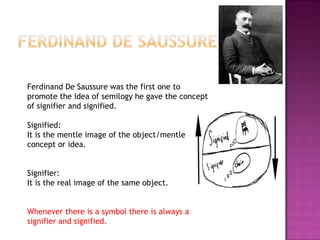
Ferdinand De Saussure was the first one to
promote the idea of semilogy he gave the concept
of signifier and signified.
Signified:
It is the mentle image of the object/mentle
concept or idea.
Signifier:
It is the real image of the same object.
Whenever there is a symbol there is always a
signifier and signified.
Charles gave the idea of Icons, Index and
symbols.
"The agility of the tongue is shown in its insisting
that the world depends upon it." --Peirce
We will present Charles Sanders Peirce's three
philosophical categories, and then explain how these
categories operate at various levels in the process of
semiosis, or sign functioning. The process of semiosis
is a triadic relationship between a sign or
representamen (a first), an object (a second) and an
interpretant (a third). Each of these three terms is
in turn broken down following the three categories.
From this structure, by observing the hierarchy of
categories, ten mechanisms of signification may be
identified.
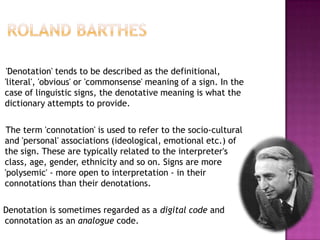
'Denotation' tends to be described as the definitional,
'literal', 'obvious' or 'commonsense' meaning of a sign. In the
case of linguistic signs, the denotative meaning is what the
dictionary attempts to provide.
The term 'connotation' is used to refer to the socio-cultural
and 'personal' associations (ideological, emotional etc.) of
the sign. These are typically related to the interpreter's
class, age, gender, ethnicity and so on. Signs are more
'polysemic' - more open to interpretation - in their
connotations than their denotations.
Denotation is sometimes regarded as a digital code and
connotation as an analogue code.
The meaning or idea
expressed by a sign,
as distinct from the
physical form in
which it is expressed
i.e Mental image of
object or the mental
concept idea.
(The concept that a
signifier refers to)
Any material thing
that signifies, e.g.,
words on a page, a
facial expression,
an image is a
signifier; The real
image of the
object.
 Pragmatics has to do with what‟s “good” and
“bad” about a language or program
 Semantics is all about meaning--what the
statements do, what the programs do
 Logic errors are semantic errors
 Syntax is the required grammar and
punctuation of the language
 Compile-time errors are syntax errors
o Intertextuality refers to far more than the 'influences' of
writers on each other. For structuralists, language has
powers which not only exceed individual control but also
determine subjectivity.
o Those who reject textual determinism (such as
poststructularist) emphasize the 'polysemic' nature
of texts - their plurality of meanings.
o Roland Barthes introduced the concept of anchorage.
Linguistic elements in a text (such as a caption) can serve
to 'anchor' (or constrain) the preffered readings of an
image (conversely the illustrative use of an image can
anchor an ambiguous verbal text).
o Any media text that is anchored in such a way as to
restrict the number of ways in which it can be interpreted
is a closed text.

Semiotics

  • 2.
     It isthe study of „signs‟ as a tool for Textual Analysis  Semiotics is concerned everything that can be taken as a sign.  The study of signs and symbols and their use of interpretation.
  • 3.
    Ferdinand De Saussurewas the first one to promote the idea of semilogy he gave the concept of signifier and signified. Signified: It is the mentle image of the object/mentle concept or idea. Signifier: It is the real image of the same object. Whenever there is a symbol there is always a signifier and signified.
  • 4.
    Charles gave theidea of Icons, Index and symbols. "The agility of the tongue is shown in its insisting that the world depends upon it." --Peirce We will present Charles Sanders Peirce's three philosophical categories, and then explain how these categories operate at various levels in the process of semiosis, or sign functioning. The process of semiosis is a triadic relationship between a sign or representamen (a first), an object (a second) and an interpretant (a third). Each of these three terms is in turn broken down following the three categories. From this structure, by observing the hierarchy of categories, ten mechanisms of signification may be identified.
  • 5.
    'Denotation' tends tobe described as the definitional, 'literal', 'obvious' or 'commonsense' meaning of a sign. In the case of linguistic signs, the denotative meaning is what the dictionary attempts to provide. The term 'connotation' is used to refer to the socio-cultural and 'personal' associations (ideological, emotional etc.) of the sign. These are typically related to the interpreter's class, age, gender, ethnicity and so on. Signs are more 'polysemic' - more open to interpretation - in their connotations than their denotations. Denotation is sometimes regarded as a digital code and connotation as an analogue code.
  • 6.
    The meaning oridea expressed by a sign, as distinct from the physical form in which it is expressed i.e Mental image of object or the mental concept idea. (The concept that a signifier refers to) Any material thing that signifies, e.g., words on a page, a facial expression, an image is a signifier; The real image of the object.
  • 7.
     Pragmatics hasto do with what‟s “good” and “bad” about a language or program  Semantics is all about meaning--what the statements do, what the programs do  Logic errors are semantic errors  Syntax is the required grammar and punctuation of the language  Compile-time errors are syntax errors
  • 8.
    o Intertextuality refersto far more than the 'influences' of writers on each other. For structuralists, language has powers which not only exceed individual control but also determine subjectivity. o Those who reject textual determinism (such as poststructularist) emphasize the 'polysemic' nature of texts - their plurality of meanings. o Roland Barthes introduced the concept of anchorage. Linguistic elements in a text (such as a caption) can serve to 'anchor' (or constrain) the preffered readings of an image (conversely the illustrative use of an image can anchor an ambiguous verbal text). o Any media text that is anchored in such a way as to restrict the number of ways in which it can be interpreted is a closed text.