Rhetoric and Composition
Logos, Ethos, Pathos
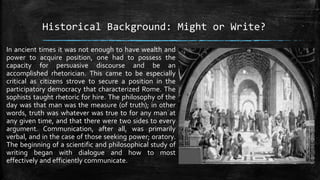
Historical Background: Might or Write?
In ancient times it was not enough to have wealth and
power to acquire position, one had to possess the
capacity for persuasive discourse and be an
accomplished rhetorician. This came to be especially
critical as citizens strove to secure a position in the
participatory democracy that characterized Rome. The
sophists taught rhetoric for hire. The philosophy of the
day was that man was the measure (of truth); in other
words, truth was whatever was true to for any man at
any given time, and that there were two sides to every
argument. Communication, after all, was primarily
verbal, and in the case of those seeking power; oratory.
The beginning of a scientific and philosophical study of
writing began with dialogue and how to most
effectively and efficiently communicate.
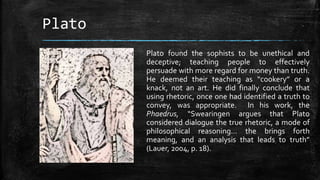
Plato
Plato found the sophists to be unethical and
deceptive; teaching people to effectively
persuade with more regard for money than truth.
He deemed their teaching as “cookery” or a
knack, not an art. He did finally conclude that
using rhetoric, once one had identified a truth to
convey, was appropriate. In his work, the
Phaedrus, “Swearingen argues that Plato
considered dialogue the true rhetoric, a mode of
philosophical reasoning… the brings forth
meaning, and an analysis that leads to truth”
(Lauer, 2004, p. 18).
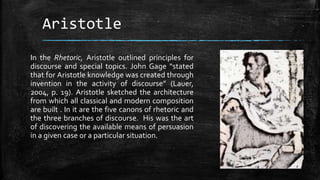
Aristotle
In the Rhetoric, Aristotle outlined principles for
discourse and special topics. John Gage “stated
that for Aristotle knowledge was created through
invention in the activity of discourse” (Lauer,
2004, p. 19). Aristotle sketched the architecture
from which all classical and modern composition
are built . In it are the five canons of rhetoric and
the three branches of discourse. His was the art
of discovering the available means of persuasion
in a given case or a particular situation.
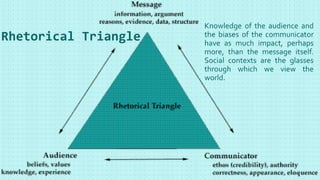
Rhetorical Triangle
Knowledge of the audience and
the biases of the communicator
have as much impact, perhaps
more, than the message itself.
Social contexts are the glasses
through which we view the
world.
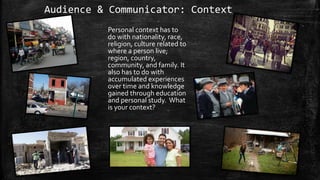
Audience & Communicator: Context
Personal context has to
do with nationality, race,
religion, culture related to
where a person live;
region, country,
community, and family. It
also has to do with
accumulated experiences
over time and knowledge
gained through education
and personal study. What
is your context?
Audience & Communicator: Bias
Definition
“a particular tendency, trend, inclin
ation, feeling, or opinion, especialy
one that is preconceived or unreaso
ned: illegal bias against older jobapp
licants; the magazine’s bias toward
art rather than photography;our stro
ng bias in favor of the idea.”
From Dictionary.com,
http://dictionary.reference.com/bro
wse/bias
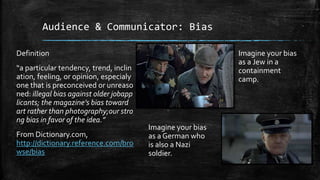
Imagine your bias
as a Jew in a
containment
camp.
Imagine your bias
as a German who
is also a Nazi
soldier.
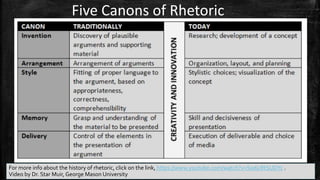
Five Canons of Rhetoric
For more info about the history of rhetoric, click on the link, https://www.youtube.com/watch?v=Sw6cRtSUDYc .
Video by Dr. Star Muir, George Mason University
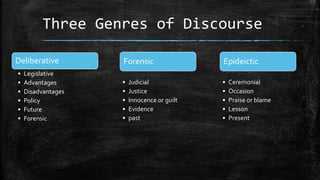
Three Genres of Discourse
Deliberative
• Legislative
• Advantages
• Disadvantages
• Policy
• Future
• Forensic
Forensic
• Judicial
• Justice
• Innocence or guilt
• Evidence
• past
Epideictic
• Ceremonial
• Occasion
• Praise or blame
• Lesson
• Present
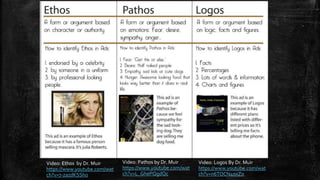
Video: Ethos by Dr. Muir
https://www.youtube.com/wat
ch?v=7-zazdKSSho
Video: Logos By Dr. Muir
https://www.youtube.com/wat
ch?v=n6TOCN40xZ0
Video: Pathos by Dr. Muir
https://www.youtube.com/wat
ch?v=L_GhePQgdQc
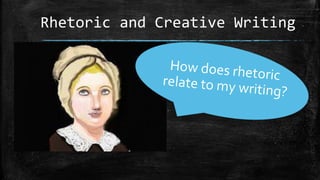
Rhetoric and Creative Writing
Jacob the Liar was originally a novel written
by the East German Jewish author Jurek
Becker. In this film adaptation, Robin Williams
plays the part of Jacob.
Note how you feel at the end of the movie.
Do you feel moved? Changed? Angry?
Your response to this movie is your first
discussion post of the week.
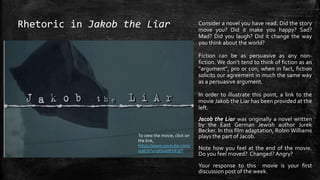
Rhetoric in Jakob the Liar
To view the movie, click on
the link,
https://www.youtube.com/
watch?v=9O1ddEbEqIY
Consider a novel you have read. Did the story
move you? Did it make you happy? Sad?
Mad? Did you laugh? Did it change the way
you think about the world?
Fiction can be as persuasive as any non-
fiction. We don’t tend to think of fiction as an
“argument”, pro or con, when in fact, fiction
solicits our agreement in much the same way
as a persuasive argument.
In order to illustrate this point, a link to the
movie Jakob the Liar has been provided at the
left.
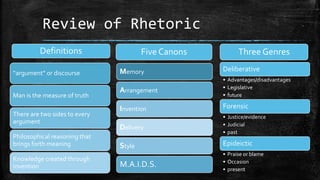
Review of Rhetoric
“argument” or discourse
Man is the measure of truth
There are two sides to every
argument
Philosophical reasoning that
brings forth meaning
Knowledge created through
invention
Memory
Arrangement
Invention
Delivery
Style
M.A.I.D.S.
Deliberative
• Advantages/disadvantages
• Legislative
• future
Forensic
• Justice/evidence
• Judicial
• past
Epideictic
• Praise or blame
• Occasion
• present
Definitions Five Canons Three Genres

EDU609 Rhetoric

  • 1.
  • 2.
    Historical Background: Mightor Write? In ancient times it was not enough to have wealth and power to acquire position, one had to possess the capacity for persuasive discourse and be an accomplished rhetorician. This came to be especially critical as citizens strove to secure a position in the participatory democracy that characterized Rome. The sophists taught rhetoric for hire. The philosophy of the day was that man was the measure (of truth); in other words, truth was whatever was true to for any man at any given time, and that there were two sides to every argument. Communication, after all, was primarily verbal, and in the case of those seeking power; oratory. The beginning of a scientific and philosophical study of writing began with dialogue and how to most effectively and efficiently communicate.
  • 3.
    Plato Plato found thesophists to be unethical and deceptive; teaching people to effectively persuade with more regard for money than truth. He deemed their teaching as “cookery” or a knack, not an art. He did finally conclude that using rhetoric, once one had identified a truth to convey, was appropriate. In his work, the Phaedrus, “Swearingen argues that Plato considered dialogue the true rhetoric, a mode of philosophical reasoning… the brings forth meaning, and an analysis that leads to truth” (Lauer, 2004, p. 18).
  • 4.
    Aristotle In the Rhetoric,Aristotle outlined principles for discourse and special topics. John Gage “stated that for Aristotle knowledge was created through invention in the activity of discourse” (Lauer, 2004, p. 19). Aristotle sketched the architecture from which all classical and modern composition are built . In it are the five canons of rhetoric and the three branches of discourse. His was the art of discovering the available means of persuasion in a given case or a particular situation.
  • 5.
    Rhetorical Triangle Knowledge ofthe audience and the biases of the communicator have as much impact, perhaps more, than the message itself. Social contexts are the glasses through which we view the world.
  • 6.
    Audience & Communicator:Context Personal context has to do with nationality, race, religion, culture related to where a person live; region, country, community, and family. It also has to do with accumulated experiences over time and knowledge gained through education and personal study. What is your context?
  • 7.
    Audience & Communicator:Bias Definition “a particular tendency, trend, inclin ation, feeling, or opinion, especialy one that is preconceived or unreaso ned: illegal bias against older jobapp licants; the magazine’s bias toward art rather than photography;our stro ng bias in favor of the idea.” From Dictionary.com, http://dictionary.reference.com/bro wse/bias Imagine your bias as a Jew in a containment camp. Imagine your bias as a German who is also a Nazi soldier.
  • 8.
    Five Canons ofRhetoric For more info about the history of rhetoric, click on the link, https://www.youtube.com/watch?v=Sw6cRtSUDYc . Video by Dr. Star Muir, George Mason University
  • 9.
    Three Genres ofDiscourse Deliberative • Legislative • Advantages • Disadvantages • Policy • Future • Forensic Forensic • Judicial • Justice • Innocence or guilt • Evidence • past Epideictic • Ceremonial • Occasion • Praise or blame • Lesson • Present
  • 10.
    Video: Ethos byDr. Muir https://www.youtube.com/wat ch?v=7-zazdKSSho Video: Logos By Dr. Muir https://www.youtube.com/wat ch?v=n6TOCN40xZ0 Video: Pathos by Dr. Muir https://www.youtube.com/wat ch?v=L_GhePQgdQc
  • 11.
  • 12.
    Jacob the Liarwas originally a novel written by the East German Jewish author Jurek Becker. In this film adaptation, Robin Williams plays the part of Jacob. Note how you feel at the end of the movie. Do you feel moved? Changed? Angry? Your response to this movie is your first discussion post of the week. Rhetoric in Jakob the Liar To view the movie, click on the link, https://www.youtube.com/ watch?v=9O1ddEbEqIY Consider a novel you have read. Did the story move you? Did it make you happy? Sad? Mad? Did you laugh? Did it change the way you think about the world? Fiction can be as persuasive as any non- fiction. We don’t tend to think of fiction as an “argument”, pro or con, when in fact, fiction solicits our agreement in much the same way as a persuasive argument. In order to illustrate this point, a link to the movie Jakob the Liar has been provided at the left.
  • 13.
    Review of Rhetoric “argument”or discourse Man is the measure of truth There are two sides to every argument Philosophical reasoning that brings forth meaning Knowledge created through invention Memory Arrangement Invention Delivery Style M.A.I.D.S. Deliberative • Advantages/disadvantages • Legislative • future Forensic • Justice/evidence • Judicial • past Epideictic • Praise or blame • Occasion • present Definitions Five Canons Three Genres