
Unidad I
     Estructura, arreglos y
    movimientos de los átomos
            Dr. Edgar García Hernández
División de Estudios de Posgrado e Investigación/Departamento de
                   Ingeniería Química y Bioquímica
                  e-mail: eddgarcia@hotmail.com
                            © 2013 ITZ

                                                                   1
• Conocer la clasificación de los materiales,
  según su estructura atómica, así como
  también sus arreglos atómicos.
• Que el alumno conozca los tipos de
  dislocaciones y su origen así como sus
  efectos en los materiales.
• Conocer los movimientos atómicos que se
  tiene al aplicar a un material ciertos
  tratamientos y trabajos mecánicos que
  ocasionan la difusión.
Contenido
1.1. Introducción a la ciencia e ingeniería de los
     materiales
1.2. Estructura atómica
1.3. Arreglos atómicos y iónicos
1.4. Imperfecciones en los arreglos atómicos y
     iónicos
1.5. Movimientos de átomos y iones en los


                                                     3
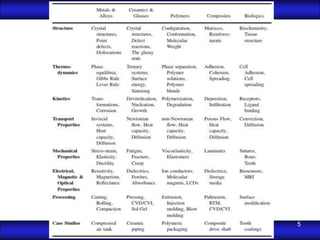
1.1. Introducción a la ciencia e
    ingeniería de materiales
  La ingeniería es la profesión en la que se
  aplica con criterio un conocimiento de las
ciencias matemáticas y naturales, adquirido
 por el estudio, la experiencia y la práctica,
      con objeto de desarrollar formas de
utilización económica de los materiales y las
fuerzas de la naturaleza para el beneficio de
                 la humanidad.
                                             4
5
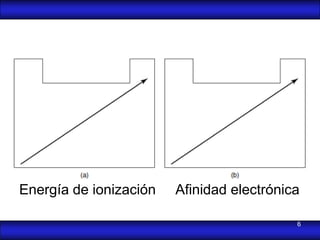
Energía de ionización   Afinidad electrónica

                                           6
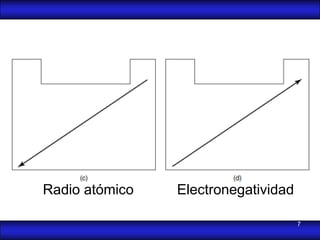
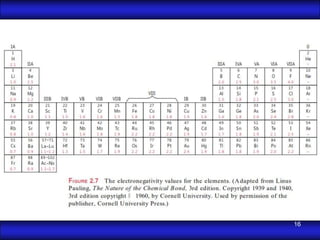
Radio atómico   Electronegatividad

                                     7
8
9
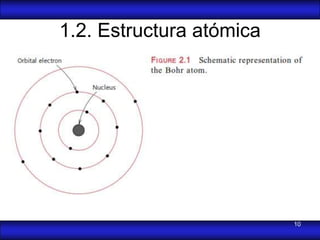
1.2. Estructura atómica


                          10
11
12
13
14
15
16
17
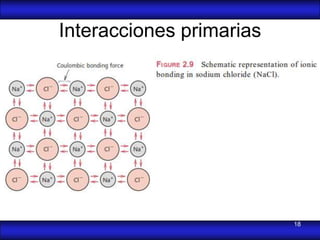
Interacciones primarias


                          18
19
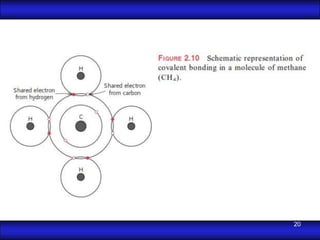
20
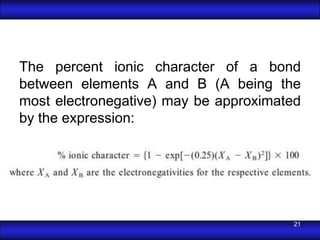
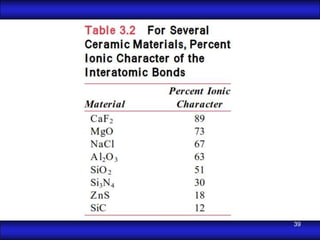
The percent ionic character of a bond
between elements A and B (A being the
most electronegative) may be approximated
by the expression:


                                       21
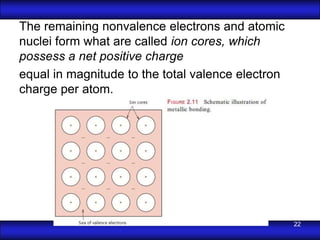
The remaining nonvalence electrons and atomic
nuclei form what are called ion cores, which
possess a net positive charge
equal in magnitude to the total valence electron
charge per atom.


                                                   22
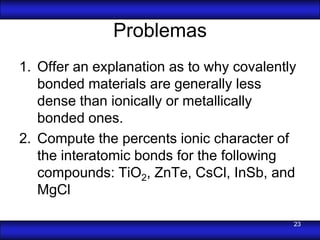
Problemas
1. Offer an explanation as to why covalently
   bonded materials are generally less
   dense than ionically or metallically
   bonded ones.
2. Compute the percents ionic character of
   the interatomic bonds for the following
   compounds: TiO2, ZnTe, CsCl, InSb, and
   MgCl

                                           23
1. Explain why hydrogen fluoride (HF) has a
   higher boiling temperature than hydrogen
   chloride (HCl) (19.4 vs. -85 oC), even
   though HF has a lower molecular weight.
2. On the basis of the hydrogen bond,
   explain the anomalous behavior of water
   when it freezes. That is, why is there
   volume expansion upon solidification?

                                          24
1.3. Arreglos atómicos y iónicos
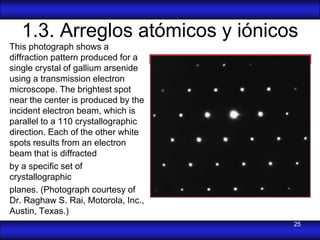
This photograph shows a
diffraction pattern produced for a
single crystal of gallium arsenide
using a transmission electron
microscope. The brightest spot
near the center is produced by the
incident electron beam, which is
parallel to a 110 crystallographic
direction. Each of the other white
spots results from an electron
beam that is diffracted
by a specific set of
crystallographic
planes. (Photograph courtesy of
Dr. Raghaw S. Rai, Motorola, Inc.,
Austin, Texas.)
                                     25
Solid materials may be classified according
to the regularity with which atoms or ions are
arranged with respect to one another.

1. crystalline materials.
2. Semi crystalline materials.
3. Noncrystalline or amorphous
   materials


                                            26
A crystalline material is one in which the
atoms are situated in a repeating or periodic
array over large atomic distances; that is,
long-range order exists, such that upon
solidification, the atoms will position
themselves in a repetitive three-dimensional
pattern, in which each atom is bonded to its
nearest-neighbor atoms. All metals, many
ceramic materials, and certain polymers
form crystalline structures under normal
solidification conditions.
                                           27
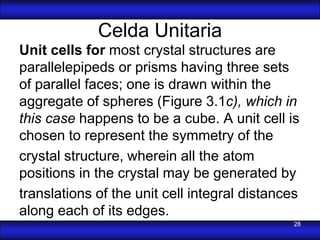
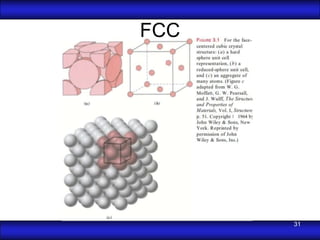
Celda Unitaria
Unit cells for most crystal structures are
parallelepipeds or prisms having three sets
of parallel faces; one is drawn within the
aggregate of spheres (Figure 3.1c), which in
this case happens to be a cube. A unit cell is
chosen to represent the symmetry of the
crystal structure, wherein all the atom
positions in the crystal may be generated by
translations of the unit cell integral distances
along each of its edges.
                                               28
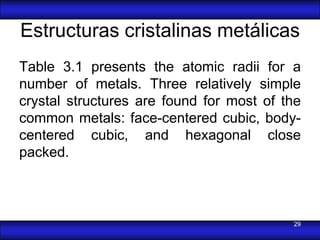
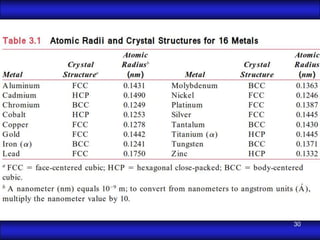
Estructuras cristalinas metálicas
Table 3.1 presents the atomic radii for a
number of metals. Three relatively simple
crystal structures are found for most of the
common metals: face-centered cubic, body-
centered cubic, and hexagonal close
packed.


                                          29
30
FCC


      31
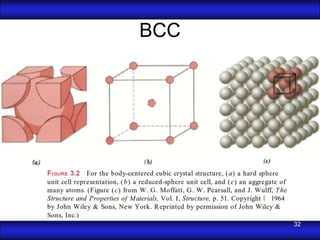
BCC


      32
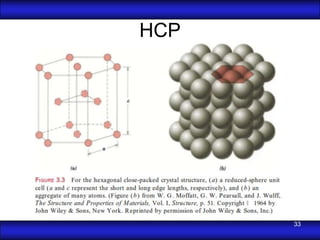
HCP


      33
Two other important characteristics of a
crystal structure are the coordination
number and the atomic packing factor
(APF). For metals, each atom has the
same number of nearest-neighbor or
touching atoms, which is the coordination
number.
For face-centered cubics, the coordination
number is 12.

                                        34
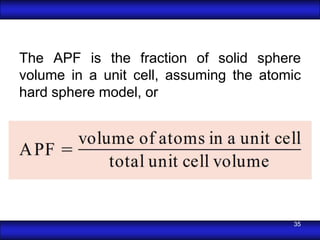
The APF is the fraction of solid sphere
volume in a unit cell, assuming the atomic
hard sphere model, or


                                        35
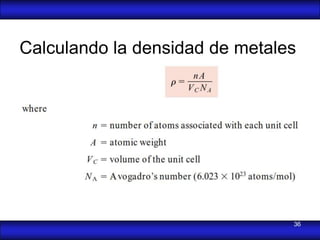
Calculando la densidad de metales


                                36
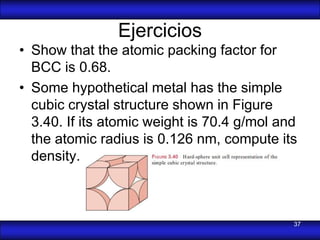
Ejercicios
• Show that the atomic packing factor for
  BCC is 0.68.
• Some hypothetical metal has the simple
  cubic crystal structure shown in Figure
  3.40. If its atomic weight is 70.4 g/mol and
  the atomic radius is 0.126 nm, compute its
  density.


                                             37
Materiales cristalinos cerámicos
Because ceramics are composed of at least
two elements, and often more, their crystal
structures are generally more complex than
those for metals. The atomic bonding in
these materials ranges from purely ionic to
totally covalent; many ceramics exhibit a
combination of these two bonding types, the
degree of ionic character being dependent
on the electronegativities of the atoms.
                                          38
39
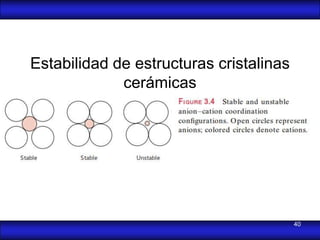
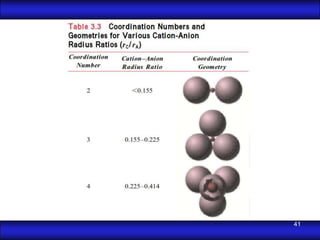
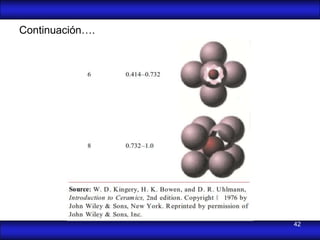
Estabilidad de estructuras cristalinas
             cerámicas


                                         40
41
Continuación….


                 42
43
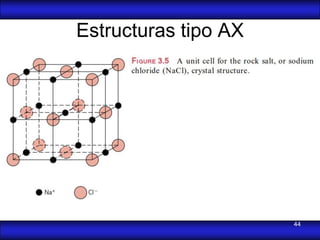
Estructuras tipo AX


                      44
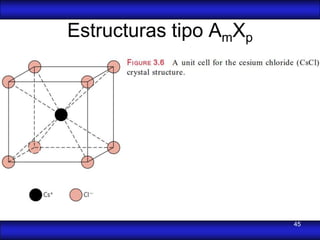
Estructuras tipo AmXp


                        45
46
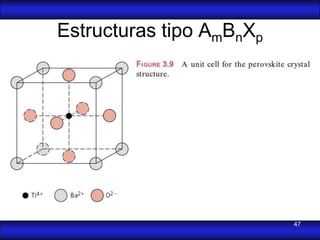
Estructuras tipo AmBnXp


                          47
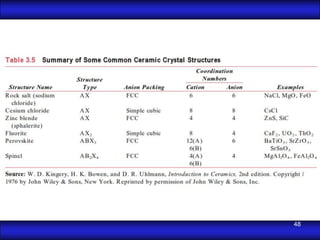
48
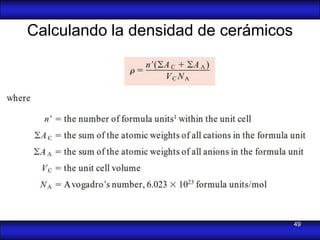
Calculando la densidad de cerámicos


                                      49
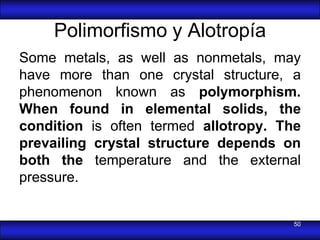
Polimorfismo y Alotropía
Some metals, as well as nonmetals, may
have more than one crystal structure, a
phenomenon known as polymorphism.
When found in elemental solids, the
condition is often termed allotropy. The
prevailing crystal structure depends on
both the temperature and the external
pressure.


                                       50
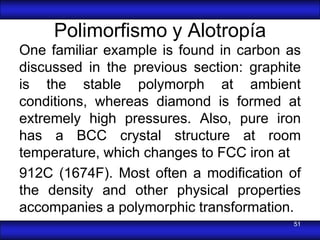
Polimorfismo y Alotropía
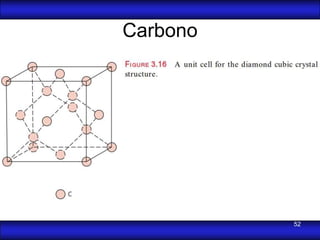
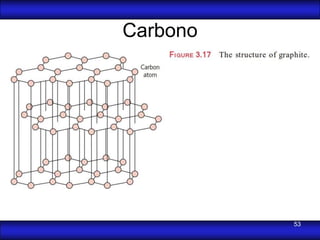
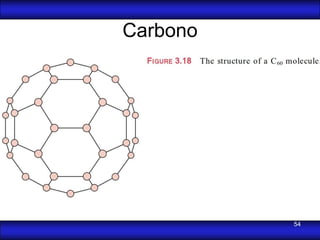
One familiar example is found in carbon as
discussed in the previous section: graphite
is the stable polymorph at ambient
conditions, whereas diamond is formed at
extremely high pressures. Also, pure iron
has a BCC crystal structure at room
temperature, which changes to FCC iron at
912C (1674F). Most often a modification of
the density and other physical properties
accompanies a polymorphic transformation.
                                         51
Carbono


          52
Carbono


          53
Carbono


          54
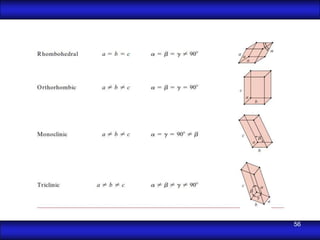
Sistemas cristalinos


                       55
56
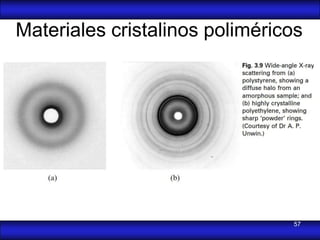
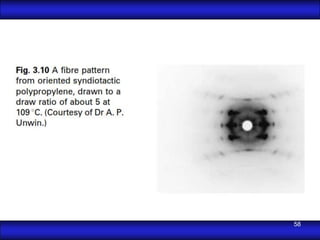
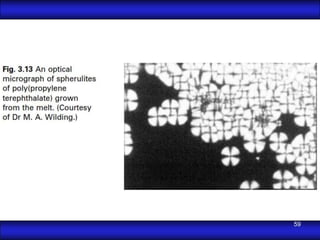
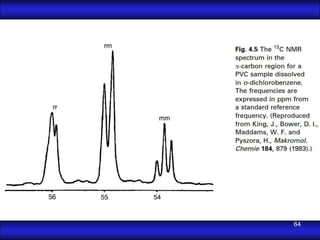
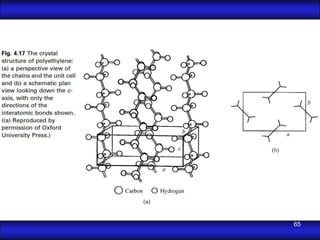
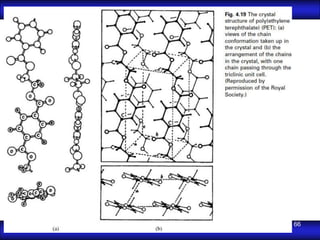
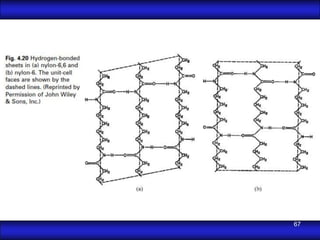
Materiales cristalinos poliméricos


                                57
58
59
60
61
62
63
64
65
66
67
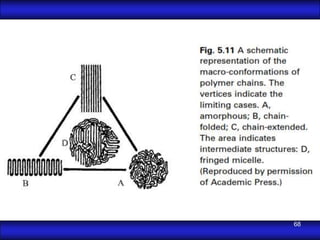
68
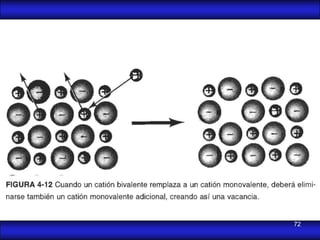
Imperfecciones en cristales
• Realmente no existen cristales perfectos
  sino que contienen varios tipos de
  imperfecciones y defectos, que afectan a
  muchas de sus propiedades físicas y
  mecánicas y también influyen en algunas
  propiedades de los materiales a nivel de
  aplicación ingenieril tal como la capacidad
  de formar aleaciones en frío, la
  conductividad eléctrica y la corrosión.
                                           69
Imperfecciones en cristales
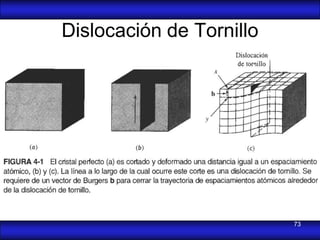
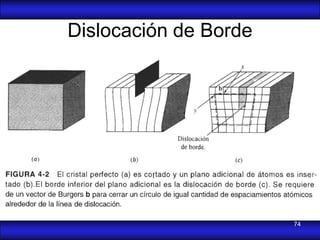
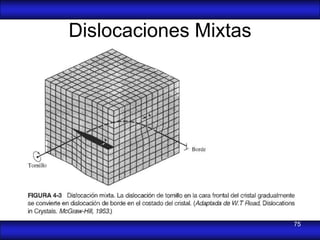
• Las imperfecciones se clasifican según su
  geometría y forma así:
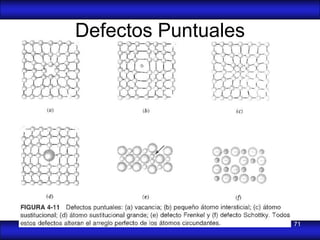
  – Defectos puntuales o de dimensión cero
  – Defectos lineales o de una dimensión
    llamados también dislocaciones
  – Defectos de dos dimensiones
• También deben incluirse los defectos
  macroscópicos tales como fisuras, poros y
  las inclusiones extrañas.
•                                         70
Defectos Puntuales


                     71
72
Dislocación de Tornillo


                          73
Dislocación de Borde


                       74
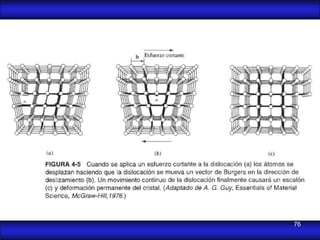
Dislocaciones Mixtas


                       75
76
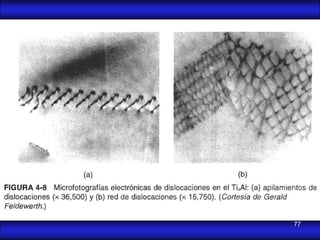
77
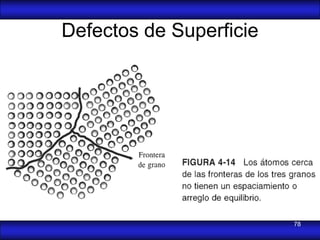
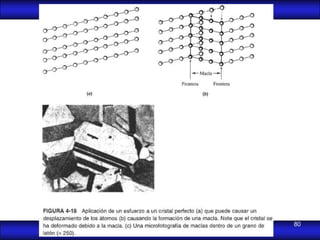
Defectos de Superficie


                         78
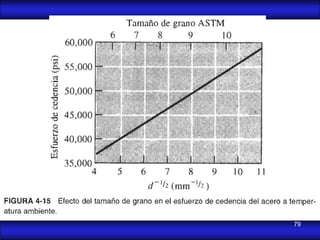
79
80
Fin de la Unidad I


                     81

Unidad I Ing. de Materiales

  • 1.
    Unidad I Estructura, arreglos y movimientos de los átomos Dr. Edgar García Hernández División de Estudios de Posgrado e Investigación/Departamento de Ingeniería Química y Bioquímica e-mail: eddgarcia@hotmail.com © 2013 ITZ 1
  • 2.
    • Conocer laclasificación de los materiales, según su estructura atómica, así como también sus arreglos atómicos. • Que el alumno conozca los tipos de dislocaciones y su origen así como sus efectos en los materiales. • Conocer los movimientos atómicos que se tiene al aplicar a un material ciertos tratamientos y trabajos mecánicos que ocasionan la difusión.
  • 3.
    Contenido 1.1. Introducción ala ciencia e ingeniería de los materiales 1.2. Estructura atómica 1.3. Arreglos atómicos y iónicos 1.4. Imperfecciones en los arreglos atómicos y iónicos 1.5. Movimientos de átomos y iones en los 3
  • 4.
    1.1. Introducción ala ciencia e ingeniería de materiales La ingeniería es la profesión en la que se aplica con criterio un conocimiento de las ciencias matemáticas y naturales, adquirido por el estudio, la experiencia y la práctica, con objeto de desarrollar formas de utilización económica de los materiales y las fuerzas de la naturaleza para el beneficio de la humanidad. 4
  • 5.
  • 6.
    Energía de ionización Afinidad electrónica 6
  • 7.
    Radio atómico Electronegatividad 7
  • 8.
  • 9.
  • 10.
  • 11.
  • 12.
  • 13.
  • 14.
  • 15.
  • 16.
  • 17.
  • 18.
  • 19.
  • 20.
  • 21.
    The percent ioniccharacter of a bond between elements A and B (A being the most electronegative) may be approximated by the expression: 21
  • 22.
    The remaining nonvalenceelectrons and atomic nuclei form what are called ion cores, which possess a net positive charge equal in magnitude to the total valence electron charge per atom. 22
  • 23.
    Problemas 1. Offer anexplanation as to why covalently bonded materials are generally less dense than ionically or metallically bonded ones. 2. Compute the percents ionic character of the interatomic bonds for the following compounds: TiO2, ZnTe, CsCl, InSb, and MgCl 23
  • 24.
    1. Explain whyhydrogen fluoride (HF) has a higher boiling temperature than hydrogen chloride (HCl) (19.4 vs. -85 oC), even though HF has a lower molecular weight. 2. On the basis of the hydrogen bond, explain the anomalous behavior of water when it freezes. That is, why is there volume expansion upon solidification? 24
  • 25.
    1.3. Arreglos atómicosy iónicos This photograph shows a diffraction pattern produced for a single crystal of gallium arsenide using a transmission electron microscope. The brightest spot near the center is produced by the incident electron beam, which is parallel to a 110 crystallographic direction. Each of the other white spots results from an electron beam that is diffracted by a specific set of crystallographic planes. (Photograph courtesy of Dr. Raghaw S. Rai, Motorola, Inc., Austin, Texas.) 25
  • 26.
    Solid materials maybe classified according to the regularity with which atoms or ions are arranged with respect to one another. 1. crystalline materials. 2. Semi crystalline materials. 3. Noncrystalline or amorphous materials 26
  • 27.
    A crystalline materialis one in which the atoms are situated in a repeating or periodic array over large atomic distances; that is, long-range order exists, such that upon solidification, the atoms will position themselves in a repetitive three-dimensional pattern, in which each atom is bonded to its nearest-neighbor atoms. All metals, many ceramic materials, and certain polymers form crystalline structures under normal solidification conditions. 27
  • 28.
    Celda Unitaria Unit cellsfor most crystal structures are parallelepipeds or prisms having three sets of parallel faces; one is drawn within the aggregate of spheres (Figure 3.1c), which in this case happens to be a cube. A unit cell is chosen to represent the symmetry of the crystal structure, wherein all the atom positions in the crystal may be generated by translations of the unit cell integral distances along each of its edges. 28
  • 29.
    Estructuras cristalinas metálicas Table3.1 presents the atomic radii for a number of metals. Three relatively simple crystal structures are found for most of the common metals: face-centered cubic, body- centered cubic, and hexagonal close packed. 29
  • 30.
  • 31.
    FCC 31
  • 32.
    BCC 32
  • 33.
    HCP 33
  • 34.
    Two other importantcharacteristics of a crystal structure are the coordination number and the atomic packing factor (APF). For metals, each atom has the same number of nearest-neighbor or touching atoms, which is the coordination number. For face-centered cubics, the coordination number is 12. 34
  • 35.
    The APF isthe fraction of solid sphere volume in a unit cell, assuming the atomic hard sphere model, or 35
  • 36.
  • 37.
    Ejercicios • Show thatthe atomic packing factor for BCC is 0.68. • Some hypothetical metal has the simple cubic crystal structure shown in Figure 3.40. If its atomic weight is 70.4 g/mol and the atomic radius is 0.126 nm, compute its density. 37
  • 38.
    Materiales cristalinos cerámicos Becauseceramics are composed of at least two elements, and often more, their crystal structures are generally more complex than those for metals. The atomic bonding in these materials ranges from purely ionic to totally covalent; many ceramics exhibit a combination of these two bonding types, the degree of ionic character being dependent on the electronegativities of the atoms. 38
  • 39.
  • 40.
    Estabilidad de estructurascristalinas cerámicas 40
  • 41.
  • 42.
  • 43.
  • 44.
  • 45.
  • 46.
  • 47.
  • 48.
  • 49.
    Calculando la densidadde cerámicos 49
  • 50.
    Polimorfismo y Alotropía Somemetals, as well as nonmetals, may have more than one crystal structure, a phenomenon known as polymorphism. When found in elemental solids, the condition is often termed allotropy. The prevailing crystal structure depends on both the temperature and the external pressure. 50
  • 51.
    Polimorfismo y Alotropía Onefamiliar example is found in carbon as discussed in the previous section: graphite is the stable polymorph at ambient conditions, whereas diamond is formed at extremely high pressures. Also, pure iron has a BCC crystal structure at room temperature, which changes to FCC iron at 912C (1674F). Most often a modification of the density and other physical properties accompanies a polymorphic transformation. 51
  • 52.
  • 53.
  • 54.
  • 55.
  • 56.
  • 57.
  • 58.
  • 59.
  • 60.
  • 61.
  • 62.
  • 63.
  • 64.
  • 65.
  • 66.
  • 67.
  • 68.
  • 69.
    Imperfecciones en cristales •Realmente no existen cristales perfectos sino que contienen varios tipos de imperfecciones y defectos, que afectan a muchas de sus propiedades físicas y mecánicas y también influyen en algunas propiedades de los materiales a nivel de aplicación ingenieril tal como la capacidad de formar aleaciones en frío, la conductividad eléctrica y la corrosión. 69
  • 70.
    Imperfecciones en cristales •Las imperfecciones se clasifican según su geometría y forma así: – Defectos puntuales o de dimensión cero – Defectos lineales o de una dimensión llamados también dislocaciones – Defectos de dos dimensiones • También deben incluirse los defectos macroscópicos tales como fisuras, poros y las inclusiones extrañas. • 70
  • 71.
  • 72.
  • 73.
  • 74.
  • 75.
  • 76.
  • 77.
  • 78.
  • 79.
  • 80.
  • 81.
    Fin de laUnidad I 81