Chapter 1
1Database and Database Users
Topics Covered
 Introduction to Database, DBMS, Database System
 Properties of Database
 Characteristics Of Database Approach
 Actors on the scene
 Database Administrator
 System Designer
 End Users
 Workers Behind the Scene
 Advantages of DBMS Approach
 When Not to use a Database
2Database and Database Users
Introduction
 A database is a collection of related data.
 By data, we mean known facts that can be recorded
and that have implicit meaning.
 For example : telephone numbers , addresses of the
people.
3Database and Database Users
Properties of database
 A database represents some aspect of the real world,
sometimes called the miniworld . Changes to the
miniworld are reflected in the database
 A database is a logically coherent collection of data
with some inherent meaning. A random assortment of
data cannot correctly be referred to as a database.
 A database is designed, built, and populated with data
for a specific purpose. It has an intended group of
users and some preconceived applications in which
these users are interested.
4Database and Database Users
Database management system(DBMS)
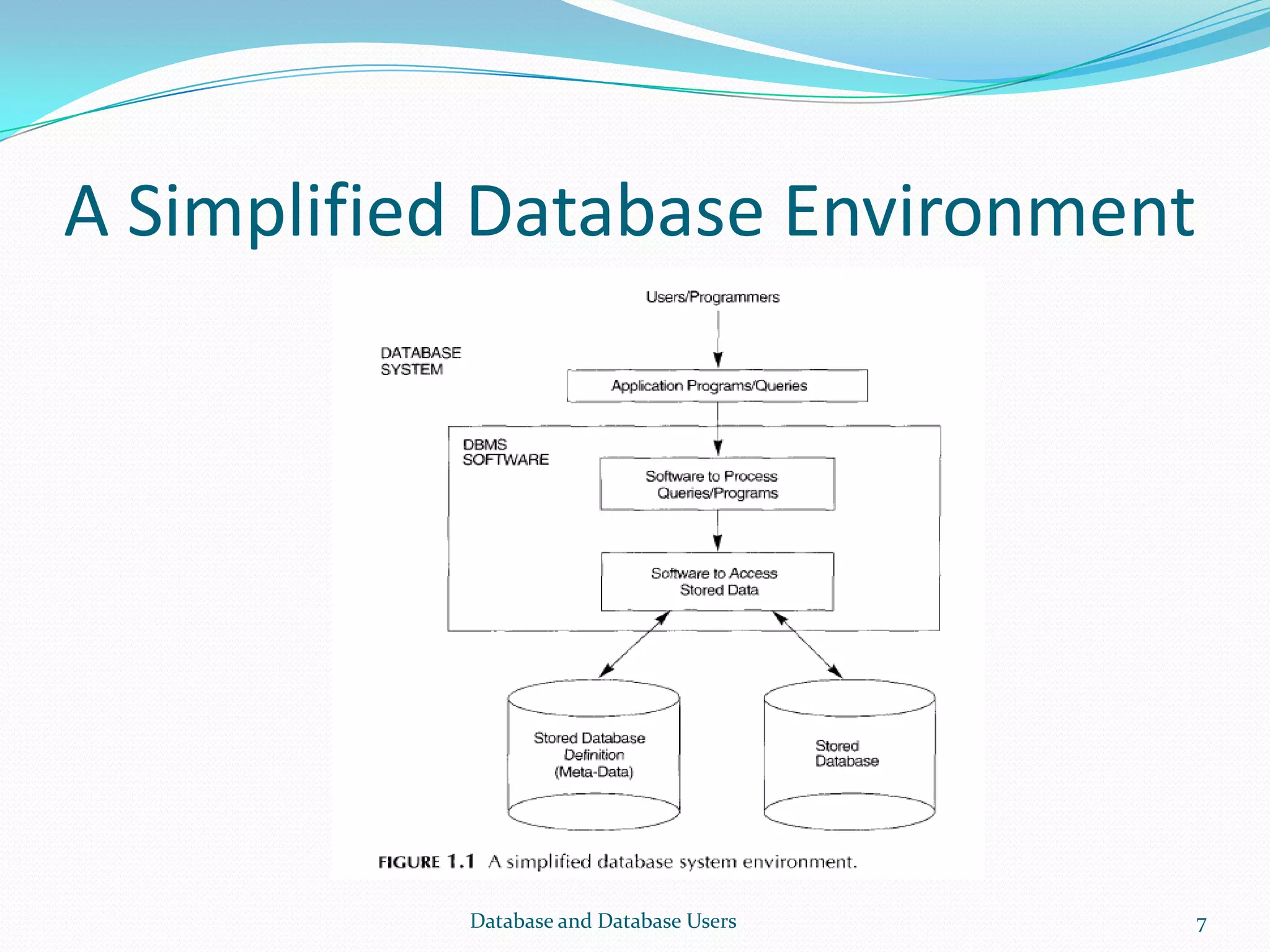
 A database management system (DBMS) is a
collection of programs that enables users to create and
maintain a database.
 The DBMS is hence a general-purpose software system
that facilitates the processes of defining, constructing,
manipulating, and sharing databases among various
users and applications.
5Database and Database Users
Database and Database Users 6
 Defining: It involves specifying the data types,
structures and constraints of the date to be stored in
the database.
Constructing : Constructing the data base is the
process of storing the data on some storage medium
that is controlled by the DBMS.
 Manipulating: Manipulating a data base includes
functions such querying the database to retrieve
specific data.
 Sharing : Sharing a data base allows multiple users
and programs to access the database simultaneously
A Simplified Database Environment
7Database and Database Users
CHARACTERISTICS OFTHE DATABASE APPROACH
 Self-describing nature of a database system
 The database system contains not only the database
itself but also a complete definition or description of the
database structure and constraints.
 This definition is stored in the DBMS catalog, which
contains information such as the structure of each file,
the type and storage format of each data item, and
various constraints on the data.
 The information stored in the catalog is called meta-
data
8Database and Database Users
CHARACTERISTICS OFTHE DATABASE APPROACH
 Insulation between programs and data, and data
abstraction
 Program-data Independence
 Program-operation Independence
 The characteristics that allows program-data
independence and program-operation independence is
called data abstraction.
9Database and Database Users
CHARACTERISTICS OFTHE DATABASE APPROACH
 Support of multiple views of the data
 A database typically has many users, each of whom may
require a different perspective or view of the database.
 A multiuser DBMS whose users have a variety of
distinct applications must provide facilities for defining
multiple views.
10Database and Database Users
CHARACTERISTICS OFTHE DATABASE APPROACH
 Sharing of data and multiuser transaction processing
 A multiuser DBMS allow multiple users to access the
database at the same time.
 The DBMS must include concurrency control software
to ensure that several users trying to update the same
data do so in a controlled manner so that the result of
the updates is correct.
11Database and Database Users
ACTORS ON THE SCENE
 Database Administrator
In a database environment, the primary resource is the
database itself, and administering these resources is
the responsibility of the database administrator
(DBA). The DBA is responsible for authorizing access
to the database, for coordinating and monitoring its
use, and for acquiring software and hardware
resources as needed.
12Database and Database Users
Database Designer
 Database designers are responsible for identifying the
data to be stored in the database and for choosing
appropriate structures to represent and store this data.
It is the responsibility of database designers to
communicate with all prospective database users in
order to understand their requirements, and to come
up with a design that meets these requirements.
13Database and Database Users
End Users
 End users are the people whose jobs require access to
the database for querying, updating, and generating
reports; the database primarily exists for their use.
There are several categories of end users:
 Casual end users occasionally access the database, but
they may need different information each time.
 Naive or parametric end users -Their main job
function revolves around constantly querying and
updating the database, using standard types of queries
and updates-called canned transactions.
14Database and Database Users
End Users
 Sophisticated end users include engineers, scientists,
business analysts, and others who thoroughly familiarize
themselves with the facilities of the DBMS so as to
implement their applications to meet their complex
requirements.
 Stand-alone users maintain personal databases by
using ready-made program packages that provide easy-
to-use menu-based or graphics-based interfaces.
15Database and Database Users
End Users
 System Analysts and Application Programmers
(Software Engineers)
 System analysts determine the requirements of end
users, especially naive and parametric end users, and
develop specifications for canned transactions that meet
these requirements. Application programmers
implement these specifications as programs.
16Database and Database Users
WORKERS BEHIND THE SCENE
 DBMS system designers and implementers are persons
who design and implement the DBMS modules and
interfaces as a software package.
 Tool developers include persons who design and
implement tools-the software packages that facilitate
database system design and use and that help improve
performance.
 Operators and maintenance personnel are the system
administration personnel who are responsible for the
actual running and maintenance of the hardware and
software environment for the database system.
17Database and Database Users
ADVANTAGES OF USING THE DBMS
APPROACH
 Controlling Redundancy
 In traditional software development utilizing file processing,
every user group maintains its own files for handling its data-
processing applications.
 Much of the data is stored twice.
 This redundancy in storing the same data multiple times
leads to several problems
 Duplication of effort
 Storage space is wasted
 In the database approach, the views of different user groups
are integrated during database design. This ensures
consistency and controls redundancy.
18Database and Database Users
ADVANTAGES OF USING THE DBMS
APPROACH
 Restricting Unauthorized Access
 When multiple users share a large database, it is likely
that most users will not be authorized to access all
information in the database.
 Hence, the type of access operation-retrieval or update-
must also be controlled.
 The DBMS should provide a security and authorization
subsystem and then enforce restrictions automatically.
19Database and Database Users
ADVANTAGES OF USING THE DBMS
APPROACH
 Providing Persistent Storage for Program Objects
 Databases can be used to provide persistent storage for
program objects and data structures.
 This is one of the main reasons for object-oriented
database systems.
 An object is said to be persistent, if it survives the
termination of program execution and can later be
directly retrieved by another program.
 Object-oriented database systems typically offer data
structure compatibility with one or more object
oriented programming languages.
20Database and Database Users
ADVANTAGES OF USING THE DBMS
APPROACH
 Providing Storage Structures for Efficient Query
Processing
 Database systems must provide capabilities for
efficiently executing queries and updates.
 Because the database is typically stored on disk, the
DBMS must provide specialized data structures to speed
up disk search for the desired records.
 Auxiliary files called indexes are used for this purpose.
21Database and Database Users
ADVANTAGES OF USING THE DBMS
APPROACH
 Providing Backup and Recovery
 A DBMS must provide facilities for recovering from
hardware or software failures.
 The backup and recovery subsystem of the DBMS is
responsible for recovery.
22Database and Database Users
ADVANTAGES OF USING THE DBMS
APPROACH
 Providing Multiple User Interfaces
 Because many types of users with varying levels of
technical knowledge use a database, a DBMS should
provide a variety of user interfaces.
 Query languages for casual users
 Programming language interfaces for application
programmers.
 Forms and command codes for parametric users
 And menu-driven interfaces and natural language
interfaces for stand-alone users.
23Database and Database Users
ADVANTAGES OF USING THE DBMS
APPROACH
 Representing Complex Relationships among Data
 A database may include numerous varieties of data that
are interrelated in many ways.
 A DBMS must have the capability to represent a variety
of complex relationships among the data as well as to
retrieve and update related data easily and efficiently.
24Database and Database Users
ADVANTAGES OF USING THE DBMS
APPROACH
 Enforcing Integrity Constraints
 Most database applications have certain integrity
constraints that must hold for the data.
 A DBMS should provide capabilities for defining and
enforcing these constraints.
 The simplest type of integrity constraint involves
specifying a data type for each data item. For example,
the value of Name must be a string.
25Database and Database Users
Implications of Using the Database
Approach
 Potential for Enforcing Standards
 Reduced Application Development Time
 Flexibility
 Availability of Up-to-Date Information
 Economies of Scale
26Database and Database Users
WHEN NOT TO USE A DBMS
 High initial investment in hardware, software, and
training
 The generality that a DBMS provides for defining and
processing data
 Overhead for providing security, concurrency
control, recovery, and integrity functions
27Database and Database Users

Chapter1

  • 1.
  • 2.
    Topics Covered  Introductionto Database, DBMS, Database System  Properties of Database  Characteristics Of Database Approach  Actors on the scene  Database Administrator  System Designer  End Users  Workers Behind the Scene  Advantages of DBMS Approach  When Not to use a Database 2Database and Database Users
  • 3.
    Introduction  A databaseis a collection of related data.  By data, we mean known facts that can be recorded and that have implicit meaning.  For example : telephone numbers , addresses of the people. 3Database and Database Users
  • 4.
    Properties of database A database represents some aspect of the real world, sometimes called the miniworld . Changes to the miniworld are reflected in the database  A database is a logically coherent collection of data with some inherent meaning. A random assortment of data cannot correctly be referred to as a database.  A database is designed, built, and populated with data for a specific purpose. It has an intended group of users and some preconceived applications in which these users are interested. 4Database and Database Users
  • 5.
    Database management system(DBMS) A database management system (DBMS) is a collection of programs that enables users to create and maintain a database.  The DBMS is hence a general-purpose software system that facilitates the processes of defining, constructing, manipulating, and sharing databases among various users and applications. 5Database and Database Users
  • 6.
    Database and DatabaseUsers 6  Defining: It involves specifying the data types, structures and constraints of the date to be stored in the database. Constructing : Constructing the data base is the process of storing the data on some storage medium that is controlled by the DBMS.  Manipulating: Manipulating a data base includes functions such querying the database to retrieve specific data.  Sharing : Sharing a data base allows multiple users and programs to access the database simultaneously
  • 7.
    A Simplified DatabaseEnvironment 7Database and Database Users
  • 8.
    CHARACTERISTICS OFTHE DATABASEAPPROACH  Self-describing nature of a database system  The database system contains not only the database itself but also a complete definition or description of the database structure and constraints.  This definition is stored in the DBMS catalog, which contains information such as the structure of each file, the type and storage format of each data item, and various constraints on the data.  The information stored in the catalog is called meta- data 8Database and Database Users
  • 9.
    CHARACTERISTICS OFTHE DATABASEAPPROACH  Insulation between programs and data, and data abstraction  Program-data Independence  Program-operation Independence  The characteristics that allows program-data independence and program-operation independence is called data abstraction. 9Database and Database Users
  • 10.
    CHARACTERISTICS OFTHE DATABASEAPPROACH  Support of multiple views of the data  A database typically has many users, each of whom may require a different perspective or view of the database.  A multiuser DBMS whose users have a variety of distinct applications must provide facilities for defining multiple views. 10Database and Database Users
  • 11.
    CHARACTERISTICS OFTHE DATABASEAPPROACH  Sharing of data and multiuser transaction processing  A multiuser DBMS allow multiple users to access the database at the same time.  The DBMS must include concurrency control software to ensure that several users trying to update the same data do so in a controlled manner so that the result of the updates is correct. 11Database and Database Users
  • 12.
    ACTORS ON THESCENE  Database Administrator In a database environment, the primary resource is the database itself, and administering these resources is the responsibility of the database administrator (DBA). The DBA is responsible for authorizing access to the database, for coordinating and monitoring its use, and for acquiring software and hardware resources as needed. 12Database and Database Users
  • 13.
    Database Designer  Databasedesigners are responsible for identifying the data to be stored in the database and for choosing appropriate structures to represent and store this data. It is the responsibility of database designers to communicate with all prospective database users in order to understand their requirements, and to come up with a design that meets these requirements. 13Database and Database Users
  • 14.
    End Users  Endusers are the people whose jobs require access to the database for querying, updating, and generating reports; the database primarily exists for their use. There are several categories of end users:  Casual end users occasionally access the database, but they may need different information each time.  Naive or parametric end users -Their main job function revolves around constantly querying and updating the database, using standard types of queries and updates-called canned transactions. 14Database and Database Users
  • 15.
    End Users  Sophisticatedend users include engineers, scientists, business analysts, and others who thoroughly familiarize themselves with the facilities of the DBMS so as to implement their applications to meet their complex requirements.  Stand-alone users maintain personal databases by using ready-made program packages that provide easy- to-use menu-based or graphics-based interfaces. 15Database and Database Users
  • 16.
    End Users  SystemAnalysts and Application Programmers (Software Engineers)  System analysts determine the requirements of end users, especially naive and parametric end users, and develop specifications for canned transactions that meet these requirements. Application programmers implement these specifications as programs. 16Database and Database Users
  • 17.
    WORKERS BEHIND THESCENE  DBMS system designers and implementers are persons who design and implement the DBMS modules and interfaces as a software package.  Tool developers include persons who design and implement tools-the software packages that facilitate database system design and use and that help improve performance.  Operators and maintenance personnel are the system administration personnel who are responsible for the actual running and maintenance of the hardware and software environment for the database system. 17Database and Database Users
  • 18.
    ADVANTAGES OF USINGTHE DBMS APPROACH  Controlling Redundancy  In traditional software development utilizing file processing, every user group maintains its own files for handling its data- processing applications.  Much of the data is stored twice.  This redundancy in storing the same data multiple times leads to several problems  Duplication of effort  Storage space is wasted  In the database approach, the views of different user groups are integrated during database design. This ensures consistency and controls redundancy. 18Database and Database Users
  • 19.
    ADVANTAGES OF USINGTHE DBMS APPROACH  Restricting Unauthorized Access  When multiple users share a large database, it is likely that most users will not be authorized to access all information in the database.  Hence, the type of access operation-retrieval or update- must also be controlled.  The DBMS should provide a security and authorization subsystem and then enforce restrictions automatically. 19Database and Database Users
  • 20.
    ADVANTAGES OF USINGTHE DBMS APPROACH  Providing Persistent Storage for Program Objects  Databases can be used to provide persistent storage for program objects and data structures.  This is one of the main reasons for object-oriented database systems.  An object is said to be persistent, if it survives the termination of program execution and can later be directly retrieved by another program.  Object-oriented database systems typically offer data structure compatibility with one or more object oriented programming languages. 20Database and Database Users
  • 21.
    ADVANTAGES OF USINGTHE DBMS APPROACH  Providing Storage Structures for Efficient Query Processing  Database systems must provide capabilities for efficiently executing queries and updates.  Because the database is typically stored on disk, the DBMS must provide specialized data structures to speed up disk search for the desired records.  Auxiliary files called indexes are used for this purpose. 21Database and Database Users
  • 22.
    ADVANTAGES OF USINGTHE DBMS APPROACH  Providing Backup and Recovery  A DBMS must provide facilities for recovering from hardware or software failures.  The backup and recovery subsystem of the DBMS is responsible for recovery. 22Database and Database Users
  • 23.
    ADVANTAGES OF USINGTHE DBMS APPROACH  Providing Multiple User Interfaces  Because many types of users with varying levels of technical knowledge use a database, a DBMS should provide a variety of user interfaces.  Query languages for casual users  Programming language interfaces for application programmers.  Forms and command codes for parametric users  And menu-driven interfaces and natural language interfaces for stand-alone users. 23Database and Database Users
  • 24.
    ADVANTAGES OF USINGTHE DBMS APPROACH  Representing Complex Relationships among Data  A database may include numerous varieties of data that are interrelated in many ways.  A DBMS must have the capability to represent a variety of complex relationships among the data as well as to retrieve and update related data easily and efficiently. 24Database and Database Users
  • 25.
    ADVANTAGES OF USINGTHE DBMS APPROACH  Enforcing Integrity Constraints  Most database applications have certain integrity constraints that must hold for the data.  A DBMS should provide capabilities for defining and enforcing these constraints.  The simplest type of integrity constraint involves specifying a data type for each data item. For example, the value of Name must be a string. 25Database and Database Users
  • 26.
    Implications of Usingthe Database Approach  Potential for Enforcing Standards  Reduced Application Development Time  Flexibility  Availability of Up-to-Date Information  Economies of Scale 26Database and Database Users
  • 27.
    WHEN NOT TOUSE A DBMS  High initial investment in hardware, software, and training  The generality that a DBMS provides for defining and processing data  Overhead for providing security, concurrency control, recovery, and integrity functions 27Database and Database Users