The Communication Process 
5 
McGraw-Hill/Irwin Copyright © 2009 by The McGraw-Hill Companies, Inc. All rights reserved.
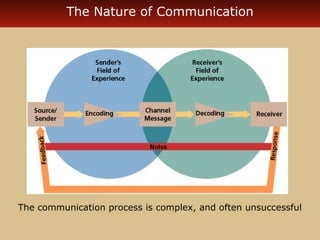
The Nature of Communication 
The communication process is complex, and often unsuccessful
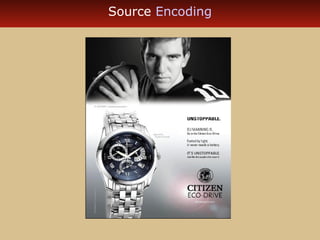
Source Encoding
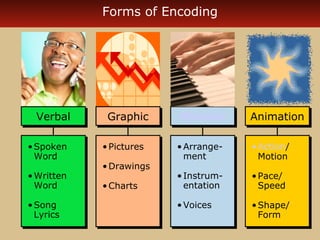
Forms of Encoding 
GGrraapphhiicc 
•Pictures 
•Drawings 
•Charts 
•Pictures 
•Drawings 
•Charts 
VVeerrbbaall 
•Spoken 
Word 
•Written 
Word 
•Song 
Lyrics 
•Spoken 
Word 
•Written 
Word 
•Song 
Lyrics 
MMuussiiccaall 
•Arrange-ment 
•Arrange-ment 
• Instrum-entation 
• Instrum-entation 
•Voices 
•Voices 
AAnniimmaattiioonn 
•Action/ 
Motion 
•Pace/ 
Speed 
•Shape/ 
Form 
•Action/ 
Motion 
•Pace/ 
Speed 
•Shape/ 
Form
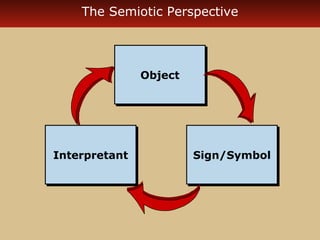
The Semiotic Perspective 
OObbjjeecctt 
IInntteerrpprreettaanntt SSiiggnn//SSyymmbbooll
An Image Can Convey More Than Words
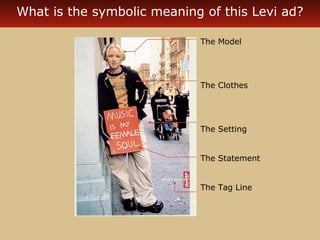
What is the symbolic meaning of this Levi ad? 
The Model 
The Clothes 
The Setting 
The Statement 
The Tag Line
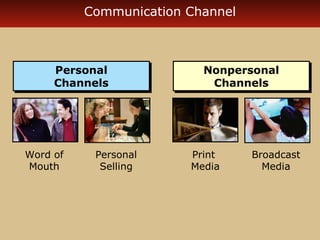
Communication Channel 
Personal 
Channels 
Personal 
Channels 
Personal 
Selling 
Word of 
Mouth 
Nonpersonal 
Channels 
Nonpersonal 
Channels 
Print 
Media 
Broadcast 
Media
Marketers Embrace Buzz Marketing
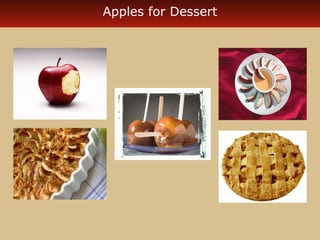
Apples for Dessert
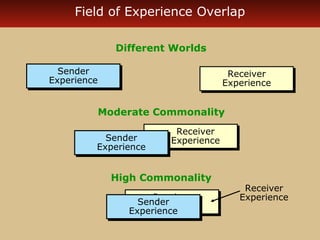
Field of Experience Overlap 
Receiver 
Experience 
Receiver 
Experience 
Sender 
Experience 
Sender 
Experience 
Different Worlds 
Moderate Commonality 
Receiver 
Receiver 
Experience 
Sender 
Experience 
Sender Experience 
Experience 
High Commonality 
Receiver 
Receiver 
Experience 
Sender 
Experience 
SeEnxdpeerrience 
Experience 
Receiver 
Experience
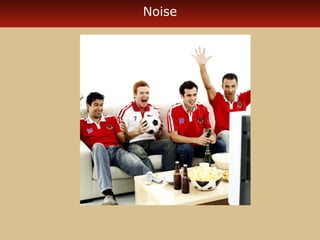
Noise
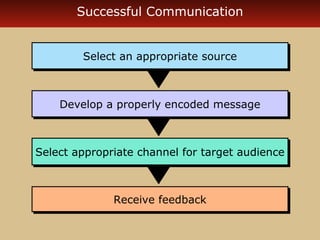
Successful Communication 
SSeelleecctt aann aapppprroopprriiaattee ssoouurrccee 
DDeevveelloopp aa pprrooppeerrllyy eennccooddeedd mmeessssaaggee 
SSeelleecctt aapppprroopprriiaattee cchhaannnneell ffoorr ttaarrggeett aauuddiieennccee 
RReecceeiivvee ffeeeeddbbaacckk
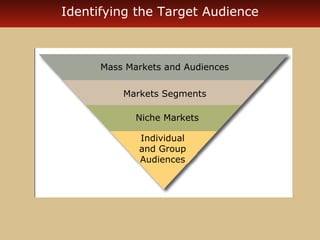
Identifying the Target Audience 
Mass Markets and Audiences 
Markets Segments 
Niche Markets 
Individual 
and Group 
Audiences
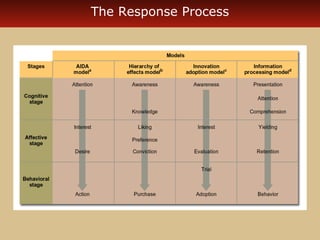
The Response Process
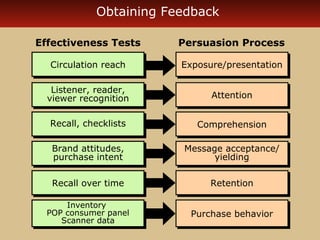
Obtaining Feedback 
Effectiveness Tests Persuasion Process 
EExxppoossuurree//pprreesseennttaattiioonn 
AAtttteennttiioonn 
CCoommpprreehheennssiioonn 
Message acceptance/ 
Message acceptance/ 
yielding 
yielding 
RReetteennttiioonn 
PPuurrcchhaassee bbeehhaavviioorr 
CCiirrccuullaattiioonn rreeaacchh 
Listener, reader, 
viewer recognition 
Listener, reader, 
viewer recognition 
RReeccaallll,, cchheecckklliissttss 
Brand attitudes, 
purchase intent 
Brand attitudes, 
purchase intent 
RReeccaallll oovveerr ttiimmee 
Inventory 
Inventory 
POP consumer panel 
POP consumer panel 
Scanner data 
Scanner data
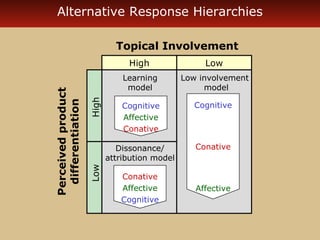
Alternative Response Hierarchies 
High Low 
Low High 
Topical Involvement 
Perceived product 
differentiation 
Learning 
model 
Low involvement 
model 
Cognitive 
Affective 
Conative 
Dissonance/ 
attribution model 
Conative 
Affective 
Cognitive 
Cognitive 
Conative 
Affective
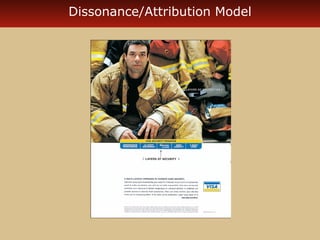
Dissonance/Attribution Model
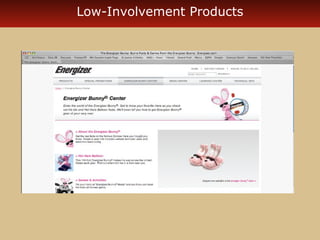
Low-Involvement Products
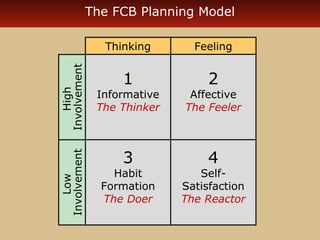
The FCB Planning Model 
Thinking Feeling 
1 
Informative 
The Thinker 
3 
Habit 
Formation 
The Doer 
Involvement 
Involvement 
Low 
2 
Affective 
The Feeler 
4 
Self- 
Satisfaction 
The Reactor 
High
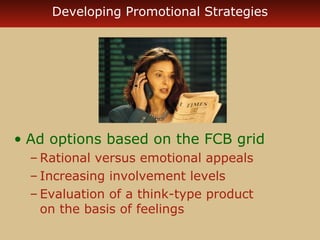
Developing Promotional Strategies 
• Ad options based on the FCB grid 
–Rational versus emotional appeals 
– Increasing involvement levels 
– Evaluation of a think-type product 
on the basis of feelings
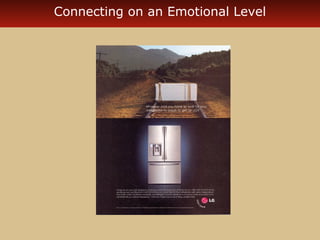
Connecting on an Emotional Level
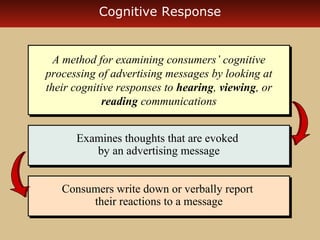
Cognitive Response 
A method for examining consumers’ cognitive 
processing of advertising messages by looking at 
their cognitive responses to hearing, viewing, or 
reading communications 
Examines thoughts that are evoked 
by an advertising message 
Consumers write down or verbally report 
their reactions to a message
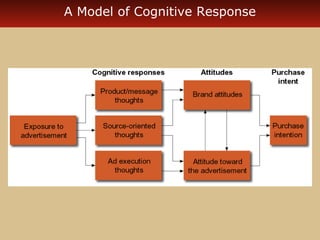
A Model of Cognitive Response
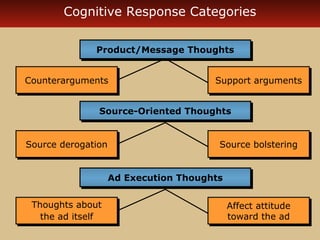
Cognitive Response Categories 
PPrroodduucctt//MMeessssaaggee TThhoouugghhttss 
CCoouunntteerraarrgguummeennttss SSuuppppoorrtt aarrgguummeennttss 
SSoouurrccee--OOrriieenntteedd TThhoouugghhttss 
SSoouurrccee ddeerrooggaattiioonn SSoouurrccee bboollsstteerriinngg 
Thoughts about 
the ad itself 
Thoughts about 
the ad itself 
Affect attitude 
toward the ad 
Affect attitude 
toward the ad 
AAdd EExxeeccuuttiioonn TThhoouugghhttss
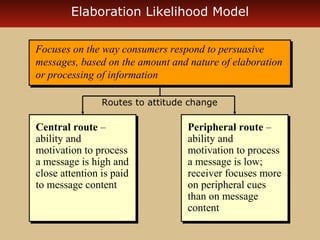
Elaboration Likelihood Model 
Focuses on the way consumers respond to persuasive 
messages, based on the amount and nature of elaboration 
or processing of information 
Focuses on the way consumers respond to persuasive 
messages, based on the amount and nature of elaboration 
or processing of information 
Routes to attitude change 
Peripheral route – 
ability and 
motivation to process 
a message is low; 
receiver focuses more 
on peripheral cues 
than on message 
content 
Peripheral route – 
ability and 
motivation to process 
a message is low; 
receiver focuses more 
on peripheral cues 
than on message 
content 
Central route – 
ability and 
motivation to process 
a message is high and 
close attention is paid 
to message content 
Central route – 
ability and 
motivation to process 
a message is high and 
close attention is paid 
to message content
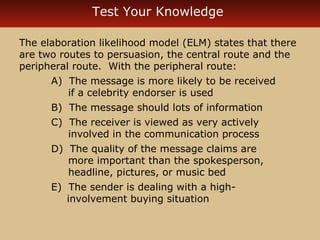
Test Your Knowledge 
The elaboration likelihood model (ELM) states that there 
are two routes to persuasion, the central route and the 
peripheral route. With the peripheral route: 
A) The message is more likely to be received 
if a celebrity endorser is used 
B) The message should lots of information 
C) The receiver is viewed as very actively 
involved in the communication process 
D) The quality of the message claims are 
more important than the spokesperson, 
headline, pictures, or music bed 
E) The sender is dealing with a high-involvement 
buying situation
Celebrity Endorsers Can Be Peripheral Cues
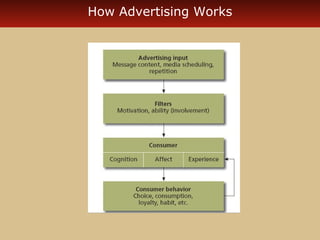
How Advertising Works

Chapter05

  • 1.
    The Communication Process 5 McGraw-Hill/Irwin Copyright © 2009 by The McGraw-Hill Companies, Inc. All rights reserved.
  • 2.
    The Nature ofCommunication The communication process is complex, and often unsuccessful
  • 3.
  • 4.
    Forms of Encoding GGrraapphhiicc •Pictures •Drawings •Charts •Pictures •Drawings •Charts VVeerrbbaall •Spoken Word •Written Word •Song Lyrics •Spoken Word •Written Word •Song Lyrics MMuussiiccaall •Arrange-ment •Arrange-ment • Instrum-entation • Instrum-entation •Voices •Voices AAnniimmaattiioonn •Action/ Motion •Pace/ Speed •Shape/ Form •Action/ Motion •Pace/ Speed •Shape/ Form
  • 5.
    The Semiotic Perspective OObbjjeecctt IInntteerrpprreettaanntt SSiiggnn//SSyymmbbooll
  • 6.
    An Image CanConvey More Than Words
  • 7.
    What is thesymbolic meaning of this Levi ad? The Model The Clothes The Setting The Statement The Tag Line
  • 8.
    Communication Channel Personal Channels Personal Channels Personal Selling Word of Mouth Nonpersonal Channels Nonpersonal Channels Print Media Broadcast Media
  • 9.
  • 10.
  • 11.
    Field of ExperienceOverlap Receiver Experience Receiver Experience Sender Experience Sender Experience Different Worlds Moderate Commonality Receiver Receiver Experience Sender Experience Sender Experience Experience High Commonality Receiver Receiver Experience Sender Experience SeEnxdpeerrience Experience Receiver Experience
  • 12.
  • 13.
    Successful Communication SSeelleeccttaann aapppprroopprriiaattee ssoouurrccee DDeevveelloopp aa pprrooppeerrllyy eennccooddeedd mmeessssaaggee SSeelleecctt aapppprroopprriiaattee cchhaannnneell ffoorr ttaarrggeett aauuddiieennccee RReecceeiivvee ffeeeeddbbaacckk
  • 14.
    Identifying the TargetAudience Mass Markets and Audiences Markets Segments Niche Markets Individual and Group Audiences
  • 15.
  • 16.
    Obtaining Feedback EffectivenessTests Persuasion Process EExxppoossuurree//pprreesseennttaattiioonn AAtttteennttiioonn CCoommpprreehheennssiioonn Message acceptance/ Message acceptance/ yielding yielding RReetteennttiioonn PPuurrcchhaassee bbeehhaavviioorr CCiirrccuullaattiioonn rreeaacchh Listener, reader, viewer recognition Listener, reader, viewer recognition RReeccaallll,, cchheecckklliissttss Brand attitudes, purchase intent Brand attitudes, purchase intent RReeccaallll oovveerr ttiimmee Inventory Inventory POP consumer panel POP consumer panel Scanner data Scanner data
  • 17.
    Alternative Response Hierarchies High Low Low High Topical Involvement Perceived product differentiation Learning model Low involvement model Cognitive Affective Conative Dissonance/ attribution model Conative Affective Cognitive Cognitive Conative Affective
  • 18.
  • 19.
  • 20.
    The FCB PlanningModel Thinking Feeling 1 Informative The Thinker 3 Habit Formation The Doer Involvement Involvement Low 2 Affective The Feeler 4 Self- Satisfaction The Reactor High
  • 21.
    Developing Promotional Strategies • Ad options based on the FCB grid –Rational versus emotional appeals – Increasing involvement levels – Evaluation of a think-type product on the basis of feelings
  • 22.
    Connecting on anEmotional Level
  • 23.
    Cognitive Response Amethod for examining consumers’ cognitive processing of advertising messages by looking at their cognitive responses to hearing, viewing, or reading communications Examines thoughts that are evoked by an advertising message Consumers write down or verbally report their reactions to a message
  • 24.
    A Model ofCognitive Response
  • 25.
    Cognitive Response Categories PPrroodduucctt//MMeessssaaggee TThhoouugghhttss CCoouunntteerraarrgguummeennttss SSuuppppoorrtt aarrgguummeennttss SSoouurrccee--OOrriieenntteedd TThhoouugghhttss SSoouurrccee ddeerrooggaattiioonn SSoouurrccee bboollsstteerriinngg Thoughts about the ad itself Thoughts about the ad itself Affect attitude toward the ad Affect attitude toward the ad AAdd EExxeeccuuttiioonn TThhoouugghhttss
  • 26.
    Elaboration Likelihood Model Focuses on the way consumers respond to persuasive messages, based on the amount and nature of elaboration or processing of information Focuses on the way consumers respond to persuasive messages, based on the amount and nature of elaboration or processing of information Routes to attitude change Peripheral route – ability and motivation to process a message is low; receiver focuses more on peripheral cues than on message content Peripheral route – ability and motivation to process a message is low; receiver focuses more on peripheral cues than on message content Central route – ability and motivation to process a message is high and close attention is paid to message content Central route – ability and motivation to process a message is high and close attention is paid to message content
  • 27.
    Test Your Knowledge The elaboration likelihood model (ELM) states that there are two routes to persuasion, the central route and the peripheral route. With the peripheral route: A) The message is more likely to be received if a celebrity endorser is used B) The message should lots of information C) The receiver is viewed as very actively involved in the communication process D) The quality of the message claims are more important than the spokesperson, headline, pictures, or music bed E) The sender is dealing with a high-involvement buying situation
  • 28.
    Celebrity Endorsers CanBe Peripheral Cues
  • 29.

Editor's Notes

  • #3 Relation to textThis slide relates to material on pp. 144-146 and Figure 5-1 of the text. Summary OverviewThis slide provides an overview of the basic elements of the communications process, which includes: Source/Sender – the person or organization that has information to share Receiver – person(s) with whom the sender is sharing thoughts Message – the information the source hopes to convey Channel – method by which the communication travels from source to receiver Encoding – putting thoughts, ideas, or information into symbolic form Decoding – transforming the senders message back into thought Response – receiver’s reactions after seeing, hearing, or reading the message Feedback – part of the receiver’s response that is communicated back to the sender Noise – unplanned distortion or interference Use of this slideThis slide can be used to introduce the communication process and discuss the basic elements in a communication system.
  • #4 Relation to textThis slide relates to pp. 146-148 of the text. Summary OverviewThe sender, or source, of a communication is the person or organization that has information to share. The source may be an individual or a nonpersonal entity, such as the corporation or organization itself. This ad for citizen watches uses professional football player Eli Manning as a spokesperson for the company. Because the receiver’s perceptions of the source influence how the communication is received, the spokesperson (source) must be someone the receiver will believe is knowledgeable and trustworthy, or someone with whom the receiver can in some way relate. The goal of the source is to put thoughts, ideas, or information into a symbolic form that can be understood by the receiver(s). Use of this slideThis slide can be used to introduce the topics of sources and encoding.
  • #5 Relation to textThis material relates to material on p. 148 of the text. Summary OverviewThis slide summarizes the various forms of encoding, which is the process by which thoughts or ideas are put into a symbolic form. Use of this slideThis slide can be used to explain the various forms by which as messages can be encoded by the sender. Many of these are used in the development of advertising messages.
  • #6 Relation to textThis slide relates to material on pp. 148-149 of the text. Summary OverviewThe encoding process leads to the development of a message that contains information or meaning the source hopes to convey. To better understand the symbolic meaning that might be conveyed in a communication, marketing researchers have begun to focus on semiotics, which studies the nature of meaning and asks how our reality – words, gestures, signs, products, symbols – acquire meaning. From a semiotic perspective, every marketing message has three components: Object – product or brand that is the focus of the message (e.g., Marlboro) Sign or symbol – sensory imagery that represents the intended meanings of the object (cowboy) Interpretant – intended meaning (masculine, rugged, individualistic) Use of slideUse this slide to demonstrate the use of semiotics as a technique to develop a meaningful communications message. It can be helpful in analyzing how various aspects of the marketing program – such as advertising messages, packaging, brand names, and even the non-verbal communications of sales people – are interpreted by receivers.
  • #7 Relation to textThis slide relates to material on p. 148 and Exhibit 5-3. Summary OverviewThis slide is an ad for Coach handbags. It is an example of a message that is conveyed primarily through an image, rather than words. The picture is an effective way for Coach to communicate it’s intended message of eloquent simplicity, as well as classic design and American style. Use of this slideThis slide can be used as an example of an ad where the message is conveyed through an image alone.
  • #8 Relation to textThis slide relates to the material on pp. 148-149, which discusses semiotics. Summary OverviewThis slide shows an ad for Levi Strauss & Company, which is a leading clothing manufacturer. Levi’s hired a cultural anthropologist to help it better understand the image and meaning of clothing and fashion among young consumers. The research team recruited hip-looking people in the streets of New York city. The chosen were given a piece of red cardboard and a white market and asked to “write down something you believe in; something that’s true about you or your world.” The model… a pre-med student at New York University The clothes… Levi’s cargo pants, her own T-shirt, zip-up sweatshirt, combat boots, and accessories The setting… the streets of the East Village section of New York city The statement… Music is my female soul The Tag Line… What’s true Use of this slideThis slide can be used as part of a discussion of semiotics. As noted in the text, some advertising and marketing people are skeptical about the value of semiotics. They question whether semiologists read too much into advertising messages and are overly intellectual in interpreting them. Ask students if they feel that the research that Levi did resulted in an effective ad.
  • #9 Relation to textThis slide relates to material on pp. 149-150 of the text. Summary OverviewCommunication channels are of two types, personal and nonpersonal. Personal channels involve direct, interpersonal (face-to-face) contact with individuals or groups. Sales people serve as personal channels when they deliver their sales messages. Social channels, such as friends, family, and co-workers, can be a powerful personal source of information through what is commonly referred to as word-of-mouth communication. Many companies work to generate positive word-of-mouth discussions for their companies or brands. Nonpersonal channels are those that carry a message without a personal contact between sender and receiver. Nonpersonal channels are generally referred to as mass media, and include various forms of print and broadcast media. Use of this slideThis slide can be used to explain the channels of the communication process and the difference between personal and nonpersonal channels. Both can be used very effectively in advertising and promotion programs.
  • #10 Relation to textThis slide relates to IMC Perspective 5-1 on pp. 151-152 of the text. Summary OverviewConsumers are tired of being bombarded with sales messages and are turned off by advertising. Even when they do catch TV commercials or print ads, these jaded consumers often ignore the marketing message. To penetrate the skepticism and capture the attention of consumers, they must bring messages to them in a different way. Many companies are turning to a stealth-type strategy known as buzz marketing, whereby consumers themselves are recruited to spread the message. Buzz marketing is just a new name for word-of-mouth. Common buzz marketing techniques: Handing out product samples Providing products to influential people and encouraging them to talk up the brand Building Web communities so customers can chat about their product experiences online Hiring actors to talk up a brand in public places This slide shows the vocalpoint website home page. Women who join this online community receive product samples, as well as a sense of empowerment, because they are asked for their opinion on a variety of issues. Use of this slideUse this slide when introducing the concept of using personal channels and buzz marketing to capture potential customers.
  • #11 Relation to textThis slide relates to page 152 of the text. Summary OverviewThe receiver is the person(s) with whom the sender shares thoughts or information. Decoding is the process of transforming the sender’s message back into thought. This process is heavily influenced by the receiver’s frame of reference or field of experience, which refers to the experienced, perceptions, attitudes, and values he/she brings to the communication situation. For effective communication to occur, the message decoding processing of the receiver must match the encoding of the sender. Use of this slideUse this slide to illustrate and discuss the decoding process and how it can be affected by personal experiences and perceptions. Ask students this question: “If someone invited you to dinner and said ‘we’re serving apples for dessert,’ would you picture apple pie, an apple tart, caramel apples, whole apples, apples with a dipping sauce… or something entirely different?”
  • #12 Relation to textThis slide relates to material on p. 152 of the text. Summary OverviewDecoding the message can be heavily influenced by the receiver’s frame of reference or field of experience, which refers to the experiences, perceptions, attitudes, and values he or she brings to the communication situation. Effective communication is more likely when there is some common ground between the two parties. This slide illustrates this concept by showing different levels of experiential overlap between the sender and the receiver. Use of this slideThis slide can be used to demonstrate that for effective communication to occur the message decoding process of the receiver must match the encoding of the sender. The more overlap present in their experiences, the greater chance of effective communication. This notion can cause great difficulty in the advertising communication process, because marketing and advertising people often have very different fields of experience from the consumers who constitute the mass markets with whom they must communicate.
  • #13 Relation to textThis slide relates to pp. 152-153 of the text. Summary OverviewThis slide illustrates the concept of noise during the communication process, which is basically anything that can distort or interfere with the reception of a message. Consider this situation, where four friends are watching a football game. Would the cheers for the play drown out the beginning of a commercial? Might reaching for a snack cause the receivers to turn their eyes from the TV screen? Would alcohol consumption affect perception? What would happen if the cell phone on the table rang? What if the electricity went off unexpectedly? Use of this slideUse this slide to point out how many things can interfere with the reception and decoding of a message. Ask them what other things might be considered noise? For example, would the program be paused or continue playing if one or more of the friends needed a bathroom break or went to the kitchen for more snacks?
  • #14 Relation to textThis slide relates to material on p. 154 of the text. Summary OverviewSuccessful communication is accomplished when the marketer selects an appropriate source, develops an effective message or appeal that is encoded properly, and then selects the channels or media that will reach the target audience. Marketers are very interested in feedback, that part of the receiver’s response that is communicated back to the sender. Feedback, which may take a variety of forms, closes the loop in the communications flow and lets the sender monitor how the intended message is being decoded and received. Use of this slideThis slide can be used to discuss each step in the communication process, and the importance of feedback so that the advertiser can determine reasons for success or failure in the process, and then make adjustments.
  • #15 Relation to textThis slide relates to material on pp. 154-156 and Figure 5-2 of the text. Summary OverviewThe marketing communications process begins with identifying the audience on which the firm’s advertising and promotional efforts will be focused. The target audience may consist of individuals, groups, niche markets, market segments, or a mass audience. This slide shows the various levels of the audience aggregation: Individuals – those with specific needs, for whom a message must be specifically tailored Small groups – multiple people in the audience who are involved in the purchase decision, such as families or members of a buying center Niche markets – smaller, well-defined markets consisting of customers who have similar needs Market segments – broader classes of people who have similar needs and can be reached with similar messages Mass markets – markets consisting of large numbers of potential customers Use of this slideThis slide can be used to show the various types of markets and customers that can be identified as a marketing target. Marketers usually approach each of these audiences differently, from a communications perspective.
  • #16 Relation to textThis slide relates to material on pp. 156-157 and Figure 5-3 of the text. Summary OverviewThis slide shows hierarchical response models that have been developed through the years to depict the stages consumers/customers go through as they learn about a company’s product or service, and then move to a stage of purchase readiness or actual behavior. These four models include: AIDA model – developed to depict the stages in the personal selling process Hierarchy of effects model – shows the process by which advertising works Innovation adoption model – shows the stages a consumers passes through in the process of adopting a new product Information processing model – a model of the process through which a consumer must pass to be influenced by advertising Use of this slideThis slide can be used to provide an overview of various hierarchical response models. It should be noted that each of these models views the consumer as passing through a cognitive, affective, and behavioral stage.
  • #17 Relation to textThis slide relates to material on p. 157 and Figure 5-4 of the text. Summary OverviewEach stage of the response hierarchy is a dependent variable that must be attained, and that may serve as an objective of the communication process. Each stage can be measured, providing the advertiser with feedback regarding the effectiveness of the strategies being used to move the consumer to purchase. Use of this slideUse this slide to explain that the information processing model can be an effective framework for planning and evaluating the effects of a promotional campaign.
  • #18 Relation to textThis slide relates to material on pp. 159-163 and Figure 5-5 of the text. Summary OverviewMichael Ray has developed a model of information processing that identifies three alternative orderings of the three stages based on perceived product differentiation and product involvement. The Standard Learning Hierarchy = learn feel do sequence. The consumer is viewed as an active participant and this sequence is likely when there is much differentiation among brands and the consumer is highly involved in the purchase process. The Dissonance/Attribution Hierarchy = do feel learn sequence. Occurs when consumers must choose between two alternatives that are similar in quality but are complex and may have unknown attributes. Focus of mass media should be on reducing dissonance after purchase. Low involvement Hierarchy = learn –do feel sequence. Occurs when involvement in the purchase decision is low, there are minimal differences among brand alternatives, and mass-media advertising is important. Use of this slideThis slide can be used to explain Michaels Ray’s alternative response hierarchies. Understanding these response sequences is important to marketers, because not all purchase decisions are explained adequately by the traditional response hierarchy. From a promotional perspective, it is important to examine the communication situation for a product or service in order to determine the type of response process that is most likely to occur.
  • #19 Relation to textThis slide relates to page 160 of the text, and Exhibit 5-7. Summary OverviewMarketers need to recognize that in some situations attitudes develop after purchase, as does learning from the mass media. Ray suggests that in these situations the main effect of the mass media is not the promotion of original choice behavior and attitude change, but rather the reduction of dissonance by reinforcing the wisdom of the purchase or providing supportive information. This ad for Visa reinforces consumers’ decision to use a Visa credit card by reassuring them of the various layers of security the company provides to its cardholders. Use of this slideUse this slide as an example of an ad that seeks to provide supportive information, thereby reducing consumer dissonance.
  • #20 Relation to textThis slide relates to page 163 of the text, and Exhibit 5-10. Summary OverviewA popular creative strategy used by advertisers of low-involvement products is what advertising analyst Harry McMahan calls VIP, or visual image personality. Basically, advertisers use symbols that lead consumers to identify and retain ads. A prime example is the Energizer Bunny shown in this ad. Other examples include the Pillsbury doughboy, Morris the cat, Tony the tiger, and Mr. Clean. Use of this slideUse this slide to show how advertisers add visual image personality to their advertisements in order to gain brand recognition and retention. Ask students if they can name other such symbols. Examples are the Marlboro man, the Taco Bell chihuahua, the Aflac duck, and the GEICO gecko.
  • #21 Relation to textThis slide relates to material on pp. 164-165 and Figure 5-6 of the text. Summary OverviewThis slide shows the advertising planning model developed by associates from the Foote Cone & Belding agency. This model builds on traditional response theories, such as the hierarchy of effects model and its variants, and research on high and low involvement. They added the dimensions of thinking versus feeling at each involvement level. Their model is known as the FCB grid and delineates four primary advertising planning strategies: Informative – for highly involved purchases where rational thinking and economic considerations prevail. Affective – for highly involved/feeling purchases. These types of products should be advertised stressing psychological and emotional motives. Habit formation – for low involvement/thinking products where routine behavior patterns and learning occurs most often after purchase. Self-satisfaction – low involvement/feeling products where appeals to sensory pleasures and social motives are important Use of this slideThis slide can be used as part of a discussion of the FCB grid, which provides a useful way for those involved in the advertising planning process to analyze consumer /product relationships and develop appropriate promotional strategies. It is also useful in developing effective creative options, such as using rational versus emotional appeals, increasing involvement levels, or getting customers to evaluate a think-type product on the basis of feeling.
  • #22 Relation to textThis slide relates to page 165 of the text. Summary OverviewConsumer research can be used to determine how consumers perceive products or brands on the involvement and thinking/feeling dimensions. This information can then be used to develop effective creative options, such as using rational versus emotional appeals, increasing involvement levels, or even getting consumers to evaluate a think-type product on the basis of feelings. Use of this slideUse this slide to illustrate some of the promotional strategies that may be developed using the principles of the FCB grid.
  • #23 Relation to textThis slide relates to page 165 and Exhibit 5-11 of the text. Summary OverviewThis advertisement encourages consumers to upgrade their appliances by focusing on product design. Imagining what will happen to the refrigerator when it is hit by a train evokes an emotional response, as does the thought of moving from an old, unattractive appliance to a sleek new design. Use of this slideUse this slide to illustrate how an ad can create an emotional response.
  • #24 Relation to textThis slide relates to the material on pp. 165-166 of the text. Summary OverviewThis slide defines the cognitive response approach to examining consumers’ processing of advertising messages. This approach examines the type of thoughts evoked by an advertising message by having consumers write down or verbally report their reactions to a message. This method is widely used in research by both academicians and advertising practitioners to determine the types of responses evoked by an advertising message, and how these thoughts relate to attitudes toward the ad, brand, and purchase intentions. Use of this slideThis slide can be used to introduce the cognitive response approach to understanding the nature of consumers’ reactions to persuasive messages.
  • #25 Relation to textThis slide relates to material on pp. 165-166 of the text and Figure 5-7. Summary OverviewThis slide shows a model of the cognitive process and how these thoughts relate to traditional outcome measures, such as brand attitude, attitude toward the ad, and purchase intentions. Cognitive responses are the thoughts that occur while reading, viewing, and/or hearing a communication. The assumption is that these thoughts reflect the recipient’s reactions and help shape ultimate acceptance or rejection of a message. The categories of cognitive responses include: Product/message thoughts Source-oriented thoughts Ad execution thoughts Use of slideThis model can be used to show how cognitive responses to an advertisement mediate outcome reactions, such as brand attitude and attitude toward the advertisement, which in turn impact purchase intentions.
  • #26 Relation to textThis slide relates to material on pp. 165-167 of the text. Summary OverviewThis slide shows the three basic categories of cognitive responses: Product/message thoughts – directed at the product or service and/or claims being made in the communication. These types of thoughts include: Counterarguments – thoughts the recipient has that are opposed to the position taken in the message Support arguments – thoughts that affirm or support the claims made in the message Source-oriented thoughts – directed at the source of the communication and include: Source derogations – negative thoughts about the spokesperson or organization making the claims Source bolsters – favorable thoughts about the spokesperson or organization making the claims Ad execution thoughts – thoughts about the ad itself, including execution factors such as creativity, quality, colors, or voice tones. Affect/attitude toward the ad represents the receivers’ feeling of favorability or unfavorability toward the ad. Use of this slideThis slide can be used to further explain the cognitive response model by providing examples of the three categories of thoughts that might occur in reaction to an advertising message.
  • #27 Relation to textThis slide relates to material on pp. 167-160 of the text and Figure 5-8. Summary OverviewDifferences in the way consumers respond to persuasive messages are addressed in the elaboration likelihood model (ELM). According to the model, the attitude formation or change process depends on the amount and nature of elaboration, or processing, of relevant information that occurs in response to a persuasive message. This model recognizes two basic routes to persuasion or attitude change: Central route to persuasion – the receiver is viewed as an active participant in the communication process whose ability and motivation to attend, comprehend, and evaluate the message is high. Peripheral route to persuasion – the receiver is viewed as lacking the motivation or ability to process information and is not likely to engage in detailed cognitive processing. Rather than evaluating the information in the message, the receiver relies on peripheral cues or cognitive shortcuts. Use of this slideThis slide can be used to explain the elaboration likelihood model and discuss its use by marketers to develop communication messages. When central processing of an ad occurs, the consumer pays close attention to message content and scrutinizes the message arguments carefully. Thus, the ad’s ability to persuade depends on the receiver’s evaluation of the arguments presented. Under the peripheral route to persuasion, the receiver’s reaction to the message depends on how he or she evaluates peripheral cues such as the attractiveness of the source, music, or imagery. These cues might help consumers form a positive attitude toward the brand even if they do not process the message portion of the ad.
  • #28 Answer: A
  • #29 Relation to textThis material relates to material on p. 170 of the text, which discusses the Elaboration Likelihood Model. Summary OverviewThis slide shows an ad for Peak Long Life antifreeze. It contains several positive peripheral cues, including an attractive and highly relevant celebrity endorser (Indy series driver Danica Patrick) and appealing visual imagery that is consistent with the brand positioning. Use of this slideThis slide can be used to show an example of an ad that might result in attitude change through a peripheral route to persuasion. The celebrity endorser and visual imagery serve as peripheral cues and help consumers form a positive attitude toward the brand, even if they do not process the message portion of the ad.
  • #30 Relation to textThis slide relates to material on pp. 170-171 and Figure 5-9. Summary OverviewThis slide presents a framework for studying how advertising works. It was developed by Vakratsas and Ambler following an extensive review of more than 250 articles and studies of the advertising response process. The framework is as follows: Advertising input – message content, media scheduling, repetition Filters – the message is mediated by factors such as motivation and ability Consumer – intermediate effects between advertising and purchase Cognition – the thinking dimension of a person’s response Affect – the feeling dimension of a person’s response Experience – the feedback dimension based on outcomes of the product purchasing and usage Consumer behavior – consumption, choice, loyalty, habit Use of this slideThis chapter has presented the process consumers go through in responding to marketing communications from a number of different perspectives. This slide can be used to explain the framework for studying how advertising works and to summarize the different models. The various communication models provide insight into how consumers process and respond to persuasive messages, which helps marketers make better decisions when planning and implementing IMC programs.