Word PartsBio – life or living things
-ology – the study of
A or An – not
Anti – against
itis – inflammation/swelling
Ist – a person who studies
Genesis - creation
Micro – small or tiny
Uni - one
Bi/Di – two
Multi – many
22
Chapter OneChapter One
copyright cmassengalecopyright cmassengale
33
What is Biology?What is Biology?
Biology-Biology-study of all livingstudy of all living
thingsthings
Living things are calledLiving things are called
organismsorganisms
copyright cmassengalecopyright cmassengale
What is Science?
Science is a way of knowing
and it’s an ongoing ever-
changing process
Have all Science Questions
been Answered?
Skeptical – its good not to always
have a definite explanation
because the world is always
changing.
Do flies come from old meat?
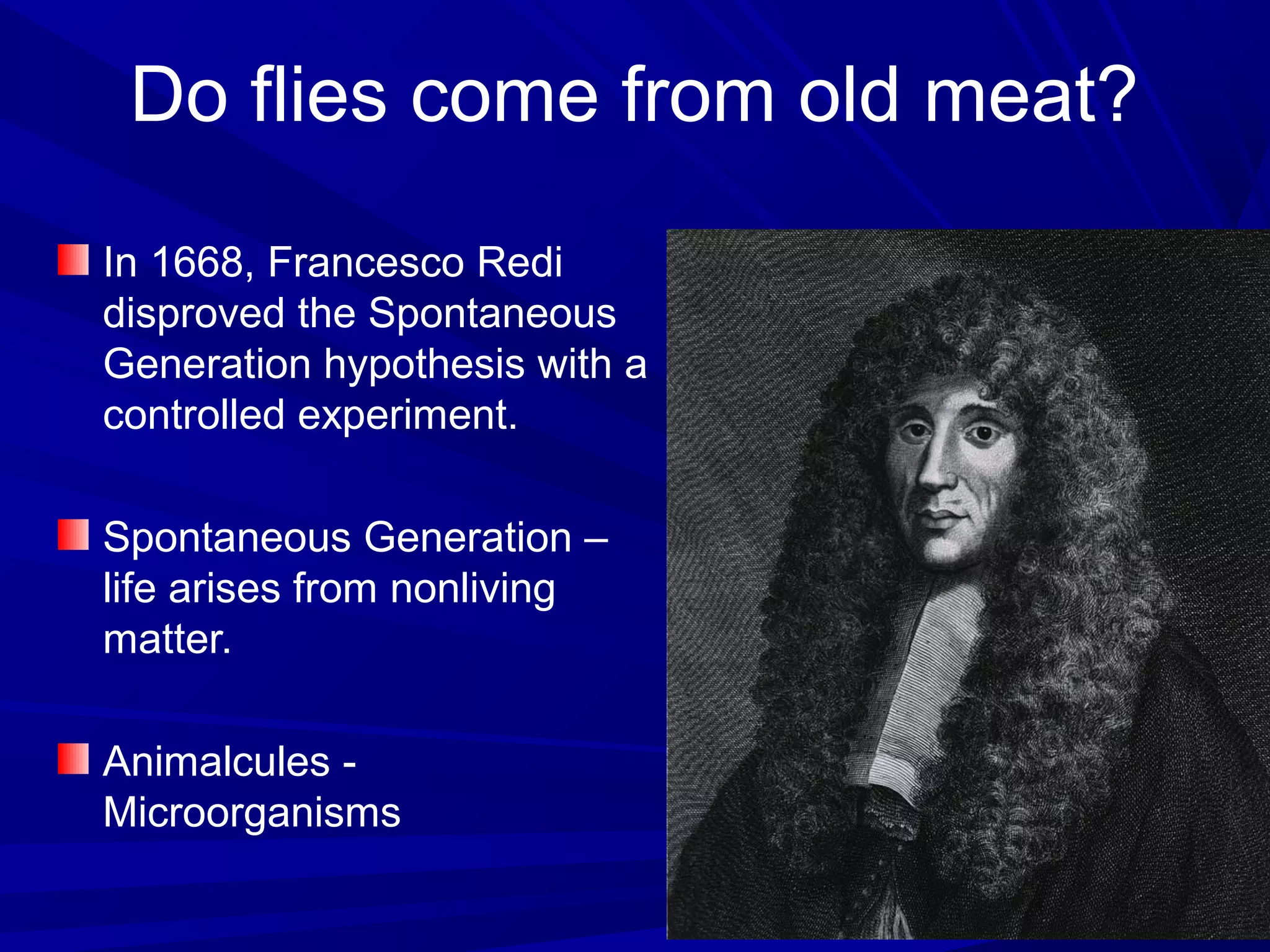
In 1668, Francesco Redi
disproved the Spontaneous
Generation hypothesis with a
controlled experiment.
Spontaneous Generation –
life arises from nonliving
matter.
Animalcules -
Microorganisms
Lazzaro Spallanzani stated, “New
organisms are produced only by
existing ones” using a gravy
experiment
Still debated because everyone
knows living things need air.
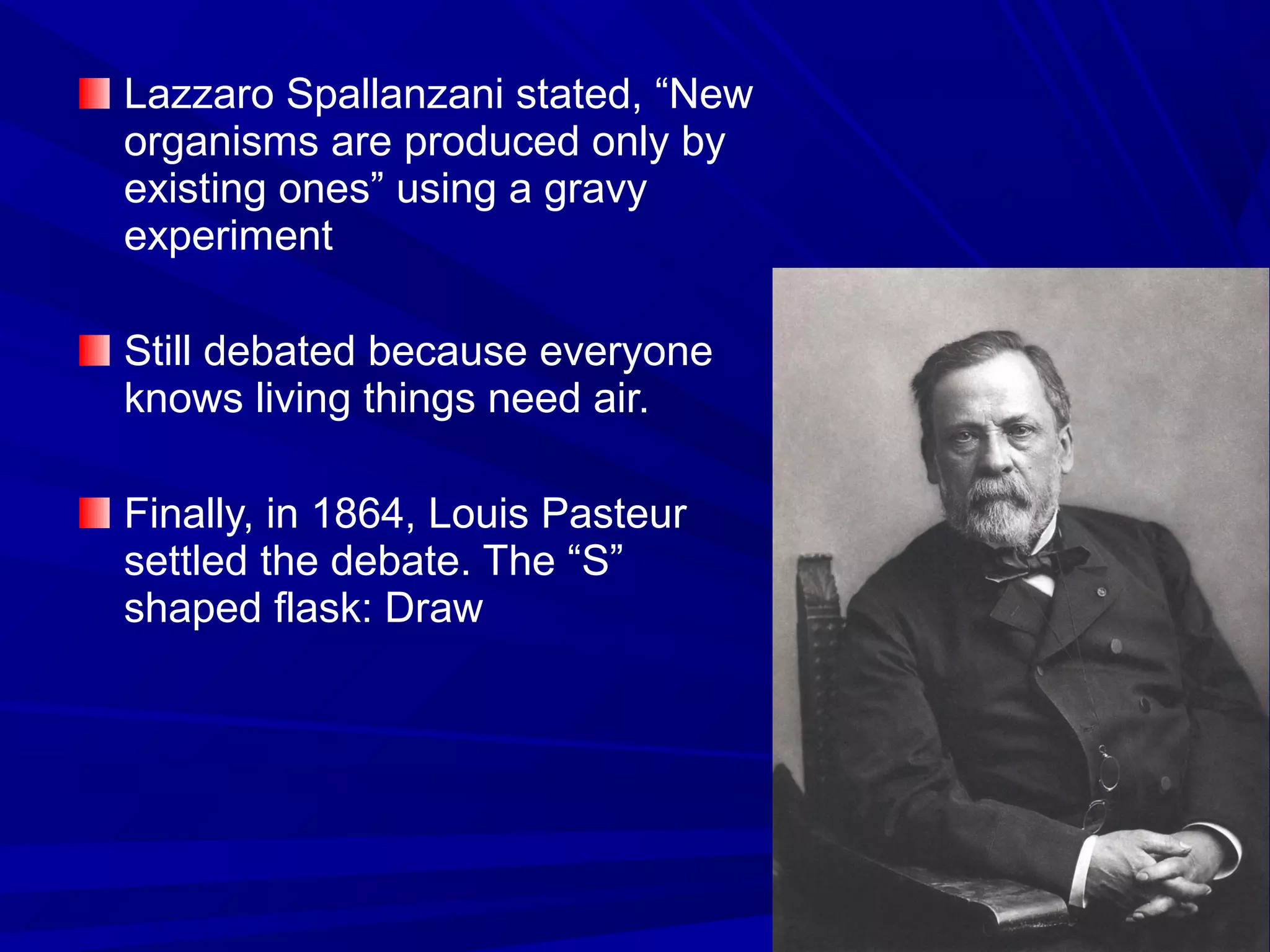
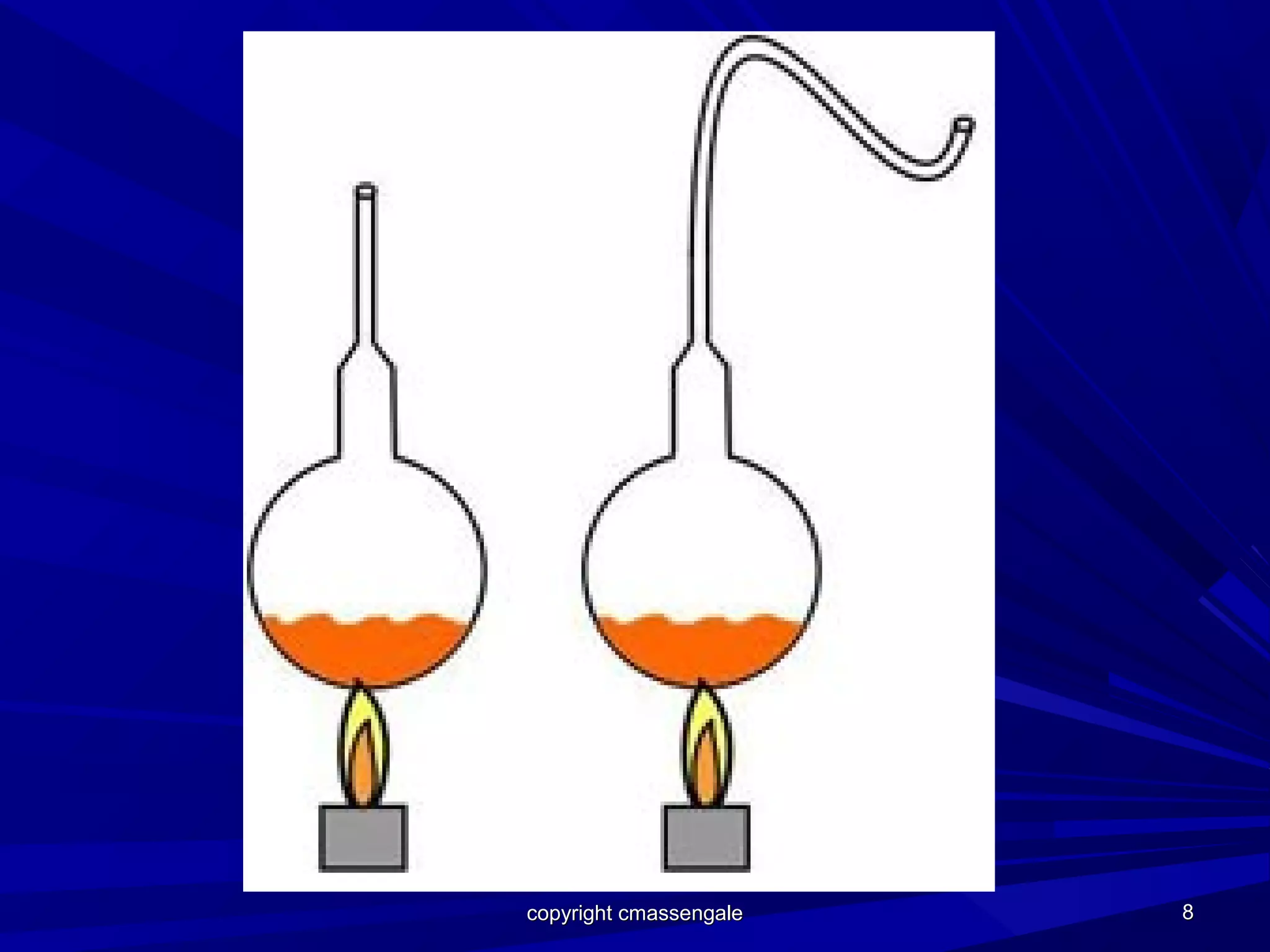
Finally, in 1864, Louis Pasteur
settled the debate. The “S”
shaped flask: Draw
copyright cmassengalecopyright cmassengale 88
Scientific Method
1. Ask a Question - not opinionated
2. Form a Hypothesis – a proposed
scientific explanation not “Educated
Guess” *Must be Testable*
3. Conduct a Controlled Experiment –
using a single manipulated variable
SM Cont.
4. Record and Analyze results – collect
data (information)
5. Prepare a Conclusion – summarize
data
6. Publish – let others review or
reproduce your work
Biotic and Abiotic Factors
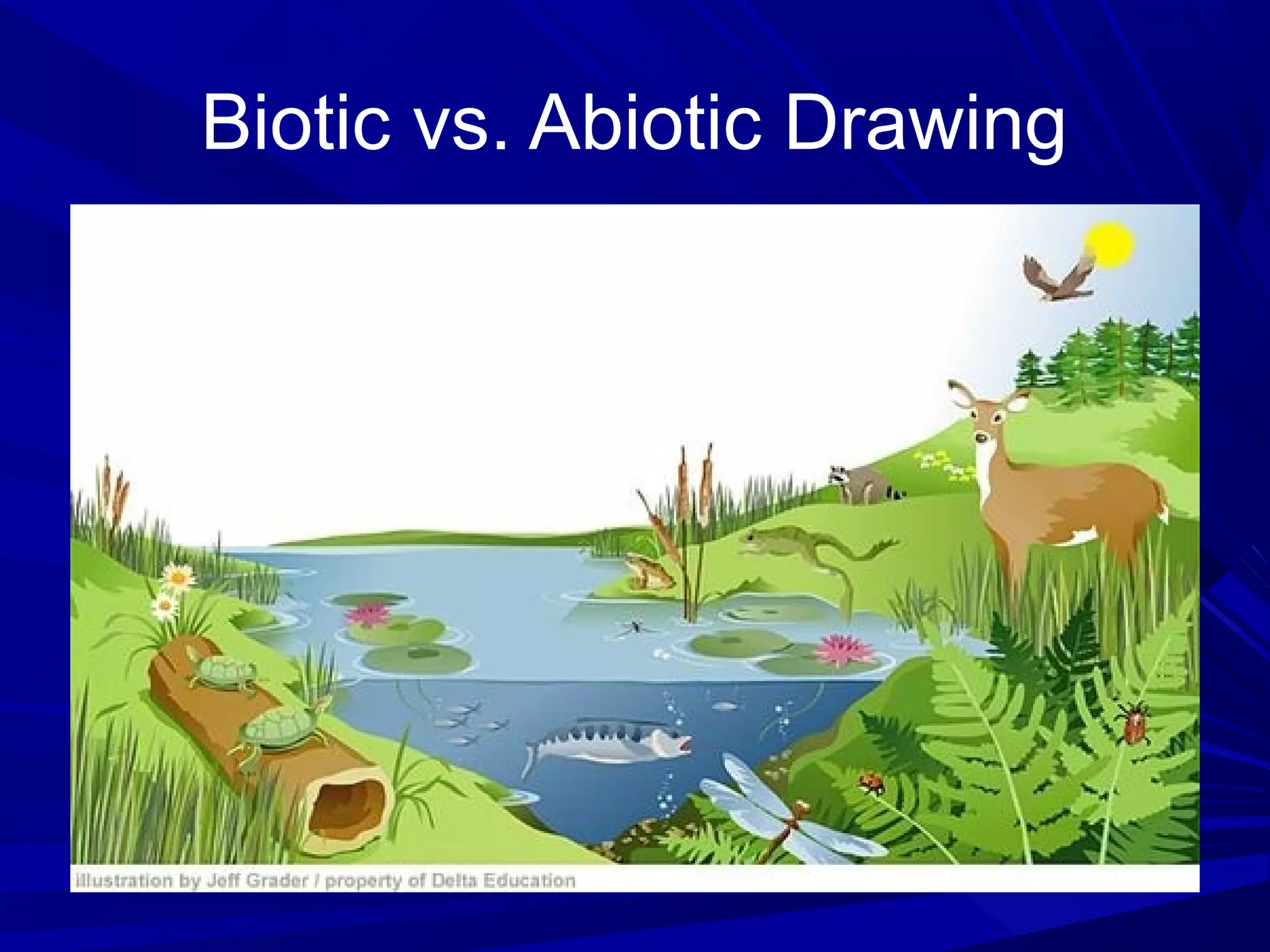
Biotic factors – interaction of living things:
1. Plants
2. Animals
3. Fungi
4. Bacteria
5. Protist
Abiotic - physical or nonliving factors that
shape an ecosystem:
temperature
precipitation
humidity
wind
nutrients
soil
sunlight
Biotic vs. Abiotic Drawing
1414
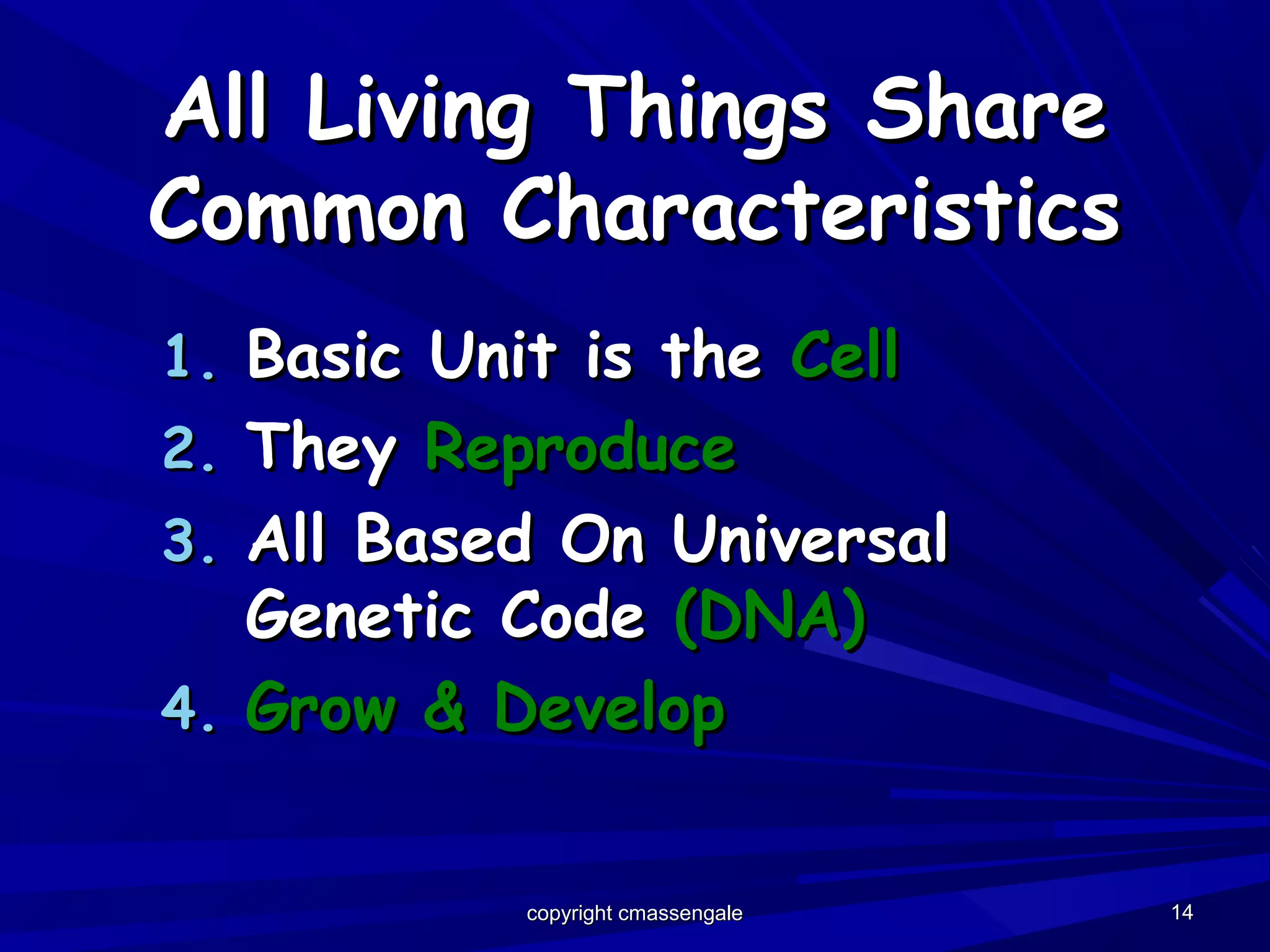
All Living Things ShareAll Living Things Share
Common CharacteristicsCommon Characteristics
1.1. Basic Unit is theBasic Unit is the CellCell
2.2. TheyThey ReproduceReproduce
3.3. All Based On UniversalAll Based On Universal
Genetic CodeGenetic Code (DNA)(DNA)
4.4. Grow & DevelopGrow & Develop
copyright cmassengalecopyright cmassengale
1515
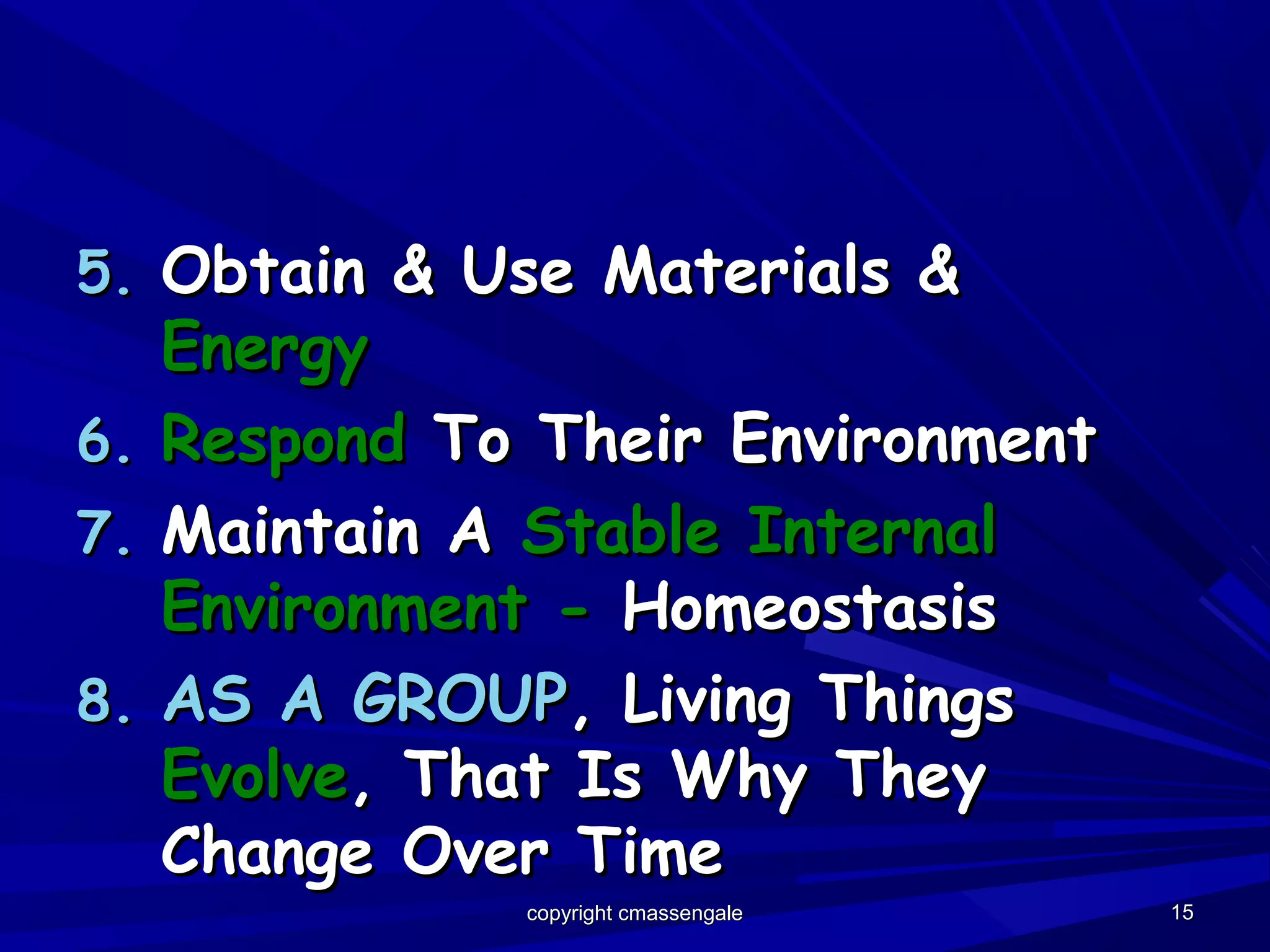
5.5. Obtain & Use Materials &Obtain & Use Materials &
EnergyEnergy
6.6. RespondRespond To Their EnvironmentTo Their Environment
7.7. Maintain AMaintain A Stable InternalStable Internal
Environment -Environment - HomeostasisHomeostasis
8.8. AS A GROUPAS A GROUP, Living Things, Living Things
EvolveEvolve, That Is Why They, That Is Why They
Change Over TimeChange Over Time
copyright cmassengalecopyright cmassengale
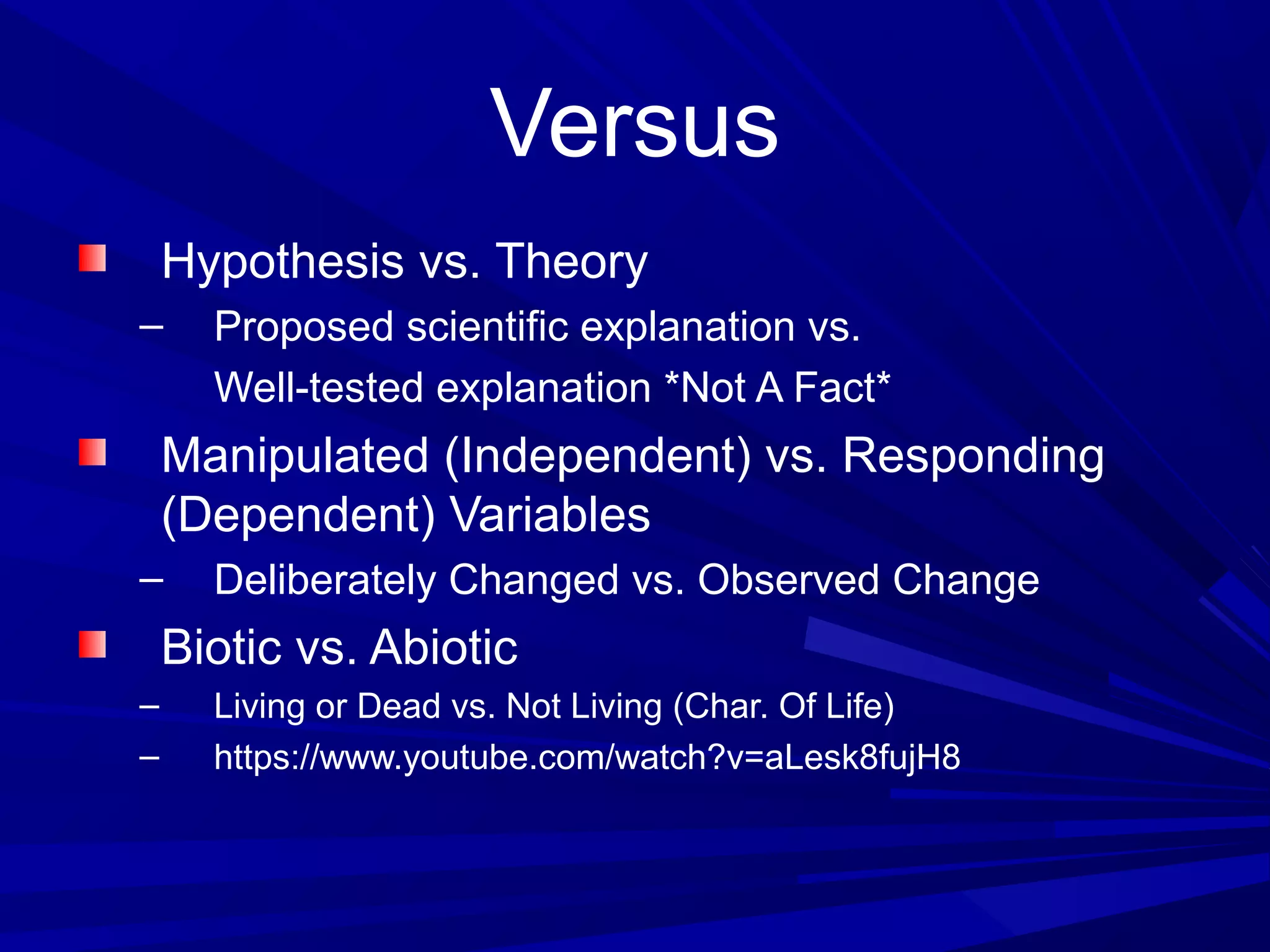
Versus
Hypothesis vs. Theory
– Proposed scientific explanation vs.
Well-tested explanation *Not A Fact*
Manipulated (Independent) vs. Responding
(Dependent) Variables
– Deliberately Changed vs. Observed Change
Biotic vs. Abiotic
– Living or Dead vs. Not Living (Char. Of Life)
– https://www.youtube.com/watch?v=aLesk8fujH8

Chapter one notes

  • 1.
    Word PartsBio –life or living things -ology – the study of A or An – not Anti – against itis – inflammation/swelling Ist – a person who studies Genesis - creation Micro – small or tiny Uni - one Bi/Di – two Multi – many
  • 2.
    22 Chapter OneChapter One copyrightcmassengalecopyright cmassengale
  • 3.
    33 What is Biology?Whatis Biology? Biology-Biology-study of all livingstudy of all living thingsthings Living things are calledLiving things are called organismsorganisms copyright cmassengalecopyright cmassengale
  • 4.
    What is Science? Scienceis a way of knowing and it’s an ongoing ever- changing process
  • 5.
    Have all ScienceQuestions been Answered? Skeptical – its good not to always have a definite explanation because the world is always changing.
  • 6.
    Do flies comefrom old meat? In 1668, Francesco Redi disproved the Spontaneous Generation hypothesis with a controlled experiment. Spontaneous Generation – life arises from nonliving matter. Animalcules - Microorganisms
  • 7.
    Lazzaro Spallanzani stated,“New organisms are produced only by existing ones” using a gravy experiment Still debated because everyone knows living things need air. Finally, in 1864, Louis Pasteur settled the debate. The “S” shaped flask: Draw
  • 8.
  • 9.
    Scientific Method 1. Aska Question - not opinionated 2. Form a Hypothesis – a proposed scientific explanation not “Educated Guess” *Must be Testable* 3. Conduct a Controlled Experiment – using a single manipulated variable
  • 10.
    SM Cont. 4. Recordand Analyze results – collect data (information) 5. Prepare a Conclusion – summarize data 6. Publish – let others review or reproduce your work
  • 11.
    Biotic and AbioticFactors Biotic factors – interaction of living things: 1. Plants 2. Animals 3. Fungi 4. Bacteria 5. Protist
  • 12.
    Abiotic - physicalor nonliving factors that shape an ecosystem: temperature precipitation humidity wind nutrients soil sunlight
  • 13.
  • 14.
    1414 All Living ThingsShareAll Living Things Share Common CharacteristicsCommon Characteristics 1.1. Basic Unit is theBasic Unit is the CellCell 2.2. TheyThey ReproduceReproduce 3.3. All Based On UniversalAll Based On Universal Genetic CodeGenetic Code (DNA)(DNA) 4.4. Grow & DevelopGrow & Develop copyright cmassengalecopyright cmassengale
  • 15.
    1515 5.5. Obtain &Use Materials &Obtain & Use Materials & EnergyEnergy 6.6. RespondRespond To Their EnvironmentTo Their Environment 7.7. Maintain AMaintain A Stable InternalStable Internal Environment -Environment - HomeostasisHomeostasis 8.8. AS A GROUPAS A GROUP, Living Things, Living Things EvolveEvolve, That Is Why They, That Is Why They Change Over TimeChange Over Time copyright cmassengalecopyright cmassengale
  • 16.
    Versus Hypothesis vs. Theory –Proposed scientific explanation vs. Well-tested explanation *Not A Fact* Manipulated (Independent) vs. Responding (Dependent) Variables – Deliberately Changed vs. Observed Change Biotic vs. Abiotic – Living or Dead vs. Not Living (Char. Of Life) – https://www.youtube.com/watch?v=aLesk8fujH8