Bellwork 10/13 Get out a piece of paper and put your name on it Big and Clearly. Draw your name into a picture of anything Make sure your heading is on there. Name Hour Date Subject
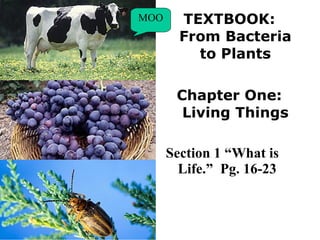
TEXTBOOK: From Bacteria to Plants Chapter One: Living Things Section 1 “What is Life.”  Pg. 16-23   MOO
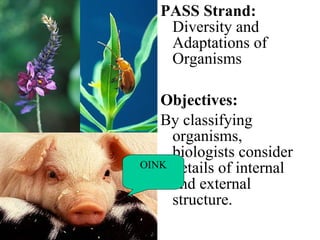
PASS Strand:  Diversity and Adaptations of Organisms Objectives: By classifying organisms, biologists consider details of internal and external structure. OINK
What is Life? A.      The Characteristics of Living Things Organisms—  a living thing . All living things have a.          cellular  organization b.         Contain similar chemicals c.          Use  energy d.         Grow and Develop e.          Respond to their  surroundings f.           Reproduce
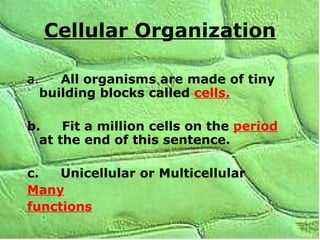
Cellular Organization a.          All organisms are made of tiny building blocks called  cells. b.         Fit a million cells on the  period  at the end of this sentence. c.         Unicellular or Multicellular Many functions
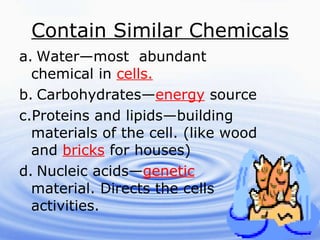
Contain Similar Chemicals a.   Water—most  abundant chemical in  cells. b.   Carbohydrates— energy  source c.Proteins and lipids—building materials of the cell. (like wood and  bricks  for houses) d.   Nucleic acids— genetic  material. Directs the cells activities.
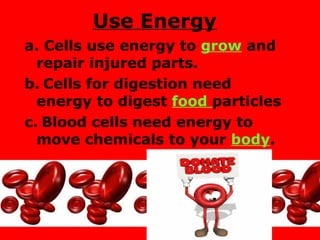
Use Energy a. Cells use energy to  grow  and repair injured parts. b.   Cells for digestion need energy to digest  food  particles c.   Blood cells need energy to move chemicals to your  body .
Grow and Develop a.       Growth —becoming larger b.         Development —change that produces a more complex organism. Ex. Acorn turns into an oak tree
Respond to their surroundings React to changes in their  environment b.    Stimulus  (plural stimuli)—a change in an organism’s surroundings that causes the organism to react. i.        Ex. Changes in temperature, light, sound  c.          Response —an action or change in behavior. An organism reacts to a stimulus with a response.
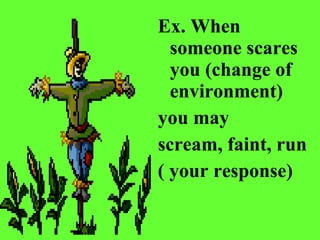
Ex. When someone scares you (change of environment)  you may  scream, faint, run  ( your response)
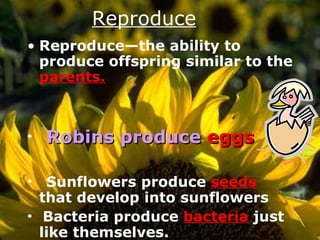
Reproduce Reproduce—the ability to produce offspring similar to the  parents.    Robins produce  eggs    Sunflowers produce  seeds  that develop into sunflowers   Bacteria produce  bacteria  just like themselves.
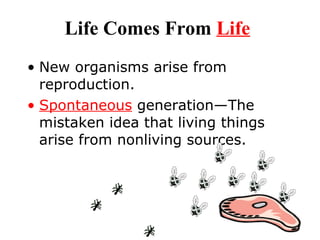
Life Comes From  Life New organisms arise from reproduction. Spontaneous  generation—The mistaken idea that living things arise from nonliving sources.
Ex. Experiments of Redi and Pasteur pg. 20,
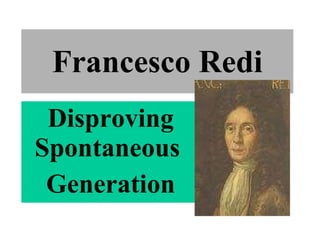
Francesco Redi Disproving Spontaneous  Generation
People used to believe that frogs sprouted from mud in ponds. What is Spontaneous Generation?
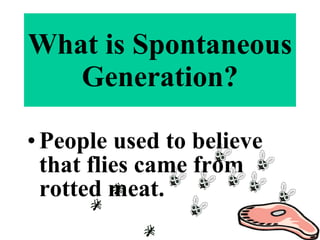
People used to believe that flies came from rotted meat. What is Spontaneous Generation?
This was a strongly held belief. What is Spontaneous Generation?
It took hundreds of years of experiments to convince people that it does not occur. What is Spontaneous Generation?
Redi was one scientist who worked to disprove this idea (in the mid-1600’s). What is Spontaneous Generation?
What did Francesco Redi do? Francesco Redi did a  controlled  experiment to prove that spontaneous generation does not happen.
What did Francesco Redi do? His experiment focused on whether or not flies come from rotting meat.
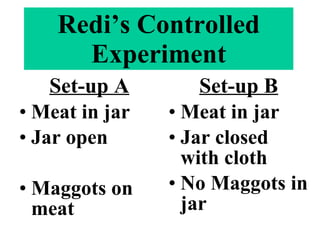
Redi’s Controlled Experiment Set-up A Meat in jar Jar open Maggots on meat Set-up B Meat in jar Jar closed with cloth No Maggots in jar
How was this a  “Controlled Experiment”? It was  controlled  because… He had only one manipulated variable – whether or not the meat was covered.
How is this a  “Controlled Experiment”? It was  controlled  because… When he got his results, he knew what caused them, because there was only one difference between the set-ups.
Redi’s Conclusion Redi concluded that  flies  had laid eggs on the rotting meat that  wasn’t covered , and the eggs hatched into maggots. …
Redi’s Conclusion So, the  meat  didn’t produce the maggots (young flies), the  adult flies  produced the young flies by laying eggs on the uncovered meat .
What we can learn… All living things come  only  from other living things. Spontaneous generation   doesn’t happen .
The Needs of Living Things           All living things must satisfy their  basic   needs  for energy, water, living space,  and stable  internal conditions.
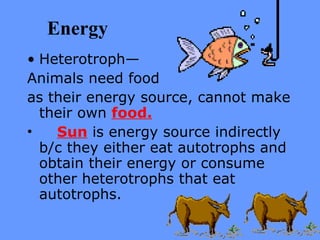
Energy   Heterotroph— Animals need  food   as their energy source, cannot make their own  food.       Sun  is energy source indirectly b/c they either eat autotrophs and obtain their energy or consume other heterotrophs that eat autotrophs.
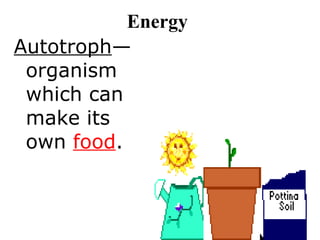
Energy Autotroph —organism which can make its own  food .
Water   All living things need water to survive. It can  dissolve  more chemicals than any other substance on earth. Helps by:  Obtain chemicals from surroundings Break down  food Grow Move substances within their bodies Reproduce
Living Space   All organisms need a space to  live.  A place to get food and water, and to find  shelter. Competition.  Plants only have so much space. Compete for sunlight/ space. Roots compete for water and nutrients. Animals can move but  share  living spaces with others or compete for area.
Stable Internal Conditions Organisms must be able to keep the conditions  inside  their bodies constant. Homeostasis —keeping the internal conditions stable despite the changes in an organism’s  surroundings .
Review What do all living things have in common?
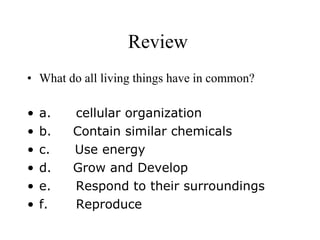
Review What do all living things have in common? a.          cellular organization b.         Contain similar chemicals c.          Use energy d.         Grow and Develop e.          Respond to their surroundings f.           Reproduce
Review What did Francisco Redi Prove?
Review What did Francisco Redi Prove? That living things do not come from non living things. (Flies do not come from meat)
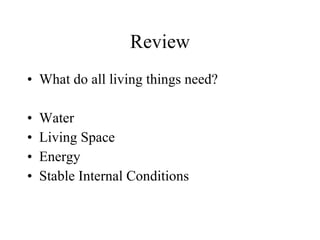
Review What do all living things need?
Review What do all living things need? Water Living Space Energy Stable Internal Conditions

Whatis Life.ClassificationNotes#1

  • 1.
    Bellwork 10/13 Getout a piece of paper and put your name on it Big and Clearly. Draw your name into a picture of anything Make sure your heading is on there. Name Hour Date Subject
  • 2.
    TEXTBOOK: From Bacteriato Plants Chapter One: Living Things Section 1 “What is Life.” Pg. 16-23 MOO
  • 3.
    PASS Strand: Diversity and Adaptations of Organisms Objectives: By classifying organisms, biologists consider details of internal and external structure. OINK
  • 4.
    What is Life?A.      The Characteristics of Living Things Organisms— a living thing . All living things have a.         cellular organization b.        Contain similar chemicals c.         Use energy d.        Grow and Develop e.         Respond to their surroundings f.          Reproduce
  • 5.
    Cellular Organization a.        All organisms are made of tiny building blocks called cells. b.        Fit a million cells on the period at the end of this sentence. c.        Unicellular or Multicellular Many functions
  • 6.
    Contain Similar Chemicalsa.   Water—most abundant chemical in cells. b.   Carbohydrates— energy source c.Proteins and lipids—building materials of the cell. (like wood and bricks for houses) d.   Nucleic acids— genetic material. Directs the cells activities.
  • 7.
    Use Energy a.Cells use energy to grow and repair injured parts. b.   Cells for digestion need energy to digest food particles c.   Blood cells need energy to move chemicals to your body .
  • 8.
    Grow and Developa.      Growth —becoming larger b.        Development —change that produces a more complex organism. Ex. Acorn turns into an oak tree
  • 9.
    Respond to theirsurroundings React to changes in their environment b.   Stimulus (plural stimuli)—a change in an organism’s surroundings that causes the organism to react. i.       Ex. Changes in temperature, light, sound c.        Response —an action or change in behavior. An organism reacts to a stimulus with a response.
  • 10.
    Ex. When someonescares you (change of environment) you may scream, faint, run ( your response)
  • 11.
    Reproduce Reproduce—the abilityto produce offspring similar to the parents.   Robins produce eggs   Sunflowers produce seeds that develop into sunflowers   Bacteria produce bacteria just like themselves.
  • 12.
    Life Comes From Life New organisms arise from reproduction. Spontaneous generation—The mistaken idea that living things arise from nonliving sources.
  • 13.
    Ex. Experiments ofRedi and Pasteur pg. 20,
  • 14.
    Francesco Redi DisprovingSpontaneous Generation
  • 15.
    People used tobelieve that frogs sprouted from mud in ponds. What is Spontaneous Generation?
  • 16.
    People used tobelieve that flies came from rotted meat. What is Spontaneous Generation?
  • 17.
    This was astrongly held belief. What is Spontaneous Generation?
  • 18.
    It took hundredsof years of experiments to convince people that it does not occur. What is Spontaneous Generation?
  • 19.
    Redi was onescientist who worked to disprove this idea (in the mid-1600’s). What is Spontaneous Generation?
  • 20.
    What did FrancescoRedi do? Francesco Redi did a controlled experiment to prove that spontaneous generation does not happen.
  • 21.
    What did FrancescoRedi do? His experiment focused on whether or not flies come from rotting meat.
  • 22.
    Redi’s Controlled ExperimentSet-up A Meat in jar Jar open Maggots on meat Set-up B Meat in jar Jar closed with cloth No Maggots in jar
  • 23.
    How was thisa “Controlled Experiment”? It was controlled because… He had only one manipulated variable – whether or not the meat was covered.
  • 24.
    How is thisa “Controlled Experiment”? It was controlled because… When he got his results, he knew what caused them, because there was only one difference between the set-ups.
  • 25.
    Redi’s Conclusion Rediconcluded that flies had laid eggs on the rotting meat that wasn’t covered , and the eggs hatched into maggots. …
  • 26.
    Redi’s Conclusion So,the meat didn’t produce the maggots (young flies), the adult flies produced the young flies by laying eggs on the uncovered meat .
  • 27.
    What we canlearn… All living things come only from other living things. Spontaneous generation doesn’t happen .
  • 28.
    The Needs ofLiving Things          All living things must satisfy their basic needs for energy, water, living space, and stable internal conditions.
  • 29.
    Energy Heterotroph— Animals need food as their energy source, cannot make their own food.      Sun is energy source indirectly b/c they either eat autotrophs and obtain their energy or consume other heterotrophs that eat autotrophs.
  • 30.
    Energy Autotroph —organismwhich can make its own food .
  • 31.
    Water All living things need water to survive. It can dissolve more chemicals than any other substance on earth. Helps by: Obtain chemicals from surroundings Break down food Grow Move substances within their bodies Reproduce
  • 32.
    Living Space All organisms need a space to live. A place to get food and water, and to find shelter. Competition. Plants only have so much space. Compete for sunlight/ space. Roots compete for water and nutrients. Animals can move but share living spaces with others or compete for area.
  • 33.
    Stable Internal ConditionsOrganisms must be able to keep the conditions inside their bodies constant. Homeostasis —keeping the internal conditions stable despite the changes in an organism’s surroundings .
  • 34.
    Review What doall living things have in common?
  • 35.
    Review What doall living things have in common? a.         cellular organization b.        Contain similar chemicals c.         Use energy d.        Grow and Develop e.         Respond to their surroundings f.          Reproduce
  • 36.
    Review What didFrancisco Redi Prove?
  • 37.
    Review What didFrancisco Redi Prove? That living things do not come from non living things. (Flies do not come from meat)
  • 38.
    Review What doall living things need?
  • 39.
    Review What doall living things need? Water Living Space Energy Stable Internal Conditions