Research proposal
1
Components of
proposal
• Title / title page
• Preliminary parts
– Declaration
– Approval
– Table of contents
– List of acronyms & abbreviations
– Operational definitions
– Abstract
• Chapter 1
– Introduction
– Background
– Problem Statement
– Purpose of the Study
– Study Objectives
– Research Questions
– Justification of the study
-Significance of the study
Operational definition
• Operational definition: Clear description of how the
variable will be measured
• Turning abstract conceptual ideas into measurable
observations.
• Defining a term by stating the actions, processes, or
operations used to measure
Basic concepts and terms used during research
process
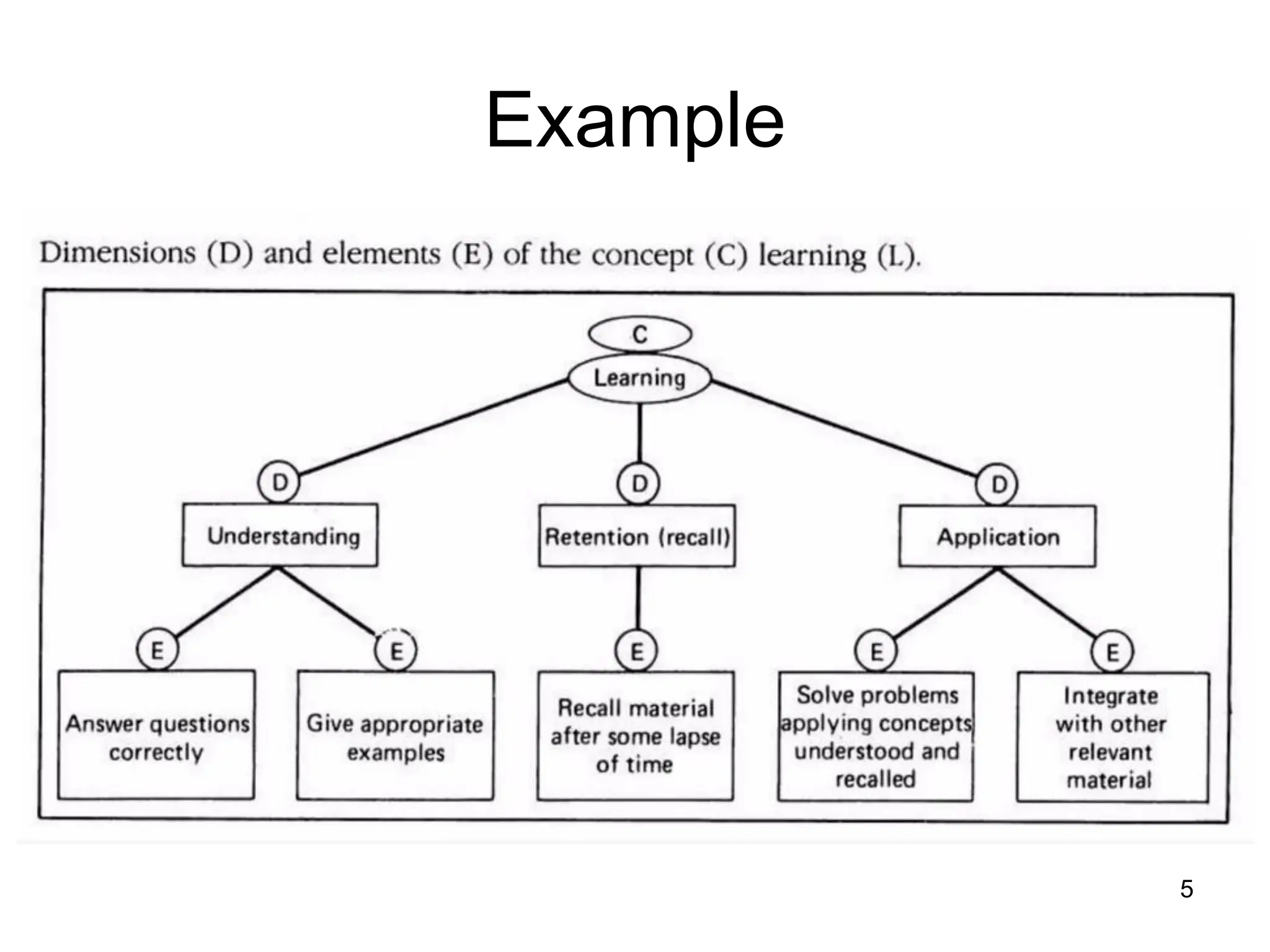
• Concepts are the abstract ideas or phenomena that are
being studied (e.g., educational achievement). Are highly
subjective in nature (e.g. educational achievement, effectiveness, satisfaction)
• One technique to measure these variables, is to reduce
the abstract notion to observable behavior and
characteristics
• Variables are properties or characteristics of the concept
(e.g., performance at school)
• Indicators are ways of measuring or quantifying variables
(e.g., yearly grade reports).
• Take an example of the effectiveness of a medicine in
curing a disease/satisfaction etc
Example
5
Basic concepts and terms used
during research process
• A variable is any concept that varies.
– Between persons
– In time
– In intensity
• Generally, variables are either Numerical or
categorical.
6
7
Variables in research
• Independent
variable:
– has a presumed
effect on the
dependent
variable
(outcome)
– May or may not
be
manipulated/chan
ge/control
• Dependent
variable:
– Something that
varies with a
change in the
independent
variable
– Observe and
measures
– Outcome variable
Operational definitions
– Specific definitions that you are going to use to describe your
variables
– All key variables should be defined so that it is clear how you
will operationalize them (e.g outcome, main exposure etc)
• E.g.Knowledge information that a person has about sickle cell
disease, sickle cell trait and sickle cell trait testing.
• knowledge of diabetes defined based on 15 questions that
assess knowledge of risk factors, signs and symptoms,
treatment. Each correct answer will be given a score of
one and the percent score will be computed. Participants
who obtain 50% score will be considered to have adequate
knowledge
– timely series completion (defined as series completion within
14 months)
8
Abbreviations & definitions
• List of acronyms & abbreviations
– all abbreviations in text should appear in this section
E.g; MoH; Ministry of Health
b.i.d; Twice daily
hCG; Human chorionic gonadotrophin
– Reader that an explanation of abbreviations
• Make sure our abbreviation list is in alphabetical order
• It contains all the significant abbreviations used in our
thesis.
• A term should not be abbreviated unless it appears three
or more times after its first mention in a paper
• Avoid using Abbreviations in headings
9
Using abbreviations (acronyms)
in your text
• Write the abbreviation in full at first mention
In this study,
• The Customer Relationship Management (CRM) at
Fontdesk & Nurses Station (F&N) is examined. At
F&N, CRM has been used for many years to
ensure that the focus is on customer contact and
that this contact is increasingly improved.
• WHO recommends that PG mothers should attend
10
Abstract
• A summary of the proposal
• Structured or unstructured
– Structured abstract has the sub-sections marked
with sub-headings
• Introduction
• Objectives
• methods (design, setting, participants, variables, analysis)
• Utility of the study
– Unstructured abstract presents all details in one
paragraph
– Preferable to use structured
• Usually 300-350 words → Do not exceed one page
11
Types of abstract
12
Research background to the
study & Problem Statement
Example
• Imagine a friend runs to you with a very long
story that you find difficult to understand why
s/he is telling you that and what he intends to
do.
• At the end of the story, you are likely to
surprisingly ask him “and so what’?
• The answer he gives to your question “and so
what?’ is referred to as the problem
statement.
• The “long talk” is the background
Introduction
• What has been said or done on this topic?
• What is the problem with what has been
said or done on the topic?
• What will you offer to solve the problem? (
study aim)
• How does your solution address social
change? (cultural, social, rules of
behaviour, economic, technological)
14
Background of the Study
Contain the following major points (Core
Elements)
• Brief discussion on what is known about the
topic under
• An articulation of the research gap or problem
that needs to be addressed
• What the researcher would like to do or aim to
achieve in the study
• Read a lot of literature and gathered relevant
information for 15
Background of the Study
• There is no “one-size-fits-all” style of
writing this part of the research
• You are free to develop your own
16
Background
• Unstructured summary of the study (no sub-
headings)
• Gives evidence for the study → existing conditions
• Before a problem statement is stated
– Historical basis for the existence of the problem
– Can start with broader problem within which your
specific study is set
– Narrow down to specific problem
– Show what is already known and the gaps to be
addressed
– Efforts made towards addressing similar challenges
– Ends with the aim of the study & The major significance
or contribution of the study to a particular discipline.
– Make reader feel urgency of the problem and the need
to study it in order to solve or contribute to its solution
17
Background …continued
• Have strong opening sentence
• Use numbers not descriptions
– “20% of deaths in children are due to malaria” rather than
“many deaths in children are due to malaria”
• Use right language
– words like “the scourge of HIV..” are insensitive
• References for major statements
• Logical flow of ideas leading to the research aim
• Usually about 600 words
– not more than 2 pages of double spaced work
18
Sample of background
• SCD contributes a significant burden worldwide with about 312,000
children expected to be born worldwide with SCD annually (Piel et al.,
2013b). Only ten percent of the world’s SCD patients are in the developed
world (Aygun and Odame, 2012).
• Sub-Sahara Africa contributes more than 75% of all SCD cases and this is
expected to increase by 2050 (Piel et al., 2013a). Piel et al’s study project
that the current burden of SCD in Africa would increase by 2050 and this
necessitates more aggressive interventions that can reduce the number of
new neonatal births with SCD (Piel et al., 2013a).
• Uganda has a varying distribution of SCD according to regions and districts
with the overall disease prevalence at 0.7% and the SCT average at 13.3%
with an estimate that at least 15,000 babies are born each year with sickle
cell disease in Uganda and that 80% of these babies die before reaching 5
years of age. Central Uganda has one of the highest prevalence of sickle
cell trait ranging from 12.8% to 19.8% (Ndeezi et al., 2016). 19
Example of background (1)
• Suppose the topic of your study is: Lived
experiences of students with
Biostatistics anxiety
• “Mathematical anxiety refers to the individual’s
unpleasant emotional mood responses when confronted
with a mathematical situation (Elliot, 2020).”. “Lou (2019)
specifically identifies some of the manifestations of this
type of anxiety, which include, but not limited to,
depression, helplessness, nervousness and fearfulness
in doing mathematical and numerical tasks.”
20
Example of background (2)
– Mathematical anxiety can negatively affect not just the academic
achievement of the students but also their future career plans and
total well-being. If left unchecked, as Shapiro (2019) claims, this
problem will expand and create a total avoidance pattern on the
part of the students, which can be expressed most visibly in the
form of cutting classes and habitual absenteeism.
– This will negatively affect the performance of students in
mathematics. In fact, the study conducted by Luttenberger and
Wimmer (2018) revealed that the outcomes of mathematical
anxiety do not only negatively affect the students’ performance in
math-related situations but also their future career as
professionals.
21
Problem statement
• Is description of an issue currently existing
which needs to be addressed.
• Provides context for the study and generates
questions which the research aims to answer.
• Helps investigator describe the problem
systematically; reflect on its importance, priority
in the country and in area and why it should be
undertaken
• Guides the research design being considered
for solving the problem
22
Components of problem statement
• The Nature and Extent of the Problem
– What is the problem?
– Who is experiencing it?
– When and where?
• Clear picture of the incidence or prevalence of problem
• distribution by ethnicity, gender, age, educational level,
etc.
• Compare the local area where the study is to be done to
the national and make arguments for doing the study
there e.g. higher incidence, increasing incidence etc
– Is it widespread? How severe is it? What its
consequences(subject, the family, community, nation 23
Identification of a Problem
statement
❖In area of specialisation/ passionate about
❖Major debates/trends in areas of
specialisation
❖Literature review in that area
• Insufficient studies have done
• Lack of understanding/controversy
• Limitations/problems in previous study
24
Components of problem statement
…continued
• Promising approaches to addressing the
problem that have been useful elsewhere &
barriers to improving the problem
• Should be clear and concise
• Should be persuasive that the research is worth
doing
• Should be backed by facts (relevant references)
25
Problem statement
•E.g.
Malaria remains the most devastating
infectious disease, particularly in Africa. One
reason is that the parasite causing the
disease is resistant to all clinically useful
antimalarial drugs. We therefore have to
devise alternative strategies to target the
parasite.
26
Problem statement
• The prevalence of SCT in Uganda is 13.3%
and the disease is 0.7% and this makes it the
fifth country with the highest-burden in Africa.
Most Ugandans discover they have sickle cell
genes when they have given birth to a child
with SCD and there are barely any follow-up
programs for people with SCT after the
identification of the trait by newborn screening.
This project aims to determine the burden and
factors influencing uptake of sickle cell trait
(SCT) screening services in secondary school
students in Uganda. 27
Purpose of the Study
• This is a clear, concise statement of general
goal or focus of a study.
• Usually based on the title of the project
• The goal in quantitative studies might be to
identify, describe, or examine relationships in a
situation or the effectiveness of an intervention,
determine outcomes of health care.
• In qualitative studies: Explore perceptions of a
phenomenon, develop a theory, describe
historical trends or elements of a culture
• Purpose should include the variables, population
& study setting.
• Purpose should focus on the study problem
statement
Purpose of the Study
The purpose of this study is to examine individual-
level and community-level factors associated with
timely human papillomavirus vaccine series
completion among adolescents in the South-
eastern U.S.
29
Objectives
• Specific objectives
– Arise directly from the general objective
– Should be SMART (Specific, Measurable,
Achievable, Relevant and Time bound)
– Appropriate action verbs →Assess, determine,
Examine, Establish, Evaluate, Identify
• Avoid vague word e.g. to understand, appreciate
30
Objectives …continued
• Take care that the objectives of your study:
– Cover different aspects of the problem and its
contributing factors in a coherent way and in a
logical sequence
– Are clearly phrased in operational terms,
specifying exactly what you are going to do, where,
and for what purpose
– Are realistic considering local conditions; and
• Keep in mind that when project is evaluated,
the results will be compared to the objectives.
– If objectives have not been spelled out clearly,
project cannot be evaluated.
31
Examples of study objectives
1. To determine Individual-level factors
associated with timely human
papillomavirus vaccine series completion
among adolescents.
2. To assess the Community-level factors
influencing timely human papillomavirus
vaccine series completion among
adolescents
32
Why are research questions
important?
“Well-crafted questions guide the
systematic planning of research.
Formulating your questions precisely
enables you to design a study with a good
chance of answering them.”
-- Light, Singer, Willett, By Design (1990)
Research Question
• A research question is an inquiry that a
researcher asks in order to gather data and
information to answer a specific question.
• Helps to guide the research process and
helps to focus the research.
• Should be specific and focused, and should
be able to be answered by the data that is
collected.
• Ask; What is? How does?
34
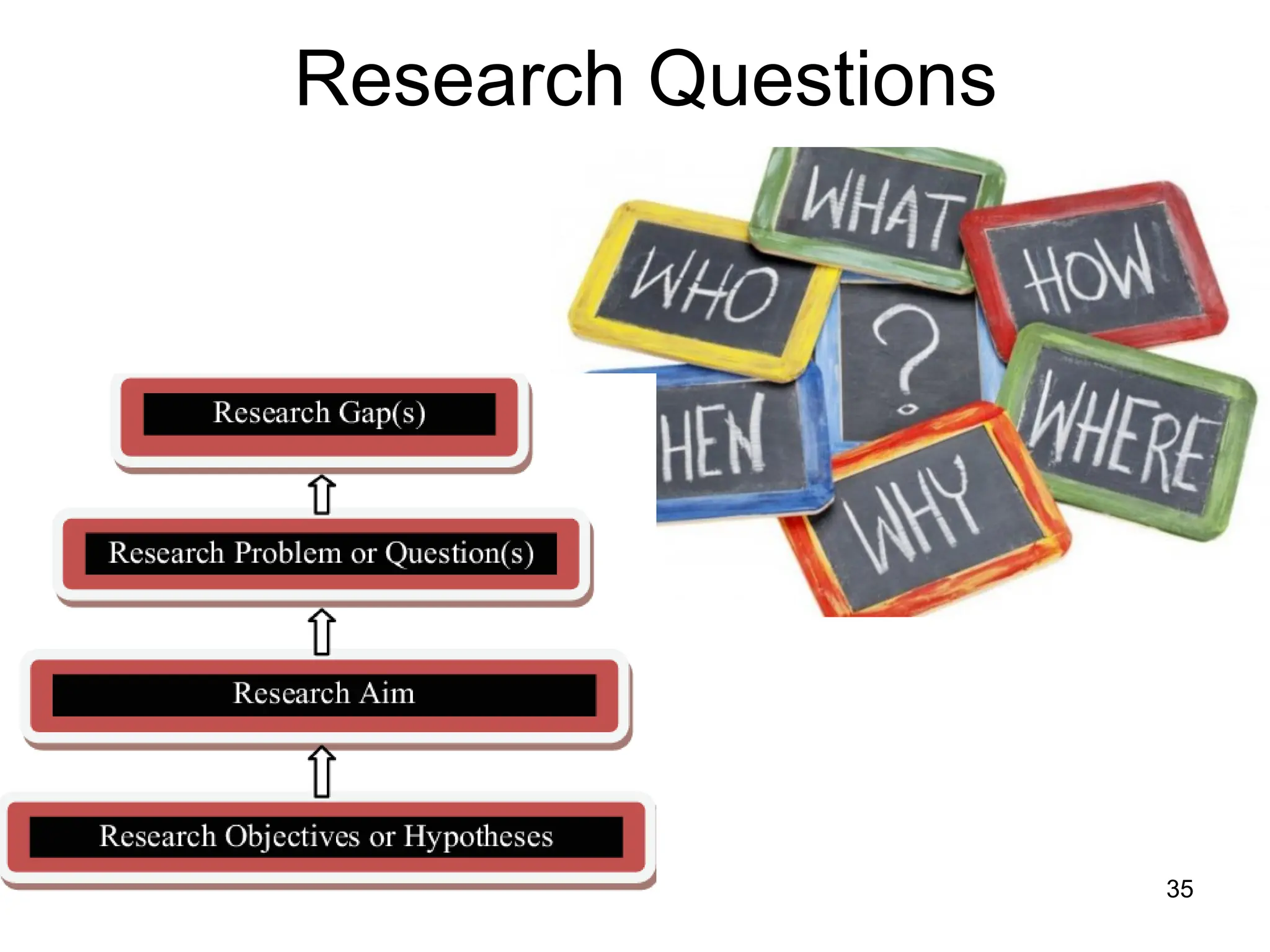
Research Questions
35
Questions to ask ourselves when
developing research questions
• Is there a need for information in this area?
• If this question is answered, what is the answer going
to be used for?
– Solve a problem in health? Basic knowledge?
• Is the specific area that I am focusing on the one that
is not well known?
• Given what we already know about the area, is the
question that I am asking the next step?
– Other priorities? Others that should be answered before?
36
37
Good research question?
• Feasible
– Subjects
– Resources
– Manageable
– Data available?
• Interesting
• Novel
– In relation to previous
findings
• Confirm or refute?
– New setting, new
population
• Ethical
– Social or scientific value
– Safe
• Relevant
– Advance scientific
knowledge?
– Influence clinical practice?
– Impact health policy?
– Guide future research?
38
A Research Question Must Identify
1. The variables under study
2. The population being studied
3. The testability of the question
Origins of research question (1)
• Literature
– Read extensively to identify and refine the
research question – identify knowledge gaps
– Read to identify methods that can be used
• Being alert to new ideas and techniques
– Conferences where recent work can be accessed
– New techniques
– New policies, guidelines
39
Origins of research question (2)
• Keeping the imagination roaming
– Everyday practice e.g. your workplace, practical
health research placements, etc
– Theories
– Mechanism of action of drug / disease mechanism
etc
• Consult experienced mentors in the areas of
interest 40
Characteristics of good research question
• Feasible
– Can start with vague study area – then identify a
topic – then narrow down to potential sub-topics for
consideration
• Number of subjects
• Technical expertise (additional skills needed that you
need to gain? Or need to employ someone to conduct?)
• Affordable in time and money
• Manageable in scope (not too broad and not too narrow)
• Information available and collectable (can you conduct
the study and draw conclusions with objectivity – data
collection approach acceptable / available)
41
Characteristics of good research
question 2
• Interesting
• to the investigator
• Who else is interested? – potential sources of funding,
dissemination of findings
• Novel
– Should be well grounded in current theoretical and
empirical knowledge
• Provides new findings
• Confirms or refutes previous findings
• Extends previous findings 42
Characteristics of good research question 3
• Ethical
– Look for any physical or psychological harm that
may arise from your research
– Queries about ethical issues with research question
must be discussed with IRB at early stage
• Relevant
– Is there current interest in chosen field or related
field? Look at relevance:
• To scientific knowledge
• To clinical and health policy
• To future research directions
43
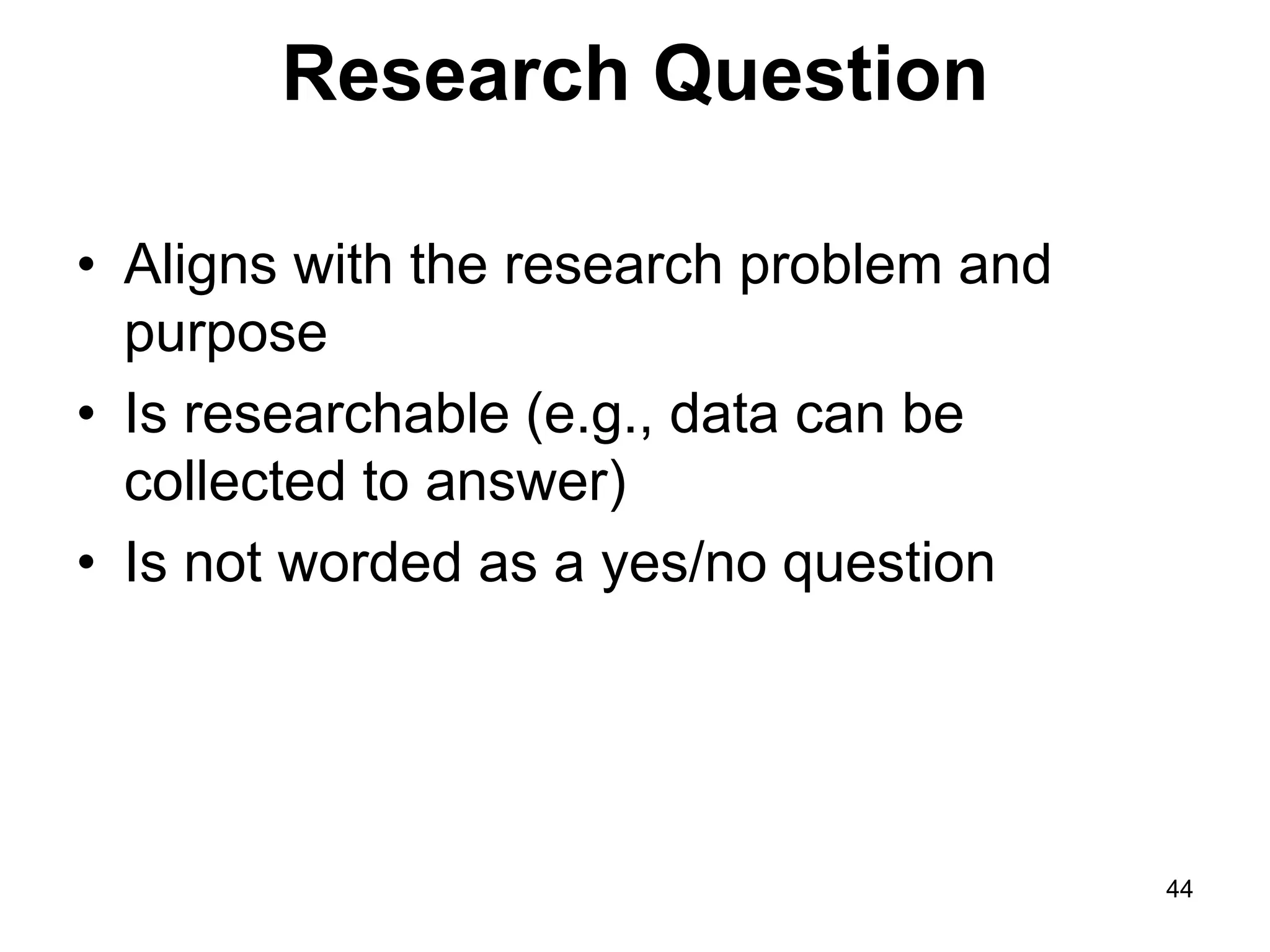
Research Question
• Aligns with the research problem and
purpose
• Is researchable (e.g., data can be
collected to answer)
• Is not worded as a yes/no question
44
Examples of study questions
1. What are the Individual-level factors associated with
timely human papillomavirus vaccine series completion
among adolescents in Uganda?
2. What are the community-level factors influencing timely
human papillomavirus vaccine series completion
among adolescents in Uganda?
45
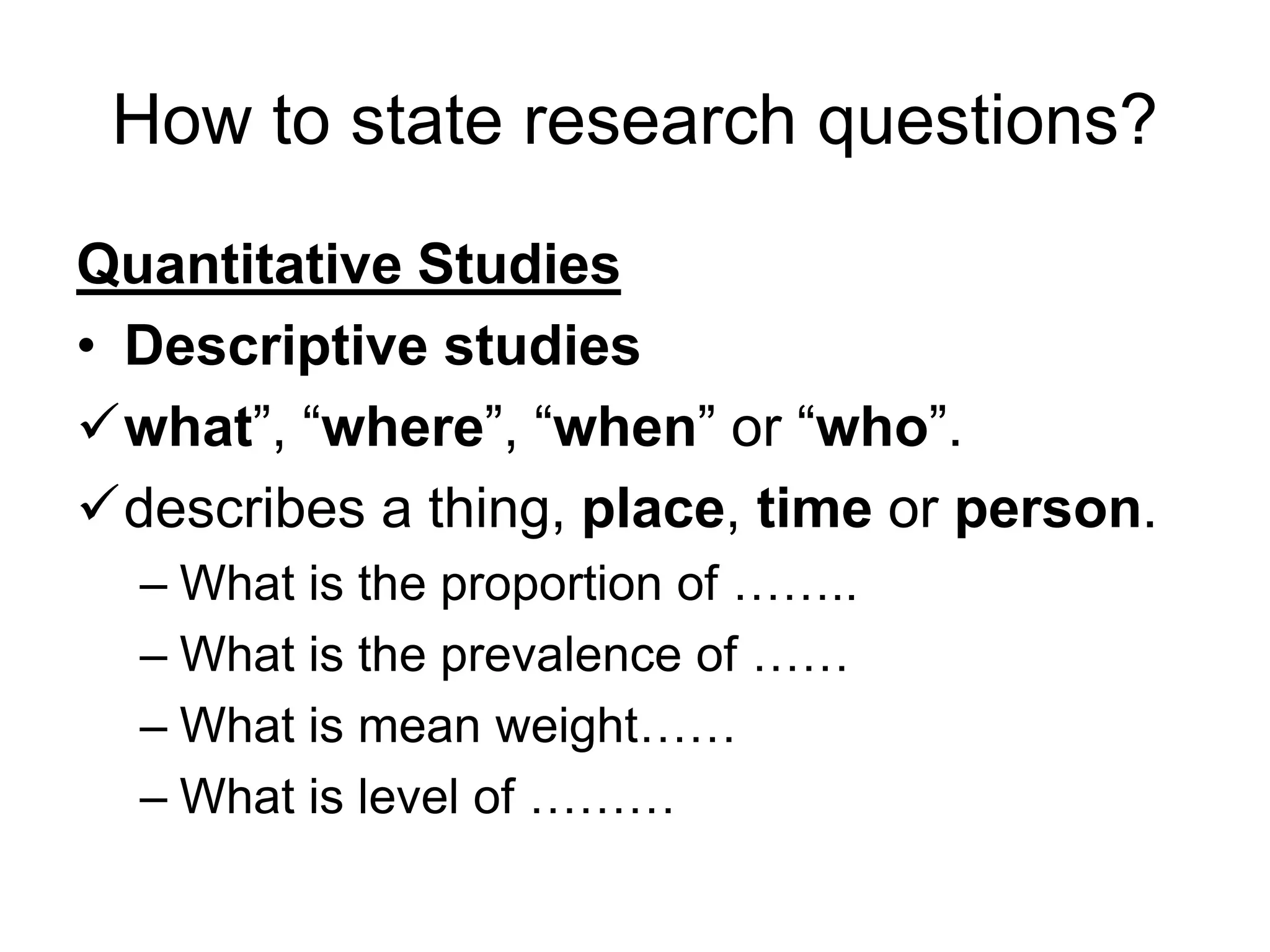
How to state research questions?
Quantitative Studies
• Descriptive studies
✓what”, “where”, “when” or “who”.
✓describes a thing, place, time or person.
– What is the proportion of ……..
– What is the prevalence of ……
– What is mean weight……
– What is level of ………
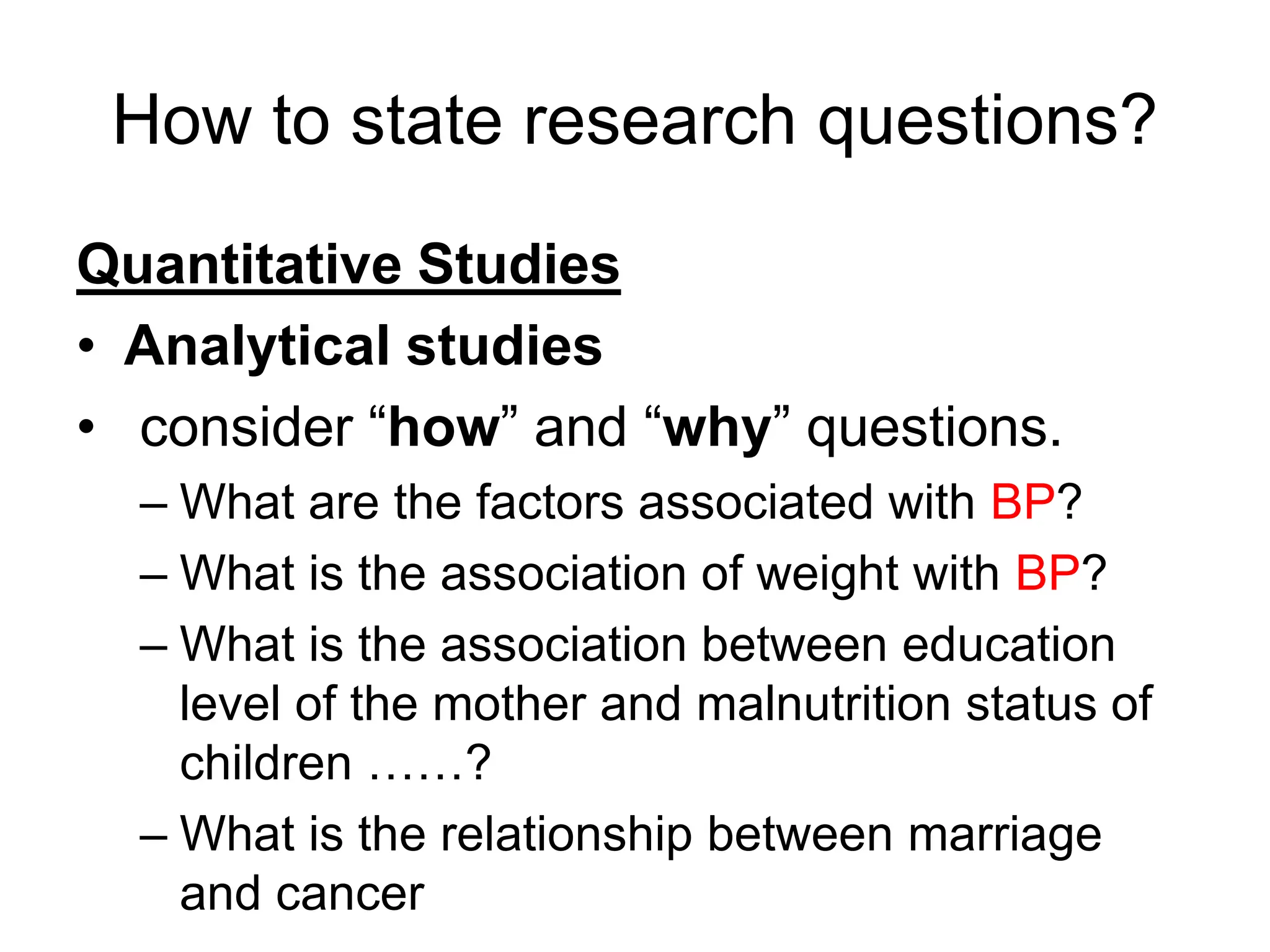
How to state research questions?
Quantitative Studies
• Analytical studies
• consider “how” and “why” questions.
– What are the factors associated with BP?
– What is the association of weight with BP?
– What is the association between education
level of the mother and malnutrition status of
children ……?
– What is the relationship between marriage
and cancer
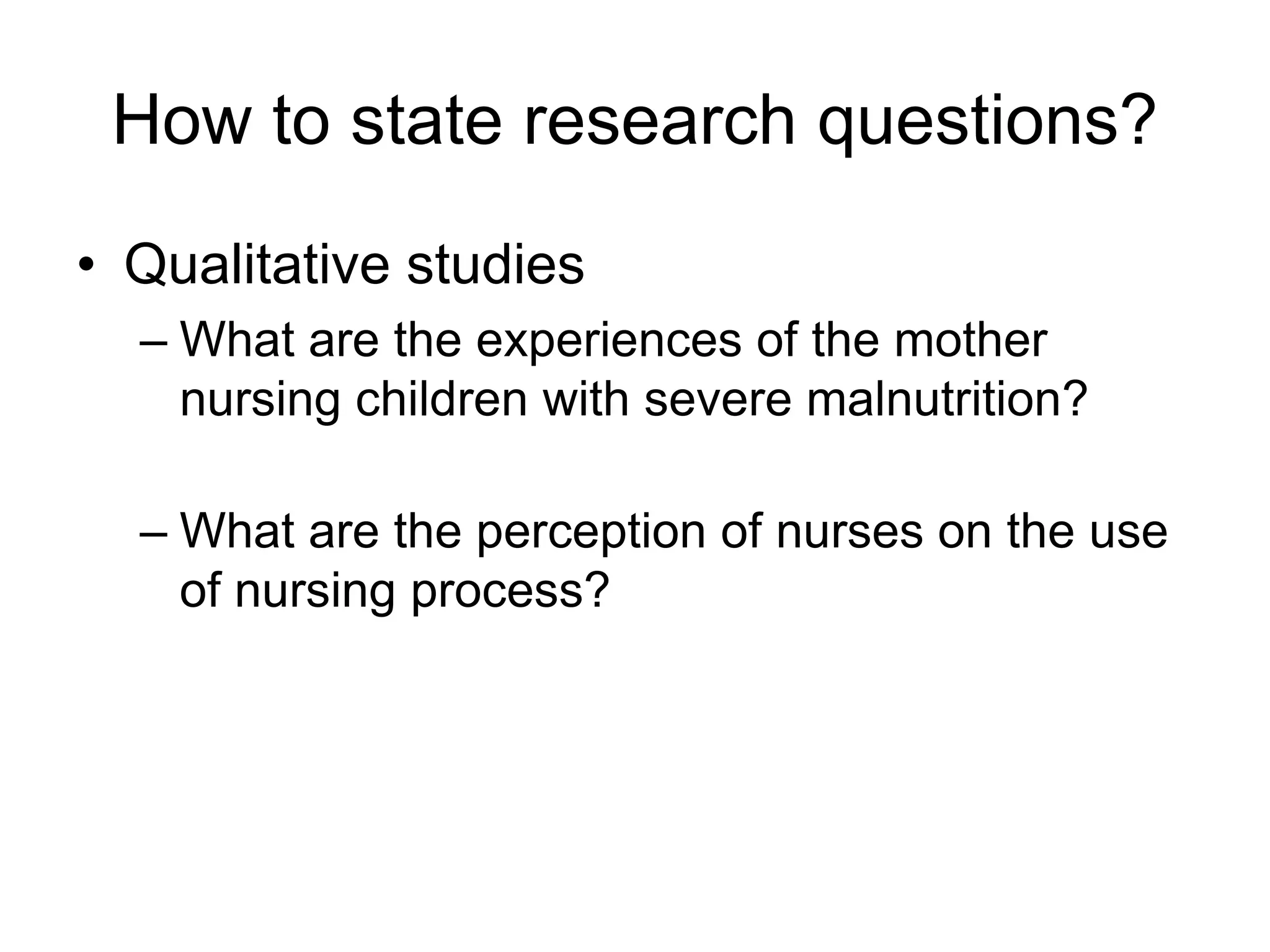
How to state research questions?
• Qualitative studies
– What are the experiences of the mother
nursing children with severe malnutrition?
– What are the perception of nurses on the use
of nursing process?
Types of Research Questions
Descriptive Research Questions
• These types of questions ask for a
description of something, such as
• “What is the average lifespan of a human?”
Comparative Research Questions
• These types of questions ask for a
comparison between two or more things,
such as
• “What is the difference in lifespan between
males and females?”
49
Types of Research Questions
Correlational Research Questions
• These types of questions ask if there is a
relationship between two or more things,
such as
• “Is there a relationship between diet and
lifespan?”
50
Types of Research Questions
Experimental Research Questions
• These types of questions ask if there is an
effect from a certain group, such as
• Does drinking alcohol affect the average
lifespan?
• Does smoking cause cancer?
51
Identifying the research
questions
52
53
Hypothesis
• Statement about the relationship
between 2 or more variables
• Converts the question into a statement
that predicts an expected outcome
• A unit or subset of the research
problem
• A tentative statement about a
population parameter that might be
true or wrong
Hypotheses
• The purpose of hypothesis testing is to determine
whether there is enough statistical evidence in favor of a
certain belief about a parameter.
• An hypothesis is a preliminary or tentative explanation by
the researcher of what the researcher considers the
outcome of an investigation will be.
• It is an informed/educated guess.
• It indicates the expectations of the researcher regarding
certain variables.
• It is the most specific way in which an answer to a
problem can be stated.
55
Directional vs. Non-Directional
Hypotheses
• Directional hypothesis
– Specifies the direction of the relationship
between independent and dependent
variables
• Non-directional hypothesis
– Shows the existence of a relationship
between variables but no direction is specified
Example of Hypothesis
• Research question:
• Ho: The number of lectures attended by
second year students has no effect on their
final exam scores
• H1/A:The number of lectures attended by
second year students has no effect on their
final exam scores 56
Significance of the study
• Significant/relevance of the study to:
❖Practice
❖Education
❖Policy
❖Research
• Each takes up a short paragraph.
(one page at most)
57
Justification
• Shows how the research relates to the priorities of the
region / country
– Gives the existing policies and guidelines on the problem to
be studied
– Identifies any gaps in these policies and guidelines that
affect the problem
• Shows how findings of proposed study will help
resolve uncertainties, lead to scientific
understanding and influence clinical practice
and public health policy
58
Sample Justification
• According to the Essential Maternal and Newborn Clinical
Care Guidelines by the Ministry of Health (2016), health
workers are encouraged to teach mothers kangaroo
mother care as a recommended method of maintaining
temperature in preterm babies, offer the babies vitamin k
since they are at risk of bleeding and give them adequate
fluids and feeds. In addition, health workers should
counsel mothers of preterm on proper hygiene to avoid
infections as well as treating their infections with
antibiotics.
• There has been onsite training of health workers to equip
them with these clinical skills and core competences to
manage preterm babies but despite this training,
knowledge regarding preterm care among primary health
care workers is still low. 59
Conceptual framework
• An organization or matrix of concepts that
provides a focus for inquiry
• A structure of assumptions, principles and rules
that holds together the ideas comprising a
broad concept.
– Concept defined as intellectual representation of
some aspect of reality that is derived from
observations made from phenomena
• Need literature to guide on its generation 60
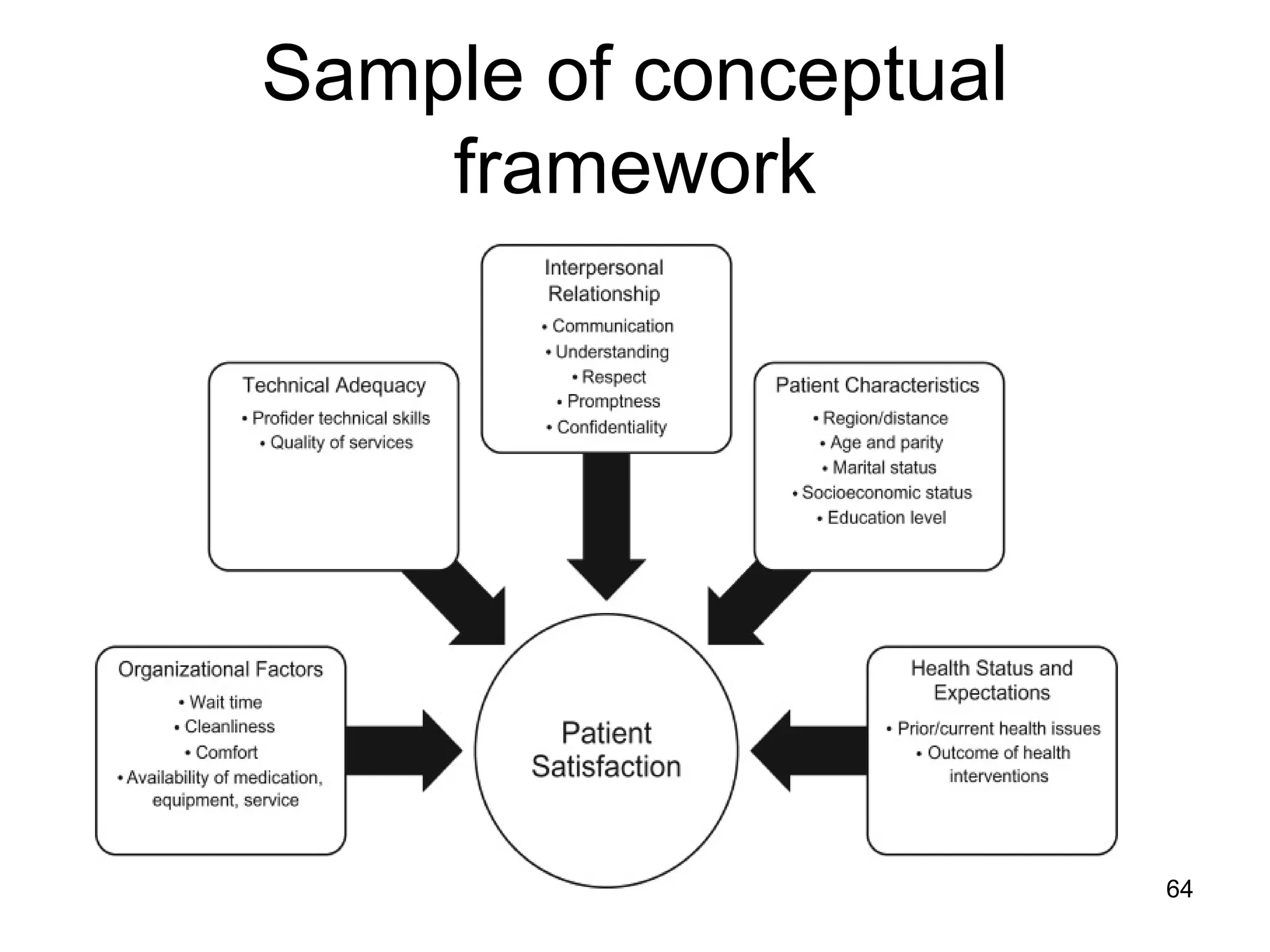
Conceptual framework
• A conceptual framework is a structured
approach to organizing and understanding
complex ideas, theories, or concepts.
• Conceptual frameworks can be written or
visual and are generally developed based on a
literature review of existing studies about your
topic.
• It serves as a foundation for understanding the
research problem and for making decisions
about how to investigate it
Conceptual framework
• Shows researchers position on the problem
• May be adapted from previous study
• It is a representation of the relationship you
expect to see between your variables, or the
characteristics or properties that you want to
study
• Describe it and show how you will apply the
theory in your study.
62
Theoretical or Conceptual
Framework
• An abstract, theoretical basis that enables
the researcher to link their findings to a
nursing body of knowledge.
• Can be a testable theory in quantitative
studies
• Can be a theory to be developed in
qualitative studies
• Involves assumptions and statements.
Sample of conceptual
framework
64
Conceptual framework
65
Example of theoretical
framework-Behavioral change model
Scope of the study
• Boundaries and limitations within which
the study will be performed.
• Sample size and population
• The duration,
• Setting (where the study will be done).
67
References
• https://www.slideshare.net/hermenio03/the
-qualities-of-good-academic-research
68

CHAPTER ONE Makerere University Uganda.pdf

  • 1.
  • 2.
    Components of proposal • Title/ title page • Preliminary parts – Declaration – Approval – Table of contents – List of acronyms & abbreviations – Operational definitions – Abstract • Chapter 1 – Introduction – Background – Problem Statement – Purpose of the Study – Study Objectives – Research Questions – Justification of the study -Significance of the study
  • 3.
    Operational definition • Operationaldefinition: Clear description of how the variable will be measured • Turning abstract conceptual ideas into measurable observations. • Defining a term by stating the actions, processes, or operations used to measure
  • 4.
    Basic concepts andterms used during research process • Concepts are the abstract ideas or phenomena that are being studied (e.g., educational achievement). Are highly subjective in nature (e.g. educational achievement, effectiveness, satisfaction) • One technique to measure these variables, is to reduce the abstract notion to observable behavior and characteristics • Variables are properties or characteristics of the concept (e.g., performance at school) • Indicators are ways of measuring or quantifying variables (e.g., yearly grade reports). • Take an example of the effectiveness of a medicine in curing a disease/satisfaction etc
  • 5.
  • 6.
    Basic concepts andterms used during research process • A variable is any concept that varies. – Between persons – In time – In intensity • Generally, variables are either Numerical or categorical. 6
  • 7.
    7 Variables in research •Independent variable: – has a presumed effect on the dependent variable (outcome) – May or may not be manipulated/chan ge/control • Dependent variable: – Something that varies with a change in the independent variable – Observe and measures – Outcome variable
  • 8.
    Operational definitions – Specificdefinitions that you are going to use to describe your variables – All key variables should be defined so that it is clear how you will operationalize them (e.g outcome, main exposure etc) • E.g.Knowledge information that a person has about sickle cell disease, sickle cell trait and sickle cell trait testing. • knowledge of diabetes defined based on 15 questions that assess knowledge of risk factors, signs and symptoms, treatment. Each correct answer will be given a score of one and the percent score will be computed. Participants who obtain 50% score will be considered to have adequate knowledge – timely series completion (defined as series completion within 14 months) 8
  • 9.
    Abbreviations & definitions •List of acronyms & abbreviations – all abbreviations in text should appear in this section E.g; MoH; Ministry of Health b.i.d; Twice daily hCG; Human chorionic gonadotrophin – Reader that an explanation of abbreviations • Make sure our abbreviation list is in alphabetical order • It contains all the significant abbreviations used in our thesis. • A term should not be abbreviated unless it appears three or more times after its first mention in a paper • Avoid using Abbreviations in headings 9
  • 10.
    Using abbreviations (acronyms) inyour text • Write the abbreviation in full at first mention In this study, • The Customer Relationship Management (CRM) at Fontdesk & Nurses Station (F&N) is examined. At F&N, CRM has been used for many years to ensure that the focus is on customer contact and that this contact is increasingly improved. • WHO recommends that PG mothers should attend 10
  • 11.
    Abstract • A summaryof the proposal • Structured or unstructured – Structured abstract has the sub-sections marked with sub-headings • Introduction • Objectives • methods (design, setting, participants, variables, analysis) • Utility of the study – Unstructured abstract presents all details in one paragraph – Preferable to use structured • Usually 300-350 words → Do not exceed one page 11
  • 12.
  • 13.
    Research background tothe study & Problem Statement Example • Imagine a friend runs to you with a very long story that you find difficult to understand why s/he is telling you that and what he intends to do. • At the end of the story, you are likely to surprisingly ask him “and so what’? • The answer he gives to your question “and so what?’ is referred to as the problem statement. • The “long talk” is the background
  • 14.
    Introduction • What hasbeen said or done on this topic? • What is the problem with what has been said or done on the topic? • What will you offer to solve the problem? ( study aim) • How does your solution address social change? (cultural, social, rules of behaviour, economic, technological) 14
  • 15.
    Background of theStudy Contain the following major points (Core Elements) • Brief discussion on what is known about the topic under • An articulation of the research gap or problem that needs to be addressed • What the researcher would like to do or aim to achieve in the study • Read a lot of literature and gathered relevant information for 15
  • 16.
    Background of theStudy • There is no “one-size-fits-all” style of writing this part of the research • You are free to develop your own 16
  • 17.
    Background • Unstructured summaryof the study (no sub- headings) • Gives evidence for the study → existing conditions • Before a problem statement is stated – Historical basis for the existence of the problem – Can start with broader problem within which your specific study is set – Narrow down to specific problem – Show what is already known and the gaps to be addressed – Efforts made towards addressing similar challenges – Ends with the aim of the study & The major significance or contribution of the study to a particular discipline. – Make reader feel urgency of the problem and the need to study it in order to solve or contribute to its solution 17
  • 18.
    Background …continued • Havestrong opening sentence • Use numbers not descriptions – “20% of deaths in children are due to malaria” rather than “many deaths in children are due to malaria” • Use right language – words like “the scourge of HIV..” are insensitive • References for major statements • Logical flow of ideas leading to the research aim • Usually about 600 words – not more than 2 pages of double spaced work 18
  • 19.
    Sample of background •SCD contributes a significant burden worldwide with about 312,000 children expected to be born worldwide with SCD annually (Piel et al., 2013b). Only ten percent of the world’s SCD patients are in the developed world (Aygun and Odame, 2012). • Sub-Sahara Africa contributes more than 75% of all SCD cases and this is expected to increase by 2050 (Piel et al., 2013a). Piel et al’s study project that the current burden of SCD in Africa would increase by 2050 and this necessitates more aggressive interventions that can reduce the number of new neonatal births with SCD (Piel et al., 2013a). • Uganda has a varying distribution of SCD according to regions and districts with the overall disease prevalence at 0.7% and the SCT average at 13.3% with an estimate that at least 15,000 babies are born each year with sickle cell disease in Uganda and that 80% of these babies die before reaching 5 years of age. Central Uganda has one of the highest prevalence of sickle cell trait ranging from 12.8% to 19.8% (Ndeezi et al., 2016). 19
  • 20.
    Example of background(1) • Suppose the topic of your study is: Lived experiences of students with Biostatistics anxiety • “Mathematical anxiety refers to the individual’s unpleasant emotional mood responses when confronted with a mathematical situation (Elliot, 2020).”. “Lou (2019) specifically identifies some of the manifestations of this type of anxiety, which include, but not limited to, depression, helplessness, nervousness and fearfulness in doing mathematical and numerical tasks.” 20
  • 21.
    Example of background(2) – Mathematical anxiety can negatively affect not just the academic achievement of the students but also their future career plans and total well-being. If left unchecked, as Shapiro (2019) claims, this problem will expand and create a total avoidance pattern on the part of the students, which can be expressed most visibly in the form of cutting classes and habitual absenteeism. – This will negatively affect the performance of students in mathematics. In fact, the study conducted by Luttenberger and Wimmer (2018) revealed that the outcomes of mathematical anxiety do not only negatively affect the students’ performance in math-related situations but also their future career as professionals. 21
  • 22.
    Problem statement • Isdescription of an issue currently existing which needs to be addressed. • Provides context for the study and generates questions which the research aims to answer. • Helps investigator describe the problem systematically; reflect on its importance, priority in the country and in area and why it should be undertaken • Guides the research design being considered for solving the problem 22
  • 23.
    Components of problemstatement • The Nature and Extent of the Problem – What is the problem? – Who is experiencing it? – When and where? • Clear picture of the incidence or prevalence of problem • distribution by ethnicity, gender, age, educational level, etc. • Compare the local area where the study is to be done to the national and make arguments for doing the study there e.g. higher incidence, increasing incidence etc – Is it widespread? How severe is it? What its consequences(subject, the family, community, nation 23
  • 24.
    Identification of aProblem statement ❖In area of specialisation/ passionate about ❖Major debates/trends in areas of specialisation ❖Literature review in that area • Insufficient studies have done • Lack of understanding/controversy • Limitations/problems in previous study 24
  • 25.
    Components of problemstatement …continued • Promising approaches to addressing the problem that have been useful elsewhere & barriers to improving the problem • Should be clear and concise • Should be persuasive that the research is worth doing • Should be backed by facts (relevant references) 25
  • 26.
    Problem statement •E.g. Malaria remainsthe most devastating infectious disease, particularly in Africa. One reason is that the parasite causing the disease is resistant to all clinically useful antimalarial drugs. We therefore have to devise alternative strategies to target the parasite. 26
  • 27.
    Problem statement • Theprevalence of SCT in Uganda is 13.3% and the disease is 0.7% and this makes it the fifth country with the highest-burden in Africa. Most Ugandans discover they have sickle cell genes when they have given birth to a child with SCD and there are barely any follow-up programs for people with SCT after the identification of the trait by newborn screening. This project aims to determine the burden and factors influencing uptake of sickle cell trait (SCT) screening services in secondary school students in Uganda. 27
  • 28.
    Purpose of theStudy • This is a clear, concise statement of general goal or focus of a study. • Usually based on the title of the project • The goal in quantitative studies might be to identify, describe, or examine relationships in a situation or the effectiveness of an intervention, determine outcomes of health care. • In qualitative studies: Explore perceptions of a phenomenon, develop a theory, describe historical trends or elements of a culture • Purpose should include the variables, population & study setting. • Purpose should focus on the study problem statement
  • 29.
    Purpose of theStudy The purpose of this study is to examine individual- level and community-level factors associated with timely human papillomavirus vaccine series completion among adolescents in the South- eastern U.S. 29
  • 30.
    Objectives • Specific objectives –Arise directly from the general objective – Should be SMART (Specific, Measurable, Achievable, Relevant and Time bound) – Appropriate action verbs →Assess, determine, Examine, Establish, Evaluate, Identify • Avoid vague word e.g. to understand, appreciate 30
  • 31.
    Objectives …continued • Takecare that the objectives of your study: – Cover different aspects of the problem and its contributing factors in a coherent way and in a logical sequence – Are clearly phrased in operational terms, specifying exactly what you are going to do, where, and for what purpose – Are realistic considering local conditions; and • Keep in mind that when project is evaluated, the results will be compared to the objectives. – If objectives have not been spelled out clearly, project cannot be evaluated. 31
  • 32.
    Examples of studyobjectives 1. To determine Individual-level factors associated with timely human papillomavirus vaccine series completion among adolescents. 2. To assess the Community-level factors influencing timely human papillomavirus vaccine series completion among adolescents 32
  • 33.
    Why are researchquestions important? “Well-crafted questions guide the systematic planning of research. Formulating your questions precisely enables you to design a study with a good chance of answering them.” -- Light, Singer, Willett, By Design (1990)
  • 34.
    Research Question • Aresearch question is an inquiry that a researcher asks in order to gather data and information to answer a specific question. • Helps to guide the research process and helps to focus the research. • Should be specific and focused, and should be able to be answered by the data that is collected. • Ask; What is? How does? 34
  • 35.
  • 36.
    Questions to askourselves when developing research questions • Is there a need for information in this area? • If this question is answered, what is the answer going to be used for? – Solve a problem in health? Basic knowledge? • Is the specific area that I am focusing on the one that is not well known? • Given what we already know about the area, is the question that I am asking the next step? – Other priorities? Others that should be answered before? 36
  • 37.
    37 Good research question? •Feasible – Subjects – Resources – Manageable – Data available? • Interesting • Novel – In relation to previous findings • Confirm or refute? – New setting, new population • Ethical – Social or scientific value – Safe • Relevant – Advance scientific knowledge? – Influence clinical practice? – Impact health policy? – Guide future research?
  • 38.
    38 A Research QuestionMust Identify 1. The variables under study 2. The population being studied 3. The testability of the question
  • 39.
    Origins of researchquestion (1) • Literature – Read extensively to identify and refine the research question – identify knowledge gaps – Read to identify methods that can be used • Being alert to new ideas and techniques – Conferences where recent work can be accessed – New techniques – New policies, guidelines 39
  • 40.
    Origins of researchquestion (2) • Keeping the imagination roaming – Everyday practice e.g. your workplace, practical health research placements, etc – Theories – Mechanism of action of drug / disease mechanism etc • Consult experienced mentors in the areas of interest 40
  • 41.
    Characteristics of goodresearch question • Feasible – Can start with vague study area – then identify a topic – then narrow down to potential sub-topics for consideration • Number of subjects • Technical expertise (additional skills needed that you need to gain? Or need to employ someone to conduct?) • Affordable in time and money • Manageable in scope (not too broad and not too narrow) • Information available and collectable (can you conduct the study and draw conclusions with objectivity – data collection approach acceptable / available) 41
  • 42.
    Characteristics of goodresearch question 2 • Interesting • to the investigator • Who else is interested? – potential sources of funding, dissemination of findings • Novel – Should be well grounded in current theoretical and empirical knowledge • Provides new findings • Confirms or refutes previous findings • Extends previous findings 42
  • 43.
    Characteristics of goodresearch question 3 • Ethical – Look for any physical or psychological harm that may arise from your research – Queries about ethical issues with research question must be discussed with IRB at early stage • Relevant – Is there current interest in chosen field or related field? Look at relevance: • To scientific knowledge • To clinical and health policy • To future research directions 43
  • 44.
    Research Question • Alignswith the research problem and purpose • Is researchable (e.g., data can be collected to answer) • Is not worded as a yes/no question 44
  • 45.
    Examples of studyquestions 1. What are the Individual-level factors associated with timely human papillomavirus vaccine series completion among adolescents in Uganda? 2. What are the community-level factors influencing timely human papillomavirus vaccine series completion among adolescents in Uganda? 45
  • 46.
    How to stateresearch questions? Quantitative Studies • Descriptive studies ✓what”, “where”, “when” or “who”. ✓describes a thing, place, time or person. – What is the proportion of …….. – What is the prevalence of …… – What is mean weight…… – What is level of ………
  • 47.
    How to stateresearch questions? Quantitative Studies • Analytical studies • consider “how” and “why” questions. – What are the factors associated with BP? – What is the association of weight with BP? – What is the association between education level of the mother and malnutrition status of children ……? – What is the relationship between marriage and cancer
  • 48.
    How to stateresearch questions? • Qualitative studies – What are the experiences of the mother nursing children with severe malnutrition? – What are the perception of nurses on the use of nursing process?
  • 49.
    Types of ResearchQuestions Descriptive Research Questions • These types of questions ask for a description of something, such as • “What is the average lifespan of a human?” Comparative Research Questions • These types of questions ask for a comparison between two or more things, such as • “What is the difference in lifespan between males and females?” 49
  • 50.
    Types of ResearchQuestions Correlational Research Questions • These types of questions ask if there is a relationship between two or more things, such as • “Is there a relationship between diet and lifespan?” 50
  • 51.
    Types of ResearchQuestions Experimental Research Questions • These types of questions ask if there is an effect from a certain group, such as • Does drinking alcohol affect the average lifespan? • Does smoking cause cancer? 51
  • 52.
  • 53.
    53 Hypothesis • Statement aboutthe relationship between 2 or more variables • Converts the question into a statement that predicts an expected outcome • A unit or subset of the research problem • A tentative statement about a population parameter that might be true or wrong
  • 54.
    Hypotheses • The purposeof hypothesis testing is to determine whether there is enough statistical evidence in favor of a certain belief about a parameter. • An hypothesis is a preliminary or tentative explanation by the researcher of what the researcher considers the outcome of an investigation will be. • It is an informed/educated guess. • It indicates the expectations of the researcher regarding certain variables. • It is the most specific way in which an answer to a problem can be stated.
  • 55.
    55 Directional vs. Non-Directional Hypotheses •Directional hypothesis – Specifies the direction of the relationship between independent and dependent variables • Non-directional hypothesis – Shows the existence of a relationship between variables but no direction is specified
  • 56.
    Example of Hypothesis •Research question: • Ho: The number of lectures attended by second year students has no effect on their final exam scores • H1/A:The number of lectures attended by second year students has no effect on their final exam scores 56
  • 57.
    Significance of thestudy • Significant/relevance of the study to: ❖Practice ❖Education ❖Policy ❖Research • Each takes up a short paragraph. (one page at most) 57
  • 58.
    Justification • Shows howthe research relates to the priorities of the region / country – Gives the existing policies and guidelines on the problem to be studied – Identifies any gaps in these policies and guidelines that affect the problem • Shows how findings of proposed study will help resolve uncertainties, lead to scientific understanding and influence clinical practice and public health policy 58
  • 59.
    Sample Justification • Accordingto the Essential Maternal and Newborn Clinical Care Guidelines by the Ministry of Health (2016), health workers are encouraged to teach mothers kangaroo mother care as a recommended method of maintaining temperature in preterm babies, offer the babies vitamin k since they are at risk of bleeding and give them adequate fluids and feeds. In addition, health workers should counsel mothers of preterm on proper hygiene to avoid infections as well as treating their infections with antibiotics. • There has been onsite training of health workers to equip them with these clinical skills and core competences to manage preterm babies but despite this training, knowledge regarding preterm care among primary health care workers is still low. 59
  • 60.
    Conceptual framework • Anorganization or matrix of concepts that provides a focus for inquiry • A structure of assumptions, principles and rules that holds together the ideas comprising a broad concept. – Concept defined as intellectual representation of some aspect of reality that is derived from observations made from phenomena • Need literature to guide on its generation 60
  • 61.
    Conceptual framework • Aconceptual framework is a structured approach to organizing and understanding complex ideas, theories, or concepts. • Conceptual frameworks can be written or visual and are generally developed based on a literature review of existing studies about your topic. • It serves as a foundation for understanding the research problem and for making decisions about how to investigate it
  • 62.
    Conceptual framework • Showsresearchers position on the problem • May be adapted from previous study • It is a representation of the relationship you expect to see between your variables, or the characteristics or properties that you want to study • Describe it and show how you will apply the theory in your study. 62
  • 63.
    Theoretical or Conceptual Framework •An abstract, theoretical basis that enables the researcher to link their findings to a nursing body of knowledge. • Can be a testable theory in quantitative studies • Can be a theory to be developed in qualitative studies • Involves assumptions and statements.
  • 64.
  • 65.
  • 66.
  • 67.
    Scope of thestudy • Boundaries and limitations within which the study will be performed. • Sample size and population • The duration, • Setting (where the study will be done). 67
  • 68.